wheel CHEVROLET CORVETTE 2010 6.G Repair Manual
[x] Cancel search | Manufacturer: CHEVROLET, Model Year: 2010, Model line: CORVETTE, Model: CHEVROLET CORVETTE 2010 6.GPages: 472, PDF Size: 11.44 MB
Page 359 of 472
Brake Rotor Wear
ZR1 models have ceramic brake rotors. Rotors should
be visually inspected whenever the brake pads are
replaced. Rotors also need to be weighed before brake
pads are replaced to confirm that the rotor mass is
greater than the wear‐out mass printed on the rotor.
The rotor can be reused if the weight of the rotor is
above the mass limit. Rotor inspection and weighing
methods can be found in the service manual. See
Service Publications Ordering Information
on
page 8‑16.
Brake Rotor Protector
{WARNING:
Ceramic rotors will be very hot after operation and
touching them may cause burns. Be sure brake
system is completely cool prior to installation of
protector, or coming in contact with them. Notice:
Rotors may be chipped if hard contact is
made with the wheel during wheel installation or
removal. Always use the rotor protectors. Be sure
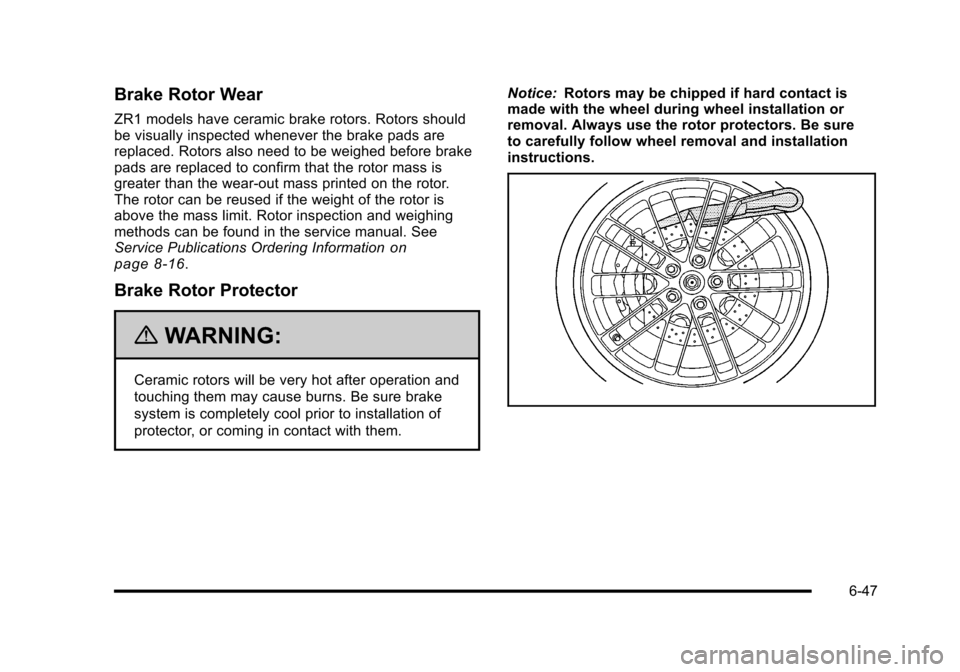
to carefully follow wheel removal and installation
instructions.
6-47
Page 360 of 472
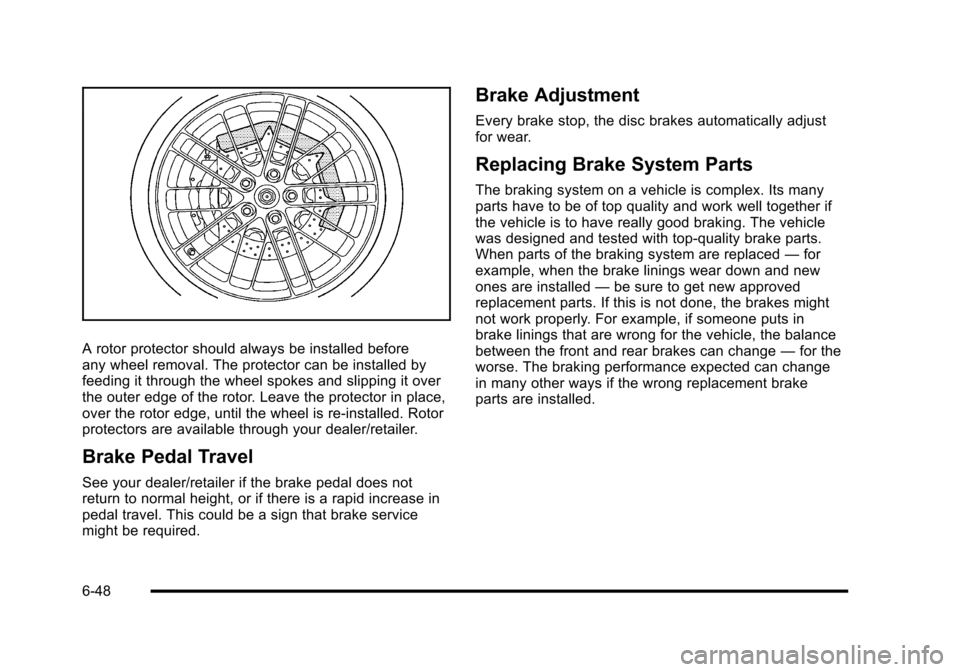
A rotor protector should always be installed before
any wheel removal. The protector can be installed by
feeding it through the wheel spokes and slipping it over
the outer edge of the rotor. Leave the protector in place,
over the rotor edge, until the wheel is re‐installed. Rotor
protectors are available through your dealer/retailer.
Brake Pedal Travel
See your dealer/retailer if the brake pedal does not
return to normal height, or if there is a rapid increase in
pedal travel. This could be a sign that brake service
might be required.
Brake Adjustment
Every brake stop, the disc brakes automatically adjust
for wear.
Replacing Brake System Parts
The braking system on a vehicle is complex. Its many
parts have to be of top quality and work well together if
the vehicle is to have really good braking. The vehicle
was designed and tested with top-quality brake parts.
When parts of the braking system are replaced —for
example, when the brake linings wear down and new
ones are installed —be sure to get new approved
replacement parts. If this is not done, the brakes might
not work properly. For example, if someone puts in
brake linings that are wrong for the vehicle, the balance
between the front and rear brakes can change —for the
worse. The braking performance expected can change
in many other ways if the wrong replacement brake
parts are installed.
6-48
Page 369 of 472
If the low-beam headlamp needs to be replaced, see
your dealer/retailer. See High Intensity Discharge (HID)
Lighting
on page 6‑56for more information.
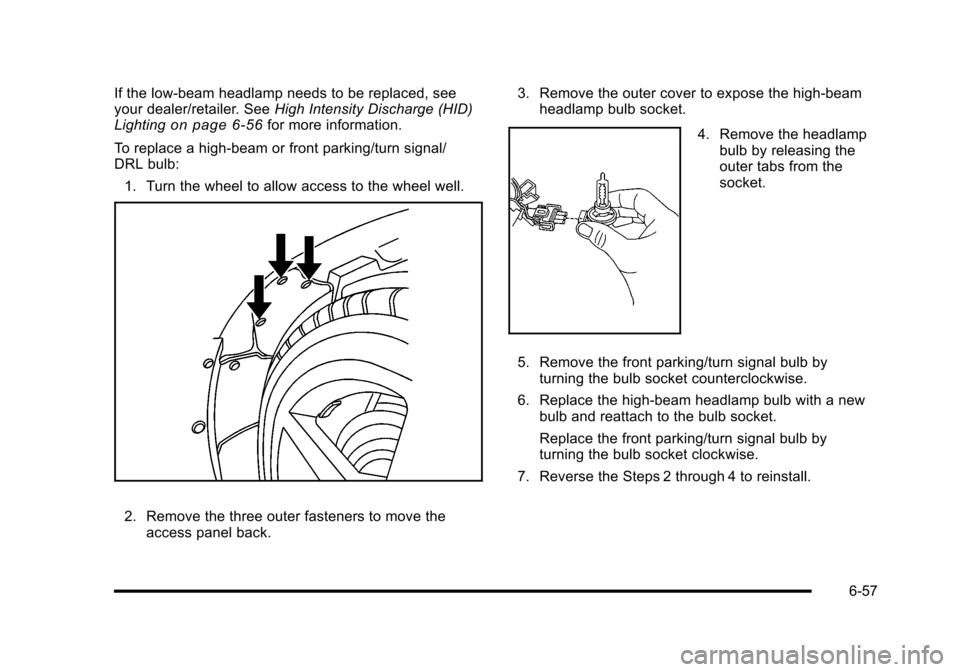
To replace a high-beam or front parking/turn signal/
DRL bulb: 1. Turn the wheel to allow access to the wheel well.
2. Remove the three outer fasteners to move the access panel back. 3. Remove the outer cover to expose the high-beam
headlamp bulb socket.
4. Remove the headlamp
bulb by releasing the
outer tabs from the
socket.
5. Remove the front parking/turn signal bulb by turning the bulb socket counterclockwise.
6. Replace the high-beam headlamp bulb with a new bulb and reattach to the bulb socket.
Replace the front parking/turn signal bulb by
turning the bulb socket clockwise.
7. Reverse the Steps 2 through 4 to reinstall.
6-57
Page 375 of 472
Low‐Profile Performance Tire
The original equipment tires on your vehicle are
classified as low‐profile performance tires. These
tires are designed for very responsive driving on
wet or dry pavement. You may also notice more
road noise with low‐profile tires and that they tend
to wear faster.
Notice:If the vehicle has low‐profile tires, they
are more susceptible to damage from road
hazards or curb impact than standard profile
tires. Tire and/or wheel assembly damage can
occur when coming into contact with road
hazards like, potholes, or sharp edged objects,
or when sliding into a curb. The vehicle
warranty does not cover this type of damage.
Keep tires set to the correct inflation pressure
and, when possible avoid contact with curbs,
potholes, and other road hazards.
Winter Tires
If you expect to drive on snow or ice covered roads
often, you may want to get winter tires for your vehicle.
All season tires provide good overall performance on
most surfaces but they may not offer the traction you
would like or the same level of performance as winter
tires on snow or ice covered roads. Winter tires, in general, are designed for increased
traction on snow and ice covered roads. With winter
tires, there may be decreased dry road traction,
increased road noise, and shorter tread life. After
switching to winter tires, be alert for changes in
vehicle handling and braking.
See your dealer/retailer for details regarding winter tire
availability and proper tire selection. Also, see
Buying
New Tires on page 6‑77.
If you choose to use winter tires:
.Use tires of the same brand and tread type on all
four wheel positions.
.Use only radial ply tires of the same size, load
range, and speed rating as the original equipment
tires.
Winter tires with the same speed rating as your original
equipment tires may not be available for H, V, W, Y, and
ZR speed rated tires. If you choose winter tires with a
lower speed rating, never exceed the tire's maximum
speed capability.
6-63
Page 377 of 472
(F) Uniform Tire Quality Grading (UTQG):Tire
manufacturers are required to grade tires based
on three performance factors: treadwear, traction
and temperature resistance. For more information
see Uniform Tire Quality Grading
on page 6‑79.
(G) Maximum Cold Inflation Load Limit
:
Maximum load that can be carried and the
maximum pressure needed to support that load.
Tire Size
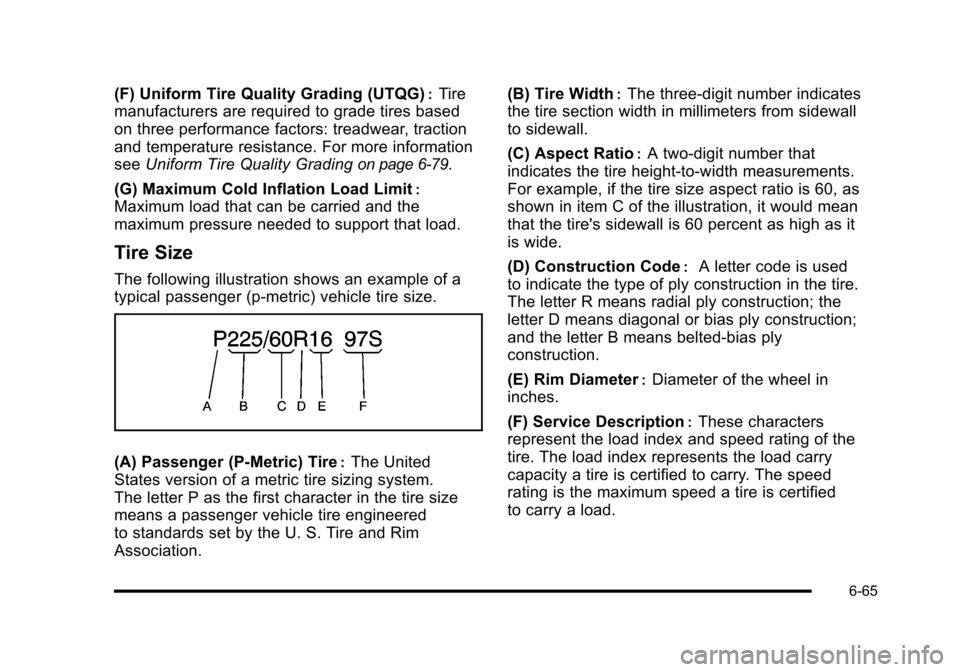
The following illustration shows an example of a
typical passenger (p‐metric) vehicle tire size.
(A) Passenger (P‐Metric) Tire:The United
States version of a metric tire sizing system.
The letter P as the first character in the tire size
means a passenger vehicle tire engineered
to standards set by the U. S. Tire and Rim
Association. (B) Tire Width
:The three‐digit number indicates
the tire section width in millimeters from sidewall
to sidewall.
(C) Aspect Ratio
:A two‐digit number that
indicates the tire height‐to‐width measurements.
For example, if the tire size aspect ratio is 60, as
shown in item C of the illustration, it would mean
that the tire's sidewall is 60 percent as high as it
is wide.
(D) Construction Code
:A letter code is used
to indicate the type of ply construction in the tire.
The letter R means radial ply construction; the
letter D means diagonal or bias ply construction;
and the letter B means belted‐bias ply
construction.
(E) Rim Diameter
:Diameter of the wheel in
inches.
(F) Service Description
:These characters
represent the load index and speed rating of the
tire. The load index represents the load carry
capacity a tire is certified to carry. The speed
rating is the maximum speed a tire is certified
to carry a load.
6-65
Page 381 of 472
Run-Flat Tires
This vehicle, when new, had run-flat tires. There is no
spare tire, no tire changing equipment, and no place to
store a tire in the vehicle. Run-flat tires perform so well
without any air that a Tire Pressure Monitor System
(TPMS) is used to alert you if a tire has lost pressure.
{WARNING:
When the low tire warning light is displayed on
the instrument panel cluster, your vehicle's
handling capabilities will be reduced during
severe maneuvers. If you drive too fast, you could
lose control of your vehicle. You or others could
be injured. Do not drive over 55 mph (90 km/h)
when the low tire warning light is displayed.
Drive cautiously and check your tire pressures
as soon as you can.
If a tire goes flat, you will not need to stop on the side
of the road to change the tire. You can just keep on
driving. The shorter the distance you drive and the
slower the speed, the greater the chance that the tire will not have to be replaced. If you drive on a deflated
run-flat tire for 25 miles (40 km) or less and at speeds of
55 mph (90 km/h) or less, there is a good chance that
the tire can be repaired. The tires on coupe, convertible
and Z06 models can operate effectively with no air
pressure for up to 100 miles (160 km) at speeds up
to 55 mph (90 km/h), but the tire would then have to
be replaced. The tires on ZR1 models can operate
effectively with no air pressure for up to 50 miles
(80 km) at speeds up to 55 mph (90 km/h), but the tire
would then have to be replaced. When a tire is filled
with air, it provides a cushion between the road and the
wheel. Because you will not have this cushion when
driving on a deflated tire, try to avoid potholes that could
damage your wheel and require replacement of it.
Some road hazards can damage a tire beyond repair.
This damage could occur even before you have driven
on the tire in a deflated condition. When a tire has
been damaged, or if you have driven any distance on
a run-flat tire, check with an authorized run-flat tire
service center to determine whether the tire can be
repaired or should be replaced. To maintain your
vehicle's run-flat feature, all replacement tires must
be self-supporting tires. As soon as possible,
contact the nearest authorized GM or run-flat servicing
facility for inspection and repair or replacement.
6-69
Page 382 of 472
To locate the nearest GM or run-flat servicing facility,
call Roadside Assistance. For phone numbers and
Roadside Service details see Roadside Assistance
Program
on page 8‑7.
{WARNING:
Run-flat tires are constructed differently than other
tires and could explode during improper service.
You or others could be injured or killed if you
attempt to repair, replace, dismount, or mount
a run-flat tire. Let only an authorized run-flat
service center repair, replace, dismount, and
mount run-flat tires.
The valve stems on your run-flat tires have sensors that
are part of the Tire Pressure Monitor System (TPMS).
See Tire Pressure Monitor System
on page 6‑72.
These sensors contain batteries which are designed
to last for 10 years under normal driving conditions. See
your dealer/retailer if you ever need to have a wheel
replaced, or if the sensors ever need replacement.
Notice: Using liquid sealants can damage the tire
valves and tire pressure monitor sensors in the
vehicle's run-flat tires. This damage would not be
covered by warranty. Do not use liquid sealants in
the vehicle's run-flat tires.
Inflation - Tire Pressure
Tires need the correct amount of air pressure to
operate effectively.
Notice:Do not let anyone tell you that
under‐inflation or over‐inflation is all right.
It is not. If your tires do not have enough air
(under‐inflation), you can get the following:
.Too much flexing
.Too much heat
.Tire overloading
.Premature or irregular wear
.Poor handling
.Reduced fuel economy
If your tires have too much air (over‐inflation),
you can get the following:
.Unusual wear
.Poor handling
.Rough ride
.Needless damage from road hazards
6-70
Page 385 of 472
As an added safety feature, your vehicle has been
equipped with a tire pressure monitoring system
(TPMS) that illuminates a low tire pressure telltale when
one or more of your tires is significantly under‐inflated.
Accordingly, when the low tire pressure telltale
illuminates, you should stop and check your tires
as soon as possible, and inflate them to the proper
pressure. Driving on a significantly under‐inflated tire
causes the tire to overheat and can lead to tire failure.
Under‐inflation also reduces fuel efficiency and tire
tread life, and may affect the vehicle's handling and
stopping ability.
Please note that the TPMS is not a substitute for proper
tire maintenance, and it is the driver's responsibility to
maintain correct tire pressure, even if under‐inflation
has not reached the level to trigger illumination of the
TPMS low tire pressure telltale.
Your vehicle has also been equipped with a TPMS
malfunction indicator to indicate when the system is
not operating properly. The TPMS malfunction indicator
is combined with the low tire pressure telltale. When
the system detects a malfunction, the telltale will flash
for approximately one minute and then remain
continuously illuminated. This sequence will continue
upon subsequent vehicle start‐ups as long as the
malfunction exists. When the malfunction indicator is illuminated, the
system may not be able to detect or signal low tire
pressure as intended. TPMS malfunctions may occur
for a variety of reasons, including the installation of
replacement or alternate tires or wheels on the vehicle
that prevent the TPMS from functioning properly.
Always check the TPMS malfunction telltale after
replacing one or more tires or wheels on your vehicle
to ensure that the replacement or alternate tires and
wheels allow the TPMS to continue to function properly.
See
Tire Pressure Monitor Operation
on page 6‑74for
additional information.
Federal Communications Commission
(FCC) and Industry Canada
See Radio Frequency Statementon page 8‑20for information regarding Part 15 of the Federal
Communications Commission (FCC) Rules and
RSS-210/211 of Industry Canada.
6-73
Page 386 of 472
Tire Pressure Monitor Operation
This vehicle may have a Tire Pressure Monitor System
(TPMS). The TPMS is designed to warn the driver when
a low tire pressure condition exists. TPMS sensors are
mounted onto each tire and wheel assembly on your
vehicle. The TPMS sensors monitor the air pressure
in the vehicle's tires and transmits the tire pressure
readings to a receiver located in the vehicle.
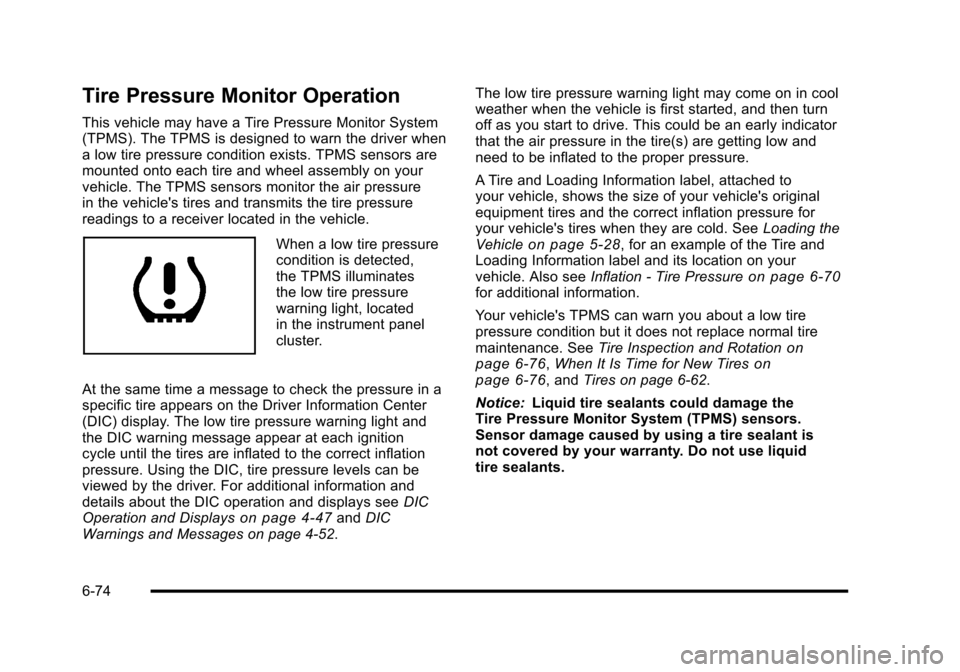
When a low tire pressure
condition is detected,
the TPMS illuminates
the low tire pressure
warning light, located
in the instrument panel
cluster.
At the same time a message to check the pressure in a
specific tire appears on the Driver Information Center
(DIC) display. The low tire pressure warning light and
the DIC warning message appear at each ignition
cycle until the tires are inflated to the correct inflation
pressure. Using the DIC, tire pressure levels can be
viewed by the driver. For additional information and
details about the DIC operation and displays see DIC
Operation and Displays
on page 4‑47and DIC
Warnings and Messages on page 4‑52. The low tire pressure warning light may come on in cool
weather when the vehicle is first started, and then turn
off as you start to drive. This could be an early indicator
that the air pressure in the tire(s) are getting low and
need to be inflated to the proper pressure.
A Tire and Loading Information label, attached to
your vehicle, shows the size of your vehicle's original
equipment tires and the correct inflation pressure for
your vehicle's tires when they are cold. See
Loading the
Vehicle
on page 5‑28, for an example of the Tire and
Loading Information label and its location on your
vehicle. Also see Inflation - Tire Pressure
on page 6‑70for additional information.
Your vehicle's TPMS can warn you about a low tire
pressure condition but it does not replace normal tire
maintenance. See Tire Inspection and Rotation
on
page 6‑76, When It Is Time for New Tireson
page 6‑76, and Tires on page 6‑62.
Notice: Liquid tire sealants could damage the
Tire Pressure Monitor System (TPMS) sensors.
Sensor damage caused by using a tire sealant is
not covered by your warranty. Do not use liquid
tire sealants.
6-74
Page 387 of 472
TPMS Malfunction Light and Message
The TPMS will not function properly if one or more of
the TPMS sensors are missing or inoperable. When the
system detects a malfunction, the low tire warning light
flashes for about one minute and then stays on for the
remainder of the ignition cycle. A DIC warning message
is also displayed. The low tire warning light and DIC
warning message come on at each ignition cycle until
the problem is corrected. Some of the conditions that
can cause the malfunction light and DIC message to
come on are:
.The TPMS sensor matching process was not done
or not completed successfully. The DIC message
should go off after successfully completing the
sensor matching process.
.One or more TPMS sensors are missing or
damaged. Under these conditions the TPMS
malfunction light (low tire warning light) comes
on, and at the same time the DIC message
is displayed. The DIC message and TPMS
malfunction light should go off once the TPMS
sensors are installed and the sensor matching
process is performed successfully.
.Replacement tires or wheels do not match your
vehicle's original equipment tires or wheels.
Tires and wheels other than those recommended
for your vehicle could prevent the TPMS from
functioning properly. See Buying New Tires
on
page 6‑77.
.Operating electronic devices or being near facilities
using radio wave frequencies similar to the TPMS
could cause the TPMS sensors to malfunction.
If the TPMS is not functioning it cannot detect or signal
a low tire condition. See your dealer/retailer for service
if the TPMS malfunction light and DIC message comes
on and stays on.
TPMS Sensor Matching Process
Each TPMS sensor has a unique identification code.
Any time you replace one or more of the TPMS sensors
or rotate your vehicle's tires, the identification codes
will need to be matched to the new tire/wheel position.
The sensors are matched to the tire/wheel positions in
the following order: driver side front tire, passenger side
front tire, passenger side rear tire, and driver side rear
tire using a TPMS diagnostic tool. See your dealer/
retailer for service.
6-75