key CHEVROLET CORVETTE 2011 6.G User Guide
[x] Cancel search | Manufacturer: CHEVROLET, Model Year: 2011, Model line: CORVETTE, Model: CHEVROLET CORVETTE 2011 6.GPages: 428, PDF Size: 6.63 MB
Page 38 of 428
Black plate (6,1)Chevrolet Corvette Owner Manual - 2011
2-6 Keys, Doors and Windows
9. To program additionaltransmitters, repeat Step 7.
Press Acc. on the ignition switch
if programming is complete.
10. Press
Kon each newly
programmed transmitter to
complete the process.
Programming without a
Recognized Transmitter
This procedure requires three
ten minute cycles to complete
the programming process.
United States owners are permitted
to program a new transmitter to
their vehicle when a recognized
transmitter is not available. The Canadian immobilizer standard
requires that Canadian owners see
their dealer for programming new
transmitters when two recognized
transmitters are not available.
1. The vehicle must be off.
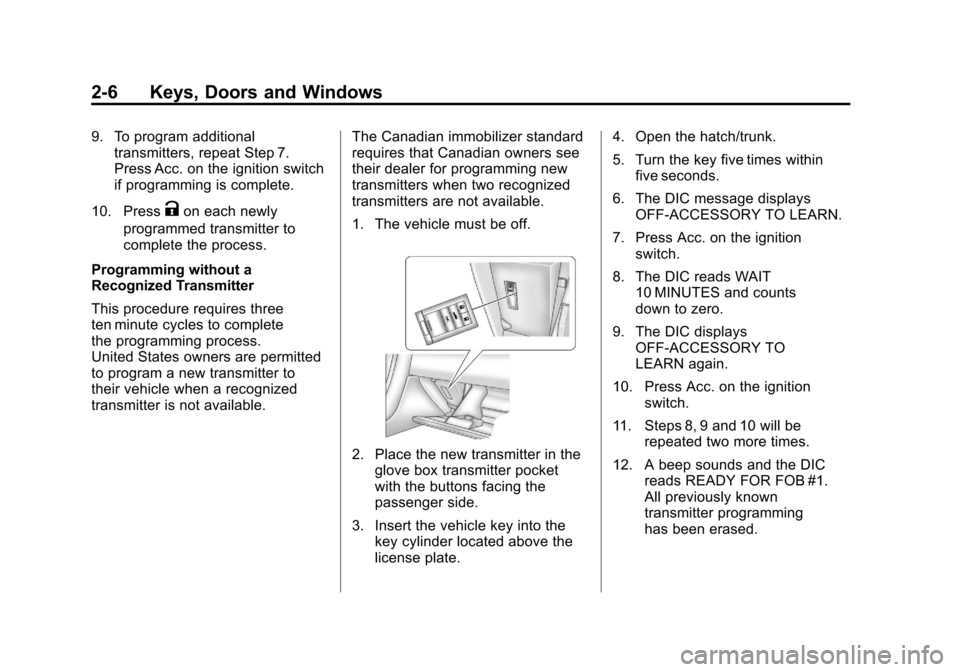
2. Place the new transmitter in the
glove box transmitter pocket
with the buttons facing the
passenger side.
3. Insert the vehicle key into the key cylinder located above the
license plate. 4. Open the hatch/trunk.
5. Turn the key five times within
five seconds.
6. The DIC message displays OFF-ACCESSORY TO LEARN.
7. Press Acc. on the ignition switch.
8. The DIC reads WAIT 10 MINUTES and counts
down to zero.
9. The DIC displays OFF-ACCESSORY TO
LEARN again.
10. Press Acc. on the ignition switch.
11. Steps 8, 9 and 10 will be repeated two more times.
12. A beep sounds and the DIC reads READY FOR FOB #1.
All previously known
transmitter programming
has been erased.
Page 39 of 428
Black plate (7,1)Chevrolet Corvette Owner Manual - 2011
Keys, Doors and Windows 2-7
13. A beep sounds onceprogramming in complete.
The DIC displays READY
FOR FOB #2.
To program additional
transmitters, take transmitter 1
out of the transmitter pocket
and place transmitter 2 in
the pocket. Up to four
transmitters can be
programmed. The DIC then
displays MAXIMUM NUMBER
OF FOBS LEARNED and exits
the programming mode.
Press Acc. on the ignition
switch to complete the process.
14. Press Acc. on the ignition switch if programming is
complete.
15. Press
Kon each newly
programmed transmitter to
complete the process.
Starting the Vehicle with a Low
Transmitter Battery
If the transmitter battery is weak,
the DIC may display NO FOBS
DETECTED when trying to start the
vehicle. To start the vehicle, place
the transmitter in the glove box
transmitter pocket with the buttons
facing the passenger side. Then,
with the vehicle in P (Park) for an
automatic transmission, press the
brake pedal and
/. If the vehicle
has a manual transmission, press
the clutch and
/. Replace the
transmitter battery as soon as
possible. Change the transmitter
battery if the DIC displays
FOB BATTERY LOW.
Battery Replacement
Notice: When replacing the
battery, do not touch any of
the circuitry on the transmitter.
Static from your body could
damage the transmitter.
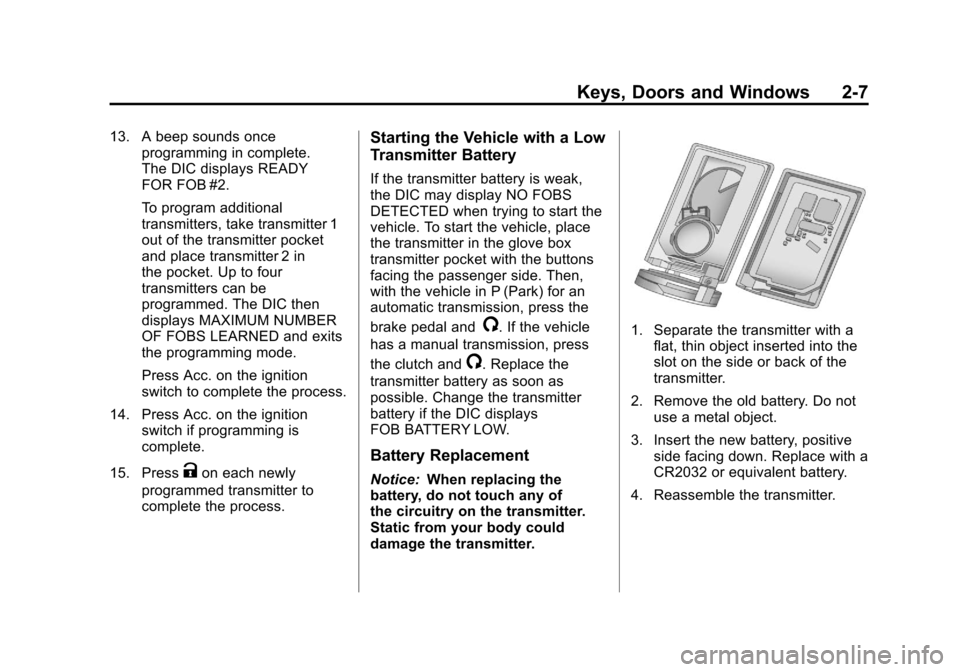
1. Separate the transmitter with a
flat, thin object inserted into the
slot on the side or back of the
transmitter.
2. Remove the old battery. Do not use a metal object.
3. Insert the new battery, positive side facing down. Replace with a
CR2032 or equivalent battery.
4. Reassemble the transmitter.
Page 40 of 428
Black plate (8,1)Chevrolet Corvette Owner Manual - 2011
2-8 Keys, Doors and Windows
Door Locks
{WARNING
Unlocked doors can be
dangerous.
.Passengers—especially
children —can easily open
the doors and fall out of a
moving vehicle. When a
door is locked it will not open.
You increase the chance
of being thrown out of the
vehicle in a crash if the doors
are not locked. So, wear
safety belts properly and
lock the doors whenever
you drive.
(Continued)
WARNING (Continued)
.Young children who get into
unlocked vehicles may be
unable to get out. A child can
be overcome by extreme heat
and can suffer permanent
injuries or even death from
heat stroke. Always lock
your vehicle whenever you
leave it.
.Outsiders can easily enter
through an unlocked door
when you slow down or stop
your vehicle. Locking your
doors can help prevent this
from happening.
There are several ways to lock and
unlock your vehicle.
From the outside, press the lock or
unlock button on the keyless access
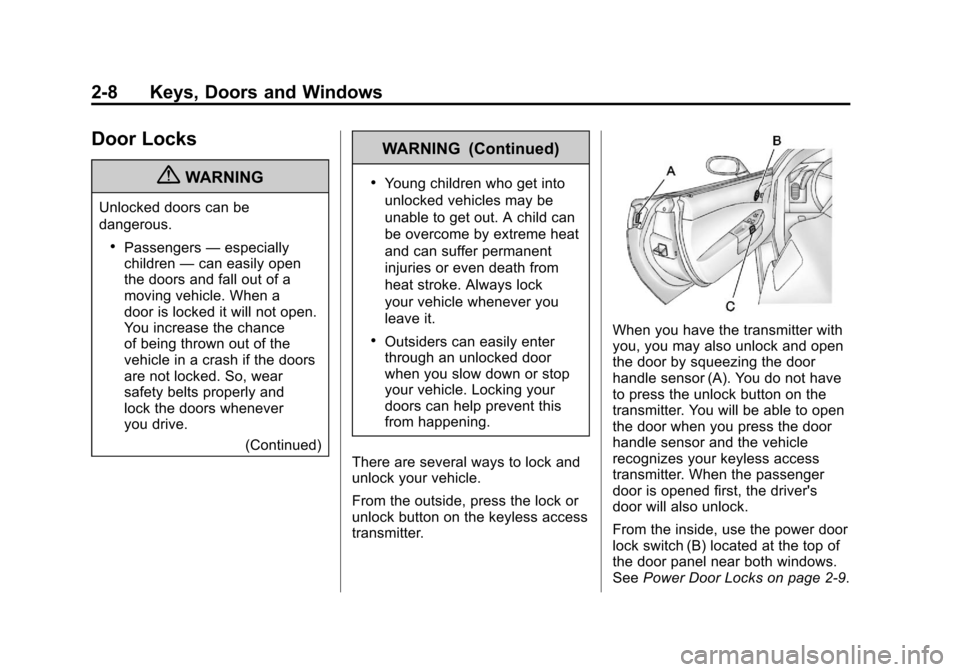
transmitter.When you have the transmitter with
you, you may also unlock and open
the door by squeezing the door
handle sensor (A). You do not have
to press the unlock button on the
transmitter. You will be able to open
the door when you press the door
handle sensor and the vehicle
recognizes your keyless access
transmitter. When the passenger
door is opened first, the driver's
door will also unlock.
From the inside, use the power door
lock switch (B) located at the top of
the door panel near both windows.
See Power Door Locks on page 2‑9.
Page 41 of 428
Black plate (9,1)Chevrolet Corvette Owner Manual - 2011
Keys, Doors and Windows 2-9
To open a door from the inside,
press the button (C) in front of the
door handle and push the door
open. You will hear a tone when
the button is pressed.
If power to the vehicle or the
keyless access transmitter is
lost, there are two ways to open
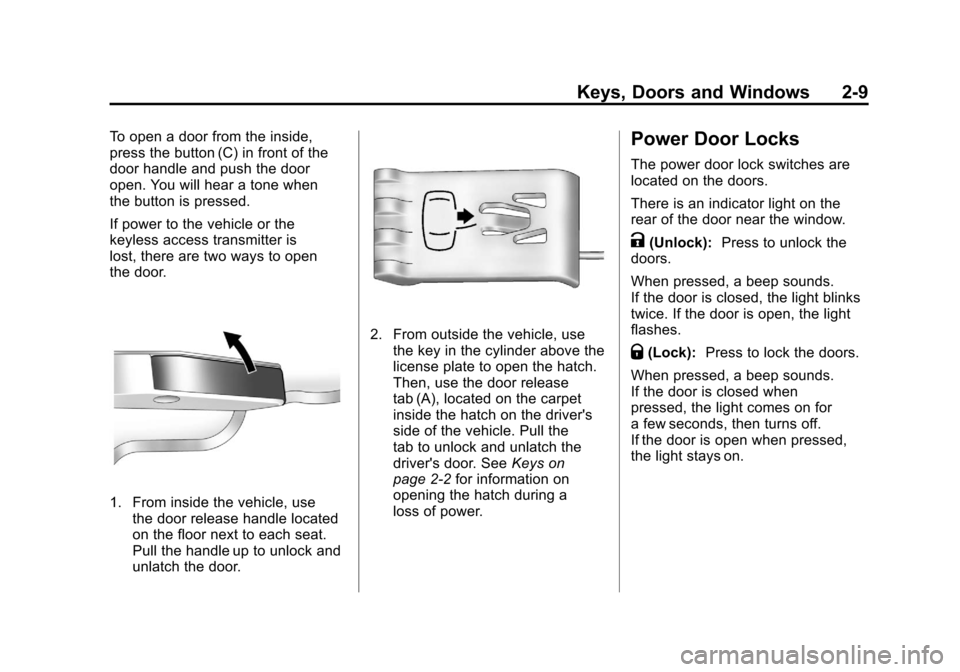
the door.
1. From inside the vehicle, usethe door release handle located
on the floor next to each seat.
Pull the handle up to unlock and
unlatch the door.
2. From outside the vehicle, usethe key in the cylinder above the
license plate to open the hatch.
Then, use the door release
tab (A), located on the carpet
inside the hatch on the driver's
side of the vehicle. Pull the
tab to unlock and unlatch the
driver's door. See Keys on
page 2‑2 for information on
opening the hatch during a
loss of power.
Power Door Locks
The power door lock switches are
located on the doors.
There is an indicator light on the
rear of the door near the window.
K(Unlock): Press to unlock the
doors.
When pressed, a beep sounds.
If the door is closed, the light blinks
twice. If the door is open, the light
flashes.
Q(Lock): Press to lock the doors.
When pressed, a beep sounds.
If the door is closed when
pressed, the light comes on for
a few seconds, then turns off.
If the door is open when pressed,
the light stays on.
Page 42 of 428
Black plate (10,1)Chevrolet Corvette Owner Manual - 2011
2-10 Keys, Doors and Windows
Automatic Door Locks
The vehicle is programmed so that,
when the doors are closed, the
ignition is on and the shift lever is
moved out of P (Park) for automatic
transmissions, or when vehicle
speed becomes faster than 13 km/h
(8 mph) for manual transmissions,
both doors will lock.
Use the power door unlock switch to
unlock the door when the vehicle is
not in P (Park). When the door is
closed again, the doors will lock
either when your foot is removed
from the brake or the vehicle
speed becomes faster than
13 km/h (8 mph).
Automatic Door Unlock
The vehicle is programmed so that
when the shift lever is moved into
P (Park) for automatic transmission
vehicles or when the ignition is
turned OFF or is in Retained
Accessory Power (RAP) for manual
transmission vehicles, both doors
will unlock.With the vehicle stopped and the
engine running, door unlocking
can be programmed through the
Driver Information Center (DIC).
This allows the driver to choose
various unlock settings.
For programming information,
see
Vehicle Personalization on
page 5‑55.
Lockout Protection
Your vehicle can be programmed
to sound the horn three times and
unlock the driver door when both
doors are closed and there is a
keyless access transmitter inside
the vehicle. When the driver door
is opened, a reminder chime will
sound continuously. The vehicle will
remain locked only when at least
one transmitter has been removed
from the vehicle and both doors are
closed. See Vehicle Personalization
on page 5‑55.
Doors
Hatch
{WARNING
Exhaust gases can enter the
vehicle if it is driven with the
liftgate, trunk/hatch open, or
with any objects that pass
through the seal between the
body and the trunk/hatch or
liftgate. Engine exhaust contains
Carbon Monoxide (CO) which
cannot be seen or smelled. It can
cause unconsciousness and even
death.
If the vehicle must be driven with
the liftgate, or trunk/hatch open:
.Close all of the windows.
.Fully open the air outlets
on or under the instrument
panel.
(Continued)
Page 43 of 428
Black plate (11,1)Chevrolet Corvette Owner Manual - 2011
Keys, Doors and Windows 2-11
WARNING (Continued)
.Adjust the Climate Control
system to a setting that
brings in only outside air
and set the fan speed to the
highest setting. See Climate
Control System in the Index.
.If the vehicle is equipped with
a power liftgate, disable the
power liftgate function.
For more information about
carbon monoxide, see Engine
Exhaust on page 9‑26.
Notice: Closing the hatch/trunk
lid forcefully or from the sides
can cause damage to the glass,
the defogger or the weather
stripping. Be sure objects will fit
in the hatch/trunk area before
closing the hatch/trunk lid. When
closing the hatch/trunk lid, gently
pull down from the center. Notice:
Do not store heavy or
sharp objects in the rear storage
compartments located in the
hatch/trunk area. The objects
could damage the underbody.
Hatch/Trunk Lid Release
There are several ways to release
the hatch/trunk lid. If your vehicle
has an automatic transmission,
the shift lever must be in P (Park).
For manual transmission vehicles,
the parking brake must be set
when the ignition is started for
the hatch/trunk release to operate.
The parking brake does not need
to be set when the ignition is off for
the hatch/trunk release to operate.
See Parking Brake on page 9‑35.
V(Hatch/Trunk) : Press this
button, located on the instrument
panel to the left of the steering
wheel. The theft-deterrent alarm
system must not be armed.
}(Hatch/Trunk) : Press this
button on the keyless access
transmitter. See Remote Keyless
Entry (RKE) System on page 2‑3.
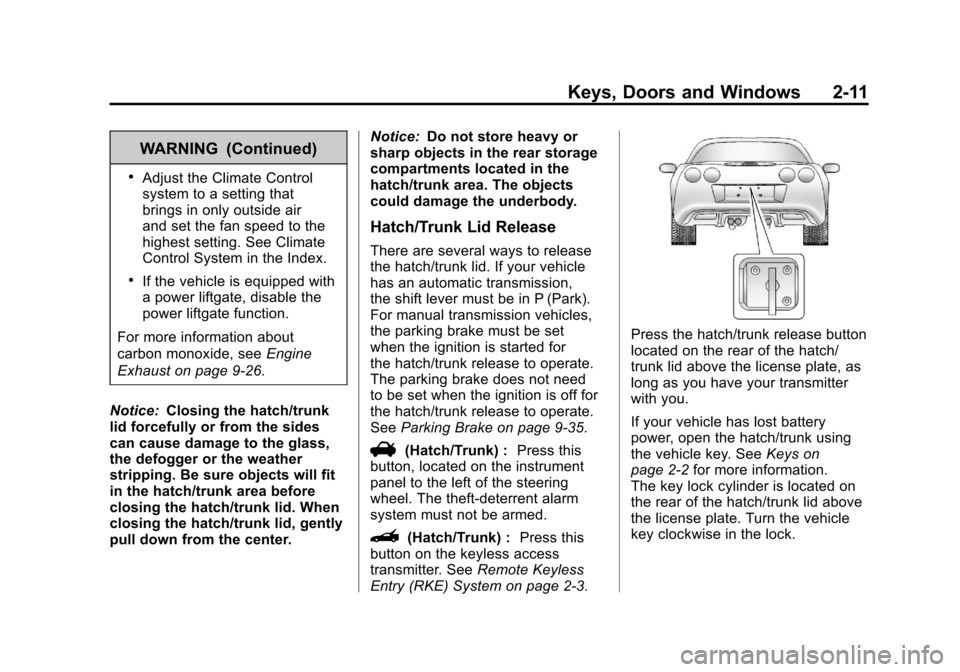
Press the hatch/trunk release button
located on the rear of the hatch/
trunk lid above the license plate, as
long as you have your transmitter
with you.
If your vehicle has lost battery
power, open the hatch/trunk using
the vehicle key. See Keys on
page 2‑2 for more information.
The key lock cylinder is located on
the rear of the hatch/trunk lid above
the license plate. Turn the vehicle
key clockwise in the lock.
Page 44 of 428
Black plate (12,1)Chevrolet Corvette Owner Manual - 2011
2-12 Keys, Doors and Windows
Closing the Rear Compartment
(Except Convertible)
To close the rear compartment lid of
your coupe, pull down on the rear
edge of the lid. Lower it until the
power pull down latch feature
activates and it will close the rest
of the way and latch automatically.
Emergency Trunk Release
Handle (Coupe)
Notice:Do not use the
emergency trunk release handle
as a tie-down or anchor point when securing items in the trunk
as it could damage the handle.
The emergency trunk release
handle is only intended to aid a
person trapped in a latched trunk,
enabling them to open the trunk
from the inside.
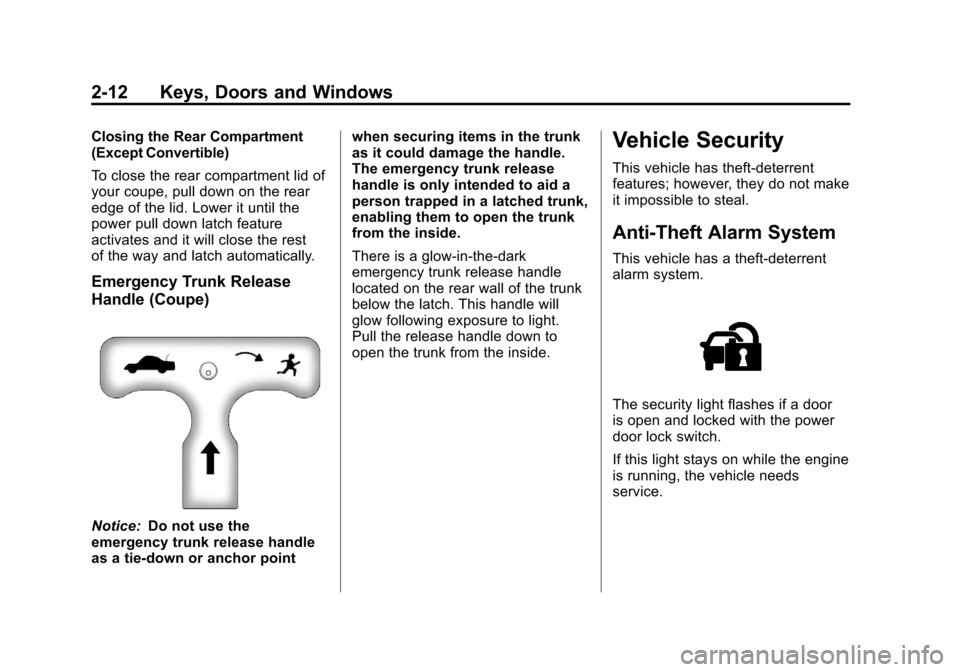
There is a glow-in-the-dark
emergency trunk release handle
located on the rear wall of the trunk
below the latch. This handle will
glow following exposure to light.
Pull the release handle down to
open the trunk from the inside.
Vehicle Security
This vehicle has theft-deterrent
features; however, they do not make
it impossible to steal.
Anti-Theft Alarm System
This vehicle has a theft-deterrent
alarm system.
The security light flashes if a door
is open and locked with the power
door lock switch.
If this light stays on while the engine
is running, the vehicle needs
service.
Page 45 of 428
Black plate (13,1)Chevrolet Corvette Owner Manual - 2011
Keys, Doors and Windows 2-13
Arming the System
To arm the system:
.PressQon the keyless access
transmitter.
.Open the door and lock the
door with the power door lock
switch. The security light should
flash. Remove the keyless
access transmitter from inside
the vehicle and close the door.
The security light stops flashing
and stays on. After 30 seconds,
the light should turn off.
The vehicle can be programmed
to automatically lock the doors
and arm the theft-deterrent
system when you exit the
vehicle. See Vehicle
Personalization on page 5‑55.
If a door or the hatch/trunk is
opened without using the keyless
access transmitter, the alarm
goes off. The horn sounds for
two minutes, then goes off to save battery power. The vehicle will not
start without a keyless access
transmitter present.
The theft-deterrent system does not
arm if the driver door is locked with
the power door lock switch after the
doors are closed.
If the keyless access transmitter is
removed from the vehicle while a
passenger is in it, have them lock
the doors after they are closed.
The alarm will not arm, so the
passenger will not set it off.
Testing the Alarm
To test the system:
1. Make sure the trunk lid/hatch is
latched.
2. Lower the window on the driver door.
3. Manually arm the system.
4. Close the doors and wait 30 seconds. 5. Reach through the open window
and manually pull the release
lever on the floor.
6. Press the unlock button on the transmitter to turn off the alarm.
If the alarm does not sound, check
to see if the horn works. The horn
fuse may be blown. See Fuses and
Circuit Breakers on page 10‑51.
If the horn works, but the alarm
does not go off, see your dealer.
Disarming the System
Press the unlock button on the
keyless access transmitter or
squeeze the door handle sensor
while the transmitter is near the
vehicle to unlock a door. Unlocking
a door any other way sets off the
alarm. If the alarm sounds, press
the unlock button on the keyless
access transmitter to disarm it.
Do not leave the key or device that
disarms or deactivates the theft
deterrent system in the vehicle.
Page 46 of 428
Black plate (14,1)Chevrolet Corvette Owner Manual - 2011
2-14 Keys, Doors and Windows
Immobilizer
SeeRadio Frequency Statement on
page 13‑19 for information
regarding Part 15 of the Federal
Communications Commission
(FCC) rules and Industry Canada
Standards RSS-210/220/310.
Immobilizer Operation
The vehicle has a passive
theft-deterrent system.
The system is automatically armed
when the ignition is turned off.
The immobilization system is
disarmed when the ignition is turned
to OFF/ACCESSORY or START and
a valid transmitter is found in the
vehicle.
You do not have to manually arm or
disarm the system.
The security light comes on if
there is a problem with arming
or disarming the theft-deterrent
system. The system has one or more
keyless access transmitters that are
matched to an immobilizer control
unit in the vehicle. Only a correctly
matched keyless access transmitter
starts the vehicle. The vehicle may
not start if the keyless access
transmitter is damaged.
If the engine does not start and the
security light comes on, there may
be a problem with the immobilizer
system. Press the START button
again.
If the vehicle does not start and
the keyless access transmitter
appears to be undamaged, try
another keyless access transmitter.
Or, place the transmitter in the
transmitter pocket. See
“NO FOBS
DETECTED” underKey and Lock
Messages on page 5‑42 for
additional information. Check the fuse. See
Fuses and Circuit
Breakers on page 10‑51. If the
engine still does not start with the
other transmitter, the vehicle needs
service. If the engine does start,
the first transmitter may be faulty.
See your dealer or have a new
keyless access transmitter
programmed to the vehicle.
The immobilizer system can
learn new or replacement keyless
access transmitters. Up to four
keyless access transmitters can
be programmed for the vehicle.
To program additional transmitters,
see “Matching transmitter(s) to Your
Vehicle” underRemote Keyless
Entry (RKE) System Operation on
page 2‑3.
Do not leave the key or device that
disarms or deactivates the theft
deterrent system in the vehicle.
Page 47 of 428
Black plate (15,1)Chevrolet Corvette Owner Manual - 2011
Keys, Doors and Windows 2-15
Exterior Mirrors
Convex Mirrors
{WARNING
A convex mirror can make things,
like other vehicles, look farther
away than they really are. If you
cut too sharply into the right lane,
you could hit a vehicle on the
right. Check the inside mirror or
glance over your shoulder before
changing lanes.
The passenger side mirror is convex
shaped. A convex mirror's surface is
curved so more can be seen from
the driver seat.
Power Mirrors
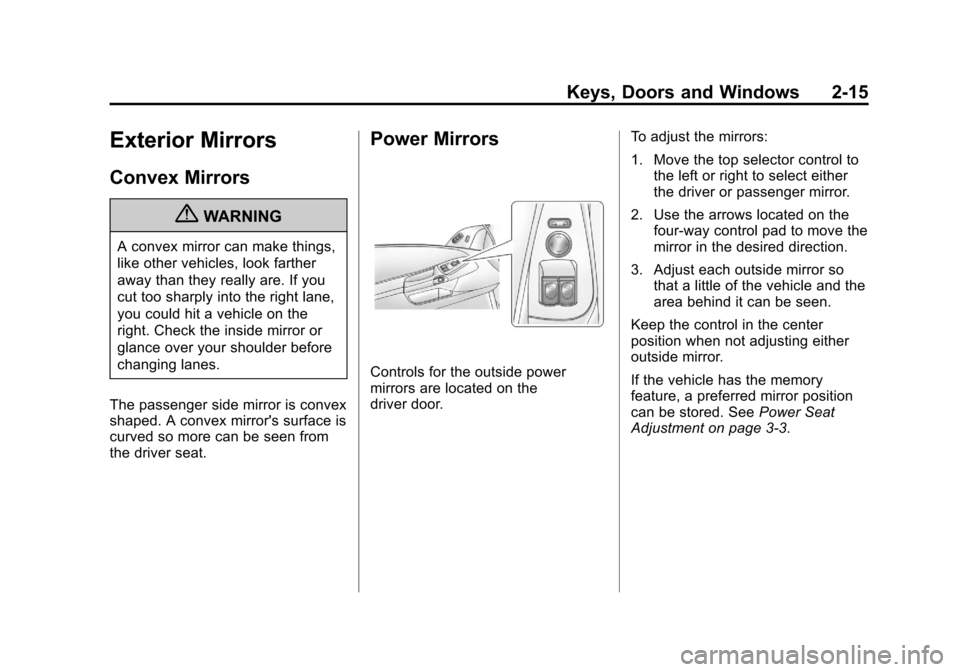
Controls for the outside power
mirrors are located on the
driver door. To adjust the mirrors:
1. Move the top selector control to
the left or right to select either
the driver or passenger mirror.
2. Use the arrows located on the four-way control pad to move the
mirror in the desired direction.
3. Adjust each outside mirror so that a little of the vehicle and the
area behind it can be seen.
Keep the control in the center
position when not adjusting either
outside mirror.
If the vehicle has the memory
feature, a preferred mirror position
can be stored. See Power Seat
Adjustment on page 3‑3.