power steering CHEVROLET DURAMAX 2006 Owners Manual
[x] Cancel search | Manufacturer: CHEVROLET, Model Year: 2006, Model line: DURAMAX, Model: CHEVROLET DURAMAX 2006Pages: 100, PDF Size: 0.71 MB
Page 21 of 100
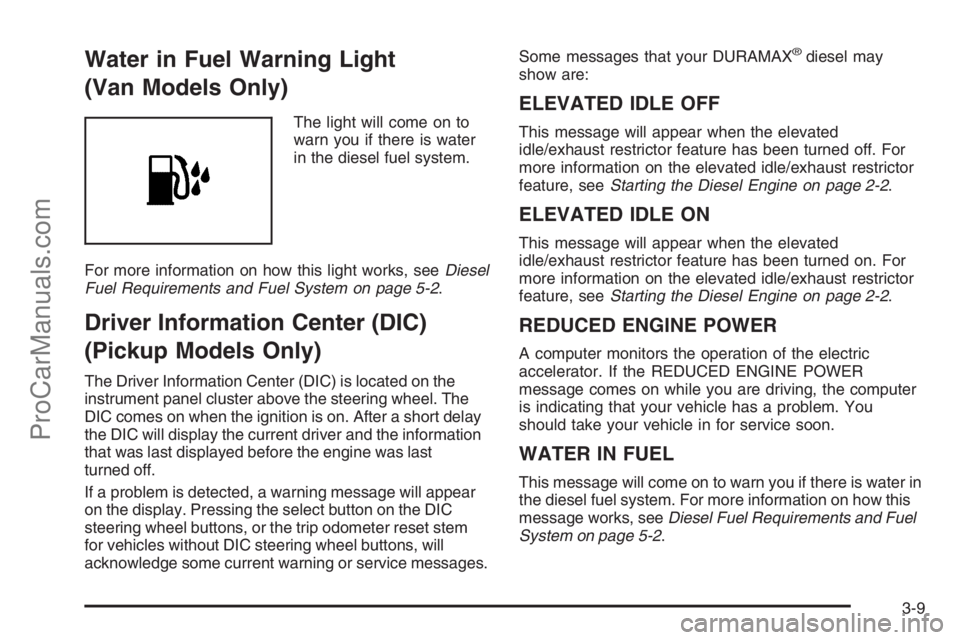
Water in Fuel Warning Light
(Van Models Only)
The light will come on to
warn you if there is water
in the diesel fuel system.
For more information on how this light works, seeDiesel
Fuel Requirements and Fuel System on page 5-2.
Driver Information Center (DIC)
(Pickup Models Only)
The Driver Information Center (DIC) is located on the
instrument panel cluster above the steering wheel. The
DIC comes on when the ignition is on. After a short delay
the DIC will display the current driver and the information
that was last displayed before the engine was last
turned off.
If a problem is detected, a warning message will appear
on the display. Pressing the select button on the DIC
steering wheel buttons, or the trip odometer reset stem
for vehicles without DIC steering wheel buttons, will
acknowledge some current warning or service messages.Some messages that your DURAMAX
®diesel may
show are:
ELEVATED IDLE OFF
This message will appear when the elevated
idle/exhaust restrictor feature has been turned off. For
more information on the elevated idle/exhaust restrictor
feature, seeStarting the Diesel Engine on page 2-2.
ELEVATED IDLE ON
This message will appear when the elevated
idle/exhaust restrictor feature has been turned on. For
more information on the elevated idle/exhaust restrictor
feature, seeStarting the Diesel Engine on page 2-2.
REDUCED ENGINE POWER
A computer monitors the operation of the electric
accelerator. If the REDUCED ENGINE POWER
message comes on while you are driving, the computer
is indicating that your vehicle has a problem. You
should take your vehicle in for service soon.
WATER IN FUEL
This message will come on to warn you if there is water in
the diesel fuel system. For more information on how this
message works, seeDiesel Fuel Requirements and Fuel
System on page 5-2.
3-9
ProCarManuals.com
Page 43 of 100
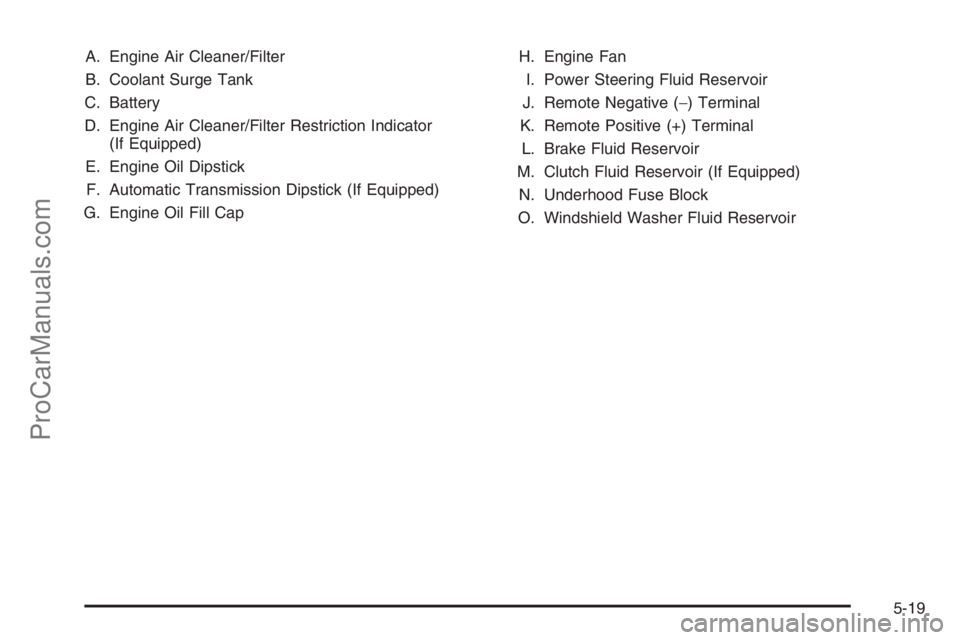
A. Engine Air Cleaner/Filter
B. Coolant Surge Tank
C. Battery
D. Engine Air Cleaner/Filter Restriction Indicator
(If Equipped)
E. Engine Oil Dipstick
F. Automatic Transmission Dipstick (If Equipped)
G. Engine Oil Fill CapH. Engine Fan
I. Power Steering Fluid Reservoir
J. Remote Negative (−) Terminal
K. Remote Positive (+) Terminal
L. Brake Fluid Reservoir
M. Clutch Fluid Reservoir (If Equipped)
N. Underhood Fuse Block
O. Windshield Washer Fluid Reservoir
5-19
ProCarManuals.com
Page 45 of 100
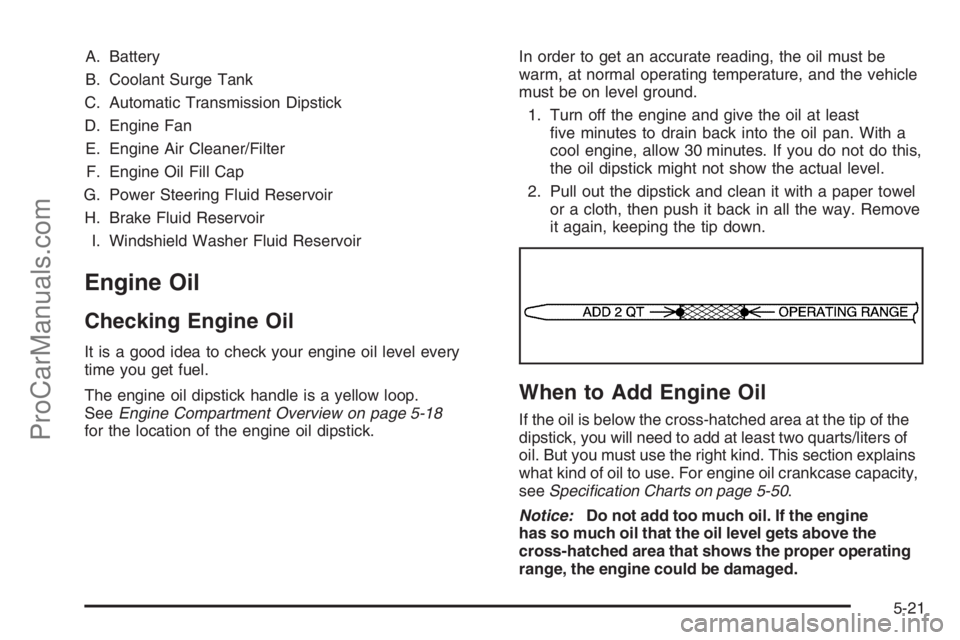
A. Battery
B. Coolant Surge Tank
C. Automatic Transmission Dipstick
D. Engine Fan
E. Engine Air Cleaner/Filter
F. Engine Oil Fill Cap
G. Power Steering Fluid Reservoir
H. Brake Fluid Reservoir
I. Windshield Washer Fluid Reservoir
Engine Oil
Checking Engine Oil
It is a good idea to check your engine oil level every
time you get fuel.
The engine oil dipstick handle is a yellow loop.
SeeEngine Compartment Overview on page 5-18
for the location of the engine oil dipstick.In order to get an accurate reading, the oil must be
warm, at normal operating temperature, and the vehicle
must be on level ground.
1. Turn off the engine and give the oil at least
five minutes to drain back into the oil pan. With a
cool engine, allow 30 minutes. If you do not do this,
the oil dipstick might not show the actual level.
2. Pull out the dipstick and clean it with a paper towel
or a cloth, then push it back in all the way. Remove
it again, keeping the tip down.
When to Add Engine Oil
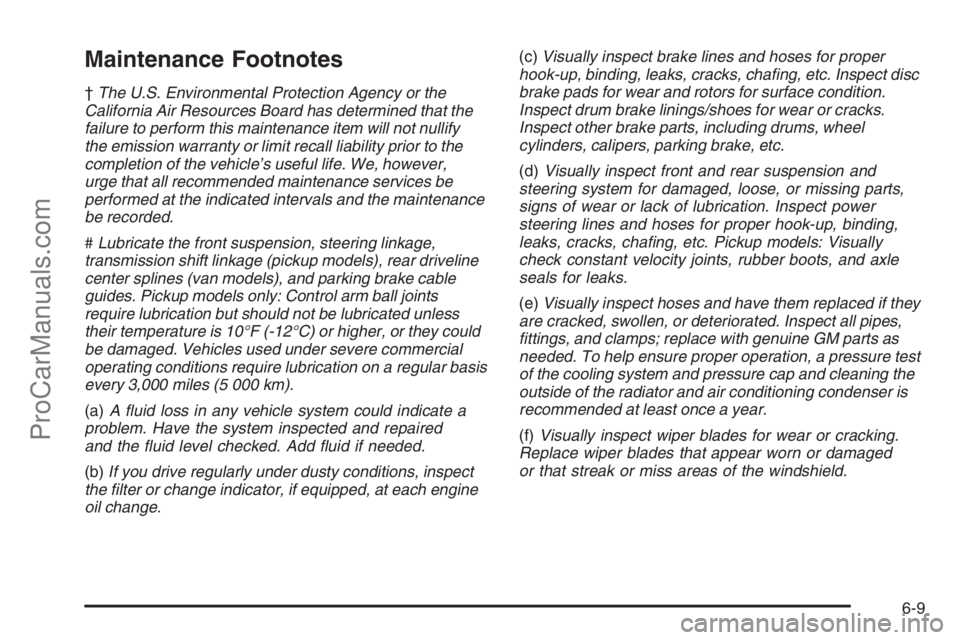
If the oil is below the cross-hatched area at the tip of the
dipstick, you will need to add at least two quarts/liters of
oil. But you must use the right kind. This section explains
what kind of oil to use. For engine oil crankcase capacity,
seeSpecication Charts on page 5-50.
Notice:Do not add too much oil. If the engine
has so much oil that the oil level gets above the
cross-hatched area that shows the proper operating
range, the engine could be damaged.
5-21
ProCarManuals.com
Page 83 of 100
Maintenance Footnotes
†The U.S. Environmental Protection Agency or the
California Air Resources Board has determined that the
failure to perform this maintenance item will not nullify
the emission warranty or limit recall liability prior to the
completion of the vehicle’s useful life. We, however,
urge that all recommended maintenance services be
performed at the indicated intervals and the maintenance
be recorded.
#Lubricate the front suspension, steering linkage,
transmission shift linkage (pickup models), rear driveline
center splines (van models), and parking brake cable
guides. Pickup models only: Control arm ball joints
require lubrication but should not be lubricated unless
their temperature is 10°F (-12°C) or higher, or they could
be damaged. Vehicles used under severe commercial
operating conditions require lubrication on a regular basis
every 3,000 miles (5 000 km).
(a)A uid loss in any vehicle system could indicate a
problem. Have the system inspected and repaired
and the uid level checked. Add uid if needed.
(b)If you drive regularly under dusty conditions, inspect
the lter or change indicator, if equipped, at each engine
oil change.(c)Visually inspect brake lines and hoses for proper
hook-up, binding, leaks, cracks, chang, etc. Inspect disc
brake pads for wear and rotors for surface condition.
Inspect drum brake linings/shoes for wear or cracks.
Inspect other brake parts, including drums, wheel
cylinders, calipers, parking brake, etc.
(d)Visually inspect front and rear suspension and
steering system for damaged, loose, or missing parts,
signs of wear or lack of lubrication. Inspect power
steering lines and hoses for proper hook-up, binding,
leaks, cracks, chang, etc. Pickup models: Visually
check constant velocity joints, rubber boots, and axle
seals for leaks.
(e)Visually inspect hoses and have them replaced if they
are cracked, swollen, or deteriorated. Inspect all pipes,
ttings, and clamps; replace with genuine GM parts as
needed. To help ensure proper operation, a pressure test
of the cooling system and pressure cap and cleaning the
outside of the radiator and air conditioning condenser is
recommended at least once a year.
(f)Visually inspect wiper blades for wear or cracking.
Replace wiper blades that appear worn or damaged
or that streak or miss areas of the windshield.
6-9
ProCarManuals.com
Page 89 of 100
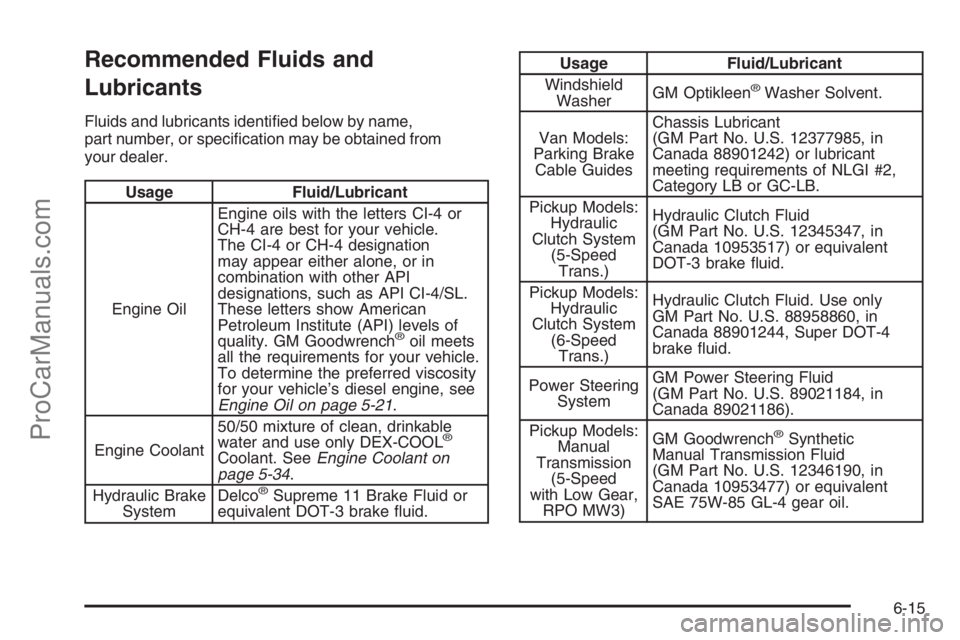
Recommended Fluids and
Lubricants
Fluids and lubricants identified below by name,
part number, or specification may be obtained from
your dealer.
Usage Fluid/Lubricant
Engine OilEngine oils with the letters CI-4 or
CH-4 are best for your vehicle.
The CI-4 or CH-4 designation
may appear either alone, or in
combination with other API
designations, such as API CI-4/SL.
These letters show American
Petroleum Institute (API) levels of
quality. GM Goodwrench
®oil meets
all the requirements for your vehicle.
To determine the preferred viscosity
for your vehicle’s diesel engine, see
Engine Oil on page 5-21.
Engine Coolant50/50 mixture of clean, drinkable
water and use only DEX-COOL
®
Coolant. SeeEngine Coolant on
page 5-34.
Hydraulic Brake
SystemDelco
®Supreme 11 Brake Fluid or
equivalent DOT-3 brake fluid.
Usage Fluid/Lubricant
Windshield
WasherGM Optikleen
®Washer Solvent.
Van Models:
Parking Brake
Cable GuidesChassis Lubricant
(GM Part No. U.S. 12377985, in
Canada 88901242) or lubricant
meeting requirements of NLGI #2,
Category LB or GC-LB.
Pickup Models:
Hydraulic
Clutch System
(5-Speed
Trans.)Hydraulic Clutch Fluid
(GM Part No. U.S. 12345347, in
Canada 10953517) or equivalent
DOT-3 brake fluid.
Pickup Models:
Hydraulic
Clutch System
(6-Speed
Trans.)Hydraulic Clutch Fluid. Use only
GM Part No. U.S. 88958860, in
Canada 88901244, Super DOT-4
brake fluid.
Power Steering
SystemGM Power Steering Fluid
(GM Part No. U.S. 89021184, in
Canada 89021186).
Pickup Models:
Manual
Transmission
(5-Speed
with Low Gear,
RPO MW3)GM Goodwrench
®Synthetic
Manual Transmission Fluid
(GM Part No. U.S. 12346190, in
Canada 10953477) or equivalent
SAE 75W-85 GL-4 gear oil.
6-15
ProCarManuals.com