lock CHEVROLET DYNASTY 1993 Service Manual
[x] Cancel search | Manufacturer: CHEVROLET, Model Year: 1993, Model line: DYNASTY, Model: CHEVROLET DYNASTY 1993Pages: 2438, PDF Size: 74.98 MB
Page 277 of 2438
WARNING: WHEN BLEEDING THE MODULATOR
ASSEMBLY WEAR SAFETY GLASSES. A CLEAR
BLEED TUBE MUST BE ATTACHED TO THE
BLEEDER SCREWS AND SUBMERGED IN A CLEAR
CONTAINER FILLED PART WAY WITH CLEAN
BRAKE FLUID. DIRECT THE FLOW OF BRAKE
FLUID AWAY FROM THE PAINTED SURFACES OF
THE VEHICLE. BRAKE FLUID AT HIGH PRESSURE
MAY COME OUT OF THE BLEEDER SCREWS,
WHEN OPENED.
When bleeding the Modulator Assembly. The fol-
lowing bleeding sequence MUSTbe followed to in-
sure complete and adequate bleeding of the brakes
hydraulic system. The Modulator Assembly can be
bled using a Manual bleeding procedure or standard
Pressure Bleeding Equipment. If the brake system is to be bled using pressure
bleeding equipment. Refer to Bleeding Brake System,
in the Service Adjustments section at the beginning
of this group, for proper equipment usage and proce-
dures.
MODULATOR ASSEMBLY BLEEDING SEQUENCE
1 SECONDARY SUMP
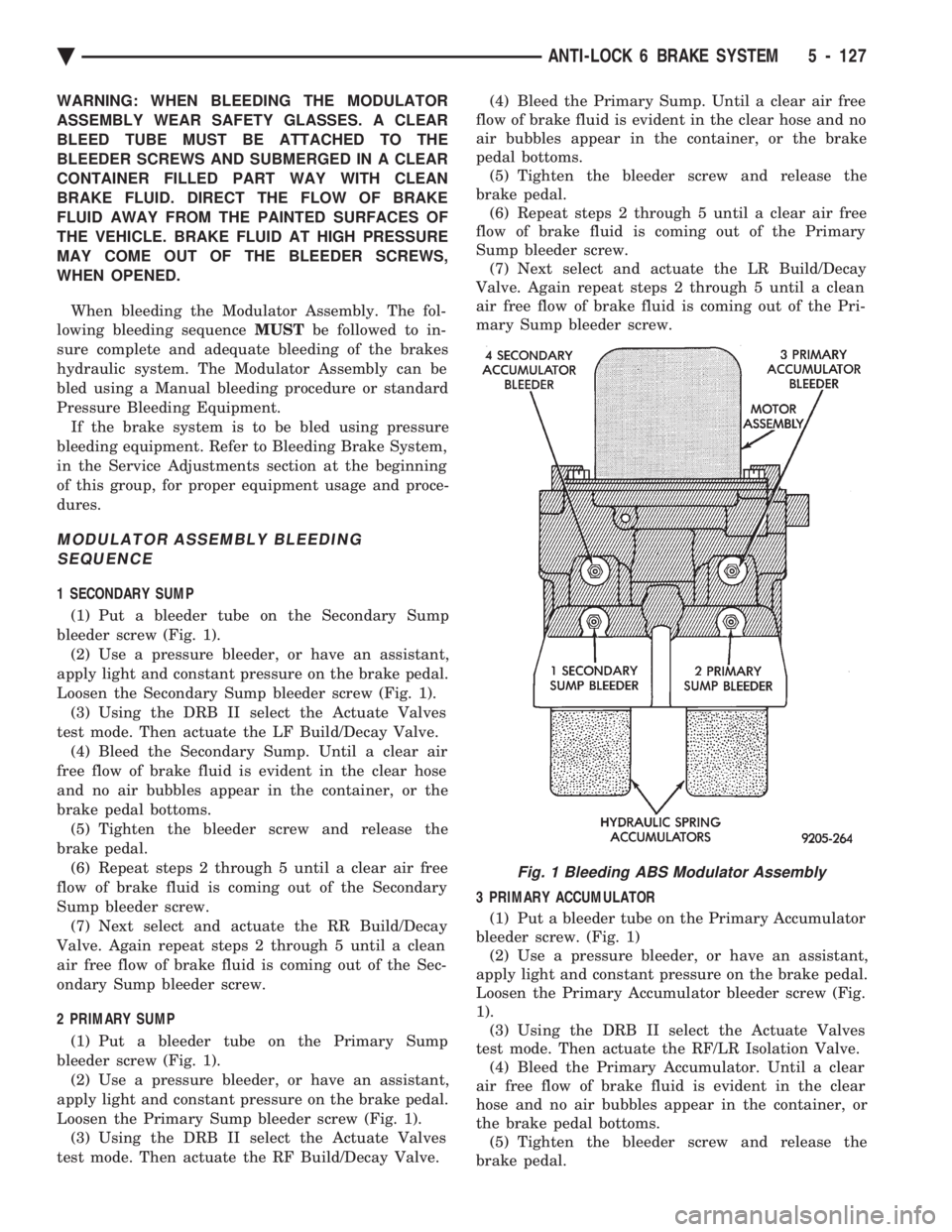
(1) Put a bleeder tube on the Secondary Sump
bleeder screw (Fig. 1). (2) Use a pressure bleeder, or have an assistant,
apply light and constant pressure on the brake pedal.
Loosen the Secondary Sump bleeder screw (Fig. 1). (3) Using the DRB II select the Actuate Valves
test mode. Then actuate the LF Build/Decay Valve. (4) Bleed the Secondary Sump. Until a clear air
free flow of brake fluid is evident in the clear hose
and no air bubbles appear in the container, or the
brake pedal bottoms. (5) Tighten the bleeder screw and release the
brake pedal. (6) Repeat steps 2 through 5 until a clear air free
flow of brake fluid is coming out of the Secondary
Sump bleeder screw. (7) Next select and actuate the RR Build/Decay
Valve. Again repeat steps 2 through 5 until a clean
air free flow of brake fluid is coming out of the Sec-
ondary Sump bleeder screw.
2 PRIMARY SUMP
(1) Put a bleeder tube on the Primary Sump
bleeder screw (Fig. 1). (2) Use a pressure bleeder, or have an assistant,
apply light and constant pressure on the brake pedal.
Loosen the Primary Sump bleeder screw (Fig. 1). (3) Using the DRB II select the Actuate Valves
test mode. Then actuate the RF Build/Decay Valve. (4) Bleed the Primary Sump. Until a clear air free
flow of brake fluid is evident in the clear hose and no
air bubbles appear in the container, or the brake
pedal bottoms. (5) Tighten the bleeder screw and release the
brake pedal. (6) Repeat steps 2 through 5 until a clear air free
flow of brake fluid is coming out of the Primary
Sump bleeder screw. (7) Next select and actuate the LR Build/Decay
Valve. Again repeat steps 2 through 5 until a clean
air free flow of brake fluid is coming out of the Pri-
mary Sump bleeder screw.
3 PRIMARY ACCUMULATOR
(1) Put a bleeder tube on the Primary Accumulator
bleeder screw. (Fig. 1) (2) Use a pressure bleeder, or have an assistant,
apply light and constant pressure on the brake pedal.
Loosen the Primary Accumulator bleeder screw (Fig.
1). (3) Using the DRB II select the Actuate Valves
test mode. Then actuate the RF/LR Isolation Valve. (4) Bleed the Primary Accumulator. Until a clear
air free flow of brake fluid is evident in the clear
hose and no air bubbles appear in the container, or
the brake pedal bottoms. (5) Tighten the bleeder screw and release the
brake pedal.
Fig. 1 Bleeding ABS Modulator Assembly
Ä ANTI-LOCK 6 BRAKE SYSTEM 5 - 127
Page 278 of 2438
(6) Repeat steps 2 through 5 until a clear air free
flow of brake fluid is coming out of the Primary Ac-
cumulator bleeder screw. (7) Next select and actuate the RF Build/Decay
Valve. Again repeat steps 2 through 5 until a clean
air free flow of brake fluid is coming out of the Pri-
mary Accumulator bleeder screw.
4 SECONDARY ACCUMULATOR (1) Put a bleeder tube on the Secondary Accumu-
lator bleeder screw. (Fig. 1) (2) Use a pressure bleeder, or have an assistant,
apply light and constant pressure on the brake pedal.
Loosen the Secondary Accumulator bleeder screw
(Fig. 1). (3) Using the DRB II select the Actuate Valves
test mode. Then actuate the LF/RR Isolation Valve. (4) Bleed the Secondary Accumulator. Until a clear
air free flow of brake fluid is evident in the clear
hose and no air bubbles appear in the container, or
the brake pedal bottoms. (5) Tighten the bleeder screw and release the
brake pedal. (6) Repeat steps 2 through 5 until a clear air free
flow of brake fluid is coming out of the Secondary
Accumulator bleeder screw. (7) Next select and actuate the LF Build/Decay
Valve. Again repeat steps 2 through 5 until a clean
air free flow of brake fluid is coming out of the Pri-
mary Accumulator bleeder screw.PUMP/MOTOR SERVICE
On the Bendix Anti-Lock 6 Brake System the
Pump/Motor assembly can only be serviced as part of
Modulator Assembly.
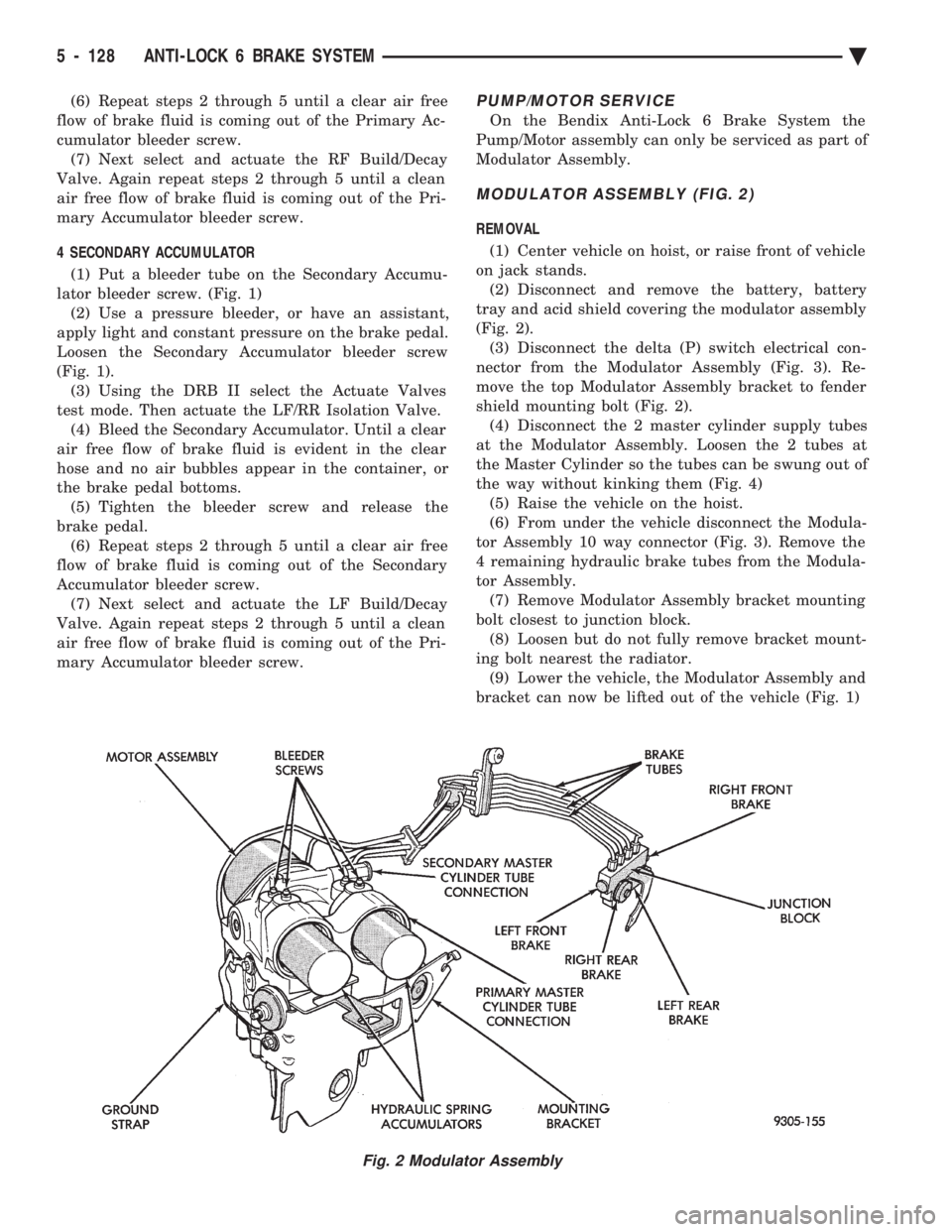
MODULATOR ASSEMBLY (FIG. 2)
REMOVAL
(1) Center vehicle on hoist, or raise front of vehicle
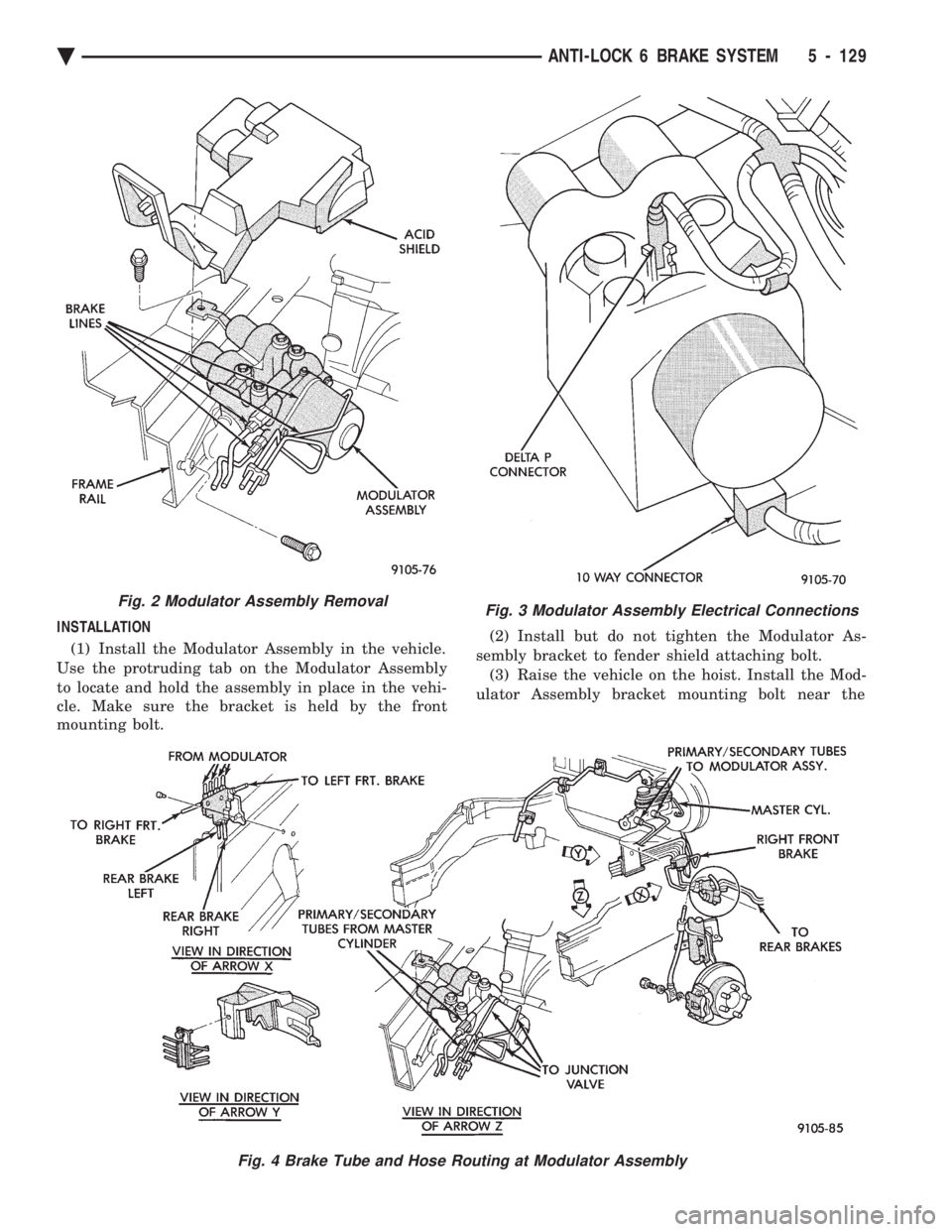
on jack stands. (2) Disconnect and remove the battery, battery
tray and acid shield covering the modulator assembly
(Fig. 2). (3) Disconnect the delta (P) switch electrical con-
nector from the Modulator Assembly (Fig. 3). Re-
move the top Modulator Assembly bracket to fender
shield mounting bolt (Fig. 2). (4) Disconnect the 2 master cylinder supply tubes
at the Modulator Assembly. Loosen the 2 tubes at
the Master Cylinder so the tubes can be swung out of
the way without kinking them (Fig. 4) (5) Raise the vehicle on the hoist.
(6) From under the vehicle disconnect the Modula-
tor Assembly 10 way connector (Fig. 3). Remove the
4 remaining hydraulic brake tubes from the Modula-
tor Assembly. (7) Remove Modulator Assembly bracket mounting
bolt closest to junction block. (8) Loosen but do not fully remove bracket mount-
ing bolt nearest the radiator. (9) Lower the vehicle, the Modulator Assembly and
bracket can now be lifted out of the vehicle (Fig. 1)
Fig. 2 Modulator Assembly
5 - 128 ANTI-LOCK 6 BRAKE SYSTEM Ä
Page 279 of 2438
INSTALLATION (1) Install the Modulator Assembly in the vehicle.
Use the protruding tab on the Modulator Assembly
to locate and hold the assembly in place in the vehi-
cle. Make sure the bracket is held by the front
mounting bolt. (2) Install but do not tighten the Modulator As-
sembly bracket to fender shield attaching bolt. (3) Raise the vehicle on the hoist. Install the Mod-
ulator Assembly bracket mounting bolt near the
Fig. 2 Modulator Assembly RemovalFig. 3 Modulator Assembly Electrical Connections
Fig. 4 Brake Tube and Hose Routing at Modulator Assembly
Ä ANTI-LOCK 6 BRAKE SYSTEM 5 - 129
Page 280 of 2438
junction block. Torque both lower mounting bracket
bolts to 28 N Im (250 in. lbs.)
(4) Reinstall the 4 hydraulic brake tubes to the
Modulator Assembly and torque the fittings to 16
N Im (145 in. lbs.).
(5) Reconnect the 10 way Modulator assembly con-
nector, and the delta P switch connector. (6) Lower the vehicle and install the 2 master cyl-
inder supply tubes to the Modulator Assembly.
Torque the Modulator Assembly fittings and the
master cylinder fittings to 16 N Im (145 in.lbs.).
(7) Torque the Modulator to fender splash shield
attaching bolt to 28 N Im (250 in. lbs.)
(8) Bleed the brake system. Refer to the Bleeding
Bendix Anti 6 Brake System in this section of the
manual for proper bleeding procedure. (9) Reinstall the acid shield and battery tray. Re-
install battery and connect battery cables.
MASTER CYLINDER AND POWER BOOSTER
REMOVAL AND INSTALLATION
If the Master Cylinder or the Power Booster need
to be serviced or replaced. Refer to Master Cylinder
or Power Brake Service section in this group of the
service manual. After servicing the Master Cylinder. Refer back to
this section of the service manual. For the appropri-
ate procedure and sequence, used to bleed the base
and ABS portion of the brake system
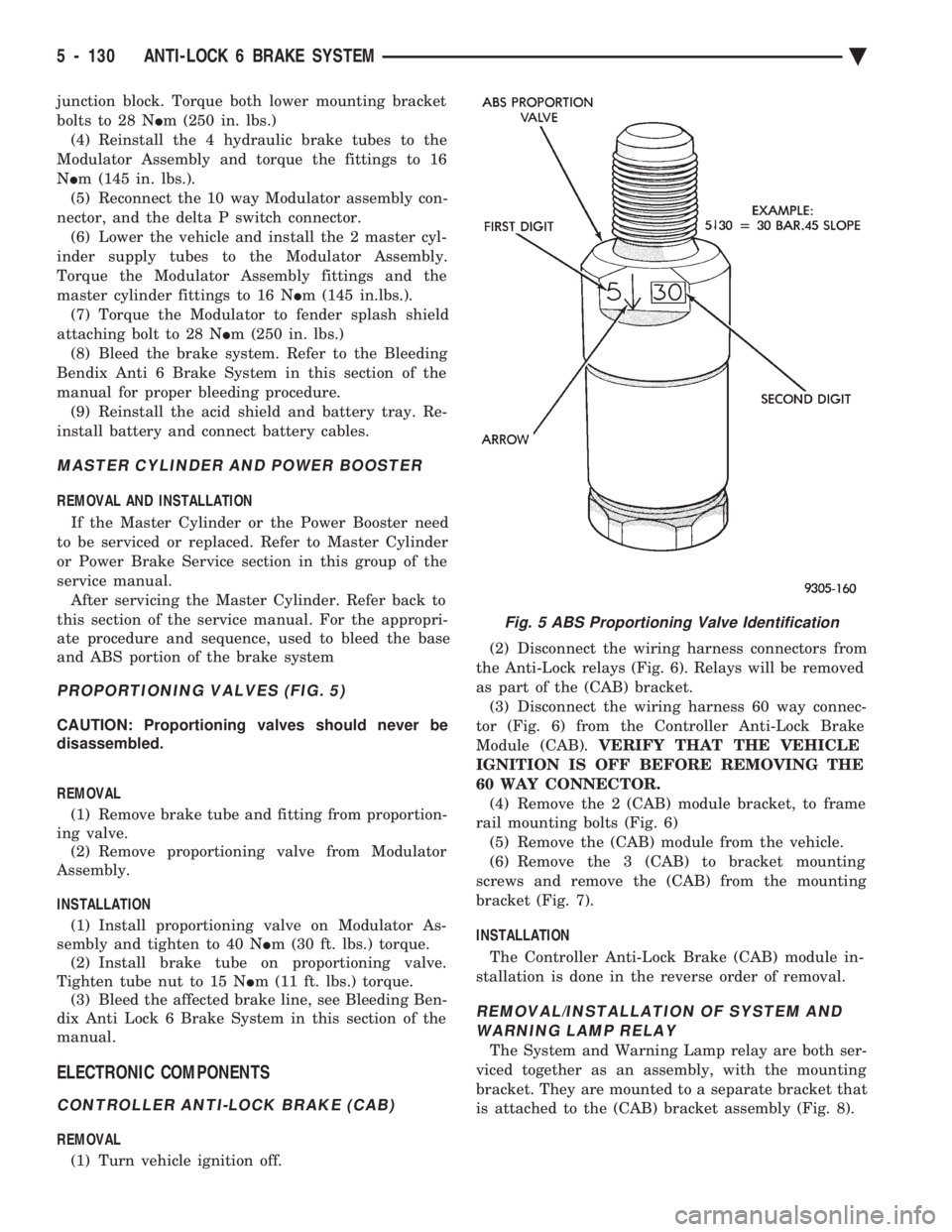
PROPORTIONING VALVES (FIG. 5)
CAUTION: Proportioning valves should never be
disassembled.
REMOVAL (1) Remove brake tube and fitting from proportion-
ing valve. (2) Remove proportioning valve from Modulator
Assembly.
INSTALLATION (1) Install proportioning valve on Modulator As-
sembly and tighten to 40 N Im (30 ft. lbs.) torque.
(2) Install brake tube on proportioning valve.
Tighten tube nut to 15 N Im (11 ft. lbs.) torque.
(3) Bleed the affected brake line, see Bleeding Ben-
dix Anti Lock 6 Brake System in this section of the
manual.
ELECTRONIC COMPONENTS
CONTROLLER ANTI-LOCK BRAKE (CAB)
REMOVAL
(1) Turn vehicle ignition off. (2) Disconnect the wiring harness connectors from
the Anti-Lock relays (Fig. 6). Relays will be removed
as part of the (CAB) bracket. (3) Disconnect the wiring harness 60 way connec-
tor (Fig. 6) from the Controller Anti-Lock Brake
Module (CAB). VERIFY THAT THE VEHICLE
IGNITION IS OFF BEFORE REMOVING THE
60 WAY CONNECTOR. (4) Remove the 2 (CAB) module bracket, to frame
rail mounting bolts (Fig. 6) (5) Remove the (CAB) module from the vehicle.
(6) Remove the 3 (CAB) to bracket mounting
screws and remove the (CAB) from the mounting
bracket (Fig. 7).
INSTALLATION
The Controller Anti-Lock Brake (CAB) module in-
stallation is done in the reverse order of removal.
REMOVAL/INSTALLATION OF SYSTEM AND WARNING LAMP RELAY
The System and Warning Lamp relay are both ser-
viced together as an assembly, with the mounting
bracket. They are mounted to a separate bracket that
is attached to the (CAB) bracket assembly (Fig. 8).
Fig. 5 ABS Proportioning Valve Identification
5 - 130 ANTI-LOCK 6 BRAKE SYSTEM Ä
Page 281 of 2438
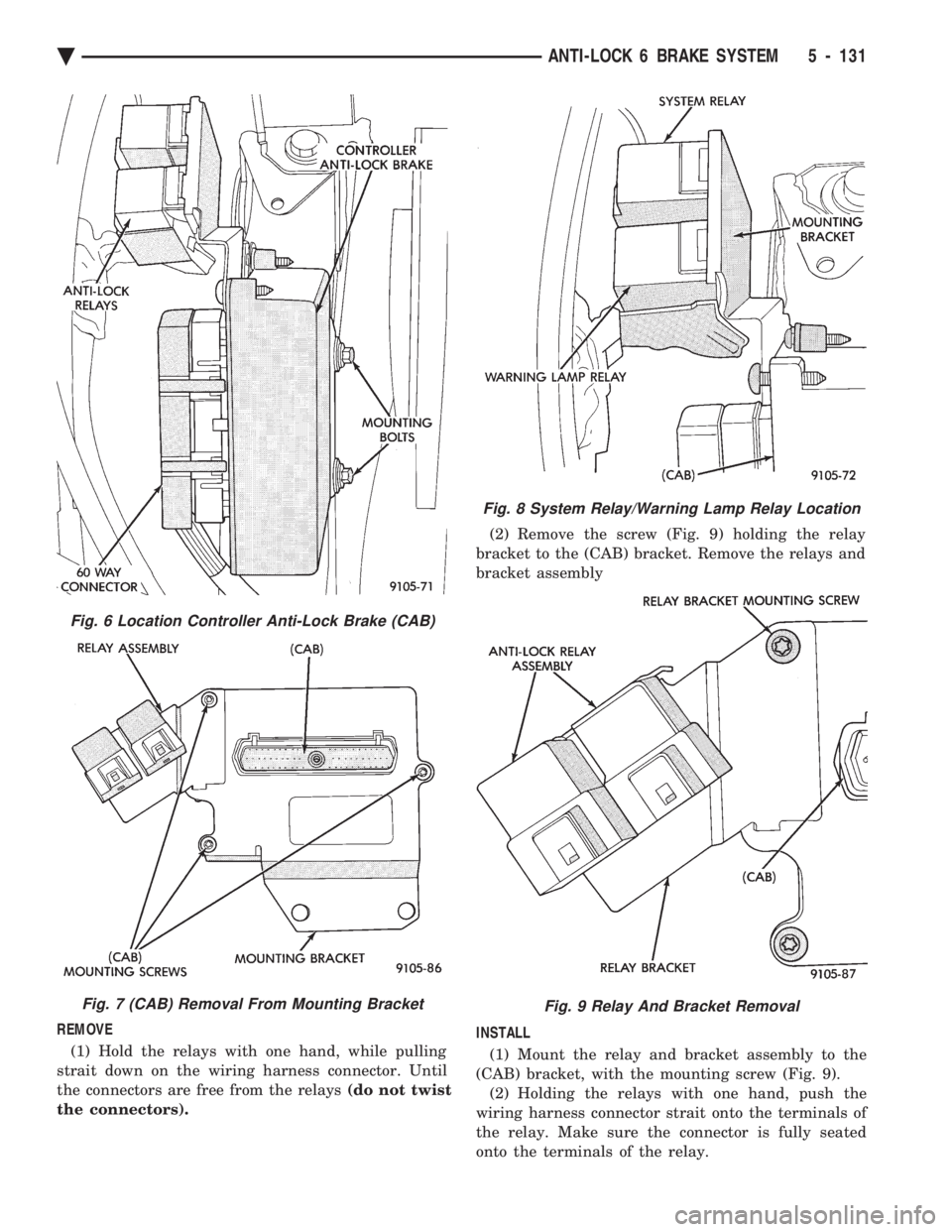
REMOVE (1) Hold the relays with one hand, while pulling
strait down on the wiring harness connector. Until
the connectors are free from the relays (do not twist
the connectors). (2) Remove the screw (Fig. 9) holding the relay
bracket to the (CAB) bracket. Remove the relays and
bracket assembly
INSTALL
(1) Mount the relay and bracket assembly to the
(CAB) bracket, with the mounting screw (Fig. 9). (2) Holding the relays with one hand, push the
wiring harness connector strait onto the terminals of
the relay. Make sure the connector is fully seated
onto the terminals of the relay.
Fig. 6 Location Controller Anti-Lock Brake (CAB)
Fig. 7 (CAB) Removal From Mounting Bracket
Fig. 8 System Relay/Warning Lamp Relay Location
Fig. 9 Relay And Bracket Removal
Ä ANTI-LOCK 6 BRAKE SYSTEM 5 - 131
Page 282 of 2438
REMOVE/INSTALL PUMP MOTOR RELAY
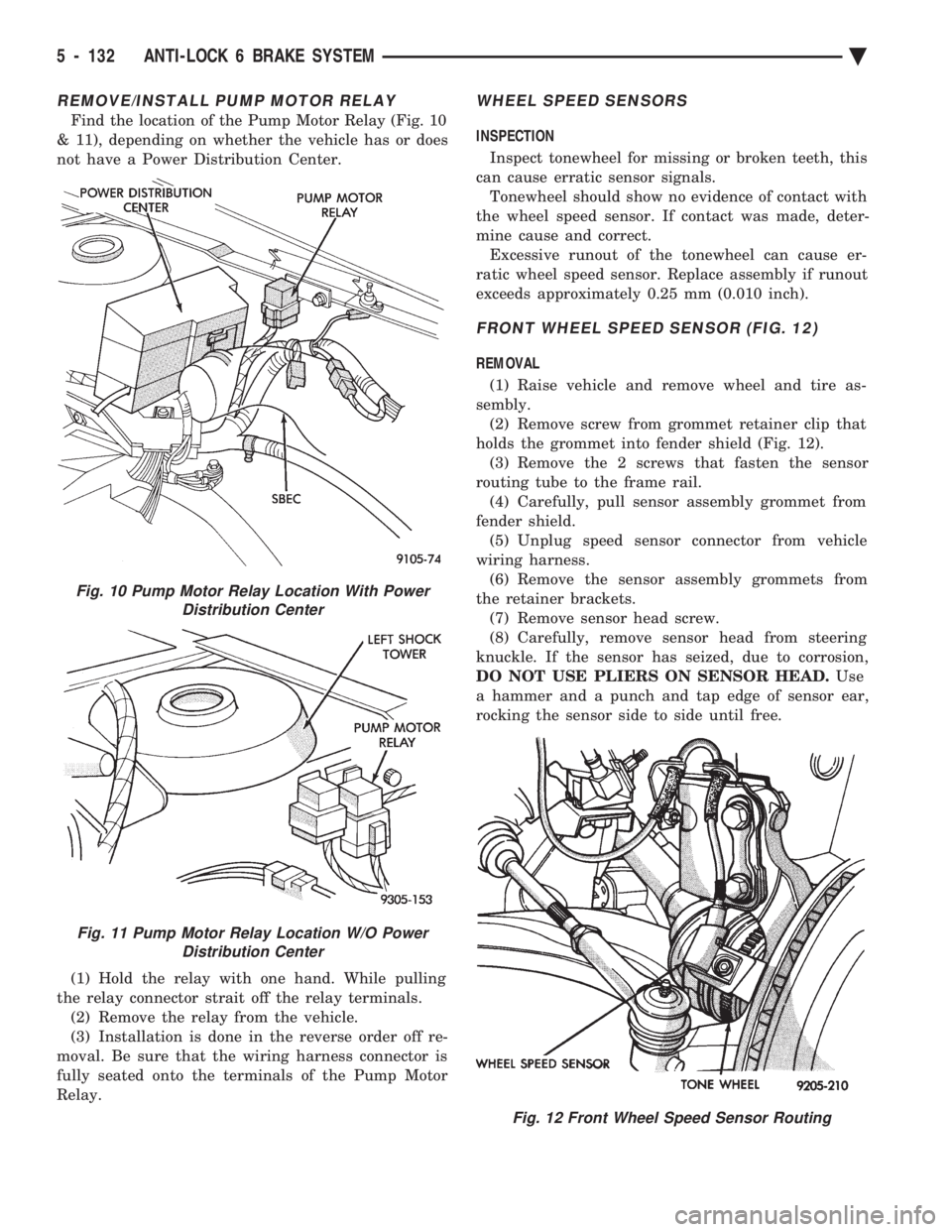
Find the location of the Pump Motor Relay (Fig. 10
& 11), depending on whether the vehicle has or does
not have a Power Distribution Center.
(1) Hold the relay with one hand. While pulling
the relay connector strait off the relay terminals. (2) Remove the relay from the vehicle.
(3) Installation is done in the reverse order off re-
moval. Be sure that the wiring harness connector is
fully seated onto the terminals of the Pump Motor
Relay.
WHEEL SPEED SENSORS
INSPECTION
Inspect tonewheel for missing or broken teeth, this
can cause erratic sensor signals. Tonewheel should show no evidence of contact with
the wheel speed sensor. If contact was made, deter-
mine cause and correct. Excessive runout of the tonewheel can cause er-
ratic wheel speed sensor. Replace assembly if runout
exceeds approximately 0.25 mm (0.010 inch).
FRONT WHEEL SPEED SENSOR (FIG. 12)
REMOVAL
(1) Raise vehicle and remove wheel and tire as-
sembly. (2) Remove screw from grommet retainer clip that
holds the grommet into fender shield (Fig. 12). (3) Remove the 2 screws that fasten the sensor
routing tube to the frame rail. (4) Carefully, pull sensor assembly grommet from
fender shield. (5) Unplug speed sensor connector from vehicle
wiring harness. (6) Remove the sensor assembly grommets from
the retainer brackets. (7) Remove sensor head screw.
(8) Carefully, remove sensor head from steering
knuckle. If the sensor has seized, due to corrosion,
DO NOT USE PLIERS ON SENSOR HEAD. Use
a hammer and a punch and tap edge of sensor ear,
rocking the sensor side to side until free.
Fig. 10 Pump Motor Relay Location With Power Distribution Center
Fig. 11 Pump Motor Relay Location W/O PowerDistribution Center
Fig. 12 Front Wheel Speed Sensor Routing
5 - 132 ANTI-LOCK 6 BRAKE SYSTEM Ä
Page 283 of 2438
INSTALLATION (1) Connect the wheel speed sensor connector to
the wiring harness. (2) Push sensor assembly grommet into hole in
fender shield. Install clip and screw. (3) Install the 2 screws that fasten the speed sen-
sor routing tube to the frame rail. (4) Install sensor grommets in brackets on fender
shield and strut damper. (5) Coat the speed sensor with High Temperature
Multi-purpose E.P. Grease before installing into the
steering knuckle. Install screw tighten to 7 N Im (60
in. lbs.)
CAUTION: Proper installation of wheel speed sen-
sor cables is critical to continued system operation.
Be sure that cables are installed in retainers. Fail-
ure to install cables in retainers, as shown in this
section, may result in contact with moving parts
and/or over extension of cables, resulting in an
open circuit.
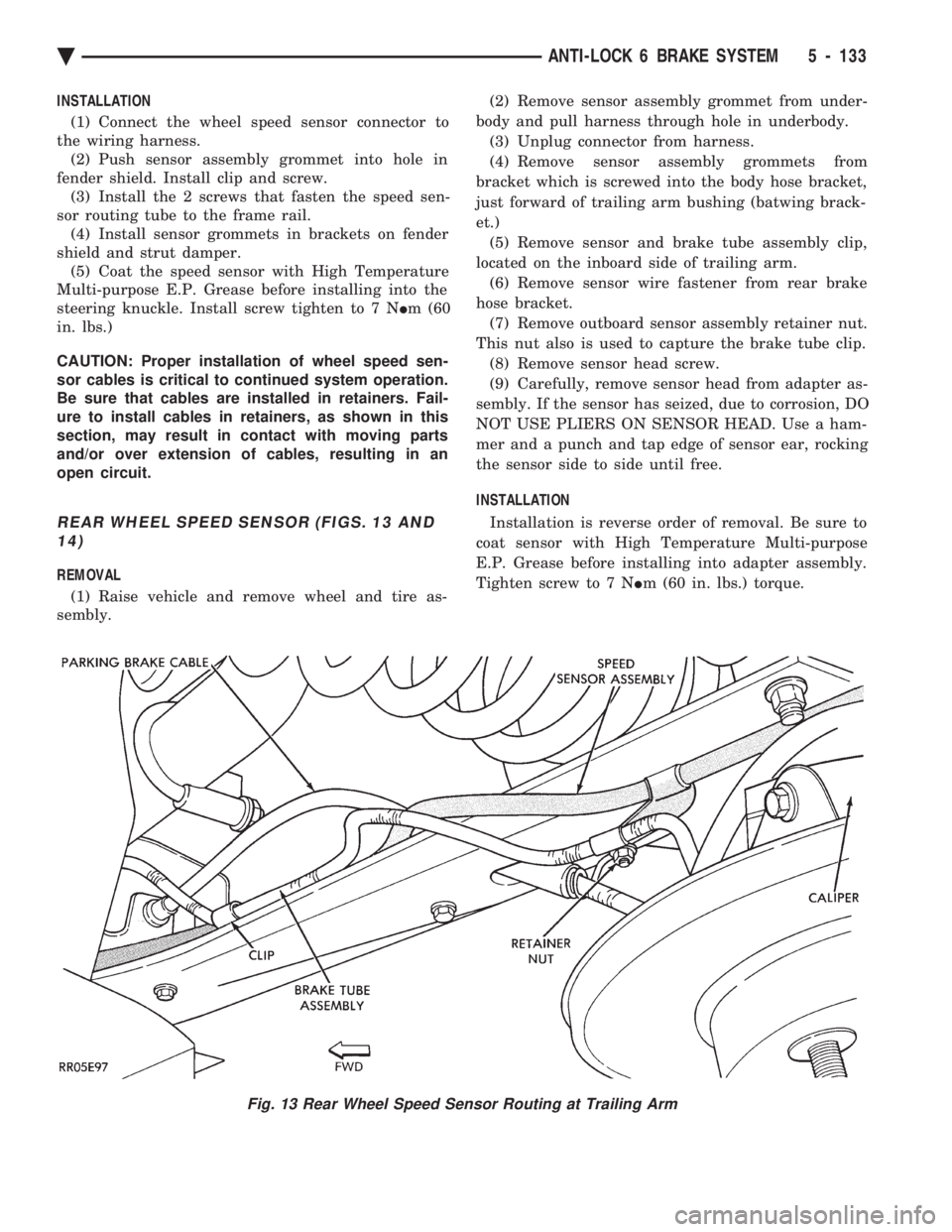
REAR WHEEL SPEED SENSOR (FIGS. 13 AND 14)
REMOVAL
(1) Raise vehicle and remove wheel and tire as-
sembly. (2) Remove sensor assembly grommet from under-
body and pull harness through hole in underbody. (3) Unplug connector from harness.
(4) Remove sensor assembly grommets from
bracket which is screwed into the body hose bracket,
just forward of trailing arm bushing (batwing brack-
et.) (5) Remove sensor and brake tube assembly clip,
located on the inboard side of trailing arm. (6) Remove sensor wire fastener from rear brake
hose bracket. (7) Remove outboard sensor assembly retainer nut.
This nut also is used to capture the brake tube clip. (8) Remove sensor head screw.
(9) Carefully, remove sensor head from adapter as-
sembly. If the sensor has seized, due to corrosion, DO
NOT USE PLIERS ON SENSOR HEAD. Use a ham-
mer and a punch and tap edge of sensor ear, rocking
the sensor side to side until free.
INSTALLATION Installation is reverse order of removal. Be sure to
coat sensor with High Temperature Multi-purpose
E.P. Grease before installing into adapter assembly.
Tighten screw to 7 N Im (60 in. lbs.) torque.
Fig. 13 Rear Wheel Speed Sensor Routing at Trailing Arm
Ä ANTI-LOCK 6 BRAKE SYSTEM 5 - 133
Page 284 of 2438
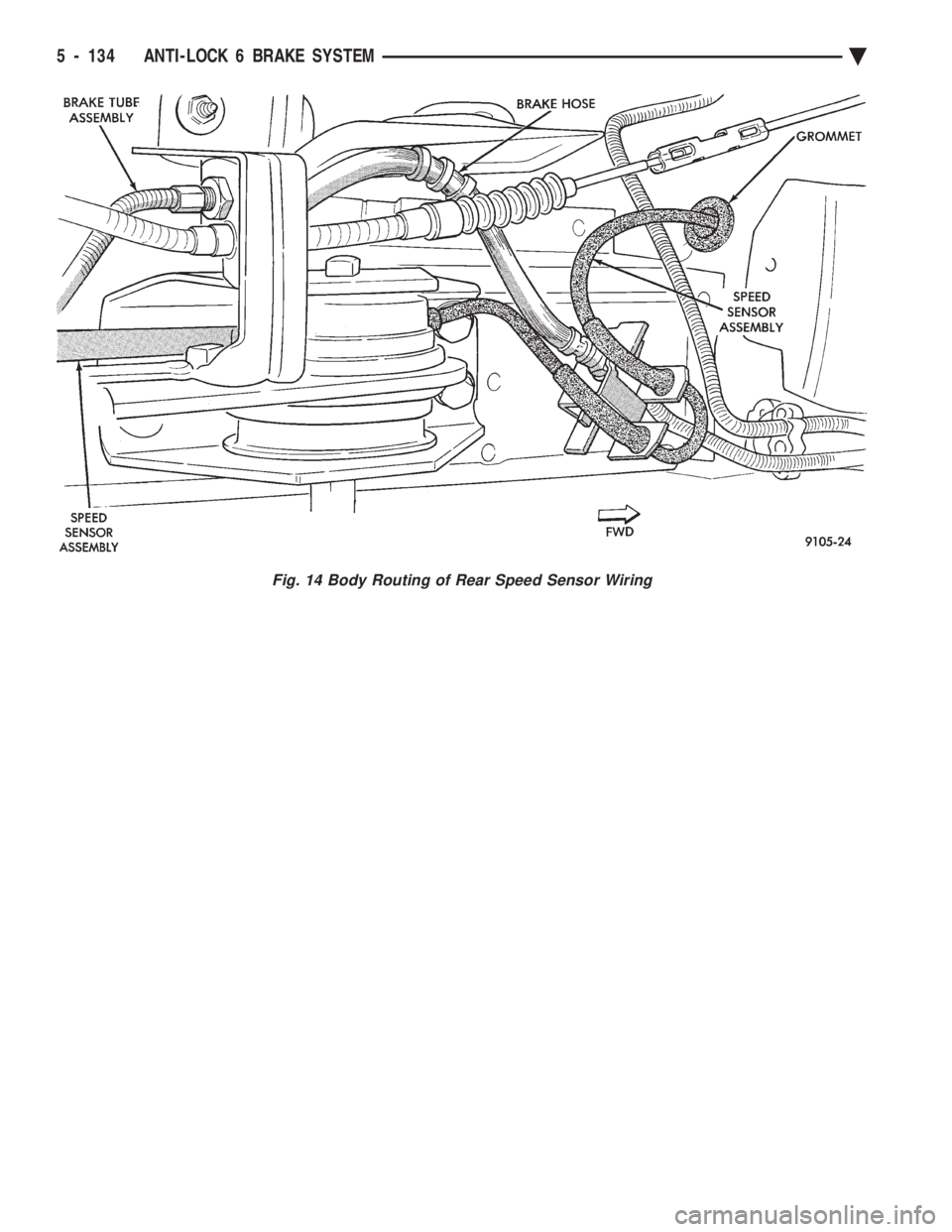
Fig. 14 Body Routing of Rear Speed Sensor Wiring
5 - 134 ANTI-LOCK 6 BRAKE SYSTEM Ä
Page 285 of 2438
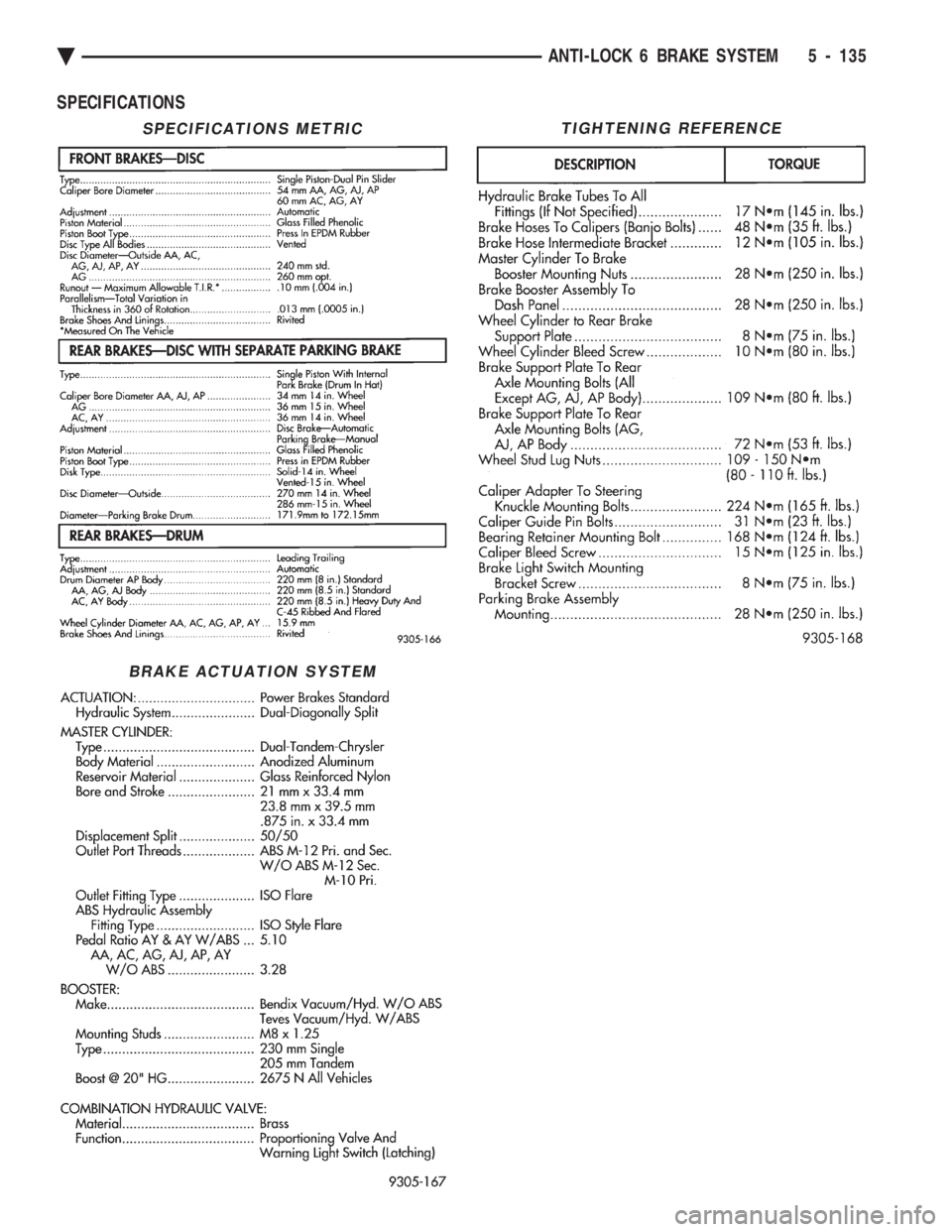
SPECIFICATIONS
SPECIFICATIONS METRIC
BRAKE ACTUATION SYSTEM
TIGHTENING REFERENCE
Ä ANTI-LOCK 6 BRAKE SYSTEM 5 - 135
Page 287 of 2438
BRAKES
CONTENTS
page page
BENDIX ANTILOCK 4 BRAKE SYSTEM ...... 12
GENERAL INFORMATION .................. 1 HYDRAULIC SYSTEM CONTROL VALVES . . . 10
SERVICE ADJUSTMENTS
.................. 3
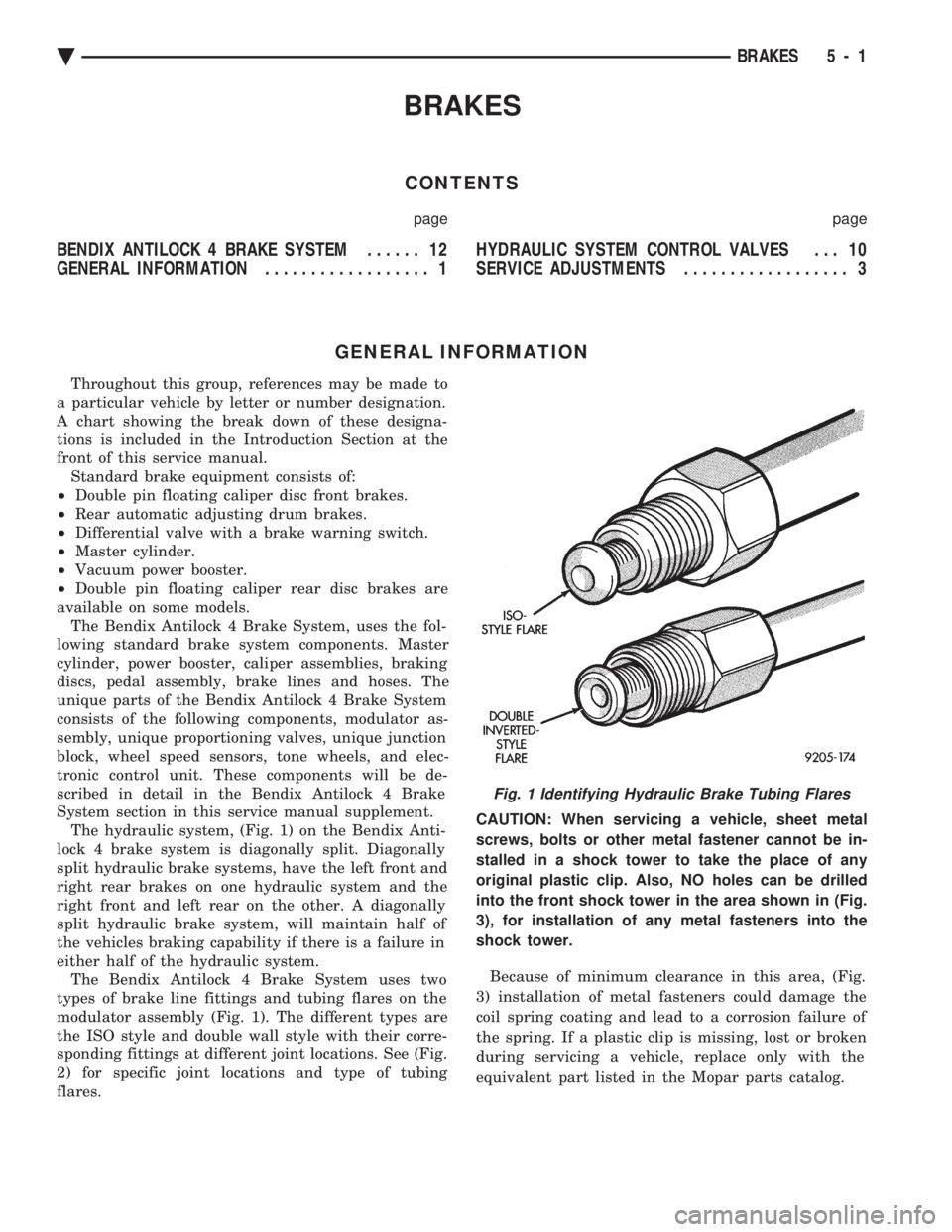
GENERAL INFORMATION
Throughout this group, references may be made to
a particular vehicle by letter or number designation.
A chart showing the break down of these designa-
tions is included in the Introduction Section at the
front of this service manual. Standard brake equipment consists of:
² Double pin floating caliper disc front brakes.
² Rear automatic adjusting drum brakes.
² Differential valve with a brake warning switch.
² Master cylinder.
² Vacuum power booster.
² Double pin floating caliper rear disc brakes are
available on some models. The Bendix Antilock 4 Brake System, uses the fol-
lowing standard brake system components. Master
cylinder, power booster, caliper assemblies, braking
discs, pedal assembly, brake lines and hoses. The
unique parts of the Bendix Antilock 4 Brake System
consists of the following components, modulator as-
sembly, unique proportioning valves, unique junction
block, wheel speed sensors, tone wheels, and elec-
tronic control unit. These components will be de-
scribed in detail in the Bendix Antilock 4 Brake
System section in this service manual supplement. The hydraulic system, (Fig. 1) on the Bendix Anti-
lock 4 brake system is diagonally split. Diagonally
split hydraulic brake systems, have the left front and
right rear brakes on one hydraulic system and the
right front and left rear on the other. A diagonally
split hydraulic brake system, will maintain half of
the vehicles braking capability if there is a failure in
either half of the hydraulic system. The Bendix Antilock 4 Brake System uses two
types of brake line fittings and tubing flares on the
modulator assembly (Fig. 1). The different types are
the ISO style and double wall style with their corre-
sponding fittings at different joint locations. See (Fig.
2) for specific joint locations and type of tubing
flares. CAUTION: When servicing a vehicle, sheet metal
screws, bolts or other metal fastener cannot be in-
stalled in a shock tower to take the place of any
original plastic clip. Also, NO holes can be drilled
into the front shock tower in the area shown in (Fig.
3), for installation of any metal fasteners into the
shock tower.
Because of minimum clearance in this area, (Fig.
3) installation of metal fasteners could damage the
coil spring coating and lead to a corrosion failure of
the spring. If a plastic clip is missing, lost or broken
during servicing a vehicle, replace only with the
equivalent part listed in the Mopar parts catalog.
Fig. 1 Identifying Hydraulic Brake Tubing Flares
Ä BRAKES 5 - 1