tow CHEVROLET DYNASTY 1993 Owner's Guide
[x] Cancel search | Manufacturer: CHEVROLET, Model Year: 1993, Model line: DYNASTY, Model: CHEVROLET DYNASTY 1993Pages: 2438, PDF Size: 74.98 MB
Page 444 of 2438
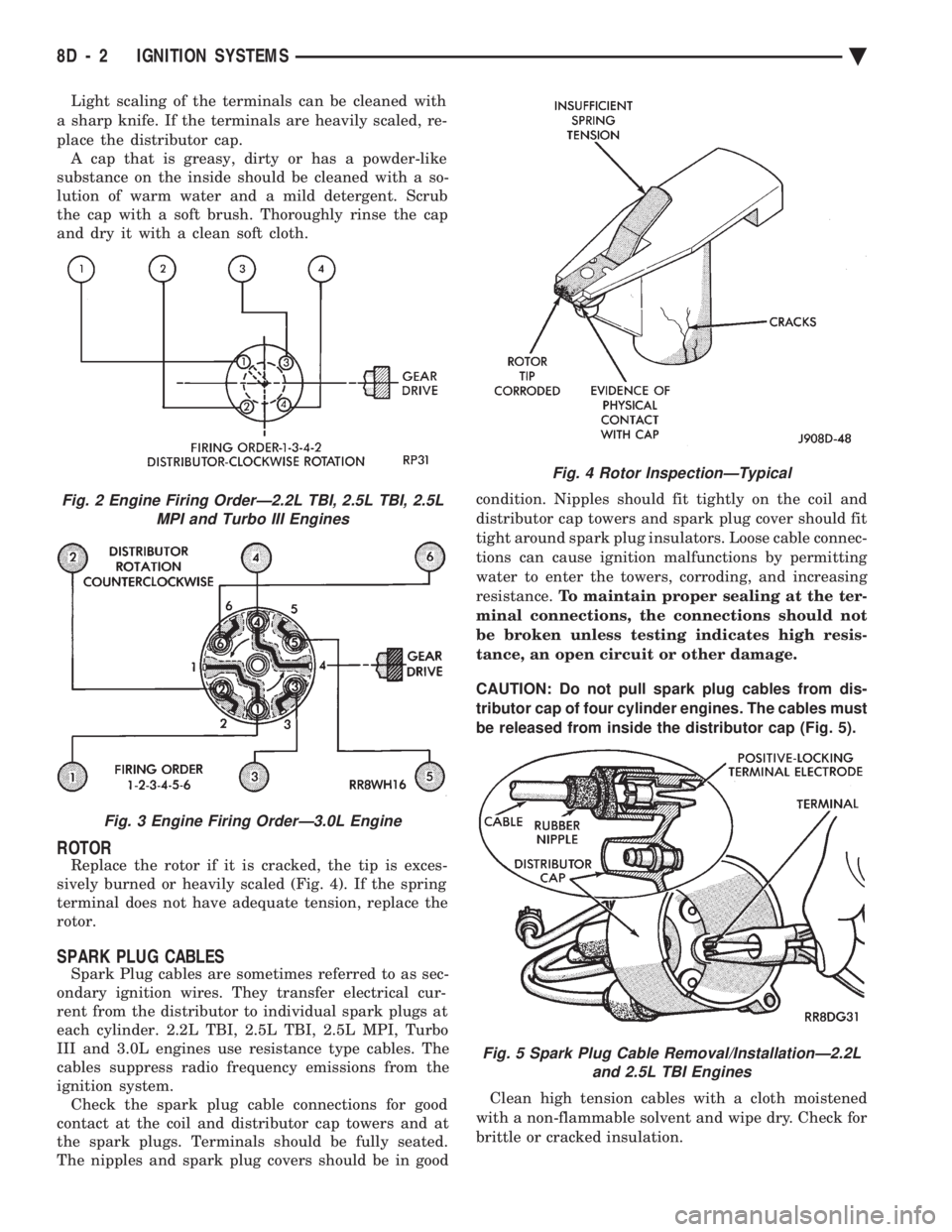
Light scaling of the terminals can be cleaned with
a sharp knife. If the terminals are heavily scaled, re-
place the distributor cap. A cap that is greasy, dirty or has a powder-like
substance on the inside should be cleaned with a so-
lution of warm water and a mild detergent. Scrub
the cap with a soft brush. Thoroughly rinse the cap
and dry it with a clean soft cloth.
ROTOR
Replace the rotor if it is cracked, the tip is exces-
sively burned or heavily scaled (Fig. 4). If the spring
terminal does not have adequate tension, replace the
rotor.
SPARK PLUG CABLES
Spark Plug cables are sometimes referred to as sec-
ondary ignition wires. They transfer electrical cur-
rent from the distributor to individual spark plugs at
each cylinder. 2.2L TBI, 2.5L TBI, 2.5L MPI, Turbo
III and 3.0L engines use resistance type cables. The
cables suppress radio frequency emissions from the
ignition system. Check the spark plug cable connections for good
contact at the coil and distributor cap towers and at
the spark plugs. Terminals should be fully seated.
The nipples and spark plug covers should be in good condition. Nipples should fit tightly on the coil and
distributor cap towers and spark plug cover should fit
tight around spark plug insulators. Loose cable connec-
tions can cause ignition malfunctions by permitting
water to enter the towers, corroding, and increasing
resistance. To maintain proper sealing at the ter-
minal connections, the connections should not
be broken unless testing indicates high resis-
tance, an open circuit or other damage.
CAUTION: Do not pull spark plug cables from dis-
tributor cap of four cylinder engines. The cables must
be released from inside the distributor cap (Fig. 5).
Clean high tension cables with a cloth moistened
with a non-flammable solvent and wipe dry. Check for
brittle or cracked insulation.
Fig. 2 Engine Firing OrderÐ2.2L TBI, 2.5L TBI, 2.5L MPI and Turbo III Engines
Fig. 3 Engine Firing OrderÐ3.0L Engine
Fig. 4 Rotor InspectionÐTypical
Fig. 5 Spark Plug Cable Removal/InstallationÐ2.2L and 2.5L TBI Engines
8D - 2 IGNITION SYSTEMS Ä
Page 445 of 2438
When testing secondary cables for punctures and
cracks with an oscilloscope follow the equipment
manufacturers instructions. If an oscilloscope is not available, secondary cables
can be tested as follows:
CAUTION: Do not leave any one spark plug cable
disconnected any longer than necessary during test-
ing. Excessive heat could damage the catalytic con-
verter. Total test time must not exceed ten minutes.
(a) With the engine not running, connect one end
of a test probe to a good ground. Use a probe made of
insulated wire with insulated alligator clips on each
end. (b) With engine running, move test probe along
entire length of all cables (approximately 0 to 1/8
inch gap). If punctures or cracks are present there
will be a noticeable spark jump from the faulty area
to the probe. Check the coil cable the same way.
Replace cracked, leaking or faulty cables.
When replacing cables, install the new high
tension cable and nipple assembly over cap or
coil tower. When entering the terminal into the
tower, push lightly, then pinch the large diam-
eter of nipple to release air trapped between the
nipple and tower. Continue pushing on the cable
and nipple until cables are properly seated in the
cap towers. A snap should be heard as terminal
goes into place. Use the same procedure to install cable in coil tower.
Wipe the spark plug insulator clean before reinstalling
cable and cover. Use the following procedure when removing the high
tension cable from the spark plug. First, remove the
cable from the retaining bracket. Then grasp the ter-
minal as close as possible to the spark plug. Rotate the
cover and pull the cable straight back. Pulling on the
cable itself will damage the conductor and termi-
nal connection. Do not use pliers and do not pull
the cable at an angle. Doing so will damage the
insulation, cable terminal or the spark plug in-
sulator. Wipe spark plug insulator clean before
reinstalling cable and cover. Resistance type cable is identified by the words
Electronic Suppression printed on the cable jacket.
Use an ohmmeter to check resistance type cable for
open circuits, loose terminals or high resistance as
follows: (a) Remove cable from spark plug.
(b) Lift distributor cap from distributor with
cables intact. Do not remove cables from cap. The
cables must be removed from the spark plugs. (c) Connect the ohmmeter between spark plug end
terminal and the corresponding electrode inside the
cap, make sure ohmmeter probes are in good contact.
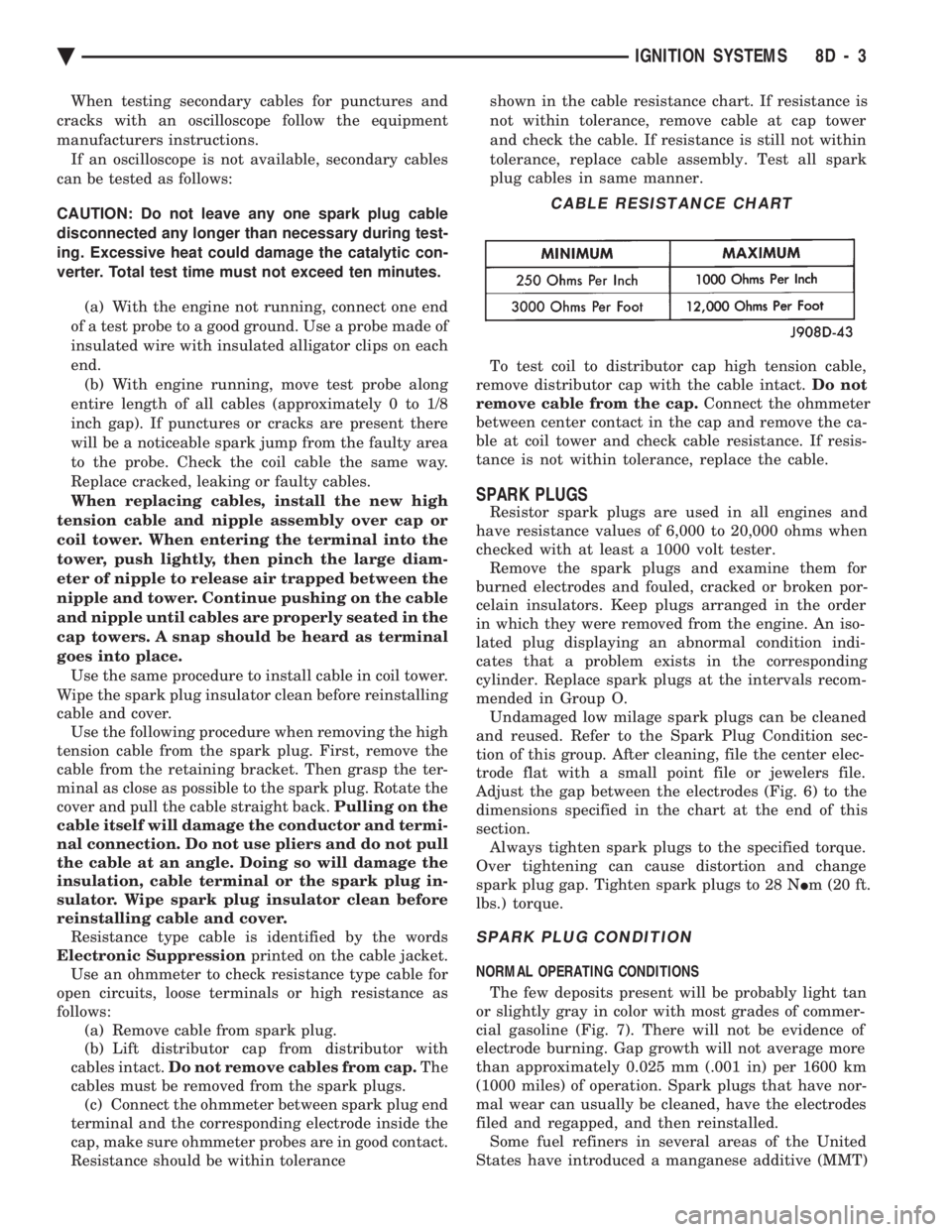
Resistance should be within tolerance shown in the cable resistance chart. If resistance is
not within tolerance, remove cable at cap tower
and check the cable. If resistance is still not within
tolerance, replace cable assembly. Test all spark
plug cables in same manner.
To test coil to distributor cap high tension cable,
remove distributor cap with the cable intact. Do not
remove cable from the cap. Connect the ohmmeter
between center contact in the cap and remove the ca-
ble at coil tower and check cable resistance. If resis-
tance is not within tolerance, replace the cable.
SPARK PLUGS
Resistor spark plugs are used in all engines and
have resistance values of 6,000 to 20,000 ohms when
checked with at least a 1000 volt tester. Remove the spark plugs and examine them for
burned electrodes and fouled, cracked or broken por-
celain insulators. Keep plugs arranged in the order
in which they were removed from the engine. An iso-
lated plug displaying an abnormal condition indi-
cates that a problem exists in the corresponding
cylinder. Replace spark plugs at the intervals recom-
mended in Group O. Undamaged low milage spark plugs can be cleaned
and reused. Refer to the Spark Plug Condition sec-
tion of this group. After cleaning, file the center elec-
trode flat with a small point file or jewelers file.
Adjust the gap between the electrodes (Fig. 6) to the
dimensions specified in the chart at the end of this
section. Always tighten spark plugs to the specified torque.
Over tightening can cause distortion and change
spark plug gap. Tighten spark plugs to 28 N Im (20 ft.
lbs.) torque.
SPARK PLUG CONDITION
NORMAL OPERATING CONDITIONS
The few deposits present will be probably light tan
or slightly gray in color with most grades of commer-
cial gasoline (Fig. 7). There will not be evidence of
electrode burning. Gap growth will not average more
than approximately 0.025 mm (.001 in) per 1600 km
(1000 miles) of operation. Spark plugs that have nor-
mal wear can usually be cleaned, have the electrodes
filed and regapped, and then reinstalled. Some fuel refiners in several areas of the United
States have introduced a manganese additive (MMT)
CABLE RESISTANCE CHART
Ä IGNITION SYSTEMS 8D - 3
Page 451 of 2438
nal. From the pick-up signal, the PCM determines
engine speed and ignition timing (coil dwell). If the
PCM does not receive a distributor signal when the
ignition switch is in the Run position, it will de-en-
ergize both relays. When the relays are de-energized,
battery voltage is not supplied to the fuel injector, ig-
nition coil, fuel pump and oxygen sensor heating el-
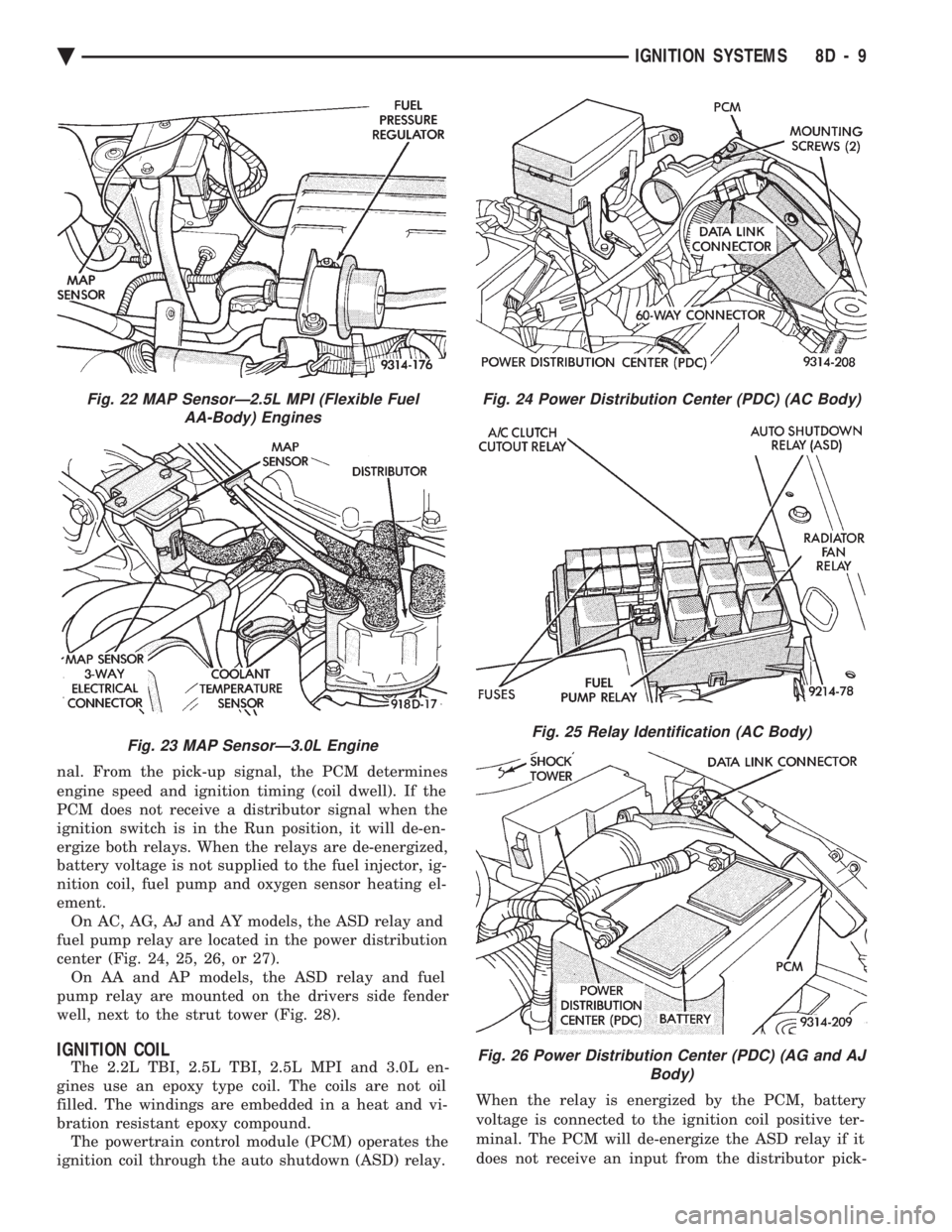
ement. On AC, AG, AJ and AY models, the ASD relay and
fuel pump relay are located in the power distribution
center (Fig. 24, 25, 26, or 27). On AA and AP models, the ASD relay and fuel
pump relay are mounted on the drivers side fender
well, next to the strut tower (Fig. 28).
IGNITION COIL
The 2.2L TBI, 2.5L TBI, 2.5L MPI and 3.0L en-
gines use an epoxy type coil. The coils are not oil
filled. The windings are embedded in a heat and vi-
bration resistant epoxy compound. The powertrain control module (PCM) operates the
ignition coil through the auto shutdown (ASD) relay. When the relay is energized by the PCM, battery
voltage is connected to the ignition coil positive ter-
minal. The PCM will de-energize the ASD relay if it
does not receive an input from the distributor pick-
Fig. 22 MAP SensorÐ2.5L MPI (Flexible Fuel AA-Body) Engines
Fig. 23 MAP SensorÐ3.0L Engine
Fig. 24 Power Distribution Center (PDC) (AC Body)
Fig. 25 Relay Identification (AC Body)
Fig. 26 Power Distribution Center (PDC) (AG and AJ Body)
Ä IGNITION SYSTEMS 8D - 9
Page 453 of 2438
2.2L TBI, 2.5L TBI, 2.5L MPI AND 3.0L IGNITION SYSTEMSÐDIAGNOSTIC PROCEDURES
INDEX
page page
Coolant Temperature Sensor Test ............ 13
Failure to Start TestÐ2.5L TBI and 3.0L Engines . 12
General Information ....................... 11
Ignition Coil ............................. 11 Manifold Absolute Pressure (MAP) Sensor Test . 13
Poor Performance Test .................... 13
Spark Plugs ............................ 11
Testing for Spark at Coil ................... 11
GENERAL INFORMATION
For additional information, refer to On Board Di-
agnostics in the Fuel Injection General Diagnosis
sections of Group 14. Also, refer to the DRBII scan
tool and appropriate Powertrain Diagnostic Proce-
dures Manual.
SPARK PLUGS
Faulty or fouled spark plugs may perform well at
idle speed, but frequently fail at higher engine
speeds. Faulty plugs can be identified in a number of
ways: poor fuel economy, power loss, decrease in en-
gine speed, hard starting and, in general, poor en-
gine performance. Spark plugs also malfunction because of carbon
fouling, excessive electrode air gap, or a broken insu-
lator. Refer to the General Information Section of
this group for spark plug diagnosis.
IGNITION COIL
The ignition coil is designed to operate without an
external ballast resistor. Inspect the coil for arcing. Test the coil according
to coil tester manufacturer's instructions. Test coil
primary and secondary resistance. Replace any coil
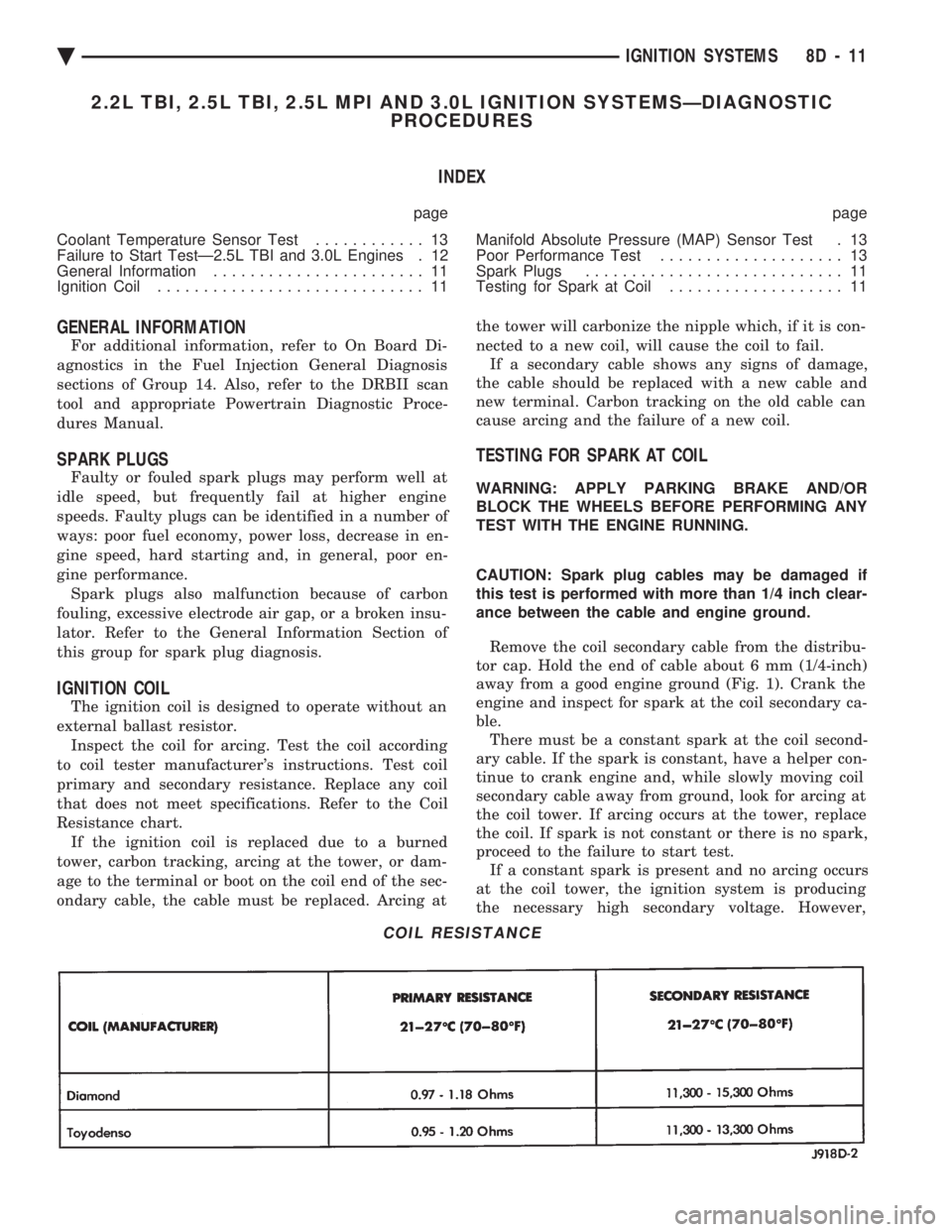
that does not meet specifications. Refer to the Coil
Resistance chart. If the ignition coil is replaced due to a burned
tower, carbon tracking, arcing at the tower, or dam-
age to the terminal or boot on the coil end of the sec-
ondary cable, the cable must be replaced. Arcing at the tower will carbonize the nipple which, if it is con-
nected to a new coil, will cause the coil to fail. If a secondary cable shows any signs of damage,
the cable should be replaced with a new cable and
new terminal. Carbon tracking on the old cable can
cause arcing and the failure of a new coil.
TESTING FOR SPARK AT COIL
WARNING: APPLY PARKING BRAKE AND/OR
BLOCK THE WHEELS BEFORE PERFORMING ANY
TEST WITH THE ENGINE RUNNING.
CAUTION: Spark plug cables may be damaged if
this test is performed with more than 1/4 inch clear-
ance between the cable and engine ground.
Remove the coil secondary cable from the distribu-
tor cap. Hold the end of cable about 6 mm (1/4-inch)
away from a good engine ground (Fig. 1). Crank the
engine and inspect for spark at the coil secondary ca-
ble. There must be a constant spark at the coil second-
ary cable. If the spark is constant, have a helper con-
tinue to crank engine and, while slowly moving coil
secondary cable away from ground, look for arcing at
the coil tower. If arcing occurs at the tower, replace
the coil. If spark is not constant or there is no spark,
proceed to the failure to start test. If a constant spark is present and no arcing occurs
at the coil tower, the ignition system is producing
the necessary high secondary voltage. However,
COIL RESISTANCE
Ä IGNITION SYSTEMS 8D - 11
Page 459 of 2438
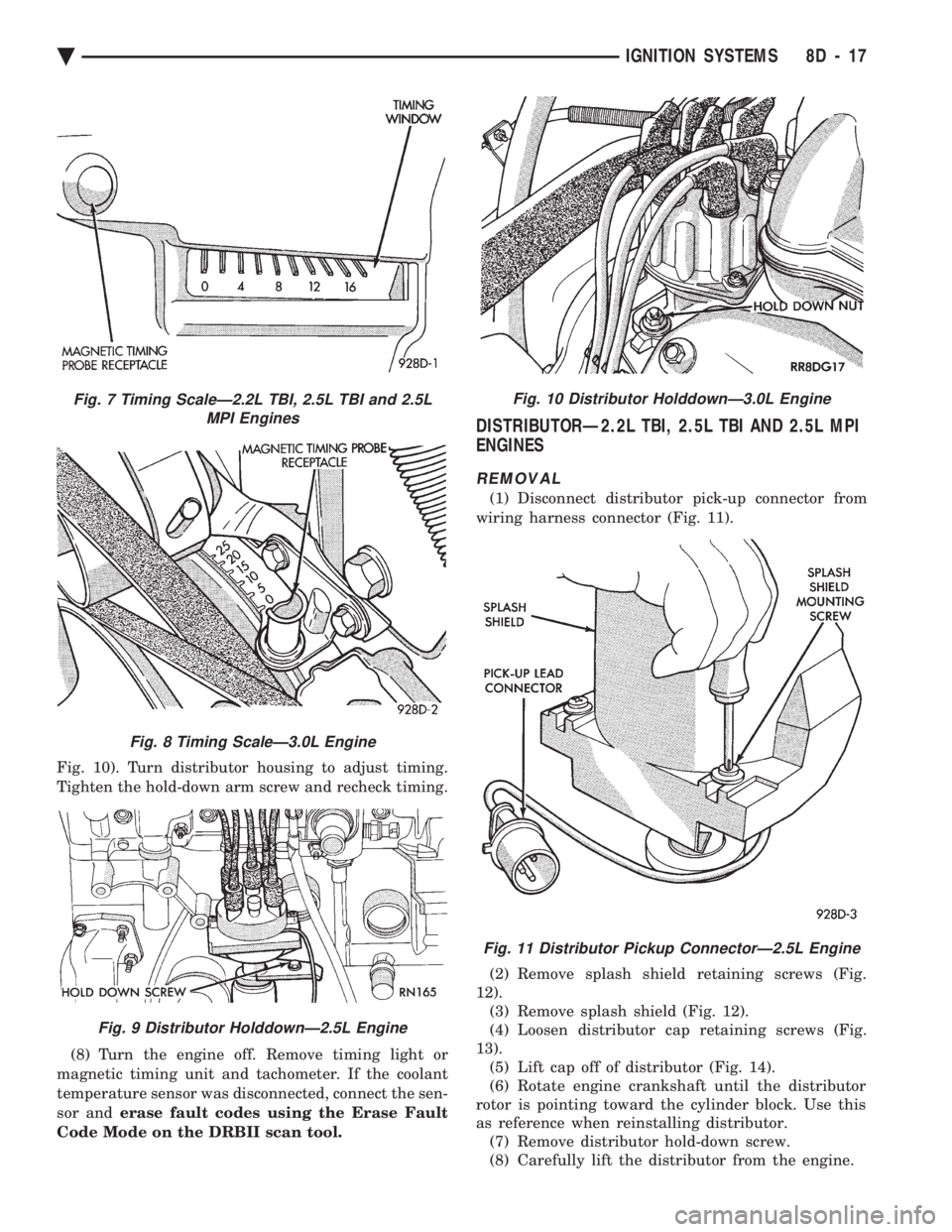
Fig. 10). Turn distributor housing to adjust timing.
Tighten the hold-down arm screw and recheck timing.
(8) Turn the engine off. Remove timing light or
magnetic timing unit and tachometer. If the coolant
temperature sensor was disconnected, connect the sen-
sor and erase fault codes using the Erase Fault
Code Mode on the DRBII scan tool.
DISTRIBUTORÐ2.2L TBI, 2.5L TBI AND 2.5L MPI
ENGINES
REMOVAL
(1) Disconnect distributor pick-up connector from
wiring harness connector (Fig. 11).
(2) Remove splash shield retaining screws (Fig.
12). (3) Remove splash shield (Fig. 12).
(4) Loosen distributor cap retaining screws (Fig.
13). (5) Lift cap off of distributor (Fig. 14).
(6) Rotate engine crankshaft until the distributor
rotor is pointing toward the cylinder block. Use this
as reference when reinstalling distributor. (7) Remove distributor hold-down screw.
(8) Carefully lift the distributor from the engine.
Fig. 10 Distributor HolddownÐ3.0L Engine
Fig. 11 Distributor Pickup ConnectorÐ2.5L Engine
Fig. 7 Timing ScaleÐ2.2L TBI, 2.5L TBI and 2.5L MPI Engines
Fig. 8 Timing ScaleÐ3.0L Engine
Fig. 9 Distributor HolddownÐ2.5L Engine
Ä IGNITION SYSTEMS 8D - 17
Page 460 of 2438
INSTALLATION
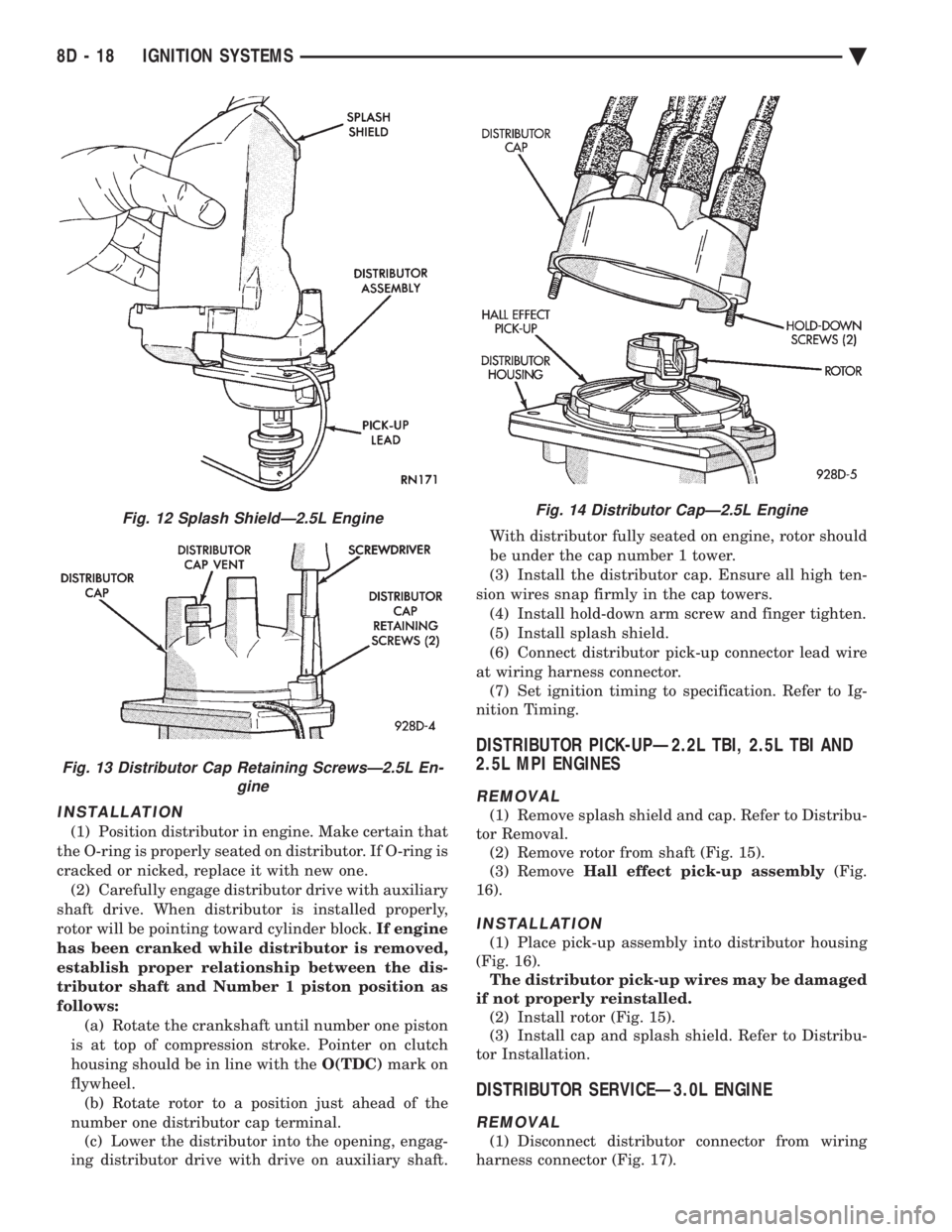
(1) Position distributor in engine. Make certain that
the O-ring is properly seated on distributor. If O-ring is
cracked or nicked, replace it with new one. (2) Carefully engage distributor drive with auxiliary
shaft drive. When distributor is installed properly,
rotor will be pointing toward cylinder block. If engine
has been cranked while distributor is removed,
establish proper relationship between the dis-
tributor shaft and Number 1 piston position as
follows: (a) Rotate the crankshaft until number one piston
is at top of compression stroke. Pointer on clutch
housing should be in line with the O(TDC)mark on
flywheel. (b) Rotate rotor to a position just ahead of the
number one distributor cap terminal. (c) Lower the distributor into the opening, engag-
ing distributor drive with drive on auxiliary shaft. With distributor fully seated on engine, rotor should
be under the cap number 1 tower.
(3) Install the distributor cap. Ensure all high ten-
sion wires snap firmly in the cap towers. (4) Install hold-down arm screw and finger tighten.
(5) Install splash shield.
(6) Connect distributor pick-up connector lead wire
at wiring harness connector. (7) Set ignition timing to specification. Refer to Ig-
nition Timing.
DISTRIBUTOR PICK-UPÐ2.2L TBI, 2.5L TBI AND
2.5L MPI ENGINES
REMOVAL
(1) Remove splash shield and cap. Refer to Distribu-
tor Removal. (2) Remove rotor from shaft (Fig. 15).
(3) Remove Hall effect pick-up assembly (Fig.
16).
INSTALLATION
(1) Place pick-up assembly into distributor housing
(Fig. 16). The distributor pick-up wires may be damaged
if not properly reinstalled. (2) Install rotor (Fig. 15).
(3) Install cap and splash shield. Refer to Distribu-
tor Installation.
DISTRIBUTOR SERVICEÐ3.0L ENGINE
REMOVAL
(1) Disconnect distributor connector from wiring
harness connector (Fig. 17).
Fig. 12 Splash ShieldÐ2.5L Engine
Fig. 13 Distributor Cap Retaining ScrewsÐ2.5L En- gine
Fig. 14 Distributor CapÐ2.5L Engine
8D - 18 IGNITION SYSTEMS Ä
Page 462 of 2438
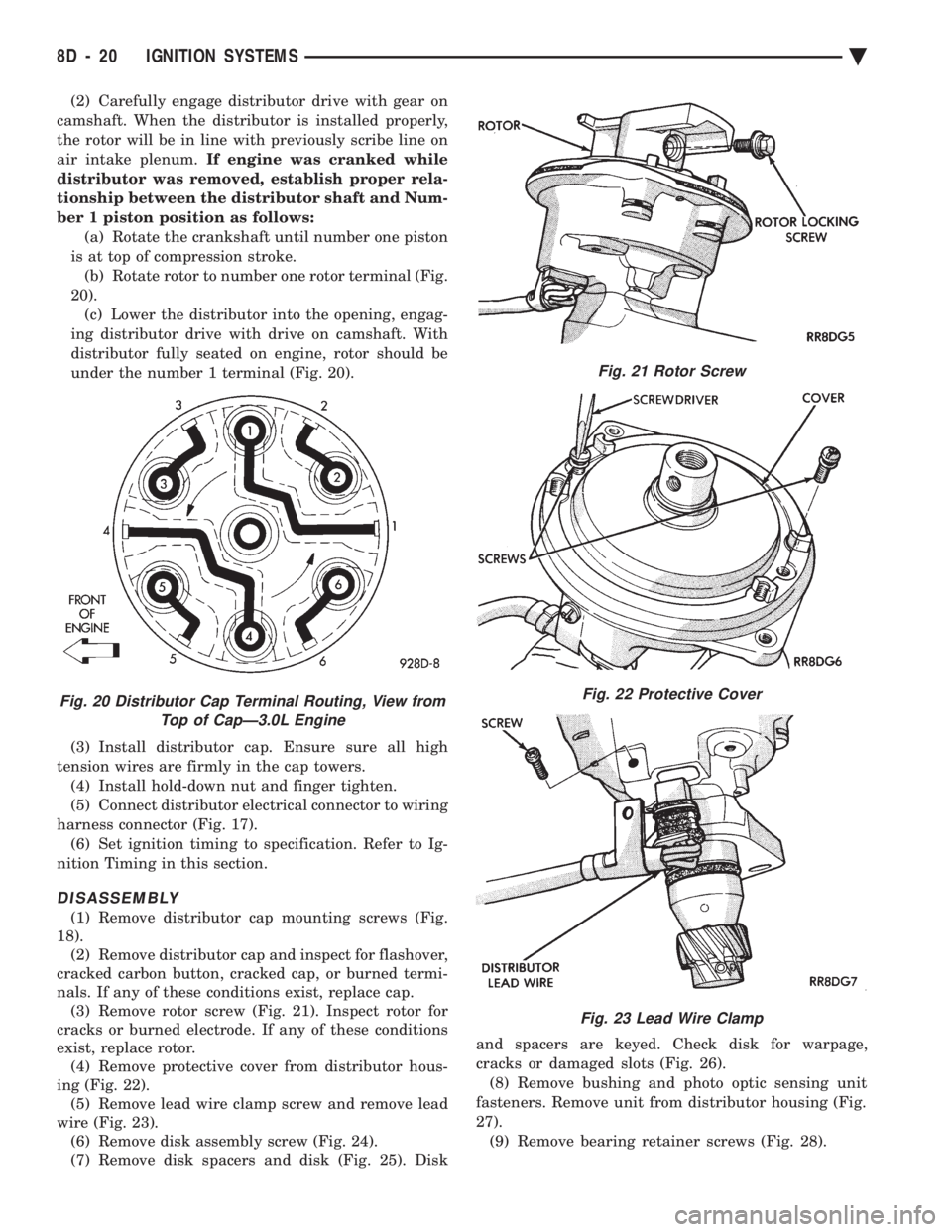
(2) Carefully engage distributor drive with gear on
camshaft. When the distributor is installed properly,
the rotor will be in line with previously scribe line on
air intake plenum. If engine was cranked while
distributor was removed, establish proper rela-
tionship between the distributor shaft and Num-
ber 1 piston position as follows: (a) Rotate the crankshaft until number one piston
is at top of compression stroke. (b) Rotate rotor to number one rotor terminal (Fig.
20). (c) Lower the distributor into the opening, engag-
ing distributor drive with drive on camshaft. With
distributor fully seated on engine, rotor should be
under the number 1 terminal (Fig. 20).
(3) Install distributor cap. Ensure sure all high
tension wires are firmly in the cap towers. (4) Install hold-down nut and finger tighten.
(5) Connect distributor electrical connector to wiring
harness connector (Fig. 17). (6) Set ignition timing to specification. Refer to Ig-
nition Timing in this section.
DISASSEMBLY
(1) Remove distributor cap mounting screws (Fig.
18). (2) Remove distributor cap and inspect for flashover,
cracked carbon button, cracked cap, or burned termi-
nals. If any of these conditions exist, replace cap. (3) Remove rotor screw (Fig. 21). Inspect rotor for
cracks or burned electrode. If any of these conditions
exist, replace rotor. (4) Remove protective cover from distributor hous-
ing (Fig. 22). (5) Remove lead wire clamp screw and remove lead
wire (Fig. 23). (6) Remove disk assembly screw (Fig. 24).
(7) Remove disk spacers and disk (Fig. 25). Disk and spacers are keyed. Check disk for warpage,
cracks or damaged slots (Fig. 26). (8) Remove bushing and photo optic sensing unit
fasteners. Remove unit from distributor housing (Fig.
27). (9) Remove bearing retainer screws (Fig. 28).
Fig. 21 Rotor Screw
Fig. 22 Protective Cover
Fig. 23 Lead Wire Clamp
Fig. 20 Distributor Cap Terminal Routing, View from Top of CapÐ3.0L Engine
8D - 20 IGNITION SYSTEMS Ä
Page 468 of 2438
tance. The cables provide suppression of radio fre-
quency emissions from the ignition system.Check the spark plug cable connections for good
contact at the coil and distributor cap towers and at
the spark plugs. Terminals should be fully seated.
The nipples and spark plug covers should be in good
condition. Nipples should fit tightly on the coil and
distributor cap towers and spark plug cover should
fit tight around spark plug insulators. Loose cable
connections can cause ignition malfunctions by per-
mitting water to enter the towers, corroding, and in-
creasing resistance.
SPARK PLUGS
The 2.2L Turbo III, 3.3L and 3.8L engines use re-
sistor spark plugs. They have resistance values of
6,000 to 20,000 ohms when checked with at least a
1000 volt tester. Remove the spark plugs and examine them for
burned electrodes and fouled, cracked or broken por-
celain insulators. Keep plugs arranged in the order
in which they were removed from the engine. An iso-
lated plug displaying an abnormal condition indi-
cates that a problem exists in the corresponding
cylinder. Replace spark plugs at the intervals recom-
mended in Group O. Spark plugs that have low milage may be cleaned
and reused if not otherwise defective. Refer to the
Spark Plug Condition section of this group. After
cleaning, file the center electrode flat with a small
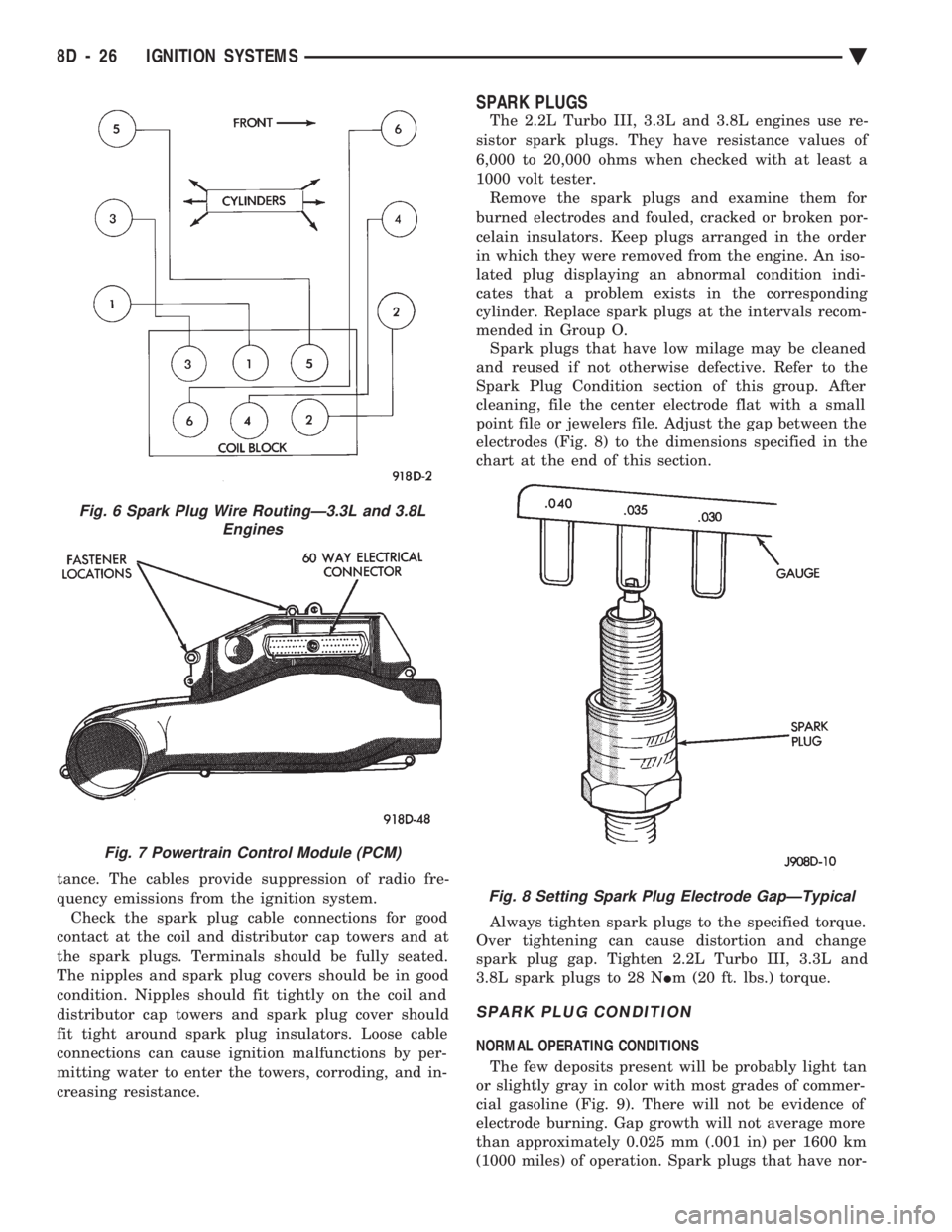
point file or jewelers file. Adjust the gap between the
electrodes (Fig. 8) to the dimensions specified in the
chart at the end of this section.
Always tighten spark plugs to the specified torque.
Over tightening can cause distortion and change
spark plug gap. Tighten 2.2L Turbo III, 3.3L and
3.8L spark plugs to 28 N Im (20 ft. lbs.) torque.
SPARK PLUG CONDITION
NORMAL OPERATING CONDITIONS
The few deposits present will be probably light tan
or slightly gray in color with most grades of commer-
cial gasoline (Fig. 9). There will not be evidence of
electrode burning. Gap growth will not average more
than approximately 0.025 mm (.001 in) per 1600 km
(1000 miles) of operation. Spark plugs that have nor-
Fig. 6 Spark Plug Wire RoutingÐ3.3L and 3.8L Engines
Fig. 7 Powertrain Control Module (PCM)
Fig. 8 Setting Spark Plug Electrode GapÐTypical
8D - 26 IGNITION SYSTEMS Ä
Page 475 of 2438
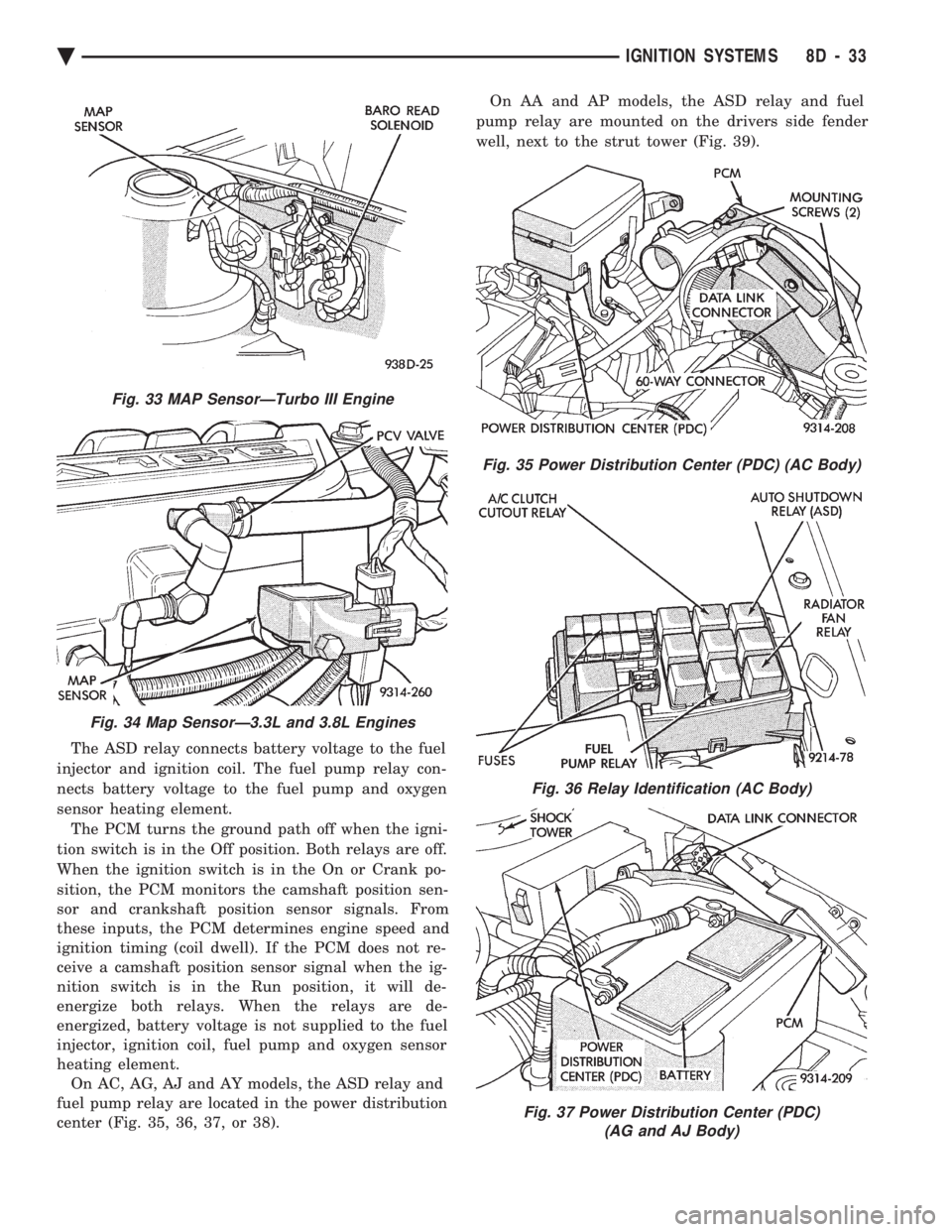
The ASD relay connects battery voltage to the fuel
injector and ignition coil. The fuel pump relay con-
nects battery voltage to the fuel pump and oxygen
sensor heating element. The PCM turns the ground path off when the igni-
tion switch is in the Off position. Both relays are off.
When the ignition switch is in the On or Crank po-
sition, the PCM monitors the camshaft position sen-
sor and crankshaft position sensor signals. From
these inputs, the PCM determines engine speed and
ignition timing (coil dwell). If the PCM does not re-
ceive a camshaft position sensor signal when the ig-
nition switch is in the Run position, it will de-
energize both relays. When the relays are de-
energized, battery voltage is not supplied to the fuel
injector, ignition coil, fuel pump and oxygen sensor
heating element. On AC, AG, AJ and AY models, the ASD relay and
fuel pump relay are located in the power distribution
center (Fig. 35, 36, 37, or 38). On AA and AP models, the ASD relay and fuel
pump relay are mounted on the drivers side fender
well, next to the strut tower (Fig. 39).
Fig. 33 MAP SensorÐTurbo III Engine
Fig. 34 Map SensorÐ3.3L and 3.8L Engines
Fig. 35 Power Distribution Center (PDC) (AC Body)
Fig. 36 Relay Identification (AC Body)
Fig. 37 Power Distribution Center (PDC) (AG and AJ Body)
Ä IGNITION SYSTEMS 8D - 33
Page 477 of 2438
2.2L TURBO III, 3.3L AND 3.8L IGNITION SYSTEMÐDIAGNOSTIC PROCEDURES INDEX
page page
Check Coil TestÐ3.3L and 3.8L Engines ...... 36
Check Coil TestÐTurbo III Engine ........... 35
Coolant Temperature Sensor Test ............ 38
Crankshaft Position Sensor and Camshaft Position Sensor Tests .......................... 38 Failure to Start Test
...................... 37
Failure to Start TestÐTurbo III Engine ........ 36
Manifold Absolute Pressure (MAP) Sensor Test . 38
Testing for Spark at CoilÐ3.3L and 3.8L Engines . 36
Testing for Spark at CoilÐTurbo III Engine ..... 35
TESTING FOR SPARK AT COILÐTURBO III ENGINE
WARNING: THE DIRECT IGNITION SYSTEM GENER-
ATES APPROXIMATELY 40,000 VOLTS. PERSONAL
INJURY COULD RESULT FROM CONTACT WITH
THIS SYSTEM.
The coil pack contains 2 independent coils. Each
coil must be checked individually.
CAUTION: Spark plug wire damage may occur if the
spark plug is moved more than 1/4 inch away from
the engine ground.
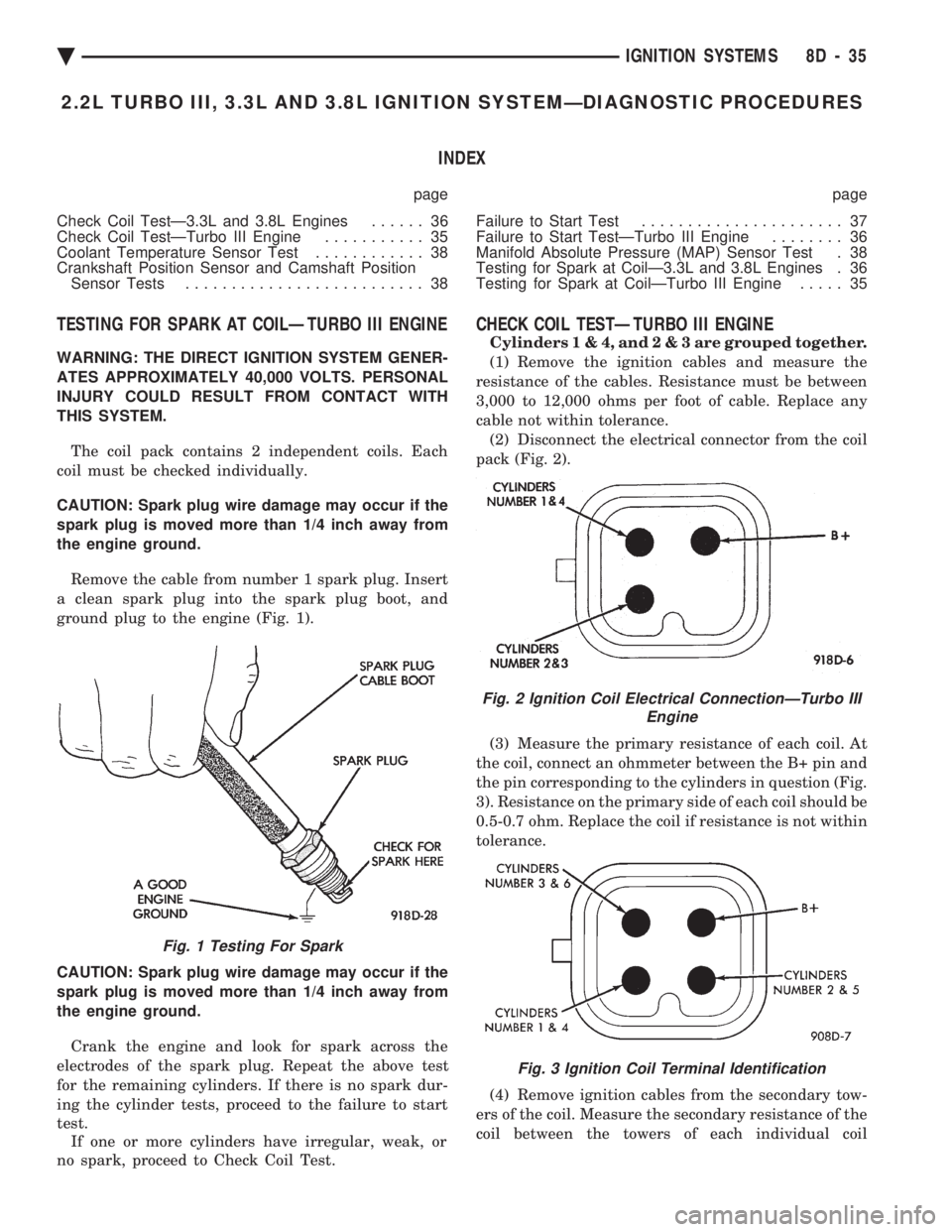
Remove the cable from number 1 spark plug. Insert
a clean spark plug into the spark plug boot, and
ground plug to the engine (Fig. 1).
CAUTION: Spark plug wire damage may occur if the
spark plug is moved more than 1/4 inch away from
the engine ground. Crank the engine and look for spark across the
electrodes of the spark plug. Repeat the above test
for the remaining cylinders. If there is no spark dur-
ing the cylinder tests, proceed to the failure to start
test. If one or more cylinders have irregular, weak, or
no spark, proceed to Check Coil Test.
CHECK COIL TESTÐTURBO III ENGINE
Cylinder s1&4,and2&3are grouped together.
(1) Remove the ignition cables and measure the
resistance of the cables. Resistance must be between
3,000 to 12,000 ohms per foot of cable. Replace any
cable not within tolerance. (2) Disconnect the electrical connector from the coil
pack (Fig. 2).
(3) Measure the primary resistance of each coil. At
the coil, connect an ohmmeter between the B+ pin and
the pin corresponding to the cylinders in question (Fig.
3). Resistance on the primary side of each coil should be
0.5-0.7 ohm. Replace the coil if resistance is not within
tolerance.
(4) Remove ignition cables from the secondary tow-
ers of the coil. Measure the secondary resistance of the
coil between the towers of each individual coil
Fig. 1 Testing For Spark
Fig. 2 Ignition Coil Electrical ConnectionÐTurbo III Engine
Fig. 3 Ignition Coil Terminal Identification
Ä IGNITION SYSTEMS 8D - 35