roof CHEVROLET DYNASTY 1993 Manual PDF
[x] Cancel search | Manufacturer: CHEVROLET, Model Year: 1993, Model line: DYNASTY, Model: CHEVROLET DYNASTY 1993Pages: 2438, PDF Size: 74.98 MB
Page 2280 of 2438
(7) Install lower portion of rear window in position
on rear tack strip, align to the bottom center mark. (8) Staple the corners of the rear window valance
and carrier to the rear tack strip. Verify the edges
are even. (9) Position rear stay pads and suspender straps
over fourth roof bow and over the outboard ends of
the rear window fabric. (10) Stretch lower end of suspender straps to edge
of rear tack strip. (11) Staple lower end of suspender straps to rear
tack strip. (12) Staple lower end of rear stay pad to rear tack
strip. (13) Position top cover retainer channel on fourth
roof bow. (14) Rivet top cover retainer channel to fourth roof
bow with aluminum pop-rivets. (15) Position top cover over the fourth roof bow re-
tainer locating the centerline reference marks. (16) Slide feature strip insert into the fourth roof
bow retainer channel. (17) Position top cover on rear tack strip.
(18) Staple top cover to rear tack strip starting
from the outboard corner and stapling inward. (19) Position rear tack strip over the mounting
studs on inside of quarter panels. (20) Install nuts and bolts to hold rear tack strip to
the quarter panels an deck panel. (21) Install rear seat back.
(22) Remove protective materials that was applied
to the body during to removal operation.
TOP COVER
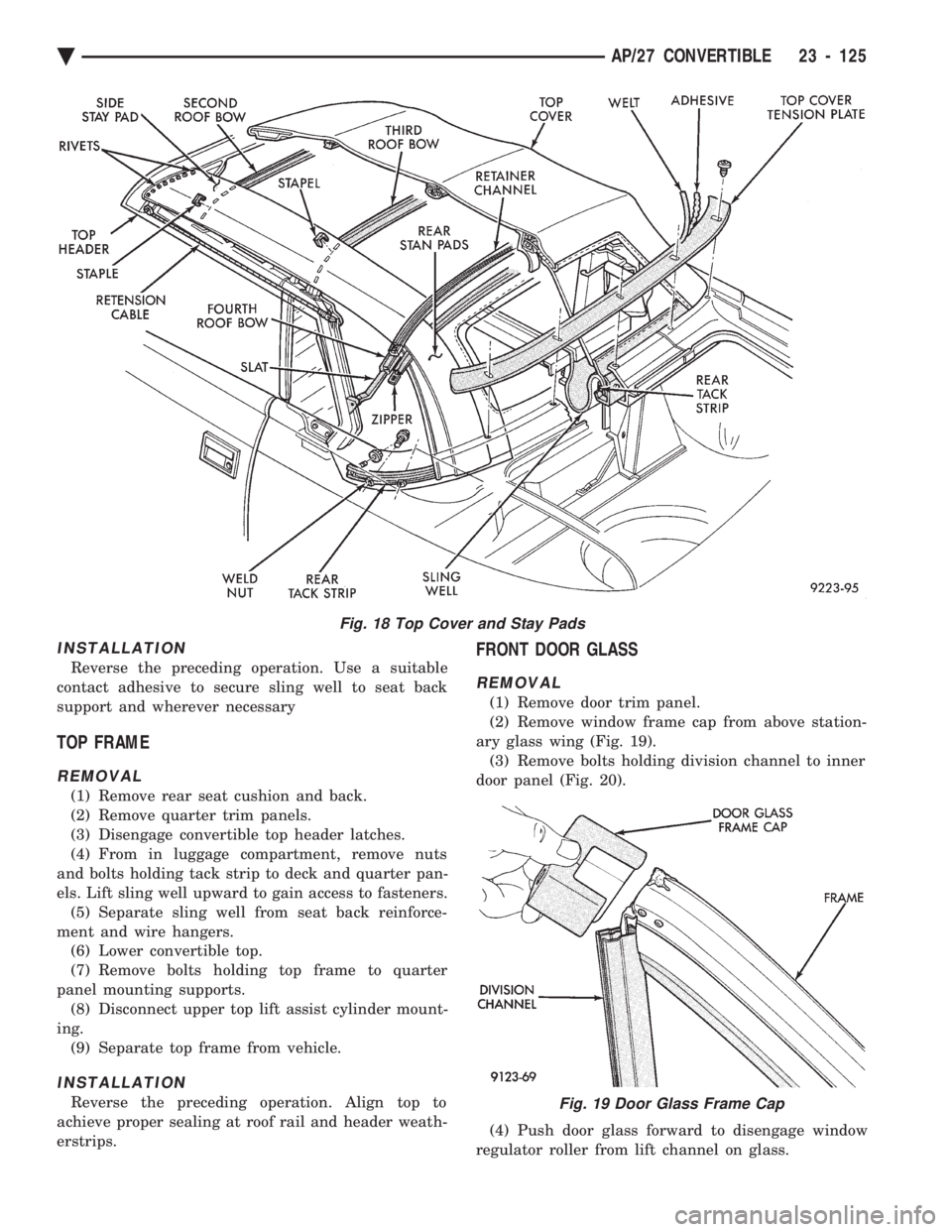
REMOVAL (FIG. 18)
(1) Open rear window and position glass, as flat as
possible, in the drop well. (2) Lower convertible top.
(3) Remove rear seat cushion and back.
(4) Remove quarter trim panels.
(5) Remove quarter glass assemblies.
(6) Raise top to mid-point.
(7) Remove screws holding cover retainer to top
header. Separate retainer from header. (8) Separate top cover from adhesive on top
header. (9) Open trunk lid. Remove screws holding rear
deck filler panel to rear deck below rear window.
Mark screw locations before removal to aid installa-
tion. The rear deck filler panel applies pressure to
top cover to eliminate wrinkles. (10) From in luggage compartment, remove nuts
and bolts holding lower top tack strip to deck and
quarter panels. Lift sling well upward to gain access
to fasteners. CAUTION: Do not damage painted surfaces when
separating tack strip from mounting locations.
(11) Separate tack strip from deck and quarter
panels and remove staples holding top cover. Leave
rear window skirt, pads and drop well attached to
tack strip. (12) Pull top cover from adhesive in quarter glass
weatherstrip channel. (13) Remove rivets holding top cover roof rail ten-
sion cables to top header. Pull tension cables from
rear of listing pockets on top cover. (14) Remove screws holding top cover fastener
strip to center roof bows. Separate top cover from
roof bows and pull retainers from listing pockets on
top cover. (15) Fold top cover so that all material is above
rear roof bow. Slide rear top cover retainer to one
side from rear roof bow channel. (16) Separate top cover from vehicle.
INSTALLATION
Reverse the preceding operation. Use contact adhe-
sive to secure top cover to header and quarter glass
weatherstrip channels. Fold replacement convertible
top along center line and mark with tailors chalk.
Measure and mark the center line of header, center
bow and tack strip. Install top cover from the center
line out. Do not over stretch top cover when remov-
ing wrinkles. Allow for some shrinkage. Water leak
and wind noise tests should be performed before re-
turning vehicle to use.
SLING-WELL
REMOVAL
(1) Remove rear seat cushion and back.
(2) Remove quarter trim panels.
(3) Remove rear shoulder harness turning loop cov-
ers. (4) Remove bolts holding shoulder harness turning
loops to seat back support. (5) Remove seat back support trim cover.
(6) Disengage wire hanger from hole in quarter
panel near front seat belt retractor. (7) Disengage convertible top header latches.
(8) From in luggage compartment, remove nuts
and bolts holding lower top tack strip to deck and
quarter panels. Lift sling well upward to gain access
to fasteners.
CAUTION: Do not damage painted surfaces when
separating tack strip from mounting locations.
(9) Separate tack strip from deck and quarter pan-
els and remove staples holding sling well and top
cover to tack strip. (10) Separate sling well from vehicle.
23 - 124 AP/27 CONVERTIBLE Ä
Page 2281 of 2438
INSTALLATION
Reverse the preceding operation. Use a suitable
contact adhesive to secure sling well to seat back
support and wherever necessary
TOP FRAME
REMOVAL
(1) Remove rear seat cushion and back.
(2) Remove quarter trim panels.
(3) Disengage convertible top header latches.
(4) From in luggage compartment, remove nuts
and bolts holding tack strip to deck and quarter pan-
els. Lift sling well upward to gain access to fasteners. (5) Separate sling well from seat back reinforce-
ment and wire hangers. (6) Lower convertible top.
(7) Remove bolts holding top frame to quarter
panel mounting supports. (8) Disconnect upper top lift assist cylinder mount-
ing. (9) Separate top frame from vehicle.
INSTALLATION
Reverse the preceding operation. Align top to
achieve proper sealing at roof rail and header weath-
erstrips.
FRONT DOOR GLASS
REMOVAL
(1) Remove door trim panel.
(2) Remove window frame cap from above station-
ary glass wing (Fig. 19). (3) Remove bolts holding division channel to inner
door panel (Fig. 20).
(4) Push door glass forward to disengage window
regulator roller from lift channel on glass.
Fig. 18 Top Cover and Stay Pads
Fig. 19 Door Glass Frame Cap
Ä AP/27 CONVERTIBLE 23 - 125
Page 2287 of 2438
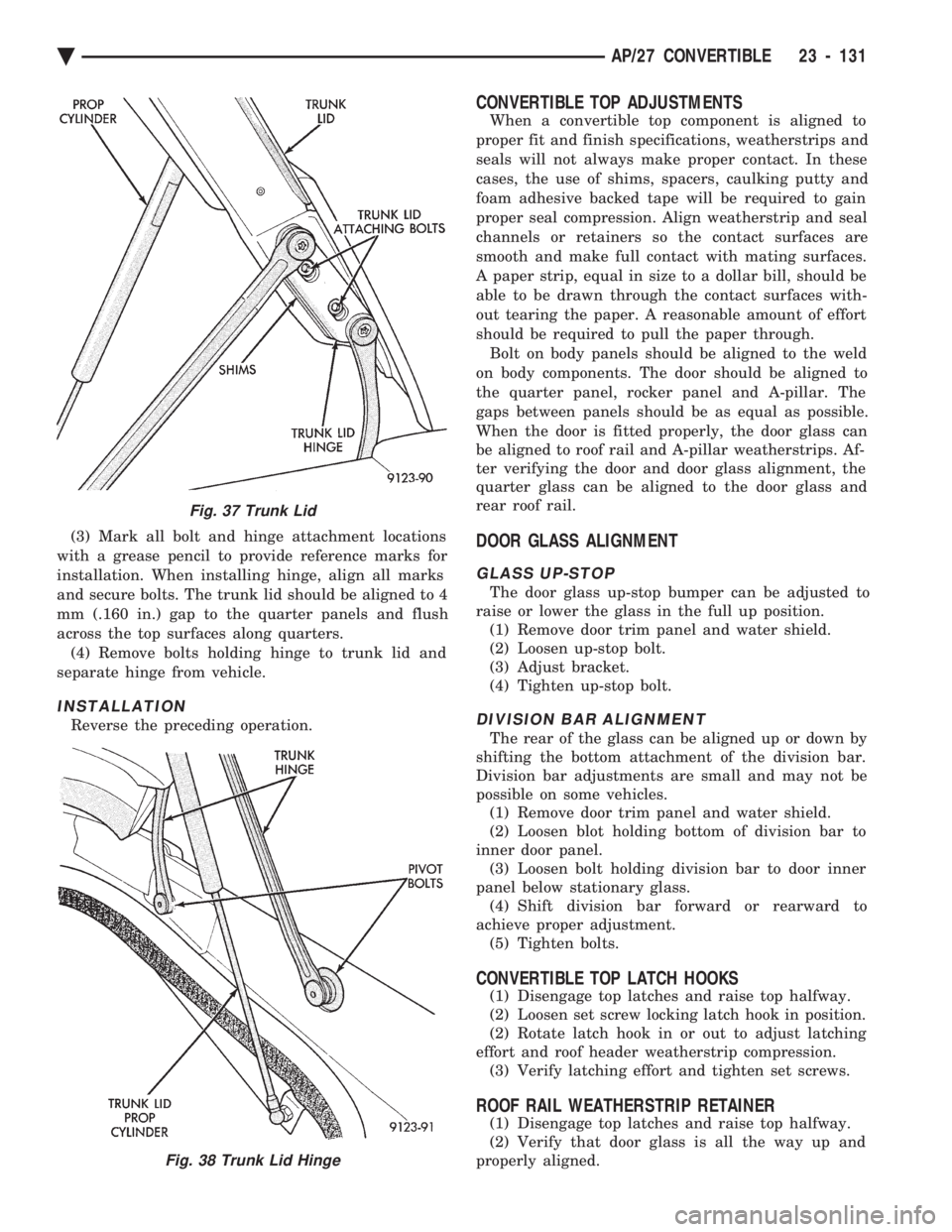
(3) Mark all bolt and hinge attachment locations
with a grease pencil to provide reference marks for
installation. When installing hinge, align all marks
and secure bolts. The trunk lid should be aligned to 4
mm (.160 in.) gap to the quarter panels and flush
across the top surfaces along quarters. (4) Remove bolts holding hinge to trunk lid and
separate hinge from vehicle.
INSTALLATION
Reverse the preceding operation.
CONVERTIBLE TOP ADJUSTMENTS
When a convertible top component is aligned to
proper fit and finish specifications, weatherstrips and
seals will not always make proper contact. In these
cases, the use of shims, spacers, caulking putty and
foam adhesive backed tape will be required to gain
proper seal compression. Align weatherstrip and seal
channels or retainers so the contact surfaces are
smooth and make full contact with mating surfaces.
A paper strip, equal in size to a dollar bill, should be
able to be drawn through the contact surfaces with-
out tearing the paper. A reasonable amount of effort
should be required to pull the paper through. Bolt on body panels should be aligned to the weld
on body components. The door should be aligned to
the quarter panel, rocker panel and A-pillar. The
gaps between panels should be as equal as possible.
When the door is fitted properly, the door glass can
be aligned to roof rail and A-pillar weatherstrips. Af-
ter verifying the door and door glass alignment, the
quarter glass can be aligned to the door glass and
rear roof rail.
DOOR GLASS ALIGNMENT
GLASS UP-STOP
The door glass up-stop bumper can be adjusted to
raise or lower the glass in the full up position. (1) Remove door trim panel and water shield.
(2) Loosen up-stop bolt.
(3) Adjust bracket.
(4) Tighten up-stop bolt.
DIVISION BAR ALIGNMENT
The rear of the glass can be aligned up or down by
shifting the bottom attachment of the division bar.
Division bar adjustments are small and may not be
possible on some vehicles. (1) Remove door trim panel and water shield.
(2) Loosen blot holding bottom of division bar to
inner door panel. (3) Loosen bolt holding division bar to door inner
panel below stationary glass. (4) Shift division bar forward or rearward to
achieve proper adjustment. (5) Tighten bolts.
CONVERTIBLE TOP LATCH HOOKS
(1) Disengage top latches and raise top halfway.
(2) Loosen set screw locking latch hook in position.
(2) Rotate latch hook in or out to adjust latching
effort and roof header weatherstrip compression. (3) Verify latching effort and tighten set screws.
ROOF RAIL WEATHERSTRIP RETAINER
(1) Disengage top latches and raise top halfway.
(2) Verify that door glass is all the way up and
properly aligned.
Fig. 37 Trunk Lid
Fig. 38 Trunk Lid Hinge
Ä AP/27 CONVERTIBLE 23 - 131
Page 2288 of 2438
(3) Loosen nuts holding roof rail weatherstrip re-
tainer to roof rail. Shift retainer inboard or outboard
to achieve proper alignment. (4) Tighten nuts to hold retainer to roof rail and
latch top header. (5) Verify weatherstrip sealing and door closing ef-
fort.
QUARTER GLASS AND ROLLER BRACKET
QUARTER GLASS
(1) Verify that door glass is properly aligned.
(2) Loosen nut holding top of quarter glass to rear
roof rail. (3) Shift quarter glass inboard or outboard, for-
ward or rearward to achieve proper alignment. (4) Tighten nut to hold top of quarter glass to rear
roof rail. (5) Verify door glass operation and weatherstrip
sealing.
ROLLER BRACKET
The roller bracket controls the in and out move-
ment at the bottom for the quarter glass. (1) Remove quarter trim panel as necessary to
gain access to the bottom of the quarter glass. (2) Lower convertible top.
(3) Loosen bolts holding roller bracket to quarter
panel reinforcement. (4) Align roller bracket to reduce quarter belt
weatherstrip contact when top is raised and proper
sash weatherstrip compression against the door
glass. (5) Tighten bolts to hold roller to quarter panel
and verify top operation and weatherstrip sealing.
TOP STACK DOWN-STOP
Adjust down-stop in or out to set top stack down
position height.
CAUTION: Avoid setting top stack position too low,
top cover can be pinched and cut between wheel-
house and fourth bow. Seal base of down-stop with silicone after adjust-
ing to prevent water leaks.
TOP STACK UP-STOP
Adjust up-stop in or out to change the contact with
the rear rail. This will effect the fore/aft position of
the No. 1 bow.
FOURTH ROOF BOW SLAT
Adjust the fourth roof bow slat to reduce wrinkles
and bagging around rear window and sail panels. (1) Verify convertible top is up and latched.
(2) Loosen bolts holding the slat to the fourth roof
bow. (3) Slide the bow up or down as necessary and
tighten bolts.
REAR TENSIONER PLATE
Adjust rear tensioner plate by loosening screws, po-
sitioning plate forward or backward, and tightening
screws. Tension can be adjusted on the back of the
top cover by varying contact.
23 - 132 AP/27 CONVERTIBLE Ä
Page 2289 of 2438
AY-VEHICLE BODY COMPONENT SERVICE INDEX
page page
A-Pillar and Roof Rail Mouldings ............ 143
B-Pillar Trim Panel ...................... 143
Body Mouldings ......................... 146
Cowl Panel Trim and Scuff Plates ........... 143
Door Frame Trim Moulding ................ 137
Front Door and Hinge .................... 137
Front Door Glass ........................ 139
Front Door Latch ........................ 138
Front Door Silencer and Water Shield ........ 137
Front Door Trim Panel .................... 136
Front Door Window Regulator .............. 138
Front End Splash Shields ................. 136
Front Seat Belts ........................ 144
Front Seats ............................ 145
Grille AY/P Body ........................ 133
Grille AY/S Body ........................ 133
Grille Opening Panel AY/P Body ............ 134
Grille Opening Panel AY/S Body ............ 134
Head Lining ............................ 142
Hood and Hinges ....................... 134
Hood Latch and Release Cable ............. 135
Hood Ornament AY/P-S .................. 134
Outside Door Handle ..................... 138
Overhead Console ....................... 142 Quarter Trim Panel
...................... 143
Rear Deck Filler Panel ................... 146
Rear Door and Hinge .................... 140
Rear Door Fixed Glass Outer Cover ÐAY-S Body ......................... 141
Rear Door Fixed Window Module ........... 142
Rear Door Frame Trim Moulding ............ 139
Rear Door Glass ........................ 141
Rear Door Glass Lift Plate and Guide Bar ..... 141
Rear Door Latch ........................ 140
Rear Door Outer CoverÐAY-P Body ......... 141
Rear Door Outside Handle ................ 140
Rear Door Silencer and Water Shield ........ 140
Rear Door Trim Panel .................... 139
Rear Door Window Regulator .............. 141
Rear Seat Belts ......................... 144
Rear Seats ............................ 145
Rear Shelf Trim Panel .................... 144
Rear Window Glass ...................... 147
Side View Mirror Trim Cover ............... 137
Trunk Lid .............................. 147
Trunk Lid Hinge ........................ 147
Trunk Lid Torsion Bar .................... 148
Vinyl Roof Bonnet ....................... 146
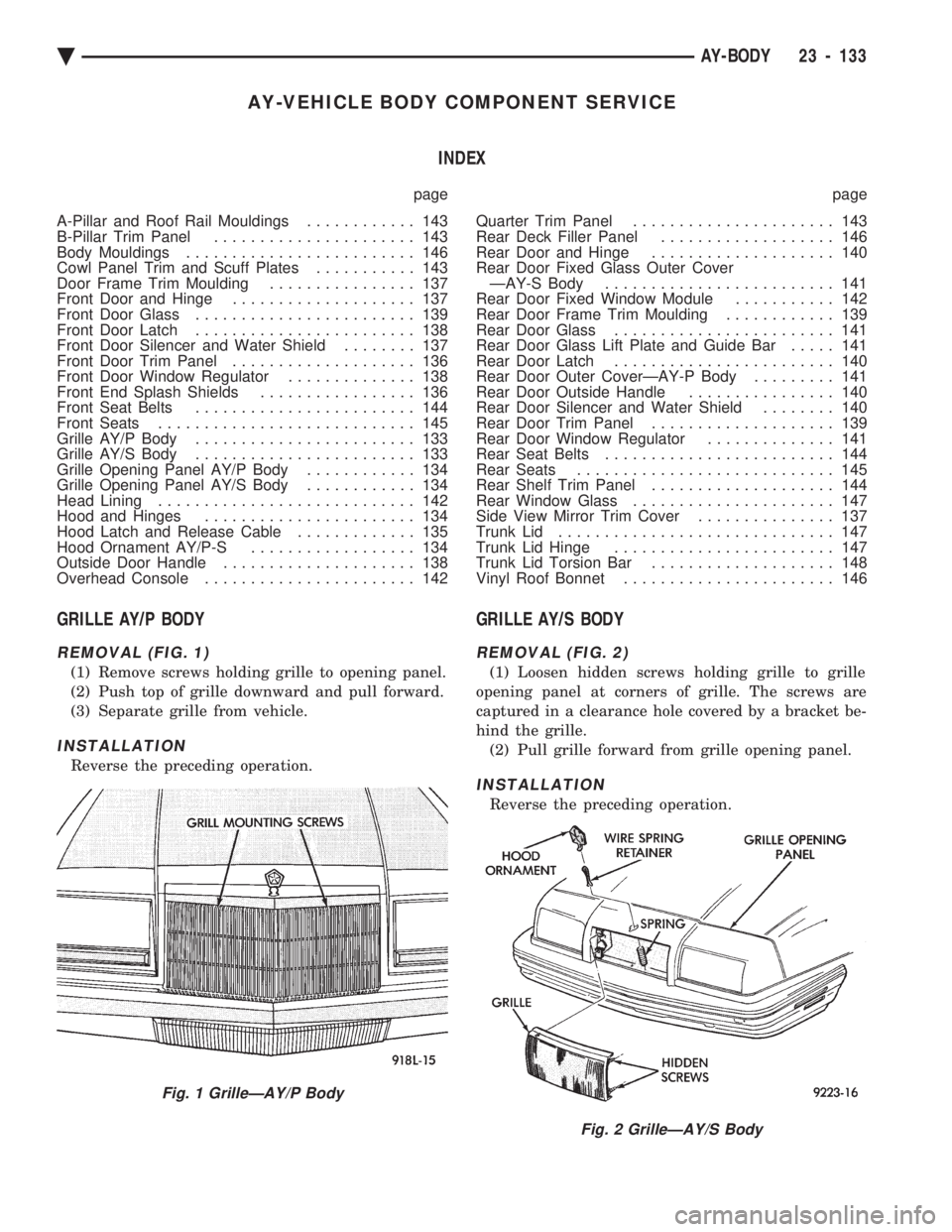
GRILLE AY/P BODY
REMOVAL (FIG. 1)
(1) Remove screws holding grille to opening panel.
(2) Push top of grille downward and pull forward.
(3) Separate grille from vehicle.
INSTALLATION
Reverse the preceding operation.
GRILLE AY/S BODY
REMOVAL (FIG. 2)
(1) Loosen hidden screws holding grille to grille
opening panel at corners of grille. The screws are
captured in a clearance hole covered by a bracket be-
hind the grille. (2) Pull grille forward from grille opening panel.
INSTALLATION
Reverse the preceding operation.
Fig. 1 GrilleÐAY/P Body
Fig. 2 GrilleÐAY/S Body
Ä AY-BODY 23 - 133
Page 2298 of 2438
INSTALLATION
Reverse the preceding operation.
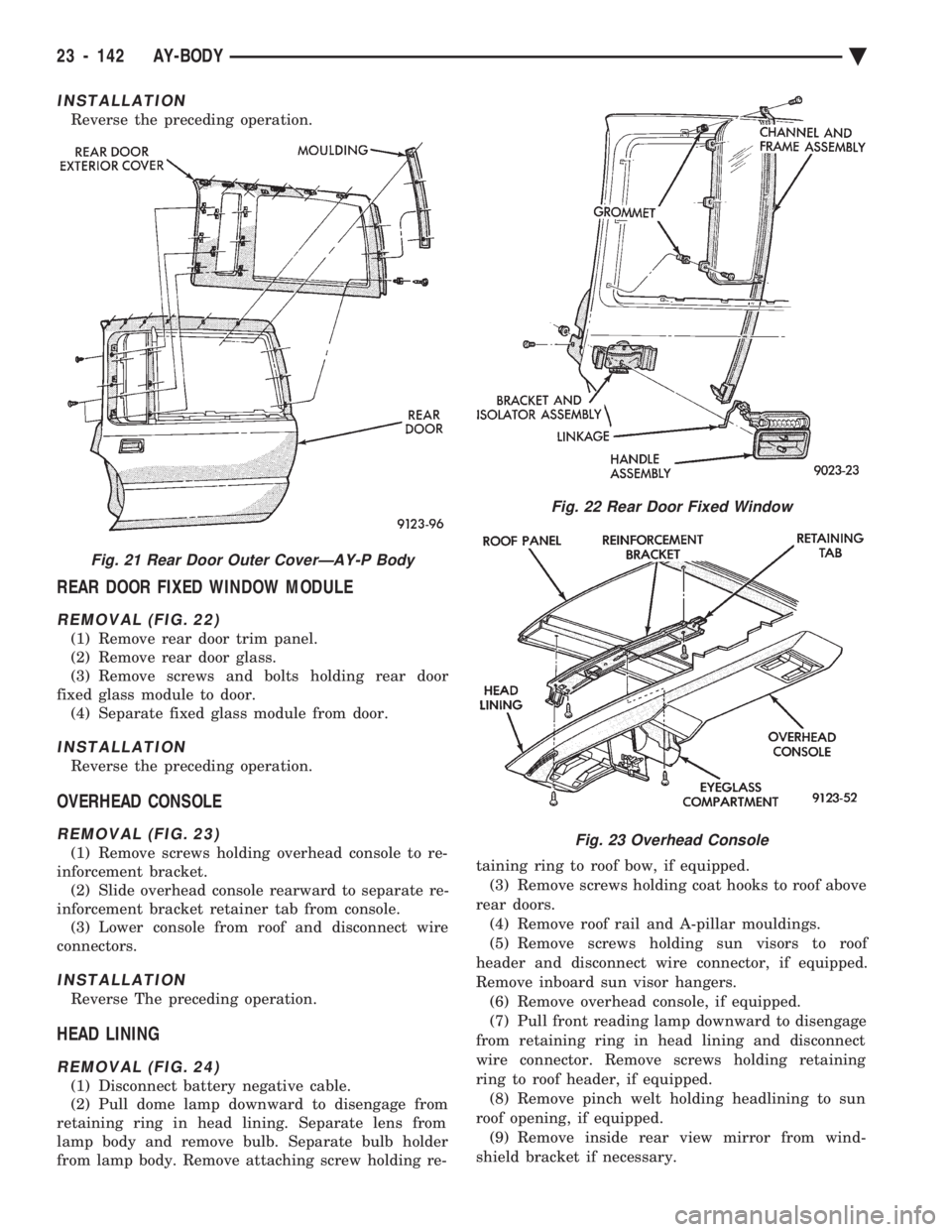
REAR DOOR FIXED WINDOW MODULE
REMOVAL (FIG. 22)
(1) Remove rear door trim panel.
(2) Remove rear door glass.
(3) Remove screws and bolts holding rear door
fixed glass module to door. (4) Separate fixed glass module from door.
INSTALLATION
Reverse the preceding operation.
OVERHEAD CONSOLE
REMOVAL (FIG. 23)
(1) Remove screws holding overhead console to re-
inforcement bracket. (2) Slide overhead console rearward to separate re-
inforcement bracket retainer tab from console. (3) Lower console from roof and disconnect wire
connectors.
INSTALLATION
Reverse The preceding operation.
HEAD LINING
REMOVAL (FIG. 24)
(1) Disconnect battery negative cable.
(2) Pull dome lamp downward to disengage from
retaining ring in head lining. Separate lens from
lamp body and remove bulb. Separate bulb holder
from lamp body. Remove attaching screw holding re- taining ring to roof bow, if equipped.
(3) Remove screws holding coat hooks to roof above
rear doors. (4) Remove roof rail and A-pillar mouldings.
(5) Remove screws holding sun visors to roof
header and disconnect wire connector, if equipped.
Remove inboard sun visor hangers. (6) Remove overhead console, if equipped.
(7) Pull front reading lamp downward to disengage
from retaining ring in head lining and disconnect
wire connector. Remove screws holding retaining
ring to roof header, if equipped. (8) Remove pinch welt holding headlining to sun
roof opening, if equipped. (9) Remove inside rear view mirror from wind-
shield bracket if necessary.
Fig. 21 Rear Door Outer CoverÐAY-P Body
Fig. 22 Rear Door Fixed Window
Fig. 23 Overhead Console
23 - 142 AY-BODY Ä
Page 2299 of 2438
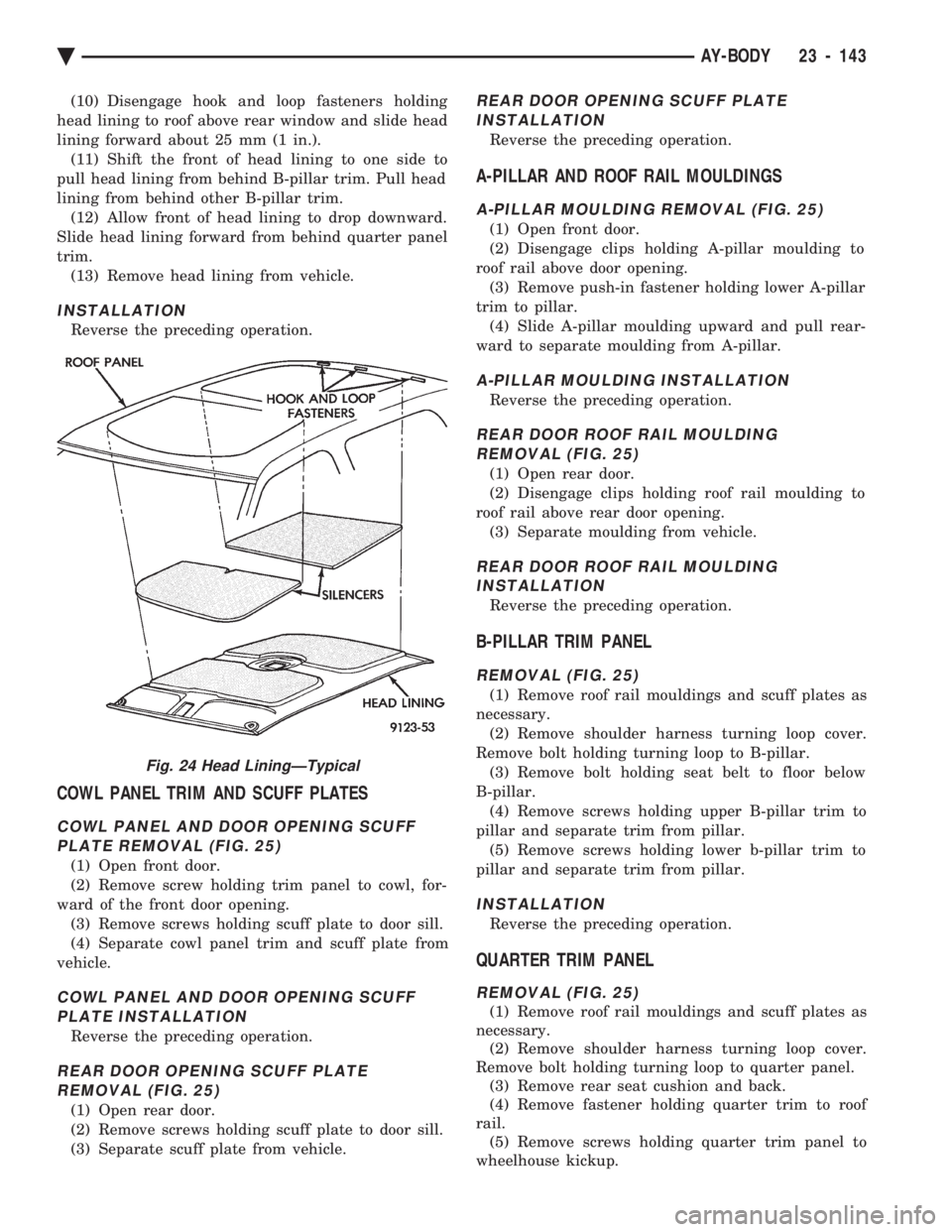
(10) Disengage hook and loop fasteners holding
head lining to roof above rear window and slide head
lining forward about 25 mm (1 in.). (11) Shift the front of head lining to one side to
pull head lining from behind B-pillar trim. Pull head
lining from behind other B-pillar trim. (12) Allow front of head lining to drop downward.
Slide head lining forward from behind quarter panel
trim. (13) Remove head lining from vehicle.
INSTALLATION
Reverse the preceding operation.
COWL PANEL TRIM AND SCUFF PLATES
COWL PANEL AND DOOR OPENING SCUFFPLATE REMOVAL (FIG. 25)
(1) Open front door.
(2) Remove screw holding trim panel to cowl, for-
ward of the front door opening. (3) Remove screws holding scuff plate to door sill.
(4) Separate cowl panel trim and scuff plate from
vehicle.
COWL PANEL AND DOOR OPENING SCUFF PLATE INSTALLATION
Reverse the preceding operation.
REAR DOOR OPENING SCUFF PLATEREMOVAL (FIG. 25)
(1) Open rear door.
(2) Remove screws holding scuff plate to door sill.
(3) Separate scuff plate from vehicle.
REAR DOOR OPENING SCUFF PLATEINSTALLATION
Reverse the preceding operation.
A-PILLAR AND ROOF RAIL MOULDINGS
A-PILLAR MOULDING REMOVAL (FIG. 25)
(1) Open front door.
(2) Disengage clips holding A-pillar moulding to
roof rail above door opening. (3) Remove push-in fastener holding lower A-pillar
trim to pillar. (4) Slide A-pillar moulding upward and pull rear-
ward to separate moulding from A-pillar.
A-PILLAR MOULDING INSTALLATION
Reverse the preceding operation.
REAR DOOR ROOF RAIL MOULDING REMOVAL (FIG. 25)
(1) Open rear door.
(2) Disengage clips holding roof rail moulding to
roof rail above rear door opening. (3) Separate moulding from vehicle.
REAR DOOR ROOF RAIL MOULDINGINSTALLATION
Reverse the preceding operation.
B-PILLAR TRIM PANEL
REMOVAL (FIG. 25)
(1) Remove roof rail mouldings and scuff plates as
necessary. (2) Remove shoulder harness turning loop cover.
Remove bolt holding turning loop to B-pillar. (3) Remove bolt holding seat belt to floor below
B-pillar. (4) Remove screws holding upper B-pillar trim to
pillar and separate trim from pillar. (5) Remove screws holding lower b-pillar trim to
pillar and separate trim from pillar.
INSTALLATION
Reverse the preceding operation.
QUARTER TRIM PANEL
REMOVAL (FIG. 25)
(1) Remove roof rail mouldings and scuff plates as
necessary. (2) Remove shoulder harness turning loop cover.
Remove bolt holding turning loop to quarter panel. (3) Remove rear seat cushion and back.
(4) Remove fastener holding quarter trim to roof
rail. (5) Remove screws holding quarter trim panel to
wheelhouse kickup.
Fig. 24 Head LiningÐTypical
Ä AY-BODY 23 - 143
Page 2302 of 2438
(3) Remove cushion from vehicle.
REAR SEAT CUSHION INSTALLATION
Reverse the preceding operation.
REAR SEAT BACK REMOVAL
(1) Remove rear seat cushion assembly.
(2) Remove bolts holding seat back to rear floor
kick-up. (3) Lift seat back upward to disengage upper hooks
from shelf support panel. (4) Separate seat back from vehicle.
REAR SEAT BACK INSTALLATION
Reverse the preceding operation.
BODY MOULDINGS
STICK-ON BODY SIDE MOULDING REMOVALAND INSTALLATION
(1) Warm the effected stick-on moulding and body
metal to approximately 38ÉC (100ÉF) using a suitable
heat lamp or heat gun. (2) Pull stick-on moulding from painted surface.
(3) Remove adhesive tape residue from painted
surface of vehicle. (4) If moulding is to be reused, Remove tape resi-
due from moulding. Clean back of moulding with Mo-
par, Super Kleen solvent or equivalent. Wipe
moulding dry with lint free cloth. Apply new body
side moulding (two sided adhesive) tape to back of
moulding. (5) Clean body surface with Mopar, Super Kleen
solvent or equivalent. Wipe surface dry with lint free
cloth. (6) Apply a length of masking tape on the body,
parallel to the top edge of the moulding to use as a
guide, if necessary. (7) Remove protective cover from tape on back of
moulding. Apply moulding to body below the mask-
ing tape guide. (8) Remove masking tape guide and heat body and
moulding, see step one. Firmly press moulding to
body surface to assure adhesion.
FRONT WHEEL OPENING MOULDING REMOVAL
(1) Remove screws holding wheel opening mould-
ing to front fender. (2) Separate moulding from fender.
FRONT WHEEL OPENING MOULDINGINSTALLATION
(1) Position moulding in wheel opening and start
top center screw of wheel opening moulding. (2) Install screws around wheel opening.
REAR WHEEL OPENING MOULDING REMOVAL
(1) Remove screws holding wheel opening mould-
ing to quarter panel. (2) Separate wheel opening moulding from quarter
panel.
REAR WHEEL OPENING MOULDING INSTALLATION
(1) Position moulding in wheel opening and start
top center screw of wheel opening moulding. (2) Install screws around wheel opening.
VINYL ROOF BONNET
REMOVAL (FIG. 30)
(1) Remove quarter panel trim covers.
(2) Remove head lining.
(3) Remove nuts holding transverse roof moulding
to roof panel and separate moulding from vehicle. (4) Remove nuts holding vinyl top bonnet to roof.
(5) Remove rear deck filler panel.
(6) Remove screws holding rear window opening
lower valance to body. (7) Disengage clips holding vinyl top bonnet to
quarter panel. (8) Pull vinyl top bonnet away from top panel to
separate bonnet from anti-flutter sealer holding bon-
net to roof.
INSTALLATION
(1) Clean anti-flutter sealer from roof surface and
inside of vinyl roof bonnet. (2) Apply a 20 mm (0.75 in.) bead of anti-flutter
sealer across the roof panel at the mid point between
the front of the bonnet and rear of roof. (3) Apply a 20 mm (0.75 in.) by 150 mm (6 in.)
bead of anti-flutter sealer down each roof side panel
at mid point between the door opening and rear of
roof. (4) Place the bonnet into position on the roof panel
and align to proper fit. (5) Reverse the removal operation.
REAR DECK FILLER PANEL
REMOVAL (FIG. 31)
(1) Raise truck lid to full up position.
(2) Remove screws holding rear deck filler panel to
body in the front trunk opening gutter. (3) Close trunk lid, do not latch.
(4) Lift filler panel upward and separate from ve-
hicle.
INSTALLATION
Reverse the preceding operation.
23 - 146 AY-BODY Ä
Page 2303 of 2438
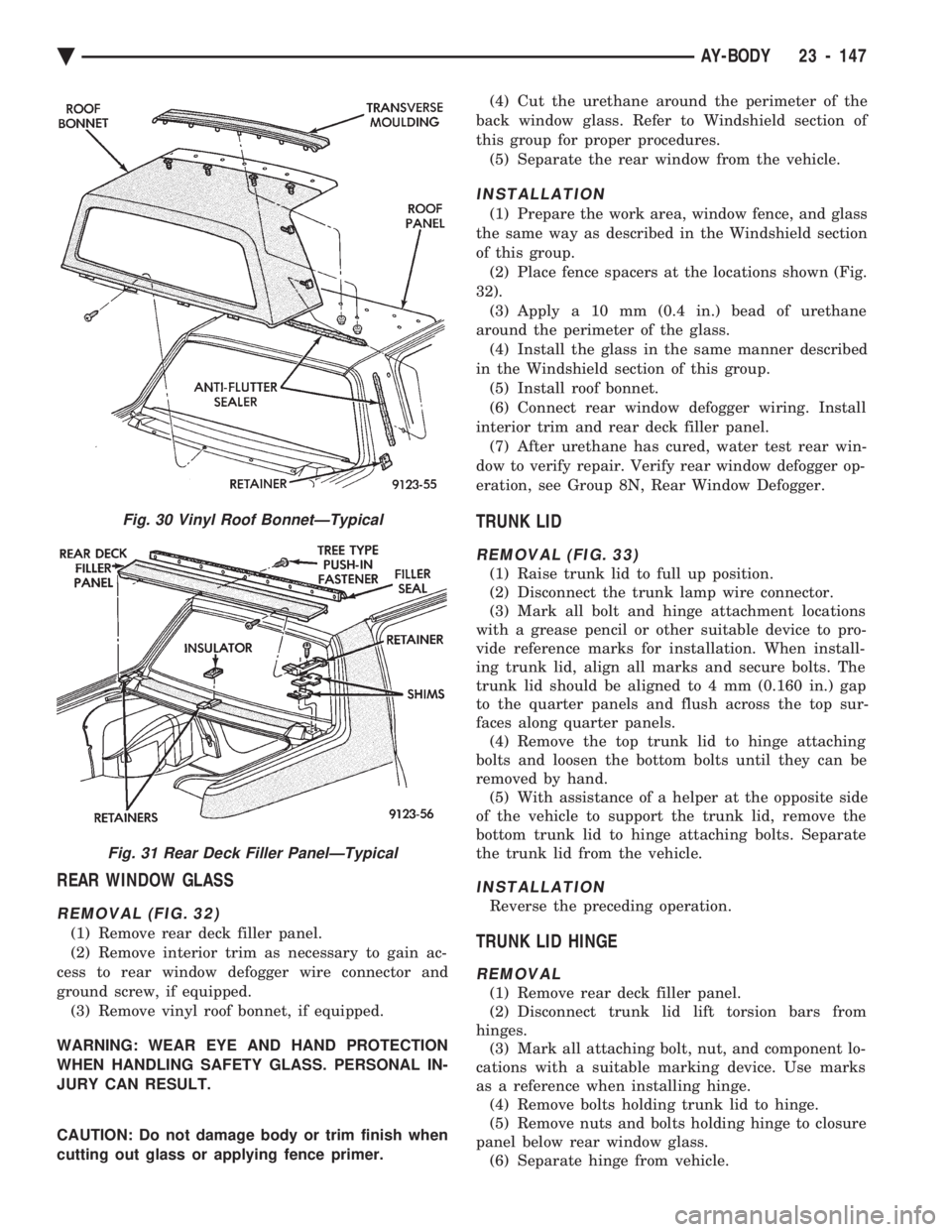
REAR WINDOW GLASS
REMOVAL (FIG. 32)
(1) Remove rear deck filler panel.
(2) Remove interior trim as necessary to gain ac-
cess to rear window defogger wire connector and
ground screw, if equipped. (3) Remove vinyl roof bonnet, if equipped.
WARNING: WEAR EYE AND HAND PROTECTION
WHEN HANDLING SAFETY GLASS. PERSONAL IN-
JURY CAN RESULT.
CAUTION: Do not damage body or trim finish when
cutting out glass or applying fence primer. (4) Cut the urethane around the perimeter of the
back window glass. Refer to Windshield section of
this group for proper procedures. (5) Separate the rear window from the vehicle.
INSTALLATION
(1) Prepare the work area, window fence, and glass
the same way as described in the Windshield section
of this group. (2) Place fence spacers at the locations shown (Fig.
32). (3) Apply a 10 mm (0.4 in.) bead of urethane
around the perimeter of the glass. (4) Install the glass in the same manner described
in the Windshield section of this group. (5) Install roof bonnet.
(6) Connect rear window defogger wiring. Install
interior trim and rear deck filler panel. (7) After urethane has cured, water test rear win-
dow to verify repair. Verify rear window defogger op-
eration, see Group 8N, Rear Window Defogger.
TRUNK LID
REMOVAL (FIG. 33)
(1) Raise trunk lid to full up position.
(2) Disconnect the trunk lamp wire connector.
(3) Mark all bolt and hinge attachment locations
with a grease pencil or other suitable device to pro-
vide reference marks for installation. When install-
ing trunk lid, align all marks and secure bolts. The
trunk lid should be aligned to 4 mm (0.160 in.) gap
to the quarter panels and flush across the top sur-
faces along quarter panels. (4) Remove the top trunk lid to hinge attaching
bolts and loosen the bottom bolts until they can be
removed by hand. (5) With assistance of a helper at the opposite side
of the vehicle to support the trunk lid, remove the
bottom trunk lid to hinge attaching bolts. Separate
the trunk lid from the vehicle.
INSTALLATION
Reverse the preceding operation.
TRUNK LID HINGE
REMOVAL
(1) Remove rear deck filler panel.
(2) Disconnect trunk lid lift torsion bars from
hinges. (3) Mark all attaching bolt, nut, and component lo-
cations with a suitable marking device. Use marks
as a reference when installing hinge. (4) Remove bolts holding trunk lid to hinge.
(5) Remove nuts and bolts holding hinge to closure
panel below rear window glass. (6) Separate hinge from vehicle.
Fig. 30 Vinyl Roof BonnetÐTypical
Fig. 31 Rear Deck Filler PanelÐTypical
Ä AY-BODY 23 - 147
Page 2417 of 2438
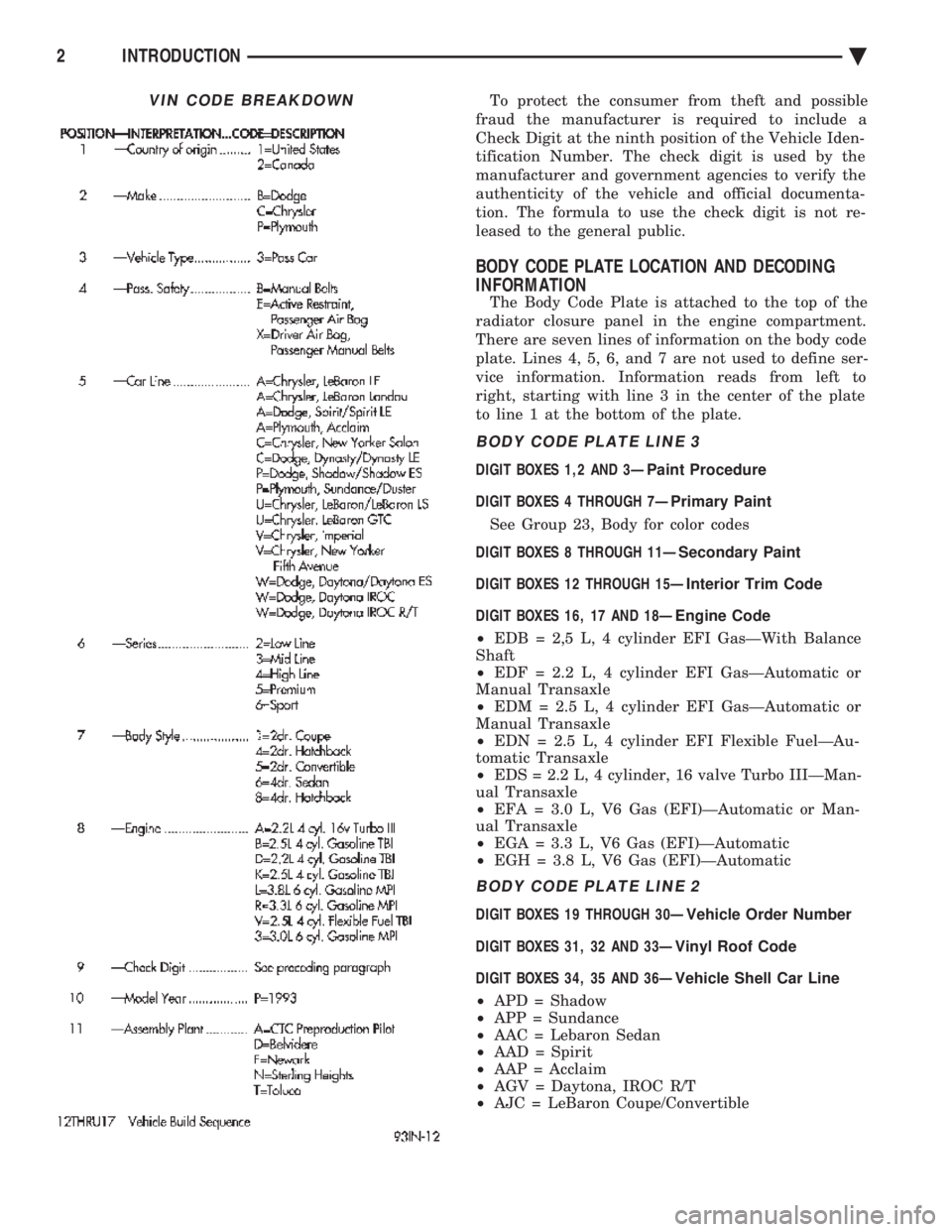
To protect the consumer from theft and possible
fraud the manufacturer is required to include a
Check Digit at the ninth position of the Vehicle Iden-
tification Number. The check digit is used by the
manufacturer and government agencies to verify the
authenticity of the vehicle and official documenta-
tion. The formula to use the check digit is not re-
leased to the general public.
BODY CODE PLATE LOCATION AND DECODING
INFORMATION
The Body Code Plate is attached to the top of the
radiator closure panel in the engine compartment.
There are seven lines of information on the body code
plate. Lines 4, 5, 6, and 7 are not used to define ser-
vice information. Information reads from left to
right, starting with line 3 in the center of the plate
to line 1 at the bottom of the plate.
BODY CODE PLATE LINE 3
DIGIT BOXES 1,2 AND 3Ð Paint Procedure
DIGIT BOXES 4 THROUGH 7Ð Primary Paint
See Group 23, Body for color codes
DIGIT BOXES 8 THROUGH 11Ð Secondary Paint
DIGIT BOXES 12 THROUGH 15Ð Interior Trim Code
DIGIT BOXES 16, 17 AND 18Ð Engine Code
² EDB = 2,5 L, 4 cylinder EFI GasÐWith Balance
Shaft
² EDF = 2.2 L, 4 cylinder EFI GasÐAutomatic or
Manual Transaxle
² EDM = 2.5 L, 4 cylinder EFI GasÐAutomatic or
Manual Transaxle
² EDN = 2.5 L, 4 cylinder EFI Flexible FuelÐAu-
tomatic Transaxle
² EDS = 2.2 L, 4 cylinder, 16 valve Turbo IIIÐMan-
ual Transaxle
² EFA = 3.0 L, V6 Gas (EFI)ÐAutomatic or Man-
ual Transaxle
² EGA = 3.3 L, V6 Gas (EFI)ÐAutomatic
² EGH = 3.8 L, V6 Gas (EFI)ÐAutomatic
BODY CODE PLATE LINE 2
DIGIT BOXES 19 THROUGH 30Ð Vehicle Order Number
DIGIT BOXES 31, 32 AND 33Ð Vinyl Roof Code
DIGIT BOXES 34, 35 AND 36Ð Vehicle Shell Car Line
² APD = Shadow
² APP = Sundance
² AAC = Lebaron Sedan
² AAD = Spirit
² AAP = Acclaim
² AGV = Daytona, IROC R/T
² AJC = LeBaron Coupe/Convertible
VIN CODE BREAKDOWN
2 INTRODUCTION Ä