steering CHEVROLET EPICA 2004 1.G Owner's Guide
[x] Cancel search | Manufacturer: CHEVROLET, Model Year: 2004, Model line: EPICA, Model: CHEVROLET EPICA 2004 1.GPages: 338, PDF Size: 2.38 MB
Page 224 of 338
Power Steering Fluid
When to Check Power Steering Fluid
The power steering fluid reservoir is located toward the
front of the engine compartment on the passenger’s
side of the vehicle. SeeEngine Compartment Overview
on page 5-12for reservoir location.
It is not necessary to regularly check power steering
fluid unless you suspect there is a leak in the system or
you hear an unusual noise. A fluid loss in this system
could indicate a problem. Have the system inspected
and repaired.
How to Check Power Steering Fluid
Turn the key off and let the engine compartment
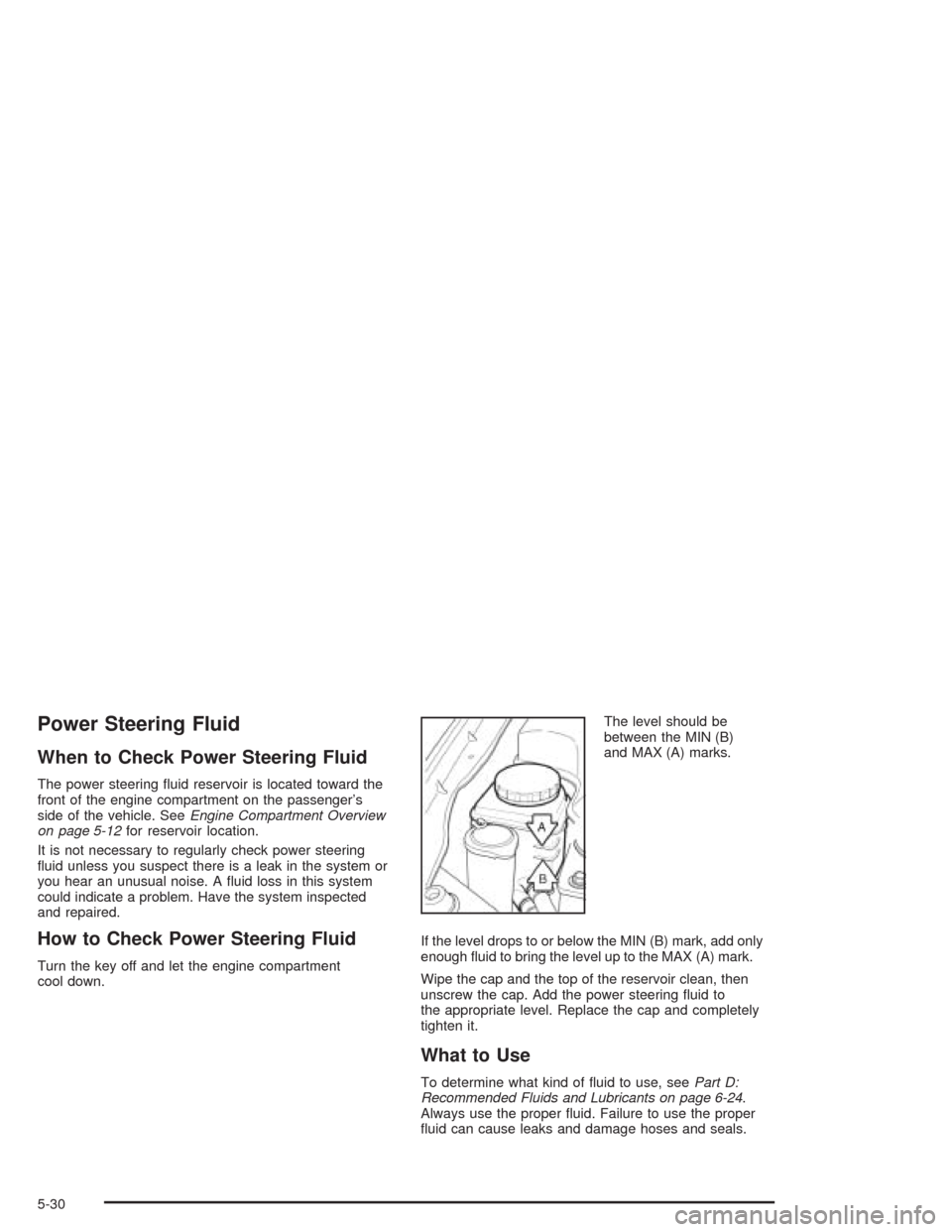
cool down.The level should be
between the MIN (B)
and MAX (A) marks.
If the level drops to or below the MIN (B) mark, add only
enough fluid to bring the level up to the MAX (A) mark.
Wipe the cap and the top of the reservoir clean, then
unscrew the cap. Add the power steering fluid to
the appropriate level. Replace the cap and completely
tighten it.
What to Use
To determine what kind of fluid to use, seePart D:
Recommended Fluids and Lubricants on page 6-24.
Always use the proper fluid. Failure to use the proper
fluid can cause leaks and damage hoses and seals.
5-30
Page 244 of 338
Tire Size
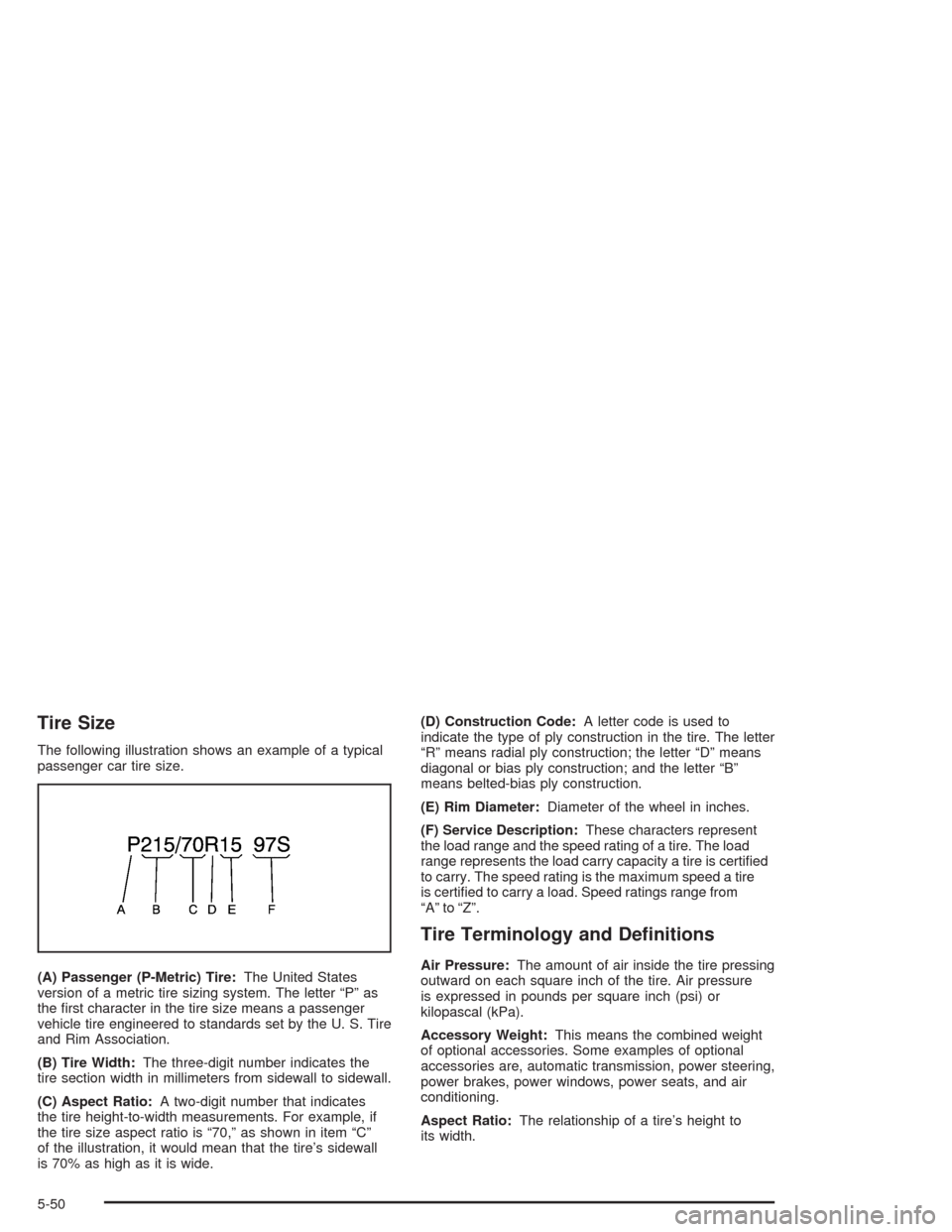
The following illustration shows an example of a typical
passenger car tire size.
(A) Passenger (P-Metric) Tire:The United States
version of a metric tire sizing system. The letter “P” as
the first character in the tire size means a passenger
vehicle tire engineered to standards set by the U. S. Tire
and Rim Association.
(B) Tire Width:The three-digit number indicates the
tire section width in millimeters from sidewall to sidewall.
(C) Aspect Ratio:A two-digit number that indicates
the tire height-to-width measurements. For example, if
the tire size aspect ratio is “70,” as shown in item “C”
of the illustration, it would mean that the tire’s sidewall
is 70% as high as it is wide.(D) Construction Code:A letter code is used to
indicate the type of ply construction in the tire. The letter
“R” means radial ply construction; the letter “D” means
diagonal or bias ply construction; and the letter “B”
means belted-bias ply construction.
(E) Rim Diameter:Diameter of the wheel in inches.
(F) Service Description:These characters represent
the load range and the speed rating of a tire. The load
range represents the load carry capacity a tire is certified
to carry. The speed rating is the maximum speed a tire
is certified to carry a load. Speed ratings range from
“A” to “Z”.
Tire Terminology and Denitions
Air Pressure:The amount of air inside the tire pressing
outward on each square inch of the tire. Air pressure
is expressed in pounds per square inch (psi) or
kilopascal (kPa).
Accessory Weight:This means the combined weight
of optional accessories. Some examples of optional
accessories are, automatic transmission, power steering,
power brakes, power windows, power seats, and air
conditioning.
Aspect Ratio:The relationship of a tire’s height to
its width.
5-50
Page 255 of 338
If a Tire Goes Flat
It’s unusual for a tire to “blowout” while you’re driving,
especially if you maintain your tires properly. If air goes
out of a tire, it’s much more likely to leak out slowly.
But if you should ever have a “blowout,” here are a few
tips about what to expect and what to do:
If a front tire fails, the flat tire will create a drag that
pulls the vehicle toward that side. Take your foot off the
accelerator pedal and grip the steering wheel firmly.
Steer to maintain lane position, and then gently brake
to a stop well out of the traffic lane.
A rear blowout, particularly on a curve, acts much like
a skid and may require the same correction you’d use in
a skid. In any rear blowout, remove your foot from the
accelerator pedal. Get the vehicle under control by
steering the way you want the vehicle to go. It may be
very bumpy and noisy, but you can still steer. Gently
brake to a stop, well off the road if possible.{CAUTION:
Lifting a vehicle and getting under it to do
maintenance or repairs is dangerous without
the appropriate safety equipment and training.
The jack provided with your vehicle is designed
only for changing a at tire. If it is used for
anything else, you or others could be badly
injured or killed if the vehicle slips off the jack.
Use the jack provided with your vehicle only for
changing a at tire.
If a tire goes flat, the next part shows how to use your
jacking equipment to change a flat tire safely.
5-61
Page 274 of 338
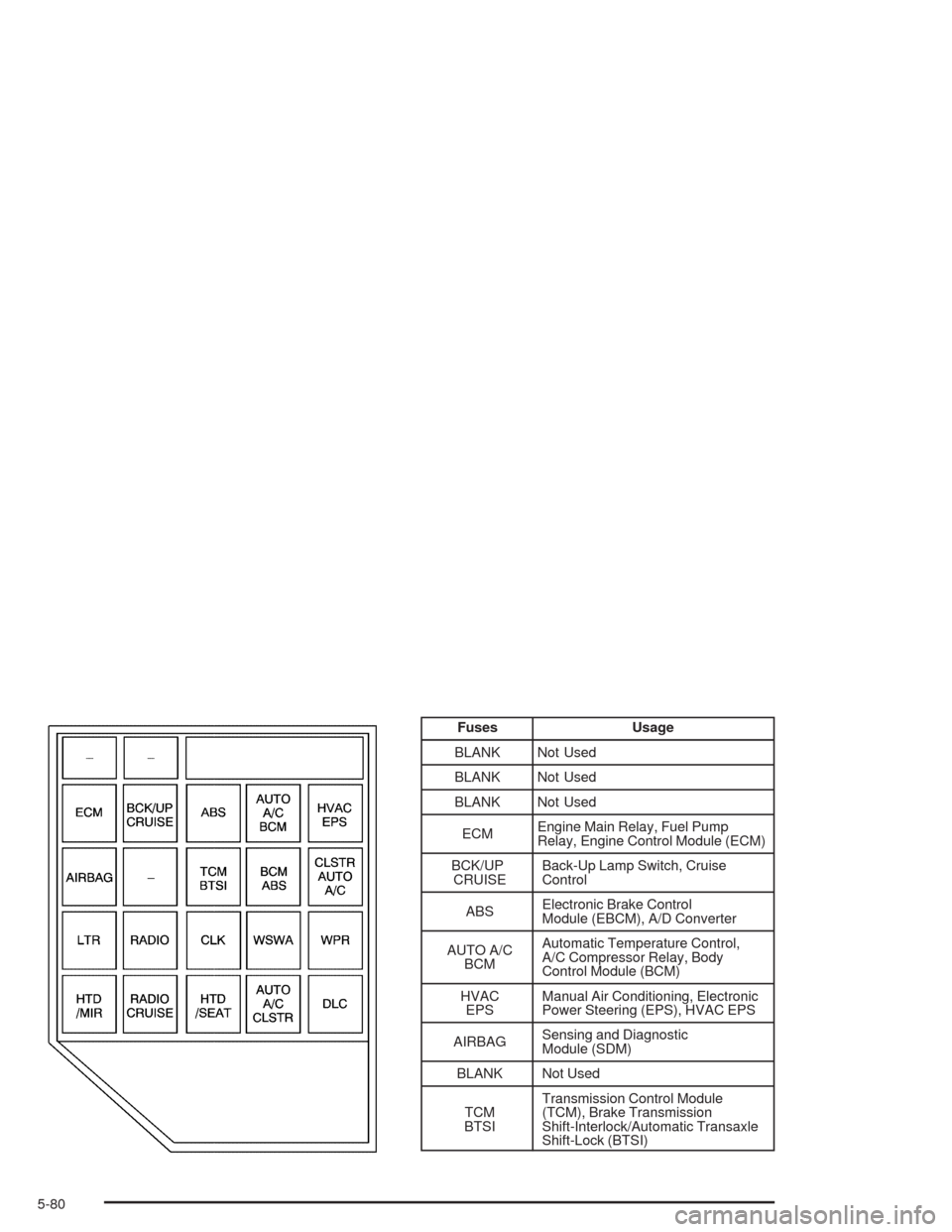
Fuses Usage
BLANK Not Used
BLANK Not Used
BLANK Not Used
ECMEngine Main Relay, Fuel Pump
Relay, Engine Control Module (ECM)
BCK/UP
CRUISEBack-Up Lamp Switch, Cruise
Control
ABSElectronic Brake Control
Module (EBCM), A/D Converter
AUTO A/C
BCMAutomatic Temperature Control,
A/C Compressor Relay, Body
Control Module (BCM)
HVAC
EPSManual Air Conditioning, Electronic
Power Steering (EPS), HVAC EPS
AIRBAGSensing and Diagnostic
Module (SDM)
BLANK Not Used
TCM
BTSITransmission Control Module
(TCM), Brake Transmission
Shift-Interlock/Automatic Transaxle
Shift-Lock (BTSI)
5-80
Page 281 of 338
Maintenance Schedule......................................6-2
Introduction...................................................6-2
Maintenance Requirements..............................6-2
Your Vehicle and the Environment....................6-2
How This Section is Organized.........................6-3
Part A: Scheduled Maintenance Services...........6-4
Using Your Maintenance Schedule....................6-4
Selecting the Right Schedule...........................6-5
Short Trip/City Scheduled Maintenance..............6-6
Long Trip/Highway Scheduled Maintenance......6-13
Part B: Owner Checks and Services................6-18
At Each Fuel Fill..........................................6-18
At Least Once a Month.................................6-18At Least Twice a Year...................................6-19
At Least Once a Year...................................6-19
Part C: Periodic Maintenance Inspections.........6-22
Steering, Suspension and Front Drive Axle
Boot and Seal Inspection............................6-22
Exhaust System Inspection............................6-22
Fuel System Inspection..................................6-22
Engine Cooling System Inspection...................6-23
Throttle System Inspection.............................6-23
Brake System Inspection................................6-23
Part D: Recommended Fluids and
Lubricants................................................6-24
Part E: Maintenance Record...........................6-25
Section 6 Maintenance Schedule
6-1
Page 302 of 338
Part C: Periodic Maintenance
Inspections
Listed in this part are inspections and services which
should be performed at least twice a year (for instance,
each spring and fall).You should let your dealer’s
service department do these jobs. Make sure any
necessary repairs are completed at once.
Proper procedures to perform these services may be
found in a service manual. SeeService Publications
Ordering Information on page 7-12.
Steering, Suspension and Front
Drive Axle Boot and Seal Inspection
Inspect the front and rear suspension and steering
system for damaged, loose or missing parts, signs of
wear or lack of lubrication. Inspect the power steering
lines and hoses for proper hook-up, binding, leaks,
cracks, chafing, etc. Clean and then inspect the
drive axle boot seals for damage, tears or leakage.
Replace seals if necessary.
Exhaust System Inspection
Inspect the complete exhaust system. Inspect the body
near the exhaust system. Look for broken, damaged,
missing or out-of-position parts as well as open seams,
holes, loose connections or other conditions which
could cause a heat build-up in the floor pan or could let
exhaust fumes into the vehicle. SeeEngine Exhaust
on page 2-29.
Fuel System Inspection
Inspect the complete fuel system for damage or leaks.
6-22
Page 304 of 338
Part D: Recommended Fluids and
Lubricants
Fluids and lubricants identified below by name, part
number or specification may be obtained from your
dealer.
Usage Fluid/Lubricant
Engine OilEngine oil which meets GM Standard
GM 6094M and displays the
American Petroleum Institute
Certified for Gasoline Engines
starburst symbol. To determine the
proper viscosity for your vehicle’s
engine, seeEngine Oil on page 5-13.
Engine
Coolant50/50 mixture of clean, drinkable
water (preferably distilled) and good
quality Ethylene Glycol Base Coolant
(GM Part No. U.S. 12378560, in
Canada 993089) and conforming
to GM Specification 1825M or
recycled coolant conforming to
GM Specification 1825M.
SeeEngine Coolant on page 5-19.
Hydraulic Brake
SystemDelco Supreme 11 Brake Fluid or
equivalent DOT-3 brake fluid.
Windshield
Washer SolventGM Optikleen
®Washer Solvent.
Usage Fluid/Lubricant
Power Steering
SystemDEXRON
®-III Automatic
Transmission Fluid.
Automatic
TransaxleAutomatic Transaxle Fluid ESSO LT
71141 or TOTAL ATF H50235.
Key Lock
CylindersMulti-Purpose Lubricant, Superlube
(GM Part No. U.S. 12346241,
in Canada 10953474).
Chassis
LubricationChassis Lubricant (GM Part No. U.S.
12377985, in Canada 88901242) or
lubricant meeting requirements of
NLGI #2, Category LB or GC-LB.
Hood Latch
Assembly,
Secondary
Latch, Pivots,
Spring
Anchor and
Release PawlLubriplate Lubricant Aerosol
(GM Part No. U.S. 12346293,
in Canada 992723) or lubricant
meeting requirements of NLGI #2,
Category LB or GC-LB.
Hood and Door
HingesMulti-Purpose Lubricant, Superlube
(GM Part No. U.S. 12346241, in
Canada 10953474).
Weatherstrip
ConditioningDielectric Silicone Grease
(GM Part No. U.S. 12345579,
in Canada 992887).
6-24
Page 320 of 338
Reporting Safety Defects to
General Motors
In addition to notifying NHTSA (or Transport Canada)
in a situation like this, we certainly hope you’ll notify us.
Please call us at 1-800-222-1020, or write:
Chevrolet Motor Division
Chevrolet Customer Assistance Center
P.O. Box 33170
Detroit, MI 48232-5170
In Canada, please call us at 1-800-263-3777 (English)
or 1-800-263-7854 (French). Or, write:
General Motors of Canada Limited
Customer Communication Centre, 163-005
1908 Colonel Sam Drive
Oshawa, Ontario L1H 8P7
Service Publications Ordering
Information
Service Manuals
Service Manuals have the diagnosis and repair
information on engines, transmission, axle, suspension,
brakes, electrical, steering, body, etc.
RETAIL SELL PRICE: $120.00
Transmission, Transaxle, Transfer
Case Unit Repair Manual
This manual provides information on unit repair
service procedures, adjustments, and specifications
for GM transmissions, transaxles, and transfer cases.
RETAIL SELL PRICE: $50.00
7-12
Page 323 of 338
A
Accessory Power Outlets.................................3-17
Adaptive Shift Logic........................................2-24
Adding Washer Fluid.......................................5-31
Additional Program Information........................... 7-9
Additives, Fuel................................................. 5-6
Add-On Electrical Equipment............................5-78
Adjusting the Speakers (Balance/Fade)..............3-50
Air Bag
Readiness Light..........................................3-33
Air Bag Systems.............................................1-46
How Does an Air Bag Restrain?....................1-52
Servicing Your Air Bag-Equipped Vehicle.........1-54
What Makes an Air Bag Inflate?....................1-52
What Will You See After an Air Bag
Inflates?..................................................1-53
When Should an Air Bag Inflate?...................1-51
Where Are the Air Bags?..............................1-49
Air Cleaner/Filter, Engine.................................5-17
Airbag Sensing and Diagnostic Module (SDM)....7-10
AM ...............................................................3-59
Antenna, Backglass.........................................3-60
Anti-lock Brake System (ABS)............................ 4-6
Anti-Lock Brake, System Warning Light..............3-36
Appearance Care............................................5-68
Care of Safety Belts....................................5-72
Chemical Paint Spotting...............................5-75Appearance Care (cont.)
Cleaning the Inside of Your Vehicle................5-69
Cleaning the Outside of Your Vehicle..............5-72
Finish Damage............................................5-74
Sheet Metal Damage...................................5-74
Underbody Maintenance...............................5-75
Vehicle Care/Appearance Materials................5-75
Weatherstrips..............................................5-72
Arming the System.........................................2-15
Ashtrays........................................................3-18
Audio System(s).............................................3-48
Audio Steering Wheel Controls......................3-59
Backglass Antenna......................................3-60
Care of Your CD Player...............................3-60
Care of Your CDs........................................3-59
Radio with CD............................................3-48
Theft-Deterrent Feature................................3-58
Trunk-Mounted CD Changer..........................3-55
Understanding Radio Reception.....................3-59
Automatic Climate Control System.....................3-22
Automatic Operation........................................3-22
Automatic Transaxle
Fluid..........................................................5-19
Operation...................................................2-22
Automatic Transaxle Inspection.........................6-19
Automatic Transaxle Shift Lock Control
System Check.............................................6-20
Auto-Off Headlamps........................................3-14
1
Page 328 of 338
F
Filter
Engine Air Cleaner......................................5-17
Finding a Station............................................3-48
Finish Care....................................................5-73
Finish Damage...............................................5-74
Flash-to-Pass Feature....................................... 3-8
Flat Tire........................................................5-61
Flat Tire, Changing.........................................5-62
Fluid
Automatic Transaxle.....................................5-19
Power Steering...........................................5-30
Windshield Washer......................................5-31
FM ...............................................................3-59
Fog Lamps....................................................3-15
Folding the Seatback........................................ 1-9
Footnotes................................................6-6, 6-13
Fuel............................................................... 5-5
Additives...................................................... 5-6
California Fuel.............................................. 5-6
Filling a Portable Fuel Container....................5-10
Filling Your Tank........................................... 5-7
Fuels in Foreign Countries.............................. 5-7
Gage.........................................................3-44
Gasoline Octane........................................... 5-5
Gasoline Specifications.................................. 5-5
Low Warning Light.......................................3-45
System Inspection.......................................6-22Fuses
Fuses and Circuit Breakers...........................5-79
Windshield Wiper.........................................5-78
G
Gage
Engine Coolant Temperature.........................3-39
Fuel..........................................................3-44
Speedometer..............................................3-32
Tachometer.................................................3-32
Gasoline
Octane........................................................ 5-5
Specifications............................................... 5-5
Glove Box.....................................................2-33
GM Mobility Program for Persons with
Disabilities.................................................... 7-5
H
Hazard Warning Flashers................................... 3-6
Head Restraints............................................... 1-8
Headlamp
Aiming.......................................................5-40
Headlamp High/Low-Beam Changer.................... 3-8
Headlamp Wiring............................................5-78
6