shift CHEVROLET EPICA 2006 1.G Owner's Manual
[x] Cancel search | Manufacturer: CHEVROLET, Model Year: 2006, Model line: EPICA, Model: CHEVROLET EPICA 2006 1.GPages: 368, PDF Size: 2.24 MB
Page 211 of 368
{CAUTION:
If you do not shift down, your brakes could
get so hot that they would not work well. You
would then have poor braking or even none
going down a hill. You could crash. Shift down
to let your engine assist your brakes on a
steep downhill slope.
{CAUTION:
Coasting downhill in NEUTRAL (N) or with the
ignition off is dangerous. Your brakes will have
to do all the work of slowing down. They could
get so hot that they would not work well. You
would then have poor braking or even none
going down a hill. You could crash. Always
have your engine running and your vehicle
in gear when you go downhill.
•Know how to go down hills. The most important
thing to know is this: let your engine do some of
the slowing down. Shift to a lower gear when you
go down a steep or long hill.
•Know how to go uphill. Drive in the highest gear
possible.
•Stay in your own lane when driving on two-lane
roads in hills or mountains. Do not swing wide
or cut across the center of the road. Drive at speeds
that let you stay in your own lane.
•As you go over the top of a hill, be alert. There
could be something in your lane, like a stalled car
or an accident.
•You may see highway signs on mountains that
warn of special problems. Examples are long
grades, passing or no-passing zones, a falling rocks
area, or winding roads. Be alert to these and take
appropriate action.
4-23
Page 216 of 368
If Your Vehicle is Stuck in Sand,
Mud, Ice or Snow
In order to free your vehicle when it is stuck, you will
need to spin the wheels, but you do not want to
spin your wheels too fast. The method known as
rocking can help you get out when you are stuck,
but you must use caution.
{CAUTION:
If you let your tires spin at high speed, they
can explode, and you or others could be
injured. And, the transaxle or other parts of
the vehicle can overheat. That could cause an
engine compartment re or other damage.
When you are stuck, spin the wheels as little
as possible. Do not spin the wheels above
35 mph (55 km/h) as shown on the
speedometer.Notice:Spinning your wheels can destroy parts of
your vehicle as well as the tires. If you spin the
wheels too fast while shifting your transaxle back
and forth, you can destroy your transaxle. See
Rocking Your Vehicle to Get It Out on page 4-28.
For information about using tire chains on your vehicle,
seeTire Chains on page 5-59.
Rocking Your Vehicle to Get It Out
First, turn your steering wheel left and right. That
will clear the area around your front wheels. Then
shift back and forth between REVERSE (R) and a
forward gear, spinning the wheels as little as possible.
Release the accelerator pedal while you shift, and press
lightly on the accelerator pedal when the transaxle is
in gear. By slowly spinning your wheels in the forward
and reverse directions, you will cause a rocking
motion that may free your vehicle. If that does not get
you out after a few tries, you may need to be towed out.
If you do need to be towed out, seeTowing Your
Vehicle on page 4-33.
4-28
Page 247 of 368
If No Steam Is Coming From
Your Engine
If you get an engine overheat warning, but see or
hear no steam, the problem may not be too serious.
Sometimes the engine can get a little too hot when you:
•Climb a long hill on a hot day.
•Stop after high-speed driving.
•Idle for long periods in traffic.
If you get the overheat warning with no sign of steam,
try this for a minute or so:
1. In heavy traffic, let the engine idle in NEUTRAL (N)
while stopped. If it is safe to do so, pull off the
road, shift to PARK (P) or NEUTRAL (N) and let
the engine idle.
2. Turn on your heater to full hot at the highest fan
speed and open the windows as necessary.If you no longer have the overheat warning, you can
drive. Just to be safe, drive slower for about 10 minutes.
If the warning does not come back on, you can drive
normally.
If the warning continues and you have not stopped,
pull over, stop, and park your vehicle right away.
If there is still no sign of steam, you can idle the engine
for three minutes while you are parked. If you still
have the warning, turn off the engine and get everyone
out of the vehicle until it cools down.
You may decide not to lift the hood, but to get service
help right away.
5-23
Page 285 of 368
Changing a Flat Tire
If a tire goes flat, avoid further tire and wheel damage
by driving slowly to a level place. Turn on your vehicle’s
hazard warning flashers. SeeHazard Warning Flashers
on page 3-6for more information.
{CAUTION:
Changing a tire can be dangerous. The vehicle
can slip off the jack and roll over or fall on you
or other people. You and they could be badly
injured or even killed. Find a level place to
change your tire. To help prevent the vehicle
from moving:
1. Set the parking brake rmly.
2. Put the shift lever in PARK (P).
3. Turn off the engine and do not restart
while the vehicle is raised.
4. Do not allow passengers to remain in
the vehicle.
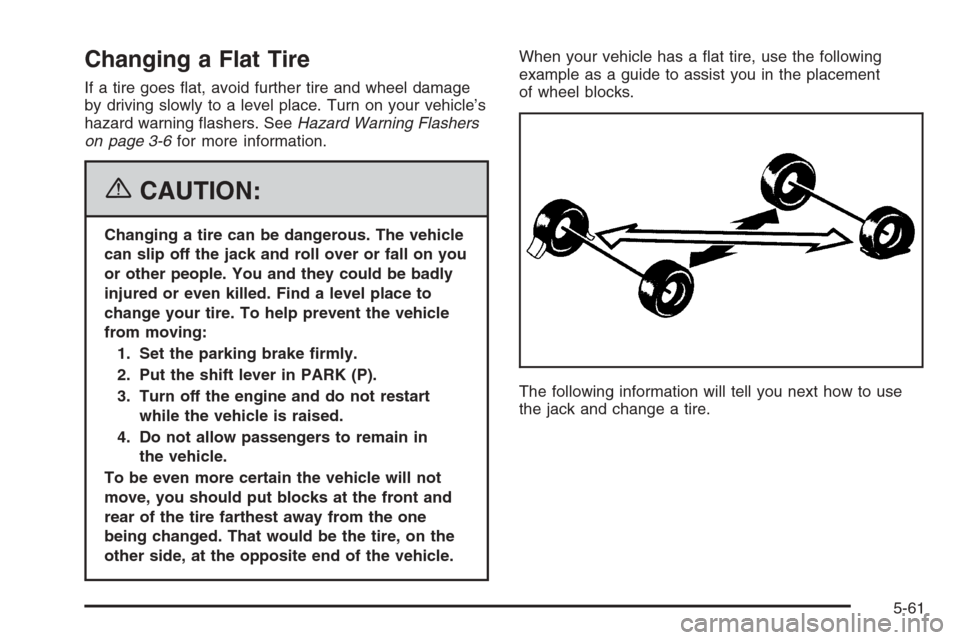
To be even more certain the vehicle will not
move, you should put blocks at the front and
rear of the tire farthest away from the one
being changed. That would be the tire, on the
other side, at the opposite end of the vehicle.When your vehicle has a flat tire, use the following
example as a guide to assist you in the placement
of wheel blocks.
The following information will tell you next how to use
the jack and change a tire.
5-61
Page 302 of 368
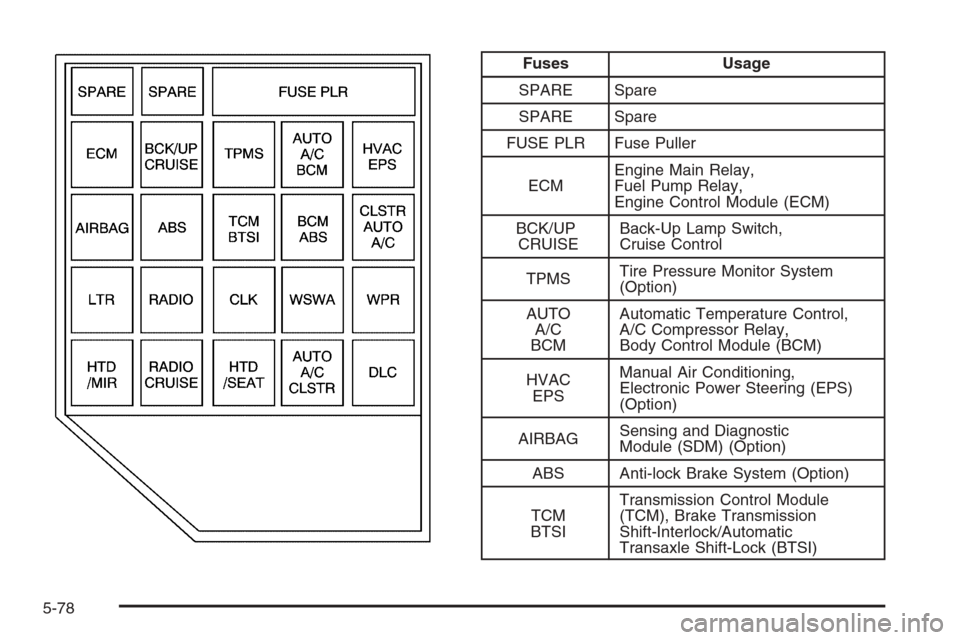
Fuses Usage
SPARE Spare
SPARE Spare
FUSE PLR Fuse Puller
ECMEngine Main Relay,
Fuel Pump Relay,
Engine Control Module (ECM)
BCK/UP
CRUISEBack-Up Lamp Switch,
Cruise Control
TPMSTire Pressure Monitor System
(Option)
AUTO
A/C
BCMAutomatic Temperature Control,
A/C Compressor Relay,
Body Control Module (BCM)
HVAC
EPSManual Air Conditioning,
Electronic Power Steering (EPS)
(Option)
AIRBAGSensing and Diagnostic
Module (SDM) (Option)
ABS Anti-lock Brake System (Option)
TCM
BTSITransmission Control Module
(TCM), Brake Transmission
Shift-Interlock/Automatic
Transaxle Shift-Lock (BTSI)
5-78
Page 329 of 368
Starter Switch Check
{CAUTION:
When you are doing this inspection, the
vehicle could move suddenly. If the vehicle
moves, you or others could be injured.
1. Before you start, be sure you have enough room
around the vehicle.
2. Firmly apply both the parking brake and the regular
brake. SeeParking Brake on page 2-25.
Do not use the accelerator pedal, and be ready to
turn off the engine immediately if it starts.
3. Try to start the engine in each gear. The vehicle
should start only in PARK (P) or NEUTRAL (N).
If the vehicle starts in any other position, your
vehicle needs service.
Automatic Transaxle Shift Lock Control
System Check
{CAUTION:
When you are doing this inspection, the
vehicle could move suddenly. If the vehicle
moves, you or others could be injured.
1. Before you start, be sure you have enough room
around the vehicle. It should be parked on a level
surface.
2. Firmly apply the parking brake. SeeParking Brake
on page 2-25.
Be ready to apply the regular brake immediately if
the vehicle begins to move.
3. With the engine off, turn the ignition to ON, but do
not start the engine. Without applying the regular
brake, try to move the shift lever out of PARK (P)
with normal effort. If the shift lever moves out
of PARK (P), your vehicle needs service.
6-21
Page 330 of 368
Ignition Transaxle Lock Check
While parked, and with the parking brake set, try to
turn the ignition to LOCK in each shift lever position.
•The ignition should turn to LOCK only when the
shift lever is in PARK (P).
•The key should come out only in LOCK.
Parking Brake and Automatic Transaxle
Park (P) Mechanism Check
{CAUTION:
When you are doing this check, your vehicle
could begin to move. You or others could
be injured and property could be damaged.
Make sure there is room in front of your
vehicle in case it begins to roll. Be ready to
apply the regular brake at once should the
vehicle begin to move.Park on a fairly steep hill, with the vehicle facing
downhill. Keeping your foot on the regular brake,
set the parking brake.
•To check the parking brake’s holding ability: With
the engine running and transaxle in NEUTRAL (N),
slowly remove foot pressure from the regular
brake pedal. Do this until the vehicle is held by
the parking brake only.
•To check the PARK (P) mechanism’s holding
ability: With the engine running, shift to PARK (P).
Then release the parking brake followed by the
regular brake.
Underbody Flushing Service
At least every spring, use plain water to flush any
corrosive materials from the underbody. Take care to
clean thoroughly any areas where mud and other
debris can collect.
6-22
Page 363 of 368
Maintenance Schedule (cont.)
Steering, Suspension and Front Drive
Axle Boot and Seal Inspection...................6-23
Throttle System Inspection............................6-24
Using.......................................................... 6-4
Your Vehicle and the Environment................... 6-2
Malfunction Indicator Light................................3-40
Manual Lumbar Controls.................................... 1-4
Manual Seats................................................... 1-2
Map Lamps ....................................................3-16
Mirrors
Automatic Dimming Rearview........................2-31
Manual Rearview Mirror................................2-31
Outside Convex Mirror.................................2-33
Outside Heated Mirrors................................2-33
Outside Power Mirrors..................................2-32
MyGMLink.com................................................ 7-3
N
New Vehicle Break-In......................................2-17
Normal Maintenance Replacement Parts............5-84
O
Odometer......................................................3-31
Odometer, Trip...............................................3-31
Off-Road Recovery..........................................4-13
Oil
Engine.......................................................5-13
Pressure Light.............................................3-43
Older Children, Restraints................................1-28
Online Owner Center........................................ 7-3
Other Warning Devices...................................... 3-6
Outlet Adjustment............................................3-27
Outside
Convex Mirror.............................................2-33
Heated Mirrors............................................2-33
Power Mirrors.............................................2-32
Owners, Canadian............................................... ii
PPark (P)
Shifting Into................................................2-26
Shifting Out of............................................2-28
9
Page 366 of 368
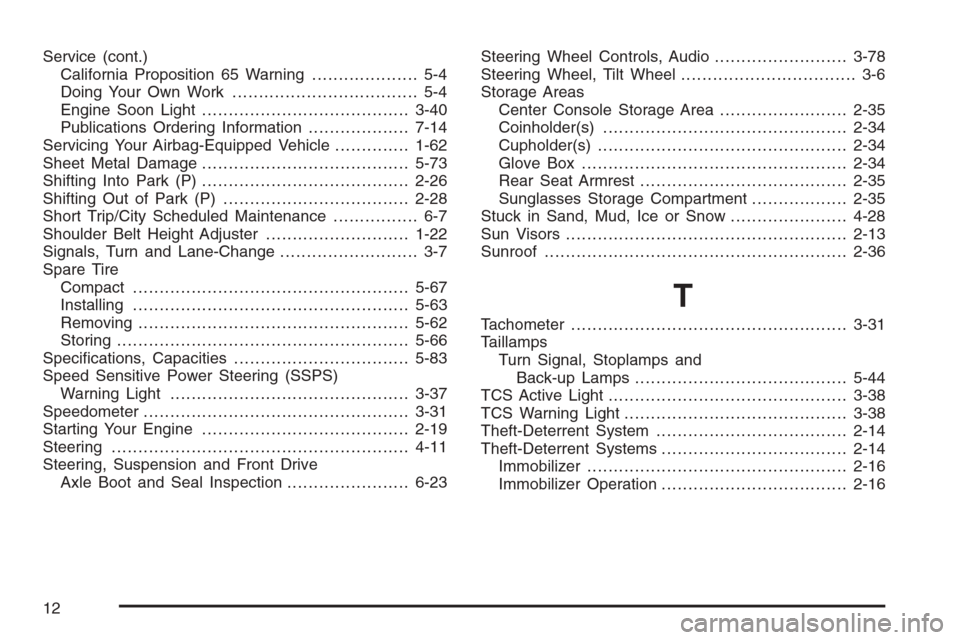
Service (cont.)
California Proposition 65 Warning.................... 5-4
Doing Your Own Work................................... 5-4
Engine Soon Light.......................................3-40
Publications Ordering Information...................7-14
Servicing Your Airbag-Equipped Vehicle..............1-62
Sheet Metal Damage.......................................5-73
Shifting Into Park (P).......................................2-26
Shifting Out of Park (P)...................................2-28
Short Trip/City Scheduled Maintenance................ 6-7
Shoulder Belt Height Adjuster...........................1-22
Signals, Turn and Lane-Change.......................... 3-7
Spare Tire
Compact....................................................5-67
Installing....................................................5-63
Removing...................................................5-62
Storing.......................................................5-66
Specifications, Capacities.................................5-83
Speed Sensitive Power Steering (SSPS)
Warning Light.............................................3-37
Speedometer..................................................3-31
Starting Your Engine.......................................2-19
Steering........................................................4-11
Steering, Suspension and Front Drive
Axle Boot and Seal Inspection.......................6-23Steering Wheel Controls, Audio.........................3-78
Steering Wheel, Tilt Wheel................................. 3-6
Storage Areas
Center Console Storage Area........................2-35
Coinholder(s)..............................................2-34
Cupholder(s)...............................................2-34
Glove Box..................................................2-34
Rear Seat Armrest.......................................2-35
Sunglasses Storage Compartment..................2-35
Stuck in Sand, Mud, Ice or Snow......................4-28
Sun Visors.....................................................2-13
Sunroof.........................................................2-36
T
Tachometer....................................................3-31
Taillamps
Turn Signal, Stoplamps and
Back-up Lamps........................................5-44
TCS Active Light.............................................3-38
TCS Warning Light..........................................3-38
Theft-Deterrent System....................................2-14
Theft-Deterrent Systems...................................2-14
Immobilizer.................................................2-16
Immobilizer Operation...................................2-16
12