brake fluid CHEVROLET EPICA 2006 1.G Owners Manual
[x] Cancel search | Manufacturer: CHEVROLET, Model Year: 2006, Model line: EPICA, Model: CHEVROLET EPICA 2006 1.GPages: 368, PDF Size: 2.24 MB
Page 225 of 368
Service............................................................5-3
Accessories and Modifications..........................5-3
California Proposition 65 Warning.....................5-4
Doing Your Own Service Work.........................5-4
Adding Equipment to the Outside
of Your Vehicle...........................................5-5
Fuel................................................................5-5
Gasoline Octane............................................5-5
Gasoline Specifications....................................5-5
California Fuel...............................................5-6
Additives.......................................................5-6
Fuels in Foreign Countries...............................5-7
Filling the Tank..............................................5-8
Filling a Portable Fuel Container.....................5-10
Checking Things Under the Hood....................5-11
Hood Release..............................................5-11
Engine Compartment Overview.......................5-12
Engine Oil...................................................5-13
Engine Air Cleaner/Filter................................5-17
Automatic Transaxle Fluid..............................5-19
Engine Coolant.............................................5-19
Coolant Surge Tank Pressure Cap..................5-22
Engine Overheating.......................................5-22
Cooling System............................................5-24
Power Steering Fluid.....................................5-29Windshield Washer Fluid................................5-30
Brakes........................................................5-31
Battery........................................................5-34
Jump Starting...............................................5-35
Headlamp Aiming...........................................5-38
Bulb Replacement..........................................5-39
Halogen Bulbs..............................................5-39
Headlamps..................................................5-39
Front Turn Signal Lamps...............................5-41
Center High-Mounted Stoplamp (CHMSL).........5-42
Parking Lamps.............................................5-43
Taillamps, Turn Signal, Stoplamps and
Back-up Lamps.........................................5-44
Replacement Bulbs.......................................5-44
Windshield Wiper Blade Replacement..............5-45
Tires..............................................................5-46
Tire Sidewall Labeling...................................5-47
Tire Terminology and Definitions.....................5-49
Inflation - Tire Pressure.................................5-52
Tire Inspection and Rotation...........................5-53
When It Is Time for New Tires.......................5-54
Buying New Tires.........................................5-55
Different Size Tires and Wheels......................5-56
Uniform Tire Quality Grading..........................5-56
Section 5 Service and Appearance Care
5-1
Page 237 of 368
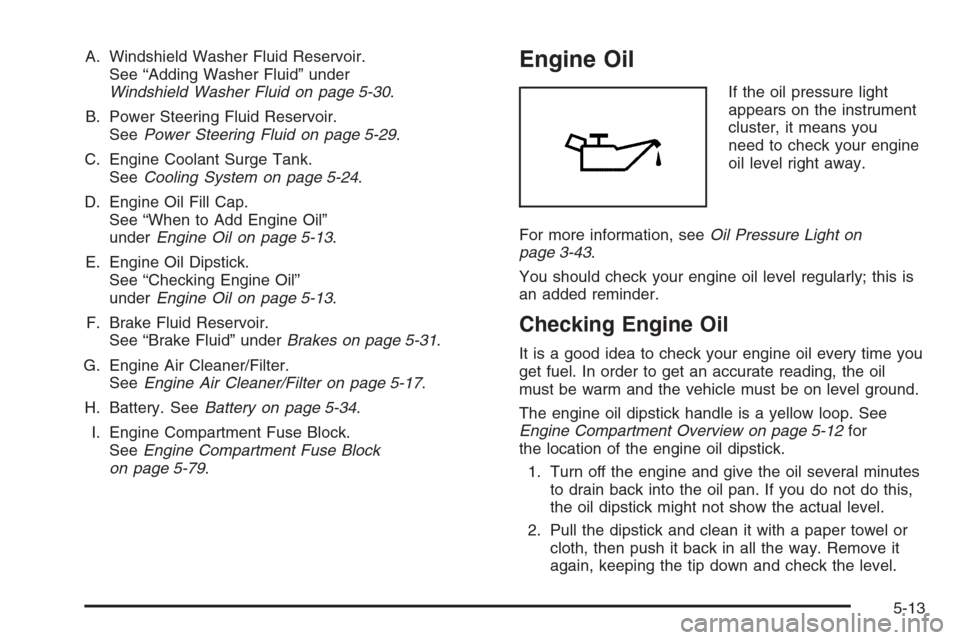
A. Windshield Washer Fluid Reservoir.
See “Adding Washer Fluid” under
Windshield Washer Fluid on page 5-30.
B. Power Steering Fluid Reservoir.
SeePower Steering Fluid on page 5-29.
C. Engine Coolant Surge Tank.
SeeCooling System on page 5-24.
D. Engine Oil Fill Cap.
See “When to Add Engine Oil”
underEngine Oil on page 5-13.
E. Engine Oil Dipstick.
See “Checking Engine Oil”
underEngine Oil on page 5-13.
F. Brake Fluid Reservoir.
See “Brake Fluid” underBrakes on page 5-31.
G. Engine Air Cleaner/Filter.
SeeEngine Air Cleaner/Filter on page 5-17.
H. Battery. SeeBattery on page 5-34.
I. Engine Compartment Fuse Block.
SeeEngine Compartment Fuse Block
on page 5-79.Engine Oil
If the oil pressure light
appears on the instrument
cluster, it means you
need to check your engine
oil level right away.
For more information, seeOil Pressure Light on
page 3-43.
You should check your engine oil level regularly; this is
an added reminder.
Checking Engine Oil
It is a good idea to check your engine oil every time you
get fuel. In order to get an accurate reading, the oil
must be warm and the vehicle must be on level ground.
The engine oil dipstick handle is a yellow loop. See
Engine Compartment Overview on page 5-12for
the location of the engine oil dipstick.
1. Turn off the engine and give the oil several minutes
to drain back into the oil pan. If you do not do this,
the oil dipstick might not show the actual level.
2. Pull the dipstick and clean it with a paper towel or
cloth, then push it back in all the way. Remove it
again, keeping the tip down and check the level.
5-13
Page 255 of 368
Brakes
Brake Fluid
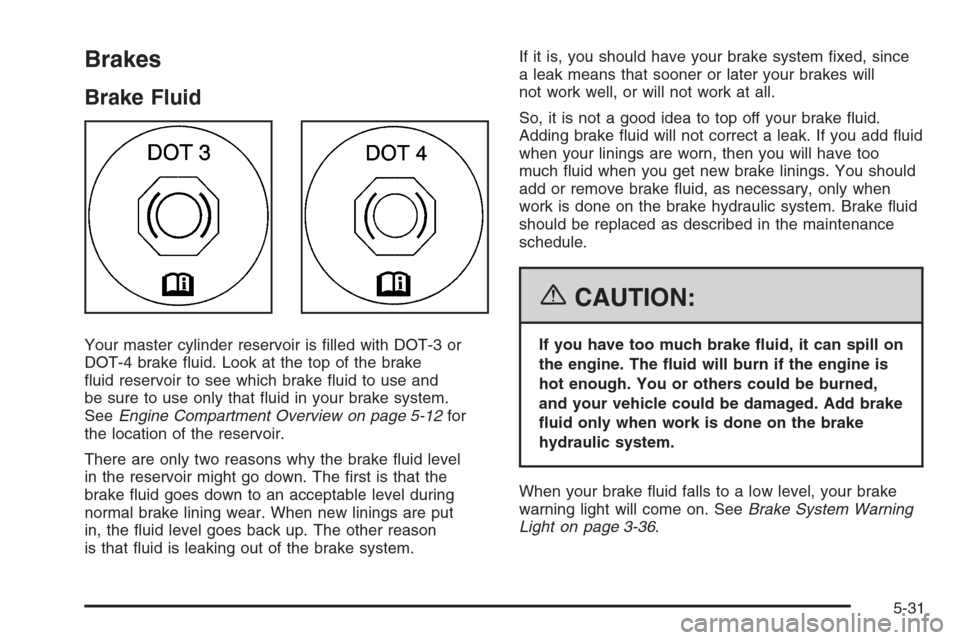
Your master cylinder reservoir is filled with DOT-3 or
DOT-4 brake fluid. Look at the top of the brake
fluid reservoir to see which brake fluid to use and
be sure to use only that fluid in your brake system.
SeeEngine Compartment Overview on page 5-12for
the location of the reservoir.
There are only two reasons why the brake fluid level
in the reservoir might go down. The first is that the
brake fluid goes down to an acceptable level during
normal brake lining wear. When new linings are put
in, the fluid level goes back up. The other reason
is that fluid is leaking out of the brake system.If it is, you should have your brake system fixed, since
a leak means that sooner or later your brakes will
not work well, or will not work at all.
So, it is not a good idea to top off your brake fluid.
Adding brake fluid will not correct a leak. If you add fluid
when your linings are worn, then you will have too
much fluid when you get new brake linings. You should
add or remove brake fluid, as necessary, only when
work is done on the brake hydraulic system. Brake fluid
should be replaced as described in the maintenance
schedule.
{CAUTION:
If you have too much brake uid, it can spill on
the engine. The uid will burn if the engine is
hot enough. You or others could be burned,
and your vehicle could be damaged. Add brake
uid only when work is done on the brake
hydraulic system.
When your brake fluid falls to a low level, your brake
warning light will come on. SeeBrake System Warning
Light on page 3-36.
5-31
Page 256 of 368
What to Add
When you do need brake fluid, use only the brake fluid
recommended. Use new brake fluid from a sealed
container only. SeePart D: Recommended Fluids and
Lubricants on page 6-25.
Always clean the brake fluid reservoir cap and the
area around the cap before removing it. This will help
keep dirt from entering the reservoir.
{CAUTION:
With the wrong kind of uid in your brake
system, your brakes may not work well, or they
may not even work at all. This could cause a
crash. Always use the proper brake uid.Notice:
Using the wrong uid can badly damage brake
system parts. For example, just a few drops
of mineral-based oil, such as engine oil, in your
brake system can damage brake system parts
so badly that they will have to be replaced.
Do not let someone put in the wrong kind
of uid.
If you spill brake uid on your vehicle’s painted
surfaces, the paint nish can be damaged. Be
careful not to spill brake uid on your vehicle.
If you do, wash it off immediately. SeeWashing
Your Vehicle on page 5-70.
Brake Wear
Your vehicle has four-wheel disc brakes.
Disc brake pads have built-in wear indicators that
make a high-pitched warning sound when the
brake pads are worn and new pads are needed.
The sound may come and go or be heard all the
time your vehicle is moving, except when you are
pushing on the brake pedal firmly.
5-32
Page 307 of 368
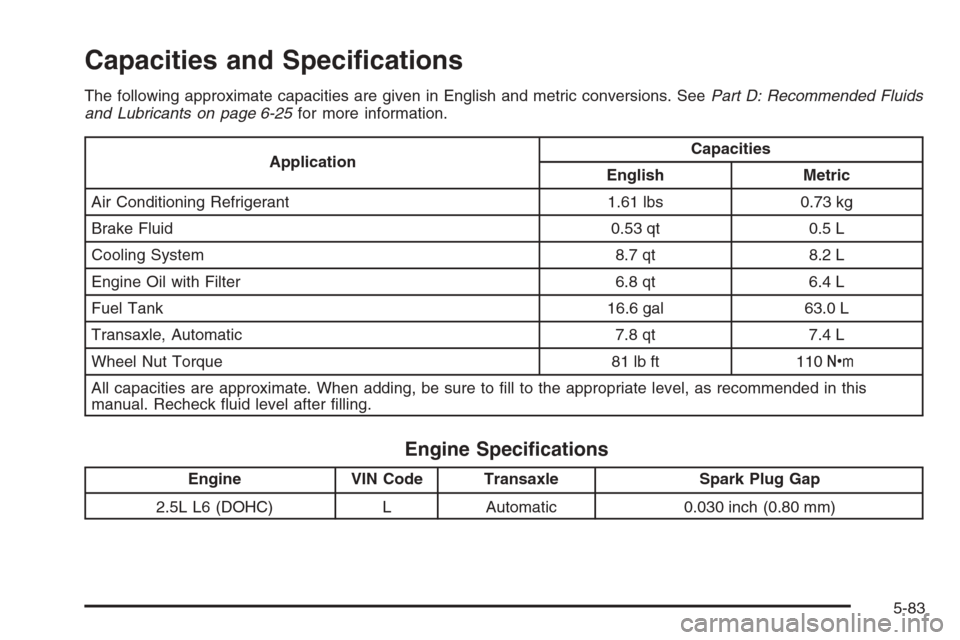
Capacities and Specications
The following approximate capacities are given in English and metric conversions. SeePart D: Recommended Fluids
and Lubricants on page 6-25for more information.
ApplicationCapacities
English Metric
Air Conditioning Refrigerant 1.61 lbs 0.73 kg
Brake Fluid 0.53 qt 0.5 L
Cooling System 8.7 qt 8.2 L
Engine Oil with Filter 6.8 qt 6.4 L
Fuel Tank 16.6 gal 63.0 L
Transaxle, Automatic 7.8 qt 7.4 L
Wheel Nut Torque 81 lb ft 110Y
All capacities are approximate. When adding, be sure to fill to the appropriate level, as recommended in this
manual. Recheck fluid level after filling.
Engine Specications
Engine VIN Code Transaxle Spark Plug Gap
2.5L L6 (DOHC) L Automatic 0.030 inch (0.80 mm)
5-83
Page 309 of 368
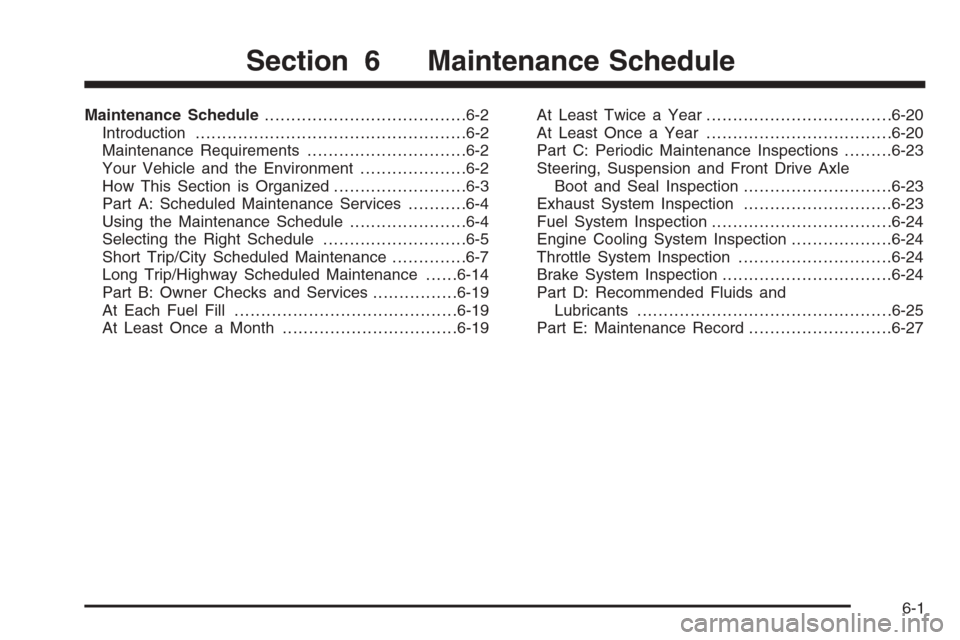
Maintenance Schedule......................................6-2
Introduction...................................................6-2
Maintenance Requirements..............................6-2
Your Vehicle and the Environment....................6-2
How This Section is Organized.........................6-3
Part A: Scheduled Maintenance Services...........6-4
Using the Maintenance Schedule......................6-4
Selecting the Right Schedule...........................6-5
Short Trip/City Scheduled Maintenance..............6-7
Long Trip/Highway Scheduled Maintenance......6-14
Part B: Owner Checks and Services................6-19
At Each Fuel Fill..........................................6-19
At Least Once a Month.................................6-19At Least Twice a Year...................................6-20
At Least Once a Year...................................6-20
Part C: Periodic Maintenance Inspections.........6-23
Steering, Suspension and Front Drive Axle
Boot and Seal Inspection............................6-23
Exhaust System Inspection............................6-23
Fuel System Inspection..................................6-24
Engine Cooling System Inspection...................6-24
Throttle System Inspection.............................6-24
Brake System Inspection................................6-24
Part D: Recommended Fluids and
Lubricants................................................6-25
Part E: Maintenance Record...........................6-27
Section 6 Maintenance Schedule
6-1
Page 313 of 368
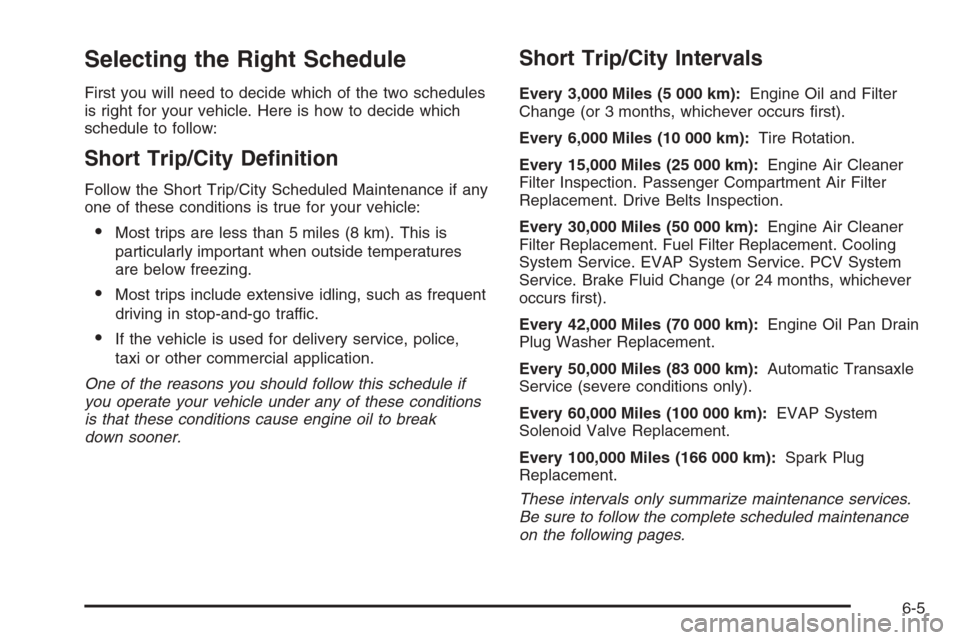
Selecting the Right Schedule
First you will need to decide which of the two schedules
is right for your vehicle. Here is how to decide which
schedule to follow:
Short Trip/City Denition
Follow the Short Trip/City Scheduled Maintenance if any
one of these conditions is true for your vehicle:
•Most trips are less than 5 miles (8 km). This is
particularly important when outside temperatures
are below freezing.
•Most trips include extensive idling, such as frequent
driving in stop-and-go traffic.
•If the vehicle is used for delivery service, police,
taxi or other commercial application.
One of the reasons you should follow this schedule if
you operate your vehicle under any of these conditions
is that these conditions cause engine oil to break
down sooner.
Short Trip/City Intervals
Every 3,000 Miles (5 000 km):Engine Oil and Filter
Change (or 3 months, whichever occurs first).
Every 6,000 Miles (10 000 km):Tire Rotation.
Every 15,000 Miles (25 000 km):Engine Air Cleaner
Filter Inspection. Passenger Compartment Air Filter
Replacement. Drive Belts Inspection.
Every 30,000 Miles (50 000 km):Engine Air Cleaner
Filter Replacement. Fuel Filter Replacement. Cooling
System Service. EVAP System Service. PCV System
Service. Brake Fluid Change (or 24 months, whichever
occurs first).
Every 42,000 Miles (70 000 km):Engine Oil Pan Drain
Plug Washer Replacement.
Every 50,000 Miles (83 000 km):Automatic Transaxle
Service (severe conditions only).
Every 60,000 Miles (100 000 km):EVAP System
Solenoid Valve Replacement.
Every 100,000 Miles (166 000 km):Spark Plug
Replacement.
These intervals only summarize maintenance services.
Be sure to follow the complete scheduled maintenance
on the following pages.
6-5
Page 314 of 368
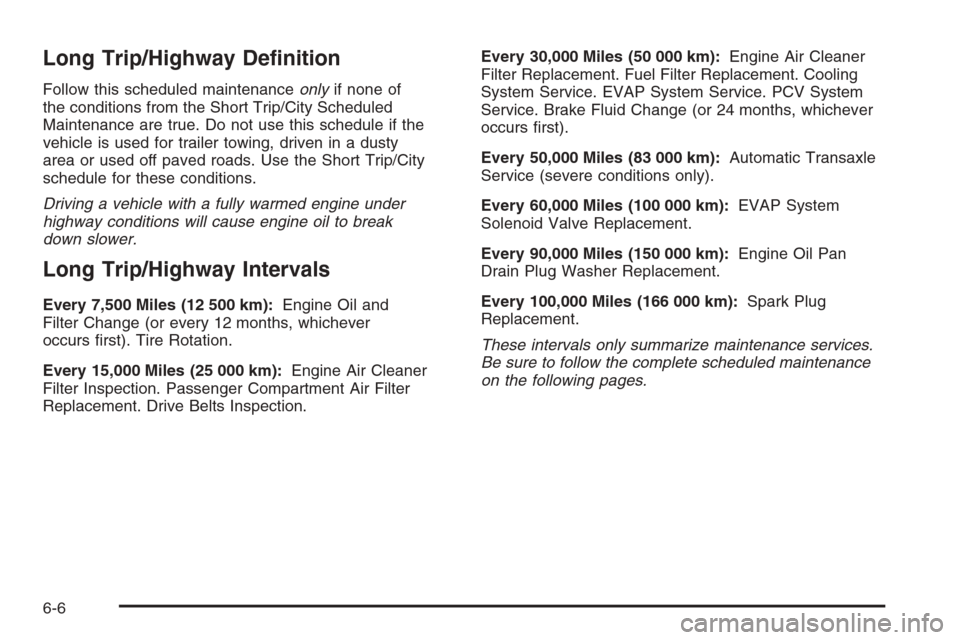
Long Trip/Highway Denition
Follow this scheduled maintenanceonlyif none of
the conditions from the Short Trip/City Scheduled
Maintenance are true. Do not use this schedule if the
vehicle is used for trailer towing, driven in a dusty
area or used off paved roads. Use the Short Trip/City
schedule for these conditions.
Driving a vehicle with a fully warmed engine under
highway conditions will cause engine oil to break
down slower.
Long Trip/Highway Intervals
Every 7,500 Miles (12 500 km):Engine Oil and
Filter Change (or every 12 months, whichever
occurs first). Tire Rotation.
Every 15,000 Miles (25 000 km):Engine Air Cleaner
Filter Inspection. Passenger Compartment Air Filter
Replacement. Drive Belts Inspection.Every 30,000 Miles (50 000 km):Engine Air Cleaner
Filter Replacement. Fuel Filter Replacement. Cooling
System Service. EVAP System Service. PCV System
Service. Brake Fluid Change (or 24 months, whichever
occurs first).
Every 50,000 Miles (83 000 km):Automatic Transaxle
Service (severe conditions only).
Every 60,000 Miles (100 000 km):EVAP System
Solenoid Valve Replacement.
Every 90,000 Miles (150 000 km):Engine Oil Pan
Drain Plug Washer Replacement.
Every 100,000 Miles (166 000 km):Spark Plug
Replacement.
These intervals only summarize maintenance services.
Be sure to follow the complete scheduled maintenance
on the following pages.
6-6
Page 333 of 368
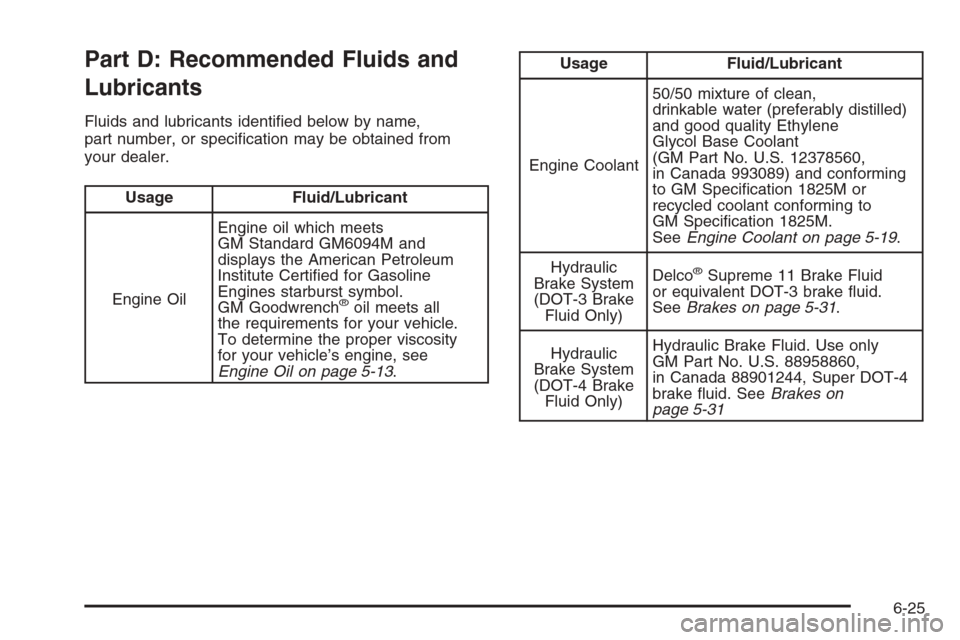
Part D: Recommended Fluids and
Lubricants
Fluids and lubricants identified below by name,
part number, or specification may be obtained from
your dealer.
Usage Fluid/Lubricant
Engine OilEngine oil which meets
GM Standard GM6094M and
displays the American Petroleum
Institute Certified for Gasoline
Engines starburst symbol.
GM Goodwrench
®oil meets all
the requirements for your vehicle.
To determine the proper viscosity
for your vehicle’s engine, see
Engine Oil on page 5-13.
Usage Fluid/Lubricant
Engine Coolant50/50 mixture of clean,
drinkable water (preferably distilled)
and good quality Ethylene
Glycol Base Coolant
(GM Part No. U.S. 12378560,
in Canada 993089) and conforming
to GM Specification 1825M or
recycled coolant conforming to
GM Specification 1825M.
SeeEngine Coolant on page 5-19.
Hydraulic
Brake System
(DOT-3 Brake
Fluid Only)Delco
®Supreme 11 Brake Fluid
or equivalent DOT-3 brake fluid.
SeeBrakes on page 5-31.
Hydraulic
Brake System
(DOT-4 Brake
Fluid Only)Hydraulic Brake Fluid. Use only
GM Part No. U.S. 88958860,
in Canada 88901244, Super DOT-4
brake fluid. SeeBrakes on
page 5-31
6-25
Page 356 of 368
Audio System(s) (cont.)
Integrated Windshield Antenna.......................3-81
Radio with CD............................3-48, 3-52, 3-59
Radio with Six-Disc CD................................3-67
Trunk-Mounted CD Changer..........................3-75
Understanding Radio Reception.....................3-79
Automatic Climate Control System.....................3-22
Automatic Transaxle
Fluid..........................................................5-19
Operation...................................................2-21
B
Backglass Antenna..........................................3-80
Battery..........................................................5-34
Before Leaving on a Long Trip.........................4-21
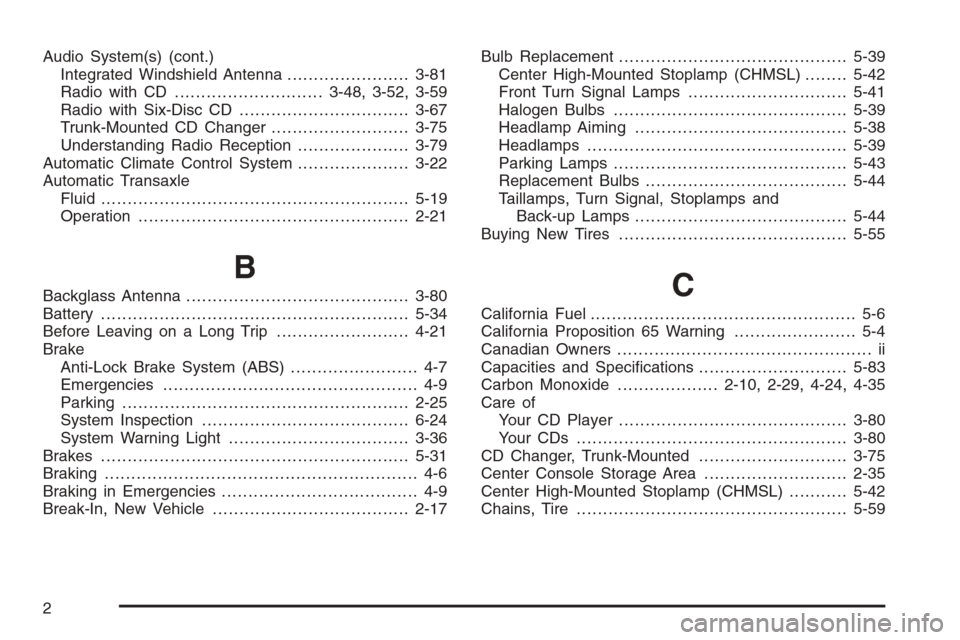
Brake
Anti-Lock Brake System (ABS)........................ 4-7
Emergencies................................................ 4-9
Parking......................................................2-25
System Inspection.......................................6-24
System Warning Light..................................3-36
Brakes..........................................................5-31
Braking........................................................... 4-6
Braking in Emergencies..................................... 4-9
Break-In, New Vehicle.....................................2-17Bulb Replacement...........................................5-39
Center High-Mounted Stoplamp (CHMSL)........5-42
Front Turn Signal Lamps..............................5-41
Halogen Bulbs............................................5-39
Headlamp Aiming........................................5-38
Headlamps.................................................5-39
Parking Lamps............................................5-43
Replacement Bulbs......................................5-44
Taillamps, Turn Signal, Stoplamps and
Back-up Lamps........................................5-44
Buying New Tires...........................................5-55C
California Fuel.................................................. 5-6
California Proposition 65 Warning....................... 5-4
Canadian Owners................................................ ii
Capacities and Specifications............................5-83
Carbon Monoxide...................2-10, 2-29, 4-24, 4-35
Care of
Your CD Player...........................................3-80
Your CDs ...................................................3-80
CD Changer, Trunk-Mounted............................3-75
Center Console Storage Area...........................2-35
Center High-Mounted Stoplamp (CHMSL)...........5-42
Chains, Tire...................................................5-59
2