check engine light CHEVROLET EQUINOX 2007 1.G User Guide
[x] Cancel search | Manufacturer: CHEVROLET, Model Year: 2007, Model line: EQUINOX, Model: CHEVROLET EQUINOX 2007 1.GPages: 492, PDF Size: 2.62 MB
Page 187 of 492
If the vehicle is idling at a stop sign, the light
may blink on and then off.
If you make a hard stop, the light may come
on for a moment. This is normal.
{CAUTION:
Do not keep driving if the oil pressure is
low. If you do, your engine can become so
hot that it catches re. You or others could
be burned. Check your oil as soon as
possible and have your vehicle serviced.
Notice:Lack of proper engine oil maintenance
may damage the engine. The repairs would
not be covered by your warranty. Always follow
the maintenance schedule in this manual for
changing engine oil.
Change Engine Oil Light
If this light comes
on and stays on for
30 seconds, it means
that service is required
for your vehicle.
After having the oil changed you will need to
reset the light. SeeEngine Oil on page 344
andScheduled Maintenance on page 439for
more information.
187
Page 200 of 492
CHECK TIRE PRESSURE
This message displays when the tire pressure
in one of the tires needs to be checked. This
message also displays LEFT FRONT, RIGHT
FRONT, LEFT REAR, or RIGHT REAR to indicate
which tire needs to be checked. You can receive
more than one tire pressure message at a time.
To read the other messages that may have
been sent at the same time, press the set/reset
button. If a tire pressure message appears on
the DIC, stop as soon as you can. Have the tire
pressures checked and set to those shown on
the Tire Loading Information label. SeeTires on
page 382,Loading Your Vehicle on page 315, and
Ination - Tire Pressure on page 390. The DIC
display also shows the tire pressure values for
the front and rear tires by pressing the vehicle
information button. SeeDIC Operation and
Displays on page 193. If the tire pressure is low,
the low tire pressure warning light comes on.
SeeTire Pressure Light on page 182.
DRIVER DOOR OPEN
This message displays when the driver’s door is
not closed properly. When this message appears,
make sure that the driver’s door is closed
completely.
ENGINE HOT A/C
(Air Conditioning) OFF
This message displays when the engine coolant
becomes hotter than the normal operating
temperature. To avoid added strain on a hot
engine, the air conditioning compressor is
automatically turned off. When the coolant
temperature returns to normal, the A/C operation
automatically resumes. You can continue to
drive your vehicle.
200
Page 289 of 492
Avoid needless heavy braking. Some people
drive in spurts — heavy acceleration followed
by heavy braking — rather than keeping pace
with traffic. This is a mistake. The brakes may
not have time to cool between hard stops.
The brakes will wear out much faster if you do
a lot of heavy braking. If you keep pace with
the traffic and allow realistic following distances,
you will eliminate a lot of unnecessary braking.
That means better braking and longer brake life.
If your vehicle’s engine ever stops while you
are driving, brake normally but do not pump the
brakes. If you do, the pedal may get harder
to push down. If the engine stops, you will still
have some power brake assist. But you will use
it when you brake. Once the power assist is
used up, it may take longer to stop and the
brake pedal will be harder to push.
Adding non-GM accessories can affect your
vehicle’s performance. SeeAccessories and
Modications on page 333.Anti-Lock Brake System (ABS)
Your vehicle has the Anti-Lock Brake
System (ABS), an advanced electronic braking
system that will help prevent a braking skid.
When you start your engine and begin to drive
away, ABS will check itself. You may hear a
momentary motor or clicking noise while this test
is going on, and you may even notice that
your brake pedal moves a little. This is normal.
If there is a problem
with ABS, this warning
light will stay on.
SeeAnti-Lock Brake
System Warning
Light on page 180.
289
Page 313 of 492
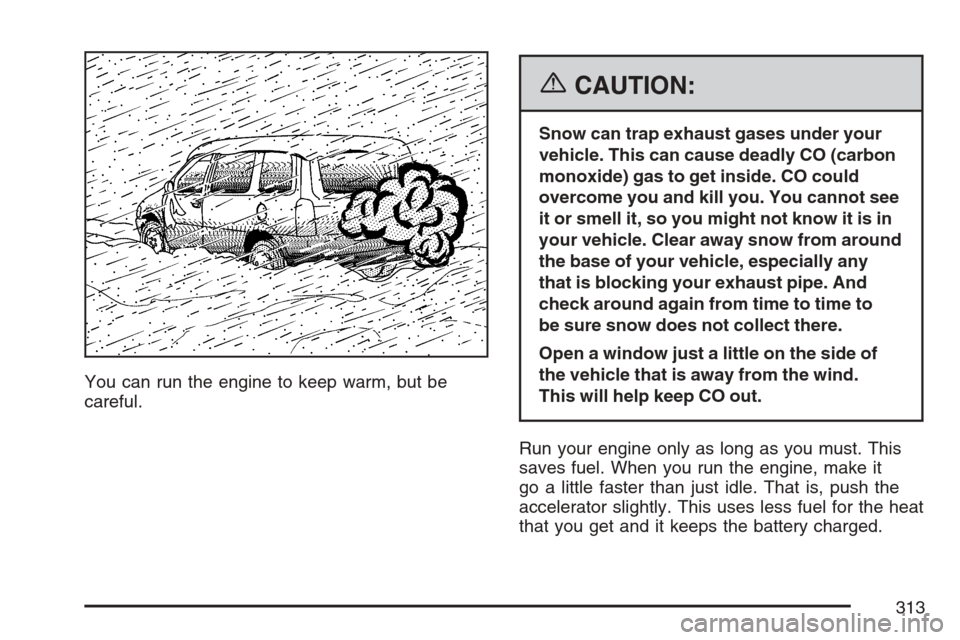
You can run the engine to keep warm, but be
careful.
{CAUTION:
Snow can trap exhaust gases under your
vehicle. This can cause deadly CO (carbon
monoxide) gas to get inside. CO could
overcome you and kill you. You cannot see
it or smell it, so you might not know it is in
your vehicle. Clear away snow from around
the base of your vehicle, especially any
that is blocking your exhaust pipe. And
check around again from time to time to
be sure snow does not collect there.
Open a window just a little on the side of
the vehicle that is away from the wind.
This will help keep CO out.
Run your engine only as long as you must. This
saves fuel. When you run the engine, make it
go a little faster than just idle. That is, push the
accelerator slightly. This uses less fuel for the heat
that you get and it keeps the battery charged.
313
Page 347 of 492
Notice:Use only engine oil identied as
meeting GM Standard GM6094M and showing
the American Petroleum Institute Certied For
Gasoline Engines starburst symbol. Failure to
use the recommended oil can result in engine
damage not covered by your warranty.
GM Goodwrench
®oil meets all the requirements
for your vehicle.
Engine Oil Additives
Do not add anything to the oil. The recommended
oils with the starburst symbol that meet GM
Standard GM6094M are all you will need for good
performance and engine protection.
Engine Oil Life System
When to Change Engine Oil
Your vehicle has a computer system that lets you
know when to change the engine oil and lter. This
is based on engine revolutions and engine
temperature, and not on mileage. Based on driving
conditions, the mileage at which an oil change will
be indicated can vary considerably. For the oil life
system to work properly, you must reset the system
every time the oil is changed.When the system has calculated that oil life has
been diminished, it will indicate that an oil change is
necessary. A change engine oil light and a
CHANGE ENGINE OIL SOON message will come
on. Change your oil as soon as possible within the
next 600 miles (1 000 km). It is possible that, if you
are driving under the best conditions, the oil life
system may not indicate that an oil change is
necessary for over a year. However, your engine oil
and lter must be changed at least once a year and
at this time the system must be reset. Your dealer
has GM-trained service people who will perform this
work using genuine GM parts and reset the system.
It is also important to check your oil regularly and
keep it at the proper level.
If the system is ever reset accidentally, you must
change your oil at 3,000 miles (5 000 km)
since your last oil change. Remember to reset the
oil life system whenever the oil is changed.
347
Page 352 of 492
Automatic Transaxle Fluid
It is not necessary to check the transaxle uid
level. A transaxle uid leak is the only reason for
uid loss. If a leak occurs, take your vehicle to
the dealership service department and have
it repaired as soon as possible.
Change the uid at the intervals listed inAdditional
Required Services on page 442, and be sure to
use the transaxle uid listed inRecommended
Fluids and Lubricants on page 448.
Notice:Use of the incorrect automatic
transaxle uid may damage your vehicle, and
the damages may not be covered by your
warranty. Always use the automatic transaxle
uid listed inRecommended Fluids and
Lubricants on page 448.
Engine Coolant
The cooling system in your vehicle is lled with
DEX-COOL®engine coolant. This coolant is
designed to remain in your vehicle for ve years or
150,000 miles (240 000 km), whichever occurs
rst, if you add only DEX-COOL
®extended
life coolant.The following explains your cooling system and
how to add coolant when it is low. If you have
a problem with engine overheating, seeEngine
Overheating on page 355.
A 50/50 mixture of clean, drinkable water and
DEX-COOL
®coolant will:
Give freezing protection down to
−34°F (−37°C).
Give boiling protection up to 265°F (129°C).
Protect against rust and corrosion.
Help keep the proper engine temperature.
Let the warning lights and gages work as
they should.
Notice:Using coolant other than DEX-COOL
®
may cause premature engine, heater core, or
radiator corrosion. In addition, the engine
coolant may require changing sooner, at the
rst maintenance service after each
30,000 miles (50 000 km) or 24 months,
whichever occurs rst. Any repairs would not
be covered by your warranty. Always use
DEX-COOL
®(silicate-free) coolant in your
vehicle.
352
Page 371 of 492
{CAUTION:
Using a match near a battery can cause
battery gas to explode. People have been
hurt doing this, and some have been
blinded. Use a ashlight if you need
more light.
Be sure the battery has enough water.
You do not need to add water to the
battery installed in your new vehicle. But
if a battery has ller caps, be sure the
right amount of uid is there. If it is low,
add water to take care of that rst. If you
do not, explosive gas could be present.
Battery uid contains acid that can
burn you. Do not get it on you. If you
accidentally get it in your eyes or on your
skin, ush the place with water and get
medical help immediately.
{CAUTION:
Fans or other moving engine parts can
injure you badly. Keep your hands away
from moving parts once the engine is
running.
5. Check that the jumper cables do not have
loose or missing insulation. If they do, you
could get a shock. The vehicles could
be damaged, too.
Before you connect the cables, here are some
basic things you should know. Positive (+)
will go to positive (+) or to a remote positive (+)
terminal if the vehicle has one. Negative (−)
will go to a heavy, unpainted metal engine part
or to a remote negative (−) terminal if the
vehicle has one.
Do not connect positive (+) to negative (−)
or you will get a short that would damage
the battery and maybe other parts, too.
And do not connect the negative (−) cable
to the negative (−) terminal on the dead
battery because this can cause sparks.
371
Page 439 of 492
If you want to purchase service information,
seeService Publications Ordering Information
on page 475.
Owner Checks and Services on page 444tells
you what should be checked, when to check it,
and what you can easily do to help keep your
vehicle in good condition.
The proper replacement parts, uids, and
lubricants to use are listed inRecommended
Fluids and Lubricants on page 448andNormal
Maintenance Replacement Parts on page 449.
When your vehicle is serviced, make sure these
are used. All parts should be replaced and all
necessary repairs done before you or anyone
else drives the vehicle. We recommend the use
of genuine GM parts.Scheduled Maintenance
When the change engine oil light and/or
CHANGE ENGINE OIL SOON message comes
on, it means that service is required for your
vehicle. Have your vehicle serviced as soon as
possible within the next 600 miles (1 000 km).
It is possible that, if you are driving under the best
conditions, the engine oil life system may not
indicate that vehicle service is necessary for over
a year. However, the engine oil and lter must
be changed at least once a year and at this time
the system must be reset. Your GM Goodwrench
®
dealer has GM-trained service technicians who
will perform this work using genuine GM parts and
reset the system.
439
Page 440 of 492
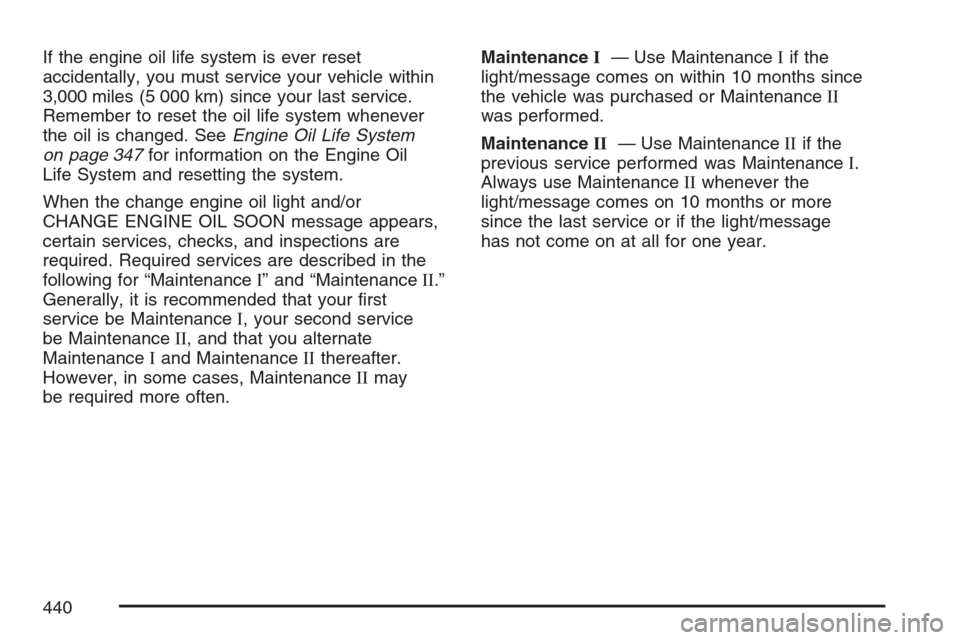
If the engine oil life system is ever reset
accidentally, you must service your vehicle within
3,000 miles (5 000 km) since your last service.
Remember to reset the oil life system whenever
the oil is changed. SeeEngine Oil Life System
on page 347for information on the Engine Oil
Life System and resetting the system.
When the change engine oil light and/or
CHANGE ENGINE OIL SOON message appears,
certain services, checks, and inspections are
required. Required services are described in the
following for “MaintenanceI” and “MaintenanceII.”
Generally, it is recommended that your rst
service be MaintenanceI, your second service
be MaintenanceII, and that you alternate
MaintenanceIand MaintenanceIIthereafter.
However, in some cases, MaintenanceIImay
be required more often.MaintenanceI— Use MaintenanceIif the
light/message comes on within 10 months since
the vehicle was purchased or MaintenanceII
was performed.
MaintenanceII— Use MaintenanceIIif the
previous service performed was MaintenanceI.
Always use MaintenanceIIwhenever the
light/message comes on 10 months or more
since the last service or if the light/message
has not come on at all for one year.
440
Page 479 of 492
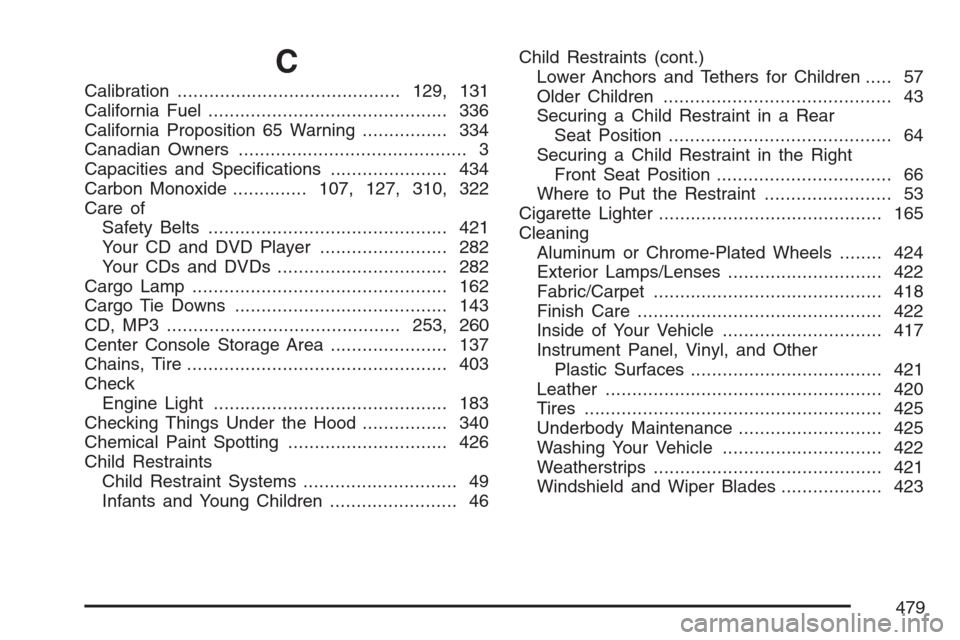
C
Calibration..........................................129, 131
California Fuel............................................. 336
California Proposition 65 Warning................ 334
Canadian Owners........................................... 3
Capacities and Specications...................... 434
Carbon Monoxide..............107, 127, 310, 322
Care of
Safety Belts............................................. 421
Your CD and DVD Player........................ 282
Your CDs and DVDs................................ 282
Cargo Lamp................................................ 162
Cargo Tie Downs........................................ 143
CD, MP3 ............................................253, 260
Center Console Storage Area...................... 137
Chains, Tire................................................. 403
Check
Engine Light............................................ 183
Checking Things Under the Hood................ 340
Chemical Paint Spotting.............................. 426
Child Restraints
Child Restraint Systems............................. 49
Infants and Young Children........................ 46Child Restraints (cont.)
Lower Anchors and Tethers for Children..... 57
Older Children........................................... 43
Securing a Child Restraint in a Rear
Seat Position.......................................... 64
Securing a Child Restraint in the Right
Front Seat Position................................. 66
Where to Put the Restraint........................ 53
Cigarette Lighter.......................................... 165
Cleaning
Aluminum or Chrome-Plated Wheels........ 424
Exterior Lamps/Lenses............................. 422
Fabric/Carpet........................................... 418
Finish Care.............................................. 422
Inside of Your Vehicle .............................. 417
Instrument Panel, Vinyl, and Other
Plastic Surfaces.................................... 421
Leather.................................................... 420
Tires........................................................ 425
Underbody Maintenance........................... 425
Washing Your Vehicle .............................. 422
Weatherstrips........................................... 421
Windshield and Wiper Blades................... 423
479