check engine light CHEVROLET EQUINOX 2009 1.G User Guide
[x] Cancel search | Manufacturer: CHEVROLET, Model Year: 2009, Model line: EQUINOX, Model: CHEVROLET EQUINOX 2009 1.GPages: 442, PDF Size: 2.46 MB
Page 168 of 442
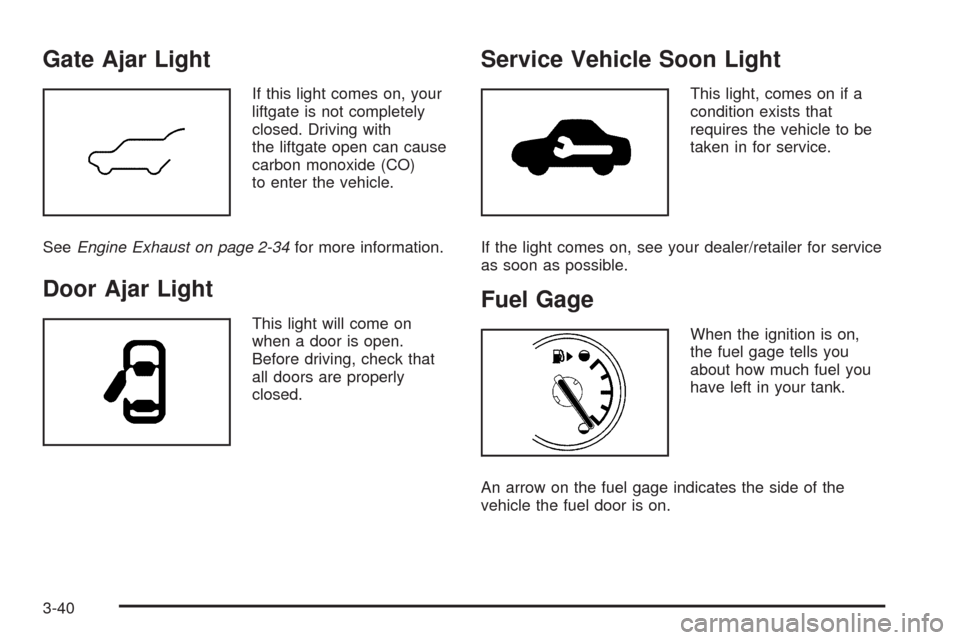
Gate Ajar Light
If this light comes on, your
liftgate is not completely
closed. Driving with
the liftgate open can cause
carbon monoxide (CO)
to enter the vehicle.
SeeEngine Exhaust on page 2-34for more information.
Door Ajar Light
This light will come on
when a door is open.
Before driving, check that
all doors are properly
closed.
Service Vehicle Soon Light
This light, comes on if a
condition exists that
requires the vehicle to be
taken in for service.
If the light comes on, see your dealer/retailer for service
as soon as possible.
Fuel Gage
When the ignition is on,
the fuel gage tells you
about how much fuel you
have left in your tank.
An arrow on the fuel gage indicates the side of the
vehicle the fuel door is on.
3-40
Page 173 of 442
Remember, you must reset the OIL LIFE yourself after
each oil change. It will not reset itself. Also, be careful not
to reset the OIL LIFE accidentally at any time other than
when the oil has just been changed. It cannot be reset
accurately until the next oil change. To reset the engine
oil life system, seeEngine Oil Life System on page 5-18.
UNITS
Press the vehicle information button until UNITS
displays. This display allows you to select between
English or Metric units of measurement. Once in this
display, press the set/reset button to select between
ENGLISH or METRIC units.
FRONT TIRES or REAR TIRES
The pressure for each tire can be viewed in the DIC.
The tire pressure will be shown in either pounds
per square inch (psi) or kilopascals (kPa). Press the
vehicle information button until the DIC displays FRONT
TIRES PSI (kPa) LF ## RF ##. Press the vehicle
information button again until the DIC displays REAR
TIRES PSI (kPa) LR ## RR ##.
If a low or high tire pressure condition is detected by the
system while driving, a message advising you to
check the pressure in a specic tire will appear in the
display. SeeInflation - Tire Pressure on page 5-59and
DIC Warnings and Messages on page 3-49for more
information.If the tire pressure display shows dashes instead of a
value, there may be a problem with your vehicle.
If this consistently occurs, see your dealer/retailer
for service.
BATTERY
Press the vehicle information button until BATTERY
displays. This display shows the current battery voltage.
If the voltage is normal, the display will show NORMAL.
If the voltage is low or high, the display will show
LOW or HIGH. Your vehicle’s charging system regulates
voltage based on the state of the battery. The battery
voltage may uctuate when viewing this information
on the DIC. This is normal. SeeCharging System Light
on page 3-29for more information.
If there is a problem with the battery charging system,
the DIC will display SERVICE BATTERY CHARGING
SYSTEM. See “SERVICE BATTERY CHARGING
SYSTEM” underDIC Warnings and Messages on
page 3-49. Also, seeElectric Power Management on
page 3-16for more information.
3-45
Page 178 of 442
CALIBRATING: DRIVE IN CIRCLES
This message displays when calibrating the compass.
Drive the vehicle in circles at less than 5 mph (8 km/h)
to complete the calibration. SeeDIC Compass on
page 3-47for more information.
CALIBRATION COMPLETE
This message displays when the compass calibration is
complete. SeeDIC Compass on page 3-47for more
information.
CHANGE ENGINE OIL SOON
This message displays and the Change Engine Oil Light
in the instrument panel cluster turns on when service
is required for the vehicle. See your dealer/retailer.
SeeChange Engine Oil Light on page 3-36,Engine Oil
on page 5-15andScheduled Maintenance on page 6-4
for more information.
Acknowledging this message will not reset the OIL LIFE
REMAINING display. That must be done at the OIL
LIFE screen under the vehicle information menu.
See “OIL LIFE” underDIC Operation and Displays on
page 3-42andEngine Oil Life System on page 5-18for
more information.
CHECK TIRE PRESSURE
This message displays when the pressure in one or
more of the vehicle’s tires needs to be checked.
This message also displays LEFT FRONT, RIGHT
FRNT (Front), LEFT REAR, or RIGHT REAR to indicate
which tire needs to be checked. You can receive
more than one tire pressure message at a time. To read
the other messages that may have been sent at the
same time, press the set/reset button. If a tire pressure
message appears on the DIC, stop as soon as you
can. Have the tire pressures checked and set to those
shown on the Tire Loading Information label. SeeTires
on page 5-52,Loading the Vehicle on page 4-20,
andInflation - Tire Pressure on page 5-59. The DIC
also shows the tire pressure values. SeeDIC Operation
and Displays on page 3-42. If the tire pressure is low,
the low tire pressure warning light comes on. SeeTire
Pressure Light on page 3-32.
DRIVER DOOR OPEN
This message displays when the driver door is not
closed properly. Close the door completely.
3-50
Page 251 of 442
Antilock Brake System (ABS)
This vehicle has the Antilock Brake System (ABS), an
advanced electronic braking system that will help
prevent a braking skid.
When the engine is started and the vehicle begins to
drive away, ABS checks itself. A momentary motor
or clicking noise might be heard while this test is going
on, and it might even be noticed that the brake pedal
moves a little. This is normal.
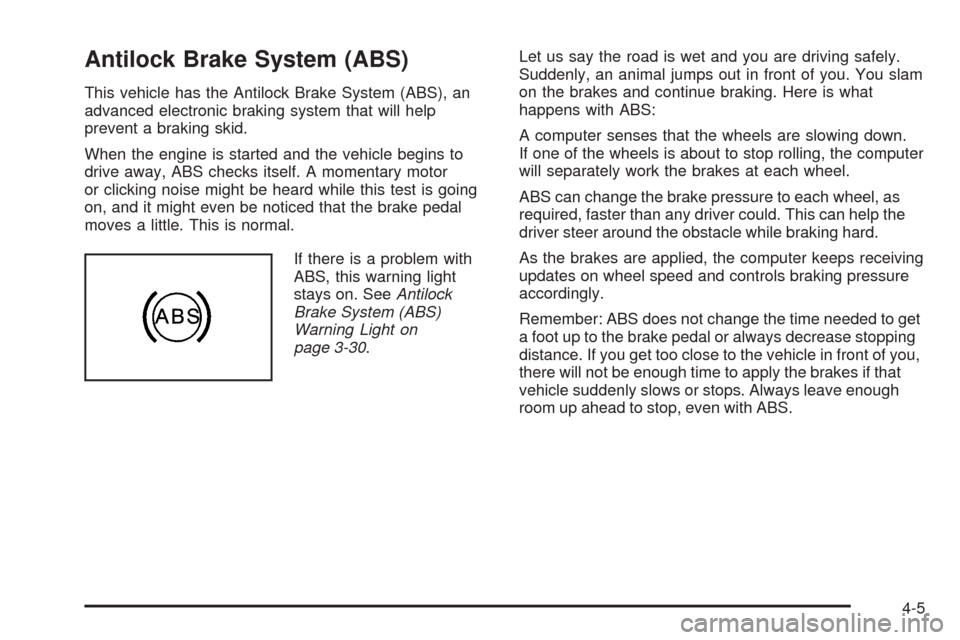
If there is a problem with
ABS, this warning light
stays on. SeeAntilock
Brake System (ABS)
Warning Light on
page 3-30.Let us say the road is wet and you are driving safely.
Suddenly, an animal jumps out in front of you. You slam
on the brakes and continue braking. Here is what
happens with ABS:
A computer senses that the wheels are slowing down.
If one of the wheels is about to stop rolling, the computer
will separately work the brakes at each wheel.
ABS can change the brake pressure to each wheel, as
required, faster than any driver could. This can help the
driver steer around the obstacle while braking hard.
As the brakes are applied, the computer keeps receiving
updates on wheel speed and controls braking pressure
accordingly.
Remember: ABS does not change the time needed to get
a foot up to the brake pedal or always decrease stopping
distance. If you get too close to the vehicle in front of you,
there will not be enough time to apply the brakes if that
vehicle suddenly slows or stops. Always leave enough
room up ahead to stop, even with ABS.
4-5
Page 283 of 442
Towing a trailer requires a certain amount of experience.
Get to know the rig before setting out for the open road.
Get acquainted with the feel of handling and braking with
the added weight of the trailer. And always keep in mind
that the vehicle you are driving is now longer and not as
responsive as the vehicle is by itself.
Before starting, check all trailer hitch parts and
attachments, safety chains, electrical connectors, lamps,
tires and mirror adjustments. If the trailer has electric
brakes, start the vehicle and trailer moving and then
apply the trailer brake controller by hand to be sure the
brakes are working. This checks the electrical connection
at the same time.
During the trip, check occasionally to be sure that the
load is secure, and that the lamps and any trailer brakes
are still working.Electronic Trailer Sway Control
Electronic Trailer Sway Control is integrated into the
StabiliTrak system of the vehicle. This feature detects
the occurrence of trailer sway that may be caused
by improper trailer weight balance, or excessive vehicle
speed. When the system detects trailer sway, the
StabiliTrak system may begin to apply the front brakes,
without you pressing the brake pedal, to help in
stabilizing the vehicle. The StabiliTrak warning light will
ash to indicate that vehicle speed should be reduced.
If the trailer continues to sway, StabiliTrak will reduce
engine torque as a method to reduce the speed of
the vehicle. Reducing the speed of the vehicle is
necessary to reduce trailer sway. Electronic Trailer
Sway Control is de-activated when StabiliTrak is turned
off, and is re-activated when it is turned back on.
SeeStabiliTrak
®System on page 4-6.
4-37
Page 304 of 442
Cold Temperature Operation
If in an area of extreme cold, where the temperature
falls below−20°F (−29°C), use either an SAE 5W-30
synthetic oil or an SAE 0W-30 engine oil. Both provide
easier cold starting for the engine at extremely low
temperatures. Always use an oil that meets the required
specication, GM6094M. See “What Kind of Engine
Oil to Use” for more information.
Engine Oil Additives / Engine Oil
Flushes
Do not add anything to the oil. The recommended
oils with the starburst symbol that meet GM Standard
GM6094M are all that is needed for good performance
and engine protection.
Engine oil system ushes are not recommended and
could cause engine damage not covered by the vehicle
warranty.
Engine Oil Life System
When to Change Engine Oil
This vehicle has a computer system that indicates when
to change the engine oil and lter. This is based on
engine revolutions and engine temperature, and not on
mileage. Based on driving conditions, the mileage at
which an oil change is indicated can vary considerably.
For the oil life system to work properly, the system
must be reset every time the oil is changed.
When the system has calculated that oil life has been
diminished, it indicates that an oil change is necessary.
A change engine oil light and a CHANGE ENGINE OIL
SOON message come on. Change the oil as soon as
possible within the next 600 miles (1 000 km). It is
possible that, if driving under the best conditions, the
oil life system might not indicate that an oil change is
necessary for over a year. However, the engine oil and
lter must be changed at least once a year and at this
time the system must be reset. Your dealer/retailer has
trained service people who will perform this work using
genuine parts and reset the system. It is also important
to check the oil regularly and keep it at the proper level.
If the system is ever reset accidentally, the oil must be
changed at 3,000 miles (5 000 km) since the last oil
change. Remember to reset the oil life system whenever
the oil is changed.
5-18
Page 396 of 442
Scheduled Maintenance
When the change engine oil light and/or CHANGE
ENGINE OIL SOON message displays, service is
required for the vehicle. Have the vehicle serviced as
soon as possible within the next 600 miles (1 000 km).
It is possible that, if driving under the best conditions,
the engine oil life system may not indicate that vehicle
service is necessary for over a year. However, the engine
oil and lter must be changed at least once a year and at
this time the system must be reset. Your dealer/retailer
has trained service technicians who will perform this work
using genuine parts and reset the system.
If the engine oil life system is ever reset accidentally,
service the vehicle within 3,000 miles (5 000 km) since
the last service. Remember to reset the oil life system
whenever the oil is changed. SeeEngine Oil Life System
on page 5-18for information on the Engine Oil Life
System and resetting the system.When the change engine oil light and/or CHANGE
ENGINE OIL SOON message appears, certain services,
checks, and inspections are required. Required services
are described in the following for “MaintenanceI” and
“MaintenanceII.” Generally, it is recommended that the
rst service be MaintenanceI, the second service be
MaintenanceII, and then alternate MaintenanceIand
MaintenanceIIthereafter. However, in some cases,
MaintenanceIImay be required more often.
MaintenanceI— Use MaintenanceIif the light/
message displays within 10 months since the vehicle
was purchased or MaintenanceIIwas performed.
MaintenanceII— Use MaintenanceIIif the previous
service performed was MaintenanceI. Always use
MaintenanceIIwhenever the light/message displays
10 months or more since the last service or if the
light/message has not come on at all for one year.
6-4
Page 399 of 442
Maintenance Footnotes
(a)Visually inspect brake lines and hoses for proper
hook-up, binding, leaks, cracks, chafing, etc. Inspect
disc brake pads for wear and rotors for surface
condition. Inspect other brake parts, including calipers,
parking brake, etc. Check parking brake adjustment.
(b)Visually inspect front and rear suspension and
steering system for damaged, loose, or missing
parts or signs of wear. Visually check constant
velocity joints, rubber boots, and axle seals for leaks.
With 3.4L V6 engine: Inspect electric power steering
cables for proper hook-up, binding, cracks, chafing, etc.
With 3.6L V6 engine: Inspect hydraulic power steering
lines and hoses for proper hook-up, binding, leaks,
cracks, chafing, etc.
(c)Visually inspect hoses and have them replaced if
they are cracked, swollen, or deteriorated. Inspect all
pipes, fittings and clamps; replace with genuine parts as
needed. To help ensure proper operation, a pressure test
of the cooling system and pressure cap and cleaning the
outside of the radiator and air conditioning condenser is
recommended at least once a year.(d)Inspect wiper blades for wear, cracking, or
contamination. Clean the windshield and wiper blades, if
contaminated. Replace wiper blades that are worn or
damaged. See Windshield Wiper Blade Replacement on
page 5-51 and Windshield and Wiper Blades on
page 5-93 for more information.
(e)Make sure the safety belt reminder light and safety
belt assemblies are working properly. Look for any other
loose or damaged safety belt system parts. If you see
anything that might keep a safety belt system from doing
its job, have it repaired. Have any torn or frayed safety
belts replaced. Also see Checking the Restraint Systems
on page 1-74.
(f)Lubricate all key lock cylinders, hood latch assemblies,
secondary latches, pivots, spring anchor and release
pawl, hood and door hinges, rear folding seats, and
liftgate hinges. More frequent lubrication may be required
when exposed to a corrosive environment. Applying
silicone grease on weatherstrips with a clean cloth will
make them last longer, seal better, and not stick or
squeak.
(g)If driving regularly under dusty conditions, the filter
may require replacement more often.
6-7
Page 430 of 442
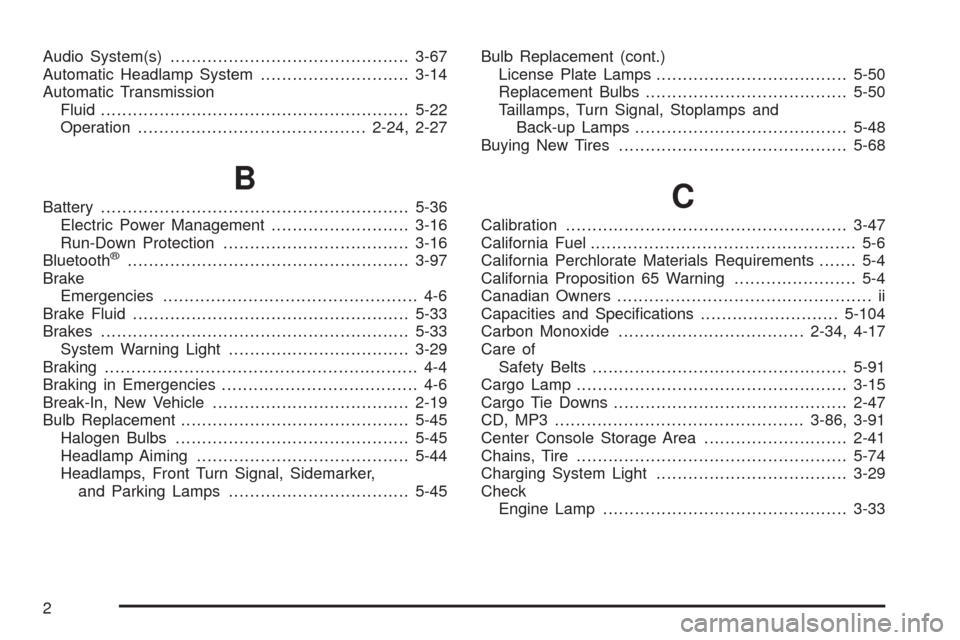
Audio System(s).............................................3-67
Automatic Headlamp System............................3-14
Automatic Transmission
Fluid..........................................................5-22
Operation...........................................2-24, 2-27
B
Battery..........................................................5-36
Electric Power Management..........................3-16
Run-Down Protection...................................3-16
Bluetooth
®.....................................................3-97
Brake
Emergencies................................................ 4-6
Brake Fluid....................................................5-33
Brakes..........................................................5-33
System Warning Light..................................3-29
Braking........................................................... 4-4
Braking in Emergencies..................................... 4-6
Break-In, New Vehicle.....................................2-19
Bulb Replacement...........................................5-45
Halogen Bulbs............................................5-45
Headlamp Aiming........................................5-44
Headlamps, Front Turn Signal, Sidemarker,
and Parking Lamps..................................5-45Bulb Replacement (cont.)
License Plate Lamps....................................5-50
Replacement Bulbs......................................5-50
Taillamps, Turn Signal, Stoplamps and
Back-up Lamps........................................5-48
Buying New Tires...........................................5-68
C
Calibration.....................................................3-47
California Fuel.................................................. 5-6
California Perchlorate Materials Requirements....... 5-4
California Proposition 65 Warning....................... 5-4
Canadian Owners................................................ ii
Capacities and Specications..........................5-104
Carbon Monoxide...................................2-34, 4-17
Care of
Safety Belts................................................5-91
Cargo Lamp...................................................3-15
Cargo Tie Downs............................................2-47
CD, MP3 ...............................................3-86, 3-91
Center Console Storage Area...........................2-41
Chains, Tire...................................................5-74
Charging System Light....................................3-29
Check
Engine Lamp..............................................3-33
2
Page 431 of 442
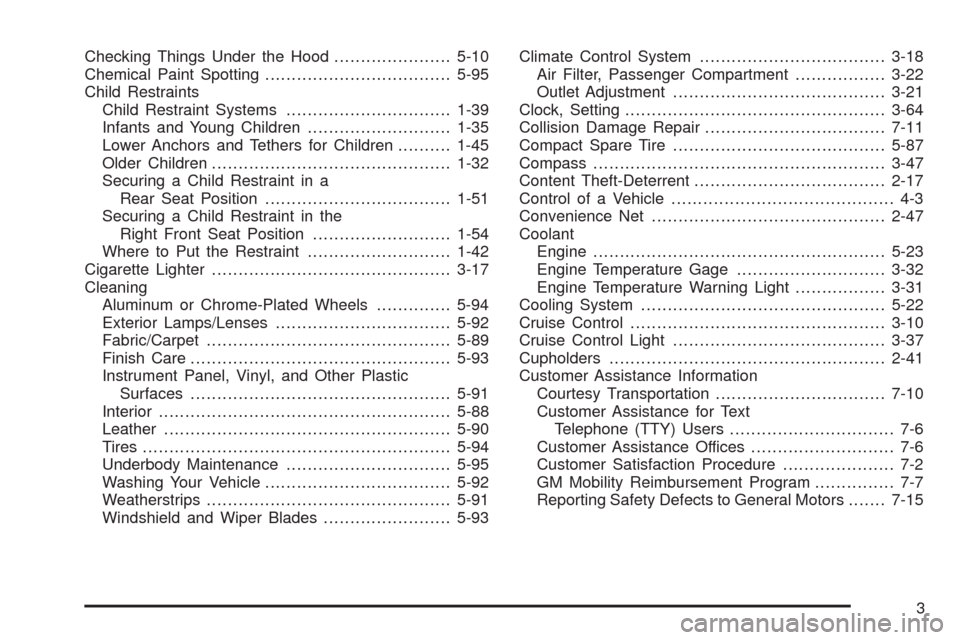
Checking Things Under the Hood......................5-10
Chemical Paint Spotting...................................5-95
Child Restraints
Child Restraint Systems...............................1-39
Infants and Young Children...........................1-35
Lower Anchors and Tethers for Children..........1-45
Older Children.............................................1-32
Securing a Child Restraint in a
Rear Seat Position...................................1-51
Securing a Child Restraint in the
Right Front Seat Position..........................1-54
Where to Put the Restraint...........................1-42
Cigarette Lighter.............................................3-17
Cleaning
Aluminum or Chrome-Plated Wheels..............5-94
Exterior Lamps/Lenses.................................5-92
Fabric/Carpet..............................................5-89
Finish Care.................................................5-93
Instrument Panel, Vinyl, and Other Plastic
Surfaces.................................................5-91
Interior.......................................................5-88
Leather......................................................5-90
Tires..........................................................5-94
Underbody Maintenance...............................5-95
Washing Your Vehicle...................................5-92
Weatherstrips..............................................5-91
Windshield and Wiper Blades........................5-93Climate Control System...................................3-18
Air Filter, Passenger Compartment.................3-22
Outlet Adjustment........................................3-21
Clock, Setting.................................................3-64
Collision Damage Repair..................................7-11
Compact Spare Tire........................................5-87
Compass.......................................................3-47
Content Theft-Deterrent....................................2-17
Control of a Vehicle.......................................... 4-3
Convenience Net............................................2-47
Coolant
Engine.......................................................5-23
Engine Temperature Gage............................3-32
Engine Temperature Warning Light.................3-31
Cooling System..............................................5-22
Cruise Control................................................3-10
Cruise Control Light........................................3-37
Cupholders....................................................2-41
Customer Assistance Information
Courtesy Transportation................................7-10
Customer Assistance for Text
Telephone (TTY) Users............................... 7-6
Customer Assistance Offices........................... 7-6
Customer Satisfaction Procedure..................... 7-2
GM Mobility Reimbursement Program............... 7-7
Reporting Safety Defects to General Motors.......7-15
3