trailer CHEVROLET EQUINOX 2017 2.G Owner's Manual
[x] Cancel search | Manufacturer: CHEVROLET, Model Year: 2017, Model line: EQUINOX, Model: CHEVROLET EQUINOX 2017 2.GPages: 327, PDF Size: 5.54 MB
Page 218 of 327
Chevrolet Equinox Owner Manual (GMNA-Localizing-U.S./Canada/Mexico-
9918169) - 2017 - CRC - 3/23/16
Vehicle Care 217
Engine Overheating
The vehicle has an indicator to warn
of engine overheating. There is an
engine coolant temperature warning
light on the vehicle's instrument
panel. SeeEngine Coolant
Temperature Gauge 0103.
The decision may be made not to lift
the hood when this warning
appears, but instead get service
help right away. See Roadside
Assistance Program 0296.
If the decision to lift the hood is
made, make sure the vehicle is
parked on a level surface.
Then check to see if the engine
cooling fan(s) are running. If the
engine is overheating, the fan(s)
should be running. If they are not,
do not continue to run the engine
and have the vehicle serviced.
Caution
Running the engine without
coolant may cause damage or a
fire. Vehicle damage would not be
covered by the vehicle warranty.
If Steam is Coming from the
Engine Compartment
{Warning
Steam from an overheated engine
can burn you badly, even if you
just open the hood. Stay away
from the engine if you see or hear
steam coming from it. Just turn it
off and get everyone away from
the vehicle until it cools down.
Wait until there is no sign of
steam or coolant before you open
the hood.
If you keep driving when the
engine is overheated, the liquids
in it can catch fire. You or others
could be badly burned. Stop the
engine if it overheats, and get out
of the vehicle until the engine
is cool.
If No Steam is Coming from
the Engine Compartment
If an engine overheat warning is
displayed but no steam can be seen
or heard, the problem may not be
too serious. Sometimes the engine
can get a little too hot when the
vehicle:
. Climbs a long hill on a hot day.
. Stops after high-speed driving.
. Idles for long periods in traffic.
. Tows a trailer.
If the overheat warning is displayed
with no sign of steam: 1. Turn the air conditioning off.
2. Turn the heater on to the highest temperature and to the
highest fan speed. Open the
windows as necessary.
3. When it is safe to do so, pull off the road, shift to P (Park) or
N (Neutral) and let the
engine idle.
If the temperature overheat gauge is
no longer in the overheat zone or an
overheat warning no longer
Page 230 of 327
Chevrolet Equinox Owner Manual (GMNA-Localizing-U.S./Canada/Mexico-
9918169) - 2017 - CRC - 3/23/16
Vehicle Care 229
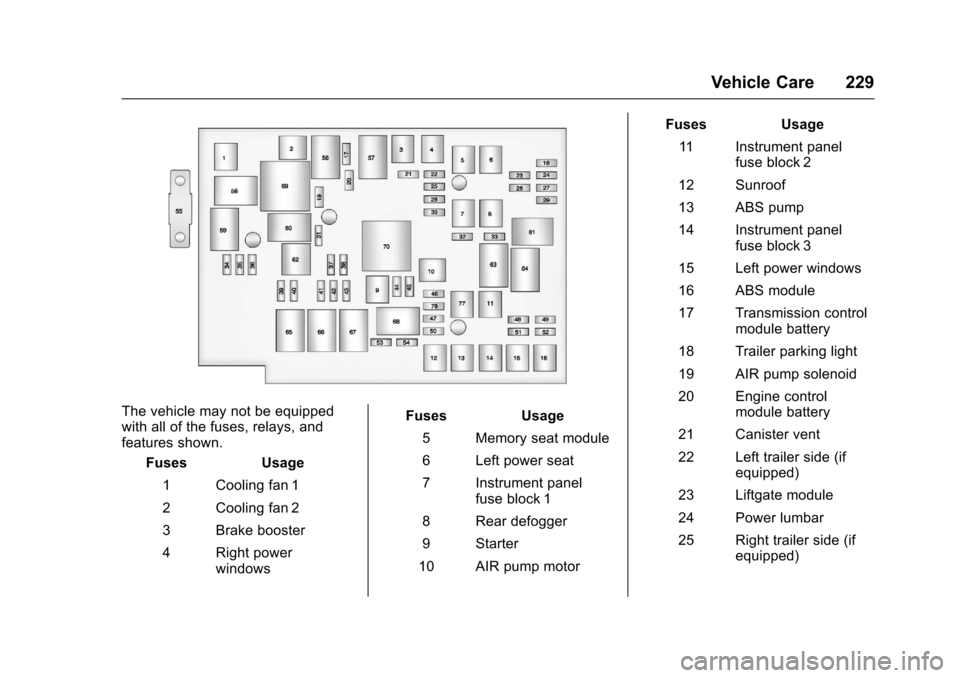
The vehicle may not be equipped
with all of the fuses, relays, and
features shown.Fuses Usage
1 Cooling fan 1
2 Cooling fan 2
3 Brake booster
4 Right power windows Fuses Usage
5 Memory seat module
6 Left power seat
7 Instrument panel fuse block 1
8 Rear defogger
9 Starter
10 AIR pump motor Fuses Usage
11 Instrument panel fuse block 2
12 Sunroof
13 ABS pump
14 Instrument panel fuse block 3
15 Left power windows
16 ABS module
17 Transmission control module battery
18 Trailer parking light
19 AIR pump solenoid
20 Engine control module battery
21 Canister vent
22 Left trailer side (if equipped)
23 Liftgate module
24 Power lumbar
25 Right trailer side (if equipped)
Page 264 of 327
Chevrolet Equinox Owner Manual (GMNA-Localizing-U.S./Canada/Mexico-
9918169) - 2017 - CRC - 3/23/16
Vehicle Care 263
Towing the Vehicle
Caution
Incorrectly towing a disabled
vehicle may cause damage. The
damage would not be covered by
the vehicle warranty.
Do not lash or hook to
suspension components. Use the
proper straps around the tires to
secure the vehicle.
Use only a flatbed tow truck for
towing a disabled vehicle. Never
use a sling type lift or damage will
occur. Use ramps to help reduce
approach angles if necessary.
A towed vehicle should have its
drive wheels off the ground.
Consult a professional towing
service if the disabled vehicle must
be towed.
Recreational Vehicle
Towing
Recreational vehicle towing means
towing the vehicle behind another
vehicle –such as behind a motor
home. The two most common types
of recreational vehicle towing are
known as dinghy towing and dolly
towing. Dinghy towing is towing the
vehicle with all four wheels on the
ground. Dolly towing is towing the
vehicle with two wheels on the
ground and two wheels up on a
device known as a dolly.
Here are some important things to
consider before recreational vehicle
towing:
. The towing capacity of the
towing vehicle. Be sure to read
the tow vehicle manufacturer's
recommendations.
. How far the vehicle will be
towed. Some vehicles have
restrictions on how far and how
long they can tow. .
The proper towing equipment.
See your dealer or trailering
professional for additional advice
and equipment
recommendations.
. If the vehicle is ready to be
towed. Just as preparing the
vehicle for a long trip, make sure
the vehicle is prepared to be
towed.
Dinghy Towing
Front-wheel-drive and
all-wheel-drive vehicles may be
dinghy towed from the front. These
vehicles can also be towed by
placing them on a platform trailer
with all four wheels off of the
ground. For other towing options,
see “Dolly Towing” following in this
section.
For vehicles being dinghy towed,
the vehicle should be run at the
beginning of each day and at each
RV fuel stop for about five minutes.
This will ensure proper lubrication of
transmission components.
Page 266 of 327

Chevrolet Equinox Owner Manual (GMNA-Localizing-U.S./Canada/Mexico-
9918169) - 2017 - CRC - 3/23/16
Vehicle Care 265
Caution
Use of a shield mounted in front
of the vehicle grille could restrict
airflow and cause damage to the
transmission. The repairs would
not be covered by the vehicle
warranty. If using a shield, only
use one that attaches to the
towing vehicle.
Dolly Towing (All-Wheel-Drive
Vehicles)
All-wheel-drive vehicles should not
be towed with two wheels on the
ground. To properly tow these
vehicles, they should be placed on
a platform trailer with all four wheels
off of the ground or dinghy towed
from the front.
Dolly Towing
(Front-Wheel-Drive Vehicles)
To tow the vehicle from the front
with the rear wheels on the ground:1. Put the front wheels on a dolly.
2. Move the shift lever to P (Park).
3. Set the parking brake.
4. Secure the vehicle to the dolly. 5. Follow the dolly manufacturer's
instructions for preparing the
vehicle and dolly for towing.
6. Release the parking brake.
Towing the Vehicle from
the Rear
Page 277 of 327
Chevrolet Equinox Owner Manual (GMNA-Localizing-U.S./Canada/Mexico-
9918169) - 2017 - CRC - 3/23/16
276 Service and Maintenance
Because of the way people use
vehicles, maintenance needs vary.
There may need to be more
frequent checks and services. The
Additional Required Services -
Normal are for vehicles that:
.Carry passengers and cargo
within recommended limits on
the Tire and Loading Information
label. See Vehicle Load
Limits 0159.
. Are driven on reasonable road
surfaces within legal driving
limits.
. Use the recommended fuel. See
Fuel 0189.
Refer to the information in the
Maintenance Schedule Additional
Required Services - Normal chart.
The Additional Required Services -
Severe are for vehicles that are:
. Mainly driven in heavy city traffic
in hot weather.
. Mainly driven in hilly or
mountainous terrain.
. Frequently towing a trailer. .
Used for high speed or
competitive driving.
. Used for taxi, police, or delivery
service.
Refer to the information in the
Maintenance Schedule Additional
Required Services - Severe chart.
{Warning
Performing maintenance work can
be dangerous and can cause
serious injury. Perform
maintenance work only if the
required information, proper tools,
and equipment are available.
If they are not, see your dealer to
have a trained technician do the
work. See Doing Your Own
Service Work 0202.
Maintenance
Schedule
Owner Checks and Services
At Each Fuel Stop
.
Check the engine oil level. See
Engine Oil 0207.
Once a Month
. Check the tire inflation
pressures. See Tire
Pressure 0240.
. Inspect the tires for wear. See
Tire Inspection 0245.
. Check the windshield washer
fluid level. See Washer
Fluid 0219.
Page 326 of 327

Chevrolet Equinox Owner Manual (GMNA-Localizing-U.S./Canada/Mexico-
9918169) - 2017 - CRC - 3/23/16
Index 325
Tires (cont'd)Designations . . . . . . . . . . . . . . . . . 236
Different Size . . . . . . . . . . . . . . . . . 248
If a Tire Goes Flat . . . . . . . . . . . . 251
Inspection . . . . . . . . . . . . . . . . . . . . 245
Messages . . . . . . . . . . . . . . . . . . . . 122
Pressure Light . . . . . . . . . . . . . . . . .110
Pressure Monitor Operation . . 242
Pressure Monitor System . . . . . 241
Rotation . . . . . . . . . . . . . . . . . . . . . . 245
Sidewall Labeling . . . . . . . . . . . . . 234
Terminology and Definitions . . 237
Uniform Tire Quality
Grading . . . . . . . . . . . . . . . . . . . . . 248
Wheel Alignment and Tire Balance . . . . . . . . . . . . . . . . . . . . . 250
Wheel Replacement . . . . . . . . . . 250
When It Is Time for New Tires . . . . . . . . . . . . . . . . . . . . . . . . 246
Winter . . . . . . . . . . . . . . . . . . . . . . . . 233
Towing Driving Characteristics . . . . . . . . 193
Equipment . . . . . . . . . . . . . . . . . . . . 198
General Information . . . . . . . . . . 193
Recreational Vehicle . . . . . . . . . . 263
Trailer . . . . . . . . . . . . . . . . . . . . . . . . 196
Trailer Sway Control (TSC) . . . 198
Vehicle . . . . . . . . . . . . . . . . . . . . . . . 263 Traction
Control System (TCS)/
StabiliTrak
®Light . . . . . . . . . . . . .110
Off Light . . . . . . . . . . . . . . . . . . . . . . 109
Traction Control/Electronic Stability Control . . . . . . . . . . . . . . . 175
Trailer
Sway Control (TSC) . . . . . . . . . . 198
Towing . . . . . . . . . . . . . . . . . . . . . . . . 196
Transmission Automatic . . . . . . . . . . . . . . . . . . . . . 170
Fluid, Automatic . . . . . . . . . . . . . . .211
Messages . . . . . . . . . . . . . . . . . . . . 122
Transportation Program, Courtesy . . . . . . . . . . . . . . . . . . . . . . 298
Turn and Lane-Change
Signals . . . . . . . . . . . . . . . . . . . . . . . . 135
Turn Signal Bulb Replacement . . . . . . . . . . . . 226
U
Uniform Tire Quality Grading . . . 248
Universal Remote System . . . . . . 130Operation . . . . . . . . . . . . . . . . . . . . . 132
Programming . . . . . . . . . . . . . . . . . 130
Using This Manual . . . . . . . . . . . . . . . . 2
V
Vehicle
Alarm System . . . . . . . . . . . . . . . . . . 36
Canadian Owners . . . . . . . . . . . . . . . 2
Control . . . . . . . . . . . . . . . . . . . . . . . 149
Identification Number (VIN) . . . 288
Load Limits . . . . . . . . . . . . . . . . . . . 159
Messages . . . . . . . . . . . . . . . . . . . . .116
Personalization . . . . . . . . . . . . . . . 123
Reminder Messages . . . . . . . . . . 123
Remote Start . . . . . . . . . . . . . . . . . . . 28
Security . . . . . . . . . . . . . . . . . . . . . . . . 36
Towing . . . . . . . . . . . . . . . . . . . . . . . . 263
Vehicle Ahead Indicator . . . . . . . . 109
Vehicle Care
Tire Pressure . . . . . . . . . . . . . . . . . 240
Vehicle Data Recording and Privacy . . . . . . . . . . . . . . . . . . . . . . . . 304
Ventilation, Air . . . . . . . . . . . . . . . . . . 145
Visors . . . . . . . . . . . . . . . . . . . . . . . . . . . 42
W
Warning Brake System Light . . . . . . . . . . . 108
Caution and Danger . . . . . . . . . . . . . 3
Lane Departure (LDW) . . . . . . . 187