engine oil CHEVROLET EXPRESS 1996 1.G User Guide
[x] Cancel search | Manufacturer: CHEVROLET, Model Year: 1996, Model line: EXPRESS, Model: CHEVROLET EXPRESS 1996 1.GPages: 376, PDF Size: 18.83 MB
Page 222 of 376
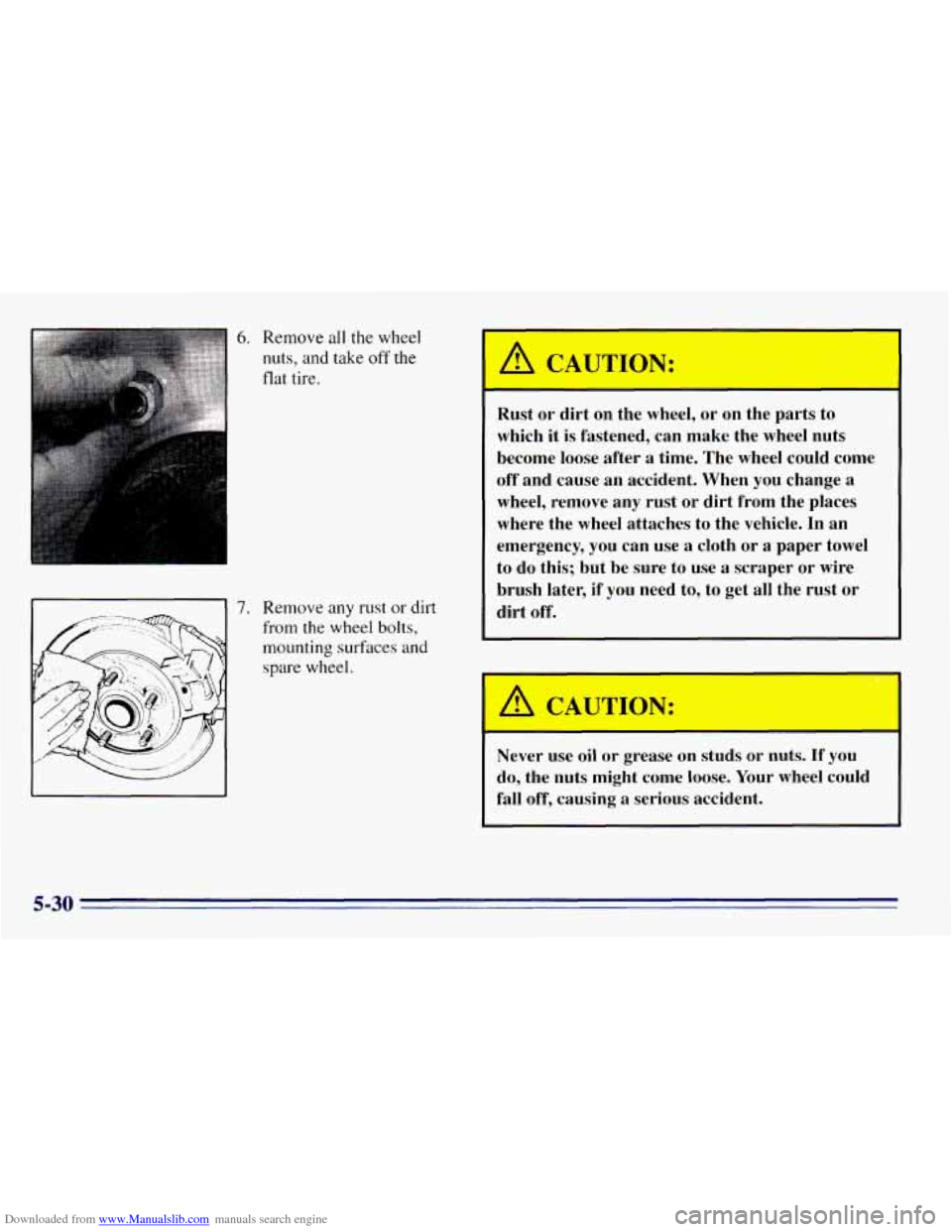
Downloaded from www.Manualslib.com manuals search engine 6. Remove all the wheel
nuts,
and take off the
flat tire.
7. Remove any rust or dirt
from the
wheel bolts,
mounting surfaces and
spare wheel.
A CAUTION:
Rust or dirt on the wheel, or on the parts to
which
it is fastened, can make the wheel nuts
become loose after a time. The wheel could come
off and cause an accident. When you change a
wheel, remove any rust or dirt from the places
where the wheel attaches to the vehicle. In an
emergency, you can use a cloth
or a paper towel
to do this; but be
sure to use a scraper or wire
brush later,
if you need to, to get all the rust or
dirt off.
I A CAUTION:
Never use oil or grease on studs or nuts. If you
do, the nuts might come loose. Your wheel could
fall off, causing
a serious accident.
I I
5-30
Page 232 of 376
Downloaded from www.Manualslib.com manuals search engine Fuels in Foreign Countries
-- Gasoline Engines
If you plan on driving in another country outside the
United States
or Canada, the proper fuel may be hard to
find. Never use leaded gasoline or any other
fuel not
recommended in
the previous text on fuel. Costly repairs
caused by use of improper fuel wouldn’t be covered by
your warranty.
~ To check on fuel availability, ask an auto club, or
1 contact a major oil company that does business in the
j country where you’ll be driving.
You can also write
us at the following address for
advice. Just tell us where you’re going and give your
Vehicle Identification Number (VIN).
General Motors Overseas Distribution Corporation,
North American Export Sales (NAES)
1908 Colonel Sam Drive
Oshawa, Ontario L1H
8P7
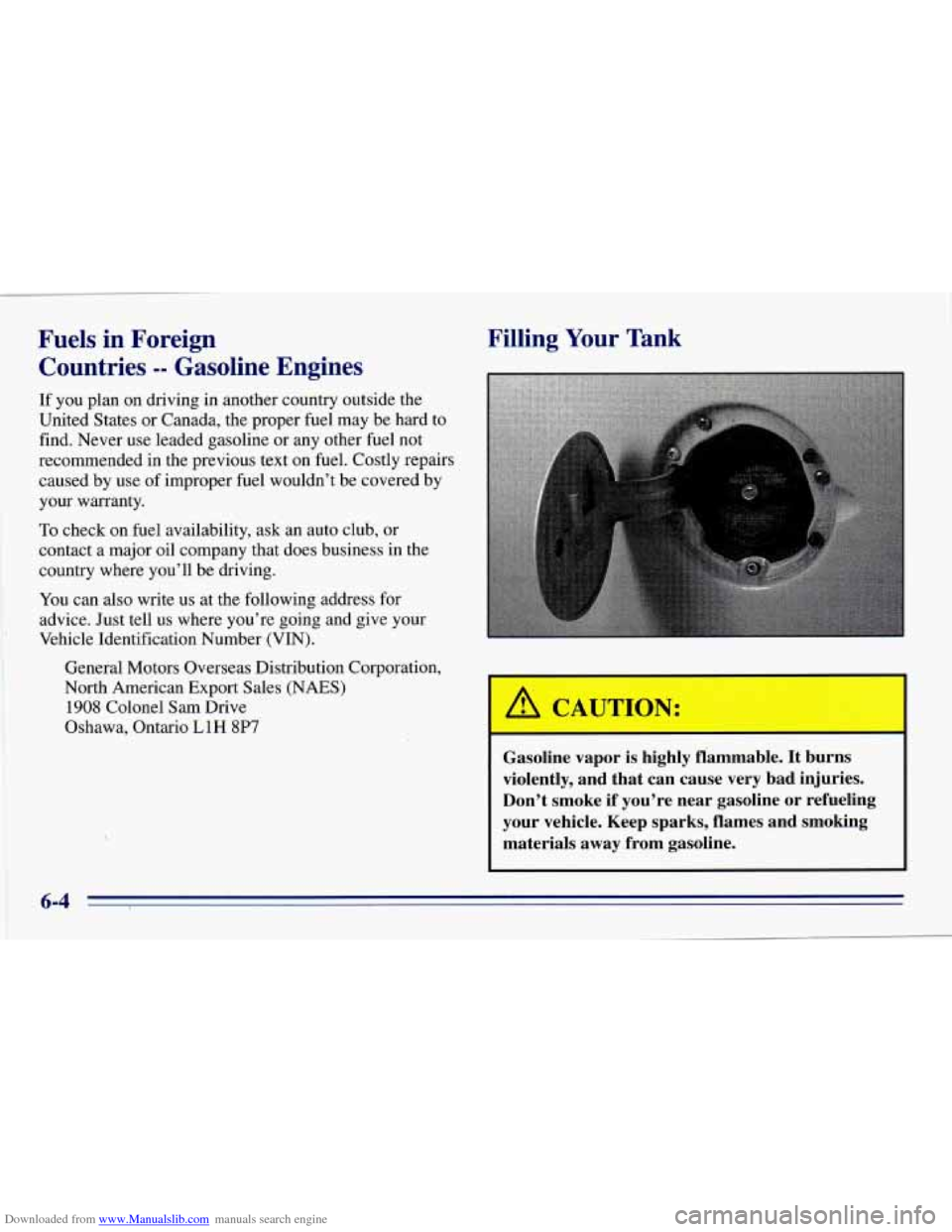
Filling Your Tank
I
1 C ,U ION: I
Gasoline vapor is highly flammable. It burns
violently, and that can cause very bad injuries.
Don’t smoke if you’re near gasoline or refueling
your vehicle. Keep sparks, flames and smoking
materials away.from gasoline.
Page 236 of 376
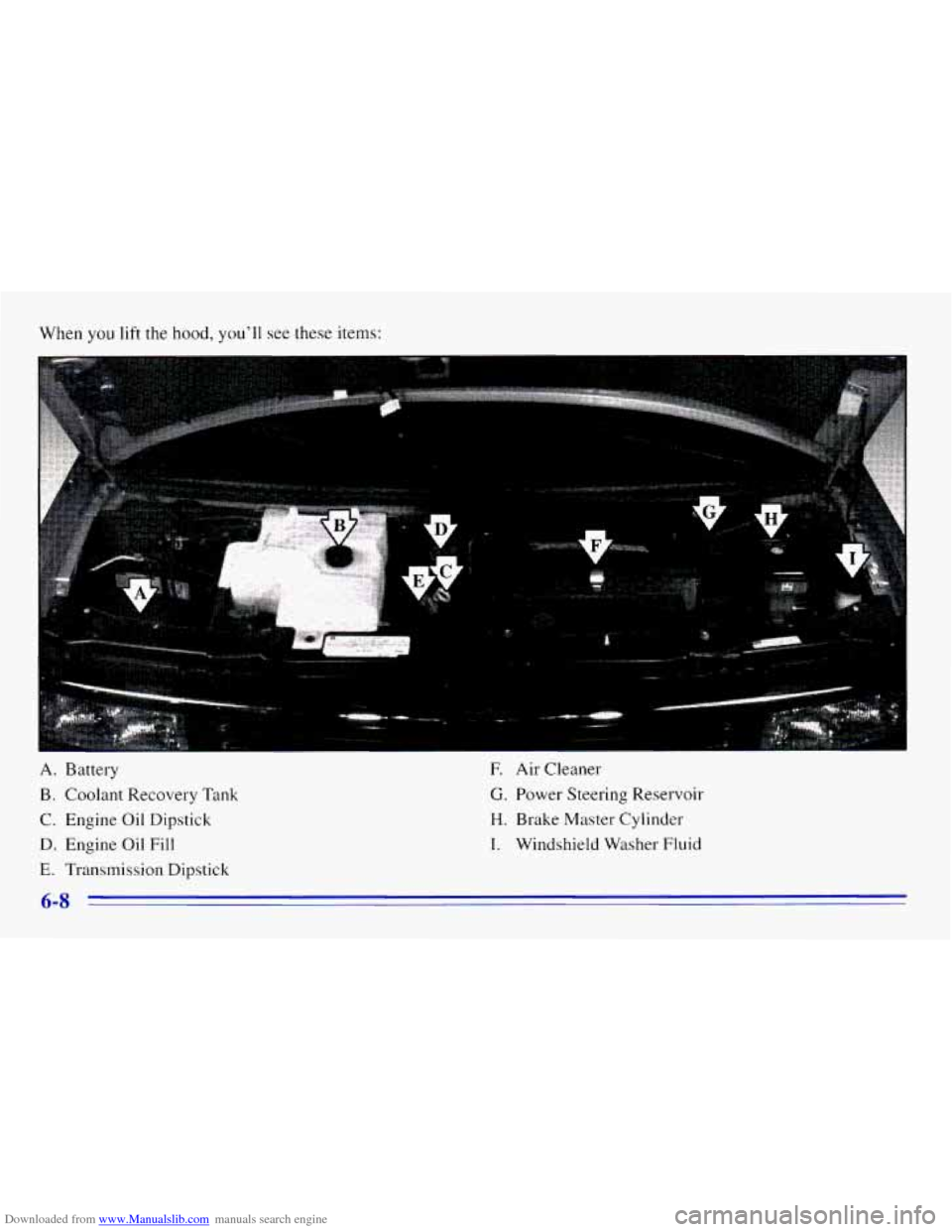
Downloaded from www.Manualslib.com manuals search engine When you lift the hood, you’ll see these items:
A. Battery
B. Coolant Recovery Tank
C. Engine Oil Dipstick
D. Engine Oil Fill
E. Transmission Dipstick
6-8
F. Air Cleaner
G. Power Steering Reservoir
H. Brake Master Cylinder
I. Windshield Washer Fluid
Page 237 of 376
Downloaded from www.Manualslib.com manuals search engine If your vehicle has a 7.4L engine and air conditioning,
your vehicle will have
a auxiliary engine fan in addition
to the belt driven fan.
A CAUTION:
If your vehicle has air conditioning, the auxiliary
engine fan under the hood can start up and
injure you even when the engine is not running.
Keep hands, clothing and tools
away from any
underhood electric fan.
Things that burn can get on hot engine parts and
start
a fire. These include liquids like gasoline,
oil, coolant, brake fluid, windshield washer and
other fluids, and plastic or rubber.
You or others
could be burned. Be careful not to drop or spill
things that will burn onto a hot engine.
Before closing the hood, be sure all the filler caps are
on properly.
Then lift the hood to relieve pressure
on the hood prop.
Remove the hood prop from the slot in the hood and
return the prop
to its retainer. Then just let the hood
down and close
it firmly.
Noise Control System
The following information relates to compliance with
Federal noise emission standards for vehicles with a
Gross Vehicle Weight Rating (GVWR) of more than
10,000
lbs. (4 536 kg). The Maintenance Schedule
booklet provides information on maintaining the noise
control system
to minimize degradation of the noise
emission control system during the life of your vehicle.
The noise control system warranty is given
in your
Warranty booklet.
These standards apply
only to vehicles sold in the
United States.
6-9
Page 239 of 376
Downloaded from www.Manualslib.com manuals search engine Engine Oil (Gasoline Engine)
If your vehicle has a diesel engine, see “Engine Oil
(Diesel Engine)” in the Diesel Engine Supplement.
It’s
a good idea to check your engine oil every time you
get fuel.
In order to get an accurate reading, the oil must
be warm and the vehicle must be
on level ground.
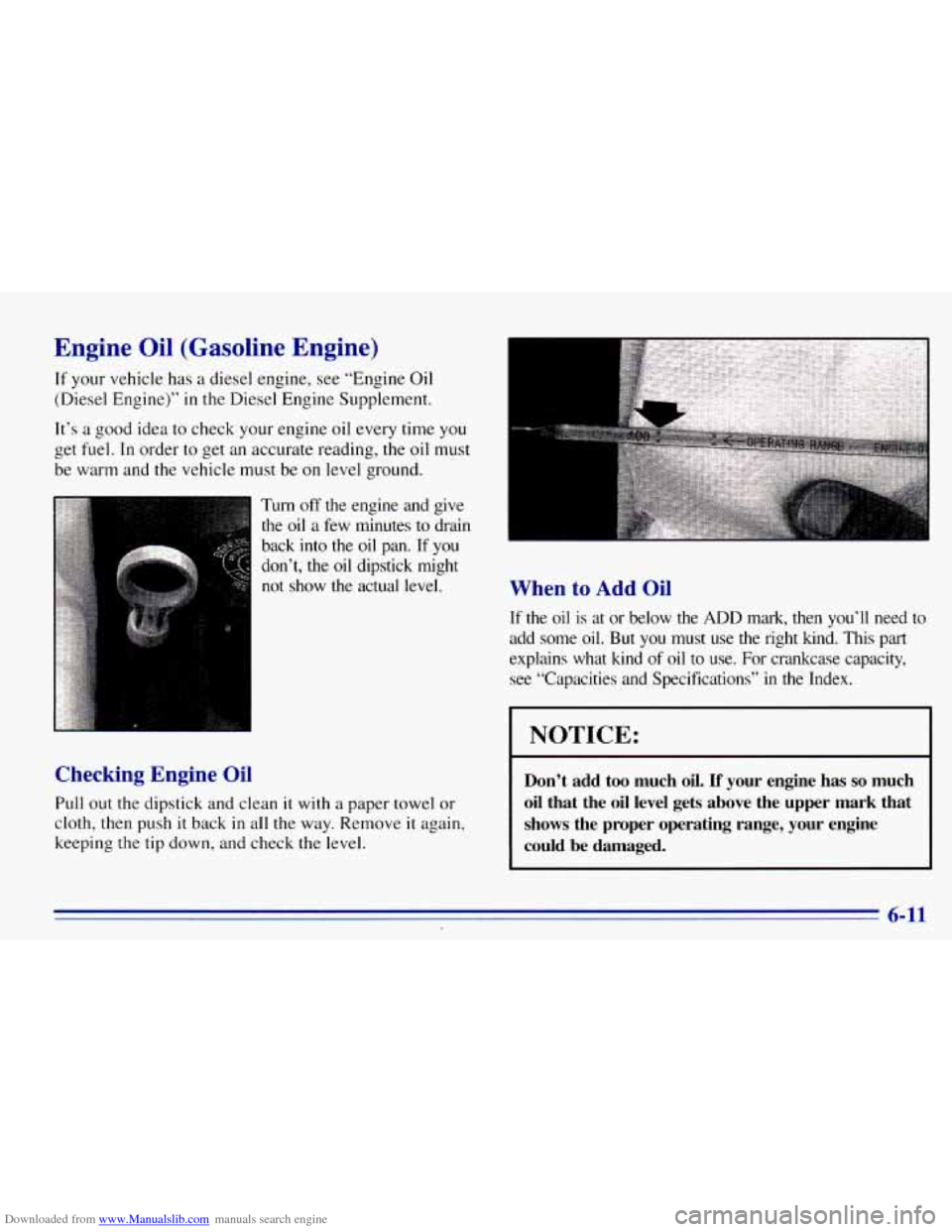
Turn off the engine and give the
oil a few minutes to drain
back
into the oil pan. If you
don’t, the oil dipstick might
not show the actual level.
Checking Engine Oil
Pull out the dipstick and clean it with a paper towel or
cloth, then push
it back in all the way. Remove it again,
keeping
the tip down, and check the level.
When to Add Oil
If the oil is at or below the ADD mark, then you’ll need to
add some
oil. But you must use the right kind. This part
explains what kind
of oil to use. For crankcase capacity,
see “Capacities and Specifications”
in the Index.
I NOTICE:
Don’t add too much oil. If’ your engine has so much
oil that the oil level gets above the upper mark that
shows the proper operating range,
your engine
could be damaged.
6-11
Page 240 of 376
Downloaded from www.Manualslib.com manuals search engine What Kind of Oil to Use
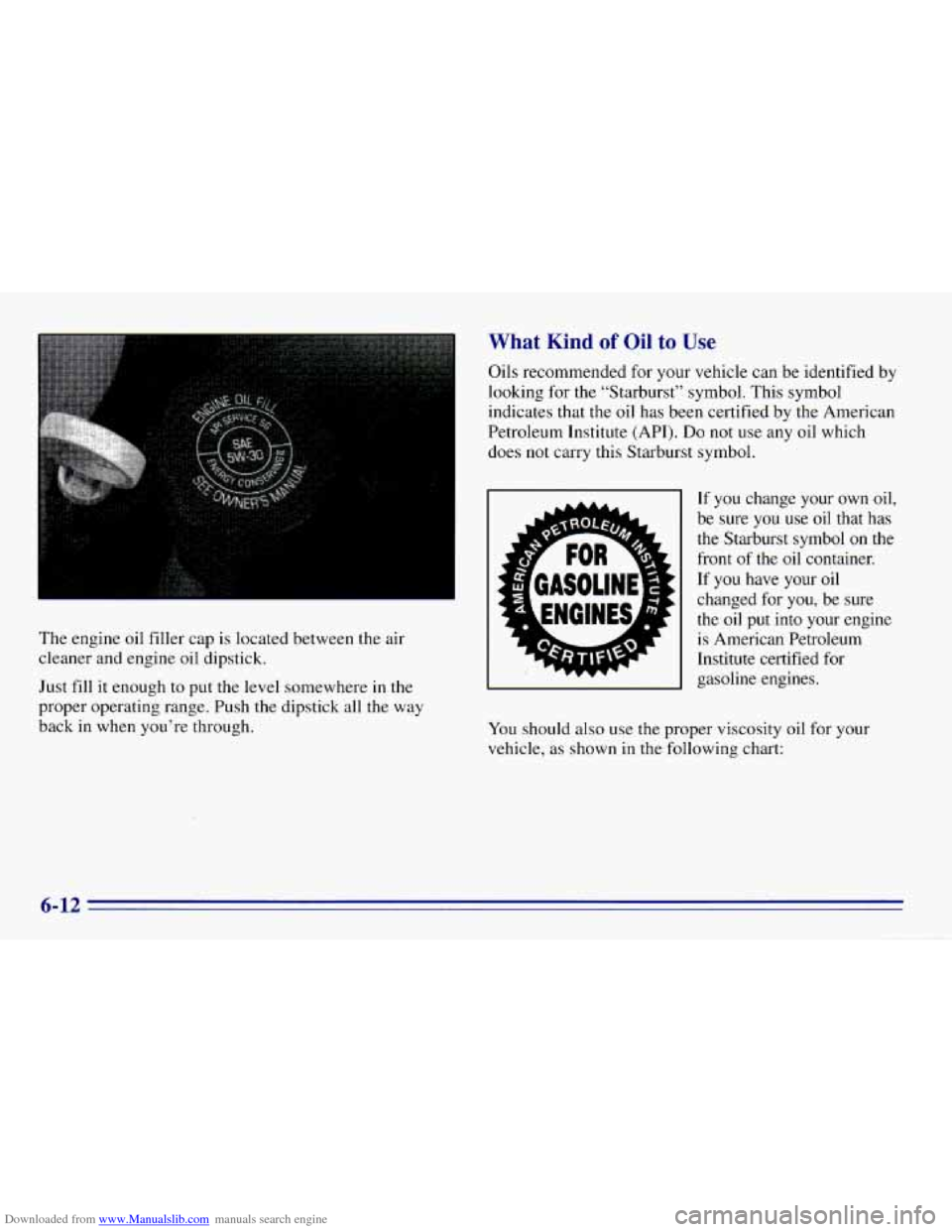
The engine oil filler cap is located between the air
cleaner and engine oil dipstick.
Just fill
it enough to put the level somewhere in the
proper operating range. Push the dipstick
all the way
back in when you’re through. Oils recommended for your vehicle can be identified
by
looking for the “Starburst” symbol. This symbol
indicates that the
oil has been certified by the American
Petroleum Institute (API).
Do not use any oil which
does not carry this Starburst symbol.
If you change your own oil,
be sure you use oil that has
the Starburst symbol on the
front
of the oil container.
If you have your oil
changed for you, be sure
the
oil put into your engine
is American Petroleum
Institute certified for
gasoline engines.
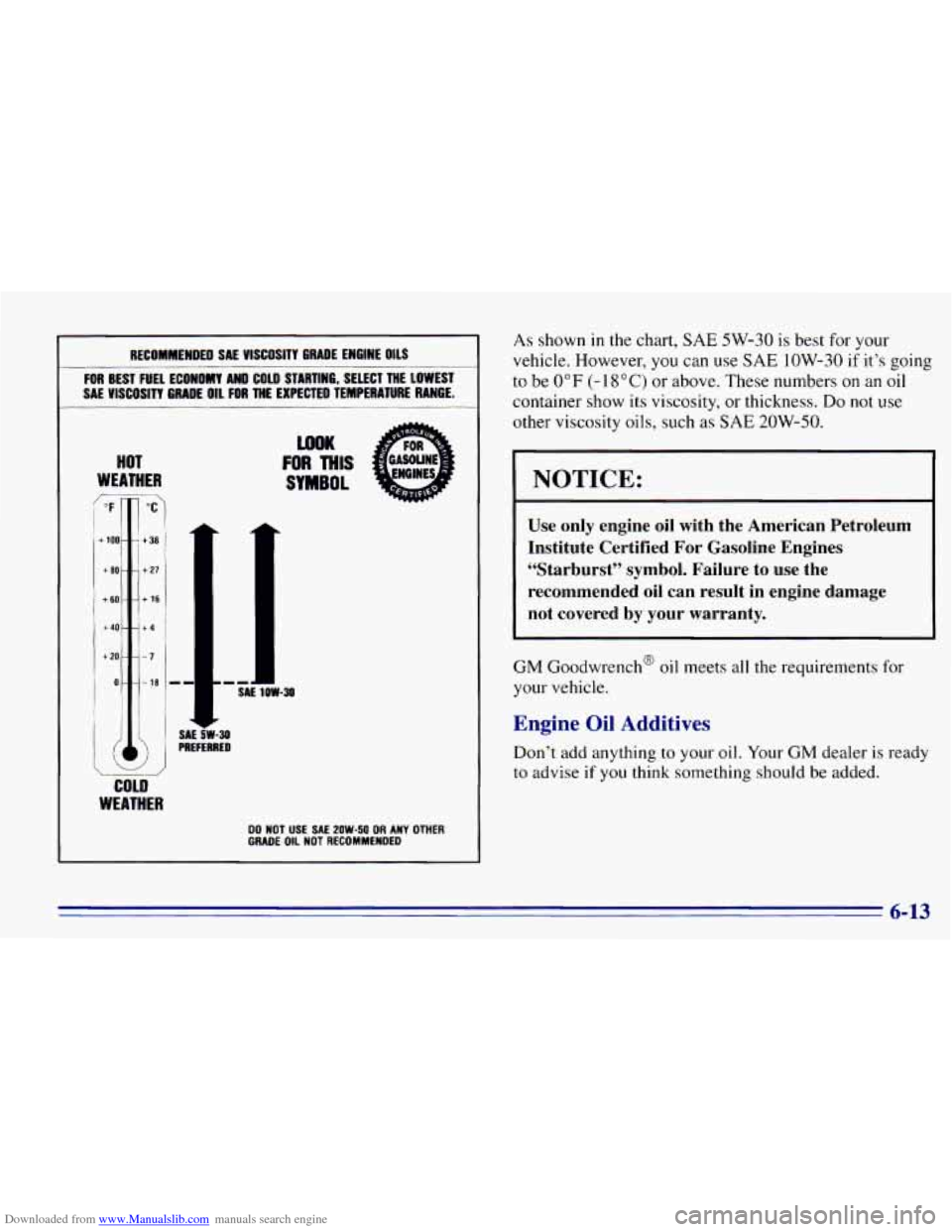
You should also use the proper viscosity oil for your
vehicle, as shown in the following chart:
6-12
Page 241 of 376
Downloaded from www.Manualslib.com manuals search engine RECOMMENDED SAE VlSCOSlTV GRADE ENGINE OILS
FOR BEST FUEL ECONOMY AND COLD STARTING, SELECT THE LOWEST
SAE
VISCOSITY GRADE OIL FOR THE EXPECTED TEMPERATURE RANGE.
HOT
WEATHER
WOK
FOR MIS
SYMBOL
r
1-30 RED
COLD
WEATHER
DO NOT USE SAE 2OW-50 OR ANY OTHER GRADE OIL NOT RECOMMENDED
As shown in the chart, SAE 5W-30 is best for your
vehicle. However, you can use
SAE IOW-30 if it’s going
to be
0°F (-18°C) or above. These numbers on an oil
container show its viscosity,
or thickness. Do not use
other viscosity
oils, such as SAE 20W-50.
I NOTICE:
Use only engine oil with the American Petroleum
Institute Certified For Gasoline Engines
“Starburst” symbol. Failure
to use the
recommended oil can result in engine damage
not covered by your warranty.
GM Goodwrench@ oil meets all the requirements for
your vehicle.
Engine Oil Additives
Don’t add anything to your oil. Your GM dealer is ready
to advise if you think something should be added.
6-13
Page 242 of 376
Downloaded from www.Manualslib.com manuals search engine When to Change Engine Oil
See if any one of these is true for you:
0 Most trips are less than 5 to 10 miles (8 to 16 km).
This is particularly important when outside
temperatures are below freezing.
Most trips include extensive idling (such as frequent
driving in stop-and-go traffic).
Most trips are through dusty areas.
0 You frequently tow a trailer or use a carrier on top of
your vehicle.
The vehicle is used for delivery service, police, taxi
Driving under these conditions causes engine oil to
break down sooner. If any one of these is true for your
vehicle, then you need to change your oil and filter
every
3,000 miles (5 000 km) or 3 months -- whichever
occurs first. or
other commercial application.
If done of them is true, change the oil and filter every
7,500 miles (12 500 km) or 12 months -- whichever
occurs first. Driving a vehicle with a fully warmed
engine under highway conditions causes engine oil to
break down slower.
What to Do with Used Oil
Did YOU know that used engine oil contains certain
elements that may be unhealthy for your skin and could
even cause cancer? Don’t let used oil stay on your skin
for very long. Clean your skin and nails with soap and
water,
or a good hand cleaner. Wash or properly throw
away clothing or rags containing used engine oil. (See
the manufacturer’s warnings about the use and disposal
of oil products.)
Used oil can be
a real threat to the environment. If you
change your own oil, be sure to drain all free-flowing oil
from the filter before disposal. Don’t ever dispose of oil
by putting it in the trash, pouring it
on the ground, into
sewers, or into streams
or bodies of water. Instead,
recycle it by taking
it to a place that collects used oil. If
you have a problem properly disposing
of your used oil,
ask your dealer, a service station or a local recycling
center for help.
6-14
Page 244 of 376
Downloaded from www.Manualslib.com manuals search engine Automatic Transmission Fluid
When to Check and Change
A good time to check your automatic transmission fluid
level is when the engine oil is changed.
Change both the fluid and filter every
50,000 miles
(83
000 km) if the vehicle’s GVWR is over 8,600 or
if
the vehicle is mainly driven under one or more of
these conditions:
0 In heavy city traffic where the outside temperature
0 In hilly or mountainous terrain.
regularly reaches
90°F (32°C) or
higher.
0 When doing frequent trailer towing.
0 Uses such as found in taxi, police or delivery service.
If your vehicle’s
GVWR is not over 8,600 and you do
not use your vehicle under any
of these conditions, the
fluid and filter do
not require changing.
See “Scheduled Maintenance Services” in the Index.
How to Check
.Because this operation can be a little difficult, you
may choose to have this done at your GM dealer
Service Department.
If you do it yourself, be sure
to follow all the
instructions here, or you could get a false reading
on
the dipstick.
NOTICE:
Too much or too little fluid can damage your
transmission. Too much can mean that some of
the
fluid could come out and fall on hot engine
parts or exhaust system parts, starting a fire. Be
sure to get an accurate reading if you check your
transmission
fluid.
6-16
-
Page 248 of 376
Downloaded from www.Manualslib.com manuals search engine Engine Coolant
The cooling system in your vehicle is filled with new
DEX-COOL
TM (orange-colored, silicate-free) engine
coolant. This coolant is designed to remain
in your
vehicle for 5 years or 100,000 miles ( 166 000 km),
whichever occurs first.
The following explains your cooling system and how
to
add coolant when it is low. If you have a problem with
engine overheating, see “Engine Overheating” in
the Index.
A 5060 mixture of water and the proper coolant for
your vehicle will:
0 Give freezing protection down to -34°F (-37°C).
Give boiling protection up to 265 “F ( 129 O C).
Protect against rust and corrosion.
0 Help keep the proper engine temperature.
Let the warning lights and gages work as they should.
NOTICE:
When adding coolant it is important that you use
DEX-COOL TM (orange-colored, silicate-free)
coolant meeting
GM Specification 6277M.
If silicated coolant is added to the system,
premature engine, heater core or radiator
corrosion may result. In addition, the engine coolant
will require change sooner -- at
30,000 miles (50 000 km) or 24 months,
whichever occurs first.
6-20