trailer CHEVROLET EXPRESS 1996 1.G User Guide
[x] Cancel search | Manufacturer: CHEVROLET, Model Year: 1996, Model line: EXPRESS, Model: CHEVROLET EXPRESS 1996 1.GPages: 376, PDF Size: 18.83 MB
Page 183 of 376
Downloaded from www.Manualslib.com manuals search engine Maximum trailer weight is calculated assuming the
driver and one passenger are in the towing vehicle and
it
has all the required trailering equipment. The weight of
additional equipment, passengers and cargo in the
towing vehicle must be must be subtracted from the
above maximum trailer weights.
You can ask your dealer for our trailering information or
advice, or
you can write us at the address listed in your
Warranty and Owner Assistance Information Booklet.
In Canada, write to:
General Motors of Canada Limited
Customer Communication Centre
1908 Colonel Sam Drive
Oshawa, Ontario
L 1 H 8P7
Weight of the Trailer Tongue
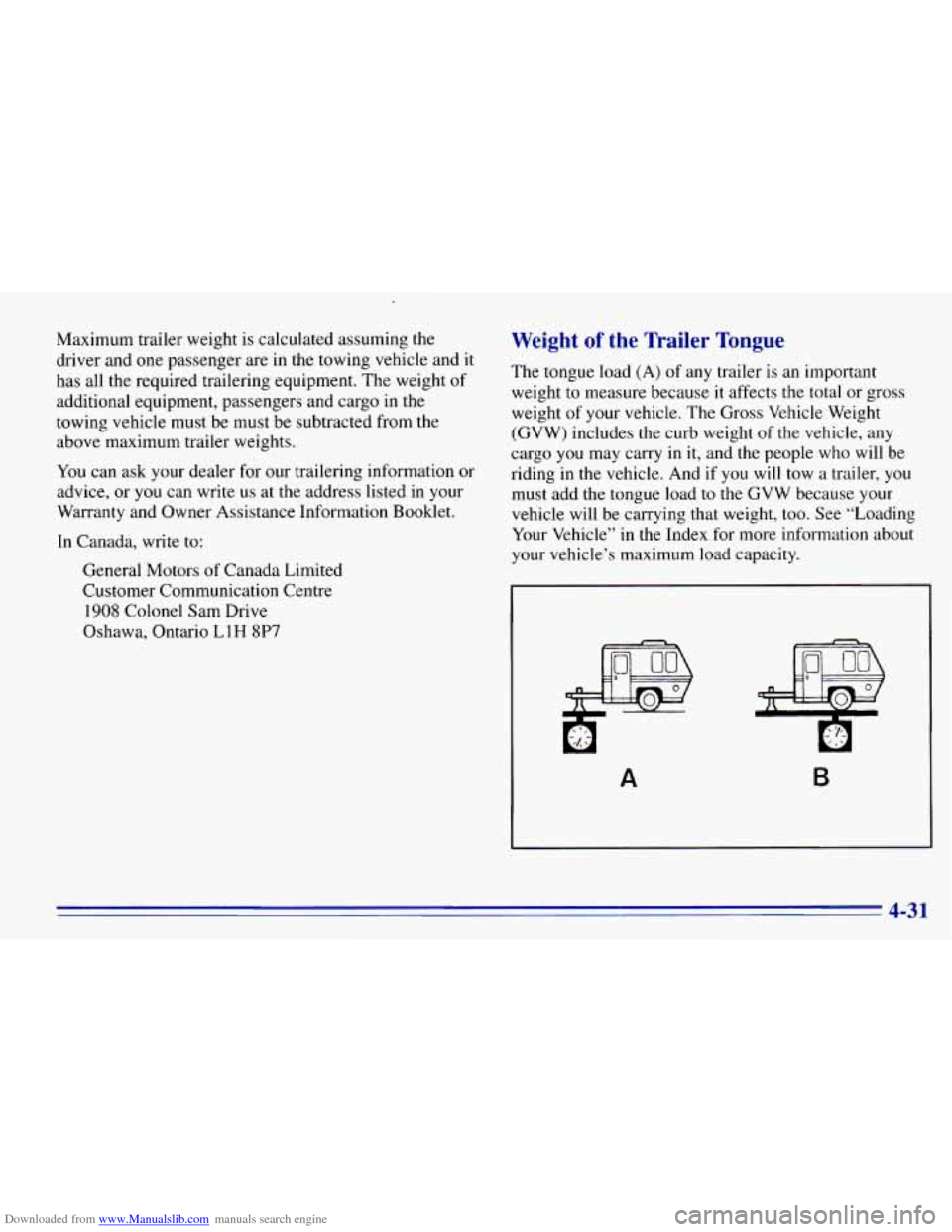
The tongue load (A) of any trailer is an important
weight to measure because it affects the total or gross
weight of your vehicle. The Gross Vehicle Weight
(GVW) includes the curb weight
of the vehicle, any
cargo
you may carry in it, and the people who will be
riding
in the vehicle. And if you will tow a trailer, you
must add the tongue load to
the GVW because your
vehicle will be carrying that weight, too. See “Loading
Your Vehicle”
in the Index for more information about
your vehicle’s maximum load capacity.
A B
4-31
Page 184 of 376
Downloaded from www.Manualslib.com manuals search engine If you’re using your platform hitch as a weight-carrying
hitch, the trailer tongue
(A) should weigh 10 percent of
the total loaded trailer weight (B). If you’re using your
platform hitch as a weight-distributing hitch, the trailer
tongue
(A) should weigh 12 percent of the total loaded
trailer weight (B).
After you’ve loaded your trailer, weigh the trailer and
then the tongue, separately, to see if the weights are
proper. If they aren’t,
you may be able to get them right
simply by moving some items around in the trailer.
Total Weight on Your Vehicle’s Tires
Be sure your vehicle’s tires are inflated to the limit for
cold tires. You’ll find these numbers
on the Certification
label at the rear edge of the driver’s door or see “Tire
Loading” in the Index. Then be sure
you don’t go over
the
GVW limit for your vehicle, including the weight of
the trailer tongue.
Hitches
It’s important to have the correct hitch equipment.
Crosswinds, large trucks going by and rough roads are
a
few reasons why you’ll need the right hitch. Here are
some rules to follow:
0
0
The bumpers on your vehicle are not intended for
hitches.
Do not attach rental hitches or other
bumper-type hitches to them. Use only a
frame-mounted hitch that does
not attach to the
bumper.
Do not use a ball hitch, because it could pull
the bumper loose.
If you’ll be pulling a trailer that, when loaded, will
weigh more than 4,000 lbs. (1 800 kg), be sure to use
a properly mounted, weight-distributing hitch and
sway control
of the proper size. This equipment is
very important for proper vehicle loading and good
handling when you’re driving.
4-32
Page 185 of 376
Downloaded from www.Manualslib.com manuals search engine 0 Will you have to make any holes in the body of your
vehicle when you install a trailer hitch?
If you’re using the wiring provided by the
factory-installed hitch,
you should not need to make
any holes in the body of your
vehicle. However, if
you have an aftermarket hitch installed,
:you may
need
to make holes in the body.
If you
do, then be sure to seal the holes later when
you remove the hitch. If you don’t seal them, deadly
carbon monoxide
(CO) from your exhaust can get
into your vehicle (see “Carbon Monoxide”
in the
Index). Dirt and water can, too.
Safety Chains
You should always attach chains between your vehicle
and your trailer. Cross the safety chains under the tongue
of the trailer so that the tongue will not drop to the road
if it becomes separated from the hitch. Instructions
about safety chains may be provided by the hitch
manufacturer or by the trailer manufacturer. Follow the
manufacturer’s recommendation for attaching safety
chains and do not attach them
to the bumper. Always
leave just enough slack
so you can turn with your rig.
And, never allow safety chains to drag on the ground.
Trailer Brakes
If your trailer weighs more than 1,000 lbs. (450 kg)
loaded, then it needs
its own brakes -- and they must be
adequate.
Be sure to read and follow the instructions for
the trailer brakes
so you’ll be able to install, adjust and
maintain them properly.
Page 186 of 376
Downloaded from www.Manualslib.com manuals search engine Driving with a m .’ .er
If you have a rear-most window open and you
pull
a trailer with your vehicle, carbon monoxide
(CO) could come into your vehicle. You can’t see
or smell
CO. It can cause unconsciousness or
death. (See “Engine Exhaust” in the Index.) To
maximize your safety when towing
a trailer:
a
a
a
Have your exhaust system inspected for
leaks, and make necessary repairs before
starting
on your trip.
Keep the rear-most windows closed.
If exhaust does come into your vehicle
through a window in the rear
or another
opening, drive with your front, main
heating or cooling system on and with the
fan on any speed. This will bring fresh,
outside air into your vehicle.
Do not use
MAX A/C because it only recirculates the
air inside your vehicle. (See “Comfort
Controls” in the Index.)
Towing a trailer requires a certain amount of experience.
Before setting
out for the open road, you’ll want to get
to know
your rig. Acquaint yourself with the feel of
handling and braking with the added weight of the
trailer. And always keep in mind that the vehicle you are
driving is now a good deal longer and not nearly
as
responsive as your vehicle is by itself.
Before
you start, check the trailer hitch and platform
(and attachments),
safety chains, electrical connector,
lamps, tires and mirror adjustment. If the trailer has
electric brakes, start your vehicle and trailer moving and
then apply the trailer brake controller by hand to be sure
the brakes are working. This lets you check your
electrical connection at the same time.
During your trip, check occasionally
to be sure that the
load is secure, and that the lamps and any trailer brakes
are still working.
Following Distance
Stay at least twice as far behind the vehicle ahead as you
would when driving your vehicle without a trailer. This
can help you avoid situations that require heavy braking
and sudden turns.
4-34
Page 187 of 376
Downloaded from www.Manualslib.com manuals search engine Passing
You’ll need more passing distance up ahead when
you’re towing a trailer. And, because you’re a good deal
longer, you’ll need to go much farther beyond the
passed vehicle before you can return to your lane.
Backing Up
Hold the bottom of the steering wheel with one hand.
Then, to move the trailer
to the left, just move that hand
to the left. To move the trailer to the right, move your
hand to the right. Always back up slowly and, if
possible, have someone guide
you.
Making firns
I NOTICE:
Making very sharp turns while trailering could
cause the trailer to come in contact with the
vehicle. Your vehicle could be damaged. Avoid
making very sharp turns while trailering.
When you’re turning with a trailer, make wider
turns than normal.
Do this so your trailer won’t
strike soft shoulders, curbs, road signs, trees or other
objects. Avoid jerky or sudden maneuvers. Signal well
in advance.
lhrn Signals When Towing a Trailer
When you tow a trailer, your vehicle has to have extra
wiring and a heavy-duty turn signal flasher (included in
the optional trailering package).
The green arrows
on your instrument panel will flash
whenever
you signal a turn or lane change. Properly
hooked up, the trailer lamps will also flash, telling other
drivers you’re about to turn, change lanes or stop.
When towing a trailer, the green arrows on your
instrument panel will flash for turns even
if the bulbs on
the trailer are burned out. Thus, you may think drivers
behind
you are seeing your signal when they are not. It’s
important to check occasionally
to be sure the trailer
bulbs are still working.
4-35
Page 188 of 376
Downloaded from www.Manualslib.com manuals search engine Driving On Grades
Reduce speed and shift to a lower gear before you start
down
a long or steep downgrade. If you don’t shift
down, you might have to use your brakes
so much that
they would get hot and
no longer work well.
On a long uphill grade, shift down and reduce
your
speed to around 45 mph (70 kdh) to reduce the
possibility
of engine and transmission overheating.
When towing at high altitude
on steep uphill grades,
consider the following: Engine coolant will boil
at a
lower temperature than at normal altitudes.
If you turn
your engine off immediately after towing at high altitude
on steep uphill grades, your vehicle may show signs
similar
to engine overheating. To avoid this, let the
engine run while parked (preferably on level ground)
with the automatic transmission
in PARK (P) for a few
minutes before turning the engine off. If you do get the
overheat warning, see “Engine Overheating”
in the Index.
Parking on Hills
You really should not park your vehicle, with a trailer
attached, on a hill. If something goes wrong, your rig
could start to move. People can be injured, and both
your vehicle and the trailer can be damaged.
But if you ever have to park your rig
on a hill, here’s
how to do it:
1. ’ Apply your regular brakes, but don’t shift into
PARK (P) yet. Then turn your wheels into the curb
if facing downhill or into traffic if facing uphill.
2. Have someone place chocks under the trailer wheels.
3. When the wheel chocks are in place, release the
regular brakes until the chocks absorb the load.
4. Re-apply the regular brakes. Then apply your
parking brake and then shift
to PARK (P).
5. Release the regular brakes.
4-36
Page 189 of 376
Downloaded from www.Manualslib.com manuals search engine When You Are Ready to Leave After
Parking on a
Hill
1. Apply your regular brakes and hold the pedal down
while you:
Start your engine;
Shift into a gear; and
Release the parking brake.
2. Let up on the brake pedal.
3. Drive slowly until the trailer is clear of the chocks.
4. Stop and have someone pick up and store the chocks.
Main ~ mr ~ ce When Trailer Towing
Your vehicle will need service more often when you’re
pulling a trailer. See the Maintenance Schedule for more
on this. Things that are especially important in trailer
operation are automatic transmission fluid (don’t
overfill), engine oil, axle lubricant, belt, cooling system
and brake adjustment. Each
of these is covered in this
manual, and the Index will help you find them quickly.
If you’re trailering, it’s a good idea
to review these
sections before
you start your trip.
Check periodically to see that all hitch nuts and bolts
are tight.
Trailer Wiring Harness
The eight-wire harness, if you have one, is stored under
your vehicle along the rear frame crossmember. It is
wrapped and bound with a plastic strap. The harness has
a 30-amp battery feed and no connector, and
you should
have a qualified electrical service person wire your
harness for
you. Attach the harness to the trailer, then
tape or strap
it to your vehicle’s frame rail. Be sure you
leave it loose enough so the wiring doesn’t bend or
break, but not
so loose that it drags on the ground.
Store the harness in its original place. Wrap the harness
together and tie it neatly
so it won’t be damaged.
The five-wire harness, if you have one, is stored inside
the vehicle at
the passenger side rear corner, behind the
jack. This should be wired by a qualified electrical
service person.
It must be routed out of your vehicle
between the rear door and the floor, with enough of the
harness left on both sides
so that the trailer or the body
won’t pull
it.
Store the harness in its original place. Wrap the harness
together and tie it neatly
so it won’t be damaged.
4-37
Page 203 of 376
Downloaded from www.Manualslib.com manuals search engine If No Steam Is Coming From Your Engine
If you get the overheat warning but see or hear no
steam, the problem may
not be too serious. Sometimes
the engine can get a little too hot when you:
0 Climb a long hill on a hot day.
0 Stop after high-speed driving.
0 Idle for long periods in traffic.
0 Tow a trailer. See “Driving on Grades” in the Index.
If
you get the overheat warning with no sign of steam,
try this for a
minute or so:
1. If you have an air conditioner, turn it off.
2. Turn on your heater to full hot at the highest fan
speed and open the window as necessary.
3. If you’re in a traffic jam, shift to NEUTRAL (N);
otherwise, shift
to the highest gear while
driving
-- DRIVE (D).
If you no longer have the overheat warning, you can
drive. Just to be safe, drive slower for about
10 minutes.
If the warning doesn’t come back on,
you can
drive normally.
If the warning continues, pull over, stop, and park your
vehicle right away.
If there’s still no sign of steam, you can idle the engine
for two or three minutes while you’re parked,
to push
the accelerator until the engine speed is about twice as
fast as normal idle speed. Bring
the engine speed back to
normal idle speed after two or three minutes. Now see
if
the warning stops. But then, if you still have the
warning,
turn ofthe engine and get everyone out qf the
vehicle
until it cools down.
You may decide not to lift the hood but to get service
help right away.
5-11
Page 211 of 376
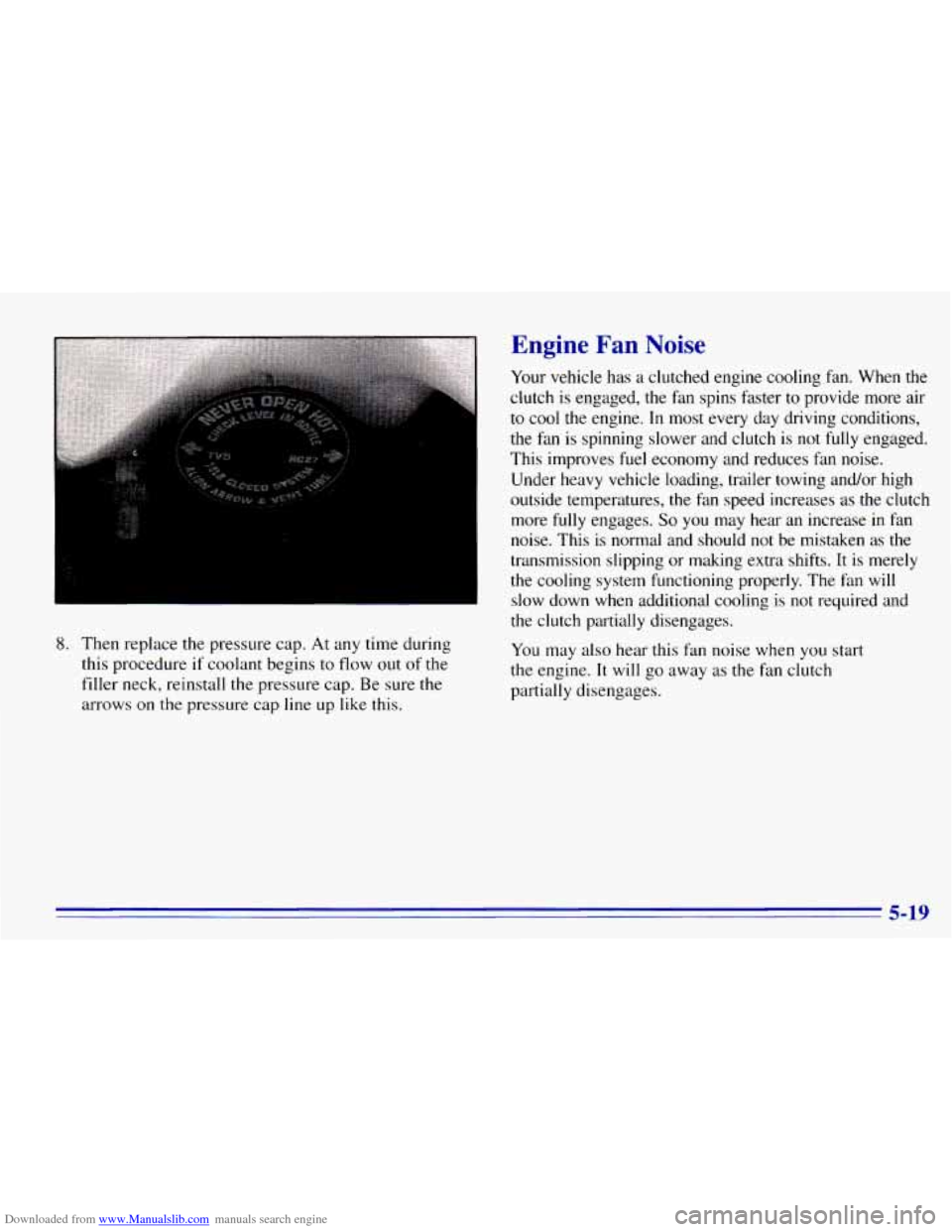
Downloaded from www.Manualslib.com manuals search engine 8. Then replace the pressure cap. At any time during
this procedure
if coolant begins to flow out of the
filler neck, reinstall the pressure cap. Be sure the
arrows
on the pressure cap line up like this.
Engine Fan Noise
Your vehicle has a clutched engine cooling fan. When the
clutch is engaged,
the fan spins faster to provide more air
to cool the engine. In most every day driving conditions,
the fan
is spinning slower and clutch is not fully engaged.
This improves fuel economy and reduces fan noise.
Under heavy vehicle loading, trailer towing and/or high
outside temperatures, the fan speed increases
as the clutch
more
fully engages. So you may hear an increase in fan
noise. This
is normal and should not be mistaken as the
transmission slipping
or making extra shifts. It is merely
the cooling system functioning properly. The fan will
slow down when additional cooling is not required and
the clutch partially disengages.
You may also hear this Fan noise when you start
the engine. It will go away as the fan clutch
partially disengages.
5-19
Page 214 of 376
Downloaded from www.Manualslib.com manuals search engine NOTICE:
Never remove or restore a tire frondto a stowage
position under the vehicle while the vehicle
is
supported by a jack. Always tighten the tire
fully against the underside of the vehicle when restowing
A flat rear tire reduces clearance to remove the spare
tire. If there is less than
12 inches (30.48 cm) between
the ground and the rear bumper or any trailer hitch, jack
up the vehicle
until the flat tire is off the ground.
(See “Removing
the Flat Tire” and “Installing the
Spare Tire,’’ Steps
4 through 8, in this section.)
Unless your vehicle has a flat rear tire, do not remove
or
restore a tire from/to a stowage position under the
vehicle while the vehicle is supported by a jack. Always
tighten the tire
fully against the underside of the vehicle
when restowing.
If you have a vehicle which was completed from a cab
and chassis, refer to the information from the body
suppliedinstaller.
The spare tire
is a full size tire, like the other tires on
your vehicle.
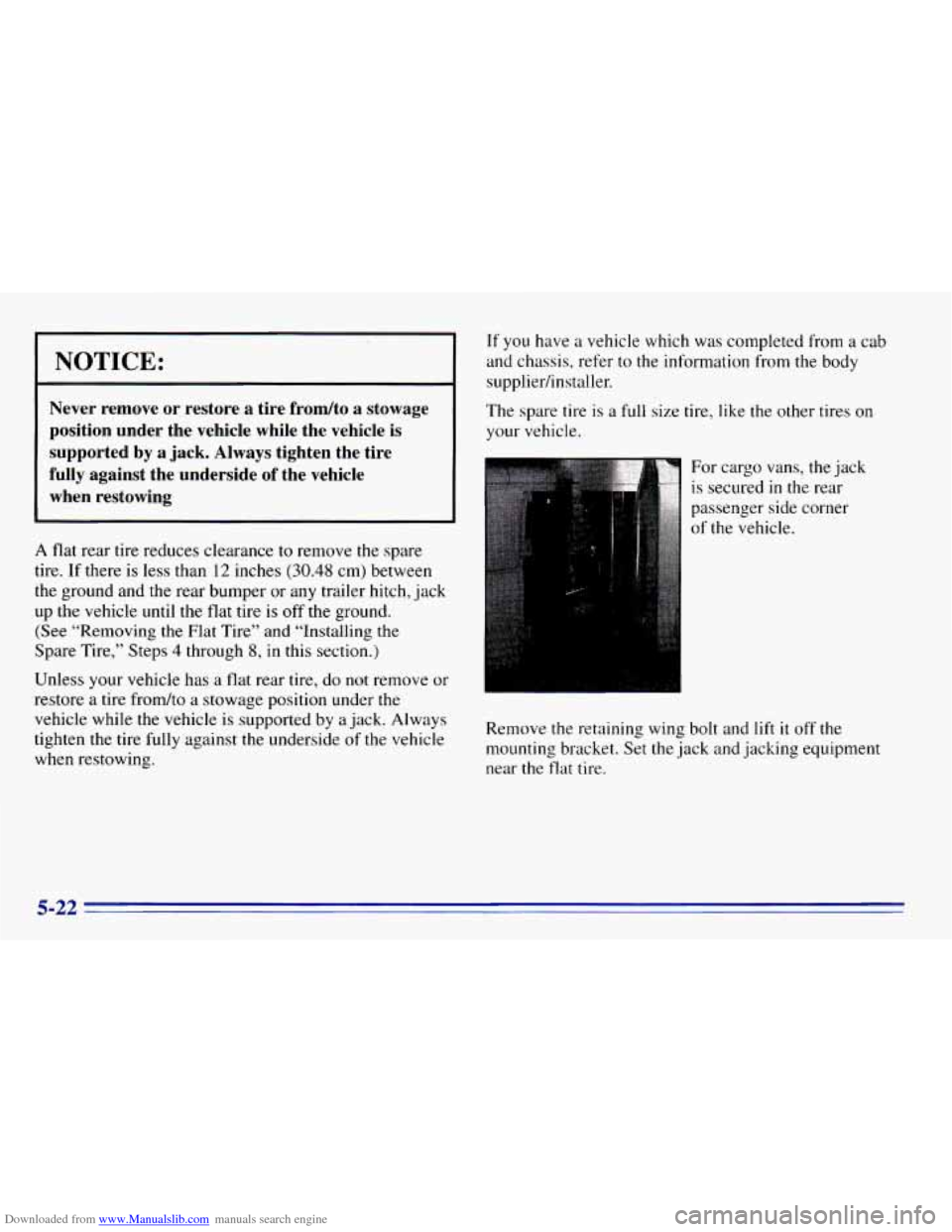
For cargo vans, the jack
is secured
in the rear
Remove the retaining wing bolt and lift
it off the
mounting bracket. Set the jack and jacking equipment
near the
flat tire.
5-22