key CHEVROLET EXPRESS 1996 1.G Owner's Manual
[x] Cancel search | Manufacturer: CHEVROLET, Model Year: 1996, Model line: EXPRESS, Model: CHEVROLET EXPRESS 1996 1.GPages: 376, PDF Size: 18.83 MB
Page 113 of 376
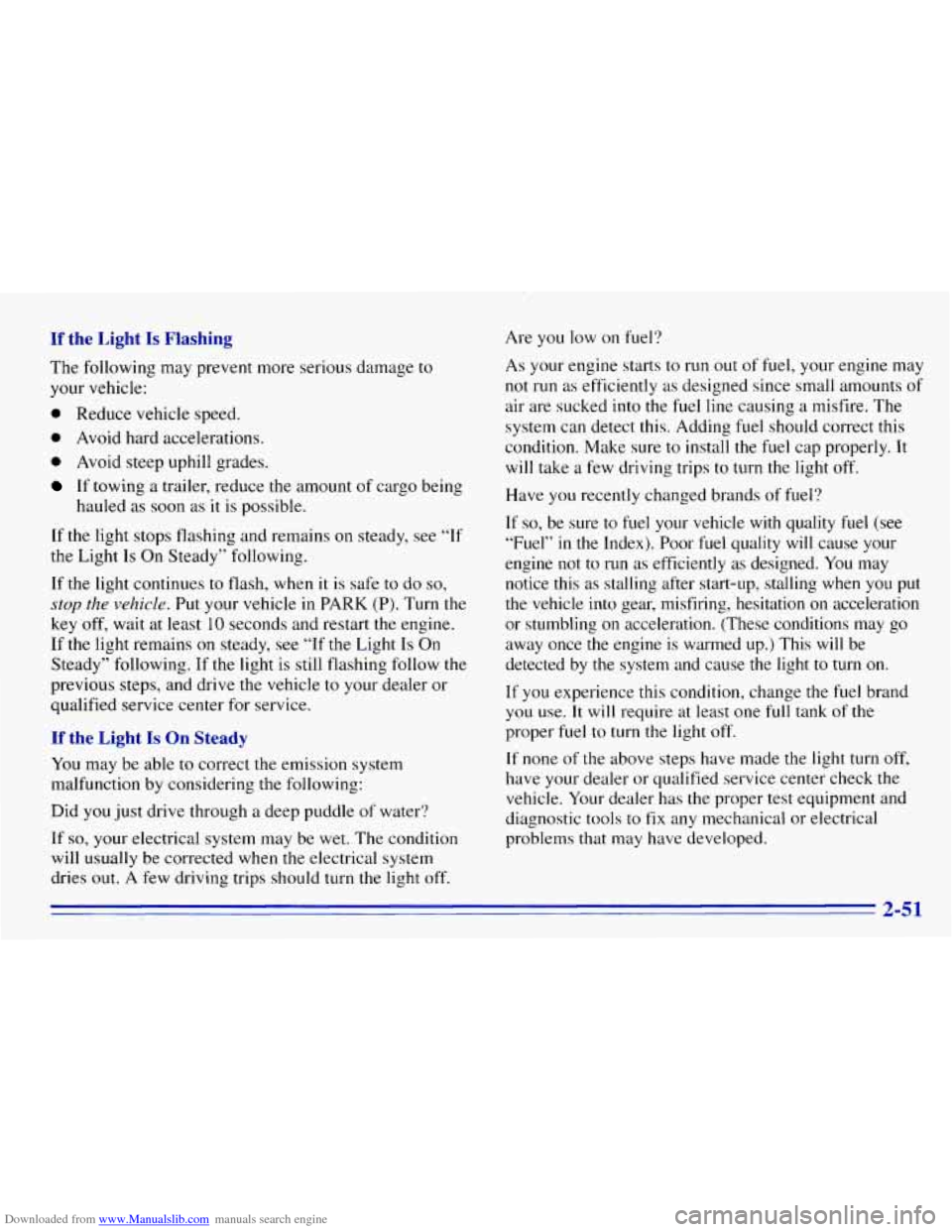
Downloaded from www.Manualslib.com manuals search engine If the Light Is Flashing Are you low on fuel?
The following may prevent more serious damage
to
your vehicle:
0 Reduce vehicle speed.
0 Avoid hard accelerations.
0 Avoid steep uphill grades.
If towing a trailer, reduce the amount of cargo being
hauled as soon as
it is possible.
If the light stops flashing and remains on steady, see
--IT
the Light Is On Steady” following.
If the light continues to flash, when
it is safe to do so,
stop the vehicle. Put your vehicle in PARK (P). Turn the
key off, wait at least
10 seconds and restart the engine.
If the light remains on steady, see “If the Light
Is On
Steady” following. If the light is still flashing follow the
previous steps, and drive the vehicle to your dealer or
qualified service center for service.
If the Light Is On Steady
You may be able to correct the emission system
malfunction by considering
the following:
Did
you just drive through a deep puddle of water?
If
so, your electrical system may be wet. The condition
will usually be corrected when
the electrical system
dries
out. A few driving trips should turn the light off. As
your engine starts
to run out of fuel, your engine may
not run
as efficiently as designed since small amounts of
air are sucked
into the fuel line causing a misfire. The
system can detect this. Adding fuel should correct this
condition. Make sure to install the fuel cap properly.
It
will take a few driving trips to turn the light off.
Have you recently changed brands
of fuel?
If
so, be sure to fuel your vehicle with quality fuel (see
“Fuel”
in the Index). Poor fuel quality will cause your
engine not to run as efficiently as designed. You may
notice
this as stalling after start-up, stalling when you put
the vehicle into gear, misfiring, hesitation on acceleration
or stumbling
on acceleration. (These conditions may go
away once the engine is warmed up.) This will be
detected by the system and cause the light
to turn on.
If you experience this condition, change the fuel brand
you use. It will require at least one full tank of the
proper fuel to turn the light off.
If none of the above steps have made the light turn off,
have your dealer or qualified service center check the
vehicle. Your dealer has the proper test equipment and
diagnostic tools to
fix any mechanical or electrical
problems that may have developed.
2-51
Page 154 of 376

Downloaded from www.Manualslib.com manuals search engine Drunken Driving
Death and injury associated with drinking and driving
is a national tragedy. It’s the number one contributor to
the highway death toll, claiming thousands of victims
every year.
Alcohol affects four things that anyone needs to
drive a vehicle:
Judgment
Muscular Coordination
0 Vision
0 Attentiveness.
Police records show
that almost half of all motor
vehicle-related deaths involve alcohol. In most cases,
these deaths are the result of someone who was drinking
and driving. In recent years, some
18,000 annual motor
vehicle-related deaths have been associated with the use
of alcohol, with more than
300,000 people injured.
Many adults
-- by some estimates, nearly half the adult
population
-- choose never to drink alcohol, so they
never drive after drinking. For persons under
21, it’s
against the law
in every U.S. state to drink alcohol.
There are good medical, psychological and
developmental reasons for
these laws. The
obvious way to solve this highway safety problem
is for people never
to drink alcohol and then drive. But
what if people
do? How much is “too much” if the
driver plans to drive? It’s
a lot less than many might
think. Although
it depends on each person and situation,
here is some general information on the problem.
The Blood Alcohol Concentration (BAC)
of someone
who is drinking depends upon four things:
0 The amount of alcohol consumed
0 The drinker’s body weight
0 The amount of food that is consumed before and
during drinking
0 The length of time it has taken the drinker to
consume the alcohol.
According
to the American Medical Association, a
180-lb. (82 kg) person who drinks three 12-ounce
(355 ml) bottles of beer in an hour will end up with a
BAC of about
0.06 percent. The person would reach the
same BAC by drinking three 4-ounce (120 ml) glasses
of wine or three mixed drinks if each had 1-1/2 ounces
(45 ml) of a liquor like whiskey, gin or vodka.
4-2
Page 193 of 376
Downloaded from www.Manualslib.com manuals search engine Section 5 Problems on the Road
Here you’ll find what to do about some problems that
can occur
on the road.
Hazard Warning Flashers
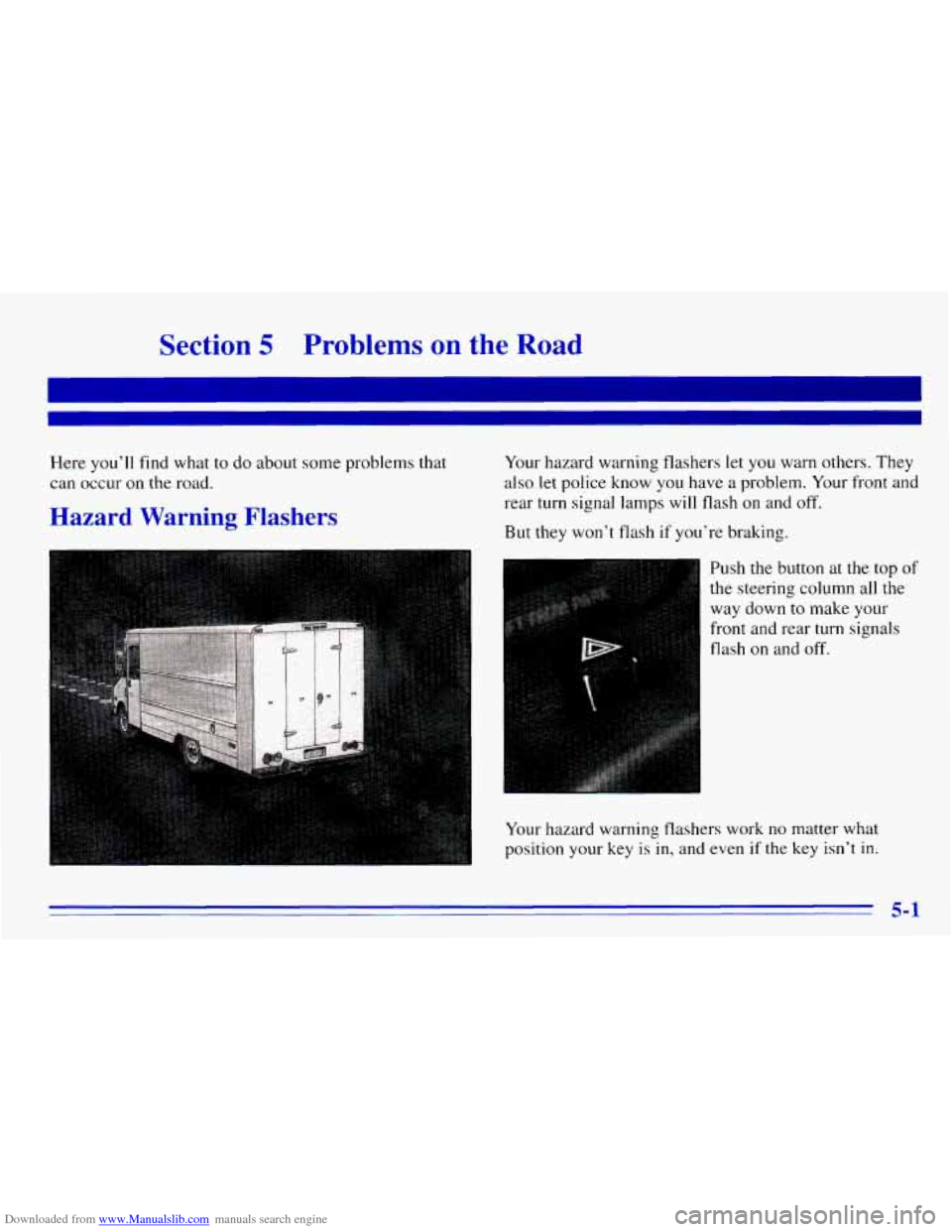
Your hazard warning flashers let you warn others. They
also let police know you have a problem. Your front and
rear turn signal lamps will flash
on and off.
But they won’t flash if you’re braking.
Push the button at
the top of
the steering column all the
way
down to make your
front and rear turn signals
flash on and
off.
Your hazard warning flashers work no matter what
position your key is in, and even if the key isn’t in.
5-1
Page 199 of 376
Downloaded from www.Manualslib.com manuals search engine I A CAUTION:
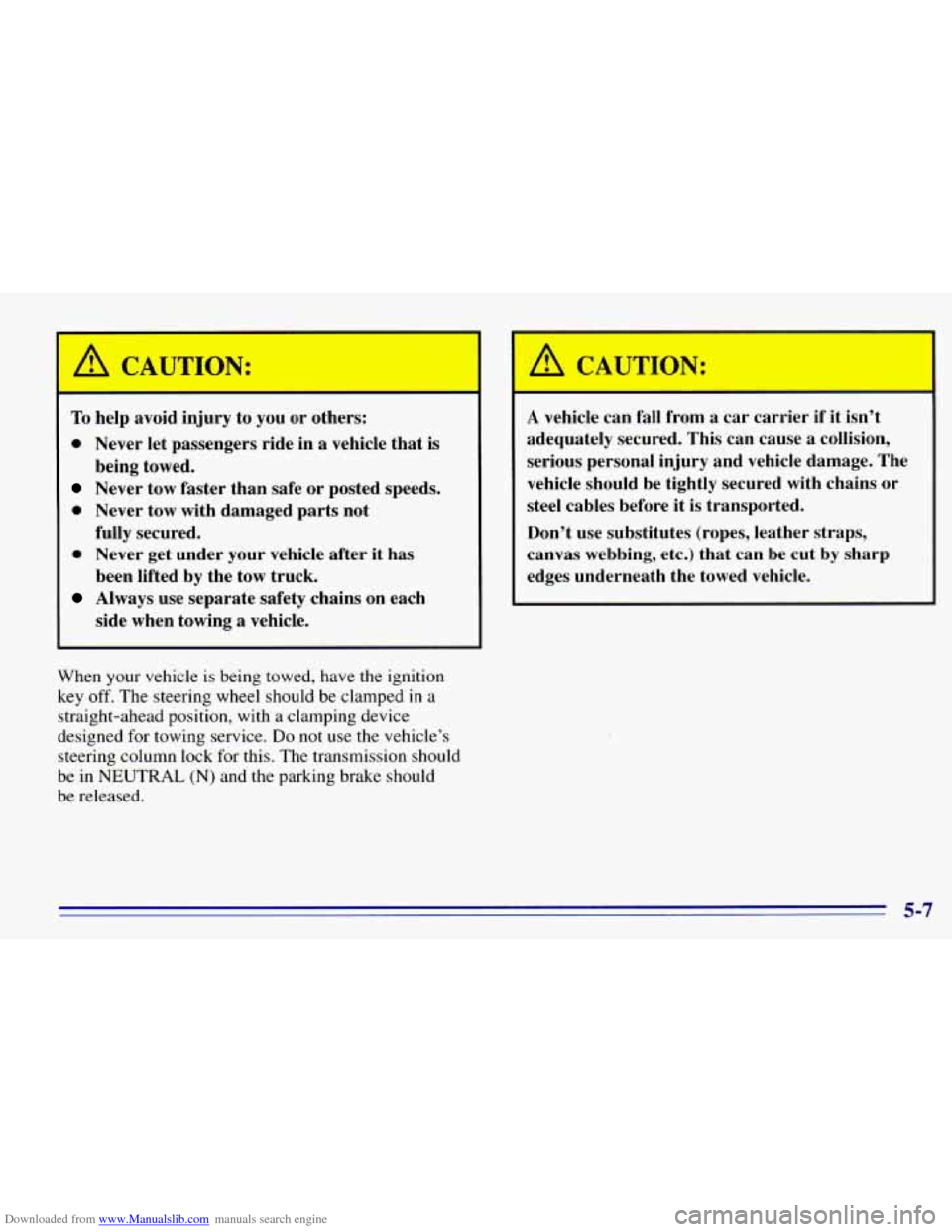
I I To help avoid injury to you or others:
0 Never let passengers ride in a vehicle that is
Never tow faster than safe or posted speeds.
0 Never tow with damaged parts not
0 Never get under your vehicle after it has
Always use separate safety chains on each
being
towed.
fully secured.
been lifted by the tow truck.
side when towing
a vehicle.
When your vehicle is being towed, have the ignition
key
off. The steering wheel should be clamped in a
straight-ahead position, with
a clamping device
designed for towing service.
Do not use the vehicle’s
steering column lock for this. The transmission should
be in NEUTRAL
(N) and the parking brake should
be released.
A CAUTION:
I
A vehicle can fall from a car carrier if it isn’t
adequately secured. This can cause
a collision,
serious personal injury and vehicle damage. The
vehicle should be tightly secured with chains or
steel cables before
it is transported.
Don’t use substitutes (ropes, leather straps,
canvas webbing, etc.) that can be cut by sharp
edges underneath the towed vehicle.
5-7
Page 291 of 376
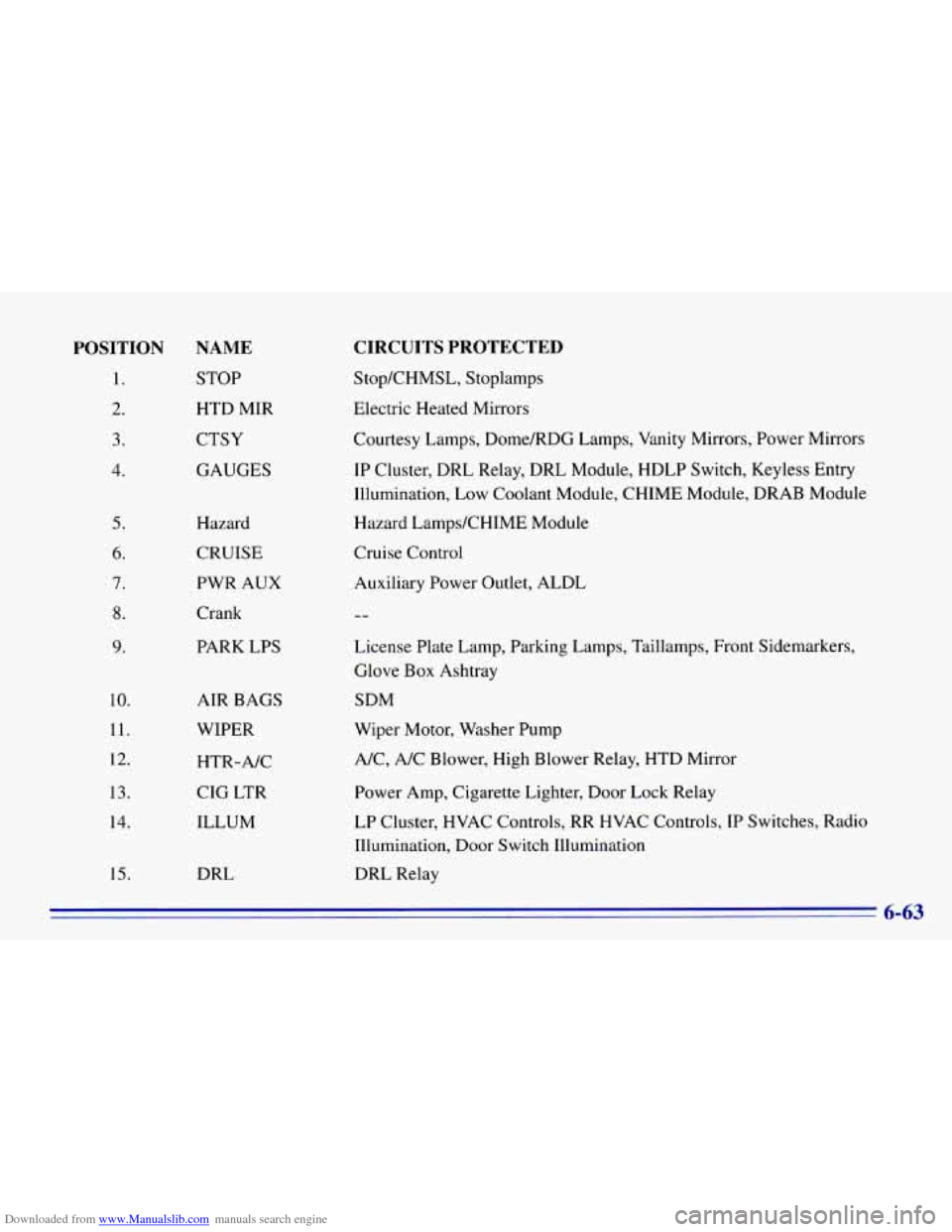
Downloaded from www.Manualslib.com manuals search engine POSITION NAME
1. STOP
2. HTD MIR
3. CTSY
4 GAUGES
5.
6.
7.
8.
9.
10.
11.
12.
13.
14.
15.
Hazard
CRUISE
PWR AUX
Crank
PARK LPS
AIR BAGS
WIPER
HTR-A/C
CIG LTR
ILLUM
DRL
CIRCUITS PROTECTED
Stop/CHMSL, Stoplamps
Electric Heated Mirrors
Courtesy
Lamps, Dome/RDG Lamps, Vanity Mirrors, Power Mirrors
IP Cluster, DRL Relay, DRL Module, HDLP Switch, Keyless Entry
Illumination, Low Coolant Module, CHIME Module, DRAB Module
Hazard LampsKHIME Module
Cruise Control Auxiliary Power Outlet, ALDL
License Plate Lamp, Parking Lamps, Taillamps, Front Sidemarkers,
Glove Box Ashtray
SDM
Wiper Motor, Washer Pump
NC, A/C Blower, High Blower Relay, HTD Mirror
Power Amp, Cigarette Lighter, Door Lock Relay
LP Cluster, HVAC Controls, RR HVAC Controls, IP Switches, Radio
Illumination, Door Switch Illumination
DRL Relay
6-63
Page 292 of 376
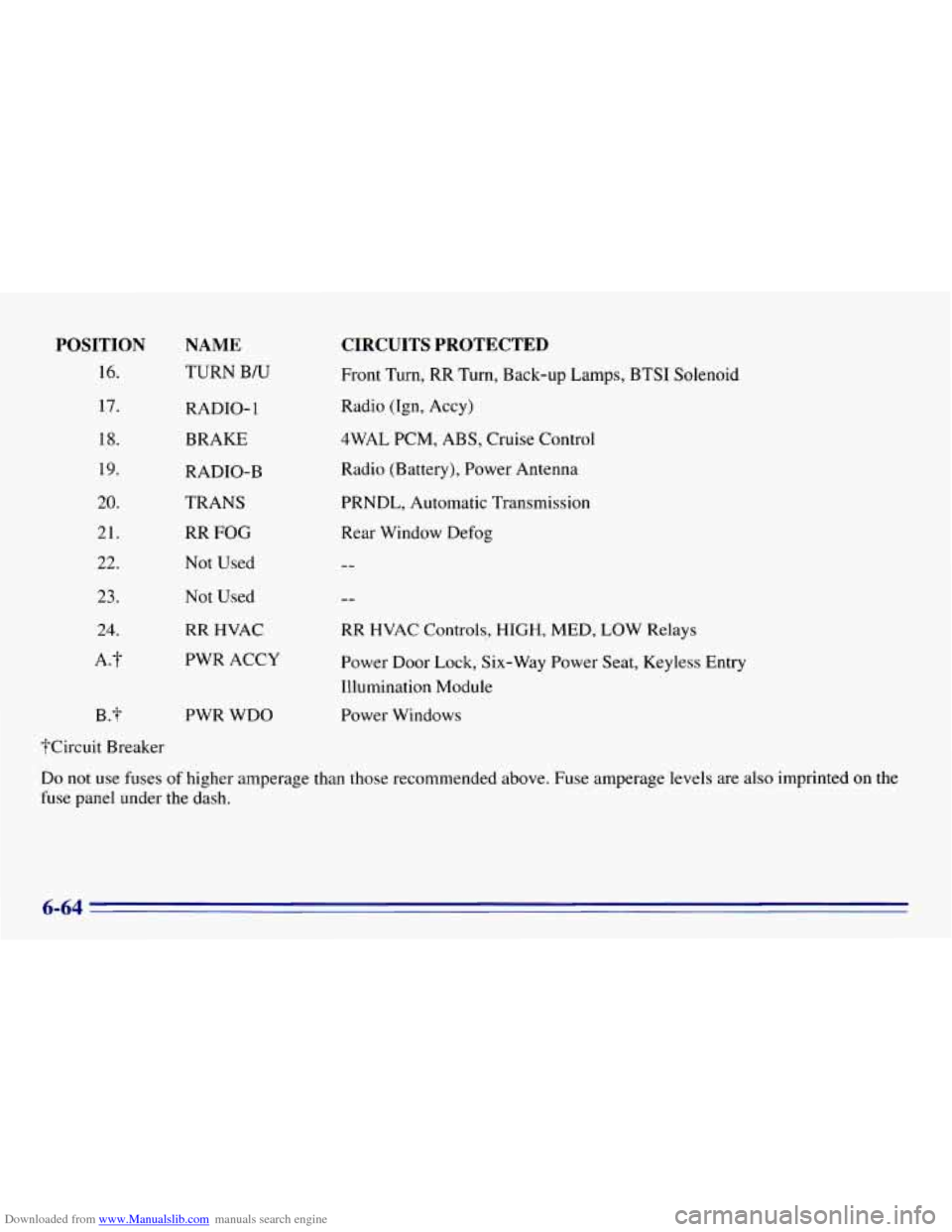
Downloaded from www.Manualslib.com manuals search engine POSITION
16.
17.
18.
19.
20.
21.
22.
23.
24.
A.7-
€3.7
NAME
TURN B/U
RADIO-
1
BRAKE
RADIO-B
TRANS RR
FOG
Not Used
Not Used
RR
HVAC
PWR ACCY
PWR WDO
CIRCUITS PROTECTED
Front Turn, RR Turn, Back-up Lamps, BTSI Solenoid
Radio (Ign, Accy)
4WAL PCM,
ABS, Cruise Control
Radio (Battery), Power Antenna
PRNDL, Automatic Transmission
Rear Window Defog
RR HVAC Controls,
HIGH, MED, LOW Relays
Power Door Lock, Six-Way Power Seat, Keyless Entry
Illumination Module
Power Windows
?Circuit Breaker Do
not use fuses of higher amperage than those recommended above. Fuse amperage levels are also imprinted on the
fuse panel under the dash.
6-64
Page 344 of 376
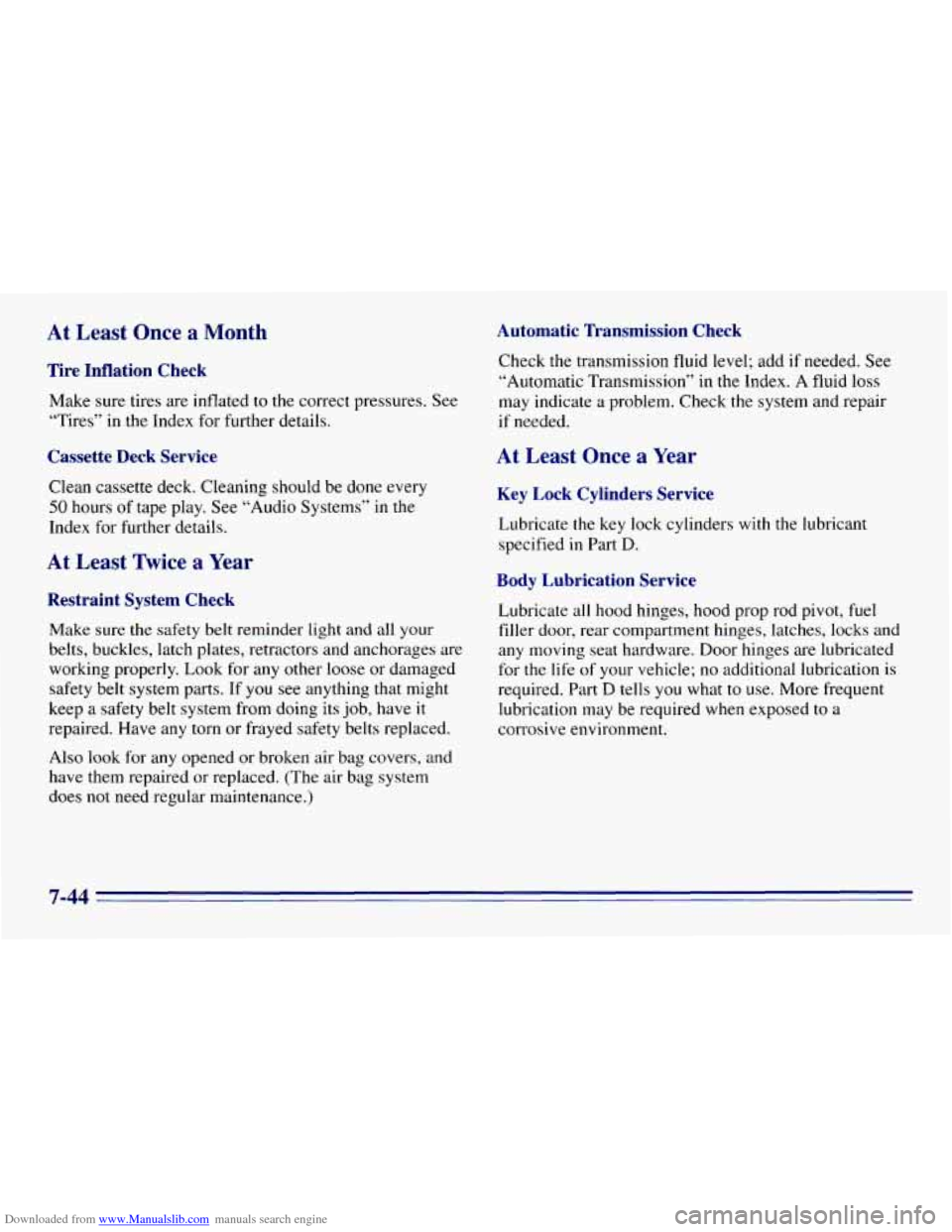
Downloaded from www.Manualslib.com manuals search engine At Least Once a Month
Tire Inflation Check
Make sure tires are inflated to the correct pressures. See
“Tires” in the Index for further details.
Cassette Deck Service
Clean cassette deck. Cleaning should be done every
50 hours of tape play. See “Audio Systems” in the
Index for further details.
At Least Twice a Year
Restraint System Check
Make sure the safety belt reminder light and all your
belts, buckles, latch plates, retractors and anchorages are
working properly. Look for any other loose or damaged
safety belt system parts. If you see anything that might
keep
a safety belt system from doing its job, have it
repaired. Have any torn or frayed safety belts replaced.
Also look for any opened or broken air bag covers,
and
have them repaired or replaced. (The air bag system
does not need regular maintenance.)
Automatic Transmission Check
Check the transmission fluid level; add if needed. See
“Automatic Transmission”
in the Index. A fluid loss
may indicate
a problem. Check the system and repair
if needed.
At Least Once a Year
Key Lock Cylinders Service
Lubricate the key lock cylinders with the lubricant
specified in Part
D.
Body Lubrication Service
Lubricate all hood hinges, hood prop rod pivot, fuel
filler door, rear compartment hinges, latches, locks and
any moving seat hardware. Door hinges are lubricated
for the life
of your vehicle; no additional lubrication is
required. Part
D tells you what to use. More frequent
lubrication may be required when exposed
to a
corrosive environment.
7-44
Page 345 of 376
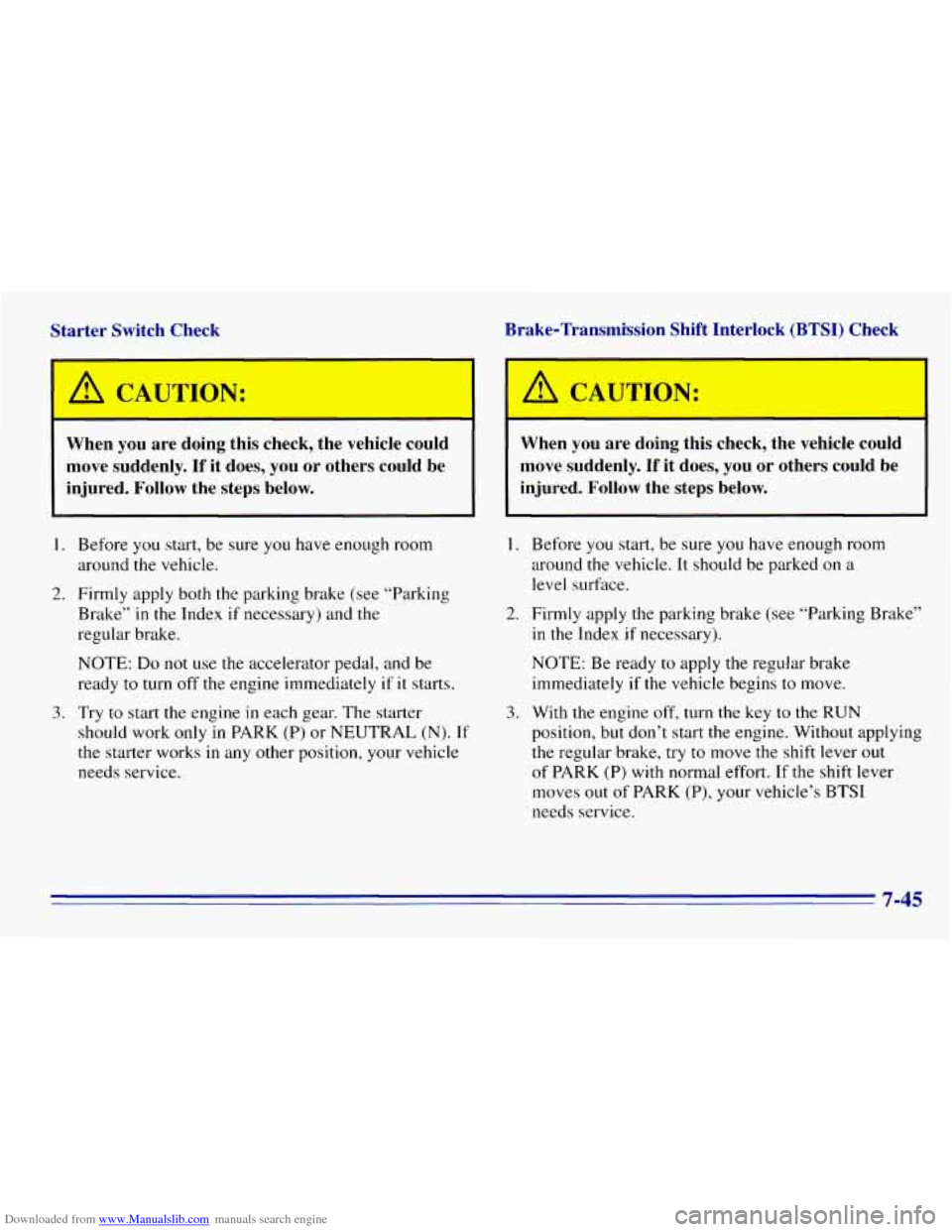
Downloaded from www.Manualslib.com manuals search engine Starter Switch Check Brake-Transmission Shift Interlock (BTSI) Check
’ A CAUTION:
When you are doing this
check, the vehicle could
move suddenly.
If it does, you or others could be
injured. Follow the steps below.
1
1. Before you start, be sure you have enough room
around the vehicle.
2. Firmly apply both the parking brake (see “Parking
Brake”
in the Index if necessary) and the
regular brake.
NOTE: Do not use the accelerator pedal, and be
ready to turn off the engine immediately
if it starts.
3. Try to start the engine in each gear. The starter
should work only
in PARK (P) or NEUTRAL (N). If
the starter works in any other position, your vehicle
needs service.
A CAUTION:
-
When you are doing this check, the vehicle could
move suddenly.
If it does, you or others could be
injured. Follow the steps below.
I. Before you start, be sure you have enough room
around
the vehicle. It should be parked on a
level surface.
2. Firmly apply the parking brake (see “Parking Brake”
in the Index if necessary).
NOTE: Be ready to apply the regular brake
immediately if the vehicle begins to move.
3. With the engine off, turn the key to the RUN
position, but don’t start the engine. Without applying
the regular brake, try to move
the shift lever out
of PARK (P) with normal effort. If the shift lever
moves
out of PARK (P), your vehicle’s BTSI
needs service.
7-45
Page 346 of 376
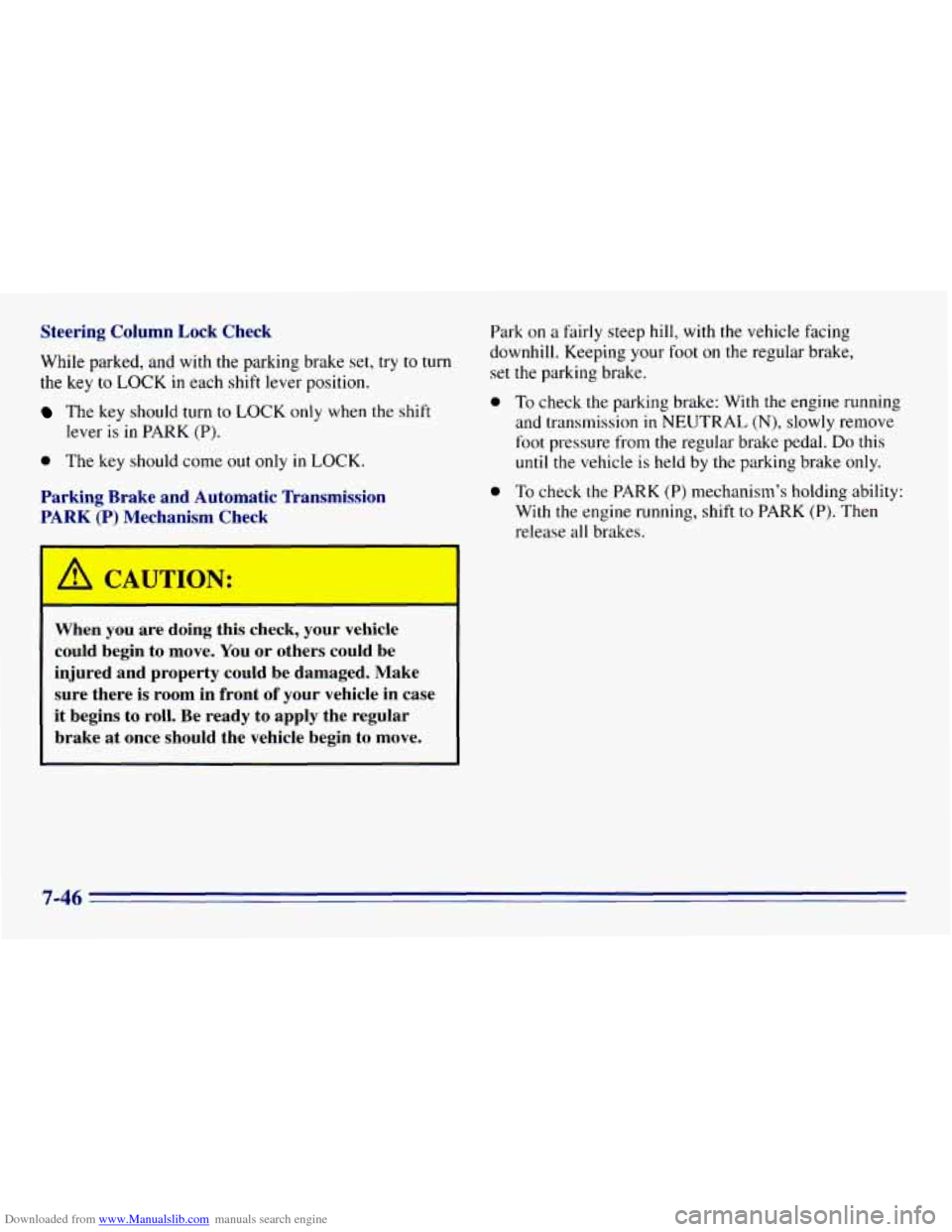
Downloaded from www.Manualslib.com manuals search engine Steering Column Lock Check
While parked, and with the parking brake set, try to turn
the key to LOCK in each shift lever position.
The key should turn to LOCK only when the shift
lever
is in PARK (P).
0 The key should come out only in LOCK.
Parking Brake and Automatic Transmission
PARK (P) Mechanism Check
When
you are doing this check, your vehicle
could begin to move. You
or others could be
injured and property could be damaged. Make
sure there is room in front
of your vehicle in case
it begins to
roll. Be ready to apply the regular
brake at once should the vehicle begin to move.
Park on a fairly steep hill, with the vehicle facing
downhill. Keeping your foot
on the regular brake,
set the parking brake.
0 To check the parking brake: With the engine running
and transmission
in NEUTRAL (N), slowly remove
foot pressure from the regular brake pedal.
Do this
until the vehicle is held by the parking brake only.
0 To check the PARK (P) mechanism’s holding ability:
With the engine running, shift to PARK
(P). Then
release all brakes.
7-46
Page 349 of 376
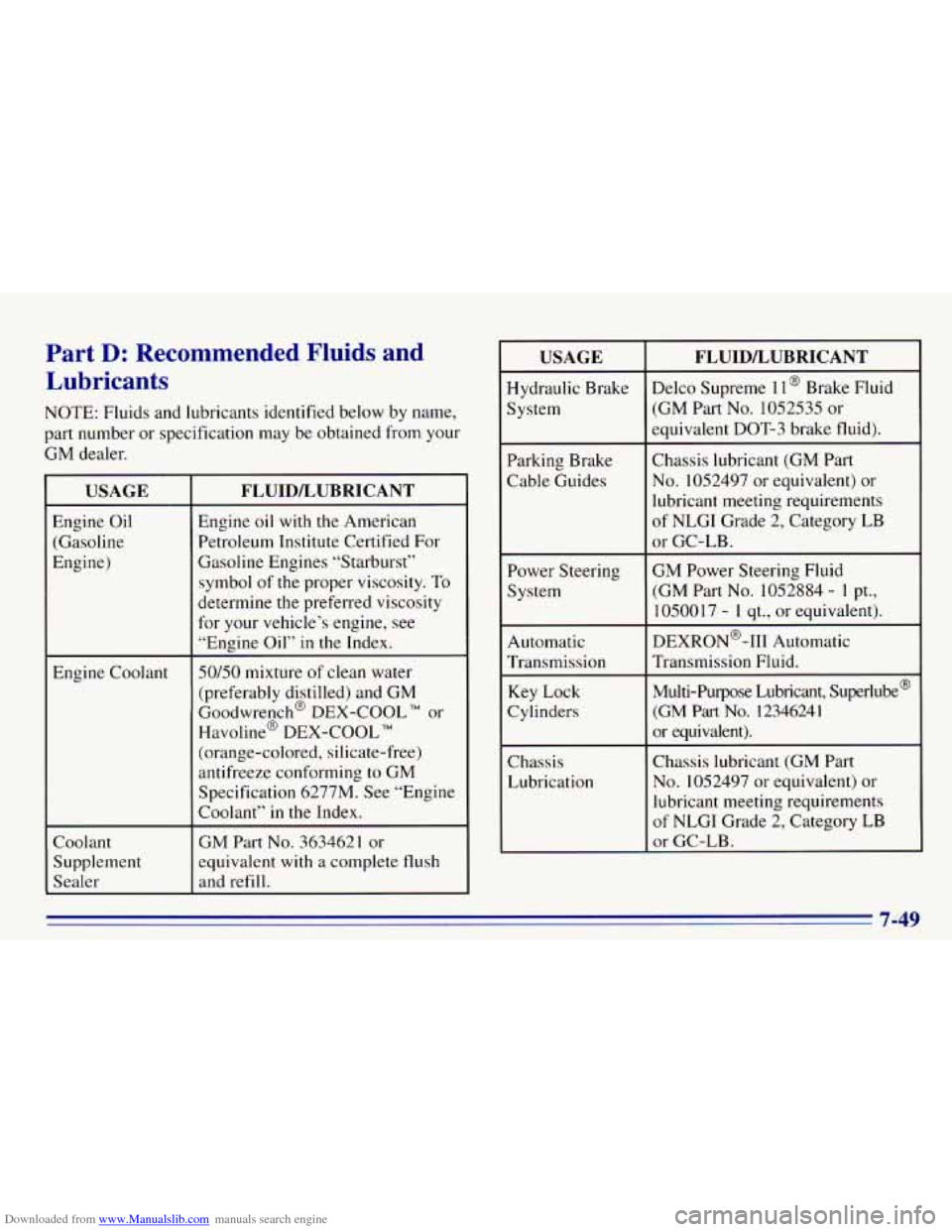
Downloaded from www.Manualslib.com manuals search engine Part D: Recommended Fluids and
Lubricants
NOTE: Fluids and lubricants identified below by name,
part number or specification may be obtained from your
GM dealer.
USAGE
Engine Oil
(Gasoline
Engine)
Engine Coolant
Coolant Supplement
Sealer
FLUIDLUBRICANT
Engine oil with the American
Petroleum Institute Certified For
Gasoline Engines “Starburst” symbol
of the proper viscosity. To
determine the preferred viscosity
for your vehicle’s engine, see
“Engine Oil”
in the Index.
50/50 mixture of clean water
(preferably distilled) and GM
Goodwrench@ DEX-COOL
or
Havoline@ DEX-COOL TM
(orange-colored, silicate-free)
antifreeze conforming
to GM
Specification 6277M. See “Engine
Coolant”
in the Index.
GM Part
No. 3634621 or
equivalent with a complete flush
and refill.
USAGE
Hydraulic Brake
System
Parking Brake
Cable Guides
Power Steering System
Automatic
Transmission
Key Lock
Cylinders
Chassis
Lubrication
FLUID/LUBRICANT
Delco Supreme 11 @ Brake Fluid
(GM Part No.
1052535 or
equivalent DOT-3 brake fluid).
Chassis lubricant (GM Part
No. 1052497 or equivalent) or
lubricant meeting requirements
of NLGI Grade 2, Category LB
or GC-LB.
GM Power Steering Fluid
(GM Part No. 1052884 - 1 pt.,
1050017
- 1 qt., or equivalent).
DEXRON@-I11 Automatic
Transmission Fluid.
Multi-Purpose Lubricant, Superlube@
(GM Part No. I234624 1
or equivalent).
Chassis lubricant (GM Part
No. 1052497 or equivalent) or
lubricant meeting requirements
of NLGI Grade
2, Category LB
or GC-LB.
7-49