ECO mode CHEVROLET EXPRESS 1996 1.G Owners Manual
[x] Cancel search | Manufacturer: CHEVROLET, Model Year: 1996, Model line: EXPRESS, Model: CHEVROLET EXPRESS 1996 1.GPages: 376, PDF Size: 18.83 MB
Page 49 of 376
Downloaded from www.Manualslib.com manuals search engine CAUTIOPT. ipontinuedi
at only 25 mph (40 km/h), a 12-1b. (5.5 kg) baby
will suddenly become
a 240-lb. (110 kg) force on
your arms. The baby
would be almost impossible
to hold.
Child Restraints
Be sure the child restraint is designed to be used in a
vehicle. If it is, it will have
a label saying that it meets
Federal Motor Vehicle Safety Standards.
Then follow the instructions for the restraint. You may
find these instructions on the restraint itself or in a
booklet, or both. These restraints
use the belt system in
your vehicle, but the child also has to be secured within
the restraint to help reduce the chance
of personal injury.
The instructions that come with the infant
or child
restraint will show you how to do that.
Where to Put the Restraint (Except Cargo
Vans and Cab and Chassis Models)
Accident statistics show that children are safer if they
are restrained in the rear rather than the front seat. We at
General Motors therefore recommend that you put your
child restraint in a rear seat. If your vehicle has a front passenger air bag,
neuer put a rear-facing child restraint
in the front passenger seat. Here’s why:
I A CAUTION: I
A child in a rear-facing child restraint can be
seriously injured
if the right front passenger’s
air bag inflates. This is because the back of a
rear-facing child restraint would be very close to
the inflating air bag.
If your vehicle has a right
front passenger’s air bag, always secure a
rear-facing child restraint in a rear seat.
You may, however, secure a forward-facing child
restraint in the right front seat. Before you secure
a forward-facing child restraint, always move the
front passenger seat
as far back as it will go. Or,
secure the child restraint in a
rear seat.
Wherever you install it, be sure to secure the child
-estraint properly.
Keep in mind that an unsecured child restraint can move
around in a collision or sudden stop and injure people in
the vehicle. Be sure
to properly secure any child
restraint in your vehicle
-- even when no child is in it.
1-37
Page 88 of 376
Downloaded from www.Manualslib.com manuals search engine Windows
Manual Windows
To operate your manual windows, turn the hand crank
on each door
to raise or lower your side door windows.
Power Windows
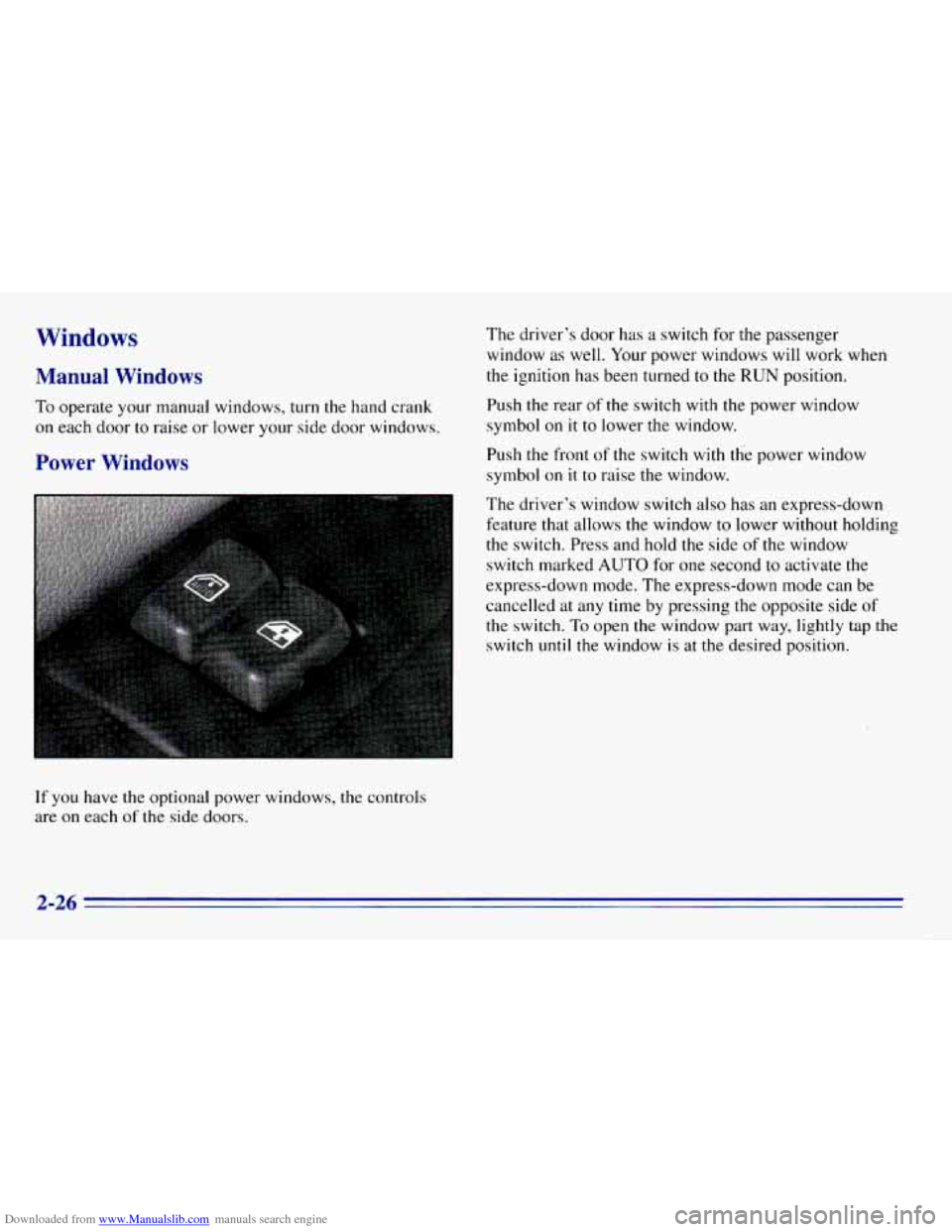
If you have the optional power windows, the controls
are on each
of the side doors. The
driver’s door has a switch for the passenger
window
as well. Your power windows will work when
the ignition
has been turned to the RUN position.
Push the rear of the switch with the power window
symbol
on it to lower the window.
Push the front
of the switch with the power window
symbol on
it to raise the window.
The driver’s window switch also
has an express-down
feature that allows the window to lower without holding
the switch. Press and hold the side
of the window
switch marked
AUTO for one second to activate the
express-down mode.
The express-down mode can be
cancelled at any time by pressing the opposite side of
the switch.
To open the window part way, lightly tap the
switch until the window is at the desired position.
2-26
Page 124 of 376
Downloaded from www.Manualslib.com manuals search engine Mode Knob
The right knob on the control panel changes the
heatedair conditioning setting.
MAX A/C: With A/C on, move the right knob to
MAX A/C for maximum cooling. This setting puts the
system in the recirculation mode and helps to maximize
your air conditioner’s performance and your vehicle’s
fuel economy. This setting also cools the air the fastest.
After the vehicle’s interior reaches
a comfortable
temperature, move
the knob clockwise to place the air
conditioning system
in the A/C mode.
A/C: Use for normal cooling on hot days. This setting
cools outside air and directs it through the instrument
panel outlets.
+e
@ VENT: This setting, with the arrow pointing at
the figure’s head, directs air through the instrument
panel
vents.
+e
‘N VENTMEAT Use this setting, with the arrows
pointing at
the figure’s feet and head, to divide
airflow between the heater floor vents and instrument
panel vents.
+# HEAT This setting, with the arrow pointing at the
figure’s feet, directs air through the heater floor vents.
This setting is useful for cold weather.
U
?# HEATDEFROST Use this setting, with the
arrow pointing at the figure’s feet and the defroster
symbol near the figure’s head,
to divide airflow between
the heater
floor vents and windshield.
0
WO
DEFROST This setting with the defrost symbol
directs
air through the windshield defroster vents.
This setting is
useful when you have fog or ice on
the windshield.
3-4
Page 129 of 376
Downloaded from www.Manualslib.com manuals search engine Audio Systems
Your DelcoB audio system has been designed to operate
easily and give years
of listening pleasure. You will get
the most enjoyment
out of it if you acquaint yourself
with it first. Find out what your Delco system can do
and how to operate all its controls, to be sure you're
getting the most
out of the advanced engineering that
went
into it.
AM-FM Stereo
Setting the
Clock for AM-FM Stereo and
AM-FM Stereo with Cassette Tape Player
Press SET. Within five seconds, press and hold the
SEEK right arrow until the correct minute appears on
the display. Press and hold the SEEK left arrow until the
correct hour appears
on the display.
Setting the Clock for AM-FM Stereo with
Compact Disc Player
Press and hold HR until the correct hour appears on the
display. Press and hold MIN until the correct minute
appears on the display.
To display the clock with the
ignition
off, press RECALL and the time will be displayed
for a few seconds. There is
an initial two-second delay
before the clock goes into the time-set mode.
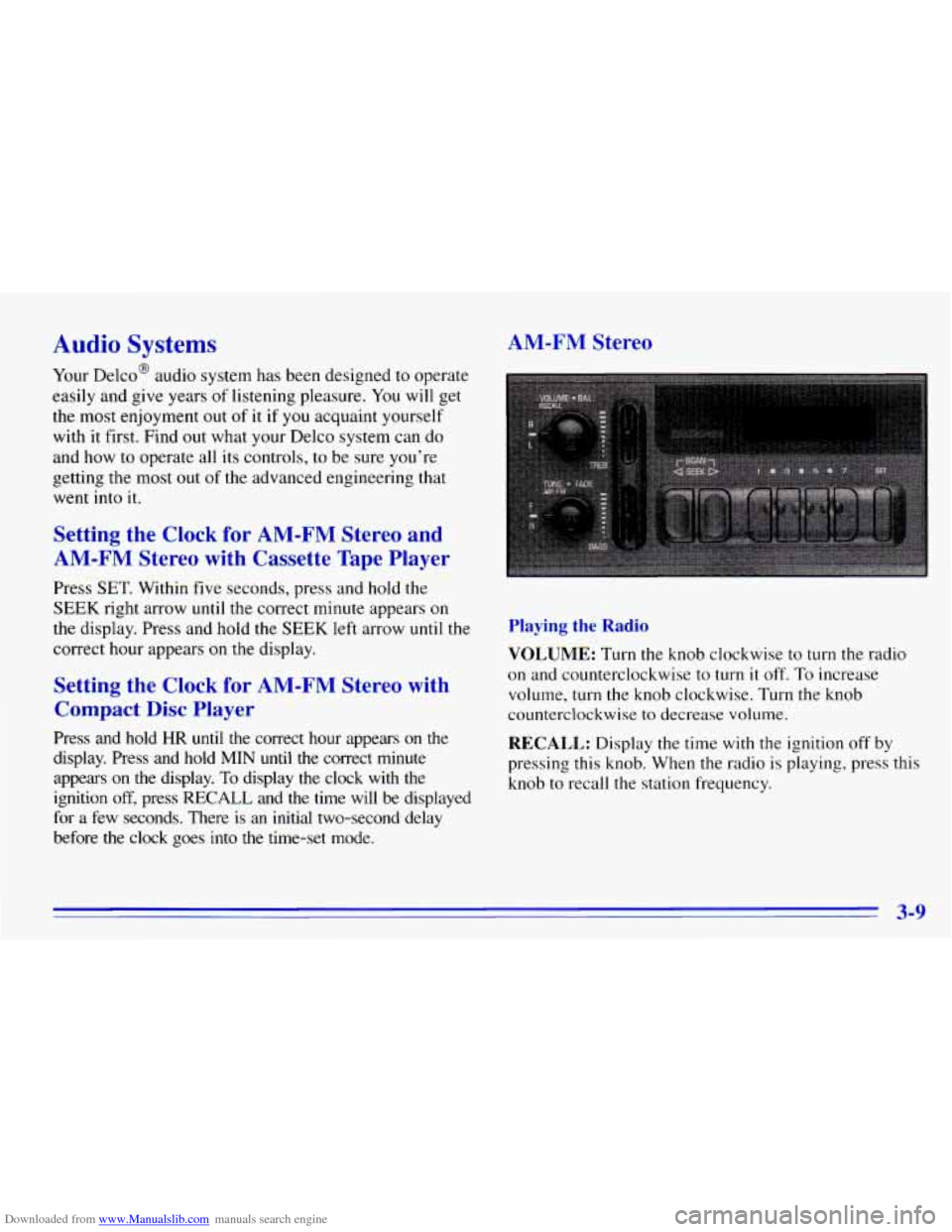
Playing the Radio
VOLUME: Turn the knob clockwise to turn the radio
on and counterclockwise to turn
it off. To increase
volume, turn the knob clockwise. Turn the knob
counterclockwise to decrease volume.
RECALL: Display the time with the ignition off by
pressing this knob. When the radio
is playing, press this
knob
to recall the station frequency.
3-9
Page 134 of 376
Downloaded from www.Manualslib.com manuals search engine SCAN: Press and hold SEEK for two seconds until
SCAN appears on the display. SCAN allows you to
listen to stations for a few seconds. The receiver will
continue
to scan and momentarily stop at each station
until you press the button again. The sound will mute
while scanning.
PUSHBUTTONS: The six numbered pushbuttons let
you return
to your favorite stations. You can set up to
18 stations
(six AM, six FMl and six FM2).
1. Press AM-FM to select the band.
2. Tune in the desired station.
3. Press AUTO TONE to select the setting you prefer.
4. Press and hold one of the six pushbuttons. The sound
will mute. When
it returns, release the button.
Whenever you press that numbered button, the
station you set
will return and the tone you selected
will be automatically selected for that button.
5. Repeat these steps for each pushbutton.
P.SCAN: The preset scan button lets you scan through
your fdvorite stations stored on your pushbuttons. Select
either the
AM, FMl or FM2 mode and then press
P.SCAN. It will scan through each station stored on your
pushbuttons and stop for
a few seconds before
continuing to scan through all
of the pushbuttons. Press
P.SCAN again or one of the pushbuttons to stop
scanning to listen to a specific preset station. P.SCAN
will light
up on the display while in this mode. If one of
the stations stored on a pushbutton is too weak for the
location you are
in, the radio display will show the
channel number (P
1 -P6) for several seconds before
advancing
to the next preset station.
2 IA
Page 136 of 376
Downloaded from www.Manualslib.com manuals search engine Once the tape is playing, use the VOL, BAL, FADE,
TREB and BASS controls just as you do for the radio.
The tape symbol and a direction arrow will be on the
display whenever a tape is being played. Anytime a tape
is inserted, the top side is selected for play first.
PREV (I): Press the PREV or the SEEK left arrow to
search for
the previous selection. A minimum
three-second blank gap
is required for the player to stop
at the beginning
of the selection. The tape direction
arrow will blink during the SEEK operation.
PROG (2): Press this button to switch from one side of
the tape to the other.
NEXT (3): Press NEXT or the SEEK right arrow to
search for
the next selection. A minimum three-second
blank gap is required for the player
to stop at the
beginning of the selection. The tape direction arrow will
blink during the SEEK operation.
REV (4): Press this button to rapidly reverse the tape to
the beginning
of the cassette reel or until you press REV
again. The radio will play the last selected station while
reversing
the tape. The tape direction arrow will blink
during
REV operation.
00 (5): Press this button to reduce cassette tape noise.
The double-D symbol will appear on the display while
the player is in this mode. Dolby Noise Reduction
is manufactured under a license
from Dolby Laboratories Licensing Corporation. Dolby
and
the double-D symbol are trademarks of Dolby
Laboratories Licensing Corporation.
FWD (6): Press this button to rapidly forward the tape
to the end of the cassette reel or until you press FWD
again. The radio will play the last selected station while
forwarding
the tape. The tape direction arrow will blink
during FWD operation.
AM-FM: Press this button to switch from a tape to
the radio.
TAPE AUX: Press this button to return to the tape
player. The lighted arrow will appear and show the
direction
of play when a tape is in the active mode.
EJECT Press this button to remove the tape. The radio
will now play. EJECT can be used with either
the ignition
or radio
off. To load a cassette tape with the ignition or
radio
off, press EJECT before loading the cassette.
CLN: This message may appear on the display. If it
does, your cassette tape player needs to be cleaned. It
will still play tapes, but
you should clean it as soon as
possible to prevent damage to your tapes and player. See
“Care of Your Cassette Tape Player’’ in the Index.
After
you clean the player, press and hold EJECT for
five seconds
to reset the CLN indicator. The radio will
display
--- to show the indicator was reset.
Page 139 of 376
Downloaded from www.Manualslib.com manuals search engine TAPE AUX: With a disc loaded in the player and the
radio playing, press
this button once to play the compact
disc.
To return to playing the radio, press AM-FM. If
both a cassette tape and CD are loaded, press TAPE
AUX to switch between the tape and compact disc.
RANDOM: Press P.SCAN to enter the random play
mode. RANDOM will appear
on the display. While in
this mode, the tracks on the discs will be played in
random order. If you press SEEK, PREV or NEXT
while
in the random mode, the PREV or NEXT track
will be scanned randomly. Press P.SCAN again to
turn
off RANDOM and return to normal operation.
RECALL: Press this button to see what track
is currently playing. Press RECALL again
within
five seconds to see how long the track has been playing.
When a new track starts to play,
the track number will
also appear. Press RECALL a third time and the time of
day will be displayed.
EJECT Press this button on the remote player to eject a
compact disc.
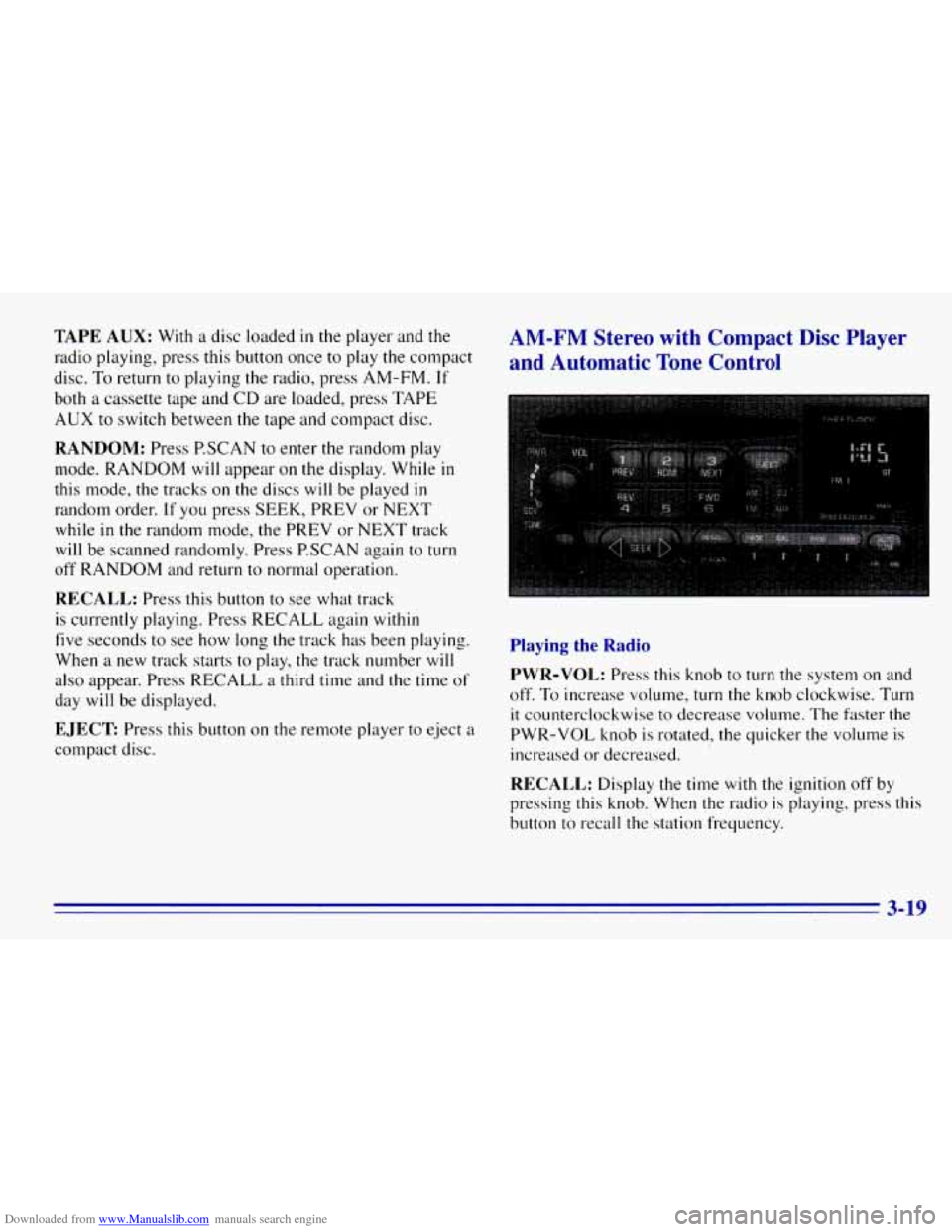
AM-FM Stereo with Compact Disc Player
and Automatic Tone Control
Playing the Radio
PWR-VOL:
Press this knob to turn the system on and
off.
To increase volume, turn the knob clockwise. Turn
it counterclockwise to decrease volume. The faster the
PWR-VOL knob is rotated, the quicker the volume is
increased or decreased.
RECALL: Display the time with the ignition off by
pressing
this knob. When the radio is playing, press this
button to recall the station frequency.
3-19
Page 141 of 376
Downloaded from www.Manualslib.com manuals search engine P.SCAN: The preset scan button lets you scan through
your favorite stations stored on your pushbuttons. Select
either the AM,
FM1 or FM2 mode and then press
P.SCAN. It will scan through each station stored
on your
pushbuttons and stop for a few seconds before
continuing to scan through all
of the pushbuttons. Press
P.SCAN again or one of the pushbuttons
to stop
scanning
to listen to a specific stored station. P.SCAN
will light up on the display while in this mode.
If one of
the stations stored on a pushbutton is too weak for the
location you are
in, the radio display will show the
channel number
(P 1 -P6) for several seconds before
advancing to the next preset station.
Setting the Tone
BASS:
Press lightly on this knob to release it from its
stored position. Turn the knob clockwise
to increase the
bass and counterclockwise
to decrease the bass. When
the BASS control is rotated, the AUTO TONE setting
will change to
MAN.
TREB: Press lightly on the TREB knob to release it
from its stored position. Turn the knob clockwise to
increase the treble and counterclockwise
to decrease the
treble. When the TREB control is rotated,
the AUTO
TONE setting will change
to MAN.
Push these knobs back in to their stored position when
you’re
not using them.
AUTO TONE: Press this button to select among the
five preset equalization settings and tailor the sound to
the music or voice being heard. Each time
you press the
button, the selection will switch
to one of the preset
settings
of CLASSIC, NEWS, ROCK, POP or JAZZ.
The display will show which mode the receiver is
in. To
return to the manual mode, press and release this button
until MAN appears on the display. This will return the
tone adjustment to the TREB and BASS controls. When
a TREB or BASS control is rotated, tone is
automatically set to MAN.
Adjusting the Speakers
BAL:
Press lightly on this knob to release it from its
stored position. Turn the control clockwise to adjust
sound to the right speakers and counterclockwise to
adjust sound to the left speakers.
FADE: Press lightly on this knob to release it from its
stored position. Turn the
control clockwise to adjust the
sound to the front and counterclockwise for rear speakers.
Push these knobs back
in to their stored position when
you’re not using them.
3-21
Page 142 of 376
Downloaded from www.Manualslib.com manuals search engine Playing a Compact Disc
PWR: Press this knob to turn the system on. (Please note
that you can also turn the system
on when you insert a
compact disc into the player with the ignition on.)
Insert a disc partway into the slot, label side up. The
player will pull
it in. Wdit a few seconds and the disc
should play.
CD and a CD symbol will also appear on
the display. Anytime you are playing a CD, the letters
CD will be next to the CD symbol.
If the disc comes back out and ERR appears on the
display,
it could be that:
0 You are driving on a very rough road. (The disc
should play when the road gets smoother.)
0 The disc is upside down.
0 It is dirty, scratched or wet.
0 It is very humid. (If so, wait about an hour and
try again.)
0 The disc player is very hot.
Press RECALL to make ERR go off the display.
RECALL: Press this button to see what track is playing.
Press
it again within five seconds to see how long the
CD has been playing that track. Elapsed time
is
displayed in minutes and tenths of a second. The track
number
will also appear when a new track begins to
play. Press RECALL again to return to the time display.
PREV (1): Press PREV or the SEEK left arrow to
search for the previous selection.
If you hold this button
or press
it more than once, the disc will advance further.
Sound is muted in this mode.
RDM (2): Press this button to play the tracks on the disc
in random (instead of 1, 2,3. . .) order. While in the
RDM mode, RANDOM appears on the display. Press
RDM again
to return to normal play.
NEXT (3): Press NEXT or the SEEK right arrow to
search for the next selection.
If you hold this button or
press
it more than once, the disc will advance further.
The
next track number will appear on the display. Sound
is muted
in this mode.
3-22
Page 143 of 376
Downloaded from www.Manualslib.com manuals search engine a REV (4): Press and hold REV to return rapidly to a
favorite passage. You will hear the disc selection play at
high speed while
you press the REV button. This allows
you to listen and find out when the disc is at the desired
selection. Release
REV to resume playing.
FWD (6): Press and hold this button to advance rapidly
within a track. You will hear the disc selection play at
high speed while you press the FWD button. This allows
you to listen and find out when the disc is
at the desired
selection. Release FWD to resume playing.
AM-FM: While in the CD mode, press this button to
stop playing the CD and play the radio. The CD symbol
will still display but the word CD will be replaced with
either
AM, FM I or FM2. (If the radio is turned off, the
disc stays
in the player and will resume playing at the
point where
it stopped.)
CD AUX: To switch between the player and the radio
when
a disc is playing, press the AM-FM button. To
return to the player, press CD
AUX. When a disc is
playing, the letters CD and the CD symbol
will appear
on the display.
(If the radio is turned off, the disc stays
in the player and will resume playing at the point where
it stopped.)
EJECT Press this button to eject the disc from the
player and play the radio. When the same or a new disc
is inserted, the disc
will start playing on track one. Ifa
compact disc is left sitting in the opening for more than
a few seconds, the player will pull the CD back in. The
radio will continue playing. When the ignition is off,
press this button to load
a CD.
Theft-Deterrent Feature
THEFTLOCK TM is designed to discourage theft of your
radio.
It works by using a secret code to disable all radio
functions whenever battery power is removed.
The THEFTLOCK feature for
the radio may be used or
ignored.
If ignored, the system plays normally and the
radio is not protected by the feature.
If THEFTLOCK is
activated, your radio
will not operate if stolen.
When THEFTLOCK
is activated, the radio will display
LOC
to indicate a locked condition anytime battery
power is removed.
If your battery loses power for any
reason,
you must unlock the radio with the secret code
before
it will operate.
3-23