window CHEVROLET EXPRESS 1997 1.G User Guide
[x] Cancel search | Manufacturer: CHEVROLET, Model Year: 1997, Model line: EXPRESS, Model: CHEVROLET EXPRESS 1997 1.GPages: 386, PDF Size: 20.32 MB
Page 90 of 386
Downloaded from www.Manualslib.com manuals search engine I A CAUTION:
It can be dangerous to get out of your vehicle if
the shift lever is not fully in
PARK (P) with the
parking brake firmly set. Your vehicle can roll.
Don’t leave your vehicle when the engine
is
running unless you have to. If you’ve left the
engine running, the vehicle can move suddenly.
You
or others could be injured. To be sure your
vehicle won’t move, even when you’re on fairly
level ground, always set your parking brake and
move the shift lever
to PARK (P).
Windows
Manual Windows
To operate your manual windows, turn the hand crank
on each door to raise or lower your side door windows.
Power Windows (Option)
Follow the proper steps to be sure your vehicle won’t
move. See “Shifting Into PARK (P)” in the Index.
If you’re pulling a trailer, see “Towing a Trailer” in
the Index.
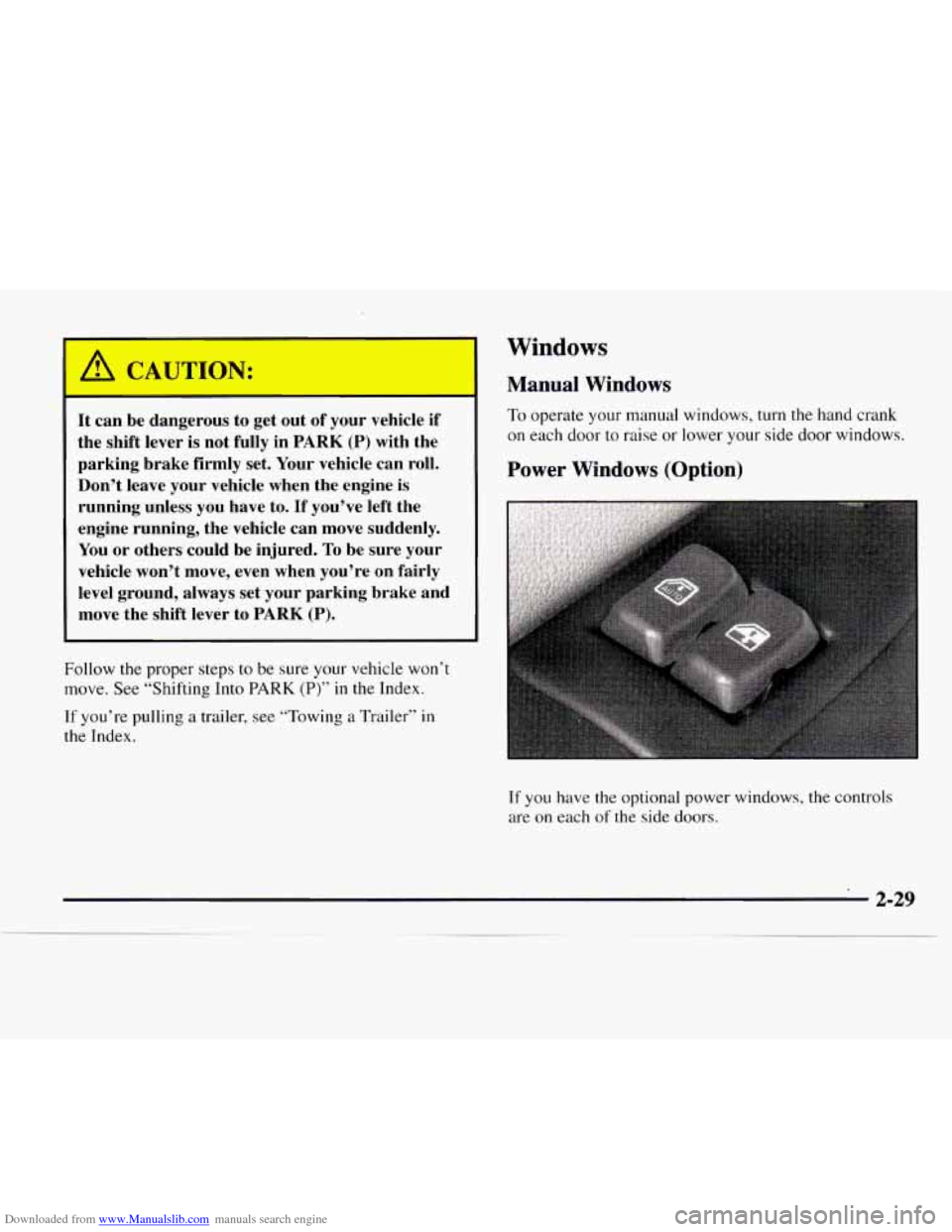
If you have the optional power windows, the controls
are
on each of the side doors.
Page 91 of 386

Downloaded from www.Manualslib.com manuals search engine The driver’s door has a switch for the passenger
windows as well. Your power windows will work when
the ignition has been turned to the
RUN position.
Push the rear of the switch with the power window
symbol on
it to lower the window.
Swing-Out Windows
Push the front of the switch with the power window
symbol on
it to raise the window.
The driver’s window switch
also has an express-down
feature that allows the window to lower without holding
the switch. Press and hold the side of the window switch
marked AUTO for one second to activate the
express-down mode. The express-down mode can be
cancelled at any time
by pressing the opposite side of
the switch. To open the window partway, lightly tap the
switch until the window is at the desired position.
Side Swing-Out Window
To open your side door swing-out windows, pull up on
the latch at the edge
of the window and swing the
window out and push down the latch into the locked
open position.
2-30
Page 92 of 386

Downloaded from www.Manualslib.com manuals search engine Rear Swing-Out Window
To close the window, pull the latch toward you and push
down
on the latch to lock it. Your rear swing-out
windows
work the same way, but the latch is at the
bottom edge of the window.
It can be dangerous to drive with the rear
swing-out windows or rear door@) open because
carbon monoxide
(CO) gas can come into your
vehicle. You can’t see
or smell CO. It can cause
unconsciousness and even death.
If you must drive with the rear swing-out
windows or rear door(s) open or if electrical
wiring or other cable connections must pass
through the seal between the body and the rear
swing-out windows or rear door(s):
0 Make sure all windows are shut.
Thrn the fan on your heating or cooling
system to its highest speed with the setting on
VENT,
HEAT, BLEND or DEE Additionally,
on vehicles with heatingair conditioning
systems,
NORM A/C or BI-LEV A/C can be
used. That will force outside air into your
vehicle. See “Comfort Controls’’ in the Index.
instrument panel, open them
all the way.
0 If you have air outlets on or under the
See “Engine Exhaust” in the Index.
2-31
Page 128 of 386
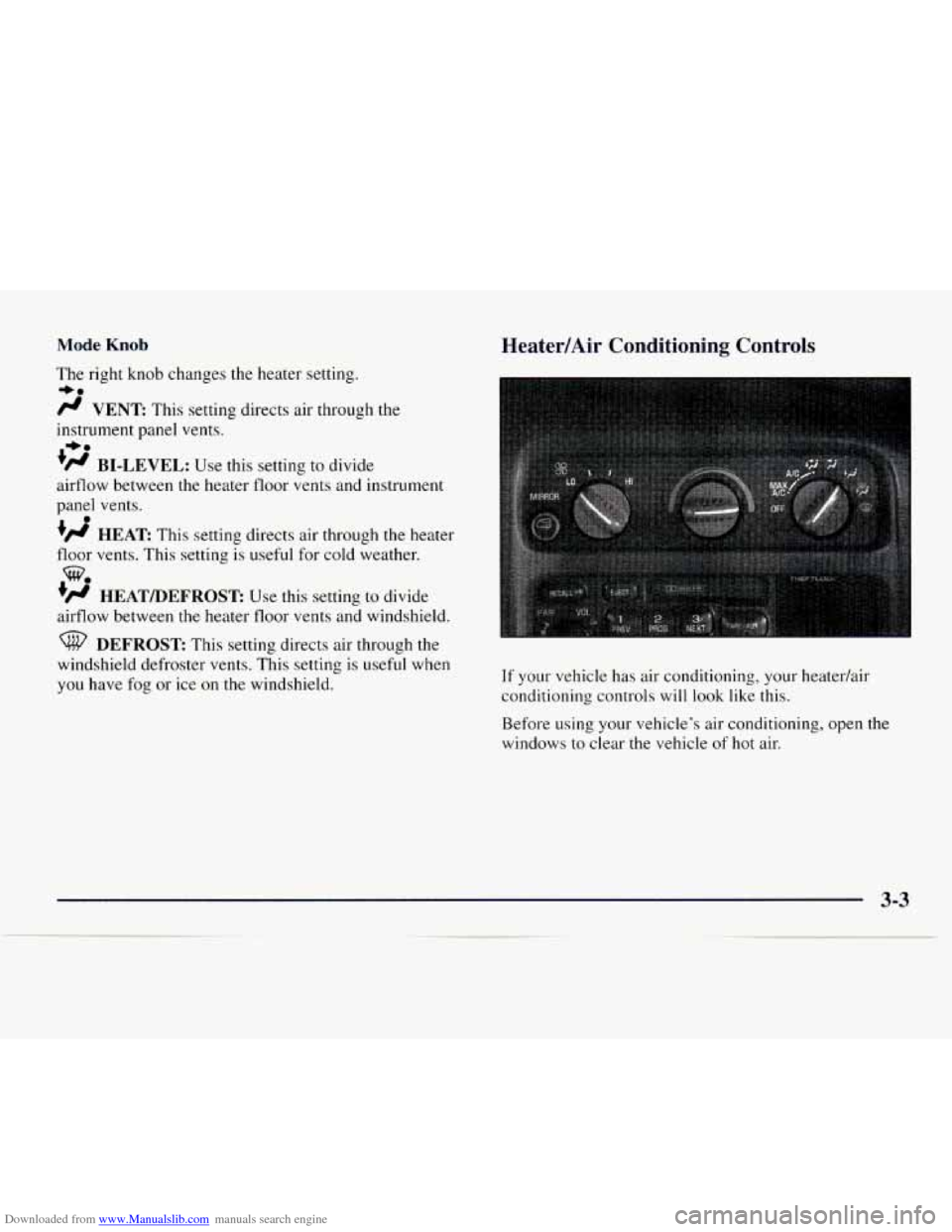
Downloaded from www.Manualslib.com manuals search engine Mode Knob
The right knob changes the heater setting.
/J VENT This setting directs air through the
instrument panel vents.
’# BI-LEVEL: Use this setting to divide
airflow between the heater floor vents and instrument
panel vents.
+# HEAT This setting directs air through the heater
floor vents. This setting is useful for cold weather.
+’, HEATDEFROST Use this setting to divide
airflow between the heater floor vents and windshield.
*a
+e
e
wa
DEFROST: This setting directs air through the
windshield defroster
vents. This setting is useful when
you have fog or ice on the windshield.
Heater/Air Conditioning Controls
If your vehicle has air conditioning, your heatedair
conditioning controls will look like this.
Before using your vehicle’s air conditioning, open the
windows
to clear the vehicle of hot air.
Page 132 of 386
Downloaded from www.Manualslib.com manuals search engine Air Conditioning Heating
Before using your
vehicle’s air conditioning, open the
windows to clear the vehicle of hot air. This reduces the
time it takes for your vehicle
to cool down. Then keep
your windows closed for the air conditioner to work at
its best.
You can use MAX
A/C with the temperature knob in the
blue area, when it’s really hot outside and you need to
cool the inside air quickly. MAX A/C lets in only a little
air from the outside.
If you first use MAX
A/C, you can then use A/C with
the temperature knob in the blue area, as
soon as the
vehicle has cooled down,
so outside air will be going
through your vehicle.
If your vehicle has rear air conditioning, setting it on
LO may enhance front A/C performance by allowing
trapped refrigerant in rear lines to circulate.
When the air conditioning, DEFROST or BLEND is on,
you may notice a slight increase or decrease in engine
speed, due to compressor operation. This is normal
because the system is designed to cycle the compressor
on and off to keep the desired temperature. On
cold days, use HEATER with the temperature knob
in the red area. Outside air will be brought in through
the floor outlets. The heater works best if you keep your
windows closed while using it.
If you use the optional engine coolant heater before
starting your engine, your heating system will produce
warmer air faster to heat the passenger compartment in
cold weather. See “Engine Coolant Heater” in the Index.
Ventilation Tips
Keep the hood and front air inlet free of ice, snow,
or any other obstruction (such as leaves). The heater
and defroster will work far better, reducing the
chance of fogging the inside of your windows.
When you enter a vehicle in cold weather, turn the
blower fan to HI for a few moments before driving
off. This helps clear the intake ducts of snow and
moisture, and reduces the chance of fogging the
inside of yow windows.
3-7
Page 174 of 386
Downloaded from www.Manualslib.com manuals search engine Once you are moving on the freeway, make certain you
allow a reasonable following distance. Expect to move
slightly slower at night.
When
you want to leave the freeway, move to the proper
lane well in advance. If you miss your exit, do not,
under any circumstances, stop and back
up. Drive on to
the next exit.
The exit ramp can be curved, sometimes quite sharply.
The exit speed is usually posted.
Reduce your speed according to your speedometer,
not
to your sense of motion. After driving for any distance
at higher speeds, you may tend
to think you are going
slower than you actually are.
Before Leaving on a
Long Trip
Make sure you’re ready. Try to be well rested. If you
must start when
you’re not fresh -- such as after a day’s
work
-- don’t plan to make too many miles that first part
of
the journey. Wear comfortable clothing and shoes you
can easily drive in.
Is your vehicle ready for a long trip? If you keep it
serviced and maintained, it’s ready
to go. If it needs
service, have
it done before starting out. Of course,
you’ll find experienced and able service experts in
GM dealerships all across North America. They’ll be
ready and willing to help
if you need it.
Here are some things
you can check before a trip:
0
0
0
0
0
0
0
Windsh.ield Washer Fluid: Is the reservoir full?
Are all windows clean inside and outside?
Wiper Blades: Are they in good shape?
Fuel, Engine Oil, Other Fluids: Have you checked
all levels?
Lamps: Are they all working? Are the lenses clean?
Tires: They are vitally important to a safe,
trouble-free trip.
Is the tread good enough for
long-distance driving? Are the tires all inflated to the
recommended pressure?
Weuther Forecasts: What’s the weather outlook
along your route? Should you delay your trip a
short
time to avoid a major storm system?
Maps: Do you have up-to-date maps?
4-21
Page 179 of 386
Downloaded from www.Manualslib.com manuals search engine 0 Tie a red cloth to your vehicle to alert police that
you’ve been stopped by the snow.
Put on extra clothing or wrap a blanket around you.
If
you have no blankets or extra clothing, make body
insulators
from newspapers, burlap bags, rags, floor
mats
-- anything you can wrap around yourself or
tuck under your clothing to keep warm.
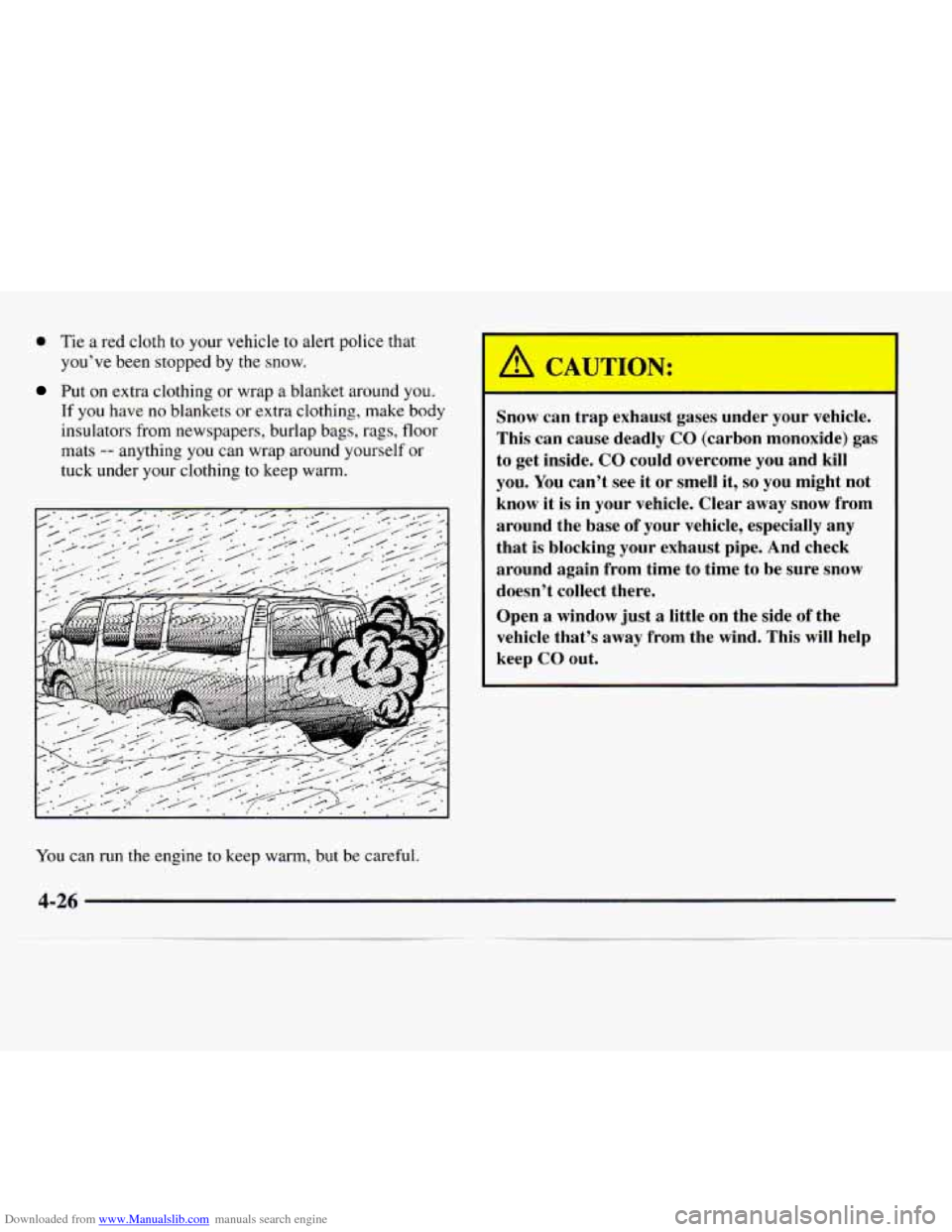
Snow can trap exhaust gases under your vehicle.
This can cause deadly CO (carbon monoxide) gas
to get inside.
CO could overcome you and kill
you. You can’t see it or smell it,
so you might not
know it is in your vehicle. Clear away snow from
around the base of your vehicle, especially any
that is blocking your exhaust pipe. And check
around again from time to time to be sure snow
doesn’t collect there.
Open a window just
a little on the side of the
vehicle that’s away from the wind. This will help
keep
CO out.
You can run the engine to keep warm, but be careful.
4-26
Page 180 of 386
Downloaded from www.Manualslib.com manuals search engine Run your engine only as long as you must. This
saves fuel. When
you run the engine, make it go a
little faster than just idle. That is, push the accelerator
slightly. This uses less fuel for the heat that
you get
and it keeps the battery (or batteries) charged.
You will
need a well-charged battery (or batteries) to restart the
vehicle, and possibly for signaling later
on with your
headlamps. Let
the heater run for awhile. If you have a
diesel engine you may have to run it at a higher speed
to get enough heat.
Then, shut the engine
off and close the window almost
all the way to preserve the heat. Start the engine again
and repeat this only when you feel really uncomfortable
from the cold. But do it
as little as possible. Preserve the
fuel as long as you can. To help keep warm, you can get
out
of the vehicle and do some fairly vigorous exercises
every half hour or
so until help comes.
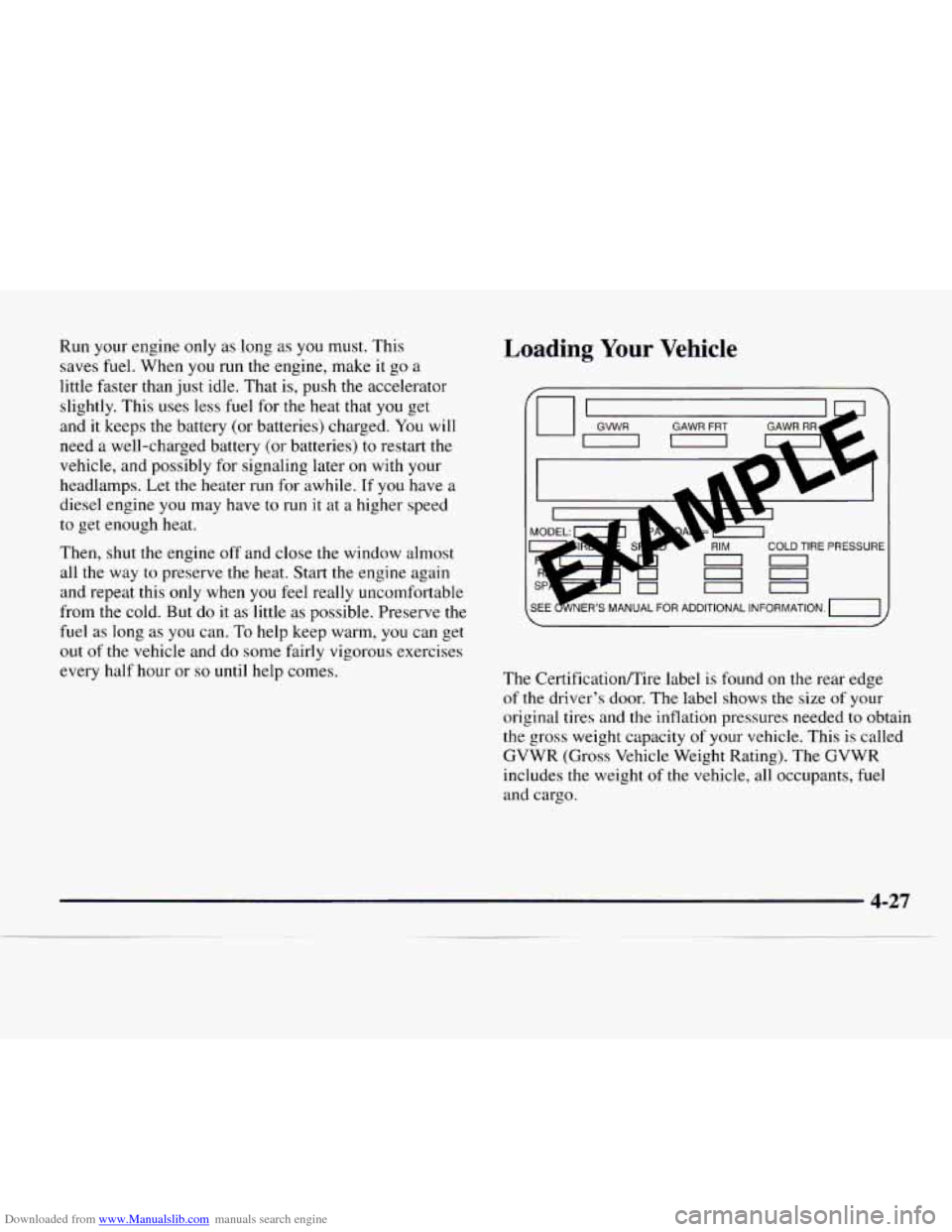
Loading Your Vehicle
fii I
in
The CertificatiodTire label is found on the rear edge
of the driver’s door. The label shows the size of your
original tires and the inflation pressures needed
to obtain
the gross weight capacity of your vehicle. This is called
GVWR (Gross Vehicle Weight Rating). The
GVWR
includes the weight of the vehicle, all occupants, fuel
and cargo.
Page 187 of 386
Downloaded from www.Manualslib.com manuals search engine Safety Chains
You should always attach chains between your vehicle
and your trailer. Cross the safety chains under the tongue
of the trailer so that the tongue will not drop to the road
if it becomes separated
from the hitch. Instructions
about safety chains may be provided by the hitch
manufacturer or by the trailer manufacturer. Follow the
manufacturer’s recommendation for attaching
safety
chains and do not attach them to the bumper. Always
leave just enough slack
so you can turn with your rig.
And, never allow safety chains to drag on
the ground.
Driving with a Trailer
Trailer Brakes
If your trailer weighs more than 1,000 Ibs. (450 kg)
loaded, then
it needs its own brakes -- and they must be
adequate. Be sure
to read and follow the instructions for
the trailer brakes so you’ll be able to install, adjust and
maintain them properly.
If you have a rear-most window open and you
pull a trailer with your vehicle, carbon monoxide
(CO) could come into your vehicle. You can’t see
or smell CO. It can cause unconsciousness or
death. (See “Engine Exhaust” in the Index.)
To
maximize your safety when towing a trailer:
0
0
0
Have your exhaust system inspected for
leaks, and make necessary repairs before
starting on
your trip.
Keep the rear-most windows closed.
If exhaust does come into your vehicle
through
a window in the rear or another
opening, drive with your front, main
heating or cooling system on and with the
fan on any speed.
This will bring fresh,
outside
air into your vehicle. Do not use
MAX A/C because it only recirculates the
air inside your vehicle. (See “ Comfort
Controls” in the Index.)
Page 206 of 386
Downloaded from www.Manualslib.com manuals search engine If No Steam Is Coming From Your Engine
If you get the overheat warning but see or hear no
steam, the problem may not be too serious. Sometimes
the engine can get a little too hot when you:
Climb a long hill on a hot day.
0 Stop after high-speed driving.
0 Idle for long periods in traffic.
Tow a trailer. See “Driving on Grades’’ in the Index.
If
you get the overheat warning with no sign of steam,
try this for a minute
or so:
1. If you have an air conditioner, turn it off.
2. Turn on your heater to full hot at the highest fan
speed and open the window as necessary.
3. If you’re in a traffic jam, shift to NEUTRAL (N);
otherwise,
shift to the highest gear while
driving
-- AUTOMATIC OVERDRIVE (@)
or DRIVE (D). If
you no
longer have the overheat warning, you can
drive. Just to be safe, drive slower for about
10 minutes.
If the warning doesn’t come back on, you can
drive normally.
If the warning continues, pull over, stop, and park your
vehicle right away.
If there’s still no sign of steam, you can idle the engine
for two or three minutes while you’re parked, to push
the accelerator until the engine speed is about twice as
fast as normal idle speed. Bring the engine speed back
to normal idle speed after two or three minutes. Now
see if the warning stops. But then, if you still have the
warning,
turn ofsthe engine and get everyone out of
the vehicle until it cools down.
You may decide not to lift the hood but to get service
help right away.