trailer CHEVROLET EXPRESS 1997 1.G Owner's Manual
[x] Cancel search | Manufacturer: CHEVROLET, Model Year: 1997, Model line: EXPRESS, Model: CHEVROLET EXPRESS 1997 1.GPages: 386, PDF Size: 20.32 MB
Page 217 of 386
Downloaded from www.Manualslib.com manuals search engine Removing the Spare Tire and Tools
I
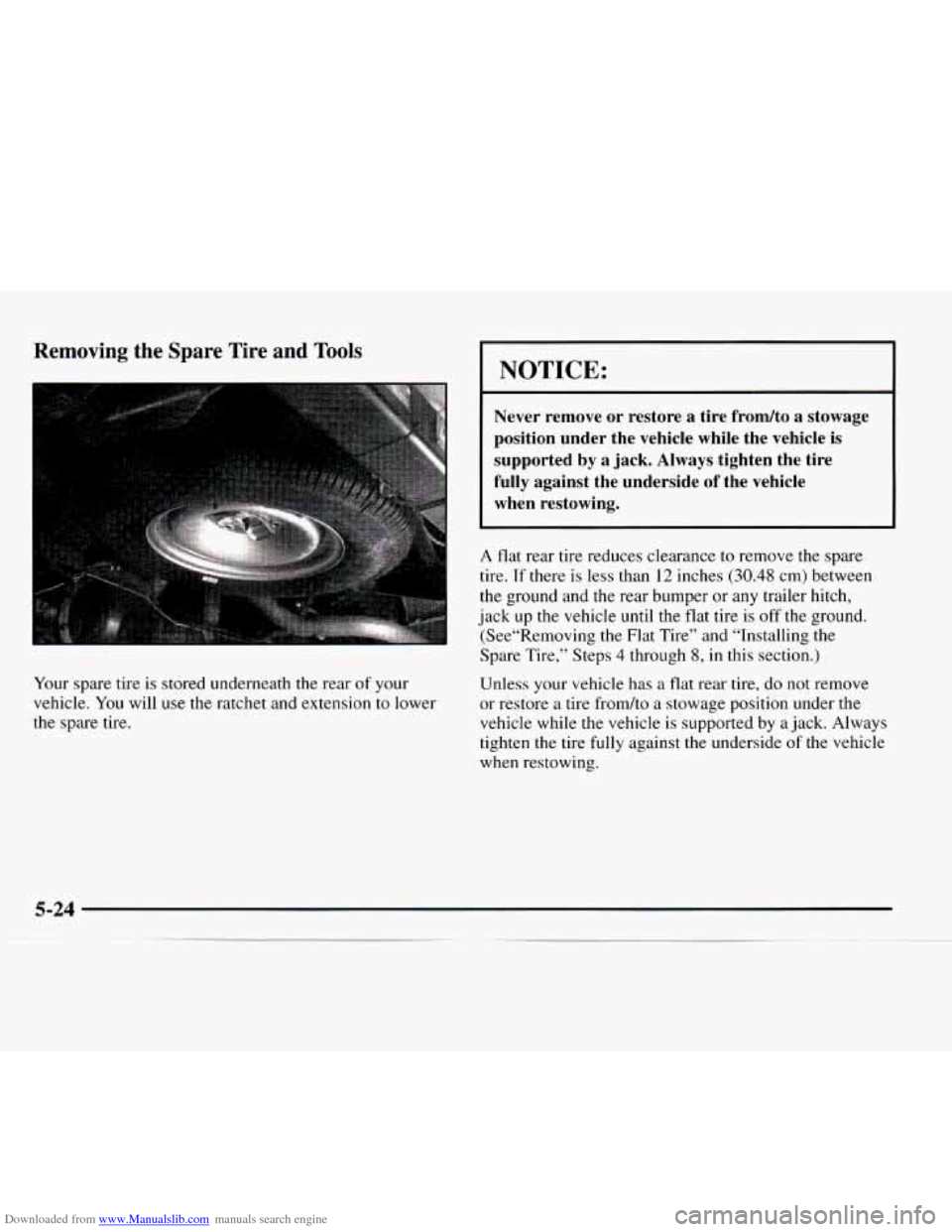
Your spare tire is stored underneath the rear of your
vehicle.
You will use the ratchet and extension to lower
the spare tire.
I
NOTICE:
Never remove or restore a tire frondto a stowage
position under the vehicle while the vehicle is
supported by a jack. Always tighten the tire
fully against the underside
of the vehicle
when restowing.
A flat rear tire reduces clearance to remove the spare
tire.
If there is less than 12 inches (30.48 cm) between
the ground and the rear bumper or any trailer hitch,
jack up the vehicle until the flat tire is
off the ground.
(See“Removing the Flat Tire” and “Installing the
Spare Tire,” Steps
4 through 8, in this section.)
Unless your vehicle has a flat rear tire, do not remove
or restore a tire fromho a stowage position under the
vehicle while the vehicle is supported by a jack. Always
tighten the tire
fully against the underside of the vehicle
when restowing.
Page 249 of 386
Downloaded from www.Manualslib.com manuals search engine Engine Oil Additives
Don’t add anything to your oil. Your GM dealer is ready
to advise if you think something should be added.
When to Change Engine Oil
If any one of these is true for you, use the short tripkity
maintenance schedule:
Most trips are less than 5 to 10 miles (8 to 16 km).
This is particularly important when outside
temperatures are below freezing.
0 Most trips include extensive idling (such as frequent
driving in stop-and-go traffic).
Most trips are through dusty areas.
You frequently tow a trailer or use a carrier on top of
your vehicle.
The vehicle is used for delivery service, police, taxi
or other commercial application.
Driving under these conditions causes engine oil to
break down sooner. If any
one of these is true for your
vehicle, then
you need to change your oil and filter
every
3,000 miles (5 000 km) or 3 months -- whichever
occurs first.
If none of them is true, use the long trip/highway
maintenance schedule. Change the oil and filter every
7,500 miles (12 500 km) or 12 months -- whichever
occurs first. Driving a vehicle with a fully warmed
engine under highway conditions causes engine oil to
break down slower.
What to Do with Used Oil
Did you know that used engine oil contains certain
elements
that may be unhealthy for your skin and could
even cause cancer? Don’t let used oil stay on your skin
for very long. Clean your skin and nails with soap and
water, or a good hand cleaner. Wash or properly throw
away clothing or rags containing used engine oil. (See
the manufacturer’s warnings about the use and disposal
of
oil products.)
Used
oil can be a real threat to the environment. If you
change your own oil, be sure to drain all free-flowing oil
from the filter before disposal. Don’t ever dispose
of oil
by putting it in the trash, pouring it
on the ground, into
sewers, or into streams
or bodies of water. Instead,
recycle
it by taking it to a place that collects used oil. If
you have a problem properly disposing of your used oil,
ask your dealer, a service station or a local recycling
center for help.
Page 251 of 386
Downloaded from www.Manualslib.com manuals search engine Operating the engine with the air cleaner off
can cause you or others to be burned. The air
cleaner not only cleans the air,
it stops flame if
the engine backfires. If it isn’t there, and the
engine backfires, you could be burned. Don’t
drive with it
off, and be careful working on the
engine with the air cleaner off.
NOTICE:
If the air cleaner is off, a backfire can cause a
damaging engine fire. And, dirt can easily get
into your engine, which will damage it. Always
have the
air cleaner in place when you’re driving.
Automatic Transmission Fluid
When to Check and Change
A good time to check your automatic transmission fluid
level is when the engine oil is changed.
Change both the fluid and filter every
50,000 miles
(83 000 km) if the vehicle’s GVWR is over 8,600 or
if the vehicle is mainly driven under one or more of
these conditions:
0 In heavy city traffic where the outside temperature
regularly reaches
90°F (32°C) or higher.
0 In hilly or mountainous terrain.
0 When doing frequent trailer towing.
0 Uses such as found in taxi, police or delivery service.
If your vehicle’s
GVWR is not over 8,600 and you do
not use your vehicle under any of these conditions, the
fluid and filter do not require changing.
See “Scheduled Maintenance Services”
in the Index.
Page 252 of 386
Downloaded from www.Manualslib.com manuals search engine How to Check
Because this operation can be a little difficult, you
may choose to have this done at your GM dealership
Service Department.
If you do it yourself, be sure to follow all the instructions
here, or you could get a false reading on the dipstick.
NOTICE:
Too much or too little fluid can damage your
transmission.
Too much can mean that some of
the fluid could come out and fall on hot engine
parts or exhaust system parts, starting a fire. Be
sure to get an accurate reading if you check your
transmission fluid.
Wait at least 30 minutes before checking the
transmission fluid level if you have been driving:
0 When outside temperatures are above 90°F (32°C).
0 At high speed for quite a while.
In heavy traffic -- especially in hot weather.
0 While pulling a trailer.
To get the right reading, the fluid should be at normal
operating temperature, which is 180°F to
200°F
(82°C to 93°C).
Checking Transmission Fluid Hot
Get the vehicle warmed up by driving about 15 maes
(24 km) when outside temperatures are above 50°F
(10°C). If it's colder than 50°F ( 10°C), drive the
vehicle
in DRIVE (D) until the engine temperature gage
moves and then remains steady for
10 minutes. Then
follow the
hot check procedures.
Checking Transmission Fluid Cold
A cold check is made after the vehicle has been sitting
for eight hours or more with the engine
off and is used
only as a reference. Let the engine run at idle for five
minutes
if outside temperatures are 50°F (10°C) or
more. If it's colder than
50°F (IOOC), you may have
to idle the engine longer. Should the fluid level be low
during a cold check, you
must perform a hot check
before adding fluid. This will give you
a more accurate
reading of the fluid level.
Page 308 of 386
Downloaded from www.Manualslib.com manuals search engine Maintenance Schedule
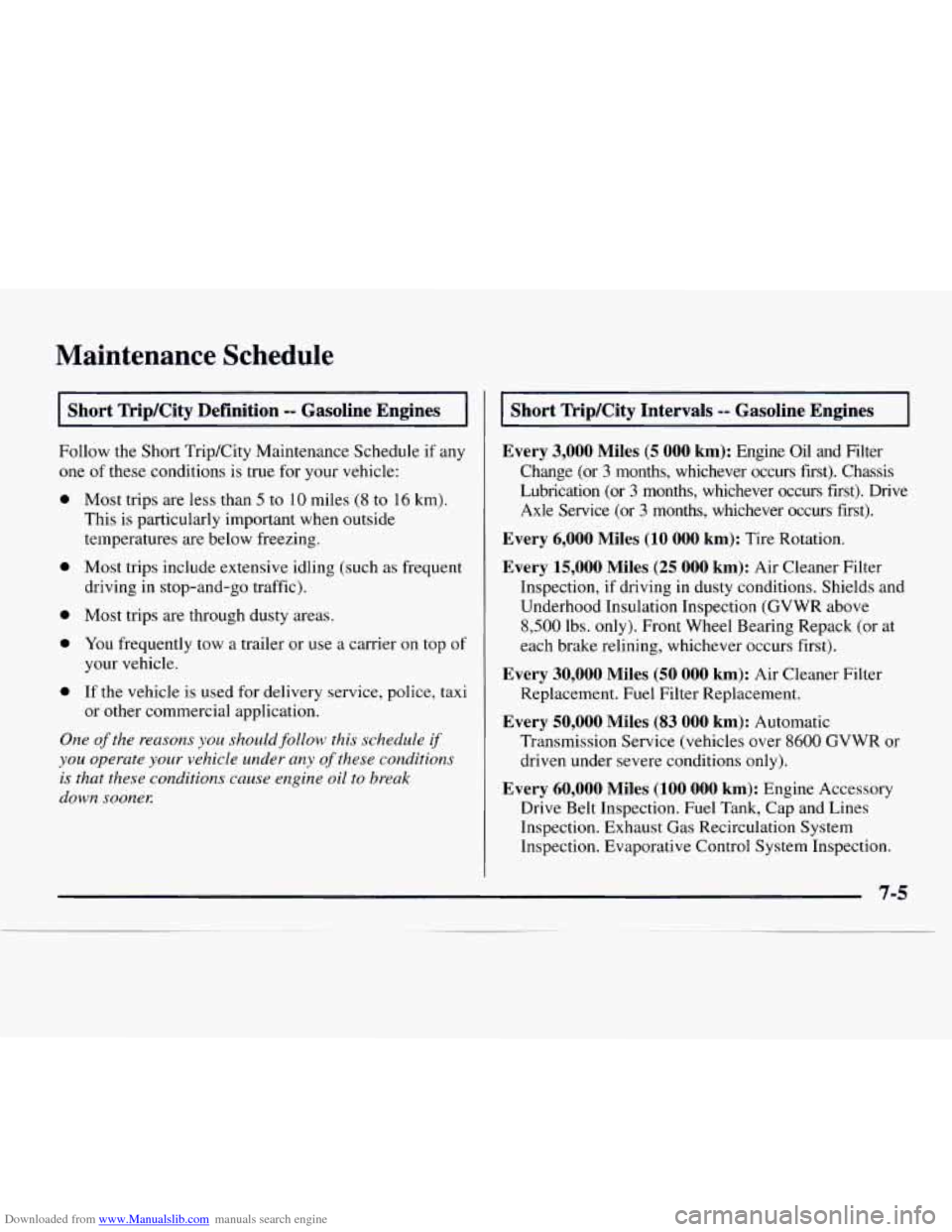
Short TripKity Definition -- Gasoline Engines
Follow the Short Trip/City Maintenance Schedule if any
one
of these conditions is true for your vehicle:
0 Most trips are less than 5 to 10 miles (8 to 16 km).
This is particularly important when outside
temperatures are below freezing.
0 Most trips include extensive idling (such as frequent
driving in stop-and-go traffic).
0 Most trips are through dusty areas.
0 You frequently tow a trailer or use a carrier on top of
your vehicle.
or other commercial application.
0 If the vehicle is used for delivery service, police, taxi
One of the reasons you should follow this schedule if
you operate your vehicle under any of these conditions
is that these conditions cause engine oil to break
down soonel:
Short TripKity Intervals -- Gasoline Engines
Every 3,000 Miles (5 000 km): Engine Oil and Filter
Change (or
3 months, whichever occurs first). Chassis
Lubrication (or
3 months, whichever occurs first). Drive
Axle Service (or
3 months, whichever occurs first).
Every 6,000 Miles (10 000 km): Tire Rotation.
Every 15,000 Miles (25 000 km): Air Cleaner Filter
Inspection, if driving in dusty conditions. Shields and
Underhood Insulation Inspection (GVWR above
8,500 lbs. only). Front Wheel Bearing Repack (or at
each brake relining, whichever occurs first).
Every 30,000 Miles (50 000 km): Air Cleaner Filter
Replacement.
Fuel Filter Replacement.
Every 50,000 Miles (83 000 km): Automatic
Transmission Service (vehicles over
8600 GVWR or
driven under severe conditions only).
Every 60,000 Miles (100 000 km): Engine Accessory
Drive Belt Inspection. Fuel Tank, Cap and Lines
Inspection. Exhaust Gas Recirculation System
Inspection. Evaporative Control System Inspection.
Page 309 of 386
Downloaded from www.Manualslib.com manuals search engine Maintenance Schedule
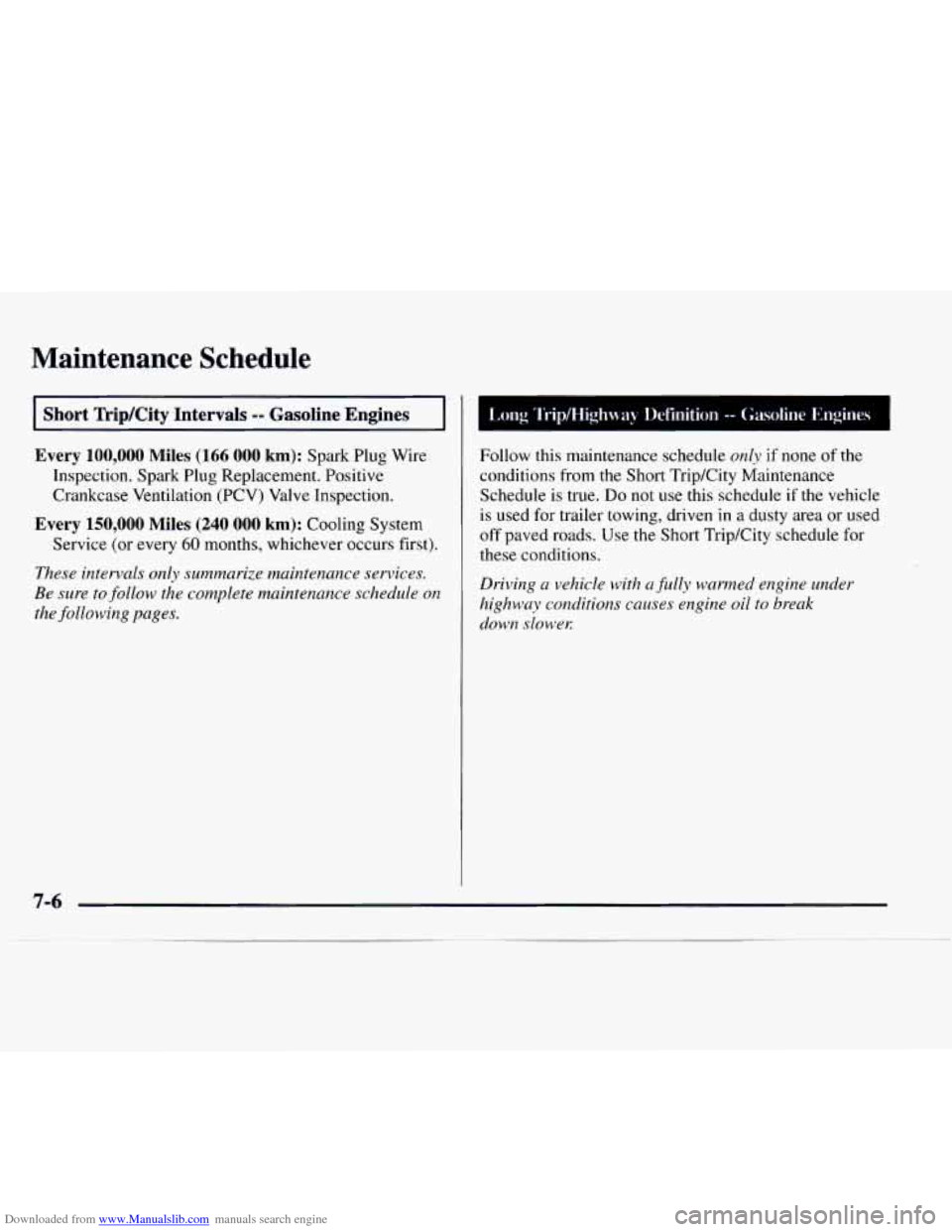
I Short TripKity Intervals -- Gasom
Every 100,000 Miles (166 000 km): Spark Plug Wire
Inspection. Spark Plug Replacement. Positive
Crankcase Ventilation (PCV) Valve Inspection.
Every 150,000 Miles (240 000 km): Cooling System
These intervals only summarize maintenance services.
Be sure to-follow the complete maintenance schedule on
the following pages.
Service (or every 60 months, whichever occurs first).
I
Follow this maintenance schedule only if none of the
conditions from
the Short Trip/City Maintenance
Schedule is true.
Do not use this schedule if the vehicle
is used
for trailer towing, driven in a dusty area or used
off paved roads. Use the Short Trip/City schedule for
these conditions.
Driving a vehicle with ~l$dly warmed engine under
highway conditions causes engine
oil to break
down slower:
Page 311 of 386
Downloaded from www.Manualslib.com manuals search engine I Short TripKity Maintenance Schedule =- Gasoline Engines I
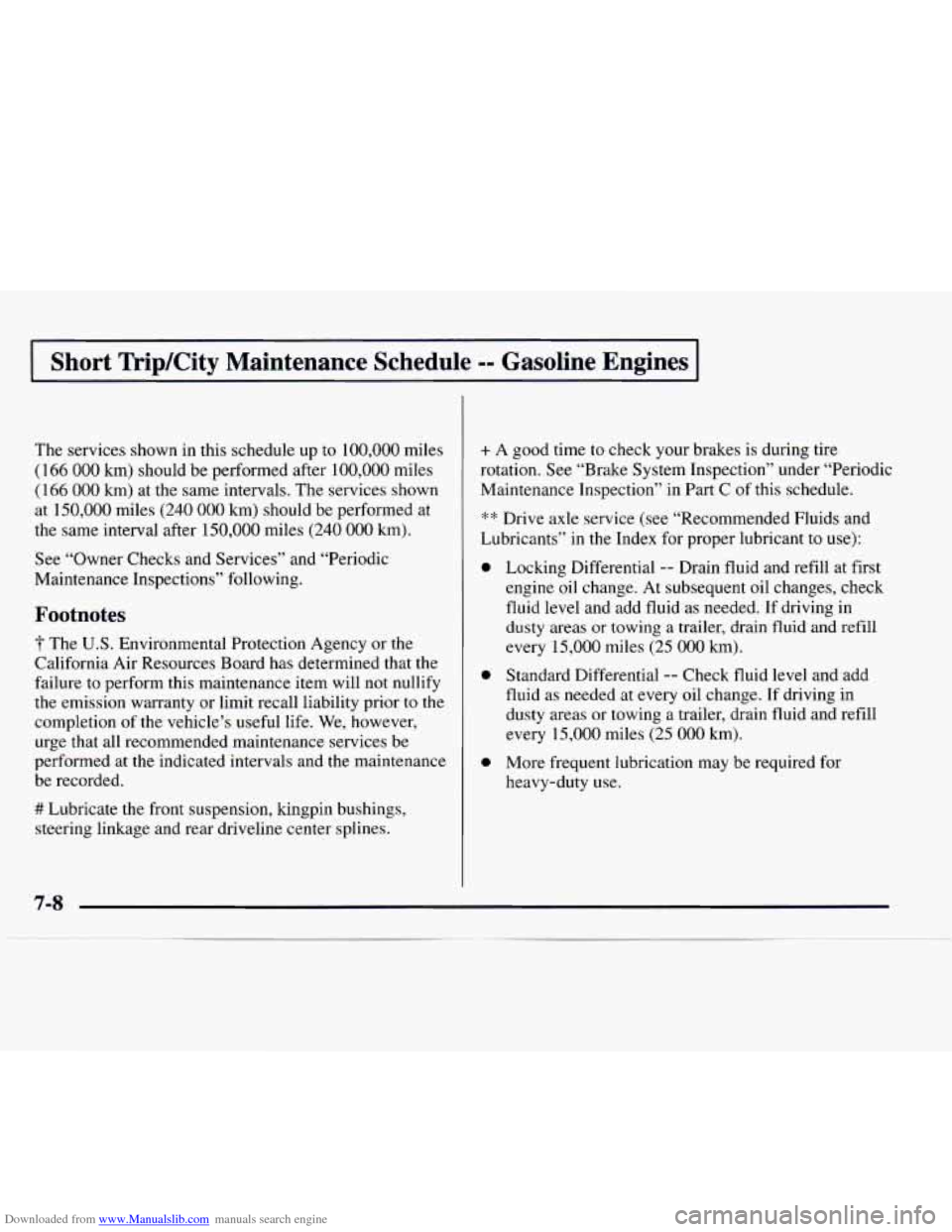
The services shown in this schedule up to 100,000 miles
(1 66 000 km) should be performed after 100,000 miles
(166
000 km) at the same intervals. The services shown
at 150,000 miles
(240 000 km) should be performed at
the same interval after 150,000 miles (240 000 km).
See “Owner Checks and Services” and “Periodic
Maintenance Inspections” following.
Footnotes
3- The U.S. Environmental Protection Agency or the
California Air Resources Board has determined that the
failure to perform this maintenance item will
not nullify
the emission warranty or limit recall liability prior
to the
completion of the vehicle’s useful life. We, however,
urge that all recommended maintenance services be
performed at the indicated intervals and the maintenance
be recorded.
# Lubricate the front suspension, kingpin bushings,
steering linkage and rear driveline center splines.
+ A good time to check your brakes is during tire
rotation. See “Brake System Inspection’’ under “Periodic
Maintenance Inspection’’ in Part
C of this schedule.
** Drive axle service (see “Recommended Fluids and
Lubricants’’
in the Index for proper lubricant to use):
0
0
0
Locking Differential -- Drain fluid and refill at first
engine
oil change. At subsequent oil changes, check
fluid level and add fluid as needed.
If driving in
dusty areas or towing a trailer, drain fluid and refill
every 15,000 miles (25
000 km).
Standard Differential
-- Check fluid level and add
fluid as needed at every oil change. If driving in
dusty areas or towing a trailer, drain fluid and refill
every
15,000 miles (25 000 km).
More frequent lubrication may be required for
heavy-duty use.
Page 322 of 386

Downloaded from www.Manualslib.com manuals search engine I Short Tkip/City Maintenance Schedule -- Gasoline Engines I
- In hilly or mountainous terrain.
- When doing frequent trailer towing.
- Uses such as found in taxi, police or
delivery service.
IJ'you do not use your vehicle under any cfthese
conditions, the fluid anclfilter
do not require changing.
DATE
SERVICED BY: ACTUAL MILEAGE
51,000 Miles (85 000 km)
0 Change engine oil and filter (or every
3 months, whichever occurs first).
An Emission Control Service.
0 Lubricate chassis components (or every
3 months, whichever occurs first).
(See footnote
#.)
0 Check axle fluid level and add fluid as
needed. (See footnote
**.)
I I I
DATE
SERVICED BY: ACTUAL MILEAGE
Page 334 of 386
Downloaded from www.Manualslib.com manuals search engine I Short ’IYipKity Maintenance Schedule =- Gasoline Engines I
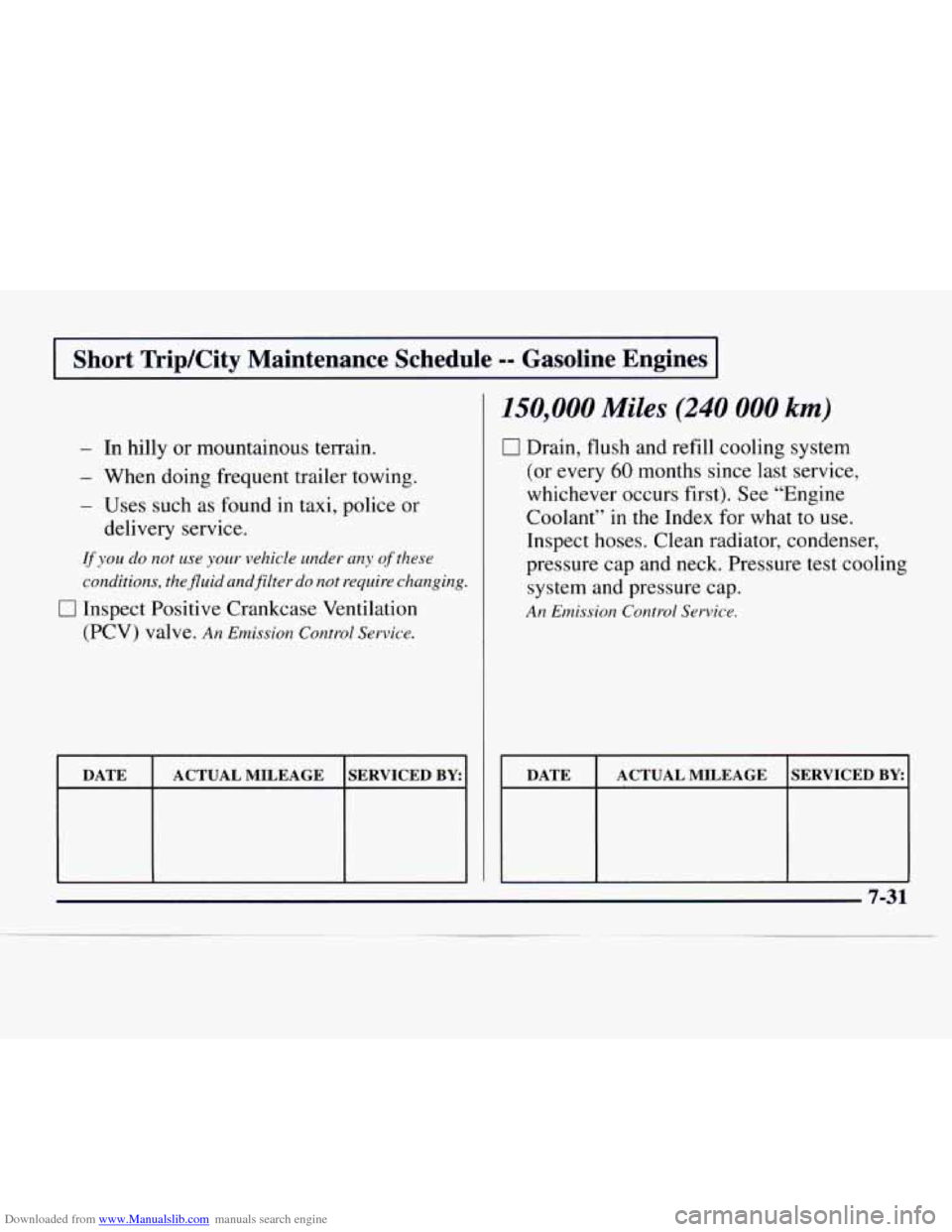
- In hilly or mountainous terrain.
- When doing frequent trailer towing.
- Uses such as found in taxi, police or
delivery service.
IJ’yo~1 do not use your vehicle under any of these
conditions, the.fluid
and.filter do not require changing.
0 Inspect Positive Crankcase Ventilation
(Pcv) valve.
An Emission Control Service.
I I I 1
DATE
SERVICED BY ACTUAL MILEAGE
150,000 Miles (240 000 km)
0 Drain, flush and refill cooling system
(or every
60 months since last service,
whichever occurs first). See “Engine
Coolant” in the Index for
what to use.
Inspect hoses. Clean radiator, condenser,
pressure cap and neck. Pressure test cooling
system and pressure cap.
An Emission Control Service.
DATE SERVICED BY ACTUAL MILEAGE
Page 340 of 386
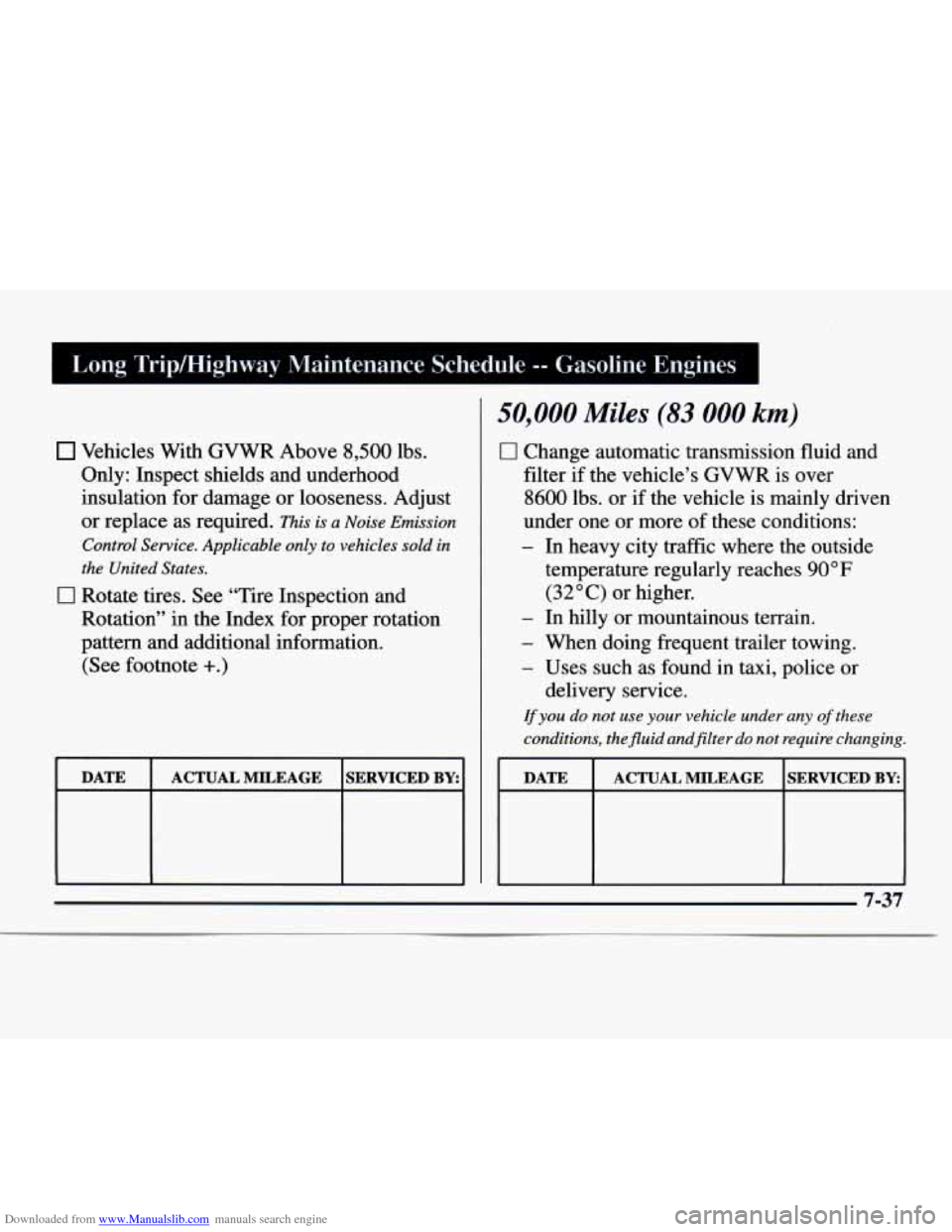
Downloaded from www.Manualslib.com manuals search engine 1 Long Tripmighway Maintenance Schedule -- Gasoline Engines
Vehicles With GVWR Above 8,500 lbs.
Only: Inspect shields and underhood
insulation for damage or looseness. Adjust
or replace as required.
This is a Noise Emission
Control Service. Applicable only to vehicles sold in
the United States.
0 Rotate tires. See “Tire Inspection and
Rotation’’ in the Index for proper rotation
pattern and additional information. (See footnote
+.)
DATE ACTUAL MILEAGE SERVICED BY
50,000 Miles (83 000 km)
0 Change automatic transmission fluid and
filter
if the vehicle’s GVWR is over
8600 lbs. or if the vehicle is mainly driven
under one or more of these conditions:
- In heavy city traffic where the outside
temperature regularly reaches
90 O F
(32°C) or higher.
- In hilly or mountainous terrain.
- When doing frequent trailer towing.
- Uses such as found in taxi, police or
lf you do not use your vehicle under any of these
conditions, thefluid andfilter do not require chang
delivery service.
ing.
DATE ACTUAL MILEAGE SERVICED BY