instrument panel CHEVROLET EXPRESS 1998 1.G Owner's Manual
[x] Cancel search | Manufacturer: CHEVROLET, Model Year: 1998, Model line: EXPRESS, Model: CHEVROLET EXPRESS 1998 1.GPages: 386, PDF Size: 20.74 MB
Page 141 of 386
Downloaded from www.Manualslib.com manuals search engine Air Conditioning 1 ~ ~ ting
Before using your vehicle’s air conditioning, open the
windows to clear the vehicle
of hot air. This reduces the
time it takes for your vehicle to cool down. Then keep
your windows closed for the air conditioner to work at
its best.
You can use
MAX A/C with the temperature knob in the
blue area when it’s really hot outside and you need to
cool the inside air quickly. MAX A/C lets in only a little
air from the outside.
If you first use MAX A/C, you can then use A/C with
the temperature knob in the blue area, as soon as
the
vehicle has cooled down, so outside air will be going
through your vehicle.
If your vehicle has rear air conditioning, setting
it on LO
may enhance front A/C performance by allowing
trapped refrigerant in rear lines
to circulate.
When the air conditioning, DEFROST or
BLEND is on,
you may notice
a slight increase or decrease in engine
speed, due to compressor operation. This is normal
because the system is designed
to cycle the compressor
on and off
to keep the desired temperature. On
cold days,
use HEATER with the temperature knob
in the red area. Outside air will be brought in through
the floor outlets. The heater works best
if you keep your
windows closed while using it.
If you
use the optional engine coolant heater before
starting your engine, your heating system will produce
warmer air faster to heat the passenger compartment in
cold weather. See “Engine Coolant Heater”
in the Index.
Ventilation Tips
Keep the hood and front air inlet free of ice, snow, or
any other obstruction (such as leaves). The heater
and defroster will work far better, reducing the
chance
of fogging the inside of your windows.
When you enter a vehicle in cold weather, turn the
blower fan to HI for a few moments before driving
off. This helps clear the intake ducts
of snow and
moisture, and reduces the chance of fogging the
inside
of your windows.
0 Keep the air path under the front seats clear of objects.
This helps air to circulate throughout your vehicle.
Your vehicle has air vents in the center and
on the sides
of your instrument panel.
3-6
Page 198 of 386
Downloaded from www.Manualslib.com manuals search engine Making Turns
NOTICE:
Making very sharp turns while trailering could
cause the trailer to come in contact with the vehicle. Your vehicle could be damaged. Avoid
making very sharp turns while trailering.
When you’re turning with a trailer, make wider turns than normal.
Do this so your trailer won’t strike soft shoulders,
curbs, road signs, trees or other objects. Avoid jerky or
sudden maneuvers. Signal well in advance.
lhrn Signals When Towing a Trailer
When you tow a trailer, your vehicle has to have extra
wiring and a heavy-duty turn signal flasher (included in
the optional trailering package).
The arrows on your instrument panel will flash
whenever you signal a turn or lane change. Properly
hooked up, the trailer lamps will also flash, telling other
drivers you’re about to turn, change lanes or stop. When
towing
a trailer, the arrows on your instrument
panel will flash for turns even if the bulbs
on the trailer
are burned out. Thus,
you may think drivers behind
you are seeing your signal when they are not. It’s
important to check occasionally
to be sure the trailer
bulbs are still working.
Driving On Grades
Reduce speed and shift to a lower gear before you start
down a long or steep downgrade. If you don’t shift
down, you might have
to use your brakes so much that
they would get hot and no longer work well.
On a long uphill grade, shift down and reduce your
speed
to around 45 mph (70 kdh) to reduce the
possibility of engine and transmission overheating.
When towing at high altitude
on steep uphill grades,
consider the following: Engine coolant will boil at a lower
temperature than
at normal altitudes. If you turn your
engine
off immediately after towing at high altitude on
steep uphill grades, your vehicle may show signs similar
to
engine overheating. To avoid this, let the engine run while
parked (preferably
on level ground) with the automatic
transmission in PARK
(P) for a few minutes before tumine
the engine off. If you do get the overheat warning, see
“Engine Overheating”
in the Index.
4-35
Page 212 of 386
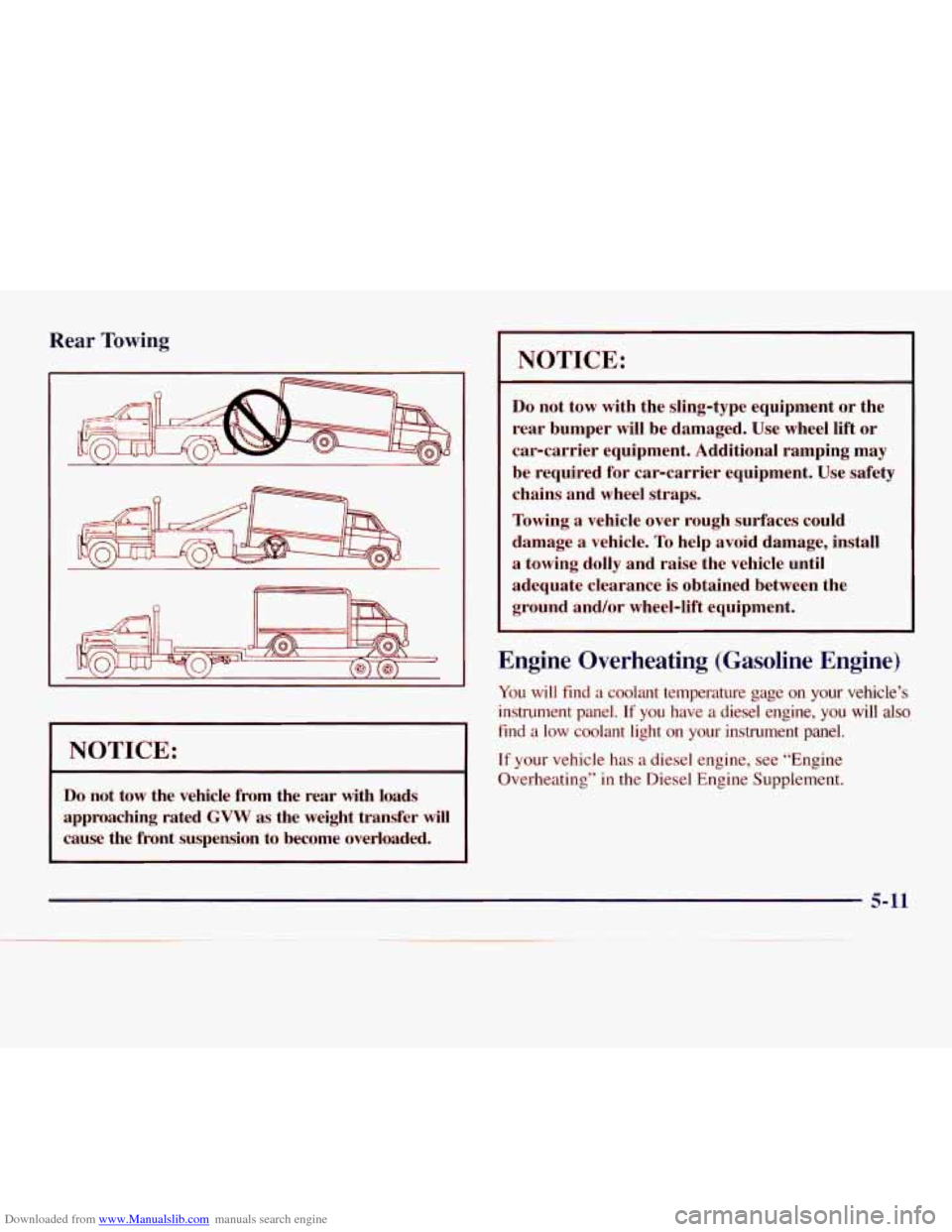
Downloaded from www.Manualslib.com manuals search engine Rear Towing
I NOTICE:
Do not tow the vehicle from the rear with loads
approaching rated
GVW as the weight transfer will
cause the front suspension to become overloaded.
I
NOTICE:
Do not tow with the sling-type equipment or the
rear bumper will be damaged. Use wheel lift or
car-carrier equipment. Additional ramping may
be required for car-carrier equipment. Use safety
chains and wheel straps.
Towing a vehicle over rough surfaces could
damage a vehicle.
To help avoid damage, install
a towing dolly and raise the vehicle until
adequate clearance is obtained between the
ground and/or wheel-lift equipment.
Engine Overheating (Gasoline Engine)
You will find a coolant temperature gage on your vehicle’s
instrument panel.
If you have a diesel engine, you will also
find a low coolant light on your instrument panel.
If your vehicle has a diesel engine, see “Engine
Overheating” in the Diesel Engine Supplement.
5-11
Page 243 of 386
Downloaded from www.Manualslib.com manuals search engine If your vehicle is certified to meet California Emission
1 Standards (inhcated on the underhood emission control
label), it is designed to operate on fuels that meet
California specifications.
If such fuels are not available
in states adopting California emissions standards, your
vehicle
will operate satisfactorily on fuels meeting
federal specifications, but emission control system
performance may be affected. The malfunction indicator
lamp on your instrument panel may
turn on andor your
vehicle may fail a smog-check test. If this occurs,
return
to your authorized GM dealer for diagnosis to determine
the cause of failure. In the event it is. determined that the
1 cause of the condition is the type of fuels used, repairs
, may not be covered by your warranty.
Some gasolines that are not reformulated for low
emissions contain an octane-enhancing additive called
methylcyclopentadienyl manganese tricarbonyl (MMT);
ask your service station operator whether
or not his fuel
contains MMT. General Motors does not recommend the
use of such gasolines.
If fuels containing MMT are used,
~ spark plug life may be reduced and your emission
control system performance may be affected. The
malfunction indicator lamp on your instrument panel
may
turn on. If this occurs, return to your authorized
GM dealer for service.
~
i
To provide cleaner air, all gasolines in the United States
are now required to contain additives that will help
prevent deposits from forming in your engine and fuel
system, allowing your emission control system to
function properly. Therefore, you should not have to add
anything to the fuel. In addition, gasolines containing
oxygenates, such as ethers and ethanol, and
reformulated gasolines may be available in your area to
help clean the air. General Motors recommends that you
use these gasolines if they comply with the
specifications described earlier.
NOTICE:
Your vehicle was not designed for fuel that
contains methanol. Don’t .use it. It can corrode
metal parts in your fuel system and also damage
plastic and rubber parts. That damage wouldn’t
be covered under your warranty.
6-4
I
Page 292 of 386
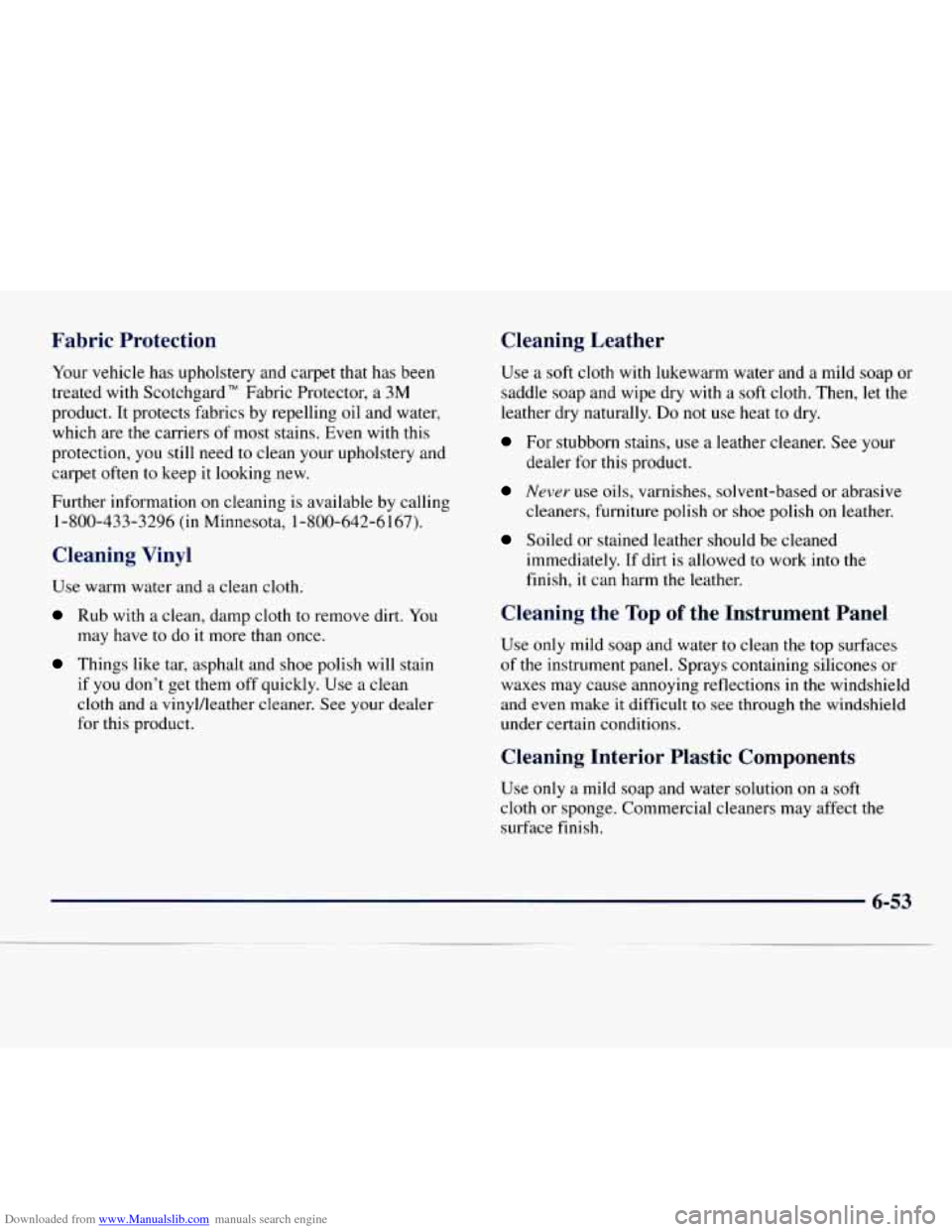
Downloaded from www.Manualslib.com manuals search engine ric Protection Cleaning Leather
Use a soft cloth with lukewarm water and a mild soap Or
saddle soap and wipe dry with a soft cloth. Then,
let the
leather dry naturally.
Do not use heat to dry.
lour
vehicle has upholstery and carpet that has been
treated with Scotchgard Fabric Protector, a 3M
product. It protects fabrics by repelling oil and water,
which are the carriers
of most stains. Even with this
protection, you still need to clean your upholstery and
carpet often
to keep it looking new.
Further information on cleaning
is available by calling
1-800-433-3296 (in Minnesota, 1-800-642-6167).
Cleaning Vinyl
Use warm water and a clean cloth.
Rub with a clean, damp cloth to remove dirt. You
may have
to do it more than once.
Things like tar, asphalt and shoe polish will stain
if
you don’t get them off quickly. Use a clean
cloth and a vinyl/leather cleaner. See your dealer
for this product.
For stubborn stains, use a leather cleaner. See your
dealer for this product.
cleaners, furniture polish or shoe polish
on leather.
Never use oils, varnishes, solvent-based or abrasive
Soiled or stained leather should be cleaned
immediately. If dirt is allowed
to work into the
finish,
it can harm the leather.
Cleaning the Top of the Instrument Panel
Use only mild soap and water to clean the top surfaces
of the instrument panel. Sprays containing silicones or
waxes may cause annoying reflections
in the windshield
and even make it difficult to see through the windshield
under certain conditions.
Cleaning Interior Plastic Components
Use only a mild soap and water solution on a soft
cloth
or sponge. Commercial cleaners may affect the
surface finish.
.
Page 298 of 386
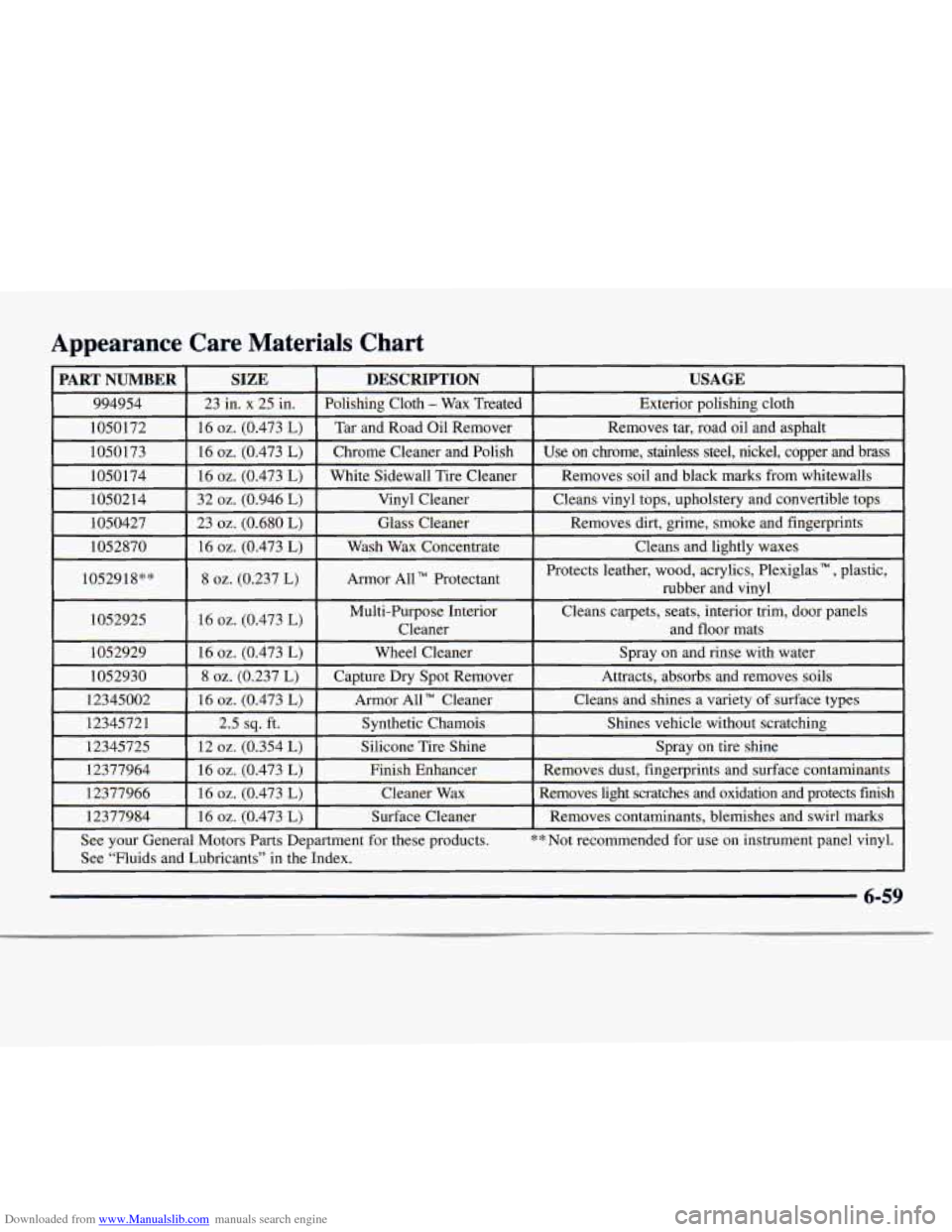
Downloaded from www.Manualslib.com manuals search engine Care Materials Chart
Appearance
PART NUMBER
994954
1050172
1050173 1050 174
10502
14
1050427
1052870
1052918**
1052925 1052929
1052930
12345002
12345721
12345725
12377964
12377966
12377984
SIZE
23 in. x 25 in.
16
oz. (0.473 L)
16 oz. (0.473 L)
16 02. (0.473 L)
32
02. (0.946 L)
23
oz. (0.680 L)
16 oz. (0.473 L)
8 oz. (0.237 L)
16 oz. (0.473 L)
16 oz. (0.473 L)
8 02. (0.237 L)
16 02. (0.473 L)
2.5 sq. ft.
12
oz. (0.354 L)
16 02. (0.473 L)
16 02. (0.473 L)
16 02. (0.473 L)
DESCRIPTION
Exterior polishing cloth
Polishing Cloth - Wax
Treated
USAGE
Tar and Road Oil Remover
Removes soil and black marks from whitewalls
White Sidewall Tire Cleaner Use on chrome, stainless steel, nickel, copper and brass Chrome\
Cleaner and Polish Removes
tar, road oil and asphalt
Vinyl Cleaner
Removes dirt, grime, smoke and fingerprints
Glass Cleaner Cleans
vinyl tops, upholstery and convertible tops
Wash Wax Concentrate Cleans
and lightly waxes
-
Armor All Protectant Protects
leather, wood, acrylics, Plexiglas N, plastic,
rubber and vinyl
..___
Multi-Purpose Interior
Cleans carpets, seats, interior trim, door panels
Cleaner and floor mats
Wheel Cleaner Spray on and rinse with water
Capture Dry Spot Remover
Attracts, absorbs and removes soils
Armor All Cleaner Cleans and shines
a
variety of surface types
Synthetic Chamois
Spray on tire shine
Silicone Tire Shine Shines vehicle
without scratching
Finish Enhancer
Removes light scratches and oxidation and protects finish
Cleaner
Wax Removes dust, fingerprints
and surface contaminants
Surface Cleaner Removes contaminants, blemishes and swirl marks
See your General Motors Parts Department for these products.
** Not recommended for use on instrument panel vinyl.
See “Fluids and Lubricants’’ in the Index.
6-59
Page 299 of 386
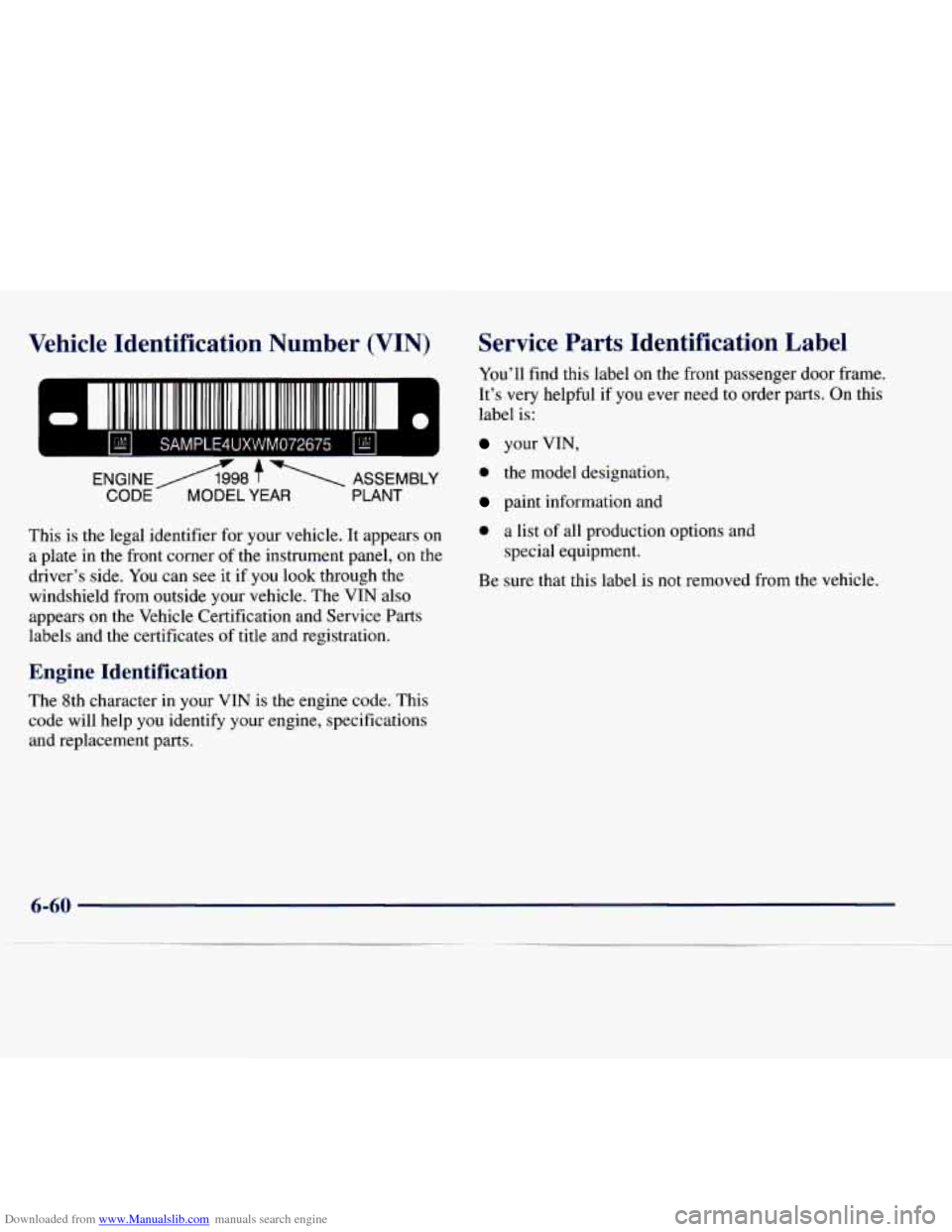
Downloaded from www.Manualslib.com manuals search engine Vehicle Identification Number (VIN)
Ir;hll SAMPLE4UXWM072675 kl
Service Parts Identific on Label ~
YOU'^^ find this label on the front passenger door frame.
It’s very helpful if you ever need
to order parts. On this
label is:
your VIN,
e the model designation,
paint information and
This is the legal identifier for your vehicle. It appears on
a plate
in the front corner of the instrument panel, on the
driver’s side. You can see it if you look through the
windshield from outside your vehicle. The VIN also
appears on
the Vehicle Certification and Service Parts
labels and the certificates
of title and registration.
Engine Identification
The 8th character in your VIN is the engine code. This
code will help you identify
your engine, specifications
and replacement parts.
e a list of all production options and
special equipment.
Be sure that this label is not removed from the vehicle.
Page 301 of 386
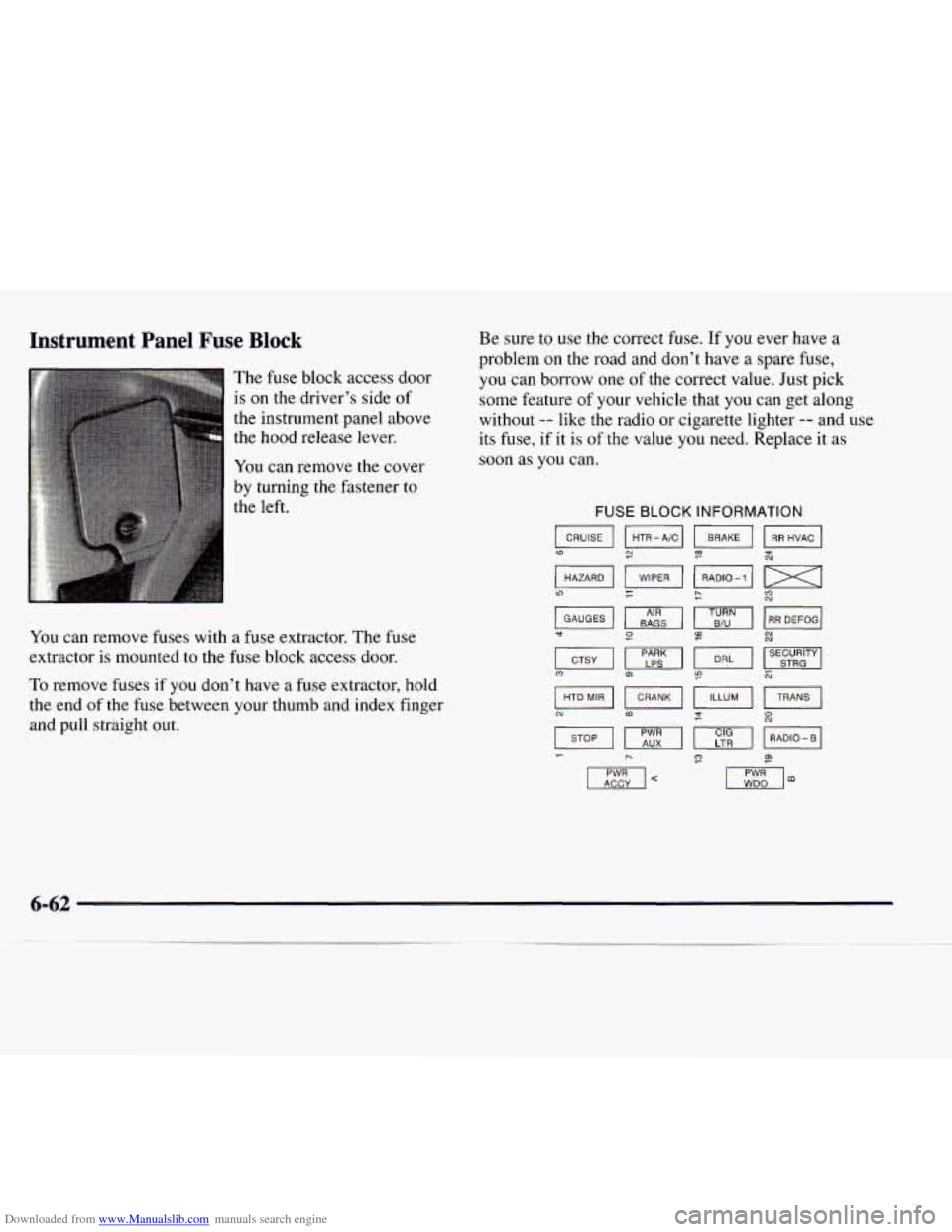
Downloaded from www.Manualslib.com manuals search engine In,c*rume-t Panel Fuse Block
The fuse block access door
is
on the driver’s side of
the instrument panel above
the hood release lever.
You can remove the cover
by turning the fastener to
the left.
You can remove fuses with
a fuse extractor. The fuse
extractor
is mounted to the fuse block access door.
To remove fuses if you don’t have a fuse extractor, hold
the end of the fuse between your thumb and index finger
and pull straight out. Be
sure
to use the correct fuse. If you ever have a
problem on the road and don’t have a spare fuse,
you can borrow one of the correct value. Just pick
some feature of your vehicle that
you can get along
without
-- like the radio or cigarette lighter -- and use
its fuse, if it is of the value you need. Replace it as
soon as you can.
FUSE BLOCK INFORMATION
Page 304 of 386
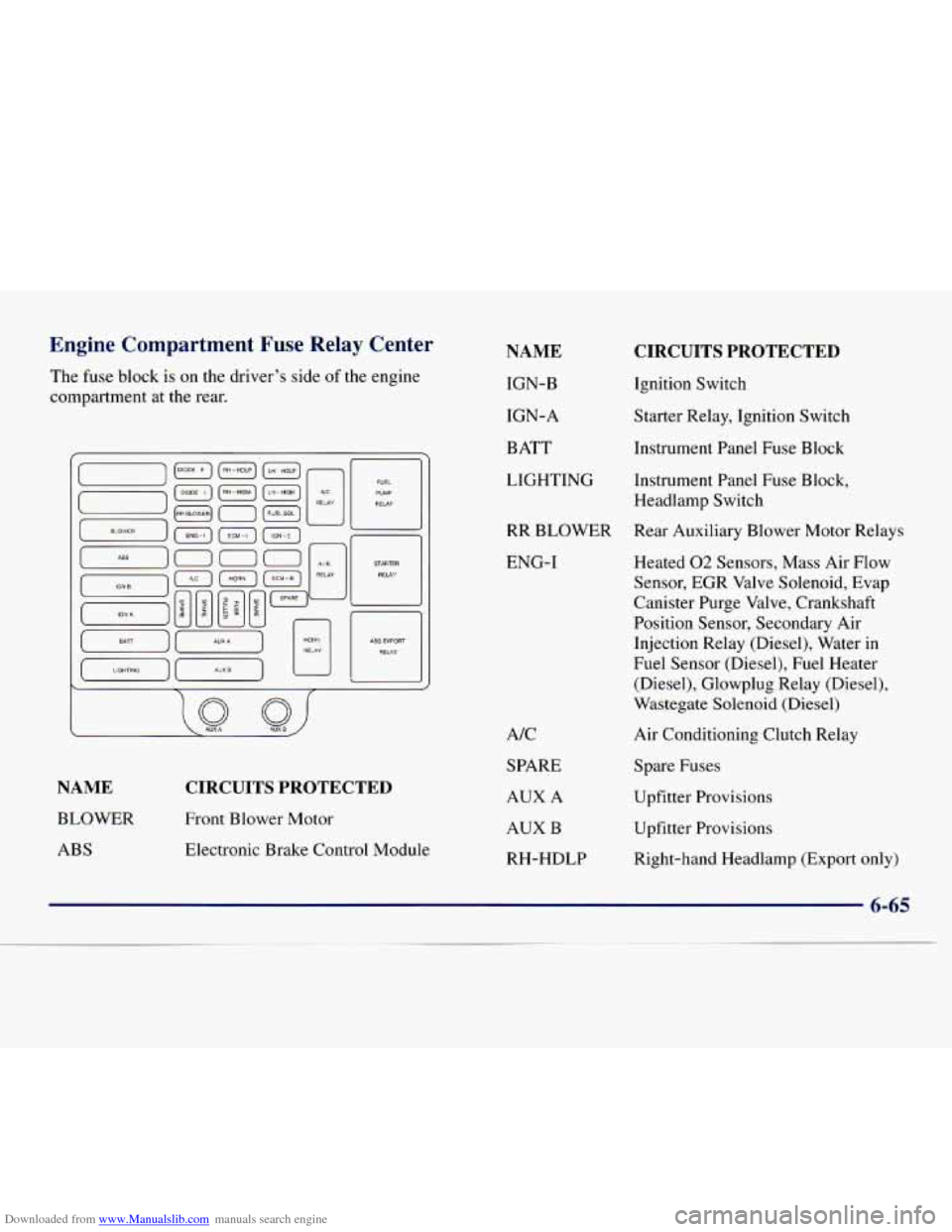
Downloaded from www.Manualslib.com manuals search engine Engine Compartment Fuse Relay Center
The fuse block is on the driver’s side of the engine
compartment at the rear.
U
NAME
IGN-B
IGN-A
BATT
LIGHTING
RR BLOWER
ENG-I
NAME
BLOWER ABS
CIRCUITS PROTECTED
Front Blower Motor
Electronic Brake Control Module AIC
SPARE
AUX A
AUX B
RH-HDLP
CIRCUITS PROTECTED
Ignition
Switch
Starter Relay, Ignition Switch
Instrument Panel
Fuse Block
Instrument Panel Fuse Block,
Headlamp Switch
Rear Auxiliary Blower Motor Relays
Heated
02 Sensors, Mass Air Flow
Sensor, EGR Valve Solenoid, Evap
Canister Purge Valve, Crankshaft
Position Sensor, Secondary Air Injection Relay (Diesel), Water in
Fuel Sensor (Diesel), Fuel Heater
(Diesel), Glowplug Relay (Diesel),
Wastegate Solenoid (Diesel)
Air Conditioning Clutch Relay
Spare Fuses
Upfitter Provisions Upfitter Provisions
Right-hand Headlamp (Export only)
Page 363 of 386
Downloaded from www.Manualslib.com manuals search engine For prompt assistance, please have the following
information available to give the Customer
Assistance Representative:
0
0
0
0
0
Your name, address, home and business
telephone numbers
Vehicle Identification Number (This is available
from
the vehicle registration or title, or the plate at
the top left
of the instrument panel and visible
through the windshield.)
Dealership name and location
Vehicle delivery date and present mileage
Nature
of concern
We encourage you to call
us so we can give your inquiry
prompt attention. However, if you wish to write
Chevrolet, address your inquiry
to:
Chevrolet Motor Division
Chevrolet Customer Assistance Center
P.O. Box 7047
Troy, MI 48007-7047
In Canada, write to: General Motors
of Canada Limited
Customer Communication Centre,
163-005
1908 Colonel Sam Drive
Oshawa, Ontario
LlH 8P7 Refer
to your Warranty and Owner Assistance
Information booklet for addresses
of
GM Overseas offices.
When contacting Chevrolet, please remember that
your concern will likely be resolved in the dealership,
using the dealer’s facilities, equipment and personnel.
That is
why we suggest you follow Step One first if
you have a concern.
Customer Assistance for Text
Telephone
(TTY) Users
To assist customers who are deaf, hard of hearing, or
speech-impaired and who use Text Telephones (TTYs),
Chevrolet has TTY equipment available at its Customer
Assistance Center. Any TTY user can communicate with
Chevrolet by dialing: 1-800-833-CHEV. (TTY users in
Canada can dial 1-800-263-3830.)
8-4