lock CHEVROLET EXPRESS 1998 1.G Workshop Manual
[x] Cancel search | Manufacturer: CHEVROLET, Model Year: 1998, Model line: EXPRESS, Model: CHEVROLET EXPRESS 1998 1.GPages: 386, PDF Size: 20.74 MB
Page 187 of 386
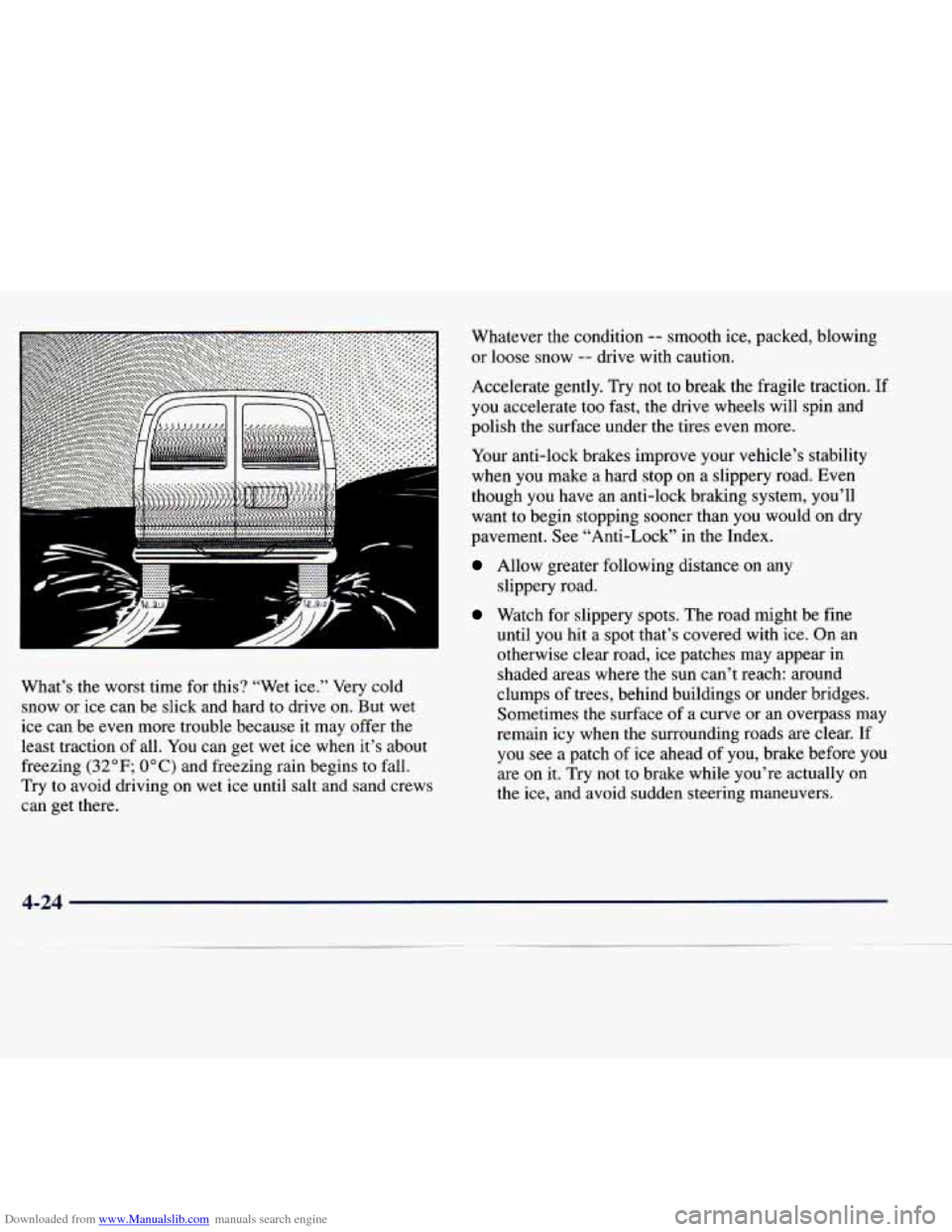
Downloaded from www.Manualslib.com manuals search engine What’s the worst time for this? “Wet ice.” Very cold
snow or ice can be slick and hard to drive on. But wet
ice can be even more trouble because it
may offer the
least traction of all. You can get wet ice when it’s about
freezing
(32°F; OOC) and freezing rain begins to fall.
Try to avoid driving on wet ice until salt
and sand crews
can get there. Whatever
the condition
-- smooth ice, packed, blowing
or loose snow -- drive with caution.
Accelerate gently. Try not to break the fragile traction.
If
you accelerate too fast, the drive wheels will spin and
polish the surface under the tires even more.
Your anti-lock brakes improve your vehicle’s stability
when you make a hard stop on a slippery road. Even
though you
have an anti-lock braking system, you’ll
want to begin stopping sooner
than you would on dry
pavement. See “Anti-Lock” in the Index.
Allow greater following distance on any
slippery road.
Watch for slippery spots. The road might be fine
until you
hit a spot that’s covered with ice. On an
otherwise clear road, ice patches may appear in
shaded areas where the
sun can’t reach: around
clumps of trees, behind buildings or under bridges.
Sometimes the surface
of a curve or an overpass may
remain
icy when the surrounding roads are clear. If
you see a patch of ice ahead of you, brake before you
are on it. Try not to brake while you’re actually on
the ice, and avoid sudden steering maneuvers.
4-24
Page 189 of 386
Downloaded from www.Manualslib.com manuals search engine ’ A CAUTION:
Snow can trap exhaust gases under your vehicle.
This can cause deadly
CO (carbon monoxide) gas
to get inside.
CO could overcome you and kill
you. You can’t see
it or smell it, so you might not
know it is in your vehicle. Clear away snow from
around the base of your vehicle, especially any
that is blocking your exhaust pipe. And check
around again from time to time to be sure snow
doesn’t collect there.
Open
a window just a little on the side of the
vehicle that’s away from the wind. This will help
keep
CO out.
Run your engine only as long as you must. This saves
fuel. When
you run the engine, make it go a little faster
than just idle. That is, push the accelerator slightly. This
uses less fuel for the heat that you get and it keeps the
battery (or batteries) charged. You will need a
well-charged battery (or batteries)
to restart the vehicle,
and possibly for signaling later on with your headlamps.
Let the heater run for a while.
If you have a diesel engine,
you may have to run it at a
higher speed to get enough heat. Then, shut the engine
off and close the window almost all the way to preserve
the heat. Start the engine again and repeat this only
when
you feel really uncomfortable from the cold. But
do it as little
as possible. Preserve the fuel as long as you
can. To help keep warm, you can get out of the vehicle
and
do some fairly vigorous exercises every half hour or
so until help comes.
4-26
Page 208 of 386
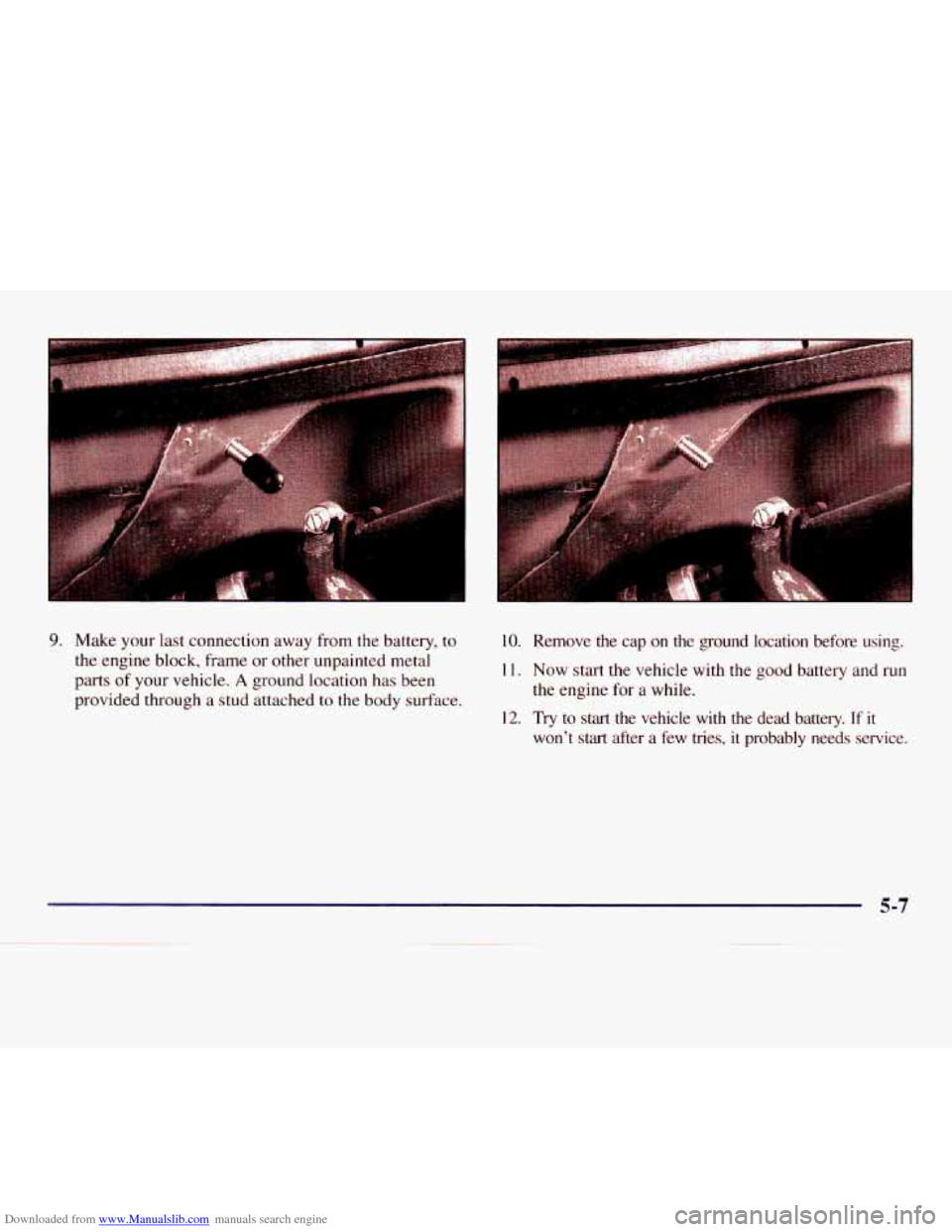
Downloaded from www.Manualslib.com manuals search engine 9. Make your last connection away from the battery, to
the engine block, frame or other unpainted metal
parts of your vehicle.
A ground location has been
provided through a stud attached to the body surface.
10. Remove the cap on the ground location before using.
1 1. Now start the vehicle with the good battery and run
the engine for a while.
12. Try to start the vehicle with the dead battery. If it
won't start after a few tries, it probably needs service.
Page 209 of 386
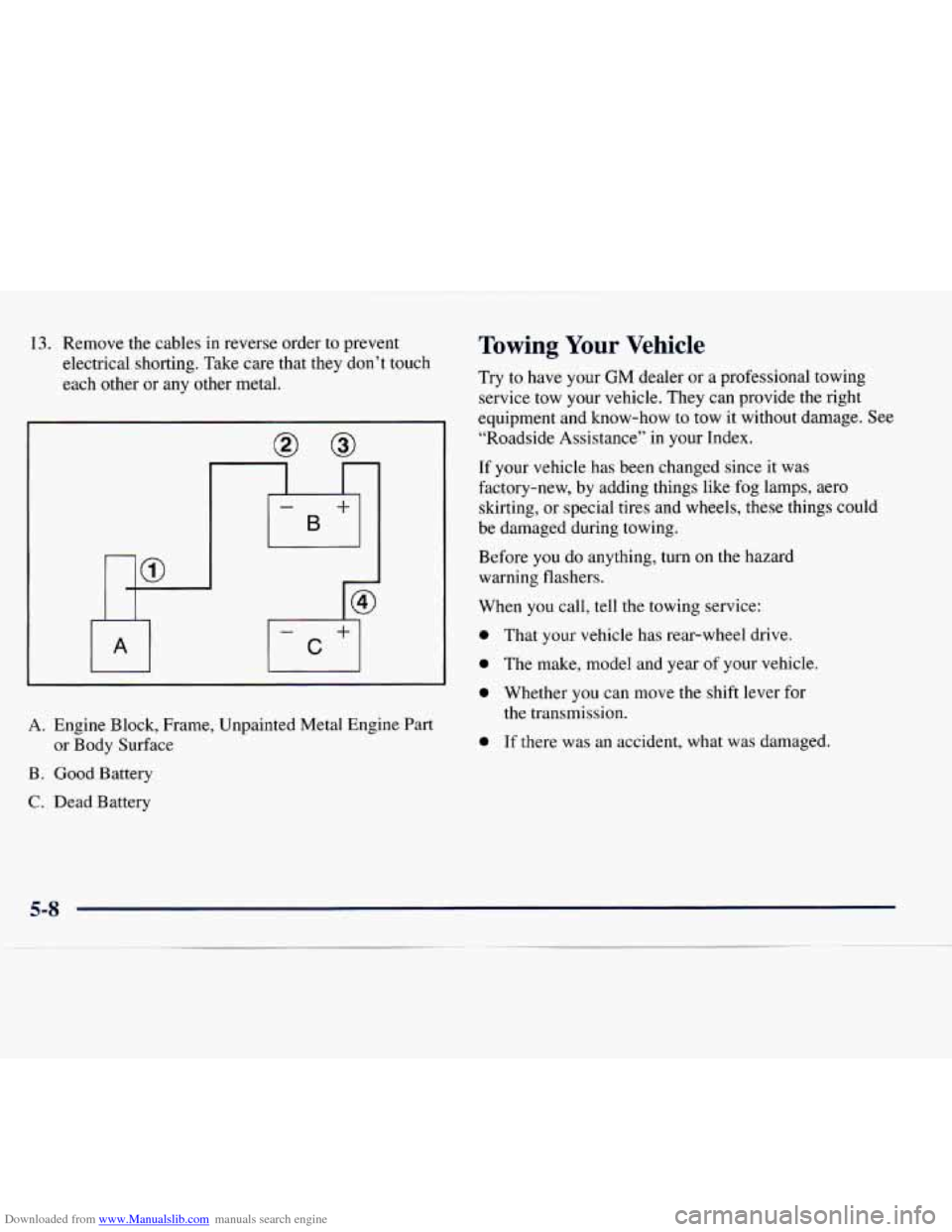
Downloaded from www.Manualslib.com manuals search engine 13. Remove the cables in reverse order to prevent
electrical shorting. Take care that they don’t touch
each other or any other metal.
A. Engine Block, Frame, Unpainted Metal Engine Part
B . Good Battery
or
Body Surface
C. Dead Battery
Towing Your Vehicle
Try to have your GM dealer or a professional towing
service tow your vehicle. They can provide the right
equipment and know-how to tow
it without damage. See
“Roadside Assistance” in your Index.
If your vehicle has been changed since it was
factory-new, by adding things like fog lamps, aero
skirting, or special tires and wheels, these things could
be damaged during towing.
Before you do anything, turn
on the hazard
warning flashers.
When
you call, tell the towing service:
0 That your vehicle has rear-wheel drive.
0 The make, model and year of your vehicle.
0 Whether you can move the shift lever for
the transmission.
0 If there was an accident, what was damaged.
Page 210 of 386
Downloaded from www.Manualslib.com manuals search engine A CAUTWN:
To help avoid injury to you or others:
Never let passengers ride in a vehicle that is
Never tow faster than safe or posted speeds.
Never tow with damaged parts not
Never get under your vehicle after it has
Always use separate safety chains on each
being
towed.
fully secured. been lifted by the tow truck.
side when towing
a vehicle.
When your vehicle is being towed, have the ignition
key
off. The steering wheel should be clamped in a
straight ahead position, with a clamping device designed
for towing service.
Do not use the vehicle’s steering
column lock for this. The transmission should be
in
NEUTRAL (N) and the parking brake should
be released.
I
A vehicle can fall from a car carrier if it isn’t
adequately secured. This can cause
a collision,
serious personal injury and vehicle damage. The
vehicle should be tightly secured with chains or
steel cables before
it is transported.
Don’t use substitutes (ropes, leather straps,
canvas webbing, etc.) that can be cut by sharp
edges underneath the towed vehicle.
5-9
Page 219 of 386
Downloaded from www.Manualslib.com manuals search engine How to Add Coolant to the Radiator
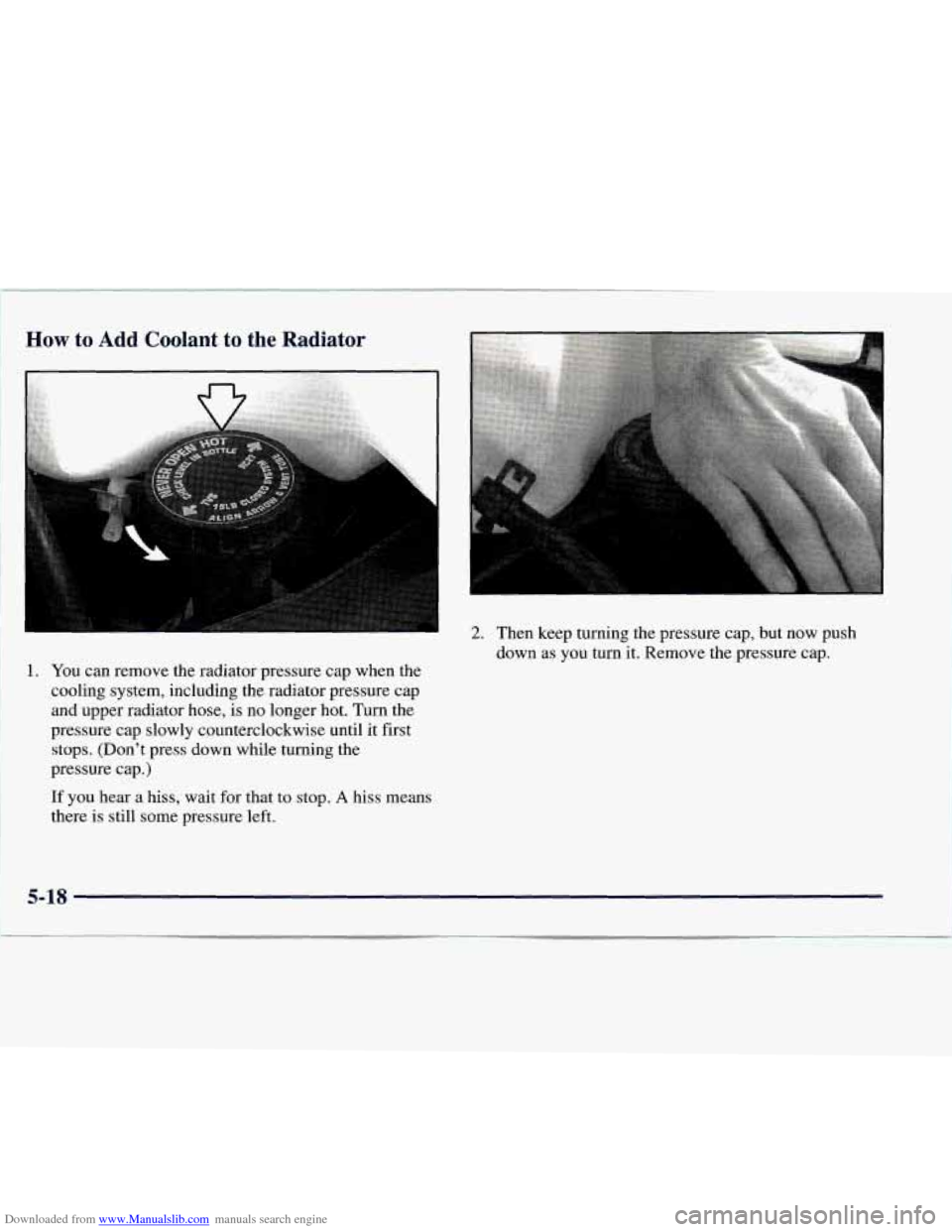
1. You can remove the radiator pressure cap when the
cooling system, including the radiator pressure cap
and upper radiator hose, is no longer hot. Turn the
pressure cap slowly counterclockwise until it first
stops. (Don’t press down while turning the
pressure cap.)
If you hear a hiss, wait for that to stop. A hiss means
there is still some pressure left.
2. Then keep turning the pressure cap, but now push
down as you turn it. Remove the pressure cap.
5-18
Page 223 of 386
Downloaded from www.Manualslib.com manuals search engine Changing a Flat Tire
If a tire goes flat, avoid further tire and wheel damage
by driving slowly to a level place. Turn on your hazard
warning flashers.
- -
Changing a tire can cause an injury. The vehicle
can slip
off the jack and roll over you or other
people. You and they could be badly injured.
Find a level place to change your tire.
To help
prevent the vehicle from moving:
1. Set the parking brake firmly.
2. Put the shift lever in PARK (P).
3. Xhrn off the engine.
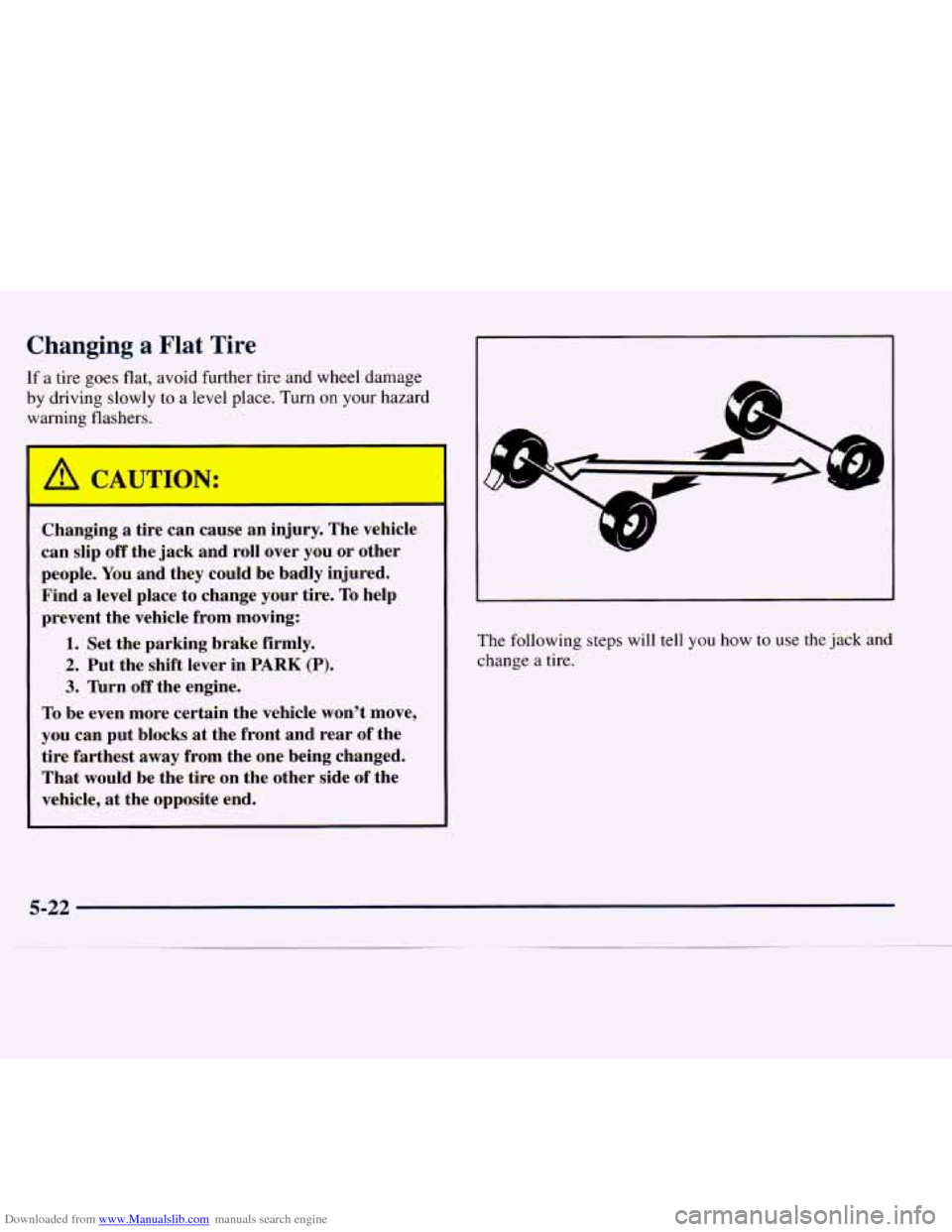
To be even more certain the vehicle won't move,
you can put blocks at the front and rear of the
tire farthest
away from the one being changed.
That would be the tire on the other side of the
vehicle, at the opposite end. The following
steps will tell you how
to use the jack and
change
a tire.
5-22
Page 228 of 386
Downloaded from www.Manualslib.com manuals search engine Removing the Wheel Covers and Locking
Wheel Nuts
I
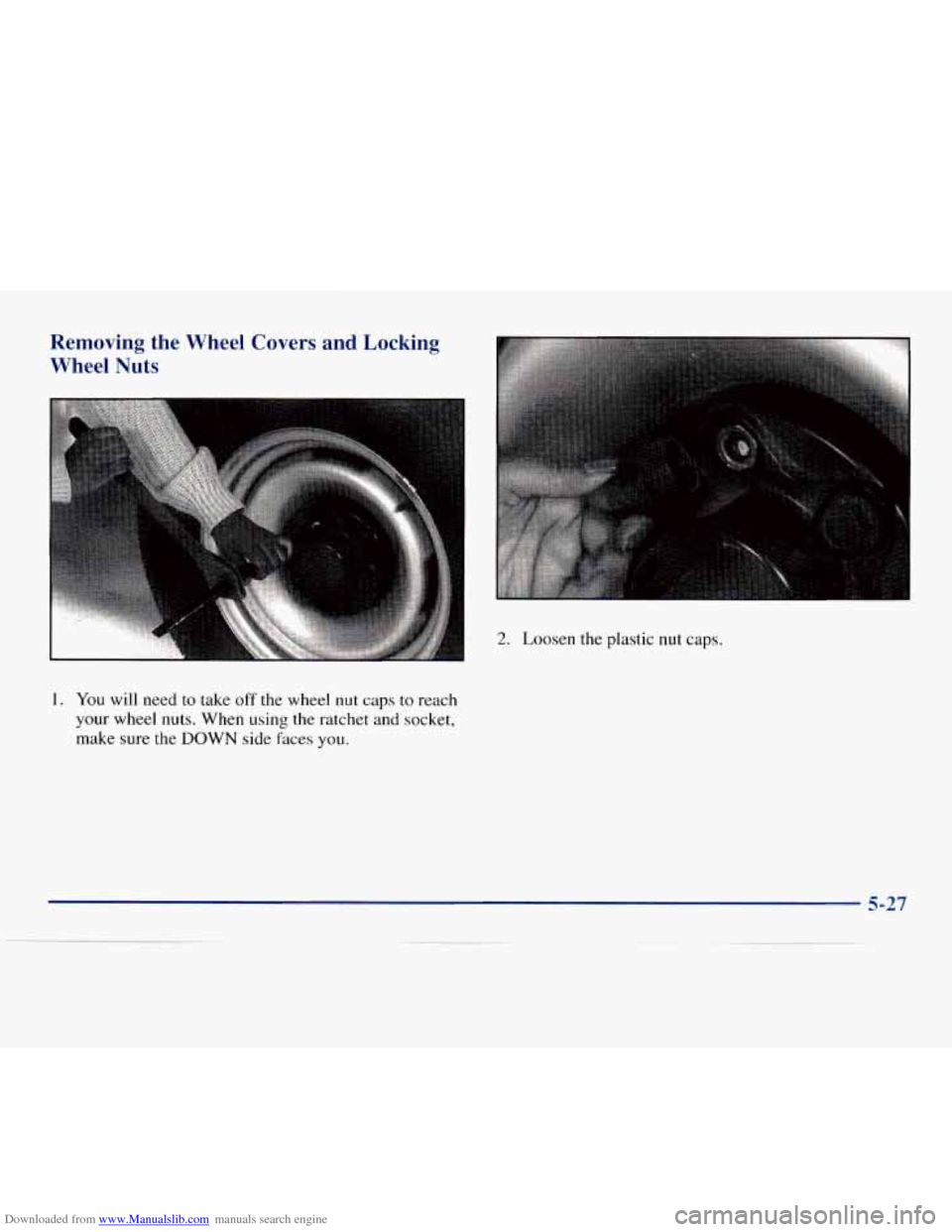
2. Loosen the plastic nut caps.
1. You will need to take off the wheel nut caps to reach
your wheel nuts. When using the ratchet
and socket,
make sure the
DOWN side faces you.
5-27
Page 234 of 386
Downloaded from www.Manualslib.com manuals search engine /1 CAUTION:
Incorrect wheel nuts or improperly tightened
wheel nuts can cause the wheel to become loose
and even come
off. This could lead to an accident.
Be sure to use the correct wheel nuts.
If you have
to replace them, be sure to get new
GM original
equipment wheel nuts.
Stop somewhere as soon as you can and have
the nuts tightened with a torque wrench
to
140 lb-ft (190 Nmm).
NOTICE:
Improperly tightened wheel nuts can lead to
brake pulsation and rotor damage. To avoid
expensive brake repairs, evenly tighten the wheel
nuts in the proper sequence and to the proper
torque specification. Put the wheel
cover back on, if
you have one.
Remove any wheel blocks.
Remember that the jack, jacking equipment and tire
must be properly stored
in their original storage
position before
you begin driving again. The next
part will show
you how.
Storing a Flat or Spare Tire and Tools
A CAUTION:
Storing a jack, a tire or other equipment in the
passenger compartment of the vehicle could
cause injury. In a sudden stop or collision, loose
equipment could strike someone. Store all these
in the proper place.
1. Put the tire on the ground at the rear of the vehicle,
with the valve stem pointed down.
5-33
Page 245 of 386
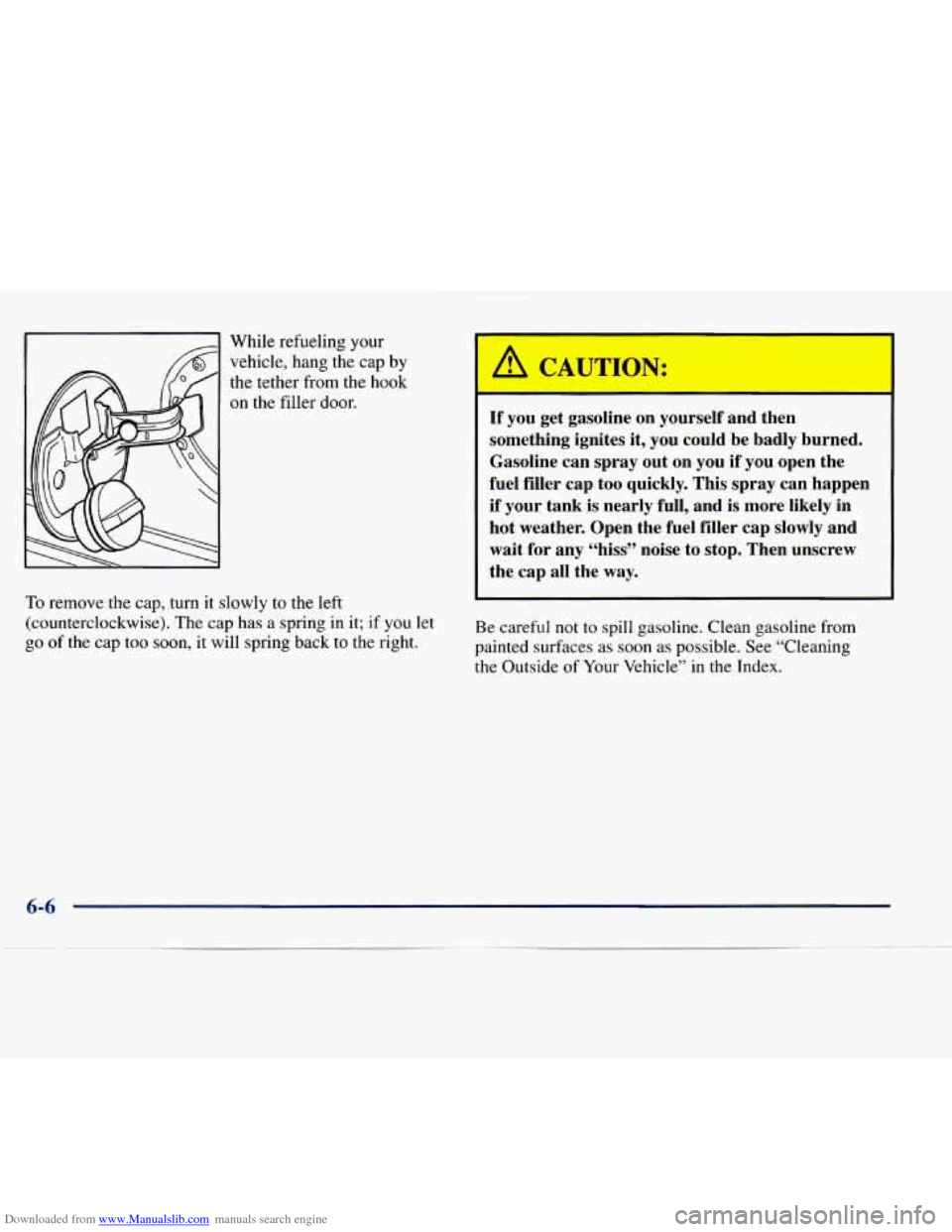
Downloaded from www.Manualslib.com manuals search engine While refueling your
vehicle, hang the cap by
the tether from the hook
on the filler door.
To remove the cap, turn it slowly to the left
(counterclockwise). The cap has a spring in it; if
you let
go of the cap too soon, it will spring back
to the right.
A CAUTION:
If you get gasoline on yourself and then
something ignites it, you could be badly burned.
Gasoline can spray out
on you if you open the
fuel filler cap too quickly. This spray can happen
if your tank is nearly full, and is more likely in
hot weather. Open the fuel filler cap slowly and
wait for any “hiss” noise to stop. Then unscrew
the cap all the way.
Be careful
not to spill gasoline. Clean gasoline from
painted surfaces as
soon as possible. See “Cleaning
the Outside
of Your Vehicle” in the Index.