lock CHEVROLET EXPRESS 1998 1.G Repair Manual
[x] Cancel search | Manufacturer: CHEVROLET, Model Year: 1998, Model line: EXPRESS, Model: CHEVROLET EXPRESS 1998 1.GPages: 386, PDF Size: 20.74 MB
Page 246 of 386
Downloaded from www.Manualslib.com manuals search engine When you put the cap back on, turn it to the right
(clockwise) until you hear a clicking sound. Make
sure
you fully install the cap. The diagnostic system
can determine if the fuel
cap has been left off or
improperly installed. This would allow
fuel to
evaporate into the atmosphere. See “Malfunction
Indicator Lamp” in the Index.
NOTICE:
If you need a new cap, be sure to get the right
type. Your dealer can get one for you.
If you get
the wrong type, it may not fit properly. This may
cause your malfunction indicator lamp to light and your fuel tank and emissions system may be
damaged. See “Malfunction Indicator Lamp” in
the Index.
Filling a Portable Fuel Container
/i CAUTIOlr:
Never fill a portable fuel container while it is in
your vehicle. Static electricity discharge from the
container can ignite the gasoline vapor.
You can
be badly burned and your vehicle damaged if this
occurs.
To help avoid injury to you and others:
Dispense gasoline only into approved
containers.
Do not fill a container while it is inside a
vehicle, in a vehicle’s trunk, pickup bed or
on any surface other than the ground.
inside of the
fill opening before operating
the nozzle. Contact should be maintained
until the filling is complete.
Bring the fill nozzle in contact with the
Don’t smoke while pumping gasoline.
Page 259 of 386
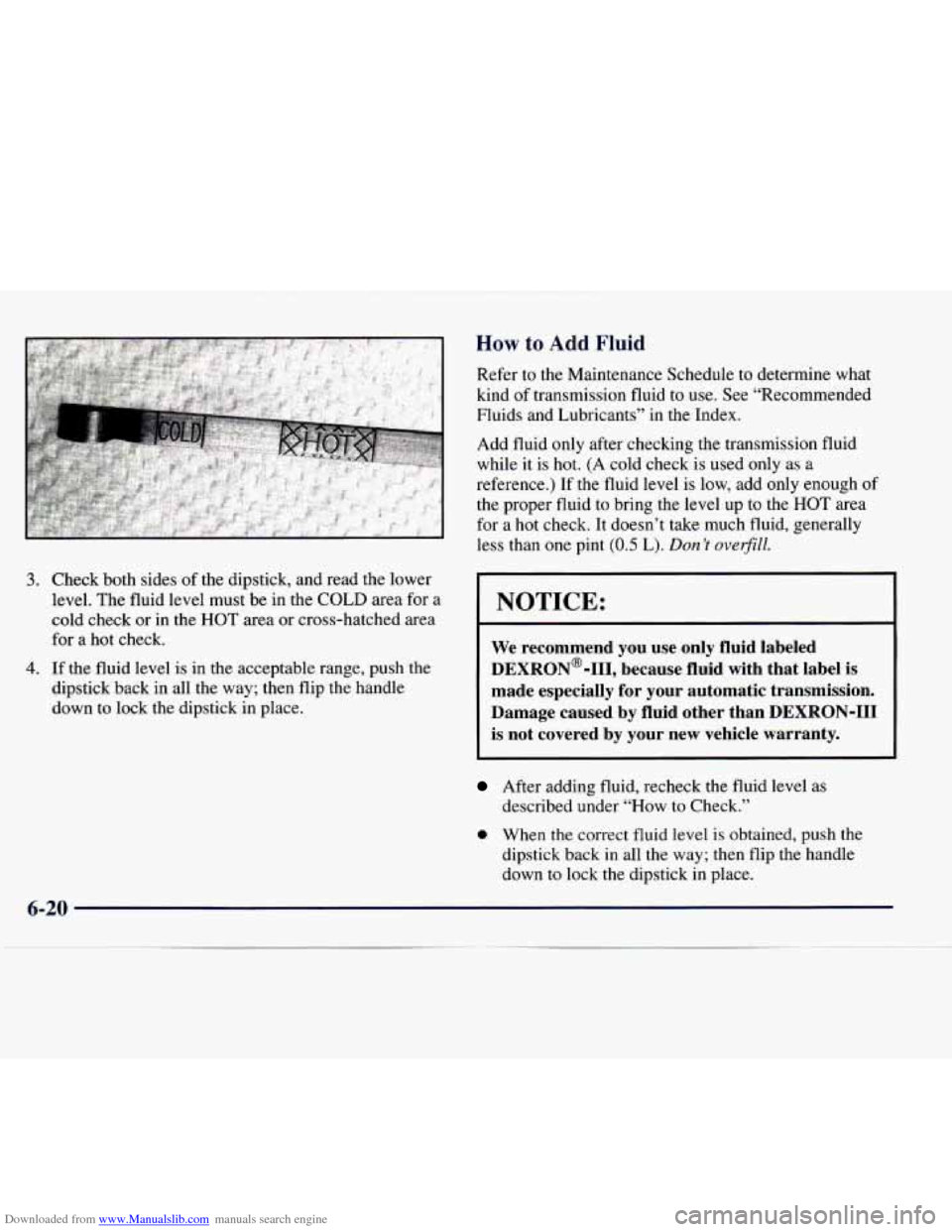
Downloaded from www.Manualslib.com manuals search engine 3. Check both sides of the dipstick, and read the lower
level. The fluid level must be in the COLD area for a
cold check or in the
HOT area or cross-hatched area
for a hot check.
4. If the fluid level is in the acceptable range, push the
dipstick back in all the
way; then flip the handle
down to lock the dipstick
in place.
How to Add Fluid
Refer to the Maintenance Schedule to determine’what
kind of transmission fluid
to use. See “Recommended
Fluids and Lubricants” in the Index.
Add fluid only after checking the transmission fluid
while it is hot. (A cold check is used only as a
reference.) If the fluid level is low, add only enough of
the proper fluid
to bring the level up to the HOT area
for a
hot check. It doesn’t take much fluid, generally
less than
one It (0.5 L). Don’t overfill.
NOTICE:
We recommend you use only fluid labeled
DEXRON@-111, because fluid with that label
is
made especially for your automatic transmission.
Damage caused
by fluid other than DEXRON-111
is not covered by your new vehicle warranty.
After adding fluid, recheck the fluid level as
described under “How to Check.”
0 When the correct fluid level is obtained, push the
dipstick back in all the way; then flip the handle
down
to lock the dipstick in place.
Page 279 of 386
Downloaded from www.Manualslib.com manuals search engine Windshield Wiper
I Blade Replacement
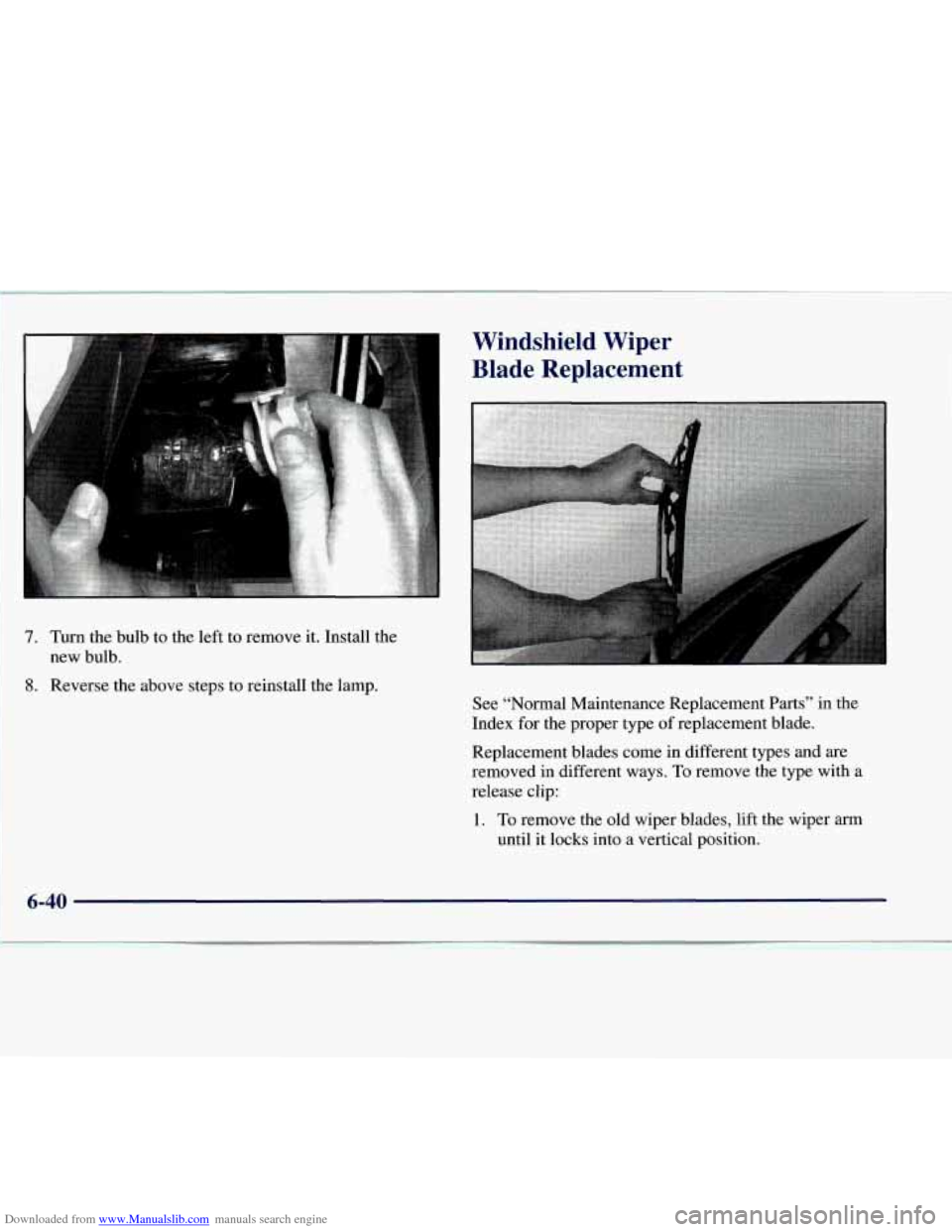
7. Turn the bulb to the left to remove it. Install the
new bulb.
8. Reverse the above steps to reinstall the lamp.
See “Normal Maintenance Replacement
Parts” in the
Index for the proper type of replacement blade.
Replacement blades come in different types and
are
removed in different ways. To remove the type with a
release clip:
1.
To remove the old wiper blades, lift the wiper arm
until it locks into a vertical position.
6-40
Page 280 of 386
Downloaded from www.Manualslib.com manuals search engine 2.
3.
4.
5.
6.
7.
Press down on the blade assembly pivot locking tab.
Pull down on the blade assembly to release it from
the wiper arm hook.
Remove the insert from the blade assembly. The
insert has two notches at one end that are locked by
bottom claws
of the blade assembly. At the notched
end, pull
the insert from the blade assembly.
To install the new wiper insert, slide the notched
end last, into the end with two blade claws. Slide
the insert all the way through the blade claws at the
opposite end.
Be sure that the notches are locked by the bottom
claws. Make sure that all other claws are properly
locked
on both sides of the insert slot.
Put the blade assembly pivot in the wiper arm
hook. Pull up until the pivot locking tab locks in
the hook slot.
Carefully lower the wiper
arm and blade assembly
into the windshield.
Tires
Yo%fS%%v vehicle comes with high-quality tires made by
a leading tire manufacturer. If you ever have questions
about your tire warranty and where to
obtain service, see
your
GM Warranty booklet for details.
A CAUTIOI.:
Poorly maintained and improperly used tires
are dangerous.
0
0
0
0
Overloading your tires can cause
overheating as
a result of too much friction.
You could have an air-out and a serious
accident. See “Loading Your Vehicle” in
the Index.
Underinflated tires pose the same danger
as overloaded tires. The resulting accident
could cause serious injury. Check all tires
frequently to maintain the recommended
pressure. Tire pressure should be checked
when your tires are cold.
Overinflated tires are more likely
to be
cut, punctured
or broken by a sudden
impact
-- such as when you hit a pothole.
Keep tires at the recommended pressure.
Worn, old tires can cause accidents.
If your
tread is badly worn, or if your tires have
been damaged, replace them.
6-41
Page 301 of 386
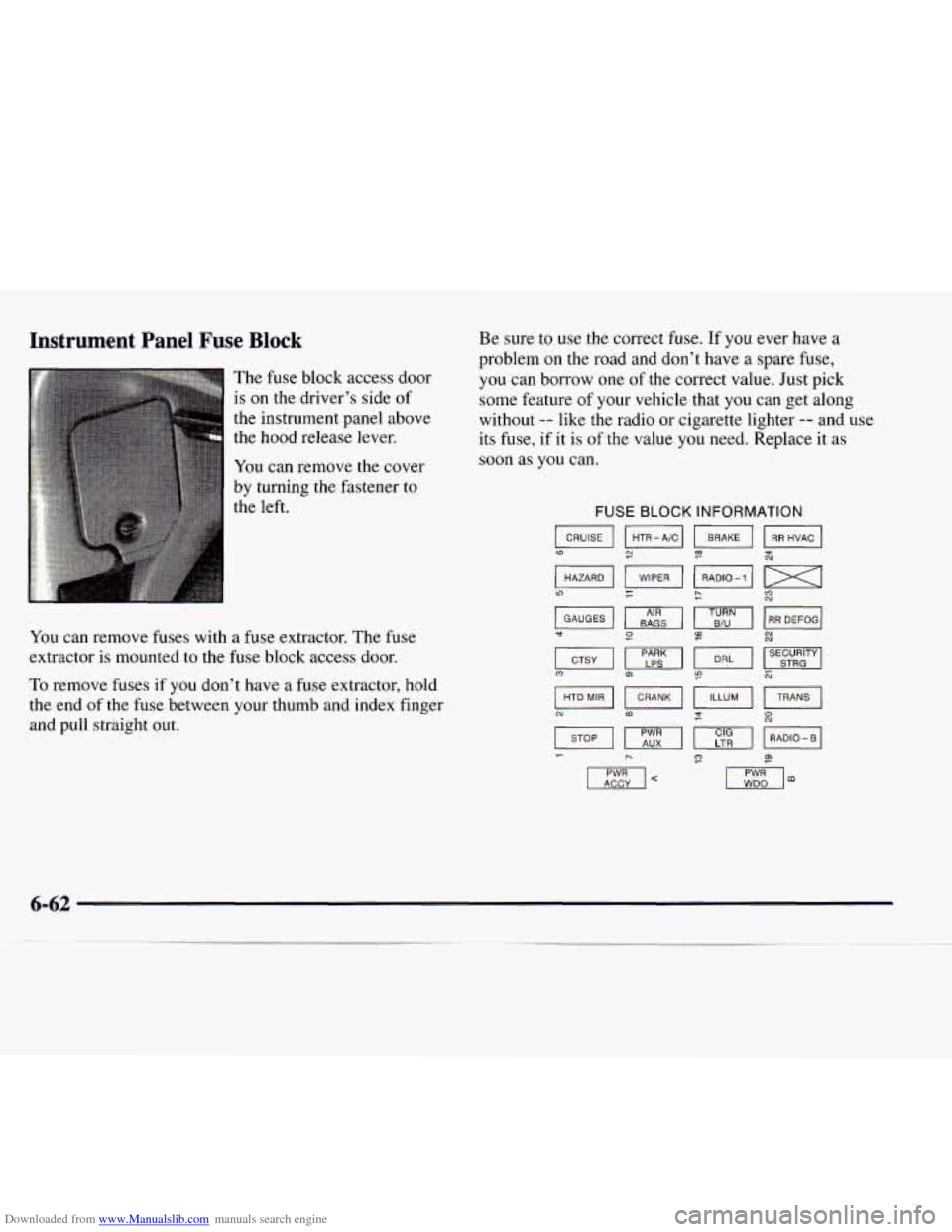
Downloaded from www.Manualslib.com manuals search engine In,c*rume-t Panel Fuse Block
The fuse block access door
is
on the driver’s side of
the instrument panel above
the hood release lever.
You can remove the cover
by turning the fastener to
the left.
You can remove fuses with
a fuse extractor. The fuse
extractor
is mounted to the fuse block access door.
To remove fuses if you don’t have a fuse extractor, hold
the end of the fuse between your thumb and index finger
and pull straight out. Be
sure
to use the correct fuse. If you ever have a
problem on the road and don’t have a spare fuse,
you can borrow one of the correct value. Just pick
some feature of your vehicle that
you can get along
without
-- like the radio or cigarette lighter -- and use
its fuse, if it is of the value you need. Replace it as
soon as you can.
FUSE BLOCK INFORMATION
Page 303 of 386
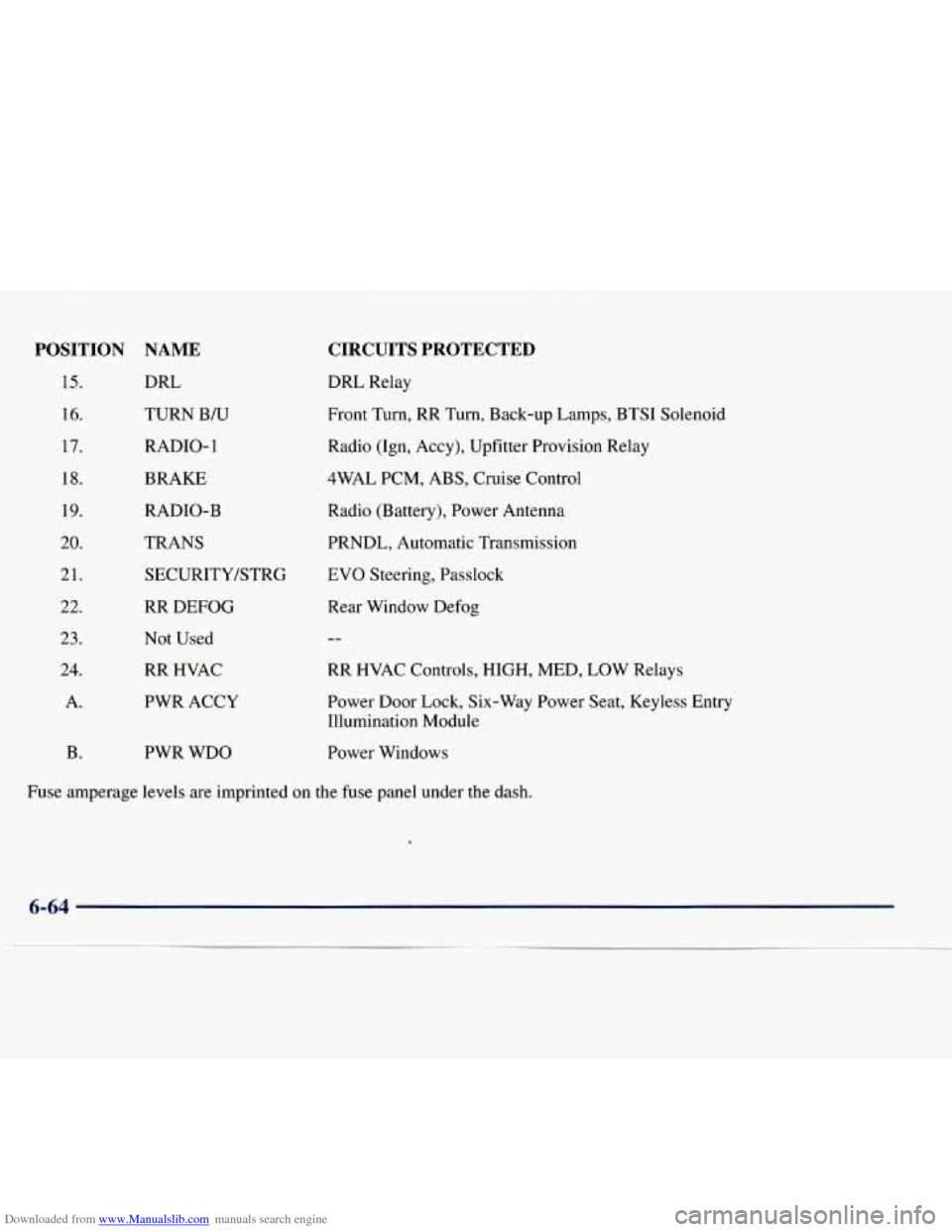
Downloaded from www.Manualslib.com manuals search engine POSITION
15.
16.
17.
18.
19.
20.
21.
22.
23.
24. A.
NAME
DRL
TURN B/U RADIO-
1
BRAKE
RADIO-B
TRANS SECURITYISTRG
RR
DEFOG
Not Used
FW HVAC
PWR ACCY
CIRCUITS PROTECTED
DRL Relay
Front Turn, RR Turn, Back-up Lamps,
BTSI Solenoid
Radio (Ign, Accy), Upfitter Provision Relav
4WAL PCM, ABS, Cruise Control
Radio (Battery), Power Antenna
PRNDL, Automatic Transmission
EVO Steering, Passlock
Rear Window Defog
RR HVAC Controls, HIGH, MED, LOW Relays Power Door Lock, Six-Way Power Seat, Keyless Entry
Illumination Module
B. PWR WDO Power Windows
Fuse amperage levels are imprinted
on the fuse panel under the dash.
6-64
Page 304 of 386
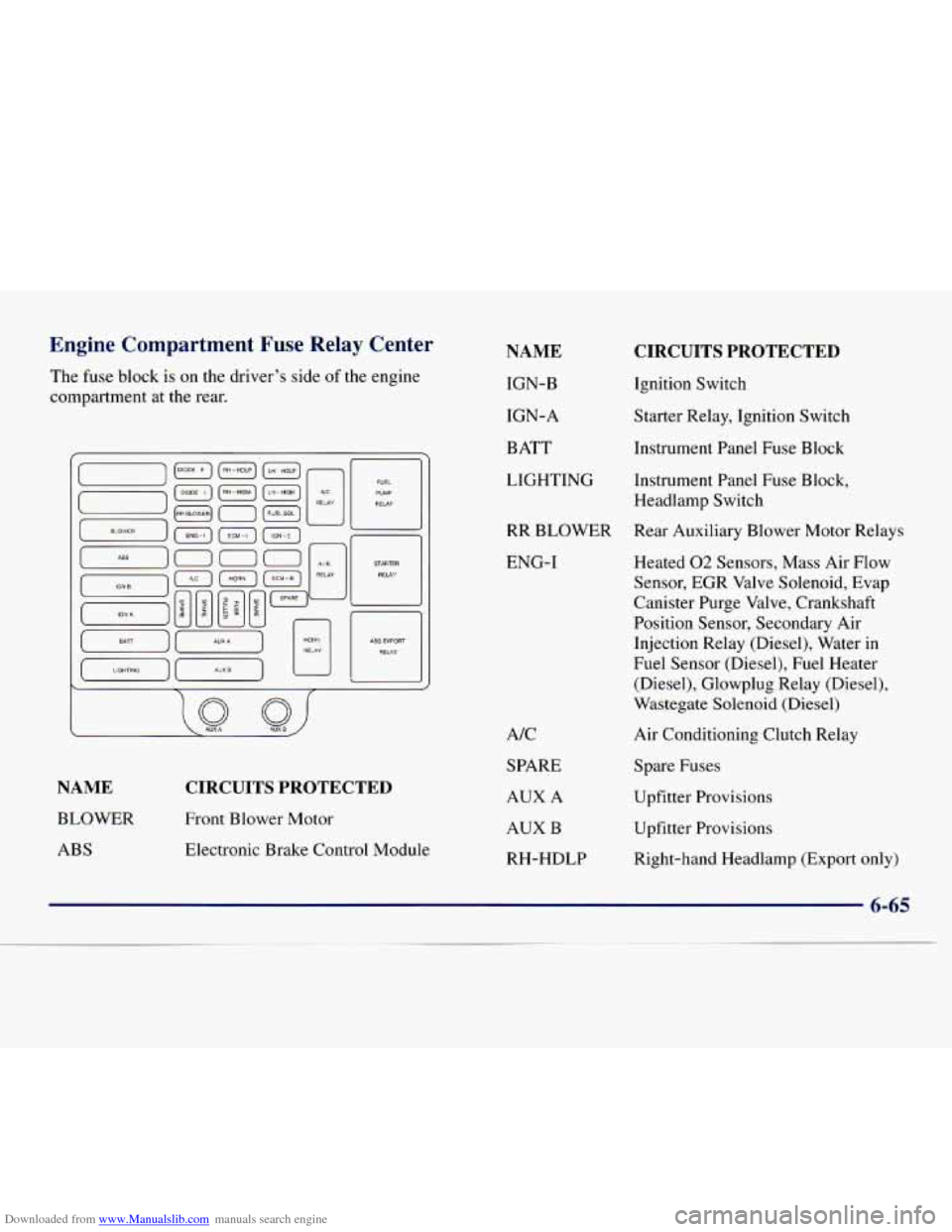
Downloaded from www.Manualslib.com manuals search engine Engine Compartment Fuse Relay Center
The fuse block is on the driver’s side of the engine
compartment at the rear.
U
NAME
IGN-B
IGN-A
BATT
LIGHTING
RR BLOWER
ENG-I
NAME
BLOWER ABS
CIRCUITS PROTECTED
Front Blower Motor
Electronic Brake Control Module AIC
SPARE
AUX A
AUX B
RH-HDLP
CIRCUITS PROTECTED
Ignition
Switch
Starter Relay, Ignition Switch
Instrument Panel
Fuse Block
Instrument Panel Fuse Block,
Headlamp Switch
Rear Auxiliary Blower Motor Relays
Heated
02 Sensors, Mass Air Flow
Sensor, EGR Valve Solenoid, Evap
Canister Purge Valve, Crankshaft
Position Sensor, Secondary Air Injection Relay (Diesel), Water in
Fuel Sensor (Diesel), Fuel Heater
(Diesel), Glowplug Relay (Diesel),
Wastegate Solenoid (Diesel)
Air Conditioning Clutch Relay
Spare Fuses
Upfitter Provisions Upfitter Provisions
Right-hand Headlamp (Export only)
Page 319 of 386
Downloaded from www.Manualslib.com manuals search engine Short Trip/City Maintenance Schedule -- Gasoline Engines
The services shown in this schedule up to 100,000 miles
(166 000 km) should be performed after 100,000 miles
(166 000 km) at the same intervals. The services shown
at 150,000 miles (240
000 km) should be performed at
the same interval after 150,000 miles (240
000 km).
See “Owner Checks and Services” and “Periodic
Maintenance Inspections” following.
Footnotes
The U.S. Environmental Protection Agency or the
California Air Resources Board has determined that the
failure to perform this maintenance item will not nullify
the emission warranty or limit recall liability prior to the
completion of the vehicle’s useful life. We, however,
urge that all recommended maintenance services be
performed at the indicated intervals and the maintenance
be recorded.
# Lubricate the front suspension, kingpin bushings,
steering linkage and rear driveline center splines.
+ A good time to check your brakes is during tire
rotation. See “Brake System Inspection” under “Periodic
Maintenance Inspections” in
Part C of this schedule.
* * Drive axle service (see “Recommended Fluids and
Lubricants” in the Index for proper lubricant to use):
0
0
0
Locking Differential -- Drain fluid and refill at first
engine oil change. At subsequent oil changes, check
fluid level and add fluid as needed. If driving in
dusty areas or towing a trailer, drain fluid and refill
every 15,000 miles (25
000 km).
Standard Differential -- Check fluid level and add
fluid as needed at every oil change. If driving in
dusty areas
or towing a trailer, drain fluid and refill
every 15,000 miles
(25 000 km).
More frequent lubrication may be required for
heavy-duty use.
7-8
Page 338 of 386
Downloaded from www.Manualslib.com manuals search engine Long Tripmighway Maintenance Schedule -- Gasoline Engines
The services shown in this schedule up to 100,000 miles
( 166 000 km) should be performed after 100,000 miles
(166
000 km) at the same intervals. The services shown
at
150,000 miles (240 000 km) should be performed at
the same interval after
150,000 miles (240 000 km).
See “Owner Checks and Services” and “Periodic
Maintenance Inspections” following.
Footnotes
The U.S. Environmental Protection Agency or the
California Air Resources Board has determined that the
failure to perform this maintenance item will not nullify
the emission warranty or limit recall liability prior to
the
completion of the vehicle’s useful life. We, however,
urge that all recommended maintenance services
be
performed at the indicated intervals and the maintenance
be recorded.
## Lubricate the front suspension, kingpin bushings,
steering linkage and rear driveline center splines.
+ A good time to check your brakes is during tire
rotation. See “Brake System Inspection” under “Periodic
Maintenance Inspections” in Part
C of this schedule.
** Drive axle service (see “Recommended Fluids and
Lubricants” in the Index for proper lubricant to use):
0 Locking Differential -- Drain fluid and refill at first
engine oil change. At subsequent oil changes, check
fluid level and add fluid as needed.
fluid as needed at every engine oil change.
0 Standard Differential -- Check fluid level and add
7-27
Page 350 of 386
Downloaded from www.Manualslib.com manuals search engine . .- . ,east Twice a Year Automatic Transmission Check
Restraint System Check
Make sure the safety belt reminder light and all your
belts, buckles, latch plates, retractors and anchorages are
working properly. Look for any other loose or damaged
safety belt system parts. If you see anything that might
keep a safety belt system from doing its
job, have it
repaired. Have any torn or frayed safety belts replaced.
Also look for any opened or broken air bag coverings,
and have them repaired or replaced. (The air bag system
does
not need regular maintenance.)
Wiper Blade Check
Inspect wiper blades for wear or cracking. Replace blade
inserts that appear worn or damaged or that streak or
miss areas of the windshield. Also see “Wiper Blades,
Cleaning” in
the Index. Check the
transmission fluid level; add if needed. See
“Automatic Transmission” in the Index. A fluid
loss may indicate a problem. Check the system and
repair if needed.
At Least Once a Year
Key Lock Cylinders Service
Lubricate the key lock cylinders with the lubricant
specified in Part
D.
Body Lubrication Service
Lubricate all hood hinges, hood prop rod pivot, fuel
filler door, rear compartment hinges, latches, locks and
any moving seat hardware. Part
D tells you what to use.
More frequent lubrication may be required when
exposed to a corrosive environment.