ignition CHEVROLET EXPRESS 1998 1.G Owners Manual
[x] Cancel search | Manufacturer: CHEVROLET, Model Year: 1998, Model line: EXPRESS, Model: CHEVROLET EXPRESS 1998 1.GPages: 386, PDF Size: 20.74 MB
Page 39 of 386
Downloaded from www.Manualslib.com manuals search engine Let only qualified technicians work on your air bag
system. Improper service can mean that your air
bag system won’t work properly. See your dealer
for service.
NOTICE:
If you damage the covering for the driver’s or the
right front passenger’s air bag, the bag may not
work properly. You may have to replace the air
bag module in the steering wheel or both the air
bag module and the instrument panel for the right front passenger’s
air bag. Do not open or
break the air bag coverings.
If your vehicle ever gets into a lot
of water -- such as
water up to the carpeting or higher
-- or if water enters
your vehicle and soaks the carpet, the air bag controller
can be soaked and ruined.
If this ever happens, and then
you start your vehicle, the damage could make the air
bags inflate, even if there’s no crash. You would have to
replace the air bags as well as
the sensors and related
parts. If your vehicle
is ever in a flood, or if it’s exposed
to water
that soaks the carpet, you can avoid needless
repair costs by turning
off the vehicle immediately. Don’t let anyone
start the vehicle, even to tow it, unless
the battery cables are first disconnected.
Servicing Your Air Bag-Equipped Vehicle
Air bags affect how your vehicle should be serviced.
There are parts
of the air bag system in several places
around your vehicle. You don’t want the system to
inflate while someone is working on your vehicle. Your
dealer and the
GM Service Manual have information
about servicing your vehicle and the air bag system.
To
purchase a service manual, see “Service and Owner
Publications” in the Index.
For up to
10 minutes after the ignition key is
turned off and the battery is disconnected, an air
bag can still inflate during improper service. You
can be injured
if you are close to an air bag when
it inflates. Avoid wires wrapped with yellow tape
or yellow connectors. They are probably part
of
the air bag system. Be sure to follow proper
service procedures, and make sure the person
performing work for you is qualified
to do so.
The air bag system does not need regular maintenance.
Page 72 of 386
Downloaded from www.Manualslib.com manuals search engine Section 2 Features and Controls
Here you can learn about the many standard and optional features on your vehicle, and information on starting,
shifting and braking. Also explained are the instrument panel and the warning systems that tell you if everything is
working properly
-- and what to do if you have a problem.
2-2 2-4
2-6
2-9
2- 15
2- 16
2- 17
2- 17
2-18
2-20
2-2 1
2-24
2-25 2-28
2-29
2-29 Keys
Door Locks
Keyless Entry System (If Equipped)
Your Doors and How They Work
Theft
Passlock@
New Vehicle “Break-In”
Ignition Positions
Starting Your Gasoline Engine
Engine Coolant Heater (If Equipped)
Automatic Transmission Operation
Parking Brake
Shifting Into PARK
(P)
Shifting Out of PARK (P)
Parking Over Things That Burn
Engine Exhaust 2-30
2-30
2-3
1
2-33
2-34
2-34
2-40
2-43
2-45
2-48
2-48
2-49 2-50
2-5
1
2-53 Running
Your Engine While You’re Parked
Locking Rear Axle (If Equipped)
Windows Horn
Tilt Wheel (Option)
Turn SignalMultifunction Lever
Exterior Lamps
Interior Lamps
Mirrors Storage Compartments
Cigarette LightedAshtray
Sun Visors
Instrument Panel
Instrument Cluster
Warning Lights, Gages and Indicators
Page 73 of 386
Downloaded from www.Manualslib.com manuals search engine Keys
I
I a CAUTION:
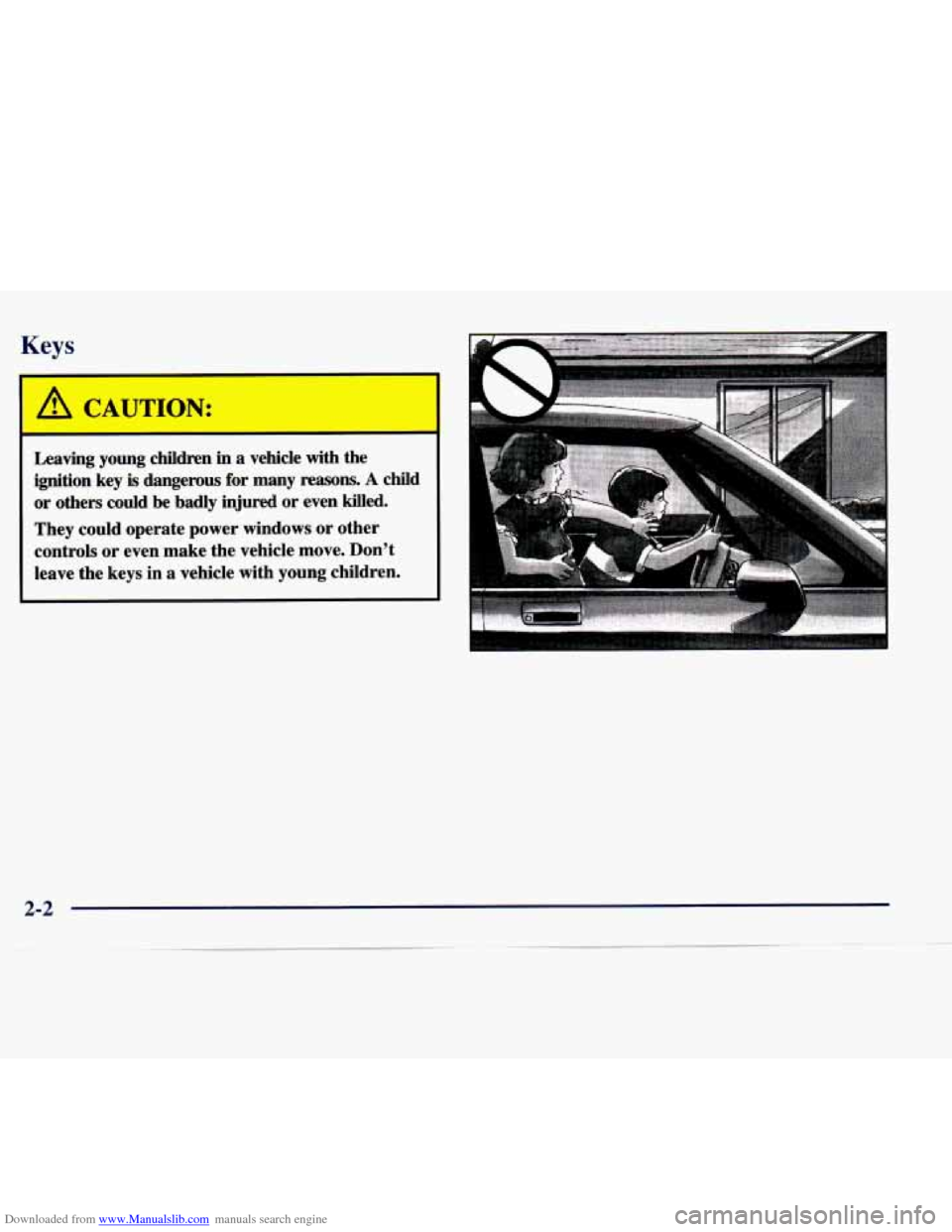
Leaving young children in a vehicle with the ignition key
is dangerous for many reasons. A child
or others could be badly injured or even killed.
They could operate power windows or other
controls or even make the vehicle move. Don't
leave the keys in
a vehicle with young children.
2-2
Page 74 of 386
Downloaded from www.Manualslib.com manuals search engine P
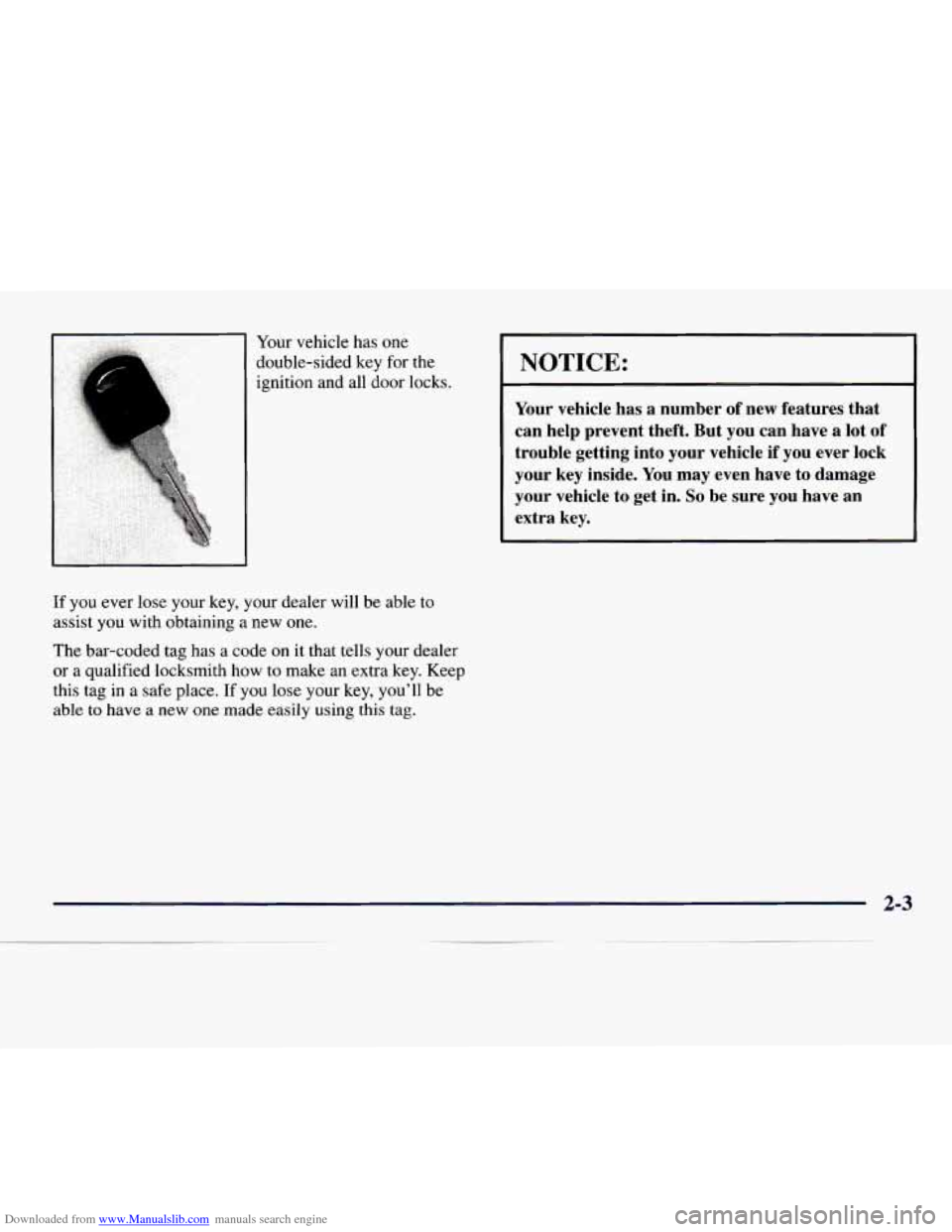
Your vehicle has one
double-sided key for
the k,. I:. ignition and all door locks.
If you ever lose your key, your dealer will be able to
assist
you with obtaining a new one.
The bar-coded tag has a code on it that tells your dealer
or
a qualified locksmith how to make an extra key. Keep
this tag in a safe place.
If you lose your key, you’ll be
able to have a new one made easily using this tag.
NOTICE:
Your vehicle has a number of new features that
can help prevent theft. But you can have a lot of
trouble getting into your vehicle if you ever lock
your key inside. You may even have to damage
your vehicle to get in.
So be sure you have an
extra key.
Page 79 of 386
Downloaded from www.Manualslib.com manuals search engine Operation
To unlock the driver's door, press the UNLOCK button.
If you press this button again within five seconds, all the
doors will unlock. Press the
REAR 2X button twice to
unlock the rear door only. When the UNLOCK or
REAR 2X button is pressed, the interior dome lamps are
turned on for 40 seconds or until the ignition switch is
activated. Press LOCK to lock all doors.
Matching Transmitter(s) To Your Vehicle
Each remote keyless entry transmitter is coded to
prevent another transmitter from unlocking your vehicle.
If a transmitter is lost or stolen, a replacement can be
purchased through your dealer. Remember to bring any
remaining transmitters with you when you
go to your
dealer. When the dealer matches the replacement
transmitter to your vehicle, any remaining transmitters
must also be matched. Once your dealer has coded the
new transmitter, the lost transmitter will not unlock your
vehicle. Each vehicle can have only two transmitters
matched to it.
Battery Replacement
Under normal use, the battery in your remote keyless
entry transmitter should last about two years.
You can tell the battery
is weak if the transmitter won't
work at the normal range
in any location. If you have to
get close to your vehicle before the transmitter works,
it's probably time to change the battery.
I 1
NOTICE:
When replacing the battery, use care not to touch
any of the circuitry. Static from your body
transferred to these surfaces may damage the
transmitter.
Use one Panasonic@ type CR2032 battery:
Page 86 of 386
Downloaded from www.Manualslib.com manuals search engine A CA JTAN:
It can be dangerous to drive with the rear doors
open because carbon monoxide
(CO) gas can
come into your vehicle. You can’t see or smell
CO. It can cause unconsciousness and even death.
If you must drive with the rear doors open or if
electrical wiring or other cable connections must
pass through the seal between the body and the
rear doors:
Make sure all windows are shut.
I’urn the fan on your heating or cooling
system to its highest speed with the setting
on VENT, HEAT, BLEND or
DEF.
Additionally, on vehicles with heatindair
conditioning
systems, NORM A/C or
BI-LEVEL A/C can be used. That will
force outside air into your vehicle. See
“Comfort Controls” in the Index.
If you have air outlets on or under the
instrument panel, open them all the way.
See “Engine Exhaust” in the Index.
Theft
Vehicle theft is big business, especially in some cities.
Although your vehicle
has a number of theft-deterrent
features, we know
that nothing we put on it can make it
impossible to steal. However, there are ways
you can help.
Key in the Ignition
If you leave your vehicle with the keys inside, it’s an
easy target for joy riders or professional thieves
-- so
don’t do it.
When you park your vehicle
and open the driver’s door,
you’ll hear a tone reminding you
to remove your key from
the ignition and take it with
you. Always do this. Your
steering wheel will be locked, and
so will your ignition
and transmission. And remember
to lock the doors.
Parking at Night
Park in a lighted spot, close all windows and lock your
vehicle. Remember
to keep your valuables out of sight.
Put them in a storage area, or take them with you.
Page 87 of 386
Downloaded from www.Manualslib.com manuals search engine Parking Lots
If you park in a lot where someone will be watching
your vehicle, it’s best
to lock it up and take your keys.
But what
if you have to leave your ignition key? What if
you have to leave something valuable in your vehicle?
Put your valuables in a storage area, like your front
Lock all the doors except the driver’s.
storage
compartment.
Passlock@
Your vehicle is equipped with the Passlock
theft-deterrent system.
Passlock
is a passive theft-deterrent system. The system
is armed once the key is removed from the ignition.
Passlock enables fuel if the ignition lock cylinder is
turned with
a valid key. If a correct key is not used,
fuel
is disabled. During normal
operation, the SECURITY light will
go
off after the engine is started.
If the engine stalls and the SECURITY light flashes,
wait
until the light stops flashing before trying to restart
the engine. Remember
to release the key from the
START position as soon as the engine starts.
If you are driving and the SECURITY light comes on, you
will be able to restart the engine if you turn the engine off.
However, your Passlock system is not working properly
and must be serviced by your dealer. Your vehicle is not
protected by Passlock at this time. You may
also want to
check the fuse (see “Fuses
and Circuit Breakers” in the
Index). See your dealer for service.
If the SECURITY light comes on while the engine is
running, a problem has been detected and the system
may need service. See your dealer for service.
In an emergency, call the
GM Roadside Assistance
Center. See “Roadside Assistance’’ in the Index.
2-16
Page 88 of 386
Downloaded from www.Manualslib.com manuals search engine New Vehicle 44Break-In”
NOTICE:
Your vehicle doesn’t need an elaborate
“break-in.” But it will perform better in the long
run
if you follow these guidelines:
Keep your speed at 55 mph (88 km/h) or
less for the first
500 miles (805 km).
Don’t drive at any one speed -- fast or
slow
-9 for the first 500 miles (805 km).
Don’t make full-throttle starts.
200 miles (322 km) or so. During this time
your new brake linings aren’t yet broken
in. Hard stops with new linings can mean
premature wear and earlier replacement.
Follow this breaking-in guideline every
time you get new brake linings.
See “Towing
a Trailer” in the Index for
more information.
Avoid making hard stops for the first
Don’t tow a trailer during break-in.
Ignition Positions
Your key lets you turn the ignition switch to five
different positions.
,------1---\D
C
A E
ACCESSORY (A): ACCESSORY lets you use things
like the radio, power windows and the windshield
wipers when the engine
is off. To get into
ACCESSORY, push in the key and turn it toward you.
Your steering wheel will remain locked, just
as it was
before you inserted
the key.
2-17
Page 89 of 386
Downloaded from www.Manualslib.com manuals search engine LOCK (B): This position locks your ignition, steering
wheel and transmission.
It’s a theft-deterrent feature.
You will only be able to remove your key when the
ignition is turned
to LOCK.
OFF (C): This position lets you turn off the engine but
still
turn the steering wheel. It doesn’t lock the steering
wheel like LOCK. Use
OFF if you must have your
vehicle in motion while the engine is off (for example, if
your vehicle is being pushed).
RUN (D): This is the position for driving.
START (E): This starts your engine.
NOTICE:
If your key seems stuck in LOCK and you can’t
turn
it, be sure you are using the correct key; if
so, is it all the way in? If it is, then turn the
steering wheel left and right while you turn the
key hard. But turn the key only with your hand.
Using
a tool to force it could break the key or the
ignition switch. If none of this works, then your
vehicle needs service.
Starting Your Gasoline Engine
If you have a diesel engine, see “Starting Your Diesel
Engine” in
the Diesel Engine Supplement.
Move your shift lever to
PARK (P) or NEUTRAL (N).
Your engine won’t start in any other position -- that’s a
safety feature. To restart when you’re already moving,
use NEUTRAL
(N) only.
NOTICE:
Don’t try to shift to PARK (P) if your vehicle is
moving. If you do, you could damage the
transmission. Shift to
PARK (P) only when your
vehicle is stopped.
1. Without pushing the accelerator pedal, turn your
ignition key to START. When the engine starts, let
go
of the key. The idle speed will go down as your
engine gets warm.
2-1s
Page 92 of 386
Downloaded from www.Manualslib.com manuals search engine 4. Before starting the engine, be sure to unplug and store
the cord as it was before
to keep it away from moving
engine parts. If you don’t, it could be damaged.
How long should you keep the coolant heater plugged
in? The answer depends on the outside temperature, the
kind of oil
you have, and some other things. Instead of
trying to list everything here, we ask that you contact
your dealer in the area where you’ll be parking your
vehicle. The dealer can give
you the best advice for that
particular area.
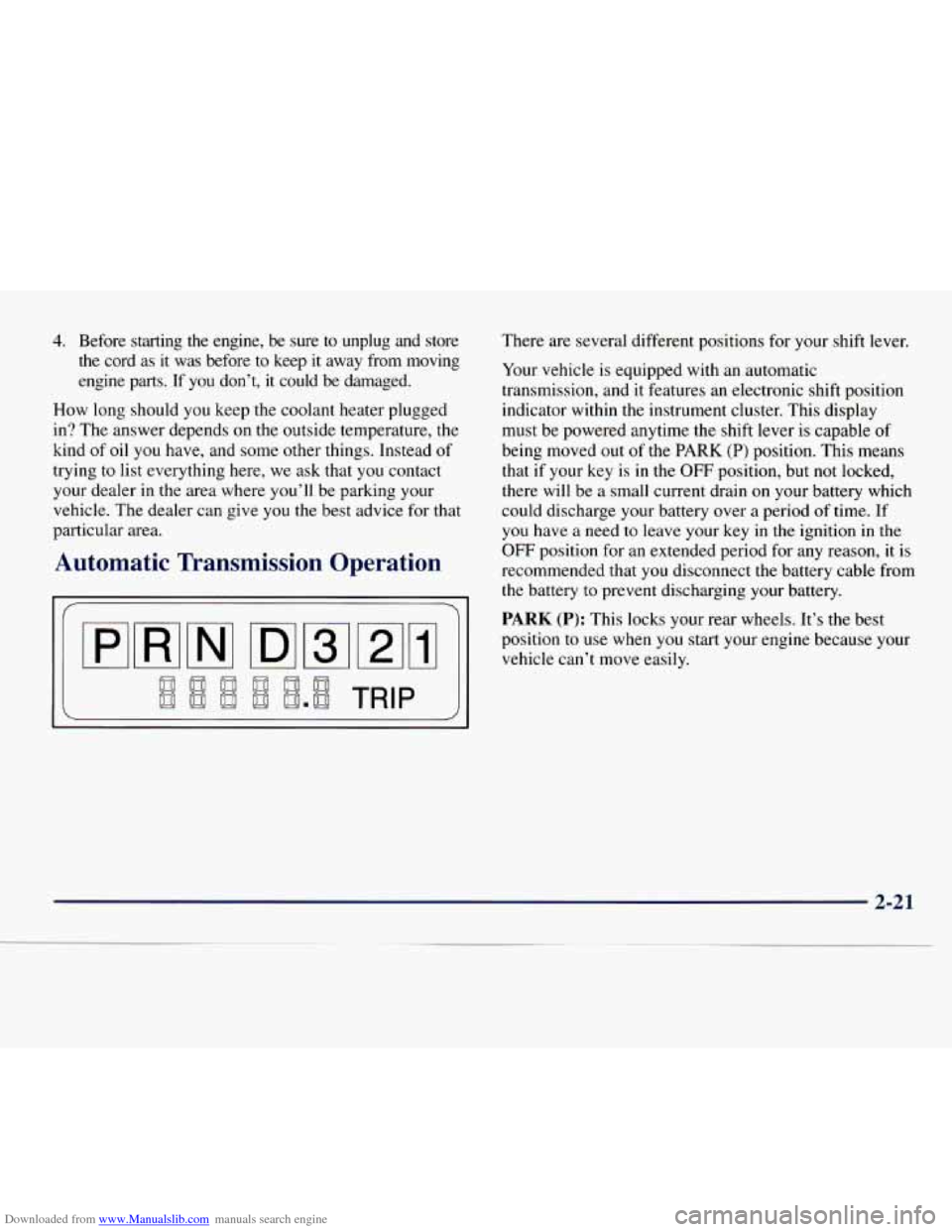
Automatic Transmission Operation
There are several different positions for your shift lever.
Your vehicle is equipped with an automatic
transmission, and it features an electronic shift position
indicator within the instrument cluster. This display
must be powered anytime the shift lever is capable of
being moved out of the
PARK (P) position. This means
that
if your key is in the OFF position, but not locked,
there will be a small current drain
on your battery which
could discharge your battery over a period
of time. If
you have a need to leave your key in the ignition in the
OFF position for an extended period for any reason, it is
recommended that
you disconnect the battery cable from
the battery
to prevent discharging your battery.
/DI 3 121 1 vehicle can’t move easily.
PARK (P): This locks your rear wheels. It’s the best
position to
use when you start your engine because your
2-21