spare wheel CHEVROLET EXPRESS 1998 1.G Owners Manual
[x] Cancel search | Manufacturer: CHEVROLET, Model Year: 1998, Model line: EXPRESS, Model: CHEVROLET EXPRESS 1998 1.GPages: 386, PDF Size: 20.74 MB
Page 226 of 386
Downloaded from www.Manualslib.com manuals search engine .. -.
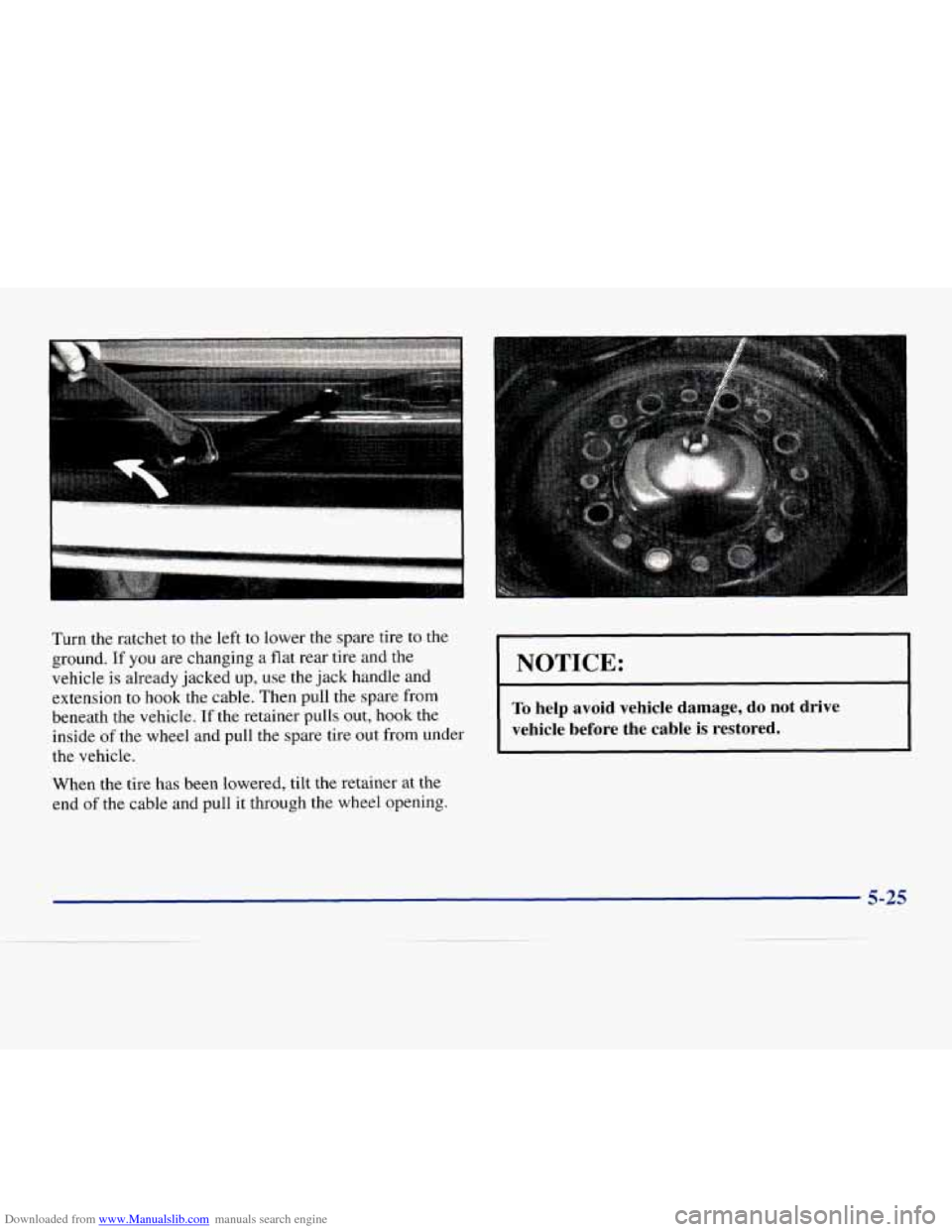
Turn
the ratchet to the left to lower the spare tire to the
ground. If you are changing a flat rear tire and the
vehicle
is already jacked up, use the jack handle and
extension to hook the cable. Then pull the spare from
beneath the vehicle.
If the retainer pulls out, hook the
inside of
the wheel and pull the spare tire out from under
the vehicle.
When the tire has been lowered, tilt
the retainer at the
end of the cable and pull it through the wheel opening.
I NOTICE: I
To help avoid vehicle damage, do not drive
vehicle before the cable
is restored. I
5-25
Page 229 of 386
Downloaded from www.Manualslib.com manuals search engine Removing the Flat Tire and Installing the
Spare Tire
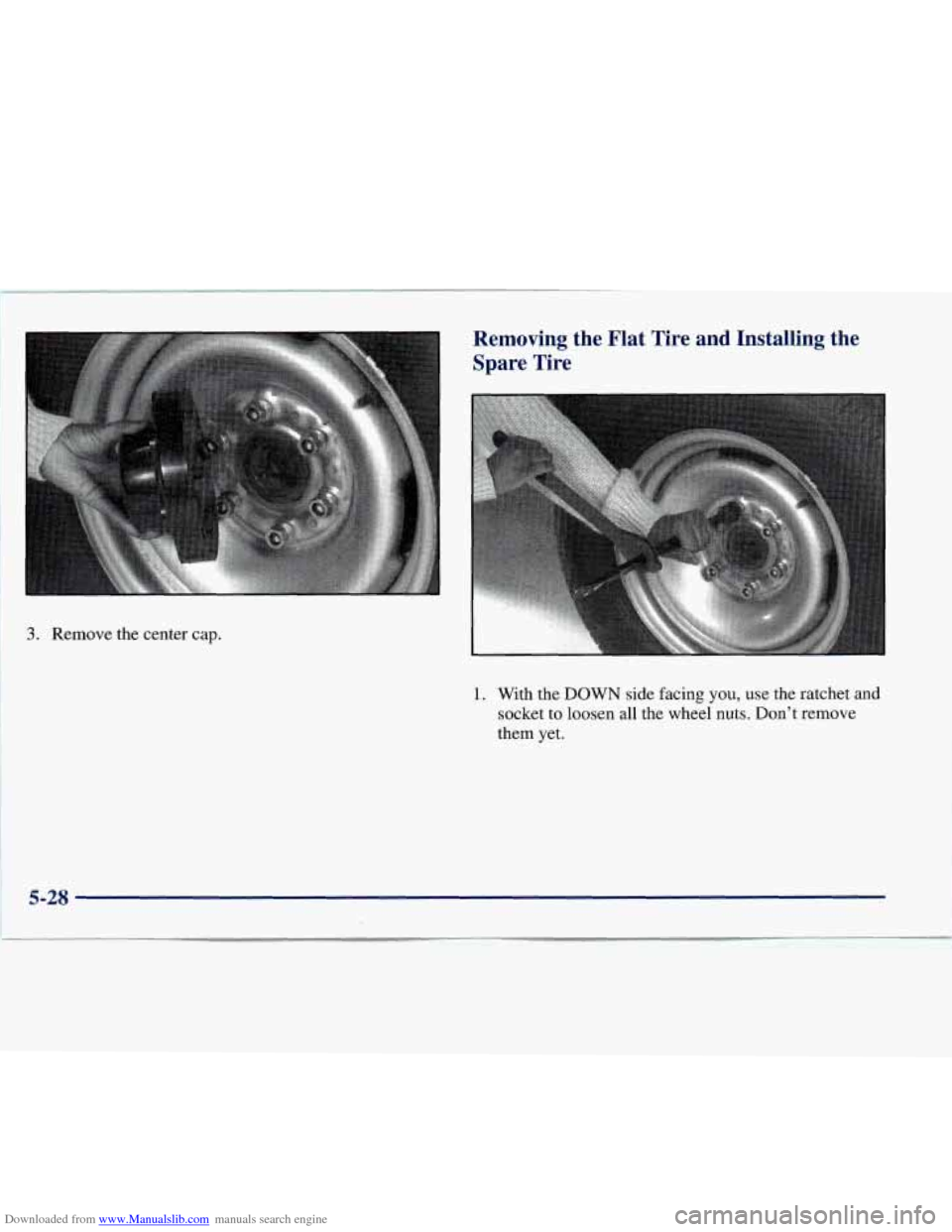
3. Remove the center cap.
1. With the DOWN side facing you, use the ratchet and
socket to loosen all the wheel nuts. Don’t remove
them yet.
5-28
Page 232 of 386
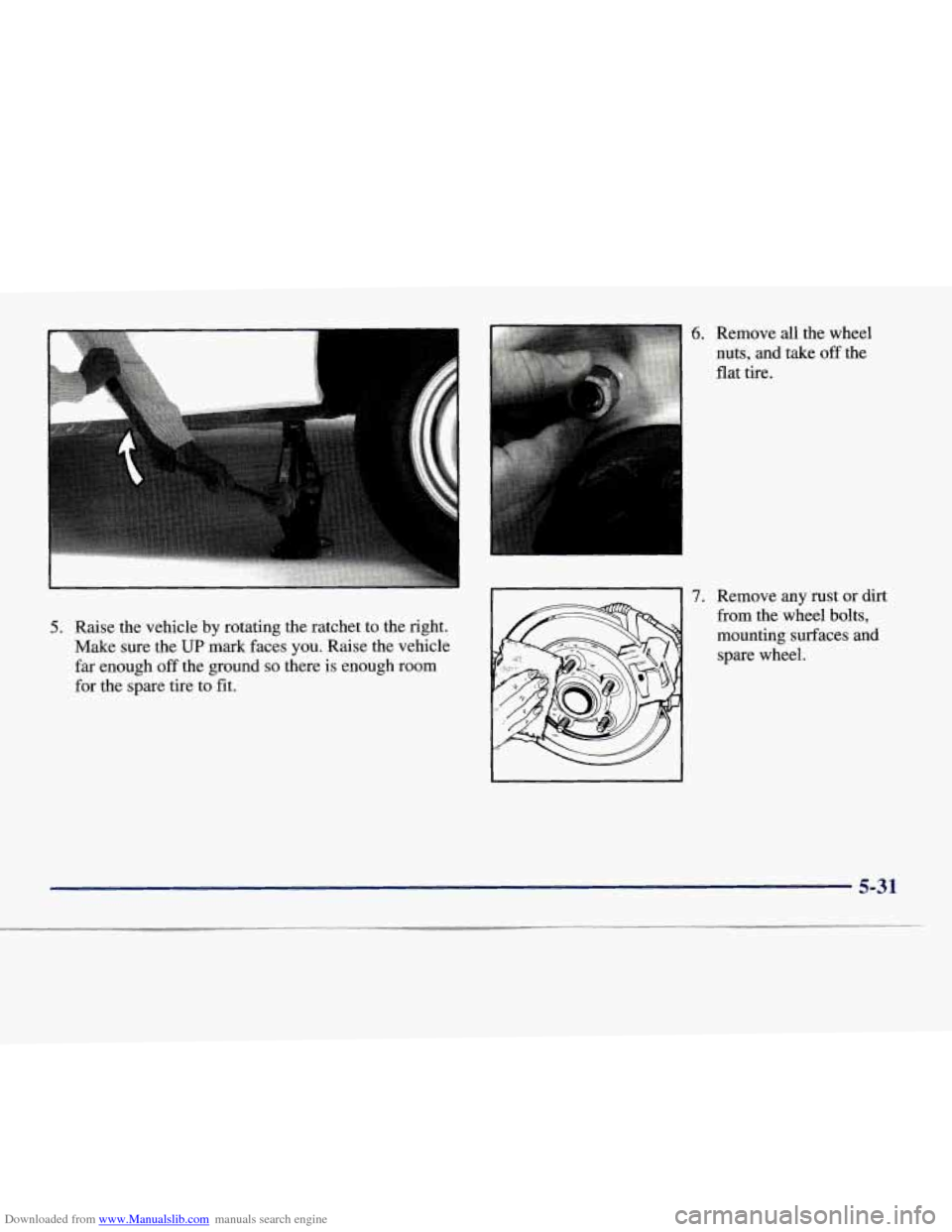
Downloaded from www.Manualslib.com manuals search engine 5. Raise the vehicle by rotating the ratchet to the right.
Make sure the
UP mark faces you. Raise the vehicle
far enough
off the ground so there is enough room
for the spare tire
to fit.
6. Remove all the wheel
nuts, and take off the
flat tire.
7. Remove any rust or dirt
from the wheel bolts,
mounting surfaces and
spare wheel.
5-31
Page 234 of 386
Downloaded from www.Manualslib.com manuals search engine /1 CAUTION:
Incorrect wheel nuts or improperly tightened
wheel nuts can cause the wheel to become loose
and even come
off. This could lead to an accident.
Be sure to use the correct wheel nuts.
If you have
to replace them, be sure to get new
GM original
equipment wheel nuts.
Stop somewhere as soon as you can and have
the nuts tightened with a torque wrench
to
140 lb-ft (190 Nmm).
NOTICE:
Improperly tightened wheel nuts can lead to
brake pulsation and rotor damage. To avoid
expensive brake repairs, evenly tighten the wheel
nuts in the proper sequence and to the proper
torque specification. Put the wheel
cover back on, if
you have one.
Remove any wheel blocks.
Remember that the jack, jacking equipment and tire
must be properly stored
in their original storage
position before
you begin driving again. The next
part will show
you how.
Storing a Flat or Spare Tire and Tools
A CAUTION:
Storing a jack, a tire or other equipment in the
passenger compartment of the vehicle could
cause injury. In a sudden stop or collision, loose
equipment could strike someone. Store all these
in the proper place.
1. Put the tire on the ground at the rear of the vehicle,
with the valve stem pointed down.
5-33
Page 285 of 386
Downloaded from www.Manualslib.com manuals search engine I A CAUTION:
If you operate your vehicle with a tire that is
badly underinflated, the tire can overheat.
An
overheated tire can lose air suddenly or catch
fire. You or others could be injured. Be sure all
tires (including the spare) are properly inflated.
Buying New Tires
To find out what kind and size of tires you need, look at
the CertificatiodTire label.
The tires installed
on your vehicle when it was new had
a Tire Performance Criteria Specification (TPC Spec)
number on each tire’s sidewall. When you get new tires,
get ones with that same TPC Spec number. That way
your vehicle will continue
to have tires that are designed
to give proper endurance, handling, speed rating,
traction, ride and other things during normal service
on your vehicle. If your tires have an all-season tread
design, the TPC number will be followed by an
“MS”
(for mud and snow). If you
ever replace your tires with those
not having a
TPC Spec number, make sure they are the same size,
load range, speed rating and construction type (bias,
bias-belted or radial) as your original tires.
Mixing tires could cause you to lose control while
driving.
If you mix tires of different sizes or types
(radial and bias-belted tires), the vehicle may not
handle properly, and you could have a crash.
Using tires
of different sizes may also cause
damage
to your vehicle. Be sure to use the same
size and type tires on all wheels.
Page 286 of 386
Downloaded from www.Manualslib.com manuals search engine TIION:
If you use bias-ply tires on your vehicle, the
wheel rim flanges could develop cracks after
many miles of driving.
A tire and/or wheel could
fail suddenly, causing a crash. Use only radial-ply
tires with the wheels on your vehicle.
Uniform Tire Quality Grading
The following information relates to the system
developed by the United States National Highway
Traffic Safety Administration, which grades tires by
treadwear, traction and temperature performance.
(This applies only to vehicles sold in the United
States.) The grades are molded on the sidewalls of
most passenger car tires. The Uniform Tire Quality
Grading system does not apply
to deep tread,
winter-type snow tires, space-saver or temporary
use spare tires, tires with nominal rim diameters
of
10 to 12 inches (25 to 30 cm), or to some
limited-production tires. While
the tires available on General Motors passenger
cars and light trucks may vary with respect to these
grades, they must also conform
to Federal safety
requirements and additional General Motors Tire
Performance Criteria (TPC) standards.
Treadwear
The treadwear grade is a comparative rating based on
the wear rate
of the tire when tested under controlled
conditions
on a specified government test course. For
example, a
tire graded 150 would wear one and a
half
(1 1/2) times as well on the government course
as
a tire graded 100. The relative performance of tires
depends upon
the actual conditions of their use,
however, and may depart significantly from the norm
due to variations in driving habits, service practices
and differences in road characteristics and climate.