automatic transmission CHEVROLET EXPRESS 2007 Owner's Manual
[x] Cancel search | Manufacturer: CHEVROLET, Model Year: 2007, Model line: EXPRESS, Model: CHEVROLET EXPRESS 2007Pages: 440, PDF Size: 2.42 MB
Page 292 of 440
How to Check Automatic Transmission
Fluid
Because this operation can be a little difficult, you may
choose to have this done at the dealer/retailer service
department.
If you do it yourself, be sure to follow all the instructions
here, or you could get a false reading on the dipstick.
Notice:Too much or too little uid can damage
your transmission. Too much can mean that some
of the uid could come out and fall on hot engine
parts or exhaust system parts, starting a re.
Too little uid could cause the transmission to
overheat. Be sure to get an accurate reading if you
check your transmission uid.
Wait at least 30 minutes before checking the
transmission fluid level if you have been driving:
•When outside temperatures are above 32°C (90°F).
•At high speed for quite a while.
•In heavy traffic — especially in hot weather.
•While pulling a trailer.To get the right reading, the fluid should be at normal
operating temperature, which is 82°C to 93°C
(180°F to 200°F).
Get the vehicle warmed up by driving about 24 km
(15 miles) when outside temperatures are above 10°C
(50°F). If it is colder than 10°C (50°F), drive the vehicle in
D (DRIVE) until the engine temperature gage moves and
then remains steady for 10 minutes.
A cold fluid check can be made after the vehicle has been
sitting for eight hours or more with the engine off, but this
is used only as a reference. Let the engine run at idle for
five minutes if outside temperatures are 50°F (10°C) or
more. If it is colder than 10°C (50°F), you may have to
idle the engine longer. Should the fluid level be low during
this cold check, you must check the fluid hot before
adding fluid. Checking the fluid hot will give you a more
accurate reading of the fluid level.
6-22
Page 294 of 440
How to Add Automatic Transmission
Fluid
Refer to the Maintenance Schedule to determine what
kind of transmission fluid to use. SeeRecommended
Fluids and Lubricants on page 7-12.
Using a funnel, add fluid down the transmission dipstick
tube only after checking the transmission fluid while it is
hot. A cold check is used only as a reference. If the fluid
level is low, add only enough of the proper fluid to bring
the level up to the HOT area for a hot check. It does not
take much fluid, generally less than one pint (0.5 L).
Do not overfill.
Notice:Use of the incorrect automatic transmission
uid may damage the vehicle, and the damages may
not be covered by the vehicle’s warranty. Always
use the automatic transmission uid listed in
Recommended Fluids and Lubricants on page 7-12.
•After adding fluid, recheck the fluid level as described
under “How to Check Automatic Transmission Fluid,”
earlier in this section.
•When the correct fluid level is obtained, push the
dipstick back in all the way; then flip the handle down
to lock the dipstick in place.
Automatic Transmission Fluid
(6-Speed Transmission)
When to Check and Change Automatic
Transmission Fluid
It is usually not necessary to check the transmission fluid
level. The only reason for fluid loss is a transmission
leak or overheating the transmission. If a small leak is
suspected, use the following procedures to check the
fluid level. However, if there is a large leak, then it may be
necessary to have the vehicle towed to a dealer/retailer
service department and have it repaired before driving
the vehicle further.
Change the fluid and filter at the intervals listed in
Scheduled Maintenance on page 7-3, and be sure
to use the transmission fluid listed inRecommended
Fluids and Lubricants on page 7-12.
6-24
Page 295 of 440
How to Check Automatic Transmission
Fluid
Because this operation can be difficult, it is recommended
to have this check done at the dealer/retailer service
department, which can monitor the transmission
temperature. The transmission fluid level increases
with temperature. To obtain a highly accurate fluid level
check, the transmission temperature must be measured.
If it is decided to check the fluid level, be sure to follow
all the instructions here, or a false reading on the
dipstick may occur.
Notice:Too much or too little uid can damage
your transmission. Too much can mean that some
of the uid could come out and fall on hot engine
parts or exhaust system parts, starting a re.
Too little uid could cause the transmission to
overheat. Be sure to get an accurate reading if you
check your transmission uid.
Wait at least 30 minutes with the engine Off, before
checking the transmission fluid level if the vehicle has
been driven:
•In hot weather, when outside temperatures are
above 32°C (90°F).
•The vehicle is heavily loaded.
•At high speed for quite a while in hot weather.
•In heavy traffic and hot weather.
•While pulling a trailer.
After driving under these conditions, a hot check can
be performed. The fluid should be Hot, which is
71°C to 93°C (160°F to 200°F).
A cold fluid level check can be performed after the vehicle
has been sitting for eight hours or more with the engine
Off, but this is used only as a reference. Let the engine
run at idle for five minutes if outside temperatures is
between 15°C to 32°C (60°F to 90°F). Should the fluid
level be low during this cold check, the fluid must be
checked Warm or Hot before adding fluid. If the outside
temperature is colder than 15°C (60°F) or hotter than
32°C (90°F), a cold check cannot be performed.
A warm fluid level check can be performed by driving
the vehicle under lightly loaded conditions and outside
temperatures between 10°C to 27°C (50°F to 80°F).
The vehicle should be driven for at least 15 miles before
performing a warm check. Checking the fluid Warm or
Hot will give a more accurate reading of the fluid level
than a cold check.
Because the vehicle is equipped with a high-efficiency
air-to-oil cooler, the transmission fluid temperature
may not reach the required Hot fluid level checking
temperature under normal lightly loaded driving vehicle
conditions.
6-25
Page 297 of 440
How to Add Automatic Transmission
Fluid
Refer to the Maintenance Schedule to determine what
kind of transmission fluid to use. SeeRecommended
Fluids and Lubricants on page 7-12.
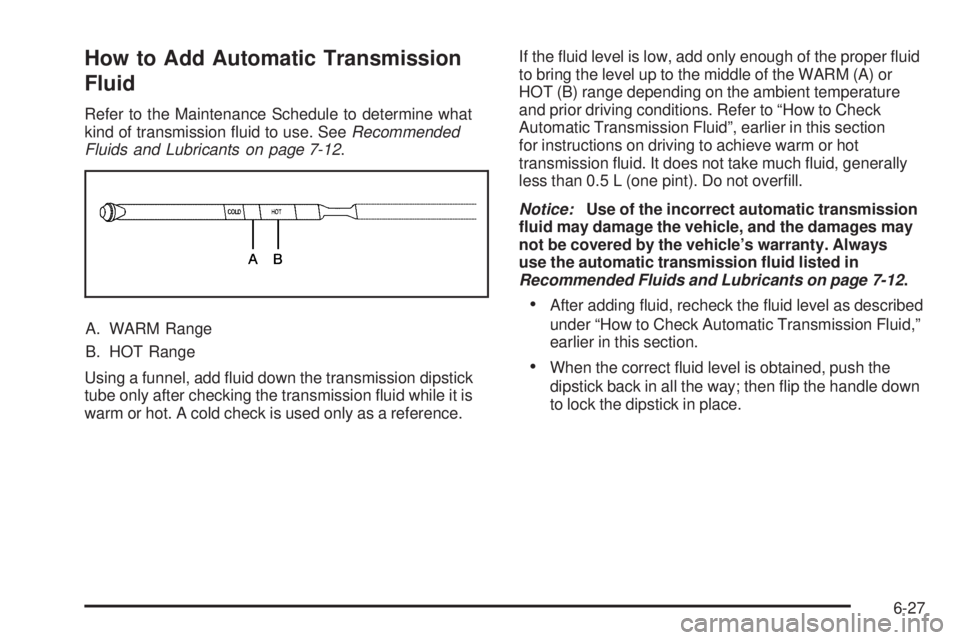
A. WARM Range
B. HOT Range
Using a funnel, add fluid down the transmission dipstick
tube only after checking the transmission fluid while it is
warm or hot. A cold check is used only as a reference.If the fluid level is low, add only enough of the proper fluid
to bring the level up to the middle of the WARM (A) or
HOT (B) range depending on the ambient temperature
and prior driving conditions. Refer to “How to Check
Automatic Transmission Fluid”, earlier in this section
for instructions on driving to achieve warm or hot
transmission fluid. It does not take much fluid, generally
less than 0.5 L (one pint). Do not overfill.
Notice:Use of the incorrect automatic transmission
uid may damage the vehicle, and the damages may
not be covered by the vehicle’s warranty. Always
use the automatic transmission uid listed in
Recommended Fluids and Lubricants on page 7-12.
•After adding fluid, recheck the fluid level as described
under “How to Check Automatic Transmission Fluid,”
earlier in this section.
•When the correct fluid level is obtained, push the
dipstick back in all the way; then flip the handle down
to lock the dipstick in place.
6-27
Page 315 of 440
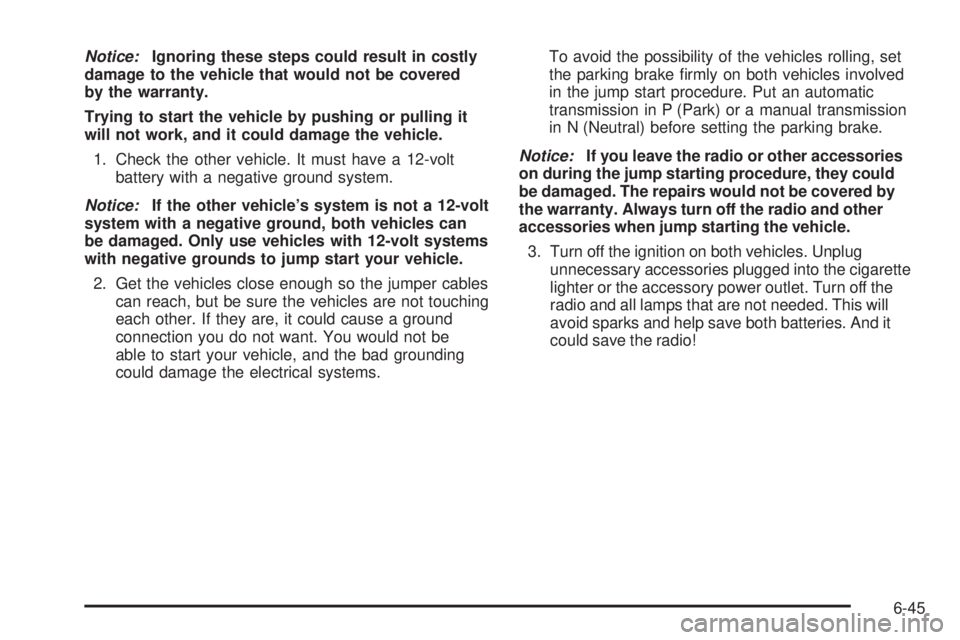
Notice:Ignoring these steps could result in costly
damage to the vehicle that would not be covered
by the warranty.
Trying to start the vehicle by pushing or pulling it
will not work, and it could damage the vehicle.
1. Check the other vehicle. It must have a 12-volt
battery with a negative ground system.
Notice:If the other vehicle’s system is not a 12-volt
system with a negative ground, both vehicles can
be damaged. Only use vehicles with 12-volt systems
with negative grounds to jump start your vehicle.
2. Get the vehicles close enough so the jumper cables
can reach, but be sure the vehicles are not touching
each other. If they are, it could cause a ground
connection you do not want. You would not be
able to start your vehicle, and the bad grounding
could damage the electrical systems.To avoid the possibility of the vehicles rolling, set
the parking brake firmly on both vehicles involved
in the jump start procedure. Put an automatic
transmission in P (Park) or a manual transmission
in N (Neutral) before setting the parking brake.
Notice:If you leave the radio or other accessories
on during the jump starting procedure, they could
be damaged. The repairs would not be covered by
the warranty. Always turn off the radio and other
accessories when jump starting the vehicle.
3. Turn off the ignition on both vehicles. Unplug
unnecessary accessories plugged into the cigarette
lighter or the accessory power outlet. Turn off the
radio and all lamps that are not needed. This will
avoid sparks and help save both batteries. And it
could save the radio!
6-45
Page 335 of 440
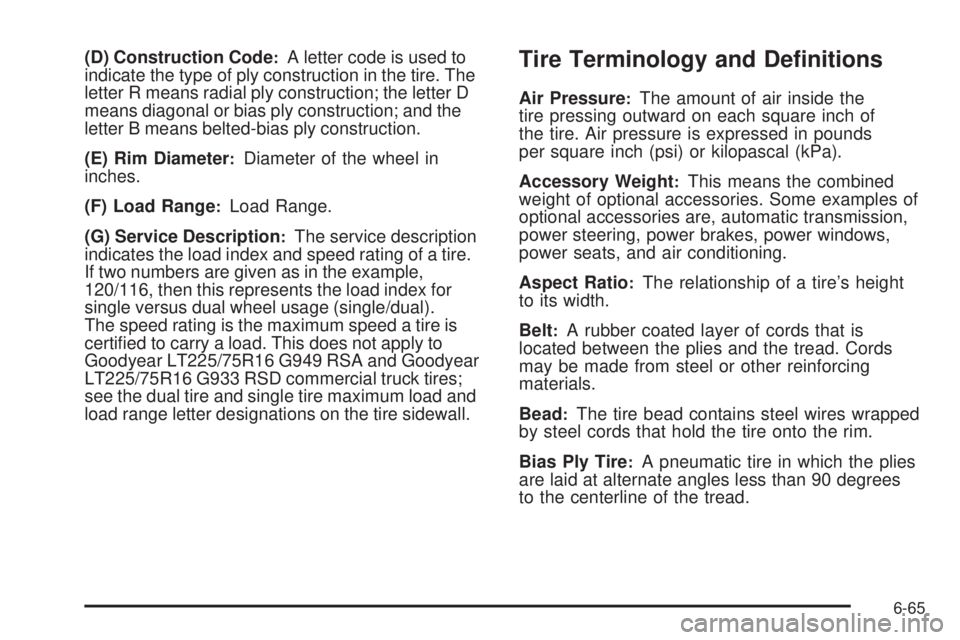
(D) Construction Code:A letter code is used to
indicate the type of ply construction in the tire. The
letter R means radial ply construction; the letter D
means diagonal or bias ply construction; and the
letter B means belted-bias ply construction.
(E) Rim Diameter
:Diameter of the wheel in
inches.
(F) Load Range
:Load Range.
(G) Service Description
:The service description
indicates the load index and speed rating of a tire.
If two numbers are given as in the example,
120/116, then this represents the load index for
single versus dual wheel usage (single/dual).
The speed rating is the maximum speed a tire is
certified to carry a load. This does not apply to
Goodyear LT225/75R16 G949 RSA and Goodyear
LT225/75R16 G933 RSD commercial truck tires;
see the dual tire and single tire maximum load and
load range letter designations on the tire sidewall.
Tire Terminology and Denitions
Air Pressure:The amount of air inside the
tire pressing outward on each square inch of
the tire. Air pressure is expressed in pounds
per square inch (psi) or kilopascal (kPa).
Accessory Weight
:This means the combined
weight of optional accessories. Some examples of
optional accessories are, automatic transmission,
power steering, power brakes, power windows,
power seats, and air conditioning.
Aspect Ratio
:The relationship of a tire’s height
to its width.
Belt
:A rubber coated layer of cords that is
located between the plies and the tread. Cords
may be made from steel or other reinforcing
materials.
Bead
:The tire bead contains steel wires wrapped
by steel cords that hold the tire onto the rim.
Bias Ply Tire
:A pneumatic tire in which the plies
are laid at alternate angles less than 90 degrees
to the centerline of the tread.
6-65
Page 387 of 440
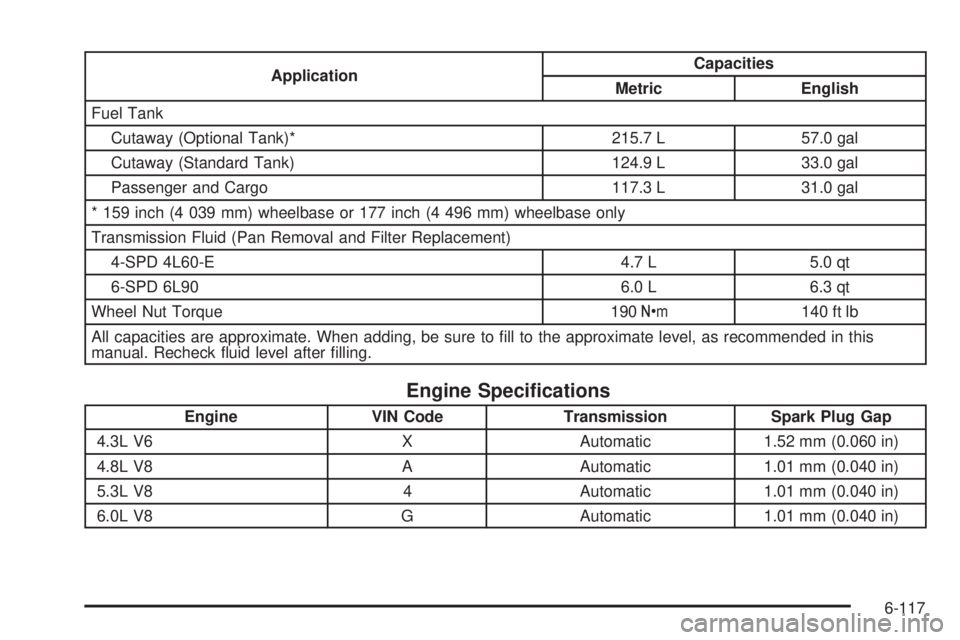
ApplicationCapacities
Metric English
Fuel Tank
Cutaway (Optional Tank)* 215.7 L 57.0 gal
Cutaway (Standard Tank) 124.9 L 33.0 gal
Passenger and Cargo 117.3 L 31.0 gal
* 159 inch (4 039 mm) wheelbase or 177 inch (4 496 mm) wheelbase only
Transmission Fluid (Pan Removal and Filter Replacement)
4-SPD 4L60-E 4.7 L 5.0 qt
6-SPD 6L90 6.0 L 6.3 qt
Wheel Nut Torque 190Y140 ft lb
All capacities are approximate. When adding, be sure to fill to the approximate level, as recommended in this
manual. Recheck fluid level after filling.
Engine Specications
Engine VIN Code Transmission Spark Plug Gap
4.3L V6 X Automatic 1.52 mm (0.060 in)
4.8L V8 A Automatic 1.01 mm (0.040 in)
5.3L V8 4 Automatic 1.01 mm (0.040 in)
6.0L V8 G Automatic 1.01 mm (0.040 in)
6-117
Page 393 of 440
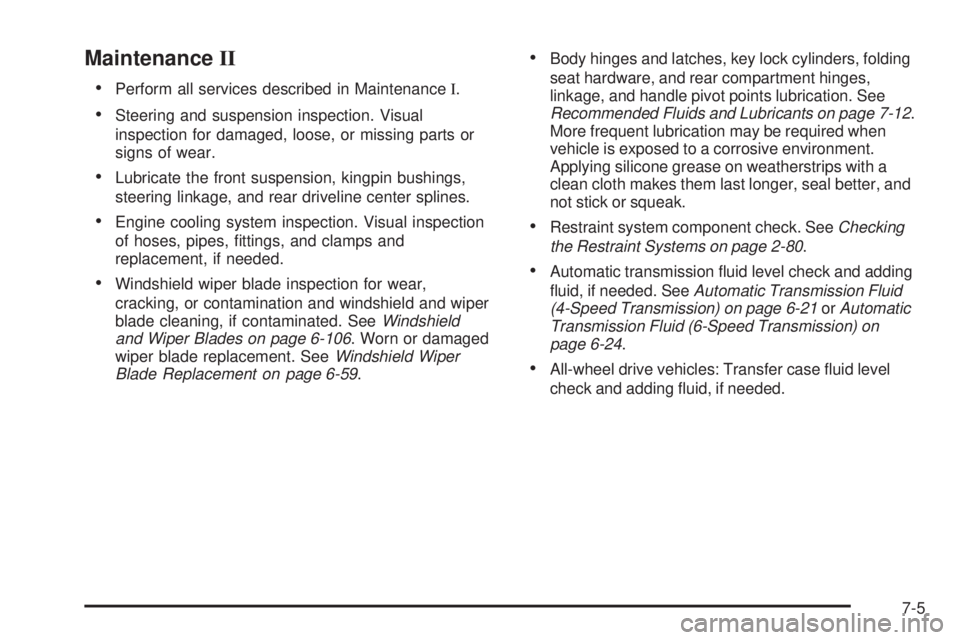
MaintenanceII
•Perform all services described in MaintenanceI.
•Steering and suspension inspection. Visual
inspection for damaged, loose, or missing parts or
signs of wear.
•Lubricate the front suspension, kingpin bushings,
steering linkage, and rear driveline center splines.
•Engine cooling system inspection. Visual inspection
of hoses, pipes, fittings, and clamps and
replacement, if needed.
•Windshield wiper blade inspection for wear,
cracking, or contamination and windshield and wiper
blade cleaning, if contaminated. SeeWindshield
and Wiper Blades on page 6-106. Worn or damaged
wiper blade replacement. SeeWindshield Wiper
Blade Replacement on page 6-59.
•Body hinges and latches, key lock cylinders, folding
seat hardware, and rear compartment hinges,
linkage, and handle pivot points lubrication. See
Recommended Fluids and Lubricants on page 7-12.
More frequent lubrication may be required when
vehicle is exposed to a corrosive environment.
Applying silicone grease on weatherstrips with a
clean cloth makes them last longer, seal better, and
not stick or squeak.
•Restraint system component check. SeeChecking
the Restraint Systems on page 2-80.
•Automatic transmission fluid level check and adding
fluid, if needed. SeeAutomatic Transmission Fluid
(4-Speed Transmission) on page 6-21orAutomatic
Transmission Fluid (6-Speed Transmission) on
page 6-24.
•All-wheel drive vehicles: Transfer case fluid level
check and adding fluid, if needed.
7-5
Page 394 of 440
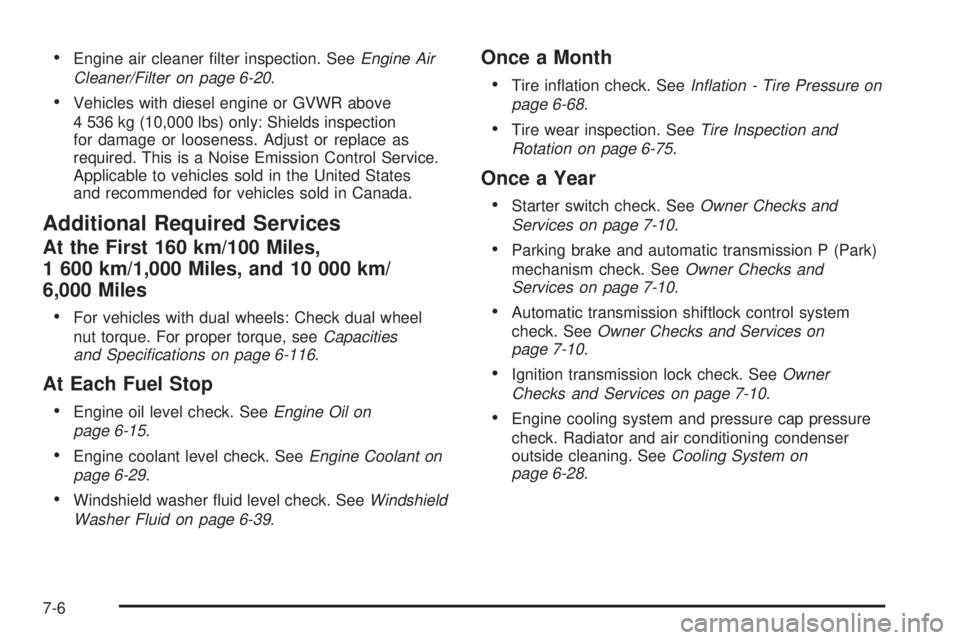
•Engine air cleaner filter inspection. SeeEngine Air
Cleaner/Filter on page 6-20.
•Vehicles with diesel engine or GVWR above
4 536 kg (10,000 lbs) only: Shields inspection
for damage or looseness. Adjust or replace as
required. This is a Noise Emission Control Service.
Applicable to vehicles sold in the United States
and recommended for vehicles sold in Canada.
Additional Required Services
At the First 160 km/100 Miles,
1 600 km/1,000 Miles, and 10 000 km/
6,000 Miles
•
For vehicles with dual wheels: Check dual wheel
nut torque. For proper torque, seeCapacities
and Specications on page 6-116.
At Each Fuel Stop
•
Engine oil level check. SeeEngine Oil on
page 6-15.
•Engine coolant level check. SeeEngine Coolant on
page 6-29.
•Windshield washer fluid level check. SeeWindshield
Washer Fluid on page 6-39.
Once a Month
•
Tire inflation check. SeeInation - Tire Pressure on
page 6-68.
•Tire wear inspection. SeeTire Inspection and
Rotation on page 6-75.
Once a Year
•
Starter switch check. SeeOwner Checks and
Services on page 7-10.
•Parking brake and automatic transmission P (Park)
mechanism check. SeeOwner Checks and
Services on page 7-10.
•Automatic transmission shiftlock control system
check. SeeOwner Checks and Services on
page 7-10.
•Ignition transmission lock check. SeeOwner
Checks and Services on page 7-10.
•Engine cooling system and pressure cap pressure
check. Radiator and air conditioning condenser
outside cleaning. SeeCooling System on
page 6-28.
7-6
Page 395 of 440
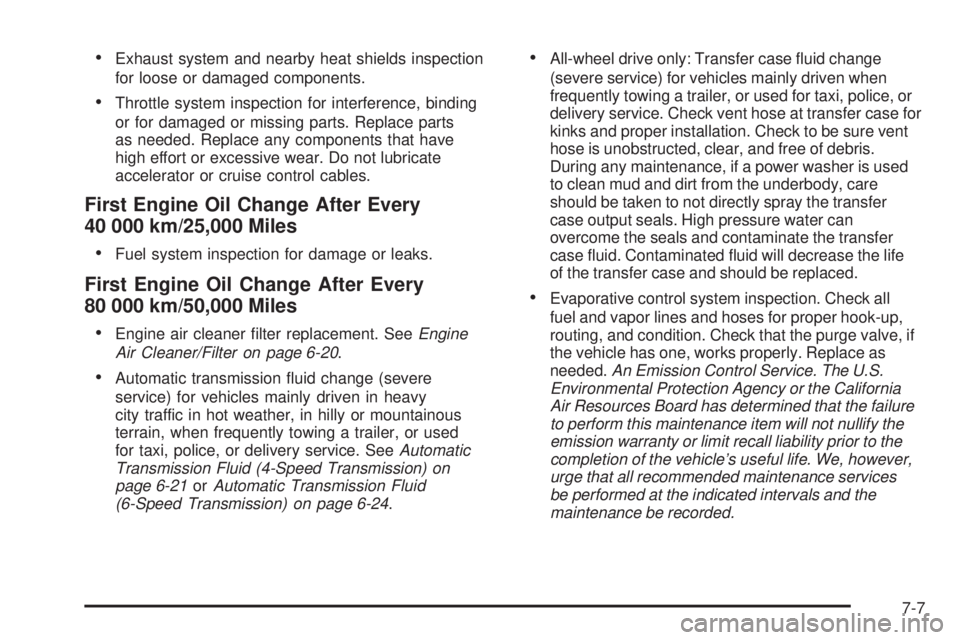
•Exhaust system and nearby heat shields inspection
for loose or damaged components.
•Throttle system inspection for interference, binding
or for damaged or missing parts. Replace parts
as needed. Replace any components that have
high effort or excessive wear. Do not lubricate
accelerator or cruise control cables.
First Engine Oil Change After Every
40 000 km/25,000 Miles
•
Fuel system inspection for damage or leaks.
First Engine Oil Change After Every
80 000 km/50,000 Miles
•
Engine air cleaner filter replacement. SeeEngine
Air Cleaner/Filter on page 6-20.
•Automatic transmission fluid change (severe
service) for vehicles mainly driven in heavy
city traffic in hot weather, in hilly or mountainous
terrain, when frequently towing a trailer, or used
for taxi, police, or delivery service. SeeAutomatic
Transmission Fluid (4-Speed Transmission) on
page 6-21orAutomatic Transmission Fluid
(6-Speed Transmission) on page 6-24.
•All-wheel drive only: Transfer case fluid change
(severe service) for vehicles mainly driven when
frequently towing a trailer, or used for taxi, police, or
delivery service. Check vent hose at transfer case for
kinks and proper installation. Check to be sure vent
hose is unobstructed, clear, and free of debris.
During any maintenance, if a power washer is used
to clean mud and dirt from the underbody, care
should be taken to not directly spray the transfer
case output seals. High pressure water can
overcome the seals and contaminate the transfer
case fluid. Contaminated fluid will decrease the life
of the transfer case and should be replaced.
•Evaporative control system inspection. Check all
fuel and vapor lines and hoses for proper hook-up,
routing, and condition. Check that the purge valve, if
the vehicle has one, works properly. Replace as
needed.An Emission Control Service. The U.S.
Environmental Protection Agency or the California
Air Resources Board has determined that the failure
to perform this maintenance item will not nullify the
emission warranty or limit recall liability prior to the
completion of the vehicle’s useful life. We, however,
urge that all recommended maintenance services
be performed at the indicated intervals and the
maintenance be recorded.
7-7