instrument panel CHEVROLET EXPRESS 2009 User Guide
[x] Cancel search | Manufacturer: CHEVROLET, Model Year: 2009, Model line: EXPRESS, Model: CHEVROLET EXPRESS 2009Pages: 440, PDF Size: 2.42 MB
Page 80 of 440
Securing a Child Restraint in
the Right Front Seat Position
(With Airbag On-Off Switch)
The vehicle has airbags. A rear seat is a safer place to
secure a forward-facing child restraint. SeeWhere to
Put the Restraint on page 2-40.
There is a switch on the instrument panel that you can
use to turn off the right front passenger’s frontal
airbag. SeeAirbag Off Switch on page 2-70for more
information, including important safety information.
A label on the sun visor says, “Never put a rear-facing
child seat in the front.” This is because the risk to
the rear-facing child is so great, if the airbag deploys.
{WARNING:
A child in a rear-facing child restraint can be
seriously injured or killed if the right front passenger
airbag inflates. This is because the back of the
rear-facing child restraint would be very close to the
inflating airbag. A child in a forward-facing child
restraint can be seriously injured or killed if the right
front passenger airbag inflates and the passenger
seat is in a forward position.
Even if the airbag switch has turned off the right
front passenger frontal airbag, no system is
fail-safe. No one can guarantee that an airbag will
not deploy under some unusual circumstance, even
though it is turned off.
Secure rear-facing child restraints in a rear seat,
even if the airbag is off. If you secure a
forward-facing child restraint in the right front seat,
always move the front passenger seat as far back
as it will go. It is better to secure the child restraint in
a rear seat.
2-56
Page 84 of 440
Airbag System
The vehicle has the following airbag:
•A frontal airbag for the driver.
The vehicle may have the following airbags:
•A frontal airbag for the right front passenger.
•A roof-rail airbag for the driver (cargo van).
•A roof-rail airbag for the right front passenger
position (cargo or passenger van equipped
with a sliding door).
If you have a passenger van with a right front
passenger roof-rail airbag and a sliding door, you
will also have a separate roof-rail airbag for the
passenger seated directly behind the right front
passenger and the third row outboard passenger
position.
•A roof-rail airbag for the driver, passenger seated
directly behind the driver, and the third row
outboard passenger position (passenger van
equipped with a sliding or hinged door).
•A roof-rail airbag for the right front passenger,
passenger seated directly behind the right
front passenger, and the third row outboard
passenger position (passenger van equipped with
a hinged door).
All of the airbags in the vehicle will have the word
AIRBAG embossed in the trim or on an attached label
near the deployment opening.
For frontal airbags, the word AIRBAG will appear on the
middle part of the steering wheel for the driver and
on the instrument panel for the right front passenger.
With roof-rail airbags, the word AIRBAG will appear
along the headliner or trim.
2-60
Page 86 of 440
{WARNING:
Children who are up against, or very close to, any
airbag when it inflates can be seriously injured or
killed. Airbags plus lap-shoulder belts offer
protection for adults and older children, but not for
young children and infants. Neither the vehicle’s
safety belt system nor its airbag system is
designed for them. Young children and infants
need the protection that a child restraint system
can provide. Always secure children properly in
your vehicle. To read how, seeOlder Children on
page 2-30orInfants and Young Children on
page 2-33.There is an airbag
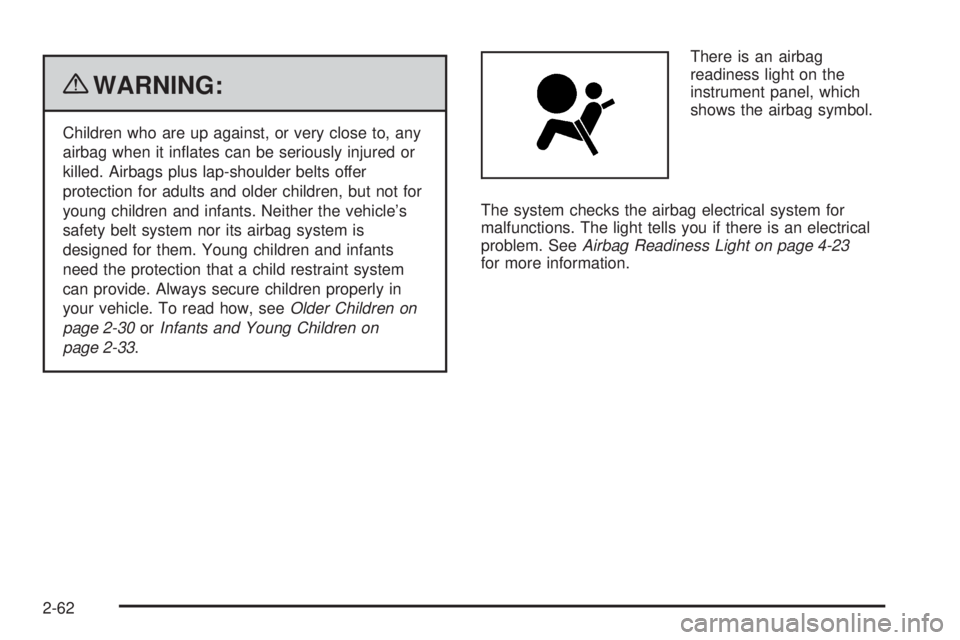
readiness light on the
instrument panel, which
shows the airbag symbol.
The system checks the airbag electrical system for
malfunctions. The light tells you if there is an electrical
problem. SeeAirbag Readiness Light on page 4-23
for more information.
2-62
Page 87 of 440
Where Are the Airbags?
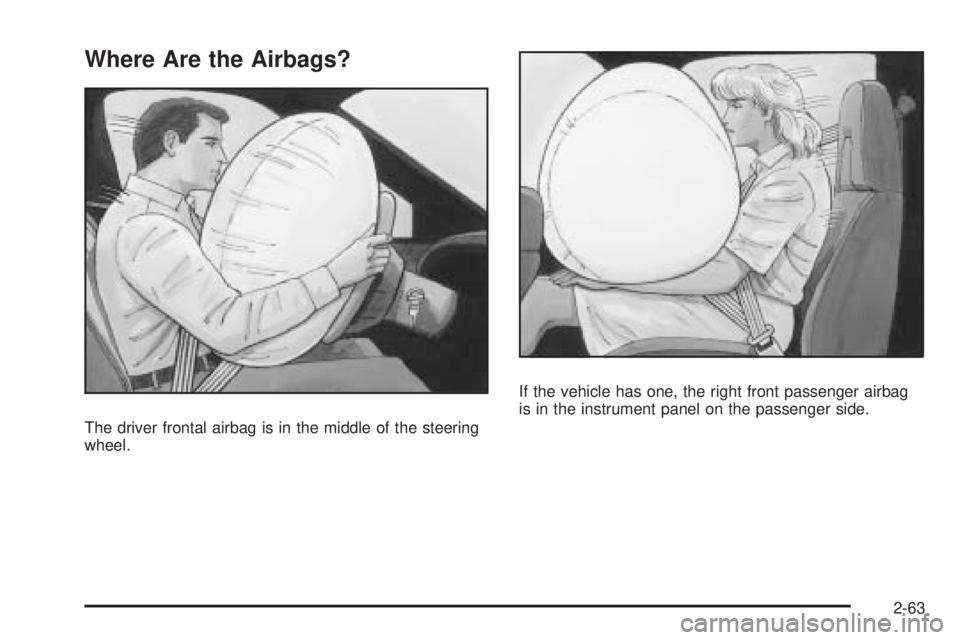
The driver frontal airbag is in the middle of the steering
wheel.If the vehicle has one, the right front passenger airbag
is in the instrument panel on the passenger side.
2-63
Page 91 of 440
In any particular crash, no one can say whether an
airbag should have inflated simply because of the
damage to a vehicle or because of what the repair costs
were. For frontal airbags, inflation is determined by
what the vehicle hits, the angle of the impact, and how
quickly the vehicle slows down. For roof-rail airbags,
deployment is determined by the location and severity of
the side impact.
What Makes an Airbag Inate?
In a deployment event, the sensing system sends an
electrical signal triggering a release of gas from
the inflator. Gas from the inflator fills the airbag causing
the bag to break out of the cover and deploy. The
inflator, the airbag, and related hardware are all part of
the airbag module.
Frontal airbag modules are located inside the steering
wheel and instrument panel. For vehicles with
roof-rail airbags, there are airbag modules in the ceiling
of the vehicle, near the side windows for the first,
second, and third rows (if equipped). SeeWhere Are
the Airbags? on page 2-63for more information.
How Does an Airbag Restrain?
In moderate to severe frontal or near frontal collisions,
even belted occupants can contact the steering wheel or
the instrument panel. In moderate to severe side
collisions, even belted occupants can contact the inside
of the vehicle.
Airbags supplement the protection provided by safety
belts. Frontal airbags distribute the force of the
impact more evenly over the occupant’s upper body,
stopping the occupant more gradually. Roof-rail airbags
distribute the force of the impact more evenly over
the occupant’s upper body.
Rollover capable roof-rail airbags are designed to help
contain the head and chest of occupants in the
outboard seating positions in the first, second, and third
rows, if equipped. The rollover capable roof-rail
airbags are designed to help reduce the risk of full or
partial ejection in rollover events, although no system
can prevent all such ejections.
But airbags would not help in many types of collisions,
primarily because the occupant’s motion is not
toward those airbags. SeeWhen Should an Airbag
Inate? on page 2-65for more information.
Airbags should never be regarded as anything more
than a supplement to safety belts.
2-67
Page 94 of 440
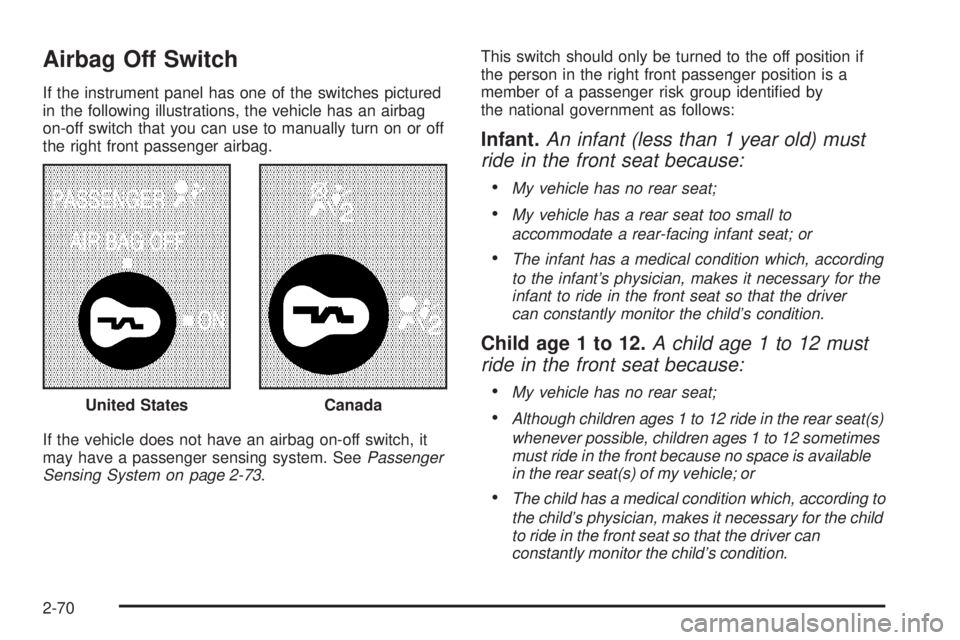
Airbag Off Switch
If the instrument panel has one of the switches pictured
in the following illustrations, the vehicle has an airbag
on-off switch that you can use to manually turn on or off
the right front passenger airbag.
If the vehicle does not have an airbag on-off switch, it
may have a passenger sensing system. SeePassenger
Sensing System on page 2-73.This switch should only be turned to the off position if
the person in the right front passenger position is a
member of a passenger risk group identified by
the national government as follows:
Infant.An infant (less than 1 year old) must
ride in the front seat because:
•
My vehicle has no rear seat;
•My vehicle has a rear seat too small to
accommodate a rear-facing infant seat; or
•The infant has a medical condition which, according
to the infant’s physician, makes it necessary for the
infant to ride in the front seat so that the driver
can constantly monitor the child’s condition.
Child age 1 to 12.A child age 1 to 12 must
ride in the front seat because:
•
My vehicle has no rear seat;
•Although children ages 1 to 12 ride in the rear seat(s)
whenever possible, children ages 1 to 12 sometimes
must ride in the front because no space is available
in the rear seat(s) of my vehicle; or
•The child has a medical condition which, according to
the child’s physician, makes it necessary for the child
to ride in the front seat so that the driver can
constantly monitor the child’s condition. United States
Canada
2-70
Page 97 of 440
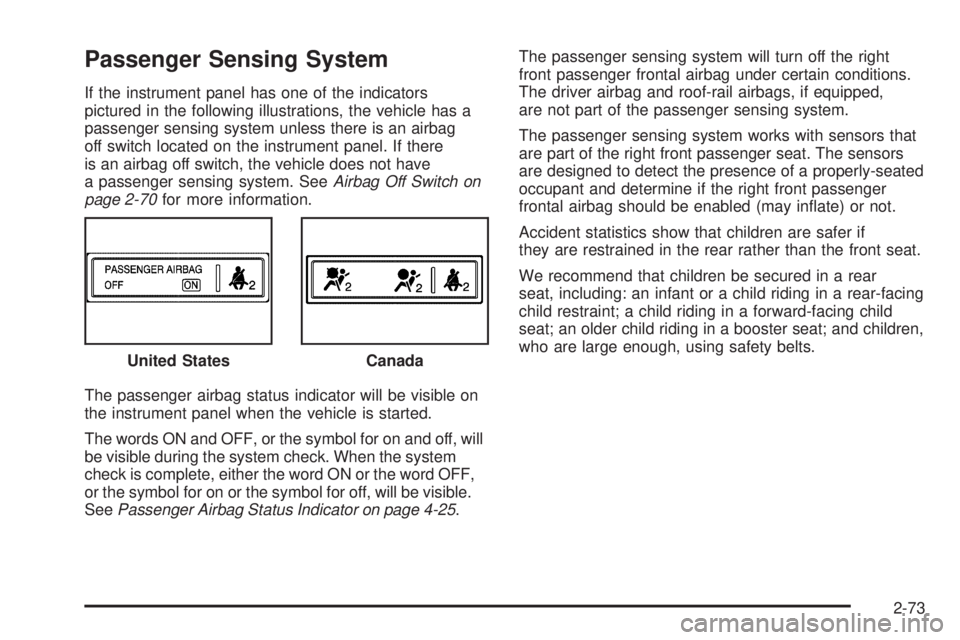
Passenger Sensing System
If the instrument panel has one of the indicators
pictured in the following illustrations, the vehicle has a
passenger sensing system unless there is an airbag
off switch located on the instrument panel. If there
is an airbag off switch, the vehicle does not have
a passenger sensing system. SeeAirbag Off Switch on
page 2-70for more information.
The passenger airbag status indicator will be visible on
the instrument panel when the vehicle is started.
The words ON and OFF, or the symbol for on and off, will
be visible during the system check. When the system
check is complete, either the word ON or the word OFF,
or the symbol for on or the symbol for off, will be visible.
SeePassenger Airbag Status Indicator on page 4-25.The passenger sensing system will turn off the right
front passenger frontal airbag under certain conditions.
The driver airbag and roof-rail airbags, if equipped,
are not part of the passenger sensing system.
The passenger sensing system works with sensors that
are part of the right front passenger seat. The sensors
are designed to detect the presence of a properly-seated
occupant and determine if the right front passenger
frontal airbag should be enabled (may inflate) or not.
Accident statistics show that children are safer if
they are restrained in the rear rather than the front seat.
We recommend that children be secured in a rear
seat, including: an infant or a child riding in a rear-facing
child restraint; a child riding in a forward-facing child
seat; an older child riding in a booster seat; and children,
who are large enough, using safety belts.
United States
Canada
2-73
Page 99 of 440
The passenger sensing system is designed to turn off
the right front passenger frontal airbag if:
•The right front passenger seat is unoccupied.
•The system determines that an infant is present in
a rear-facing infant seat.
•The system determines that a small child is present
in a child restraint.
•The system determines that a small child is present
in a booster seat.
•A right front passenger takes his/her weight off of
the seat for a period of time.
•The right front passenger seat is occupied by a
smaller person, such as a child who has outgrown
child restraints.
•Or, if there is a critical problem with the airbag
system or the passenger sensing system.
When the passenger sensing system has turned off the
right front passenger frontal airbag, the off indicator
will light and stay lit to remind you that the airbag is off.
SeePassenger Airbag Status Indicator on page 4-25.
The passenger sensing system is designed to turn
on (may inflate) the right front passenger frontal airbag
anytime the system senses that a person of adult
size is sitting properly in the right front passenger seat.When the passenger sensing system has allowed the
airbag to be enabled, the on indicator will light and stay
lit to remind you that the airbag is active.
For some children, including those in child restraints,
and for very small adults, the passenger sensing system
may or may not turn off the right front passenger
frontal airbag, depending upon the person’s seating
posture and body build. Everyone in your vehicle who
has outgrown child restraints should wear a safety
belt properly — whether or not there is an airbag for that
person.
{WARNING:
If the airbag readiness light in the instrument panel
cluster ever comes on and stays on, it means that
something may be wrong with the airbag system.
If this ever happens, have the vehicle serviced
promptly, because an adult-size person sitting in
the right front passenger’s seat may not have the
protection of the airbag(s). SeeAirbag Readiness
Light on page 4-23for more on this, including
important safety information.
2-75
Page 103 of 440
Adding Equipment to Your
Airbag-Equipped Vehicle
Q:Is there anything I might add to or change
about the vehicle that could keep the airbags
from working properly?
A:Yes. If you add things that change the vehicle’s
frame, bumper system, height, front end or side
sheet metal, they may keep the airbag system from
working properly. Changing or moving any parts
of the front seats, safety belts, the airbag sensing
and diagnostic module, steering wheel, instrument
panel, roof-rail airbag modules, ceiling headliner
or pillar garnish trim, front sensors, or airbag wiring
can affect the operation of the airbag system.
In addition, the vehicle may have a passenger
sensing system for the right front passenger
position, which includes sensors that are part of the
passenger seat. The passenger sensing system
may not operate properly if the original seat trim is
replaced with non-GM covers, upholstery or
trim, or with GM covers, upholstery or trim designed
for a different vehicle. Any object, such as an
aftermarket seat heater or a comfort enhancing pad
or device, installed under or on top of the seat
fabric, could also interfere with the operation of thepassenger sensing system. This could either
prevent proper deployment of the passenger
airbag(s) or prevent the passenger sensing system
from properly turning off the passenger airbag(s).
SeePassenger Sensing System on page 2-73.
If you have any questions about this, you should
contact Customer Assistance before you modify the
vehicle. The phone numbers and addresses for
Customer Assistance are in Step Two of the
Customer Satisfaction Procedure in this manual.
SeeCustomer Satisfaction Procedure on page 8-2.
If the vehicle has rollover roof-rail airbags, see
Different Size Tires and Wheels on page 6-80for
additional important information.
Q:Because I have a disability, I have to get my
vehicle modied. How can I nd out whether
this will affect my airbag system?
A:If you have questions, call Customer Assistance.
The phone numbers and addresses for Customer
Assistance are in Step Two of the Customer
Satisfaction Procedure in this manual. See
Customer Satisfaction Procedure on page 8-2.
In addition, your dealer/retailer and the service manual
have information about the location of the airbag sensors,
sensing and diagnostic module and airbag wiring.
2-79
Page 126 of 440
PASS-Key®III+ Electronic
Immobilizer
SeeRadio Frequency Statement on page 8-20for
information regarding Part 15 of the Federal
Communications Commission (FCC) Rules and
RSS-210/211 of Industry and Science Canada.
PASS-Key®III+ Electronic
Immobilizer Operation
Your vehicle is equipped with the PASS-Key®III+
(Personalized Automotive Security System)
theft-deterrent system. PASS-Key
®III+ is a passive
theft deterrent system.
The system is automatically armed when the key is
removed from the ignition.
You do not have to manually arm or disarm the system.The security light will come on if there is a problem with
arming or disarming the theft-deterrent system.
When the PASS-Key
®III+ system senses that someone
is using the wrong key, it shuts down the vehicle’s
starter and fuel systems. The starter will not work and
fuel will stop being delivered to the engine. Anyone
using a trial-and-error method to start the vehicle will be
discouraged because of the high number of electrical
key codes.
If the engine does not start and the security message
comes on, the key may have a damaged transponder.
Turn the ignition off and try again.
If the engine still does not start, and the key appears to
be undamaged, try another ignition key. At this time,
you may also want to check the instrument panel PASS
KEY fuse. If the engine still does not start with the
other key, your vehicle needs service. If your vehicle
does start, the first key may be faulty. See your
dealer/retailer or a locksmith who can service the
PASS-Key
®III+ to have a new key made. SeeFuses
and Circuit Breakers on page 6-110.
3-20