automatic transmission CHEVROLET EXPRESS 2017 User Guide
[x] Cancel search | Manufacturer: CHEVROLET, Model Year: 2017, Model line: EXPRESS, Model: CHEVROLET EXPRESS 2017Pages: 289, PDF Size: 11.46 MB
Page 173 of 289
Chevrolet Express Owner Manual (GMNA-Localizing-U.S./Canada/Mexico-
15555951) - 2022 - CRC - 1/27/22
172 Vehicle Care
Vehicle Care
General Information
General Information . . . . . . . . . . . . . . . . . . . 173
California Perchlorate MaterialsRequirements . . . . . . . . . . . . . . . . . . . . . . . . 173
Accessories and Modifications . . . . . . . . . . 173
Vehicle Checks
Doing Your Own Service Work . . . . . . . . . 173
Hood . . . . . . . . . . . . . . . . . . . . . . . . . . . . . . . . . . 174
Engine Compartment Overview . . . . . . . . 176
Engine Oil . . . . . . . . . . . . . . . . . . . . . . . . . . . . . 179
Engine Oil Life System . . . . . . . . . . . . . . . . . 181
Automatic Transmission Fluid . . . . . . . . . . 181
Engine Air Cleaner/Filter . . . . . . . . . . . . . . . 182
Cooling System . . . . . . . . . . . . . . . . . . . . . . . . 183
Engine Overheating . . . . . . . . . . . . . . . . . . . . 187
Engine Fan . . . . . . . . . . . . . . . . . . . . . . . . . . . . 188
Power Steering Fluid . . . . . . . . . . . . . . . . . . 188
Washer Fluid . . . . . . . . . . . . . . . . . . . . . . . . . . 189
Brakes . . . . . . . . . . . . . . . . . . . . . . . . . . . . . . . . . 189
Brake Fluid . . . . . . . . . . . . . . . . . . . . . . . . . . . . 190
Battery - North America . . . . . . . . . . . . . . . 191
Rear Axle . . . . . . . . . . . . . . . . . . . . . . . . . . . . . . 192
Noise Control System . . . . . . . . . . . . . . . . . . 192
Starter Switch Check . . . . . . . . . . . . . . . . . . . 193
Automatic Transmission Shift Lock Control Function Check . . . . . . . . . . . . . . 193
Ignition Transmission Lock Check . . . . . . 193 Park Brake and P (Park) Mechanism
Check . . . . . . . . . . . . . . . . . . . . . . . . . . . . . . . . 193
Wiper Blade Replacement . . . . . . . . . . . . . 194
Windshield Replacement . . . . . . . . . . . . . . 194
Headlamp Aiming
Front Headlamp Aiming . . . . . . . . . . . . . . . 194
Bulb Replacement
Bulb Replacement . . . . . . . . . . . . . . . . . . . . . 195
Halogen Bulbs . . . . . . . . . . . . . . . . . . . . . . . . . 195
Front Turn Signal, Sidemarker, and Parking Lamps . . . . . . . . . . . . . . . . . . . . . . . 195
Taillamps . . . . . . . . . . . . . . . . . . . . . . . . . . . . . . 195
Center High-Mounted Stoplamp (CHMSL) . . . . . . . . . . . . . . . . . . . . . . . . . . . . . 196
License Plate Lamp . . . . . . . . . . . . . . . . . . . . 197
Electrical System
Electrical System Overload . . . . . . . . . . . . . 197
Fuses and Circuit Breakers . . . . . . . . . . . . . 198
Engine Compartment Fuse Block . . . . . . 199
Floor Console Fuse Block . . . . . . . . . . . . . . 202
Wheels and Tires
Tires . . . . . . . . . . . . . . . . . . . . . . . . . . . . . . . . . . 204
All-Season Tires . . . . . . . . . . . . . . . . . . . . . . . 204
Winter Tires . . . . . . . . . . . . . . . . . . . . . . . . . . . 205
Tire Sidewall Labeling . . . . . . . . . . . . . . . . . 205
Tire Designations . . . . . . . . . . . . . . . . . . . . . . 207
Tire Terminology and Definitions . . . . . 208
Tire Pressure . . . . . . . . . . . . . . . . . . . . . . . . . . 210 Tire Pressure Monitor System . . . . . . . . . . 211
Tire Pressure Monitor Operation . . . . . . . 212
Tire Inspection . . . . . . . . . . . . . . . . . . . . . . . . . 214
Tire Rotation . . . . . . . . . . . . . . . . . . . . . . . . . . 214
When It Is Time for New Tires . . . . . . . . 216
Buying New Tires . . . . . . . . . . . . . . . . . . . . . . 217
Different Size Tires and Wheels . . . . . . . . 218
Uniform Tire Quality Grading . . . . . . . . . . 218
Wheel Alignment and Tire Balance . . . . 219
Wheel Replacement . . . . . . . . . . . . . . . . . . . 220
Tire Chains . . . . . . . . . . . . . . . . . . . . . . . . . . . . 220
If a Tire Goes Flat . . . . . . . . . . . . . . . . . . . . . 221
Tire Changing . . . . . . . . . . . . . . . . . . . . . . . . . 222
Full-Size Spare Tire . . . . . . . . . . . . . . . . . . . . 230
Jump Starting
Jump Starting - North America . . . . . . . . 230
Towing the Vehicle
Towing the Vehicle . . . . . . . . . . . . . . . . . . . . 233
Recreational Vehicle Towing . . . . . . . . . . . 234
Appearance Care
Exterior Care . . . . . . . . . . . . . . . . . . . . . . . . . . 235
Interior Care . . . . . . . . . . . . . . . . . . . . . . . . . . . 239
Floor Mats . . . . . . . . . . . . . . . . . . . . . . . . . . . . 242
Page 182 of 289
Chevrolet Express Owner Manual (GMNA-Localizing-U.S./Canada/Mexico-
15555951) - 2022 - CRC - 1/27/22
Vehicle Care 181
trash or pouring it on the ground, into
sewers, or into streams or bodies of water.
Recycle it by taking it to a place that
collects used oil.
Engine Oil Life System
When to Change Engine Oil
This vehicle has a computer system that
indicates when to change the engine oil and
filter. This is based on a combination of
factors which include engine revolutions,
engine temperature, and miles driven. Based
on driving conditions, the mileage at which
an engine oil change is indicated can vary
considerably. For the oil life system to work
properly, the system must be reset every
time the oil is changed.
When the system has calculated that oil life
has been diminished, it indicates that an oil
change is necessary. A CHANGE ENGINE OIL
SOON message comes on. Change the oil as
soon as possible within the next 1 000 km
(600 mi). It is possible that, if driving under
the best conditions, the oil life system
might indicate that an oil change is not
necessary for up to a year. The engine oil
and filter must be changed at least once a
year and, at this time, the system must be
reset. Your dealer has trained service peoplewho will perform this work and reset the
system. It is also important to check the oil
regularly over the course of an oil drain
interval and keep it at the proper level.
If the system is ever reset accidentally, the
oil must be changed at 5 000 km (3,000 mi)
since the last oil change. Remember to reset
the oil life system whenever the oil is
changed.
How to Reset the Engine Oil Life System
Reset the system whenever the engine oil is
changed so that the system can calculate
the next engine oil change.
To reset the Engine Oil Life System on most
models:
1. Display the OIL LIFE REMAINING on the DIC. See Driver Information Center (DIC)
0 82.
2. Press and hold
Von the DIC while the
Oil Life display is active. The oil life will
change to 100%.
The oil life system can also be reset as
follows: 1. Display the OIL LIFE REMAINING on the DIC. See Driver Information Center (DIC)
0 82. 2. Fully press and release the accelerator
pedal three times within five seconds.
If the display shows 100%, the system is
reset.
If the CHANGE ENGINE OIL SOON message
comes back on when the vehicle is started,
the engine oil life system has not reset.
Repeat the procedure.
Automatic Transmission Fluid
How to Check Automatic Transmission
Fluid
It is not necessary to check the transmission
fluid level. A transmission fluid leak is the
only reason for fluid loss. If a leak occurs,
take the vehicle to your dealer and have it
repaired as soon as possible.
There is a special procedure for checking and
changing the transmission fluid. Because this
procedure is difficult, this should be done at
your dealer. Contact your dealer for
additional information.
Caution
Use of the incorrect automatic
transmission fluid may damage the
vehicle, and the damage may not be
(Continued)
Page 183 of 289
Chevrolet Express Owner Manual (GMNA-Localizing-U.S./Canada/Mexico-
15555951) - 2022 - CRC - 1/27/22
182 Vehicle Care
Caution (Continued)
covered by the vehicle warranty. Always
use the correct automatic transmission
fluid. SeeRecommended Fluids and
Lubricants 0251.
Change the fluid and filter at the intervals
listed in Maintenance Schedule 0245, and
be sure to use the fluid listed in
Recommended Fluids and Lubricants 0251.
Engine Air Cleaner/Filter
The air cleaner/filter assembly is on the
front of the engine compartment on the
driver side of the vehicle. See Engine
Compartment Overview 0176.
When to Inspect the Engine Air Cleaner/Filter
For intervals on changing and inspecting the
engine air filter, see Maintenance Schedule
0 245.
How to Inspect/Replace the Engine Air
Cleaner/Filter
Do not start the engine or have the engine
running with the engine air filter housing
open. Before removing the engine air filter,
make sure that the engine air filter housing and nearby components are free of dirt and
debris. Do not clean the engine air filter or
components with water or compressed air.
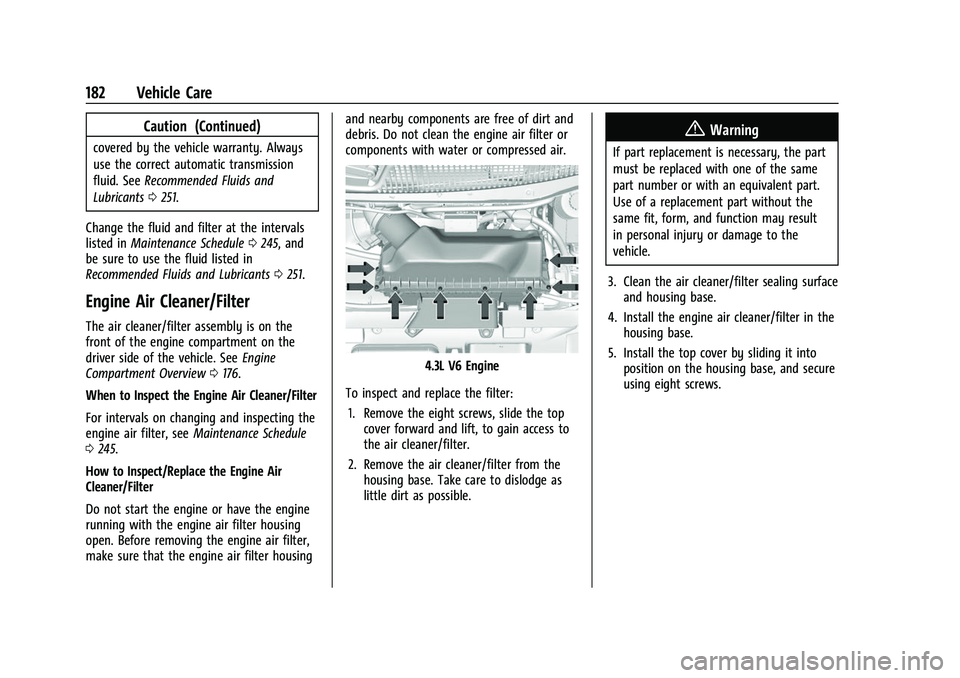
4.3L V6 Engine
To inspect and replace the filter: 1. Remove the eight screws, slide the top cover forward and lift, to gain access to
the air cleaner/filter.
2. Remove the air cleaner/filter from the housing base. Take care to dislodge as
little dirt as possible.
{Warning
If part replacement is necessary, the part
must be replaced with one of the same
part number or with an equivalent part.
Use of a replacement part without the
same fit, form, and function may result
in personal injury or damage to the
vehicle.
3. Clean the air cleaner/filter sealing surface and housing base.
4. Install the engine air cleaner/filter in the housing base.
5. Install the top cover by sliding it into position on the housing base, and secure
using eight screws.
Page 194 of 289
Chevrolet Express Owner Manual (GMNA-Localizing-U.S./Canada/Mexico-
15555951) - 2022 - CRC - 1/27/22
Vehicle Care 193
Air Intake:
.Removal of the air cleaner silencer.
.Modification of the air cleaner.
Exhaust:
.Removal of the muffler and/or resonator.
.Removal of the exhaust pipes and exhaust
pipe clamps.
Fuel Operated Heater (FOH) - Diesel Engine:
.Removal of the muffler.
Starter Switch Check
{Warning
When you are doing this inspection, the
vehicle could move suddenly. If the
vehicle moves, you or others could be
injured.
1. Before starting this check, be sure there is enough room around the vehicle.
2. Apply both the parking brake and the regular brake.
Do not use the accelerator pedal, and be
ready to turn off the engine immediately
if it starts. 3. Try to start the engine in each gear. The
vehicle should start only in P (Park) or
N (Neutral). If the vehicle starts in any
other position, contact your dealer for
service.
Automatic Transmission Shift Lock
Control Function Check
{Warning
When you are doing this inspection, the
vehicle could move suddenly. If the
vehicle moves, you or others could be
injured.
1. Before starting this check, be sure there is enough room around the vehicle.
It should be parked on a level surface.
2. Apply the parking brake. Be ready to apply the regular brake immediately if
the vehicle begins to move.
3. With the engine off, turn the ignition on, but do not start the engine. Without
applying the regular brake, try to move
the shift lever out of P (Park) with
normal effort. If the shift lever moves
out of P (Park), contact your dealer for
service.
Ignition Transmission Lock Check
While parked, and with the parking brake
set, try to turn the ignition off in each shift
lever position.
.The ignition should turn to off only when
the shift lever is in P (Park).
.The ignition key should come out only
when the ignition is off.
Contact your dealer if service is required.
Park Brake and P (Park)
Mechanism Check
{Warning
When you are doing this check, the
vehicle could begin to move. You or
others could be injured and property
could be damaged. Make sure there is
room in front of the vehicle in case it
begins to roll. Be ready to apply the
regular brake at once should the vehicle
begin to move.
Park on a fairly steep hill, with the vehicle
facing downhill. Keeping your foot on the
regular brake, set the parking brake.
Page 209 of 289
Chevrolet Express Owner Manual (GMNA-Localizing-U.S./Canada/Mexico-
15555951) - 2022 - CRC - 1/27/22
208 Vehicle Care
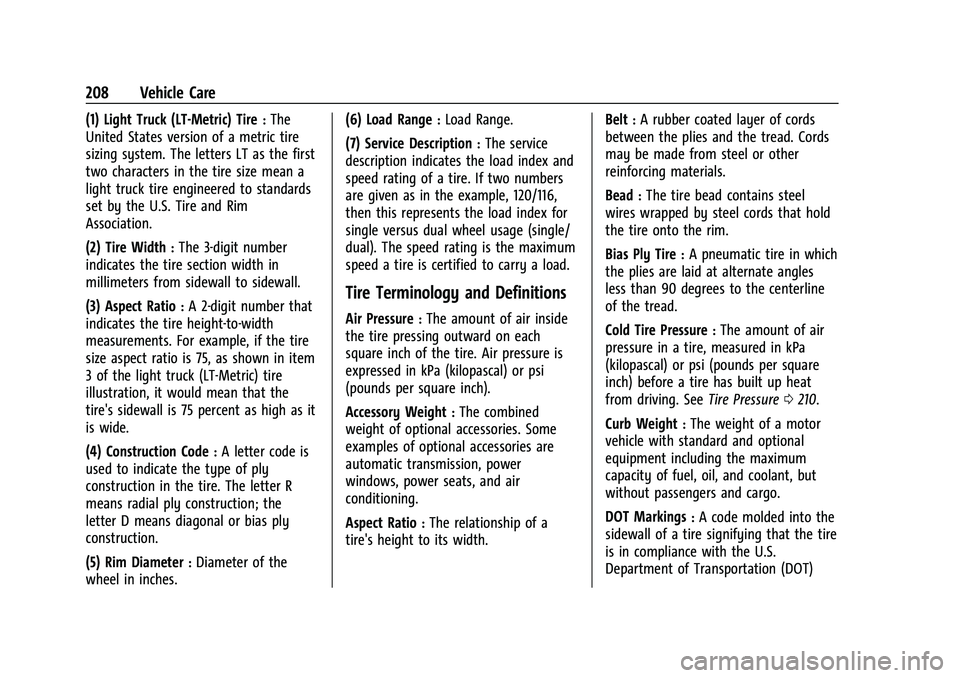
(1) Light Truck (LT-Metric) Tire:The
United States version of a metric tire
sizing system. The letters LT as the first
two characters in the tire size mean a
light truck tire engineered to standards
set by the U.S. Tire and Rim
Association.
(2) Tire Width
:The 3-digit number
indicates the tire section width in
millimeters from sidewall to sidewall.
(3) Aspect Ratio
:A 2-digit number that
indicates the tire height-to-width
measurements. For example, if the tire
size aspect ratio is 75, as shown in item
3 of the light truck (LT-Metric) tire
illustration, it would mean that the
tire's sidewall is 75 percent as high as it
is wide.
(4) Construction Code
:A letter code is
used to indicate the type of ply
construction in the tire. The letter R
means radial ply construction; the
letter D means diagonal or bias ply
construction.
(5) Rim Diameter
:Diameter of the
wheel in inches. (6) Load Range
:Load Range.
(7) Service Description
:The service
description indicates the load index and
speed rating of a tire. If two numbers
are given as in the example, 120/116,
then this represents the load index for
single versus dual wheel usage (single/
dual). The speed rating is the maximum
speed a tire is certified to carry a load.
Tire Terminology and Definitions
Air Pressure:The amount of air inside
the tire pressing outward on each
square inch of the tire. Air pressure is
expressed in kPa (kilopascal) or psi
(pounds per square inch).
Accessory Weight
:The combined
weight of optional accessories. Some
examples of optional accessories are
automatic transmission, power
windows, power seats, and air
conditioning.
Aspect Ratio
:The relationship of a
tire's height to its width. Belt
:A rubber coated layer of cords
between the plies and the tread. Cords
may be made from steel or other
reinforcing materials.
Bead
:The tire bead contains steel
wires wrapped by steel cords that hold
the tire onto the rim.
Bias Ply Tire
:A pneumatic tire in which
the plies are laid at alternate angles
less than 90 degrees to the centerline
of the tread.
Cold Tire Pressure
:The amount of air
pressure in a tire, measured in kPa
(kilopascal) or psi (pounds per square
inch) before a tire has built up heat
from driving. See Tire Pressure0210.
Curb Weight
:The weight of a motor
vehicle with standard and optional
equipment including the maximum
capacity of fuel, oil, and coolant, but
without passengers and cargo.
DOT Markings
:A code molded into the
sidewall of a tire signifying that the tire
is in compliance with the U.S.
Department of Transportation (DOT)
Page 223 of 289
Chevrolet Express Owner Manual (GMNA-Localizing-U.S./Canada/Mexico-
15555951) - 2022 - CRC - 1/27/22
222 Vehicle Care
{Warning
Changing a tire can be dangerous. The
vehicle can slip off the jack and roll over
or fall causing injury or death. Find a
level place to change the tire. To help
prevent the vehicle from moving:1. Set the parking brake firmly.
2. Put an automatic transmission in P (Park) or a manual transmission in
1 (First) or R (Reverse).
3. Turn off the engine and do not restart while the vehicle is raised.
4. Do not allow passengers to remain in the vehicle.
5. Place wheel blocks, if equipped, on both sides of the tire at the opposite
corner of the tire being changed.
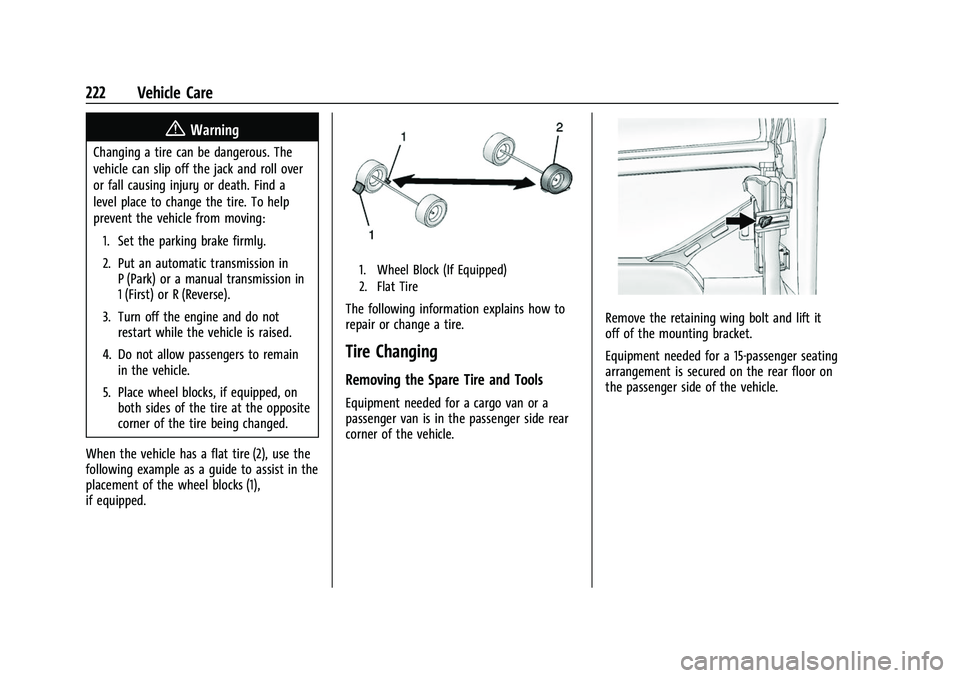
When the vehicle has a flat tire (2), use the
following example as a guide to assist in the
placement of the wheel blocks (1),
if equipped.
1. Wheel Block (If Equipped)
2. Flat Tire
The following information explains how to
repair or change a tire.
Tire Changing
Removing the Spare Tire and Tools
Equipment needed for a cargo van or a
passenger van is in the passenger side rear
corner of the vehicle.
Remove the retaining wing bolt and lift it
off of the mounting bracket.
Equipment needed for a 15-passenger seating
arrangement is secured on the rear floor on
the passenger side of the vehicle.
Page 232 of 289

Chevrolet Express Owner Manual (GMNA-Localizing-U.S./Canada/Mexico-
15555951) - 2022 - CRC - 1/27/22
Vehicle Care 231
Caution
Ignoring these steps could result in costly
damage to the vehicle that would not be
covered by the vehicle warranty. Trying
to start the vehicle by pushing or pulling
it will not work, and it could damage the
vehicle.
1. Check the other vehicle. It must have a 12-volt battery with a negative ground
system.
Caution
If the other vehicle does not have a
12-volt system with a negative ground,
both vehicles can be damaged. Only use
a vehicle that has a 12-volt system with a
negative ground for jump starting.
2. Get the vehicles close enough so the jumper cables can reach, but be sure the
vehicles are not touching each other.
If they are, it could cause a ground
connection you do not want. You would
not be able to start your vehicle, and the
bad grounding could damage the
electrical systems. To avoid the possibility of the vehicles
rolling, set the parking brake firmly on
both vehicles involved in the jump start
procedure. Put an automatic transmission
in P (Park) or a manual transmission in
Neutral before setting the parking brake.
Caution
If any accessories are left on or plugged
in during the jump starting procedure,
they could be damaged. The repairs
would not be covered by the vehicle
warranty. Whenever possible, turn off or
unplug all accessories on either vehicle
when jump starting.
3. Turn the ignition off on both vehicles. Unplug unnecessary accessories plugged
into the cigarette lighter or the accessory
power outlet. Turn off the radio and all
lamps that are not needed. This will
avoid sparks and help save both
batteries. And it could save the radio!
4. Open the hoods and locate the positive (+) and negative (−) terminal
locations of the other vehicle.
On your van, use the unpainted radio
antenna bracket as a remote negative (−)
terminal.
{Warning
Using a match near a battery can cause
battery gas to explode. People have been
hurt doing this, and some have been
blinded. Use a flashlight if you need
more light.
Battery fluid contains acid that can burn
you. Do not get it on you. If you
accidentally get it in your eyes or on
your skin, flush the place with water and
get medical help immediately.
{Warning
Fans or other moving engine parts can
injure you badly. Keep your hands away
from moving parts once the engine is
running.
5. Check that the jumper cables do not have loose or missing insulation. If they
do, you could get a shock. The vehicles
could be damaged too.
Before you connect the cables, here are
some basic things you should know.
Positive (+) will go to positive (+) or to a
remote positive (+) terminal if the vehicle
Page 247 of 289
Chevrolet Express Owner Manual (GMNA-Localizing-U.S./Canada/Mexico-
15555951) - 2022 - CRC - 1/27/22
246 Service and Maintenance
help the longevity and efficient operation of
the air conditioning system. This service can
be complex. See your dealer.
Tire Rotation and Required Services
Every 12 000 km (7,500 mi)
Rotate the tires, if recommended for the
vehicle, and perform the following services.
SeeTire Rotation 0214.
.Check engine oil level and oil
life percentage. If needed, change engine
oil and filter, and reset oil life system.
See Engine Oil 0179 and
Engine Oil Life System 0181.
.Check engine coolant level. See Cooling
System 0183.
.Check windshield washer fluid level. See
Washer Fluid 0189.
.Check tire inflation pressures, including
the spare. See Tire Pressure0210.
.Inspect tire wear. See Tire Inspection
0 214.
.Visually check for fluid leaks.
.Inspect engine air cleaner filter. See
Engine Air Cleaner/Filter 0182.
.Inspect brake system. See Exterior Care
0 235.
.Visually inspect steering, suspension, and
chassis components for damage, including
cracks or tears in the rubber boots, loose
or missing parts, or signs of wear at least
once a year. See Exterior Care0235.
.Inspect power steering for proper
attachment, connections, binding, leaks,
cracks, chafing, etc.
.Visually inspect halfshafts and drive
shafts for excessive wear, lubricant leaks,
and/or damage including: tube dents or
cracks, constant velocity joint or universal
joint looseness, cracked or missing boots,
loose or missing boot clamps, center
bearing excessive looseness, loose or
missing fasteners, and axle seal leaks.
.Check restraint system components. See
Safety System Check 036.
.Visually inspect the fuel system including
the evaporative (EVAP) system for
damage or leaks. Visually check all fuel
pipes, vapor lines, and hoses for proper
attachment, connection, routing, and
condition.
.Visually inspect exhaust system and
nearby heat shields for loose or damaged
parts.
.Lubricate body components. See Exterior
Care 0235.
.Check starter switch. See Starter Switch
Check 0193.
.Check automatic transmission shift lock
control function. See Automatic
Transmission Shift Lock Control Function
Check 0193.
.Check ignition transmission lock. See
Ignition Transmission Lock Check 0193.
.Check parking brake and automatic
transmission park mechanism. See Park
Brake and P (Park) Mechanism Check
0 193.
.Check accelerator pedal for damage, high
effort, or binding. Replace if needed.
.Lubricate the steering linkage (greasable
joints). See Normal and Severe
Maintenance Schedules. For severe
commercial use vehicles, see Special
Application Services 0248.
.Visually inspect the spare tire to ensure
that it is tightly stowed under the vehicle.
Push, pull, and try to turn the tire. If the
spare tire moves, tighten as necessary.
See Tire Changing 0222.
Page 249 of 289
Chevrolet Express Owner Manual (GMNA-Localizing-U.S./Canada/Mexico-
15555951) - 2022 - CRC - 1/27/22
248 Service and Maintenance
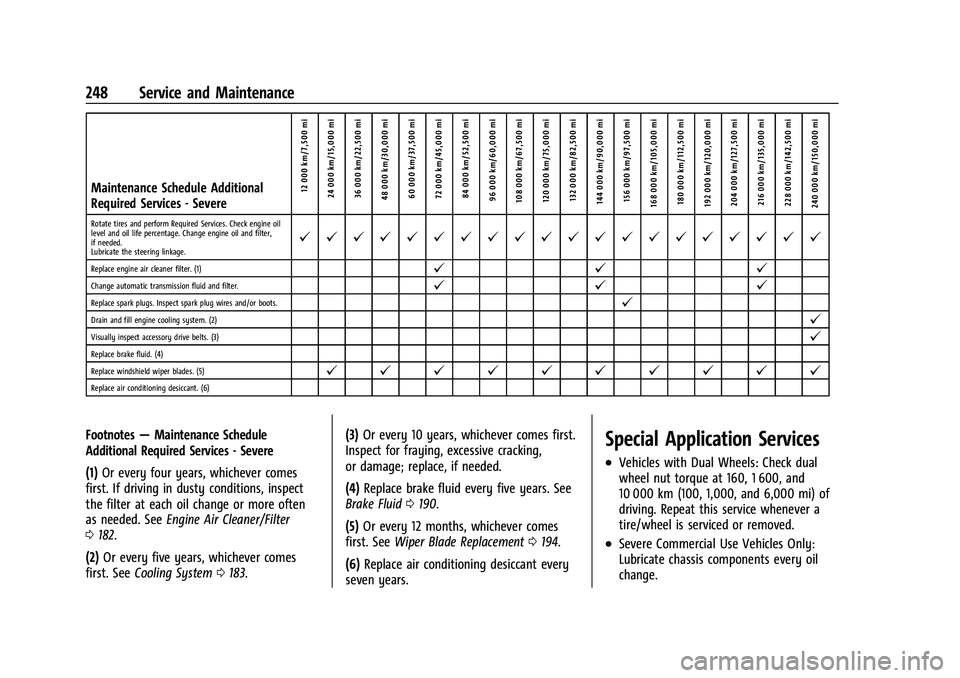
Maintenance Schedule Additional
Required Services - Severe12 000 km/7,500 mi
24 000 km/15,000 mi
36 000 km/22,500 mi
48 000 km/30,000 mi 60 000 km/37,500 mi
72 000 km/45,000 mi84 000 km/52,500 mi
96 000 km/60,000 mi
108 000 km/67,500 mi 120 000 km/75,000 mi 132 000 km/82,500 mi
144 000 km/90,000 mi 156 000 km/97,500 mi
168 000 km/105,000 mi 180 000 km/112,500 mi
192 000 km/120,000 mi 204 000 km/127,500 mi 216 000 km/135,000 mi
228 000 km/142,500 mi
240 000 km/150,000 mi
Rotate tires and perform Required Services. Check engine oil
level and oil life percentage. Change engine oil and filter,
if needed.
Lubricate the steering linkage.@ @ @ @ @ @ @ @ @ @ @ @ @ @ @ @ @ @ @ @
Replace engine air cleaner filter. (1)@ @@
Change automatic transmission fluid and filter.@@@
Replace spark plugs. Inspect spark plug wires and/or boots.@
Drain and fill engine cooling system. (2)@
Visually inspect accessory drive belts. (3)@
Replace brake fluid. (4)
Replace windshield wiper blades. (5)
@ @ @ @ @ @ @ @ @ @
Replace air conditioning desiccant. (6)
Footnotes—Maintenance Schedule
Additional Required Services - Severe
(1) Or every four years, whichever comes
first. If driving in dusty conditions, inspect
the filter at each oil change or more often
as needed. See Engine Air Cleaner/Filter
0 182.
(2) Or every five years, whichever comes
first. See Cooling System 0183. (3)
Or every 10 years, whichever comes first.
Inspect for fraying, excessive cracking,
or damage; replace, if needed.
(4) Replace brake fluid every five years. See
Brake Fluid 0190.
(5) Or every 12 months, whichever comes
first. See Wiper Blade Replacement 0194.
(6) Replace air conditioning desiccant every
seven years.Special Application Services
.Vehicles with Dual Wheels: Check dual
wheel nut torque at 160, 1 600, and
10 000 km (100, 1,000, and 6,000 mi) of
driving. Repeat this service whenever a
tire/wheel is serviced or removed.
.Severe Commercial Use Vehicles Only:
Lubricate chassis components every oil
change.
Page 252 of 289
Chevrolet Express Owner Manual (GMNA-Localizing-U.S./Canada/Mexico-
15555951) - 2022 - CRC - 1/27/22
Service and Maintenance 251
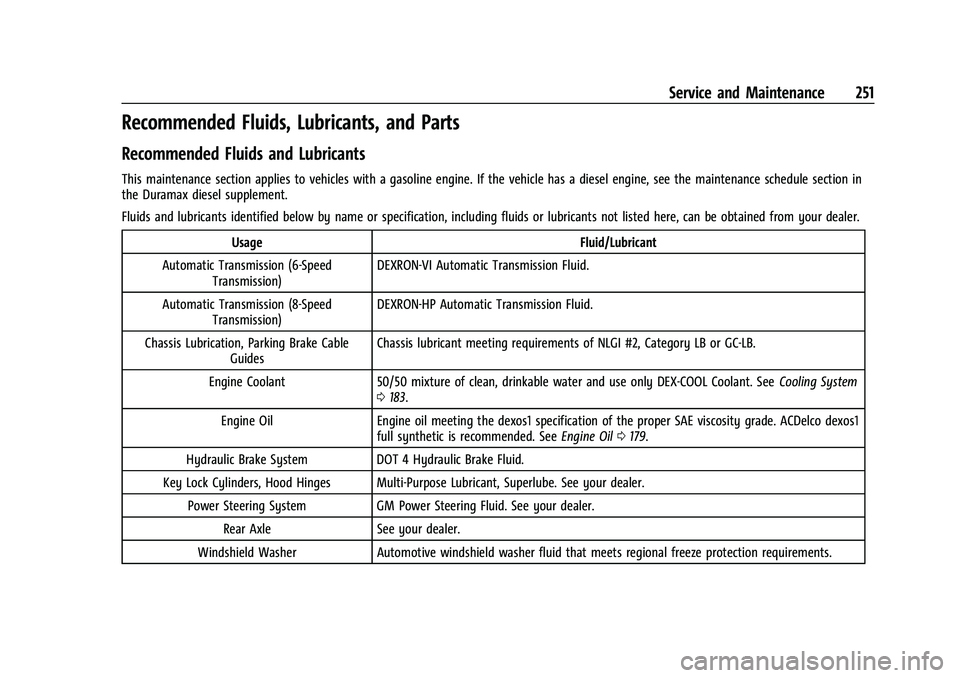
Recommended Fluids, Lubricants, and Parts
Recommended Fluids and Lubricants
This maintenance section applies to vehicles with a gasoline engine. If the vehicle has a diesel engine, see the maintenance schedule section in
the Duramax diesel supplement.
Fluids and lubricants identified below by name or specification, including fluids or lubricants not listed here, can be obtained from your dealer.Usage Fluid/Lubricant
Automatic Transmission (6-Speed Transmission) DEXRON-VI Automatic Transmission Fluid.
Automatic Transmission (8-Speed Transmission) DEXRON-HP Automatic Transmission Fluid.
Chassis Lubrication, Parking Brake Cable Guides Chassis lubricant meeting requirements of NLGI #2, Category LB or GC-LB.
Engine Coolant 50/50 mixture of clean, drinkable water and use only DEX-COOL Coolant. See Cooling System
0 183.
Engine Oil Engine oil meeting the dexos1 specification of the proper SAE viscosity grade. ACDelco dexos1 full synthetic is recommended. See Engine Oil0179.
Hydraulic Brake System DOT 4 Hydraulic Brake Fluid.
Key Lock Cylinders, Hood Hinges Multi-Purpose Lubricant, Superlube. See your dealer. Power Steering System GM Power Steering Fluid. See your dealer. Rear Axle See your dealer.
Windshield Washer Automotive windshield washer fluid that meets regional freeze protection requirements.