inflation pressure CHEVROLET EXPRESS 2020 Get To Know Guide
[x] Cancel search | Manufacturer: CHEVROLET, Model Year: 2020, Model line: EXPRESS, Model: CHEVROLET EXPRESS 2020Pages: 356, PDF Size: 5.7 MB
Page 270 of 356

Chevrolet Express Owner Manual (GMNA-Localizing-U.S./Canada/Mexico-
13882570) - 2020 - CRC - 11/1/19
Vehicle Care 269
unusual wear continues after the
rotation, check the wheel
alignment. SeeWhen It Is Time
for New Tires 0270 and
Wheel Replacement 0275.
If the full-size spare tire is part of
the tire rotation, make sure the
tire rotated into the spare
position is stored securely.
Push, pull, and then try to rotate
or turn the tire. If it moves, use
the wheel wrench/hoist shaft to
tighten the cable. See Tire
Changing 0278.Use this rotation pattern when
rotating the tires if the vehicle
has single rear wheels.
Use this rotation pattern when
rotating the tires if the vehicle
has dual rear wheels.
When installing dual wheels,
check that the vent holes in the
inner and outer wheels on each
side are lined up.
Adjust the front and rear tires to
the recommended inflation
pressure on the Tire and
Loading Information label after the tires have been rotated. See
Tire Pressure
0263 and
Vehicle Load Limits 0158.
Reset the Tire Pressure Monitor
System. See Tire Pressure
Monitor Operation 0265.
Check that all wheel nuts are
properly tightened. See “Wheel
Nut Torque” underCapacities
and Specifications 0318.
{Warning
Rust or dirt on a wheel, or on
the parts to which it is
fastened, can make wheel
nuts become loose after time.
The wheel could come off and
cause a crash. When
changing a wheel, remove any
rust or dirt from places where
the wheel attaches to the
vehicle. In an emergency, a
cloth or a paper towel can be
(Continued)
Page 271 of 356
Chevrolet Express Owner Manual (GMNA-Localizing-U.S./Canada/Mexico-
13882570) - 2020 - CRC - 11/1/19
270 Vehicle Care
Warning (Continued)
used; however, use a scraper
or wire brush later to remove
all rust or dirt.
Lightly coat the center of the
wheel hub with wheel bearing
grease after a wheel change or
tire rotation to prevent corrosion
or rust build-up. Do not get
grease on the flat wheel
mounting surface or on the
wheel nuts or bolts.
Dual Tire Rotation
When the vehicle is new,
or whenever a wheel, wheel bolt,
or wheel nut is replaced or serviced,
check the wheel nut torque after
160, 1 600, and 10 000 km (100,
1,000, and 6,000 mi) of driving. For
proper torque and wheel nut
tightening information, see “Removing the Flat Tire and
Installing the Spare Tire”
underTire
Changing 0278 and“Wheel Nut
Torque” underCapacities and
Specifications 0318.
The outer tire on a dual wheel setup
generally wears faster than the
inner tire. Tires last longer and wear
more evenly if they are rotated. See
Tire Inspection 0268 and
Tire Rotation 0268. Also see
Maintenance Schedule 0305.
See Tires 0255 and
Tire Pressure 0263 for more
information on proper tire inflation.
When It Is Time for New
Tires
Factors, such as maintenance,
temperatures, driving speeds,
vehicle loading, and road conditions
affect the wear rate of the tires.
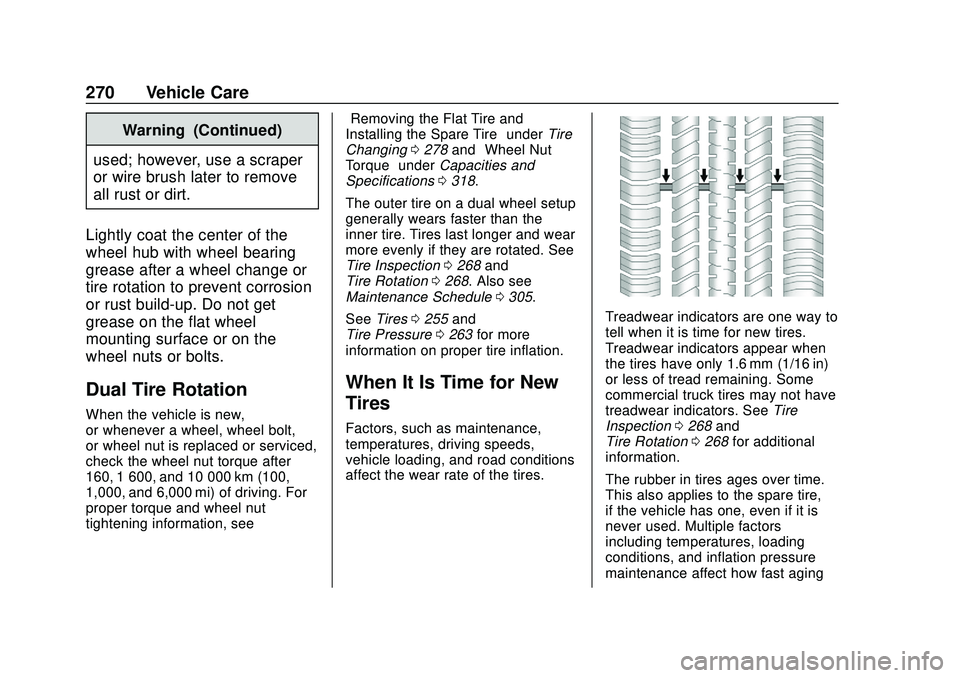
Treadwear indicators are one way to
tell when it is time for new tires.
Treadwear indicators appear when
the tires have only 1.6 mm (1/16 in)
or less of tread remaining. Some
commercial truck tires may not have
treadwear indicators. See Tire
Inspection 0268 and
Tire Rotation 0268 for additional
information.
The rubber in tires ages over time.
This also applies to the spare tire,
if the vehicle has one, even if it is
never used. Multiple factors
including temperatures, loading
conditions, and inflation pressure
maintenance affect how fast aging
Page 288 of 356

Chevrolet Express Owner Manual (GMNA-Localizing-U.S./Canada/Mexico-
13882570) - 2020 - CRC - 11/1/19
Vehicle Care 287
Incorrectly Stored
9. Return the jacking equipment to the proper location. Secure
the items and replace the jack
cover.
Full-Size Spare Tire
If this vehicle came with a full-size
spare tire, it was fully inflated when
new, however, it can lose air over
time. Check the inflation pressure
regularly. See Tire Pressure0263
and
Vehicle Load Limits 0158. For
instructions on how to remove,
install, or store a spare tire, see Tire
Changing 0278. After installing the spare tire on the
vehicle, stop as soon as possible
and check that the spare is correctly
inflated. The spare tire is made to
perform well at speeds up to
112 km/h (70 mph) at the
recommended inflation pressure, so
you can finish your trip.
Have the damaged or flat road tire
repaired or replaced back onto the
vehicle, as soon as possible, so the
spare tire will be available in case it
is needed again.
Do not mix tires and wheels of
different sizes, because they will not
fit. Keep the spare tire and its wheel
together.
If this vehicle has a spare tire that
does not match the original road
tires and wheels in size and type,
do not include the spare in the tire
rotation.
If equipped with a temporary use
full-size spare tire, it is indicated on
the tire sidewall. See
Tire Sidewall
Labeling 0257. The spare tire
should not be driven on over
112 km/h (70 mph), or 88 km/h
(55 mph) when pulling a trailer, at the proper inflation pressure. Repair
and replace the road tire as soon as
it is convenient, and stow the spare
tire for future use.
Page 306 of 356
Chevrolet Express Owner Manual (GMNA-Localizing-U.S./Canada/Mexico-
13882570) - 2020 - CRC - 11/1/19
Service and Maintenance 305
Maintenance
Schedule
Owner Checks and Services
Check the engine oil level. See
Engine Oil0222.
Once a Month
. Check the tire inflation
pressures, including the spare.
See Tire Pressure 0263.
. Inspect the tires for wear. See
Tire Inspection 0268.
. Check the windshield washer
fluid level. See Washer Fluid
0 237.
Engine Oil Change
When the CHANGE ENGINE OIL
SOON message displays, have the
engine oil and filter changed within
the next 1 000 km (600 mi). If driven
under the best conditions, the
engine oil life system may not
indicate the need for vehicle service
for up to a year. The engine oil and
filter must be changed at least once
a year and the oil life system must be reset. Your trained dealer
technician can perform this work.
If the engine oil life system is reset
accidentally, service the vehicle
within 5 000 km (3,000 mi) since the
last service. Reset the oil life
system when the oil is changed.
See
Engine Oil Life System 0224.
Extended Idle Use
When the vehicle is used in a way
that requires extended idle time,
one hour of use shall be deemed
the same as 53 km (33 mi). See
Driver Information Center (DIC) 099
for hourmeter.
Air Conditioning Desiccant
(Replace Every Seven Years)
The air conditioning system requires
maintenance every seven years.
This service requires replacement of
the desiccant to help the longevity
and efficient operation of the air
conditioning system. This service
can be complex. See your dealer.
Tire Rotation and Required
Services Every 12 000 km
(7,500 mi)
Rotate the tires, if recommended for
the vehicle, and perform the
following services. See Tire
Rotation 0268.
. Check engine oil level and oil
life percentage. If needed,
change engine oil and filter, and
reset oil life system. See Engine
Oil 0222 and
Engine Oil Life System 0224.
. Check engine coolant level. See
Cooling System 0230.
. Check windshield washer fluid
level. See Washer Fluid 0237.
. Check tire inflation pressures,
including the spare. See Tire
Pressure 0263.
. Inspect tire wear. See Tire
Inspection 0268.
. Visually check for fluid leaks.
. Inspect engine air cleaner filter.
See Engine Air Cleaner/Filter
0 229.