transmission CHEVROLET EXPRESS CARGO 2021 Owner's Guide
[x] Cancel search | Manufacturer: CHEVROLET, Model Year: 2021, Model line: EXPRESS CARGO, Model: CHEVROLET EXPRESS CARGO 2021Pages: 296, PDF Size: 6.68 MB
Page 176 of 296
Chevrolet Express Owner Manual (GMNA-Localizing-U.S./Canada/Mexico-
14583525) - 2021 - CRC - 12/9/20
Driving and Operating 175
Refer to the aftermarket electric trailer brake
controller owner's manual to determine wire
color coding of the electric trailer brake
controller. The wire colors on the brake
controller may be different from the vehicle.
Trailer Lamps
Always check all trailer lamps are working at
the beginning of each trip, and periodically
on longer trips.
Turn Signals When Towing a Trailer
When properly connected, the trailer turn
signals will illuminate to indicate the vehicle
is turning, changing lanes, or stopping.
When towing a trailer, the arrows on the
instrument cluster will illuminate even if the
trailer is not properly connected or the bulbs
are burned out.
Tow/Haul Mode
Tow/Haul assists when pulling a heavy
trailer or a large or heavy load. For
instructions on how to enter Tow/Haul
mode, seeTow/Haul Mode 0145.
Tow/Haul Mode is designed to be most
effective when the vehicle and trailer
combined weight is at least 75% of the vehicle's Gross Combined Weight Rating
(GCWR). See
“Trailer Weight” underTrailer
Towing 0164.
Tow/Haul Mode is most useful when towing
a heavy trailer or carrying a large or
heavy load:
.through rolling terrain
.in stop-and-go traffic
.in busy parking lots
Operating the vehicle in Tow/Haul Mode
when lightly loaded or not towing will not
cause damage; however, it is not
recommended and may result in unpleasant
engine and transmission driving
characteristics and reduced fuel economy.
Trailer Sway Control (TSC)
Vehicles with StabiliTrak/Electronic Stability
Control (ESC) have a Trailer Sway Control
(TSC) feature. Trailer sway is unintended
side-to-side motion of a trailer while towing.
If the vehicle is towing a trailer and the TSC
detects that sway is increasing, the vehicle
brakes are selectively applied at each wheel,
to help reduce excessive trailer sway.
If TSC is enabled, the Traction Control
System (TCS)/StabiliTrak/ESC warning light
will flash on the instrument cluster. Reduce
vehicle speed by gradually removing your
foot from the accelerator. If trailer sway
continues, StabiliTrak/ESC can reduce engine
torque to help slow the vehicle. TSC will not
function if StabiliTrak/ESC is turned off. See
Traction Control/Electronic Stability Control
0 147.
{Warning
Trailer sway can result in a crash and in
serious injury or death, even if the
vehicle is equipped with TSC.
If the trailer begins to sway, reduce
vehicle speed by gradually removing your
foot from the accelerator. Then pull over
to check the trailer and vehicle to help
correct possible causes, including an
improperly or overloaded trailer,
(Continued)
Page 178 of 296
Chevrolet Express Owner Manual (GMNA-Localizing-U.S./Canada/Mexico-
14583525) - 2021 - CRC - 12/9/20
Vehicle Care 177
Vehicle Care
General Information
General Information . . . . . . . . . . . . . . . . . . . 178
California Proposition 65 Warning . . . . . 178
California Perchlorate MaterialsRequirements . . . . . . . . . . . . . . . . . . . . . . . . 178
Accessories and Modifications . . . . . . . . . 178
Vehicle Checks
Doing Your Own Service Work . . . . . . . . . 179
Hood . . . . . . . . . . . . . . . . . . . . . . . . . . . . . . . . . . 179
Engine Compartment Overview . . . . . . . . 181
Engine Oil . . . . . . . . . . . . . . . . . . . . . . . . . . . . . 184
Engine Oil Life System . . . . . . . . . . . . . . . . 186
Automatic Transmission Fluid (6-Speed Transmission) . . . . . . . . . . . . . . . . . . . . . . . . 186
Automatic Transmission Fluid (8-Speed Transmission) . . . . . . . . . . . . . . . . . . . . . . . . 189
Engine Air Cleaner/Filter . . . . . . . . . . . . . . . 189
Cooling System . . . . . . . . . . . . . . . . . . . . . . . . 191
Engine Overheating . . . . . . . . . . . . . . . . . . . 194
Engine Fan . . . . . . . . . . . . . . . . . . . . . . . . . . . . 195
Power Steering Fluid . . . . . . . . . . . . . . . . . . 196
Washer Fluid . . . . . . . . . . . . . . . . . . . . . . . . . . 196
Brakes . . . . . . . . . . . . . . . . . . . . . . . . . . . . . . . . . 197
Brake Fluid . . . . . . . . . . . . . . . . . . . . . . . . . . . . 197
Battery - North America . . . . . . . . . . . . . . . 199
Rear Axle . . . . . . . . . . . . . . . . . . . . . . . . . . . . . . 199
Noise Control System . . . . . . . . . . . . . . . . . 199 Starter Switch Check . . . . . . . . . . . . . . . . . . 200
Automatic Transmission Shift Lock
Control Function Check . . . . . . . . . . . . . . 201
Ignition Transmission Lock Check . . . . . . 201
Park Brake and P (Park) Mechanism Check . . . . . . . . . . . . . . . . . . . . . . . . . . . . . . . . 201
Wiper Blade Replacement . . . . . . . . . . . . . 201
Windshield Replacement . . . . . . . . . . . . . . 202
Headlamp Aiming
Front Headlamp Aiming . . . . . . . . . . . . . . . 202
Bulb Replacement
Bulb Replacement . . . . . . . . . . . . . . . . . . . . . 202
Halogen Bulbs . . . . . . . . . . . . . . . . . . . . . . . . . 202
Front Turn Signal, Sidemarker, and Parking Lamps . . . . . . . . . . . . . . . . . . . . . . . 202
Taillamps . . . . . . . . . . . . . . . . . . . . . . . . . . . . . . 203
Center High-Mounted Stoplamp (CHMSL) . . . . . . . . . . . . . . . . . . . . . . . . . . . . . 204
License Plate Lamp . . . . . . . . . . . . . . . . . . . . 204
Electrical System
Electrical System Overload . . . . . . . . . . . . 205
Fuses and Circuit Breakers . . . . . . . . . . . . . 205
Engine Compartment Fuse Block . . . . . . 206
Floor Console Fuse Block . . . . . . . . . . . . . . 210
Wheels and Tires
Tires . . . . . . . . . . . . . . . . . . . . . . . . . . . . . . . . . . . 212
All-Season Tires . . . . . . . . . . . . . . . . . . . . . . . . 212
Winter Tires . . . . . . . . . . . . . . . . . . . . . . . . . . . 213 Tire Sidewall Labeling . . . . . . . . . . . . . . . . . . 213
Tire Designations . . . . . . . . . . . . . . . . . . . . . . 214
Tire Terminology and Definitions . . . . . . 215
Tire Pressure . . . . . . . . . . . . . . . . . . . . . . . . . . . 217
Tire Pressure Monitor System . . . . . . . . . 218
Tire Pressure Monitor Operation . . . . . . . 218
Tire Inspection . . . . . . . . . . . . . . . . . . . . . . . . . 221
Tire Rotation . . . . . . . . . . . . . . . . . . . . . . . . . . . 221
When It Is Time for New Tires . . . . . . . . 223
Buying New Tires . . . . . . . . . . . . . . . . . . . . . . 223
Different Size Tires and Wheels . . . . . . . . 225
Uniform Tire Quality Grading . . . . . . . . . . 225
Wheel Alignment and Tire Balance . . . . 226
Wheel Replacement . . . . . . . . . . . . . . . . . . . 226
Tire Chains . . . . . . . . . . . . . . . . . . . . . . . . . . . . 227
If a Tire Goes Flat . . . . . . . . . . . . . . . . . . . . . 227
Tire Changing . . . . . . . . . . . . . . . . . . . . . . . . . 229
Full-Size Spare Tire . . . . . . . . . . . . . . . . . . . . 236
Jump Starting
Jump Starting - North America . . . . . . . . 237
Towing the Vehicle
Towing the Vehicle . . . . . . . . . . . . . . . . . . . 240
Recreational Vehicle Towing . . . . . . . . . . . 240
Appearance Care
Exterior Care . . . . . . . . . . . . . . . . . . . . . . . . . . 242
Interior Care . . . . . . . . . . . . . . . . . . . . . . . . . . 246
Floor Mats . . . . . . . . . . . . . . . . . . . . . . . . . . . . 248
Page 187 of 296
Chevrolet Express Owner Manual (GMNA-Localizing-U.S./Canada/Mexico-
14583525) - 2021 - CRC - 12/9/20
186 Vehicle Care
Never dispose of oil by putting it in the
trash or pouring it on the ground, into
sewers, or into streams or bodies of water.
Recycle it by taking it to a place that
collects used oil.
Engine Oil Life System
When to Change Engine Oil
This vehicle has a computer system that
indicates when to change the engine oil and
filter. This is based on a combination of
factors which include engine revolutions,
engine temperature, and miles driven. Based
on driving conditions, the mileage at which
an engine oil change is indicated can vary
considerably. For the oil life system to work
properly, the system must be reset every
time the oil is changed.
When the system has calculated that oil life
has been diminished, it indicates that an oil
change is necessary. A CHANGE ENGINE OIL
SOON message comes on. Change the oil as
soon as possible within the next 1 000 km
(600 mi). It is possible that, if driving under
the best conditions, the oil life system
might indicate that an oil change is not
necessary for up to a year. The engine oil
and filter must be changed at least once a
year and, at this time, the system must bereset. Your dealer has trained service people
who will perform this work and reset the
system. It is also important to check the oil
regularly over the course of an oil drain
interval and keep it at the proper level.
If the system is ever reset accidentally, the
oil must be changed at 5 000 km (3,000 mi)
since the last oil change. Remember to reset
the oil life system whenever the oil is
changed.
How to Reset the Engine Oil Life System
Reset the system whenever the engine oil is
changed so that the system can calculate
the next engine oil change.
To reset the Engine Oil Life System on most
models:
1. Display the OIL LIFE REMAINING on the DIC. See Driver Information Center (DIC)
0 81.
2. Press and hold
Von the DIC while the
Oil Life display is active. The oil life will
change to 100%.
The oil life system can also be reset as
follows: 1. Display the OIL LIFE REMAINING on the DIC. See Driver Information Center (DIC)
0 81. 2. Fully press and release the accelerator
pedal three times within five seconds.
If the display shows 100%, the system is
reset.
If the CHANGE ENGINE OIL SOON message
comes back on when the vehicle is started,
the engine oil life system has not reset.
Repeat the procedure.
Automatic Transmission Fluid
(6-Speed Transmission)
When to Check and Change Automatic
Transmission Fluid
It is usually not necessary to check the
transmission fluid level. The only reason for
fluid loss is a transmission leak or
overheated transmission. If a small leak is
suspected, use the following procedures to
check the fluid level. However, if there is a
large leak, it may be necessary to have the
vehicle towed to a dealer and have it
repaired before driving the vehicle further.
Change the fluid and filter at the intervals
listed in Maintenance Schedule 0251, and be
sure to use the transmission fluid listed in
Recommended Fluids and Lubricants 0257.
Page 188 of 296
Chevrolet Express Owner Manual (GMNA-Localizing-U.S./Canada/Mexico-
14583525) - 2021 - CRC - 12/9/20
Vehicle Care 187
How to Check Automatic Transmission
Fluid
Because this operation can be difficult, it is
recommended to have this check done at
your dealer, which can monitor the
transmission temperature. The transmission
fluid level increases with temperature. To
obtain a highly accurate fluid level check,
the transmission temperature must be
measured.
If it is decided to check the fluid level, be
sure to follow all the instructions here, or a
false reading on the dipstick may occur.
Caution
Too much or too little fluid can damage
the transmission. Too much can mean
that some of the fluid could come out
and fall on hot engine parts or exhaust
system parts, starting a fire. Too little
fluid could cause the transmission to
overheat. Be sure to get an accurate
reading if checking the transmission fluid.Wait at least 30 minutes with the engine
off, before checking the transmission fluid
level if the vehicle has been driven:
.In hot weather, when outside
temperatures are above 32 °C (90 °F).
.The vehicle is heavily loaded.
.At high speed for quite a while in hot
weather.
.In heavy traffic and hot weather.
.While pulling a trailer.
After driving under these conditions, a hot
check can be performed. The fluid should be
hot, which is 71 °C to 93 °C (160 °F to
200 °F).
A cold fluid level check can be performed
after the vehicle has been sitting for eight
hours or more with the engine off, but this
is used only as a reference. Let the engine
run at idle for five minutes if the outside
temperature is between 15 °C to 32 °C (60 °F
to 90 °F). Should the fluid level be low
during this cold check, the fluid must be
checked warm or hot before adding fluid.
If the outside temperature is colder than
15 °C (60 °F) or hotter than 32 °C (90 °F), a
cold check cannot be performed. A warm fluid level check can be performed
by driving the vehicle under lightly loaded
conditions and outside temperatures
between 10 °C to 27 °C (50 °F to 80 °F). The
vehicle should be driven for at least 24 km
(15 mi) before performing a warm check.
Checking the fluid warm or hot will give a
more accurate reading of the fluid level than
a cold check.
Because the vehicle is equipped with a
high-efficiency air-to-oil cooler, the
transmission fluid temperature may not
reach the required hot fluid level checking
temperature under normal lightly loaded
driving vehicle conditions.
Checking the Fluid Level
Prepare the vehicle:
1. Park the vehicle on a level place. Keep the engine running.
2. With the parking brake applied, place the shift lever in P (Park).
3. With a foot on the brake pedal, move the shift lever through each gear range,
pausing for about three seconds in each
range. When M is reached, move the
selector from M1 through M3. Then,
position the shift lever in P (Park).
Page 189 of 296
Chevrolet Express Owner Manual (GMNA-Localizing-U.S./Canada/Mexico-
14583525) - 2021 - CRC - 12/9/20
188 Vehicle Care
4. Let the engine run at idle fortwo minutes or more.
Then, without shutting off the engine, use
the steps that follow.
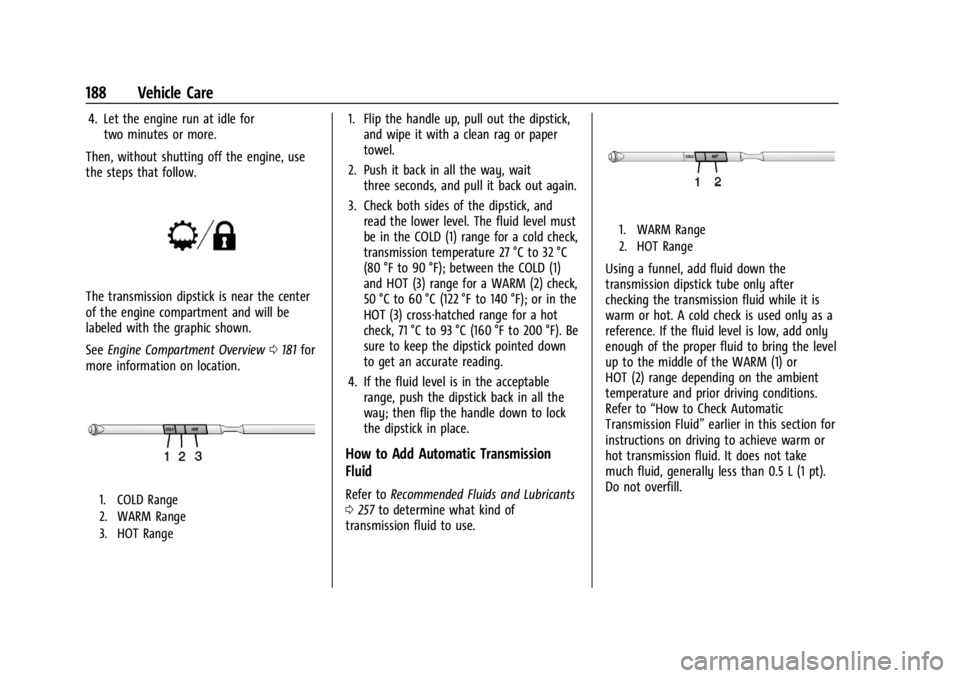
The transmission dipstick is near the center
of the engine compartment and will be
labeled with the graphic shown.
See Engine Compartment Overview 0181 for
more information on location.
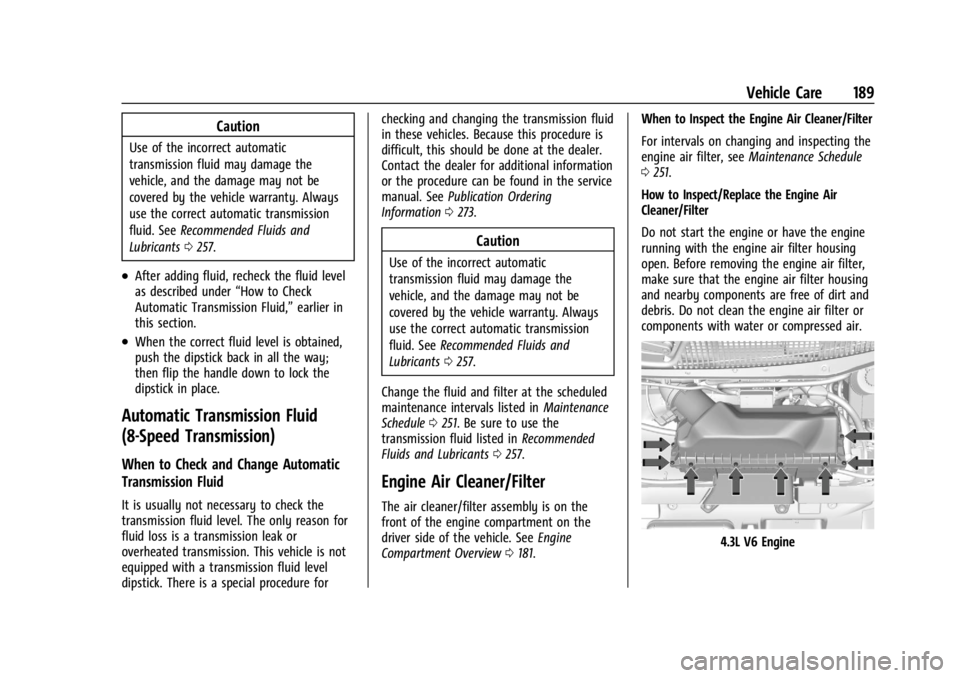
1. COLD Range
2. WARM Range
3. HOT Range
1. Flip the handle up, pull out the dipstick, and wipe it with a clean rag or paper
towel.
2. Push it back in all the way, wait three seconds, and pull it back out again.
3. Check both sides of the dipstick, and read the lower level. The fluid level must
be in the COLD (1) range for a cold check,
transmission temperature 27 °C to 32 °C
(80 °F to 90 °F); between the COLD (1)
and HOT (3) range for a WARM (2) check,
50 °C to 60 °C (122 °F to 140 °F); or in the
HOT (3) cross-hatched range for a hot
check, 71 °C to 93 °C (160 °F to 200 °F). Be
sure to keep the dipstick pointed down
to get an accurate reading.
4. If the fluid level is in the acceptable range, push the dipstick back in all the
way; then flip the handle down to lock
the dipstick in place.
How to Add Automatic Transmission
Fluid
Refer to Recommended Fluids and Lubricants
0 257 to determine what kind of
transmission fluid to use.
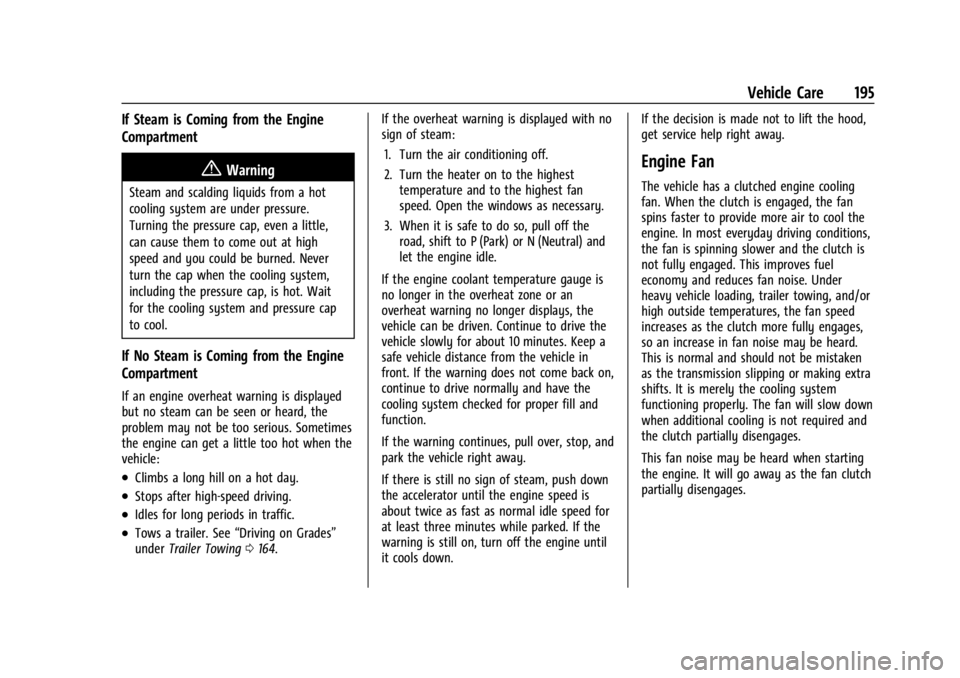
1. WARM Range
2. HOT Range
Using a funnel, add fluid down the
transmission dipstick tube only after
checking the transmission fluid while it is
warm or hot. A cold check is used only as a
reference. If the fluid level is low, add only
enough of the proper fluid to bring the level
up to the middle of the WARM (1) or
HOT (2) range depending on the ambient
temperature and prior driving conditions.
Refer to “How to Check Automatic
Transmission Fluid” earlier in this section for
instructions on driving to achieve warm or
hot transmission fluid. It does not take
much fluid, generally less than 0.5 L (1 pt).
Do not overfill.
Page 190 of 296
Chevrolet Express Owner Manual (GMNA-Localizing-U.S./Canada/Mexico-
14583525) - 2021 - CRC - 12/9/20
Vehicle Care 189
Caution
Use of the incorrect automatic
transmission fluid may damage the
vehicle, and the damage may not be
covered by the vehicle warranty. Always
use the correct automatic transmission
fluid. SeeRecommended Fluids and
Lubricants 0257.
.After adding fluid, recheck the fluid level
as described under “How to Check
Automatic Transmission Fluid,” earlier in
this section.
.When the correct fluid level is obtained,
push the dipstick back in all the way;
then flip the handle down to lock the
dipstick in place.
Automatic Transmission Fluid
(8-Speed Transmission)
When to Check and Change Automatic
Transmission Fluid
It is usually not necessary to check the
transmission fluid level. The only reason for
fluid loss is a transmission leak or
overheated transmission. This vehicle is not
equipped with a transmission fluid level
dipstick. There is a special procedure for checking and changing the transmission fluid
in these vehicles. Because this procedure is
difficult, this should be done at the dealer.
Contact the dealer for additional information
or the procedure can be found in the service
manual. See
Publication Ordering
Information 0273.
Caution
Use of the incorrect automatic
transmission fluid may damage the
vehicle, and the damage may not be
covered by the vehicle warranty. Always
use the correct automatic transmission
fluid. See Recommended Fluids and
Lubricants 0257.
Change the fluid and filter at the scheduled
maintenance intervals listed in Maintenance
Schedule 0251. Be sure to use the
transmission fluid listed in Recommended
Fluids and Lubricants 0257.
Engine Air Cleaner/Filter
The air cleaner/filter assembly is on the
front of the engine compartment on the
driver side of the vehicle. See Engine
Compartment Overview 0181. When to Inspect the Engine Air Cleaner/Filter
For intervals on changing and inspecting the
engine air filter, see
Maintenance Schedule
0 251.
How to Inspect/Replace the Engine Air
Cleaner/Filter
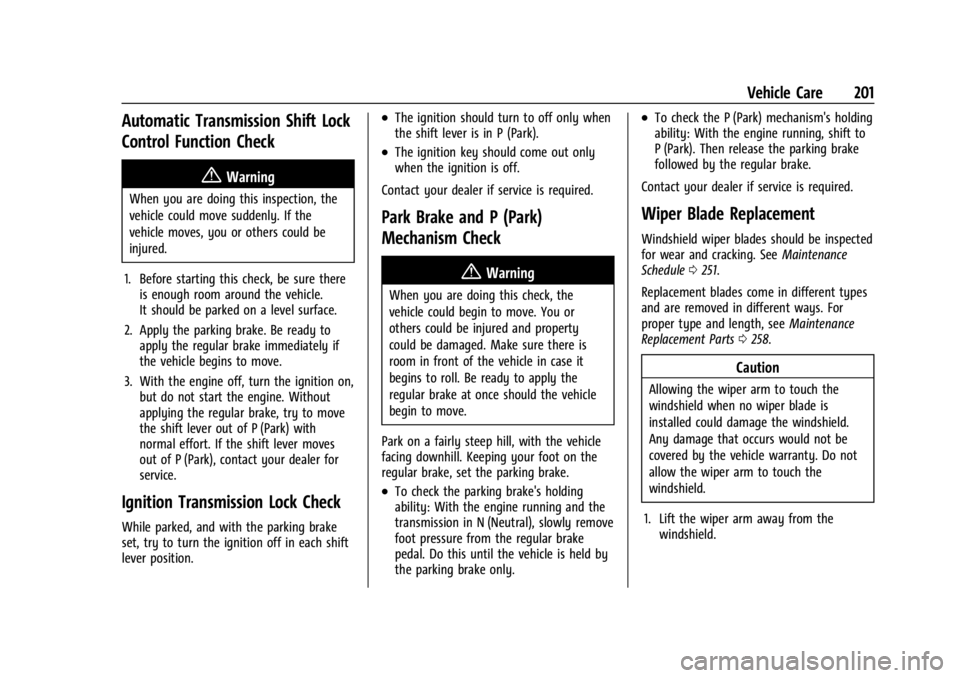
Do not start the engine or have the engine
running with the engine air filter housing
open. Before removing the engine air filter,
make sure that the engine air filter housing
and nearby components are free of dirt and
debris. Do not clean the engine air filter or
components with water or compressed air.
4.3L V6 Engine
Page 196 of 296
Chevrolet Express Owner Manual (GMNA-Localizing-U.S./Canada/Mexico-
14583525) - 2021 - CRC - 12/9/20
Vehicle Care 195
If Steam is Coming from the Engine
Compartment
{Warning
Steam and scalding liquids from a hot
cooling system are under pressure.
Turning the pressure cap, even a little,
can cause them to come out at high
speed and you could be burned. Never
turn the cap when the cooling system,
including the pressure cap, is hot. Wait
for the cooling system and pressure cap
to cool.
If No Steam is Coming from the Engine
Compartment
If an engine overheat warning is displayed
but no steam can be seen or heard, the
problem may not be too serious. Sometimes
the engine can get a little too hot when the
vehicle:
.Climbs a long hill on a hot day.
.Stops after high-speed driving.
.Idles for long periods in traffic.
.Tows a trailer. See“Driving on Grades”
under Trailer Towing 0164. If the overheat warning is displayed with no
sign of steam:
1. Turn the air conditioning off.
2. Turn the heater on to the highest temperature and to the highest fan
speed. Open the windows as necessary.
3. When it is safe to do so, pull off the road, shift to P (Park) or N (Neutral) and
let the engine idle.
If the engine coolant temperature gauge is
no longer in the overheat zone or an
overheat warning no longer displays, the
vehicle can be driven. Continue to drive the
vehicle slowly for about 10 minutes. Keep a
safe vehicle distance from the vehicle in
front. If the warning does not come back on,
continue to drive normally and have the
cooling system checked for proper fill and
function.
If the warning continues, pull over, stop, and
park the vehicle right away.
If there is still no sign of steam, push down
the accelerator until the engine speed is
about twice as fast as normal idle speed for
at least three minutes while parked. If the
warning is still on, turn off the engine until
it cools down. If the decision is made not to lift the hood,
get service help right away.
Engine Fan
The vehicle has a clutched engine cooling
fan. When the clutch is engaged, the fan
spins faster to provide more air to cool the
engine. In most everyday driving conditions,
the fan is spinning slower and the clutch is
not fully engaged. This improves fuel
economy and reduces fan noise. Under
heavy vehicle loading, trailer towing, and/or
high outside temperatures, the fan speed
increases as the clutch more fully engages,
so an increase in fan noise may be heard.
This is normal and should not be mistaken
as the transmission slipping or making extra
shifts. It is merely the cooling system
functioning properly. The fan will slow down
when additional cooling is not required and
the clutch partially disengages.
This fan noise may be heard when starting
the engine. It will go away as the fan clutch
partially disengages.
Page 202 of 296
Chevrolet Express Owner Manual (GMNA-Localizing-U.S./Canada/Mexico-
14583525) - 2021 - CRC - 12/9/20
Vehicle Care 201
Automatic Transmission Shift Lock
Control Function Check
{Warning
When you are doing this inspection, the
vehicle could move suddenly. If the
vehicle moves, you or others could be
injured.
1. Before starting this check, be sure there is enough room around the vehicle.
It should be parked on a level surface.
2. Apply the parking brake. Be ready to apply the regular brake immediately if
the vehicle begins to move.
3. With the engine off, turn the ignition on, but do not start the engine. Without
applying the regular brake, try to move
the shift lever out of P (Park) with
normal effort. If the shift lever moves
out of P (Park), contact your dealer for
service.
Ignition Transmission Lock Check
While parked, and with the parking brake
set, try to turn the ignition off in each shift
lever position.
.The ignition should turn to off only when
the shift lever is in P (Park).
.The ignition key should come out only
when the ignition is off.
Contact your dealer if service is required.
Park Brake and P (Park)
Mechanism Check
{Warning
When you are doing this check, the
vehicle could begin to move. You or
others could be injured and property
could be damaged. Make sure there is
room in front of the vehicle in case it
begins to roll. Be ready to apply the
regular brake at once should the vehicle
begin to move.
Park on a fairly steep hill, with the vehicle
facing downhill. Keeping your foot on the
regular brake, set the parking brake.
.To check the parking brake's holding
ability: With the engine running and the
transmission in N (Neutral), slowly remove
foot pressure from the regular brake
pedal. Do this until the vehicle is held by
the parking brake only.
.To check the P (Park) mechanism's holding
ability: With the engine running, shift to
P (Park). Then release the parking brake
followed by the regular brake.
Contact your dealer if service is required.
Wiper Blade Replacement
Windshield wiper blades should be inspected
for wear and cracking. See Maintenance
Schedule 0251.
Replacement blades come in different types
and are removed in different ways. For
proper type and length, see Maintenance
Replacement Parts 0258.
Caution
Allowing the wiper arm to touch the
windshield when no wiper blade is
installed could damage the windshield.
Any damage that occurs would not be
covered by the vehicle warranty. Do not
allow the wiper arm to touch the
windshield.
1. Lift the wiper arm away from the windshield.
Page 208 of 296
Chevrolet Express Owner Manual (GMNA-Localizing-U.S./Canada/Mexico-
14583525) - 2021 - CRC - 12/9/20
Vehicle Care 207
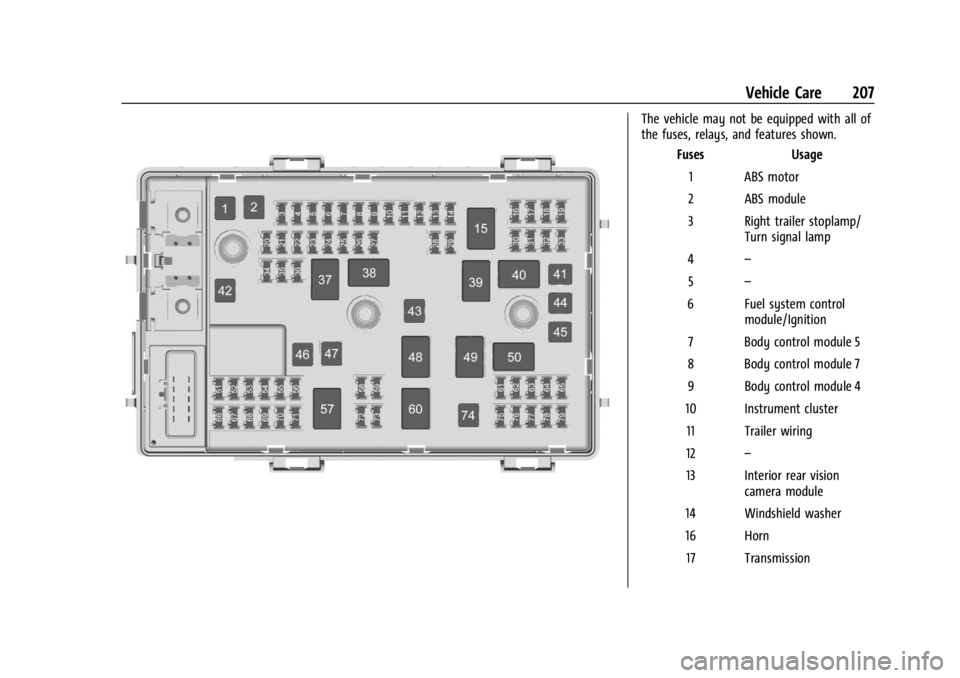
The vehicle may not be equipped with all of
the fuses, relays, and features shown.Fuses Usage
1 ABS motor
2 ABS module
3 Right trailer stoplamp/ Turn signal lamp
4 –
5 –
6 Fuel system control module/Ignition
7 Body control module 5
8 Body control module 7
9 Body control module 4
10 Instrument cluster 11 Trailer wiring
12 –
13 Interior rear vision camera module
14 Windshield washer
16 Horn 17 Transmission
Page 209 of 296

Chevrolet Express Owner Manual (GMNA-Localizing-U.S./Canada/Mexico-
14583525) - 2021 - CRC - 12/9/20
208 Vehicle Care
FusesUsage
18 A/C
19 Engine control module battery
20 Left stop/turn cutaway lamp
21 Left stop/turn trailer lamp
22 Right stop/turn cutaway lamp
23 NOX Sensor (Diesel only)
24 Fuel pump 25 Auxiliary power outlet
26 Body control module 3 27 Special equipment option
28 Airbag
29 Steering wheel sensor
30 Engine control module ignition
31 Transmission control module Ignition Fuses
Usage
32 Transmission control module 1 battery
33 Rear parking aid module
34 NOX Sensor (Diesel only)
35 Fuel heater control module (Diesel only)
36 Fuel system control module battery
41 Transmission control module 2, battery
signal
42 Trailer wiring
43 Electro viscous fan clutch (Diesel only)
44 Starter solenoid 45 Engine control module, powertrain signal 2
46 DC-AC inverter 47 –
51 Left high-beam headlamp Fuses
Usage
52 Right high-beam headlamp
53 Left low-beam headlamp
54 Right low-beam headlamp
55 Wipers
56 Canister vent solenoid
58 Body control module 2
59 Body control module 1 61 Engine oil solenoid/ Crankcase vent heater
(Diesel only)
62 O2 sensor 2
63 –
64 Mass airflow/ Canister vent
65 Ignition coils/injectors - odd
66 Daytime running lamps 2
67 Daytime running lamps 1