seats CHEVROLET EXPRESS CARGO VAN 2003 1.G User Guide
[x] Cancel search | Manufacturer: CHEVROLET, Model Year: 2003, Model line: EXPRESS CARGO VAN, Model: CHEVROLET EXPRESS CARGO VAN 2003 1.GPages: 386, PDF Size: 2.73 MB
Page 32 of 386
Center Passenger Position
(3rd, 4th and 5th Row)Lap Belt
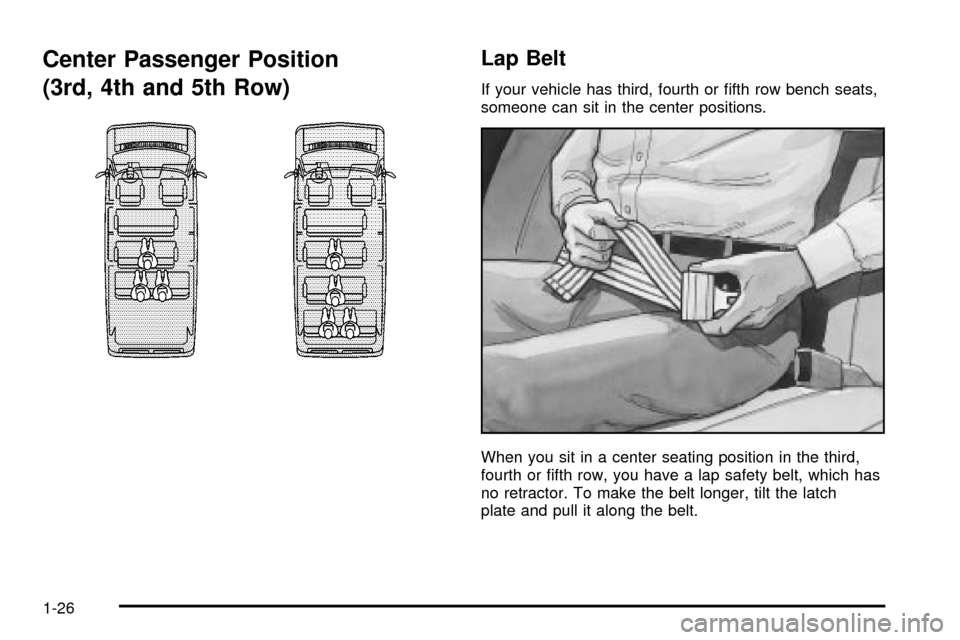
If your vehicle has third, fourth or ®fth row bench seats,
someone can sit in the center positions.
When you sit in a center seating position in the third,
fourth or ®fth row, you have a lap safety belt, which has
no retractor. To make the belt longer, tilt the latch
plate and pull it along the belt.
1-26
Page 37 of 386
Rear Safety Belt Comfort Guides for
Children and Small Adults
Your vehicle may have this feature already. If it doesn't,
you can get it from any GM dealer.
Rear safety belt comfort guides will provide added
safety belt comfort for older children who have outgrown
booster seats and for small adults. When installed on
a shoulder belt, the comfort guide better positions
the belt away from the neck and head.
There is one guide available for each outside passenger
position in the rear seats. To provide added safety
belt comfort for children who have outgrown child
restraints and booster seats and for smaller adults, the
comfort guides may be installed on the shoulder
belts. Here's how to install a comfort guide and use the
safety belt:
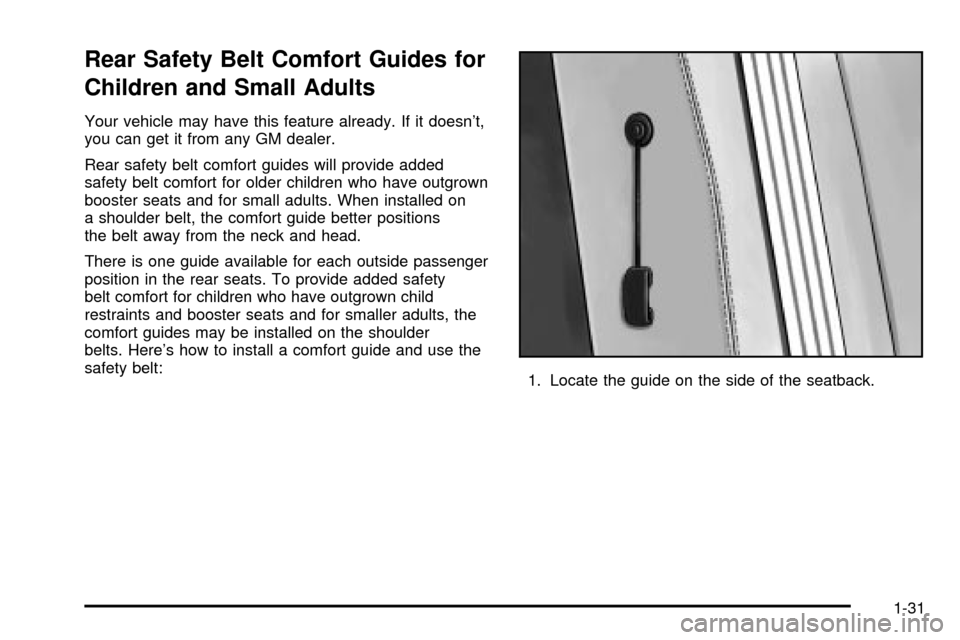
1. Locate the guide on the side of the seatback.
1-31
Page 40 of 386
Child Restraints
Older Children
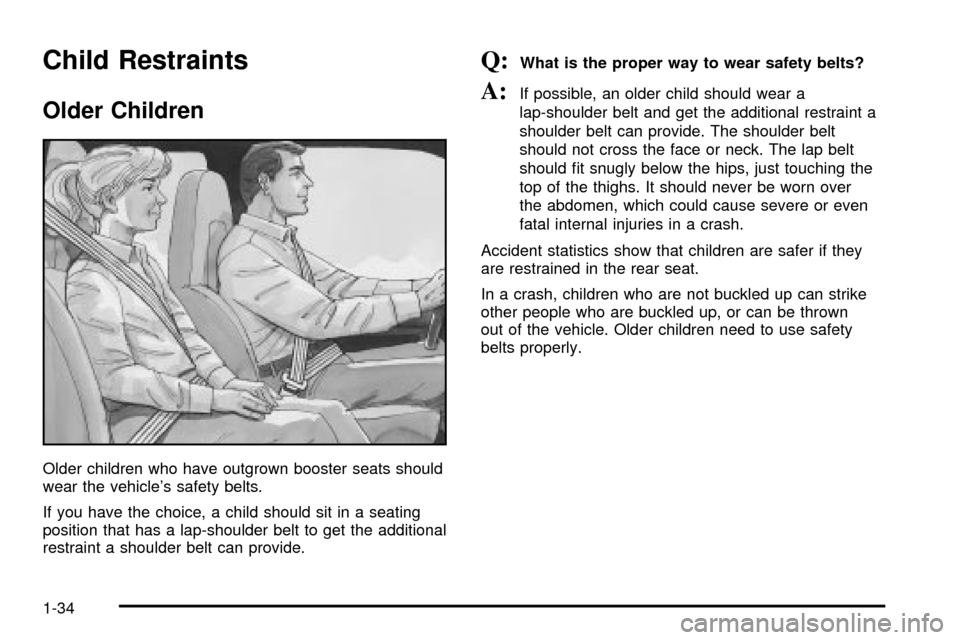
Older children who have outgrown booster seats should
wear the vehicle's safety belts.
If you have the choice, a child should sit in a seating
position that has a lap-shoulder belt to get the additional
restraint a shoulder belt can provide.
Q:What is the proper way to wear safety belts?
A:If possible, an older child should wear a
lap-shoulder belt and get the additional restraint a
shoulder belt can provide. The shoulder belt
should not cross the face or neck. The lap belt
should ®t snugly below the hips, just touching the
top of the thighs. It should never be worn over
the abdomen, which could cause severe or even
fatal internal injuries in a crash.
Accident statistics show that children are safer if they
are restrained in the rear seat.
In a crash, children who are not buckled up can strike
other people who are buckled up, or can be thrown
out of the vehicle. Older children need to use safety
belts properly.
1-34
Page 49 of 386
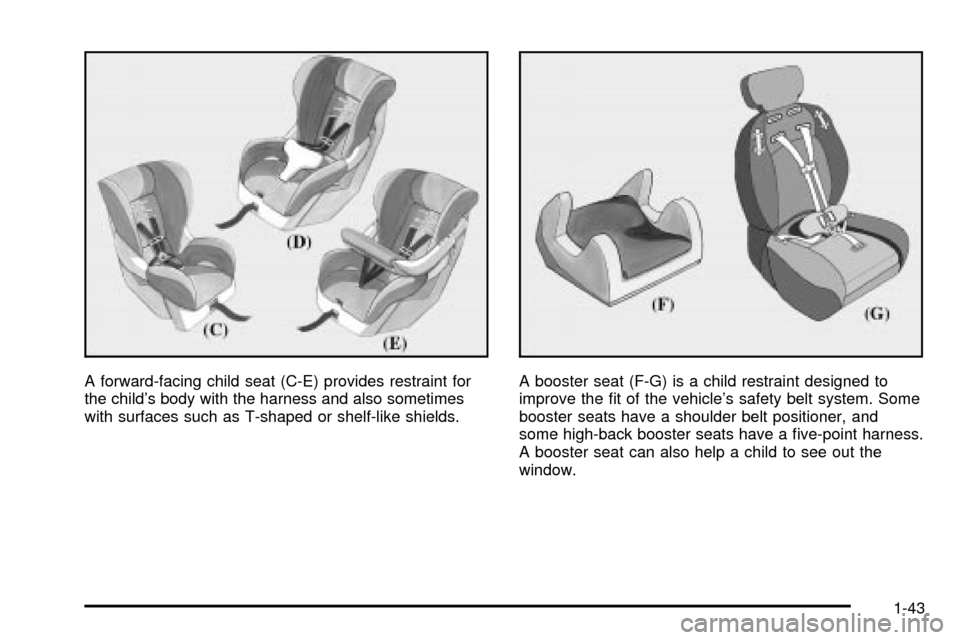
A forward-facing child seat (C-E) provides restraint for
the child's body with the harness and also sometimes
with surfaces such as T-shaped or shelf-like shields.A booster seat (F-G) is a child restraint designed to
improve the ®t of the vehicle's safety belt system. Some
booster seats have a shoulder belt positioner, and
some high-back booster seats have a ®ve-point harness.
A booster seat can also help a child to see out the
window.
1-43
Page 56 of 386
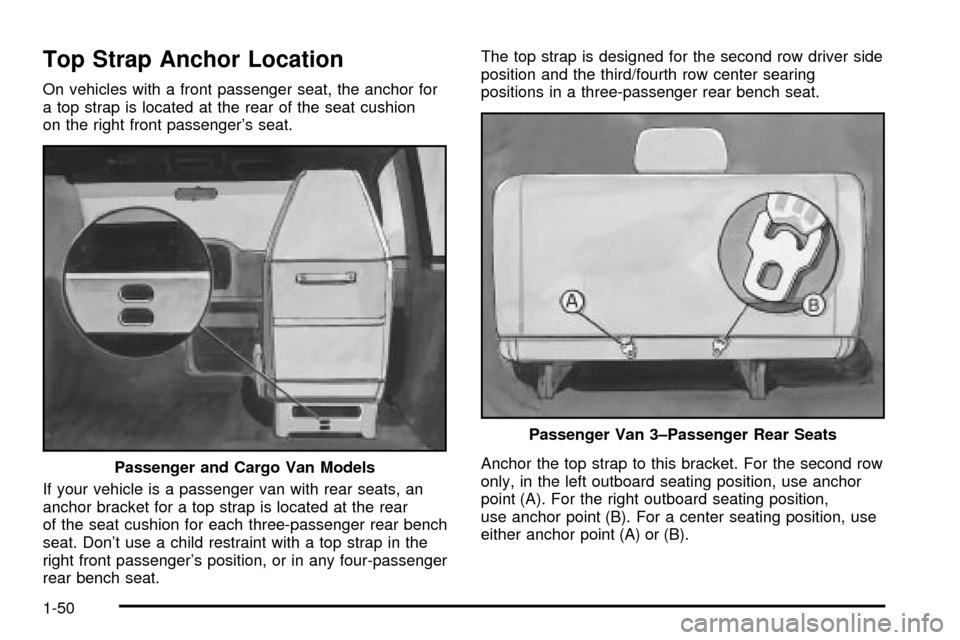
Top Strap Anchor Location
On vehicles with a front passenger seat, the anchor for
a top strap is located at the rear of the seat cushion
on the right front passenger's seat.
If your vehicle is a passenger van with rear seats, an
anchor bracket for a top strap is located at the rear
of the seat cushion for each three-passenger rear bench
seat. Don't use a child restraint with a top strap in the
right front passenger's position, or in any four-passenger
rear bench seat.The top strap is designed for the second row driver side
position and the third/fourth row center searing
positions in a three-passenger rear bench seat.
Anchor the top strap to this bracket. For the second row
only, in the left outboard seating position, use anchor
point (A). For the right outboard seating position,
use anchor point (B). For a center seating position, use
either anchor point (A) or (B). Passenger and Cargo Van Models
Passenger Van 3±Passenger Rear Seats
1-50
Page 57 of 386
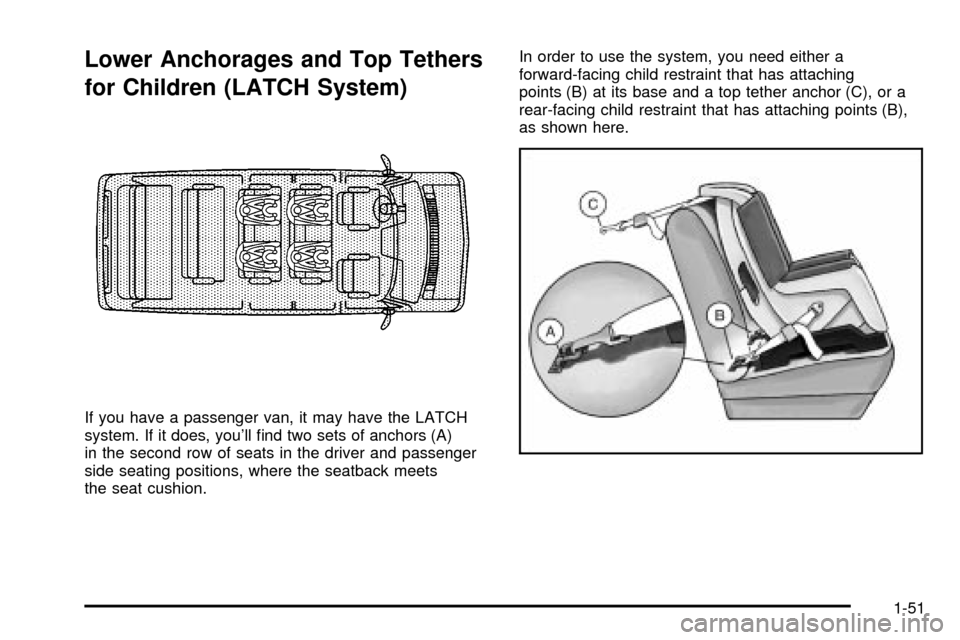
Lower Anchorages and Top Tethers
for Children (LATCH System)
If you have a passenger van, it may have the LATCH
system. If it does, you'll ®nd two sets of anchors (A)
in the second row of seats in the driver and passenger
side seating positions, where the seatback meets
the seat cushion.In order to use the system, you need either a
forward-facing child restraint that has attaching
points (B) at its base and a top tether anchor (C), or a
rear-facing child restraint that has attaching points (B),
as shown here.
1-51
Page 66 of 386
Although a rear seat is a safer place, you can secure a
forward-facing child restraint in the right front seat.
{CAUTION:
If the air bag readiness light ever comes on
when you have turned off the air bag, it means
that something may be wrong with the air bag
system. The right front passenger's air bag
could in¯ate even though the switch is off. If
this ever happens, don't let anyone whom the
national government has identi®ed as a
member of a passenger air bag risk group sit
in the right front passenger's position (for
example, don't secure a rear-facing child
restraint in your vehicle) until you have your
vehicle serviced. See ªAir Bag Off Switchº in
the Index.You'll be using the lap-shoulder belt. See
Top Strap on
page 1-48if the child restraint has one. Be sure to
follow the instructions that came with the child restraint.
Secure the child in the child restraint when and as
the instructions say.
1. If your vehicle has a passenger air bag and an air
bag off switch, and you are using a rear-facing child
restraint in this seat, make sure the air bag is
turned off. See
Air Bag Off Switch on page 1-70.If
your child restraint is forward-facing, always
move the seat as far back as it will go before
securing it in this seat. See
Power Seat on page 1-4orManual Seats on page 1-3.
2. Put the restraint on the seat.
3. Pick up the latch plate, and run the lap and shoulder
portions of the vehicle's safety belt through or
around the restraint. The child restraint instructions
will show you how.
1-60
Page 74 of 386

Seat Position Sensors
Vehicles with dual stage air bags are also equipped with
special sensors which enable the sensing system to
monitor the position of both the driver and passenger
front seats. The seat position sensors provide
information which is used to determine if the air bags
should deploy at a reduced level or at full depoyment.
Air Bag Systems
In any particular crash, no one can say whether an air
bag should have in¯ated simply because of the damage
to a vehicle or because of what the repair costs were.
In¯ation is determined by the angle of the impact
and how quickly the vehicle slows down in front or
near-frontal impacts.
What Makes an Air Bag In¯ate?
In an impact of sufficient severity, the air bag sensing
system detects that the vehicle is in a crash. The
sensing system triggers a release of gas from the
in¯ator, which in¯ates the air bag. The in¯ator, air bag,
and related hardware are all part of the air bag
modules inside the steering wheel and in the instrument
panel in front of the right front passenger.
How Does an Air Bag Restrain?
In moderate to severe frontal or near-frontal collisions,
even belted occupants can contact the steering wheel or
the instrument panel. Air bags supplement the
protection provided by safety belts. Air bags distribute
the force of the impact more evenly over the occupant's
upper body, stopping the occupant more gradually.
But air bags would not help you in many types of
collisions, including rollovers, rear impacts and many
side impacts, primarily because an occupant's motion is
not toward those air bags. Air bags should never be
regarded as anything more than a supplement to safety
belts, and then only in moderate to severe frontal or
near-frontal collisions.
What Will You See After an Air Bag
In¯ates?
After an air bag in¯ates, it quickly de¯ates, so quickly
that some people may not even realize the air bag
in¯ated. Some components of the air bag module ± the
steering wheel hub for the driver's air bag, or the
instrument panel for the right front passenger's
bag ± will be hot for a short time. The parts of the bag
that come into contact with you may be warm, but
not too hot to touch. There will be some smoke and dust
coming from the vents in the de¯ated air bags.
1-68
Page 140 of 386

Turn the center knob clockwise or counterclockwise
to change the direction of the air¯ow in the
rear-seating area.
To change the current mode, select one of the following:
D(Vent):Use this mode to direct air to the upper
outlets, with a little air directed to the ¯oor outlets.
2(Floor):Use this mode to direct most of the air to
the ¯oor outlets.
9(Fan):Turn the left knob clockwise or
counterclockwise to HIGH, MED (Medium) or LOW to
increase or decrease the fan speed in the rear-seating
area. Turn the knob to OFF to turn off the fan.
(Temperature Control):To increase or decrease the
temperature for the rear of the vehicle, turn the right
knob located on the climate-control panel.
The air-conditioning system on the main climate-control
panel must be turned on to direct cooled air to the
rear of the vehicle. If it is not on, then the temperature
in the rear of the vehicle will remain at cabin
temperature.
Be sure to keep the area under the front seats clear of
any objects so that the air inside of your vehicle can
circulate effectively.For information on how to use the main climate-control
system, see
Climate Control System on page 3-19listed previously in this section. For information
on ventilation, see ªOutlet Adjustmentº earlier in this
section.
Defogging and Defrosting
Fog on the inside of windows is a result of high humidity
(moisture) condensing on the cool window glass. This
can be minimized if the climate control is used properly.
There are two modes to clear fog or frost from your
windshield and side windows.
Use the defog mode to clear the windows of fog or
moisture and warm the passengers. Use the defrost
mode to remove fog or frost from the windshield more
quickly. For best results, clear all snow and ice from the
windshield before defrosting.
Turn the knob on the right of the climate control panel
to select the defog or defrost mode.
-(Blend):With this setting, the outside air comes out
of both the ¯oor and defroster outlets. Adjust the
temperature knob for warmer or cooler air. The air
conditioning compressor may operate in this setting to
dehumidify the air.
1(Defrost):This setting operates the defroster.
Most of the air comes out near the windshield, with
some going to the ¯oor outlets and front side windows.
3-22
Page 224 of 386
The Certi®cation/Tire label also tells you the maximum
weights for the front and rear axles, called Gross
Axle Weight Rating (GAWR). To ®nd out the actual loads
on your front and rear axles, you need to go to a
weigh station and weigh your vehicle. Your dealer can
help you with this. Be sure to spread out your load
equally on both sides of the centerline.
Never exceed the GVWR for your vehicle, or the GAWR
for either the front or rear axle.
And, if you do have a heavy load, you should spread
it out.
{CAUTION:
Do not load your vehicle any heavier than the
GVWR, or either the maximum front or rear
GAWR. If you do, parts on your vehicle can
break, and it can change the way your vehicle
handles. These could cause you to lose
control and crash. Also, overloading can
shorten the life of your vehicle.
{CAUTION:
Things you put inside your vehicle can strike
and injure people in a sudden stop or turn, or
in a crash.
·Put things in the cargo area of your
vehicle. Try to spread the weight evenly.
·Never stack heavier things, like suitcases,
inside the vehicle so that some of them
are above the tops of the seats.
·Don't leave an unsecured child restraint in
your vehicle.
·When you carry something inside the
vehicle, secure it whenever you can.
·Don't leave a seat folded down unless you
need to.
Payload
The Payload Capacity is shown on the Certi®cation/Tire
label. This is the maximum load capacity that your vehicle
can carry. Be sure to include the weight of the people
inside as part of your load. If you added any accessories
or equipment after your vehicle left the factory, remember
to subtract the weight of these things from the payload.
Your dealer can help you with this.
4-30