towing CHEVROLET EXPRESS CARGO VAN 2003 1.G Owner's Manual
[x] Cancel search | Manufacturer: CHEVROLET, Model Year: 2003, Model line: EXPRESS CARGO VAN, Model: CHEVROLET EXPRESS CARGO VAN 2003 1.GPages: 386, PDF Size: 2.73 MB
Page 265 of 386

GM Mobility Program for Persons
with Disabilities
This program, available to
quali®ed applicants, can
reimburse you up to
$1,000 toward aftermarket
driver or passenger
adaptive equipment you
may require for your
vehicle (hand controls,
wheelchair/scooter
lifts, etc.).
This program can also provide you with free resource
information, such as area driver assessment centers and
mobility equipment installers. The program is available
for a limited period of time from the date of vehicle
purchase/lease. See your dealer for more details or call
the GM Mobility Assistance Center at 1-800-323-9935.
Text telephone (TTY) users, call 1-800-833-9935.
GM of Canada also has a Mobility Program. Call
1-800-GM-DRIVE (463-7483) for details. All TTY users
call 1-800-263-3830.
Roadside Assistance Program
To enhance Chevrolet's strong commitment to customer
satisfaction, Chevrolet is excited to announce the
establishment of the Chevrolet Roadside Assistance
Center. As the owner of a 2003 Chevrolet, membership
in Roadside Assistance is free.
Roadside Assistance is available 24 hours a day,
365 days a year, by calling 1-800-CHEV-USA
(243-8872). This toll-free number will provide you
over-the-phone roadside assistance with minor
mechanical problems. If your problem cannot be
resolved over the phone, our advisors have access to a
nationwide network of dealer recommended service
providers. Roadside membership is free; however some
services may incur costs.
Roadside offers two levels of service to the customer,
Basic CareandCourtesy Care:
RoadsideBasic Careprovides:
·Toll-free number, 1-800-CHEV-USA (243-8872),
text telephone (TTY) users, call 1-888-889-2438
·Free towing for warranty repairs
·Basic over-the-phone technical advice
·Available dealer services at reasonable costs
(i.e., wrecker services, locksmith/key service,
glass repair, etc.)
7-5
Page 266 of 386

RoadsideCourtesy Careprovides:
·RoadsideBasic Careservices
(as outlined previously)
Plus:
·FREE Non-Warranty Towing (to the closest dealer
from a legal roadway)
·FREE Locksmith/Key Service (when keys are lost
on the road or locked inside)
·FREE Flat Tire Service (spare installed on the road)
·FREE Jump Start (at home or on the road)
·FREE Fuel Delivery ($5 of fuel delivered
on the road)
Chevrolet offers Courtesy Transportation for customers
needing warranty service. Courtesy Transportation
will be offered in conjunction with the coverage provided
by the Bumper-to-Bumper New Vehicle Limited
Warranty to eligible purchasers of 2003 Chevrolet
passenger cars and light duty trucks. (See your selling
dealer for details.)
Courtesy Careis available to retail and retail lease
customers operating 2003 and newer Chevrolet vehicles
for a period of 3 years/36,000 miles (60 000 km),
whichever occurs ®rst. All
Courtesy Careservices must
be pre-arranged by Chevrolet Roadside or dealer
service management.
Basic CareandCourtesy Careare not part of or
included in the coverage provided by the New Vehicle
Limited Warranty. Chevrolet reserves the right to
modify or discontinue
Basic CareandCourtesy Careat
any time.
The Roadside Assistance Center uses companies that
will provide you with quality and priority service.
When roadside services are required, our advisors will
explain any payment obligations that may be incurred
for utilizing outside services.
For prompt assistance when calling, please have the
following available to give to the advisor;
·Vehicle Identi®cation Number (VIN)
·License plate number
·Vehicle color
·Vehicle location
·Telephone number where you can be reached
·Vehicle mileage
·Description of problem
Canadian Roadside Assistance
Vehicles purchased in Canada have an extensive
Roadside Assistance program accessible from anywhere
in Canada or the United States. Please refer to the
Warranty and Owner Assistance Information book.
7-6
Page 289 of 386

Automatic Transmission Fluid
When to Check and Change
A good time to check your automatic transmission ¯uid
level is when the engine oil is changed.
Change both the ¯uid and ®lter every 50,000 miles
(83,000 km) if the vehicle's GVWR is over 8,600 or if
the vehicle is mainly driven under one or more of these
conditions:
·In heavy city traffic where the outside temperature
regularly reaches 90ÉF (32ÉC) or higher.
·In hilly or mountainous terrain.
·When doing frequent trailer towing.
·Uses such as found in taxi, police or delivery
service.
If your vehicle's GVWR is not over 8,600 and you do
not use your vehicle under any of these conditions,
change the ¯uid and ®lter every 100,000 miles
(166 000 km).
See
Part A: Scheduled Maintenance Services on
page 6-4.
How to Check
Because this operation can be a little difficult, you may
choose to have this done at the dealership service
department.
If you do it yourself, be sure to follow all the instructions
here, or you could get a false reading on the dipstick.
Notice:Too much or too little ¯uid can damage
your transmission. Too much can mean that some
of the ¯uid could come out and fall on hot engine
part or exhaust system parts, starting a ®re.
Too little ¯uid could cause the transmission to
overheat. Be sure to get an accurate reading if you
check your transmission ¯uid.
Wait at least 30 minutes before checking the
transmission ¯uid level if you have been driving:
·When outside temperatures are above 90ÉF (32ÉC).
·At high speed for quite a while.
·In heavy traffic ± especially in hot weather.
·While pulling a trailer.
To get the right reading, the ¯uid should be at
normal operating temperature, which is 180ÉF to 200ÉF
(82ÉC to 93ÉC).
5-19
Page 295 of 386
{CAUTION:
Steam from an overheated engine can burn
you badly, even if you just open the hood.
Stay away from the engine if you see or hear
steam coming from it. Just turn it off and get
everyone away from the vehicle until it cools
down. Wait until there is no sign of steam or
coolant before you open the hood.
If you keep driving when your engine is
overheated, the liquids in it can catch ®re. You
or others could be badly burned. Stop your
engine if it overheats, and get out of the
vehicle until the engine is cool.
See ªOverheated Engine Protection Operating
Modeº in the Index for information on driving
to a safe place in an emergency.
Notice:If your engine catches ®re because you
keep driving with no coolant, your vehicle can
be badly damaged. The costly repairs would
not be covered by your warranty.See ªOverheated Engine Protection Operating
Modeº in the Index for information on driving
to a safe place in an emergency.
If No Steam Is Coming From Your
Engine
If you get an engine overheat warning but see or hear
no steam, the problem may not be too serious.
Sometimes the engine can get a little too hot when you:
·Climb a long hill on a hot day.
·Stop after high-speed driving.
·Idle for long periods in traffic.
·Tow a trailer. See ªDriving on Gradesº inTowing a
Trailer on page 4-31
.
If you get the overheat warning with no sign of steam,
try this for a minute or so:
1. In heavy traffic, let the engine idle in NEUTRAL(N)
while stopped. If it is safe to do so, pull off the road,
shift to PARK (P) or NEUTRAL(N) and let the
engine idle.
2. Turn on your heater to full hot at the highest fan
speed and open the window as necessary.
5-25
Page 304 of 386
Engine Fan Noise
Your vehicle has a clutched engine cooling fan. When
the clutch is engaged, the fan spins faster to provide
more air to cool the engine. In most everyday driving
conditions, the fan is spinning slower and the clutch is
not fully engaged. This improves fuel economy and
reduces fan noise. Under heavy vehicle loading, trailer
towing and/or high outside temperatures, the fan
speed increases as the clutch more fully engages. So
you may hear an increase in fan noise. This is
normal and should not be mistaken as the transmission
slipping or making extra shifts. It is merely the cooling
system functioning properly. The fan will slow down
when additional cooling is not required and the clutch
partially disengages.
You may also hear this fan noise when you start the
engine. It will go away as the fan clutch partially
disengages.
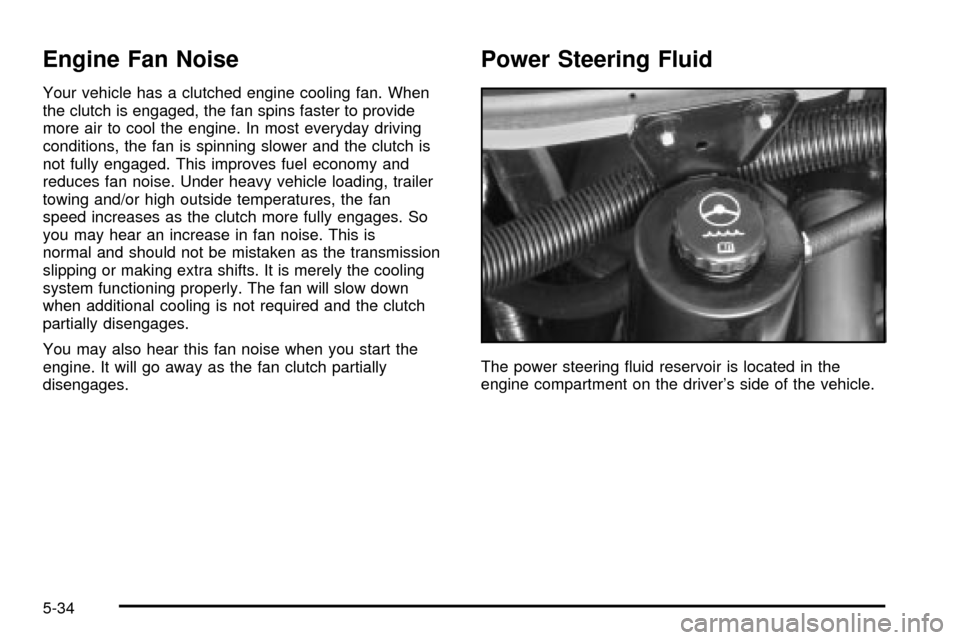
Power Steering Fluid
The power steering ¯uid reservoir is located in the
engine compartment on the driver's side of the vehicle.
5-34
Page 379 of 386

Locks............................................................. 2-8
Cargo Door Relocking.................................... 2-8
Door........................................................... 2-7
Leaving Your Vehicle....................................2-10
Lockout Protection.......................................2-10
Power Door.................................................. 2-8
Rear Door Security Locks............................... 2-8
Loss of Control...............................................4-12
Low Coolant Warning Light..............................3-33
M
Maintenance, Normal Replacement Parts..........5-100
Maintenance Schedule.....................................6-11
At Each Fuel Fill.........................................6-11
At Least Once a Month................................6-11
At Least Once a Year..................................6-13
At Least Twice a Year..................................6-12
At the First 100, 1,000 and 6,000 Miles
(160, 1 600 and 10 000km).......................6-11
Brake System Inspection..............................6-17
Engine Cooling System Inspection.................6-16
Exhaust System Inspection...........................6-16
Fuel System Inspection................................6-16
How This Section is Organized....................... 6-3
Introduction.................................................. 6-2
Maintenance Requirements............................. 6-2
Part A - Scheduled Maintenance Services......... 6-4Maintenance Schedule (cont.)
Part B - Owner Checks and Services.............6-11
Part C - Periodic MaintenanceInspections......6-16
Part D - Recommended Fluids and
Lubricants...............................................6-18
Part E - Maintenance Record........................6-20
Rear Axle Service........................................6-17
Scheduled Maintenance................................. 6-5
Steering and Suspension Inspection...............6-16
Throttle System Inspection............................6-17
Transfer Case and Front Axle
(All-Wheel Drive) Inspection.......................6-17
Using Your................................................... 6-4
Your Vehicle and the Environment................... 6-2
Maintenance When Trailer Towing.....................4-43
Making Turns.................................................4-42
Malfunction Indicator Light................................3-33
Manual Seats................................................... 1-3
Manual Windows............................................2-16
Matching Transmitter(s) to Your Vehicle............... 2-5
Mexico, Central America and Caribbean Islands/
Countries (Except Puerto Rico and
U.S. Virgin Islands) ± Customer Assistance....... 7-4
Mirrors..........................................................2-31
Manual Rearview Mirror................................2-31
Outside Camper-Type Mirrors........................2-32
Outside Convex Mirror.................................2-34
Outside Heated Mirrors................................2-34
9
Page 382 of 386

Rear Door Security Locks.................................. 2-8
Rear Doors....................................................2-14
Rear Heating System......................................3-20
Rear Safety Belt Comfort Guides......................1-31
Rear Seat Audio (RSA)....................................3-71
Rear Seat Operation......................................... 1-6
Rear Seat Outside Passenger Positions.............1-28
Rear Seat Passengers, Safety Belts..................1-28
Rear Seat Radio Controls................................3-71
Rear Window Defogger....................................3-23
Rearview Mirrors.............................................2-31
Reclining Seatbacks.......................................... 1-4
Recreational Vehicle Towing.............................4-29
Remote Keyless Entry System, Operation............ 2-4
Remote Keyless Entry System............................ 2-3
Removing the Flat Tire and Installing the
Spare Tire..................................................5-72
Removing the Rear Seat................................... 1-6
Removing the Spare Tire and Tools...................5-66
Removing the Wheel Covers............................5-72
Replacement Bulbs.........................................5-54
Replacing Brake System Parts..........................5-40
Replacing Restraint System Parts After
a Crash.....................................................1-75
Replacing the Rear Seats.................................. 1-8
Reporting Safety Defects................................... 7-9
Canadian Government................................... 7-9
General Motors............................................. 7-9
United States Government.............................. 7-8Restraint System Check...................................6-12
Checking Your Restraint Systems...................1-74
Replacing Restraint System Parts After
a Crash..................................................1-75
Restraint Systems...........................................1-74
Checking....................................................1-74
Replacing Parts...........................................1-75
Resynchronization............................................. 2-5
Retained Accessory Power (RAP)......................2-21
Right Front Passenger Position, Safety Belts......1-25
Roadside......................................................... 7-5
Assistance Program....................................... 7-5
Rocking Your Vehicle To Get It Out...................4-28
Running Your Engine While You Are Parked.......2-30
S
Safety Belt.....................................................3-26
Reminder Light............................................3-26
Safety Belts...................................................5-83
Care of......................................................5-83
Center Passenger Position....................1-25, 1-26
Driver Position............................................1-16
How to Wear Safety Belts Properly................1-15
Questions and Answers About Safety Belts.....1-14
Rear Safety Belt Comfort Guides for Children
and Small Adults......................................1-31
Rear Seat Passengers.................................1-28
Right Front Passenger Position......................1-25
12
Page 384 of 386

T
Taillamps.......................................................5-52
Theft-Deterrent, Radio.....................................3-73
Theft-Deterrent Systems...................................2-19
Passlock
ž...................................................2-19
Throttle System Inspection...............................6-17
Tilt Wheel........................................................ 3-7
Tire In¯ation Check.........................................6-11
Tires.............................................................5-56
Buying New Tires........................................5-60
Chains.......................................................5-63
Changing a Flat Tire....................................5-65
Dual Tire Operation.....................................5-57
If a Tire Goes Flat.......................................5-64
In¯ation -- Tire Pressure...............................5-56
Inspection and Rotation................................5-58
Uniform Tire Quality Grading.........................5-61
Wheel Alignment and Tire Balance.................5-62
Wheel Replacement.....................................5-62
When It Is Time for New Tires......................5-59
To Use the Engine Coolant Heater....................2-23
Top Strap Anchor Location...............................1-50
Top Strap......................................................1-48
Torque Lock...................................................2-28
Total Weight on Your Vehicle's Tires..................4-39
Tow/Haul Mode Light.......................................3-38
Tow/Haul Mode...............................................4-32Towing..........................................................4-29
Recreational Vehicle.....................................4-29
Towing a Trailer..........................................4-31
Your Vehicle...............................................4-29
Trailer Brakes.................................................4-40
Trailer Wiring Harness.....................................4-44
Transfer Case................................................5-46
Transmission Operation, Automatic....................2-24
Transmission, Transaxle, Transfer Case Unit
Repair Manual............................................7-10
Transmission..................................................5-19
Fluid, Automatic...........................................5-19
Transportation Options...................................... 7-7
Trip Odometer................................................3-25
Turn and Lane Change Signals.......................... 3-8
Turn Signal/Multifunction Lever........................... 3-7
Turn Signals When Towing a Trailer..................4-42
U
Underbody Flushing Service.............................6-15
Understanding Radio Reception........................3-73
Uniform Tire Quality Grading............................5-61
United States ± Customer Assistance.................. 7-4
Using Cleaner on Fabric..................................5-81
Using RDS............................................3-51, 3-62
Using Song List Mode.....................................3-69
14