driver CHEVROLET EXPRESS CARGO VAN 2004 1.G Owners Manual
[x] Cancel search | Manufacturer: CHEVROLET, Model Year: 2004, Model line: EXPRESS CARGO VAN, Model: CHEVROLET EXPRESS CARGO VAN 2004 1.GPages: 406, PDF Size: 2.66 MB
Page 7 of 406
Front Seats......................................................1-3
Manual Seats................................................1-3
Power Seat...................................................1-4
Reclining Seatbacks........................................1-4
Rear Seats.......................................................1-6
Rear Seat Operation.......................................1-6
Safety Belts...................................................1-10
Safety Belts: They Are for Everyone................1-10
Questions and Answers About Safety Belts......1-14
How to Wear Safety Belts Properly.................1-15
Driver Position..............................................1-15
Safety Belt Use During Pregnancy..................1-23
Right Front Passenger Position.......................1-24
Center Passenger Position
(2nd Row)................................................1-24
Center Passenger Position
(3rd, 4th and 5th Row)...............................1-25
Rear Seat Passengers..................................1-27
Rear Safety Belt Comfort Guides for
Children and Small Adults..........................1-31
Safety Belt Extender.....................................1-33Child Restraints.............................................1-34
Older Children..............................................1-34
Infants and Young Children............................1-36
Child Restraint Systems.................................1-43
Where to Put the Restraint.............................1-46
Top Strap....................................................1-50
Top Strap Anchor Location.............................1-51
Lower Anchorages and Top Tethers for
Children (LATCH System)...........................1-53
Securing a Child Restraint Designed for the
LATCH System (Rear)...............................1-55
Securing a Child Restraint Designed for the
LATCH System (Front)...............................1-56
Securing a Child Restraint in a Rear Outside
Seat Position............................................1-58
Securing a Child Restraint in a Center Seat
Position (2nd Row)....................................1-61
Securing a Child Restraint in a Center Seat
Position (3rd, 4th
and 5th Row)............................................1-62
Securing a Child Restraint in the Right Front
Seat Position............................................1-65
Section 1 Seats and Restraint Systems
1-1
Page 9 of 406
Front Seats
Manual Seats
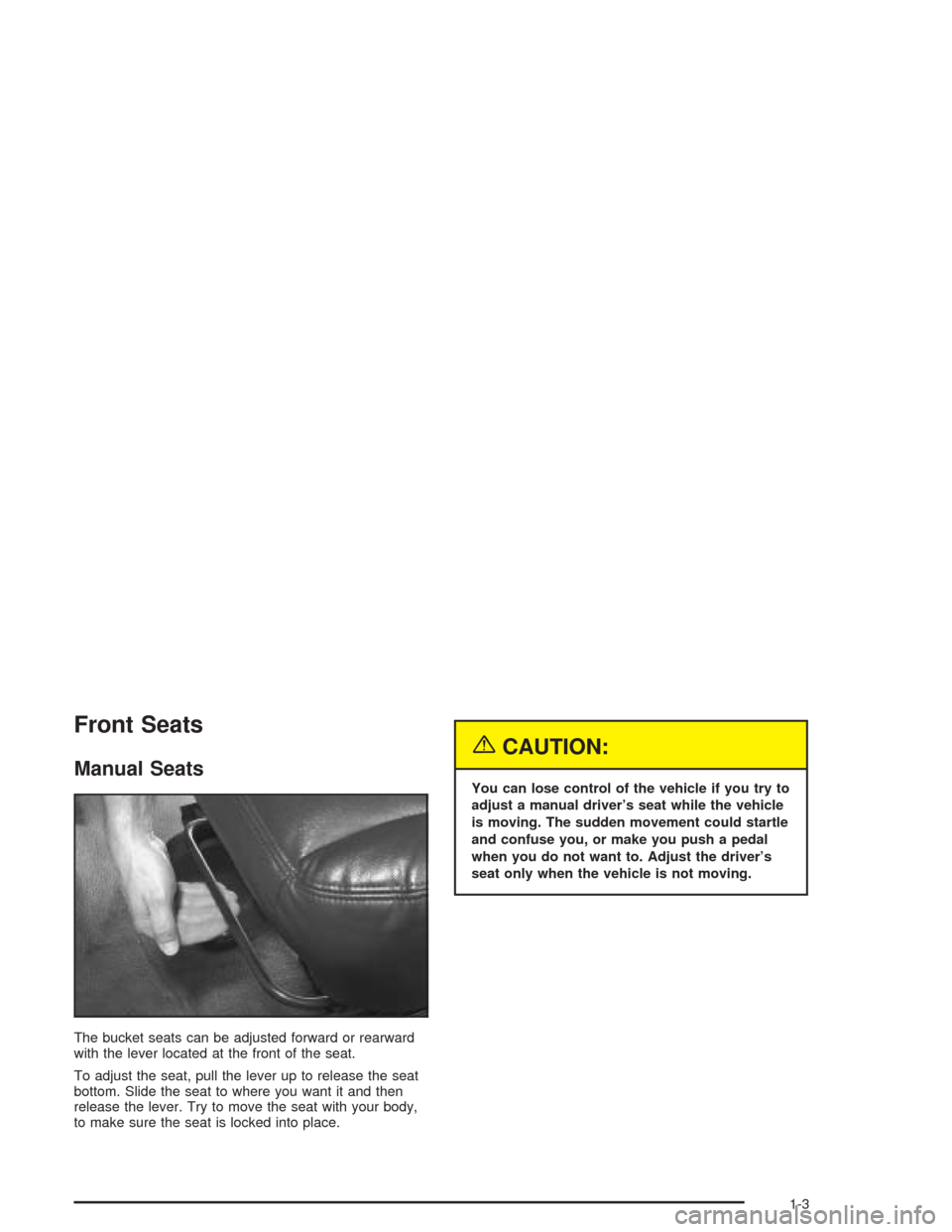
The bucket seats can be adjusted forward or rearward
with the lever located at the front of the seat.
To adjust the seat, pull the lever up to release the seat
bottom. Slide the seat to where you want it and then
release the lever. Try to move the seat with your body,
to make sure the seat is locked into place.
{CAUTION:
You can lose control of the vehicle if you try to
adjust a manual driver’s seat while the vehicle
is moving. The sudden movement could startle
and confuse you, or make you push a pedal
when you do not want to. Adjust the driver’s
seat only when the vehicle is not moving.
1-3
Page 10 of 406
Power Seat
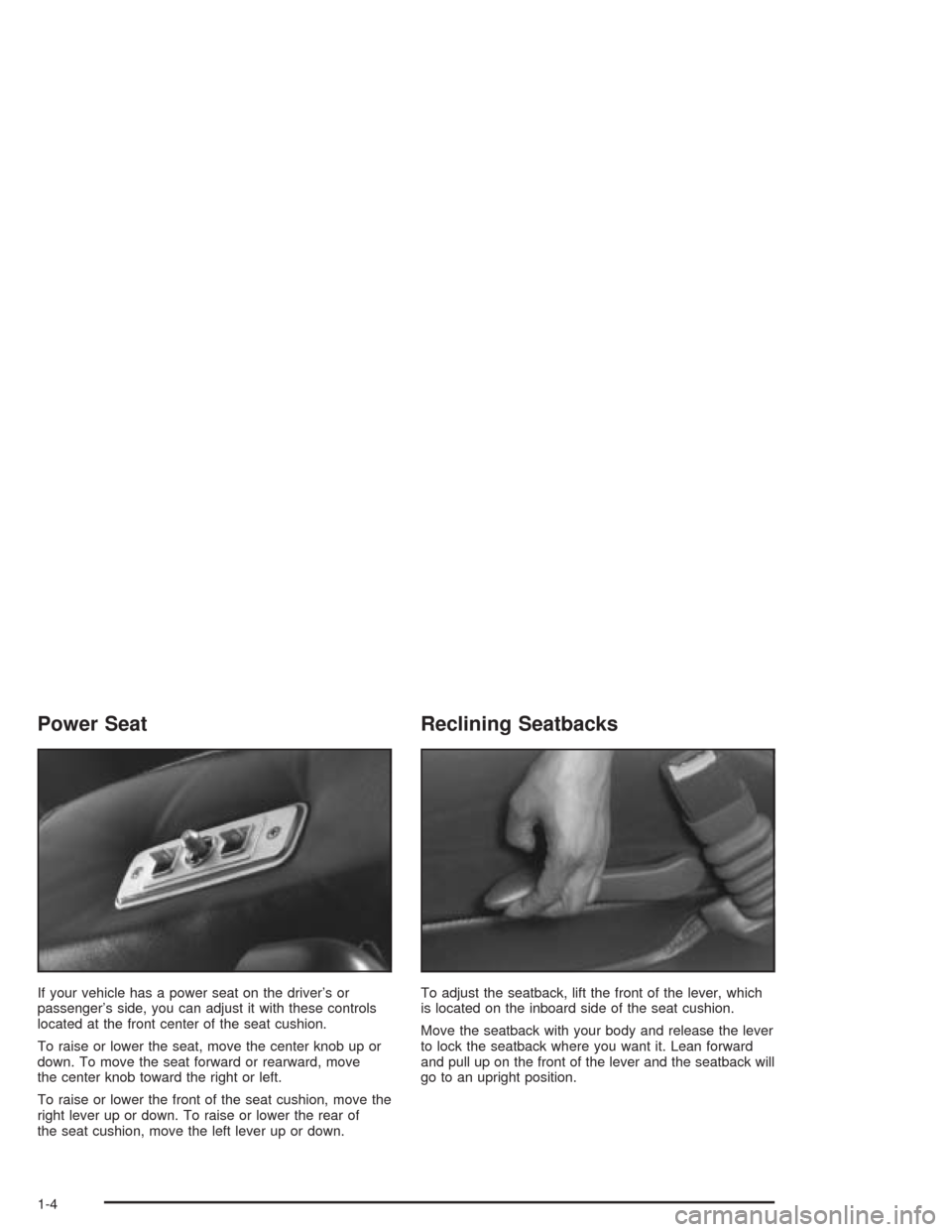
If your vehicle has a power seat on the driver’s or
passenger’s side, you can adjust it with these controls
located at the front center of the seat cushion.
To raise or lower the seat, move the center knob up or
down. To move the seat forward or rearward, move
the center knob toward the right or left.
To raise or lower the front of the seat cushion, move the
right lever up or down. To raise or lower the rear of
the seat cushion, move the left lever up or down.
Reclining Seatbacks
To adjust the seatback, lift the front of the lever, which
is located on the inboard side of the seat cushion.
Move the seatback with your body and release the lever
to lock the seatback where you want it. Lean forward
and pull up on the front of the lever and the seatback will
go to an upright position.
1-4
Page 12 of 406
Rear Seats
Rear Seat Operation
Removing the Rear Seat
1. Disconnect the quick
release latch plates for
the lap shoulder belts
on the bench seat to be
removed. To do this,
press the tip of a key
into the release hole of
the safety belt buckle
while pulling up on the
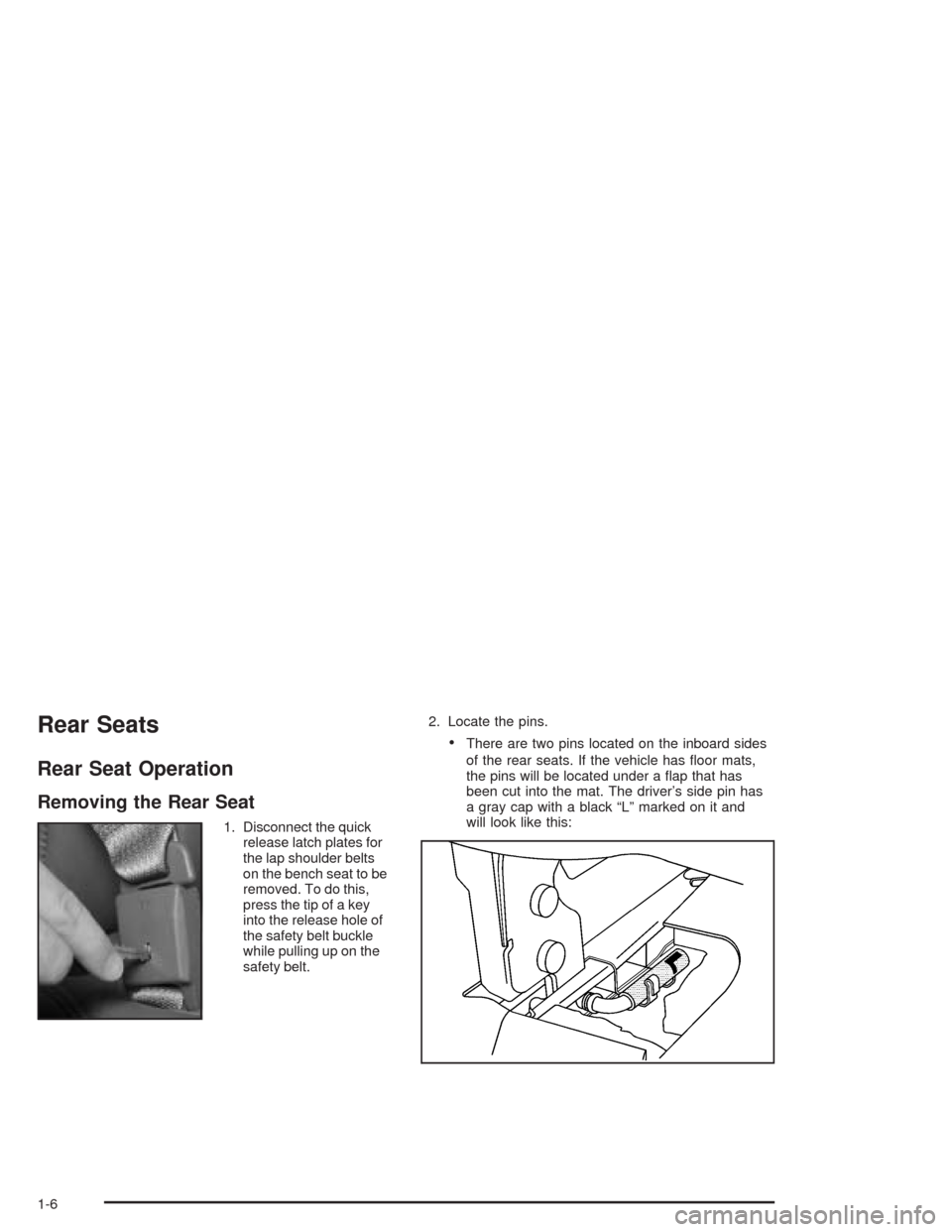
safety belt.2. Locate the pins.
There are two pins located on the inboard sides
of the rear seats. If the vehicle has oor mats,
the pins will be located under a ap that has
been cut into the mat. The driver’s side pin has
a gray cap with a black “L” marked on it and
will look like this:
1-6
Page 14 of 406
Replacing the Rear Seats
{CAUTION:
A seat that isn’t locked into place properly can
move around in a collision or sudden stop.
People in the vehicle could be injured. Be sure
to lock the seat into place properly when
installing it.
{CAUTION:
A safety belt that is improperly routed, not
properly attached, or twisted will not provide
the protection needed in a crash. The person
wearing the belt could be seriously injured.
After raising the rear seatback, always check
to be sure that the safety belts are properly
routed and attached, and are not twisted.1. Position the seat into the open slots in both rails.
Push the seat forward in the rail, hooking both
seat bases onto the pins inside of the rails.
2. To install the locking pins at the rear of the seat
base, locate the hole in the rail for the pin. It is
found on the inboard side of the seat. If the vehicle
has oor mats, pull the ap that has been cut
into the mat.
3. Insert the locking pin into the seat base and push
the seat to line up with the pin with the base. The
pin with the black cap marked “R” must be installed
on the passenger’s side and the pin with the gray
cap marked “L” on the driver’s side.
1-8
Page 21 of 406
Q:If I’m a good driver, and I never drive far from
home, why should I wear safety belts?
A:You may be an excellent driver, but if you’re in an
accident – even one that isn’t your fault – you and
your passengers can be hurt. Being a good
driver doesn’t protect you from things beyond your
control, such as bad drivers.
Most accidents occur within 25 miles (40 km) of
home. And the greatest number of serious injuries
and deaths occur at speeds of less than 40 mph
(65 km/h).
Safety belts are for everyone.
How to Wear Safety Belts Properly
This part is only for people of adult size.
Be aware that there are special things to know about
safety belts and children. And there are different
rules for smaller children and babies. If a child will be
riding in your vehicle, seeOlder Children on page 1-34
orInfants and Young Children on page 1-36. Follow
those rules for everyone’s protection.
First, you’ll want to know which restraint systems your
vehicle has.
We’ll start with the driver position.
Driver Position
This part describes the driver’s restraint system.
Lap-Shoulder Belt
The driver has a lap-shoulder belt. Here’s how to wear it
properly.
1. Close and lock the door.
2. Adjust the seat so you can sit up straight. To see
how, see “Seats” in the Index.
1-15
Page 30 of 406
The best way to protect the fetus is to protect the
mother. When a safety belt is worn properly, it’s more
likely that the fetus won’t be hurt in a crash. For
pregnant women, as for anyone, the key to making
safety belts effective is wearing them properly.
Right Front Passenger Position
To learn how to wear the right front passenger’s safety
belt properly, seeDriver Position on page 1-15.
The right front passenger’s safety belt works the same
way as the driver’s safety belt – except for one thing.
If you ever pull the shoulder portion of the belt out all the
way, you will engage the child restraint locking feature.
If this happens, just let the belt go back all the way
and start again.
Center Passenger Position
(2nd Row)
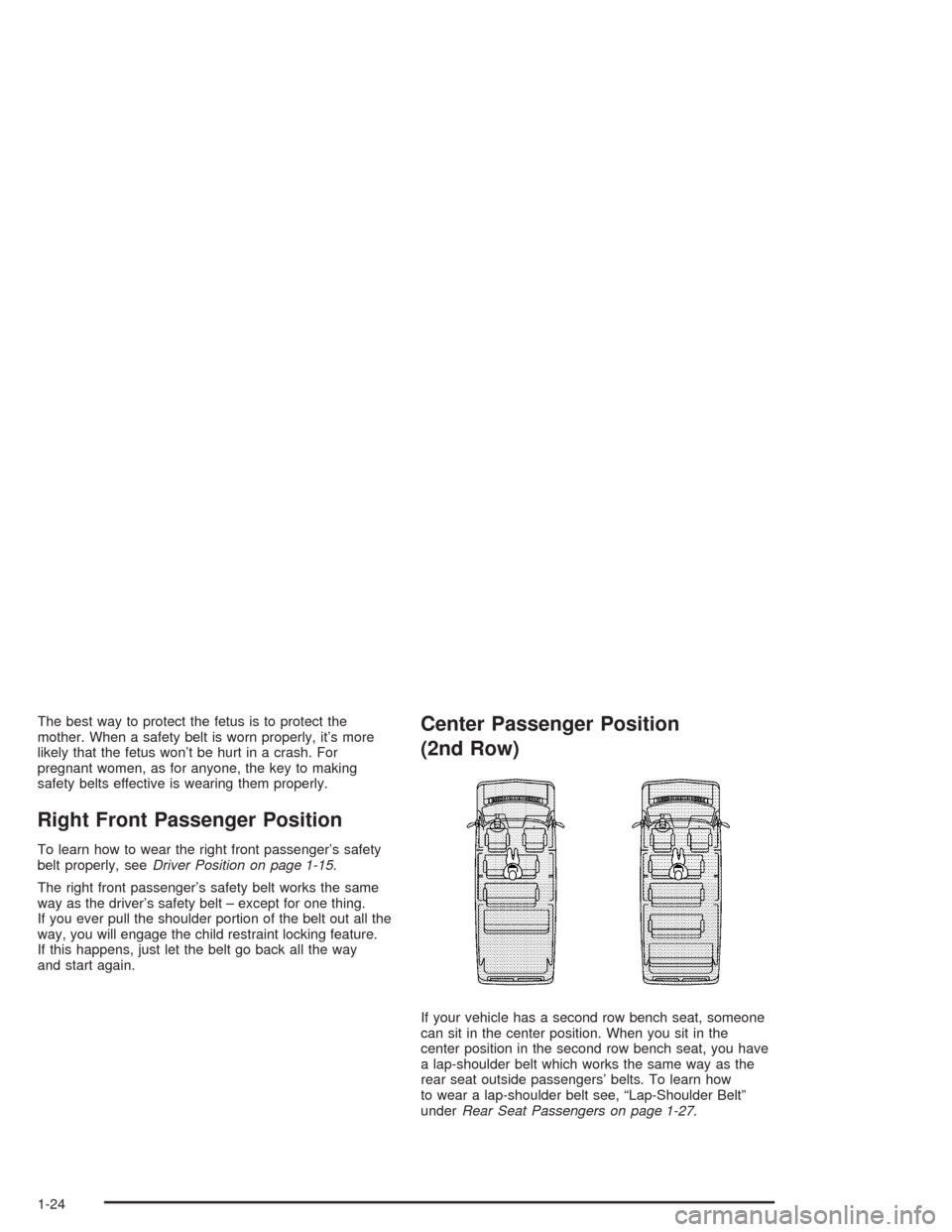
If your vehicle has a second row bench seat, someone
can sit in the center position. When you sit in the
center position in the second row bench seat, you have
a lap-shoulder belt which works the same way as the
rear seat outside passengers’ belts. To learn how
to wear a lap-shoulder belt see, “Lap-Shoulder Belt”
underRear Seat Passengers on page 1-27.
1-24
Page 58 of 406
Passenger Van
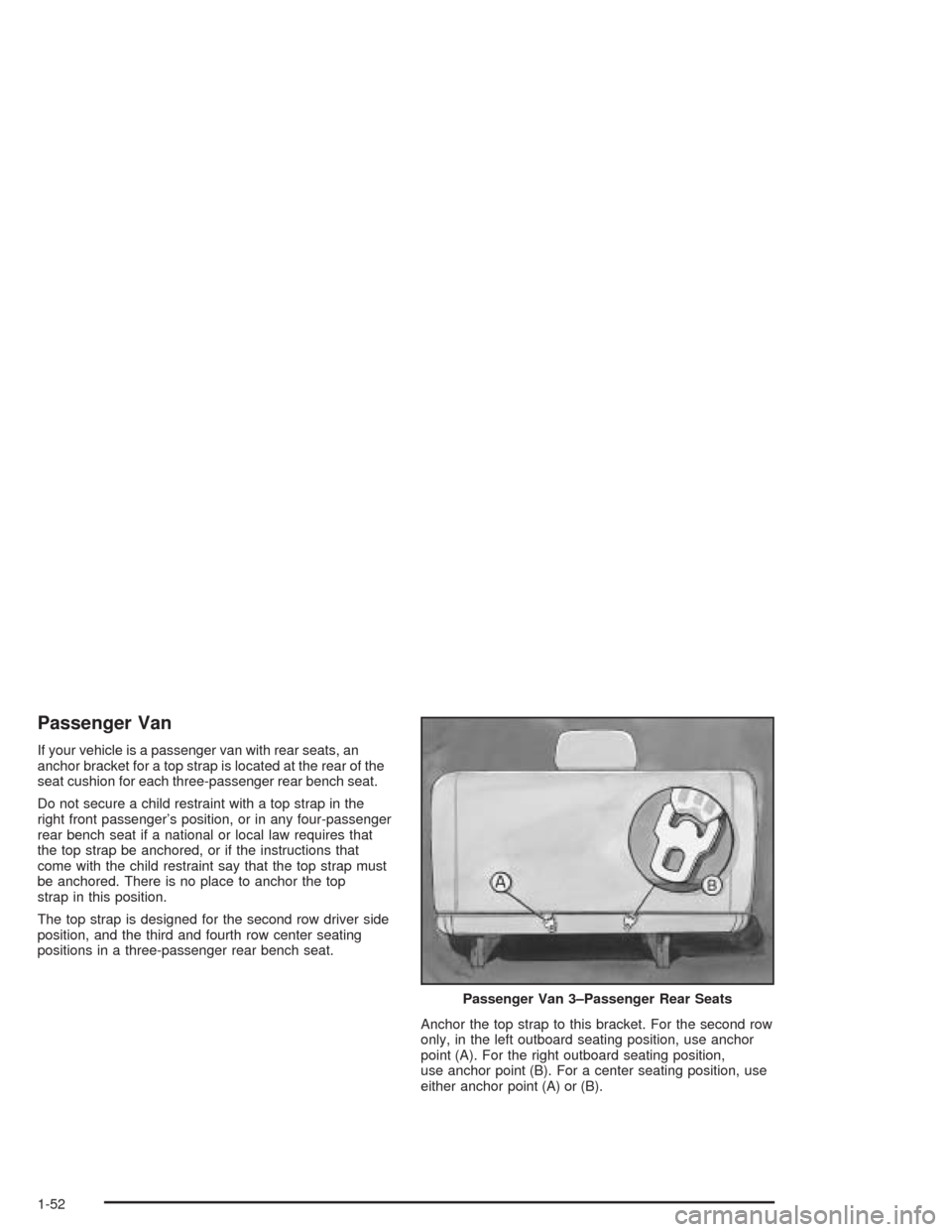
If your vehicle is a passenger van with rear seats, an
anchor bracket for a top strap is located at the rear of the
seat cushion for each three-passenger rear bench seat.
Do not secure a child restraint with a top strap in the
right front passenger’s position, or in any four-passenger
rear bench seat if a national or local law requires that
the top strap be anchored, or if the instructions that
come with the child restraint say that the top strap must
be anchored. There is no place to anchor the top
strap in this position.
The top strap is designed for the second row driver side
position, and the third and fourth row center seating
positions in a three-passenger rear bench seat.
Anchor the top strap to this bracket. For the second row
only, in the left outboard seating position, use anchor
point (A). For the right outboard seating position,
use anchor point (B). For a center seating position, use
either anchor point (A) or (B).Passenger Van 3–Passenger Rear Seats
1-52
Page 59 of 406
Lower Anchorages and Top Tethers
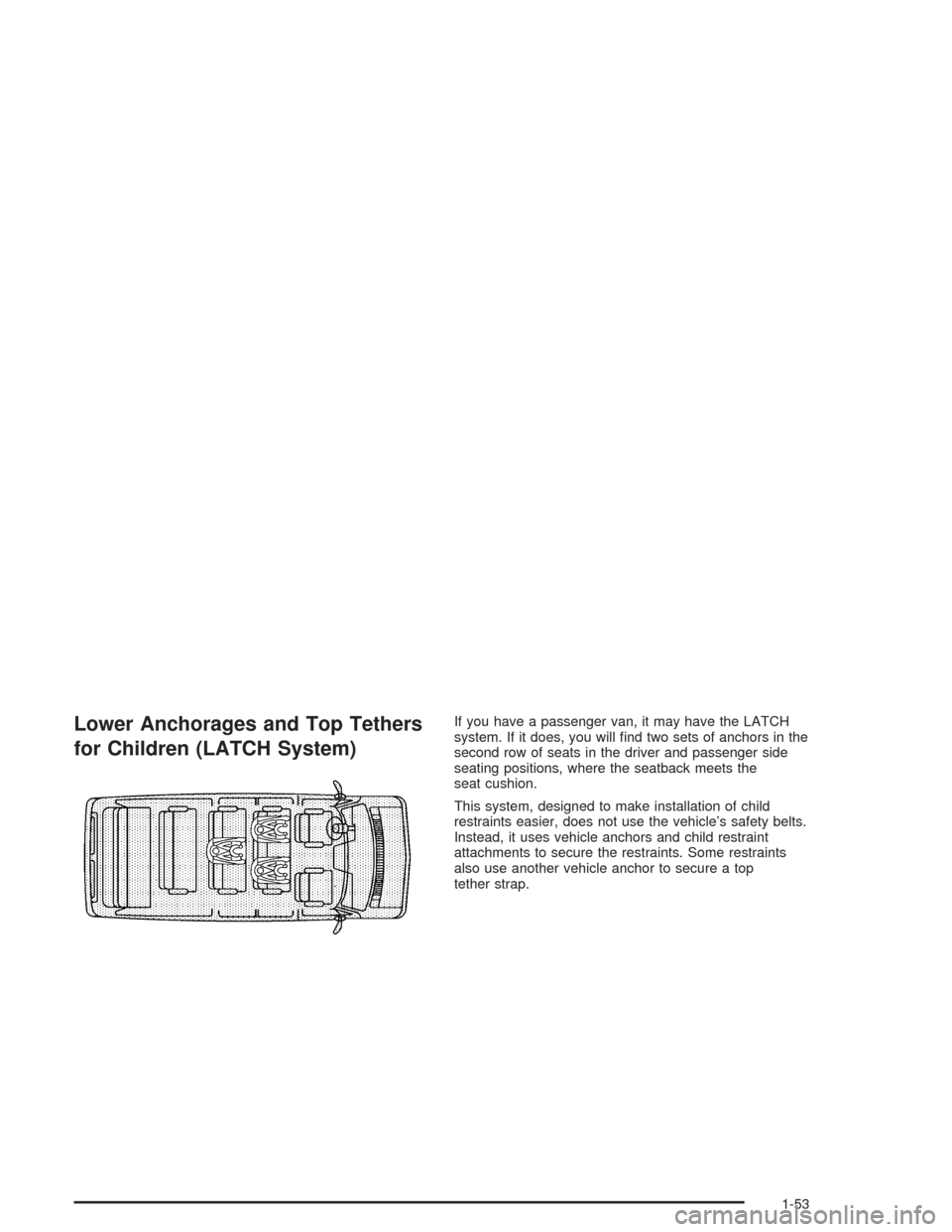
for Children (LATCH System)If you have a passenger van, it may have the LATCH
system. If it does, you will nd two sets of anchors in the
second row of seats in the driver and passenger side
seating positions, where the seatback meets the
seat cushion.
This system, designed to make installation of child
restraints easier, does not use the vehicle’s safety belts.
Instead, it uses vehicle anchors and child restraint
attachments to secure the restraints. Some restraints
also use another vehicle anchor to secure a top
tether strap.
1-53
Page 76 of 406
Air Bag System
This part explains the air bag system.
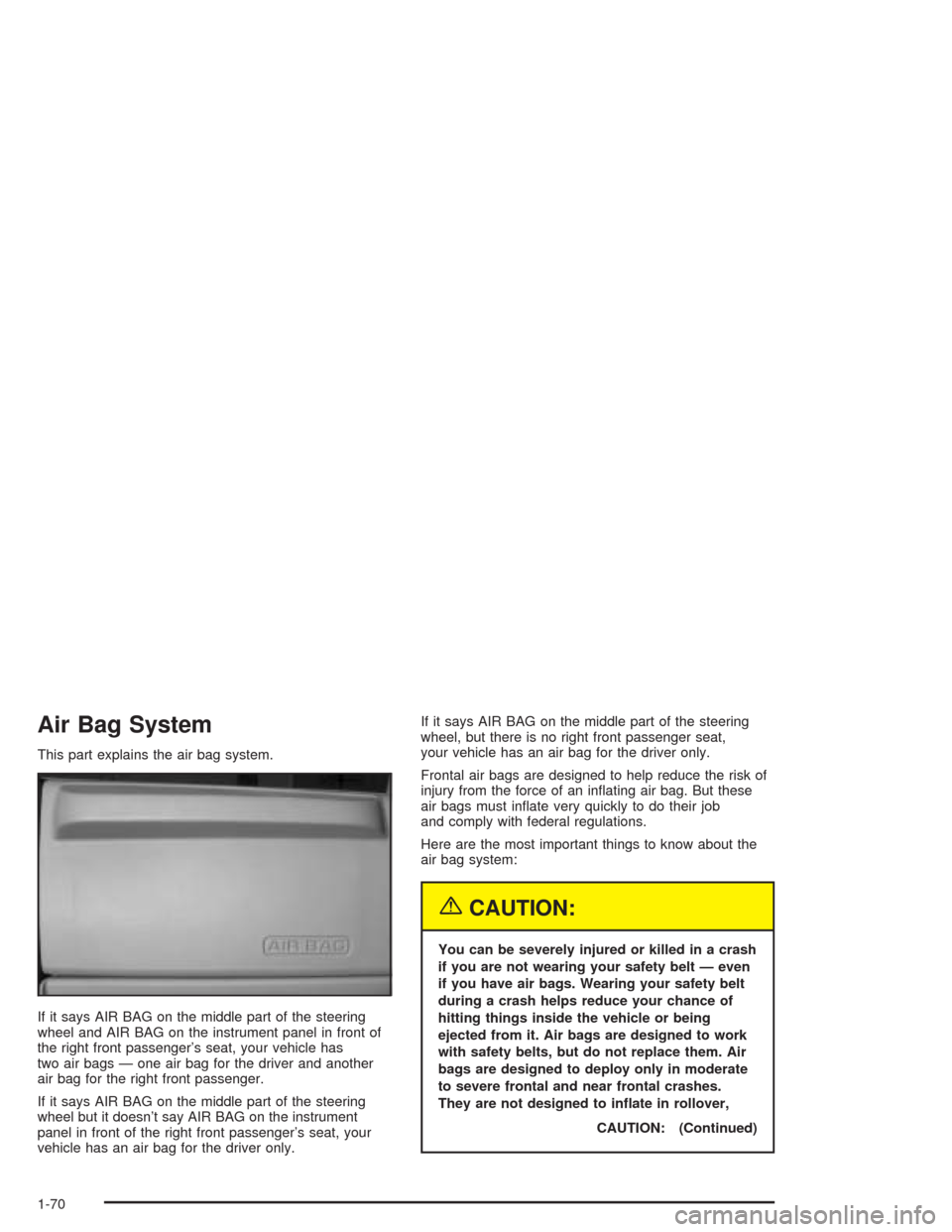
If it says AIR BAG on the middle part of the steering
wheel and AIR BAG on the instrument panel in front of
the right front passenger’s seat, your vehicle has
two air bags — one air bag for the driver and another
air bag for the right front passenger.
If it says AIR BAG on the middle part of the steering
wheel but it doesn’t say AIR BAG on the instrument
panel in front of the right front passenger’s seat, your
vehicle has an air bag for the driver only.If it says AIR BAG on the middle part of the steering
wheel, but there is no right front passenger seat,
your vehicle has an air bag for the driver only.
Frontal air bags are designed to help reduce the risk of
injury from the force of an inating air bag. But these
air bags must inate very quickly to do their job
and comply with federal regulations.
Here are the most important things to know about the
air bag system:
{CAUTION:
You can be severely injured or killed in a crash
if you are not wearing your safety belt — even
if you have air bags. Wearing your safety belt
during a crash helps reduce your chance of
hitting things inside the vehicle or being
ejected from it. Air bags are designed to work
with safety belts, but do not replace them. Air
bags are designed to deploy only in moderate
to severe frontal and near frontal crashes.
They are not designed to inate in rollover,
CAUTION: (Continued)
1-70