seats CHEVROLET EXPRESS CARGO VAN 2006 1.G Owner's Manual
[x] Cancel search | Manufacturer: CHEVROLET, Model Year: 2006, Model line: EXPRESS CARGO VAN, Model: CHEVROLET EXPRESS CARGO VAN 2006 1.GPages: 406, PDF Size: 2.51 MB
Page 144 of 406
Rear Window Defogger
Some vehicles may have a rear window defogger.
much snow from the window as possible.
The rear window defogger uses a warming grid to
remove fog or frost from the rear window and will only
work when the ignition is RUN.
The rear window defogger will turn off several minutes
after the button is pressed. If turned on again, the
defogger will run for several more minutes before turning
off. The defogger can also be turned off by pressing
the button again or by turning off the engine.
Notice:Do not use a razor blade or sharp object
to clear the inside rear window. Do not adhere
anything to the defogger grid lines in the rear glass.
These actions may damage the rear defogger.
Repairs would not be covered by your warranty.
Outlet Adjustment
Use the outlets located near the center and on the
sides of the instrument panel to change the direction
of airflow.
Operation Tips
•Clear away any ice, snow or leaves from the air
inlets at the base of the windshield that may
block the flow of air into your vehicle.
•Use of non-GM approved hood deflectors may
adversely affect the performance of the system.
•Keep the path under the front seats clear of objects
to help circulate the air inside of your vehicle more
effectively.
3-20
Page 146 of 406
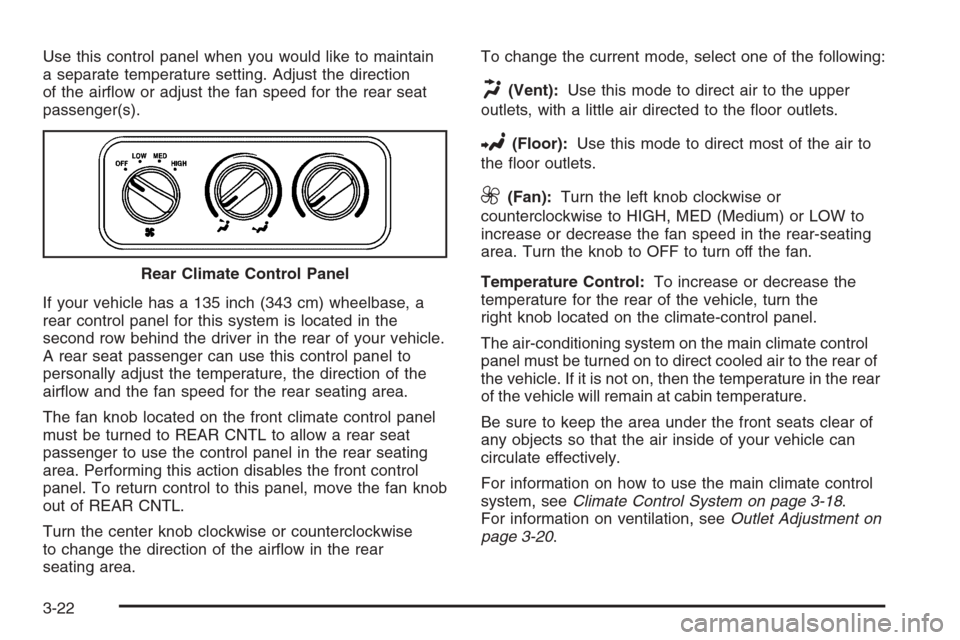
Use this control panel when you would like to maintain
a separate temperature setting. Adjust the direction
of the airflow or adjust the fan speed for the rear seat
passenger(s).
If your vehicle has a 135 inch (343 cm) wheelbase, a
rear control panel for this system is located in the
second row behind the driver in the rear of your vehicle.
A rear seat passenger can use this control panel to
personally adjust the temperature, the direction of the
airflow and the fan speed for the rear seating area.
The fan knob located on the front climate control panel
must be turned to REAR CNTL to allow a rear seat
passenger to use the control panel in the rear seating
area. Performing this action disables the front control
panel. To return control to this panel, move the fan knob
out of REAR CNTL.
Turn the center knob clockwise or counterclockwise
to change the direction of the airflow in the rear
seating area.To change the current mode, select one of the following:
H(Vent):Use this mode to direct air to the upper
outlets, with a little air directed to the floor outlets.
2(Floor):Use this mode to direct most of the air to
the floor outlets.
9(Fan):Turn the left knob clockwise or
counterclockwise to HIGH, MED (Medium) or LOW to
increase or decrease the fan speed in the rear-seating
area. Turn the knob to OFF to turn off the fan.
Temperature Control:To increase or decrease the
temperature for the rear of the vehicle, turn the
right knob located on the climate-control panel.
The air-conditioning system on the main climate control
panel must be turned on to direct cooled air to the rear of
the vehicle. If it is not on, then the temperature in the rear
of the vehicle will remain at cabin temperature.
Be sure to keep the area under the front seats clear of
any objects so that the air inside of your vehicle can
circulate effectively.
For information on how to use the main climate control
system, seeClimate Control System on page 3-18.
For information on ventilation, seeOutlet Adjustment on
page 3-20. Rear Climate Control Panel
3-22
Page 239 of 406
{CAUTION:
Things you put inside your vehicle can strike
and injure people in a sudden stop or turn,
or in a crash.
Put things in the cargo area of your
vehicle. Try to spread the weight evenly.
Never stack heavier things, like suitcases,
inside the vehicle so that some of them
are above the tops of the seats.
Do not leave an unsecured child restraint
in your vehicle.
When you carry something inside the
vehicle, secure it whenever you can.
Do not leave a seat folded down unless
you need to.
Add-On Equipment
When you carry removable items, you may need to put
a limit on how many people you carry inside your
vehicle. Be sure to weigh your vehicle before you buy
and install the new equipment.
Towing
Towing Your Vehicle
Consult your dealer or a professional towing service if
you need to have your disabled vehicle towed. See
Roadside Assistance Program on page 7-6.
If you want to tow your vehicle behind another vehicle
for recreational purposes (such as behind a motorhome),
see “Recreational Vehicle Towing” following.
Recreational Vehicle Towing
Recreational vehicle towing means towing your vehicle
behind another vehicle — such as behind a motorhome.
The two most common types of recreational vehicle
towing are known as “dinghy” (towing your vehicle with
all four wheels on the ground) and “dolly” (towing your
vehicle with two wheels on the ground and two wheels
up on a device known as a “dolly”).
With the proper preparation and equipment, many
vehicles can be towed in these ways. See “Dinghy
Towing” and “Dolly Towing” following.
4-35
Page 313 of 406
Tire Terminology and Denitions
Air Pressure:The amount of air inside the tire pressing
outward on each square inch of the tire. Air pressure
is expressed in pounds per square inch (psi) or
kilopascal (kPa).
Accessory Weight:This means the combined weight
of optional accessories. Some examples of optional
accessories are, automatic transmission, power steering,
power brakes, power windows, power seats, and air
conditioning.
Aspect Ratio:The relationship of a tire’s height to
its width.
Belt:A rubber coated layer of cords that is located
between the plies and the tread. Cords may be made
from steel or other reinforcing materials.
Bead:The tire bead contains steel wires wrapped by
steel cords that hold the tire onto the rim.
Bias Ply Tire:A pneumatic tire in which the plies are
laid at alternate angles less than 90 degrees to the
centerline of the tread.
Cold Ination Pressure:The amount of air pressure in
a tire, measured in pounds per square inch (psi) or
kilopascals (kPa) before a tire has built up heat
from driving. SeeInation - Tire Pressure on page 5-59.Curb Weight:This means the weight of a motor
vehicle with standard and optional equipment including
the maximum capacity of fuel, oil, and coolant, but
without passengers and cargo.
DOT Markings:A code molded into the sidewall of a
tire signifying that the tire is in compliance with the
U.S. Department of Transportation (DOT) motor vehicle
safety standards. The DOT code includes the Tire
Identification Number (TIN), an alphanumeric designator
which can also identify the tire manufacturer, production
plant, brand, and date of production.
GVWR:Gross Vehicle Weight Rating, seeLoading
Your Vehicle on page 4-30.
GAWR FRT:Gross Axle Weight Rating for the front
axle, seeLoading Your Vehicle on page 4-30.
GAWR RR:Gross Axle Weight Rating for the rear axle,
seeLoading Your Vehicle on page 4-30.
Intended Outboard Sidewall:The side of an
asymmetrical tire, that must always face outward
when mounted on a vehicle.
Kilopascal (kPa):The metric unit for air pressure.
Light Truck (LT-Metric) Tire:A tire used on light duty
trucks and some multipurpose passenger vehicles.
5-57
Page 400 of 406
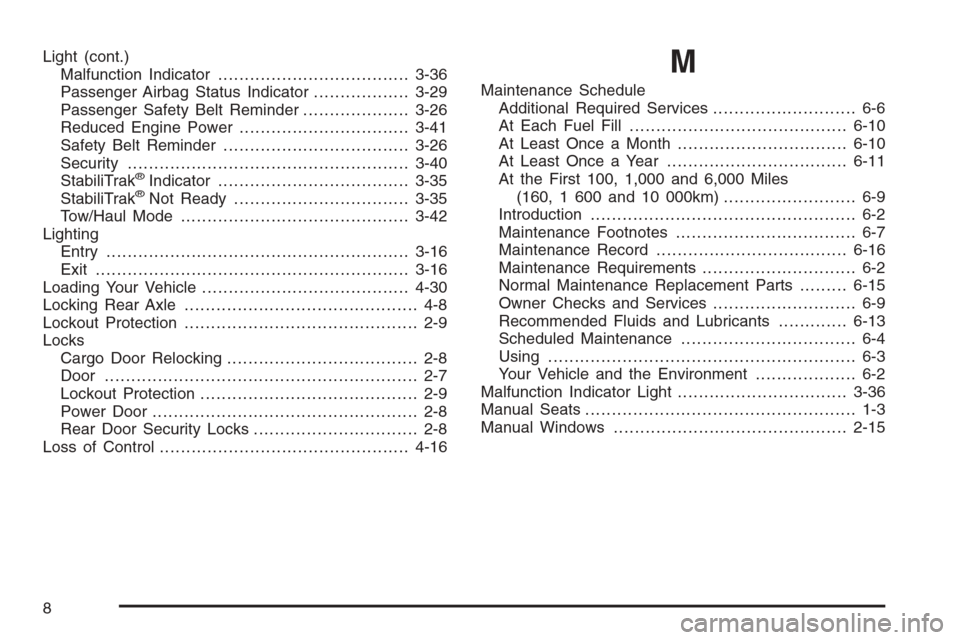
Light (cont.)
Malfunction Indicator....................................3-36
Passenger Airbag Status Indicator..................3-29
Passenger Safety Belt Reminder....................3-26
Reduced Engine Power................................3-41
Safety Belt Reminder...................................3-26
Security.....................................................3-40
StabiliTrak
®Indicator....................................3-35
StabiliTrak®Not Ready.................................3-35
Tow/Haul Mode ...........................................3-42
Lighting
Entry.........................................................3-16
Exit ...........................................................3-16
Loading Your Vehicle.......................................4-30
Locking Rear Axle............................................ 4-8
Lockout Protection............................................ 2-9
Locks
Cargo Door Relocking.................................... 2-8
Door ........................................................... 2-7
Lockout Protection......................................... 2-9
Power Door .................................................. 2-8
Rear Door Security Locks............................... 2-8
Loss of Control...............................................4-16
M
Maintenance Schedule
Additional Required Services........................... 6-6
At Each Fuel Fill.........................................6-10
At Least Once a Month................................6-10
At Least Once a Year..................................6-11
At the First 100, 1,000 and 6,000 Miles
(160, 1 600 and 10 000km)......................... 6-9
Introduction.................................................. 6-2
Maintenance Footnotes.................................. 6-7
Maintenance Record....................................6-16
Maintenance Requirements............................. 6-2
Normal Maintenance Replacement Parts.........6-15
Owner Checks and Services........................... 6-9
Recommended Fluids and Lubricants.............6-13
Scheduled Maintenance................................. 6-4
Using.......................................................... 6-3
Your Vehicle and the Environment................... 6-2
Malfunction Indicator Light................................3-36
Manual Seats................................................... 1-3
Manual Windows............................................2-15
8
Page 404 of 406
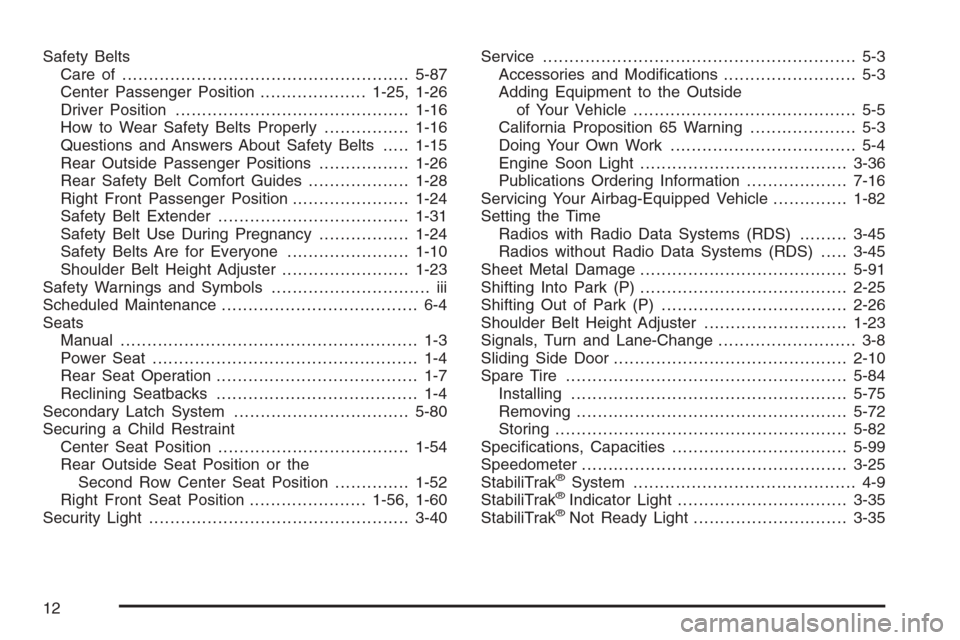
Safety Belts
Care of ......................................................5-87
Center Passenger Position....................1-25, 1-26
Driver Position............................................1-16
How to Wear Safety Belts Properly................1-16
Questions and Answers About Safety Belts.....1-15
Rear Outside Passenger Positions.................1-26
Rear Safety Belt Comfort Guides...................1-28
Right Front Passenger Position......................1-24
Safety Belt Extender....................................1-31
Safety Belt Use During Pregnancy.................1-24
Safety Belts Are for Everyone.......................1-10
Shoulder Belt Height Adjuster........................1-23
Safety Warnings and Symbols.............................. iii
Scheduled Maintenance..................................... 6-4
Seats
Manual........................................................ 1-3
Power Seat.................................................. 1-4
Rear Seat Operation...................................... 1-7
Reclining Seatbacks...................................... 1-4
Secondary Latch System.................................5-80
Securing a Child Restraint
Center Seat Position....................................1-54
Rear Outside Seat Position or the
Second Row Center Seat Position..............1-52
Right Front Seat Position......................1-56, 1-60
Security Light.................................................3-40Service........................................................... 5-3
Accessories and Modifications......................... 5-3
Adding Equipment to the Outside
of Your Vehicle.......................................... 5-5
California Proposition 65 Warning.................... 5-3
Doing Your Own Work................................... 5-4
Engine Soon Light.......................................3-36
Publications Ordering Information...................7-16
Servicing Your Airbag-Equipped Vehicle..............1-82
Setting the Time
Radios with Radio Data Systems (RDS).........3-45
Radios without Radio Data Systems (RDS).....3-45
Sheet Metal Damage.......................................5-91
Shifting Into Park (P).......................................2-25
Shifting Out of Park (P)...................................2-26
Shoulder Belt Height Adjuster...........................1-23
Signals, Turn and Lane-Change.......................... 3-8
Sliding Side Door............................................2-10
Spare Tire.....................................................5-84
Installing....................................................5-75
Removing...................................................5-72
Storing.......................................................5-82
Specifications, Capacities.................................5-99
Speedometer..................................................3-25
StabiliTrak
®System.......................................... 4-9
StabiliTrak®Indicator Light................................3-35
StabiliTrak®Not Ready Light.............................3-35
12