seats CHEVROLET EXPRESS CARGO VAN 2006 1.G User Guide
[x] Cancel search | Manufacturer: CHEVROLET, Model Year: 2006, Model line: EXPRESS CARGO VAN, Model: CHEVROLET EXPRESS CARGO VAN 2006 1.GPages: 406, PDF Size: 2.51 MB
Page 31 of 406
Center Passenger Position
(3rd, 4th and 5th Row)
Lap Belt
If your vehicle has third, fourth or fifth row bench seats,
someone can sit in the center positions.
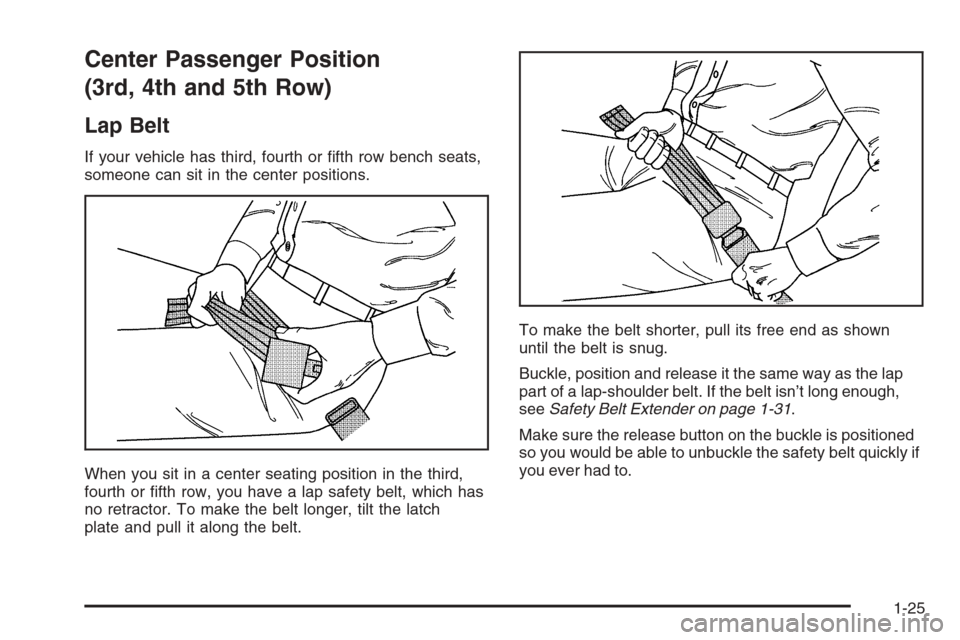
When you sit in a center seating position in the third,
fourth or fifth row, you have a lap safety belt, which has
no retractor. To make the belt longer, tilt the latch
plate and pull it along the belt.To make the belt shorter, pull its free end as shown
until the belt is snug.
Buckle, position and release it the same way as the lap
part of a lap-shoulder belt. If the belt isn’t long enough,
seeSafety Belt Extender on page 1-31.
Make sure the release button on the buckle is positioned
so you would be able to unbuckle the safety belt quickly if
you ever had to.
1-25
Page 34 of 406
The safety belt locks if there is a sudden stop or a crash.
{CAUTION:
You can be seriously hurt if your shoulder belt
is too loose. In a crash, you would move
forward too much, which could increase injury.
The shoulder belt should t against your body.
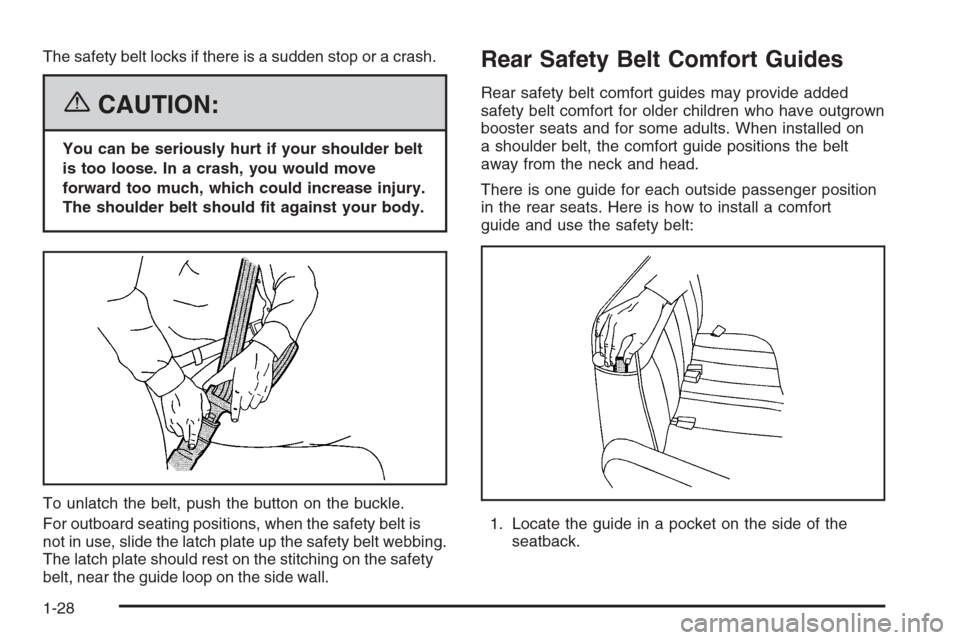
To unlatch the belt, push the button on the buckle.
For outboard seating positions, when the safety belt is
not in use, slide the latch plate up the safety belt webbing.
The latch plate should rest on the stitching on the safety
belt, near the guide loop on the side wall.
Rear Safety Belt Comfort Guides
Rear safety belt comfort guides may provide added
safety belt comfort for older children who have outgrown
booster seats and for some adults. When installed on
a shoulder belt, the comfort guide positions the belt
away from the neck and head.
There is one guide for each outside passenger position
in the rear seats. Here is how to install a comfort
guide and use the safety belt:
1. Locate the guide in a pocket on the side of the
seatback.
1-28
Page 37 of 406
Safety Belt Extender
If the vehicle’s safety belt will fasten around you, you
should use it.
But if a safety belt is not long enough, your dealer will
order you an extender. It is free. When you go in to order
it, take the heaviest coat you will wear, so the extender
will be long enough for you. To help avoid personal injury,
do not let someone else use it, and use it only for the seat
it is made to fit. The extender has been designed for
adults. Never use it for securing child seats. To wear
it, just attach it to the regular safety belt. For more
information, see the instruction sheet that comes with
the extender.
Child Restraints
Older Children
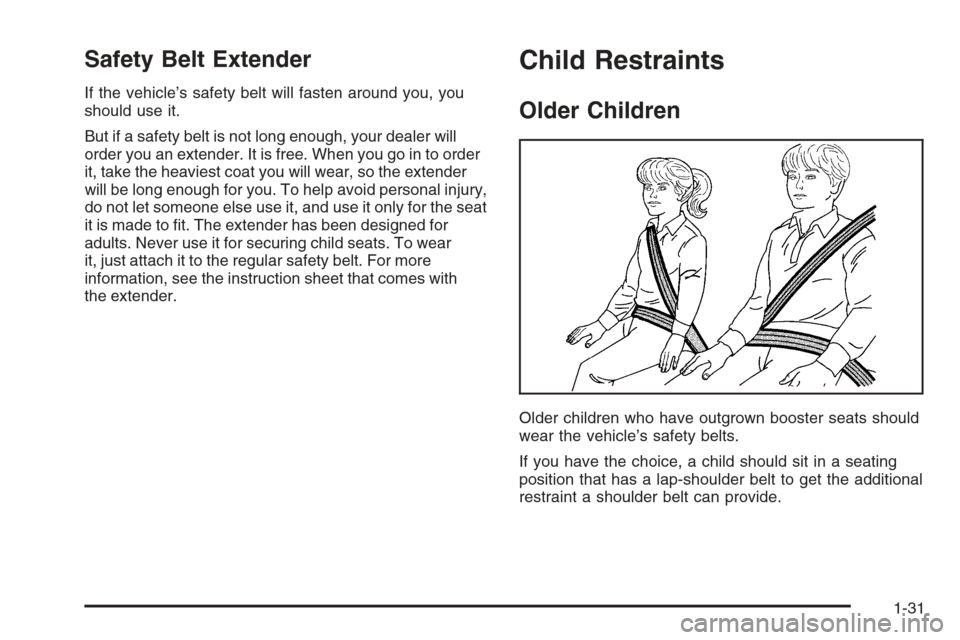
Older children who have outgrown booster seats should
wear the vehicle’s safety belts.
If you have the choice, a child should sit in a seating
position that has a lap-shoulder belt to get the additional
restraint a shoulder belt can provide.
1-31
Page 44 of 406
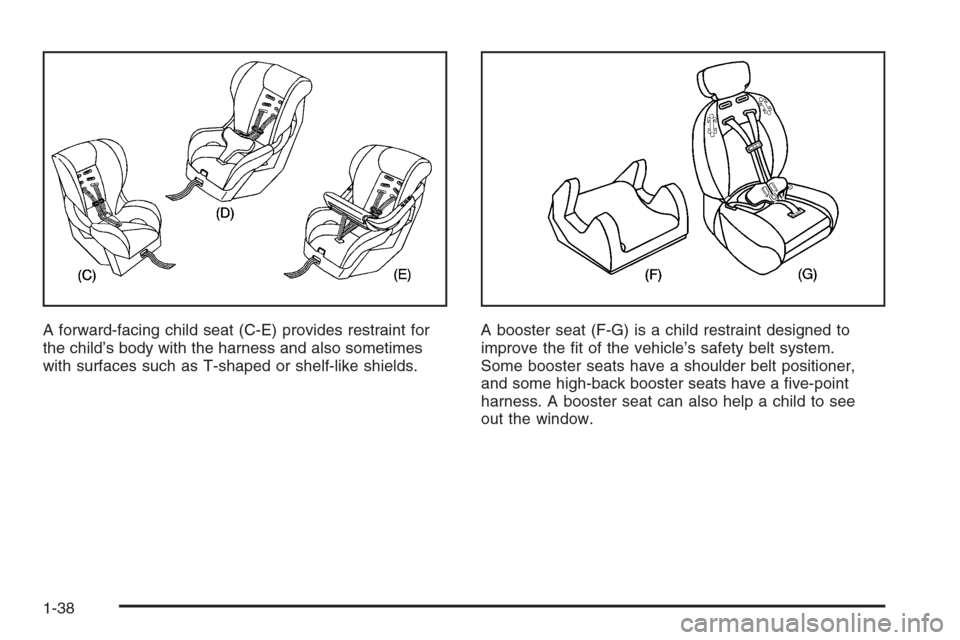
A forward-facing child seat (C-E) provides restraint for
the child’s body with the harness and also sometimes
with surfaces such as T-shaped or shelf-like shields.A booster seat (F-G) is a child restraint designed to
improve the fit of the vehicle’s safety belt system.
Some booster seats have a shoulder belt positioner,
and some high-back booster seats have a five-point
harness. A booster seat can also help a child to see
out the window.
1-38
Page 45 of 406
Q:How Should I Use a Child Restraint?
A:A child restraint system is any device designed for
use in a motor vehicle to restrain, seat, or position
children. A built-in child restraint system is a
permanent part of the motor vehicle. An add-on
child restraint system is a portable one, which
is purchased by the vehicle’s owner. To help reduce
injuries, an add-on child restraint must be secured
in the vehicle. With built-in or add-on child
restraints, the child has to be secured within the
child restraint.
When choosing an add-on child restraint, be sure
the child restraint is designed to be used in a
vehicle. If it is, it will have a label saying that it
meets federal motor vehicle safety standards. Then
follow the instructions for the restraint. You may
find these instructions on the restraint itself or in a
booklet, or both.
Securing an Add-on Child Restraint
in the Vehicle
{CAUTION:
A child can be seriously injured or killed in a
crash if the child restraint is not properly
secured in the vehicle. Make sure the child
restraint is properly installed in the vehicle
using the vehicle’s safety belt or LATCH
system, following the instructions that came
with that restraint, and also the instructions in
this manual.
To help reduce the chance of injury, the child restraint
must be secured in the vehicle. Child restraint systems
must be secured in vehicle seats by lap belts or the
lap belt portion of a lap-shoulder belt, or by the LATCH
system. SeeLower Anchors and Tethers for Children
(LATCH) on page 1-43for more information. A child can
be endangered in a crash if the child restraint is not
properly secured in the vehicle.
1-39
Page 64 of 406
If you need to secure a forward-facing child restraint in
the right front seat position, move the seat as far
back as it will go before securing the forward-facing
child restraint. SeeManual Seats on page 1-3or
Power Seat on page 1-4.
If your child restraint is equipped with the LATCH
system, seeLower Anchors and Tethers for Children
(LATCH) on page 1-43.
You will be using the lap-shoulder belt to secure the
child restraint in this position. Be sure to follow the
instructions that came with the child restraint. Secure
the child in the child restraint when and as the
instructions say.
1. Your vehicle has a right front passenger’s frontal
airbag. SeePassenger Sensing System on
page 1-76. General Motors recommends that
rear-facing child restraints be secured in a rear seat,
even if the airbag is off. If your child restraint is
forward-facing, move the seat as far back as it
will go before securing the child restraint in this seat.
SeeManual Seats on page 1-3orPower Seat
on page 1-4.
When the passenger sensing system has turned off
the right front passenger’s frontal airbag, the off
indicator in the passenger airbag status indicator
should light and stay lit when you turn the ignition to
RUN or START. SeePassenger Airbag Status
Indicator on page 3-29.2. Put the child restraint on the seat.
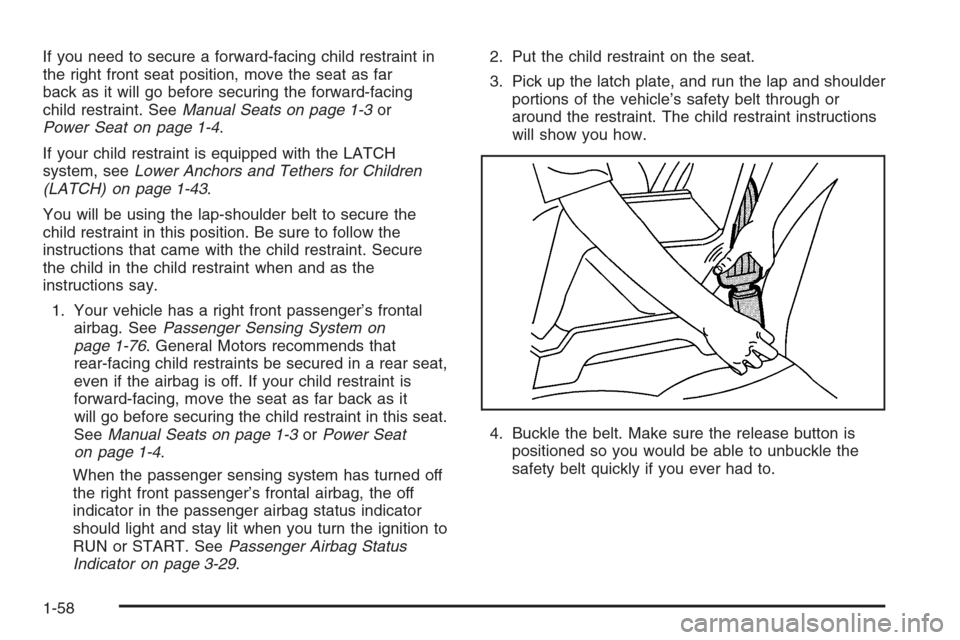
3. Pick up the latch plate, and run the lap and shoulder
portions of the vehicle’s safety belt through or
around the restraint. The child restraint instructions
will show you how.
4. Buckle the belt. Make sure the release button is
positioned so you would be able to unbuckle the
safety belt quickly if you ever had to.
1-58
Page 68 of 406
Never put a rear facing child restraint in the right front
passenger’s seat unless the airbag is off. Here is why:
{CAUTION:
A child in a rear-facing child restraint can be
seriously injured or killed if the right front
passenger’s airbag inates. This is because
the back of the rear-facing child restraint
would be very close to the inating airbag.
Be sure the airbag is off before using a
rear-facing child restraint in the right front seat
position. If you secure a forward-facing child
restraint in the right front seat, always move
the right front passenger seat as far back as it
will go.A rear seat is a safer place to secure a forward facing
child restraint. SeeWhere to Put the Restraint on
page 1-41. If you need to secure a forward-facing child
restraint in the right front seat position, move the
seat as far back as it will go before securing a
forward-facing child restraint. SeeManual Seats on
page 1-3orPower Seat on page 1-4.
{CAUTION:
If the airbag readiness light in the instrument
panel cluster ever comes on when you have
turned off the airbag, it means that something
may be wrong with the airbag system. The right
front passenger’s airbag could inate even
though the switch is off. If this ever happens,
have the vehicle serviced promptly. Until you
have the vehicle serviced, do not let anyone
whom the national government has identied
as a member of a passenger airbag risk group
sit in the right front passenger’s position
(for example, do not secure a rear-facing child
restraint in the right front passenger’s seat).
SeeAirbag Off Switch on page 1-73.
1-62
Page 69 of 406
If your child restraint is equipped with the LATCH
system, seeLower Anchors and Tethers for Children
(LATCH) on page 1-43.
You will be using the lap-shoulder belt to secure the
child restraint in this position. Be sure to follow the
instructions that came with the child restraint. Secure
the child in the child restraint when and as the
instructions say.
1. Your vehicle has a right front passenger’s frontal
airbag. SeeAirbag Off Switch on page 1-73. If your
child restraint is forward-facing, move the seat as far
back as it will go before securing the restraint in this
seat. SeeManual Seats on page 1-3orPower Seat
on page 1-4. If you need to use a rear-facing child
restraint in this seat, make sure the airbag is off once
the child restraint has been installed.
When the airbag off switch has turned off the right
front passenger’s frontal airbag, the off indicator in
the airbag off light should light and stay lit when you
turn the ignition to RUN or START. SeeAirbag Off
Light on page 3-28.
2. Put the child restraint on the seat.
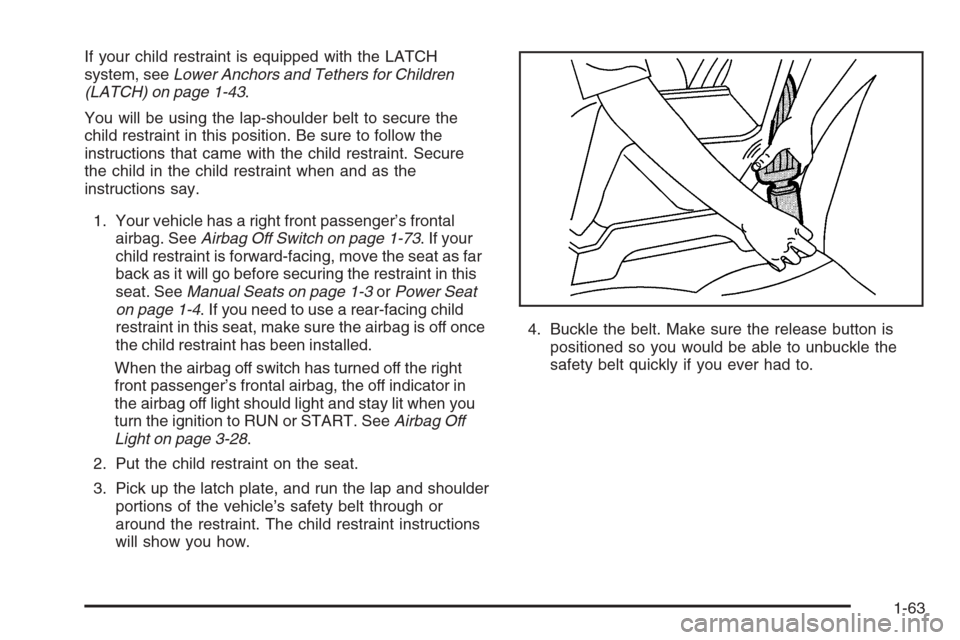
3. Pick up the latch plate, and run the lap and shoulder
portions of the vehicle’s safety belt through or
around the restraint. The child restraint instructions
will show you how.4. Buckle the belt. Make sure the release button is
positioned so you would be able to unbuckle the
safety belt quickly if you ever had to.
1-63
Page 77 of 406
Dual Stage Airbags
If your vehicle has frontal airbags with dual stage
deployment, the restraint will adjust according to the
crash severity. Your vehicle is equipped with electronic
frontal sensors which help the sensing system distinguish
between a moderate and a more severe frontal impact.
For moderate frontal impacts, these airbags inflate at a
level less than full deployment. For more severe frontal
impacts, full deployment occurs. If the front of your
vehicle goes straight into a wall that does not move or
deform, the threshold level for the reduced deployment is
about 12 to 16 mph (19 to 26 km/h), and the threshold
level for a full deployment is about 16 to 25 mph
(26 to 40 km/h). (The threshold level can vary, however,
with specific vehicle design, so that it can be somewhat
above or below this range.)
Vehicles with dual stage airbags are also equipped with
special sensors which enable the sensing system to
monitor the position of both the driver and passenger
front seats. The seat position sensors provide
information which is used to determine if the airbags
should deploy at a reduced level or at full deployment.
What Makes an Airbag Inate?
In an impact of sufficient severity, the airbag sensing
system detects that the vehicle is in a crash. The
sensing system triggers a release of gas from the
inflator, which inflates the airbag. The inflator, airbag,
and related hardware are all part of the airbag modules
inside the steering wheel and in the instrument panel
in front of the right front passenger.
How Does an Airbag Restrain?
In moderate to severe frontal or near-frontal collisions,
even belted occupants can contact the steering wheel or
the instrument panel. Airbags supplement the protection
provided by safety belts. Airbags distribute the force
of the impact more evenly over the occupant’s upper
body, stopping the occupant more gradually. But
airbags would not help you in many types of collisions,
including rollovers, rear impacts and many side
impacts, primarily because an occupant’s motion is
not toward those airbags. Airbags should never
be regarded as anything more than a supplement to
safety belts, and then only in moderate to severe frontal
or near-frontal collisions.
1-71
Page 89 of 406
Q:Because I have a disability, I have to get my
vehicle modied. How can I nd out whether
this will affect my airbag system?
A:Changing or moving any parts of the front seats,
safety belts, the airbag sensing and diagnostic
module, steering wheel, the instrument panel, or
airbag wiring can affect the operation of the airbag
system. If you have questions, call Customer
Assistance. The phone numbers and addresses for
Customer Assistance are in Step Two of the
Customer Satisfaction Procedure in this manual.
SeeCustomer Satisfaction Procedure on page 7-2.
Restraint System Check
Checking the Restraint Systems
Now and then, make sure the safety belt reminder light
and all your belts, buckles, latch plates, retractors
and anchorages are working properly. Look for any other
loose or damaged safety belt system parts. If you see
anything that might keep a safety belt system from doing
its job, have it repaired. SeeCare of Safety Belts on
page 5-87for more information.
Torn or frayed safety belts may not protect you in a
crash. They can rip apart under impact forces. If a belt
is torn or frayed, get a new one right away.
Also look for any opened or broken airbag covers, and
have them repaired or replaced. The airbag system
does not need regular maintenance.
Notice:If you damage the covering for the driver’s
or the right front passenger’s airbag, the airbag
may not work properly. You may have to replace the
airbag module in the steering wheel or both the
airbag module and the instrument panel for the right
front passenger’s airbag. Do not open or break
the airbag coverings.
1-83