tow CHEVROLET EXPRESS CARGO VAN 2006 1.G Repair Manual
[x] Cancel search | Manufacturer: CHEVROLET, Model Year: 2006, Model line: EXPRESS CARGO VAN, Model: CHEVROLET EXPRESS CARGO VAN 2006 1.GPages: 406, PDF Size: 2.51 MB
Page 344 of 406
Washing Your Vehicle
The paint finish on the vehicle provides beauty, depth of
color, gloss retention, and durability.
The best way to preserve the vehicle’s finish is to keep
it clean by washing it often with lukewarm or cold water.
Do not wash the vehicle in the direct rays of the sun.
Use a car washing soap. Do not use strong soaps
or chemical detergents. Be sure to rinse the vehicle well,
removing all soap residue completely. GM-approved
cleaning products can be obtained from your dealer.
SeeVehicle Care/Appearance Materials on page 5-92.
Do not use cleaning agents that are petroleum
based, or that contain acid or abrasives. All cleaning
agents should be flushed promptly and not allowed
to dry on the surface, or they could stain. Dry the finish
with a soft, clean chamois or an all-cotton towel to
avoid surface scratches and water spotting.
High pressure car washes may cause water to enter
the vehicle.
Cleaning Exterior Lamps/Lenses
Use only lukewarm or cold water, a soft cloth and a
car washing soap to clean exterior lamps and lenses.
Follow instructions underWashing Your Vehicle
on page 5-88.
Finish Care
Occasional waxing or mild polishing of your vehicle by
hand may be necessary to remove residue from the
paint finish. You can get GM-approved cleaning products
from your dealer. SeeVehicle Care/Appearance
Materials on page 5-92.
If your vehicle has a “basecoat/clearcoat” paint finish,
the clearcoat gives more depth and gloss to the colored
basecoat. Always use waxes and polishes that are
non-abrasive and made for a basecoat/clearcoat
paint finish.
Notice:Machine compounding or aggressive
polishing on a basecoat/clearcoat paint nish may
damage it. Use only non-abrasive waxes and
polishes that are made for a basecoat/clearcoat
paint nish on your vehicle.
5-88
Page 346 of 406
Aluminum Wheels
Notice:If you use strong soaps, chemicals,
abrasive polishes, cleaners, brushes, or cleaners
that contain acid on aluminum or chrome-plated
wheels, you could damage the surface of the
wheel(s). The repairs would not be covered by your
warranty. Use only GM-approved cleaners on
aluminum or chrome-plated wheels.
Keep the wheels clean using a soft clean cloth with mild
soap and water. Rinse with clean water. After rinsing
thoroughly, dry with a soft clean towel. A wax may then
be applied.
Notice:Using chrome polish on aluminum wheels
could damage the wheels. The repairs would not
be covered by your warranty. Use chrome polish
on chrome wheels only.
The surface of these wheels is similar to the painted
surface of the vehicle. Do not use strong soaps,
chemicals, abrasive polishes, abrasive cleaners,
cleaners with acid, or abrasive cleaning brushes
on them because the surface could be damaged.
Do not use chrome polish on aluminum wheels.Notice:If you drive your vehicle through an
automatic car wash that has silicone carbide tire
cleaning brushes, you could damage the aluminum
or chrome-plated wheels. The repairs would not
be covered by your warranty. Never drive a vehicle
equipped with aluminum or chrome-plated wheels
through an automatic car wash that uses silicone
carbide tire cleaning brushes.
Do not take the vehicle through an automatic car wash
that has silicone carbide tire cleaning brushes. These
brushes can also damage the surface of these wheels.
Tires
To clean the tires, use a stiff brush with tire cleaner.
Notice:Using petroleum-based tire dressing
products on your vehicle may damage the paint
nish and/or tires. When applying a tire dressing,
always wipe off any overspray from all painted
surfaces on your vehicle.
5-90
Page 364 of 406
(b)Visually inspect front and rear suspension and
steering system for damaged, loose, or missing parts,
signs of wear, or lack of lubrication. Inspect power
steering lines and hoses for proper hook-up, binding,
leaks, cracks, chang, etc.
(c)Visually inspect hoses and have them replaced
if they are cracked, swollen, or deteriorated. Inspect
all pipes, ttings, and clamps; replace with genuine
GM parts as needed. To help ensure proper operation,
a pressure test of the cooling system and pressure
cap and cleaning the outside of the radiator and
air conditioning condenser is recommended at least
once a year.
(d)Visually inspect wiper blades for wear or cracking.
Replace wiper blades that appear worn or damaged
or that streak or miss areas of the windshield.
(e)Make sure the safety belt reminder light and all your
belts, buckles, latch plates, retractors, and anchorages
are working properly. Look for any other loose or
damaged safety belt system parts. If you see anything
that might keep a safety belt system from doing its
job, have it repaired. Have any torn or frayed safety belts
replaced. Also look for any opened or broken airbag
coverings, and have them repaired or replaced.
The airbag system does not need regular maintenance.(f)Lubricate all key lock cylinders, hood hinges, hood
prop rod pivot, hood latch assembly, secondary
latch, pivots, spring anchor, release pawl, rear
compartment hinges, latches, locks, fuel door hinge,
and any moving seat hardware. More frequent
lubrication may be required when exposed to a corrosive
environment. Applying silicone grease on weatherstrips
with a clean cloth will make them last longer, seal
better, and not stick or squeak.
(g)Vehicles with Gross Vehicle Weight Rating (GVWR)
above 10,000 lbs (4 536 kg) only: Inspect shields for
damage or looseness. Adjust or replace as required.
This is a Noise Emission Control Service. Applicable to
vehicles sold in the United States and recommended
for vehicles sold in Canada.
(h)Change automatic transmission uid and lter if the
vehicle is mainly driven under one or more of these
conditions:
-In heavy city traffic where the outside temperature
regularly reaches 90°F (32°C) or higher.
-In hilly or mountainous terrain.
-When doing frequent trailer towing.
-Uses such as found in taxi, police, or
delivery service.
6-8
Page 380 of 406
GM Mobility Reimbursement
Program
This program, available to qualified applicants, can
reimburse you up to $1,000 of the cost of eligible
aftermarket adaptive equipment required for your vehicle,
such as hand controls or a wheelchair/scooter lift.
The offer is available for a very limited period of time
from the date of vehicle purchase/lease. For more
details, or to determine your vehicle’s eligibility, visit
gmmobility.com or call the GM Mobility Assistance
Center at 1-800-323-9935. Text telephone (TTY) users,
call 1-800-833-9935.
GM of Canada also has a Mobility Program.
Call 1-800-GM-DRIVE (463-7483) for details.
TTY users call 1-800-263-3830.
Roadside Assistance Program
As the owner of a new Chevrolet vehicle, you are
automatically enrolled in the Chevrolet Roadside
Assistance program. This value-added service is
intended to provide you with peace of mind as you drive
in the city or travel the open road. Call Chevrolet’s
Roadside Assistance at1-800-CHEV-USA,
(1-800-243-8872)24 hours a day, 365 days a year to
speak with a Chevrolet Roadside Assistance
representative.
We will provide the following services during the
Bumper-to-Bumper warranty period, at no expense
to you:
•Fuel Delivery:Delivery of enough fuel
($5 maximum) for the customer to get to the
nearest service station.
•Lock-out Service (identication required):
Replacement keys or locksmith service will be
covered at no charge if you are unable to gain entry
into your vehicle. Delivery of the replacement key will
be covered within 10 miles (16 km).
•Emergency Tow:Tow to the nearest dealership for
warranty service or in the event of a vehicle-disabling
accident. Assistance provided when the vehicle is
mired in sand, mud, or snow.
7-6
Page 388 of 406
•If your vehicle cannot be driven, know where the
towing service will be taking it. Get a card from the
tow truck operator or write down the driver’s name,
the service’s name, and the phone number.
•Remove any valuables from your vehicle before it is
towed away. Make sure this includes your insurance
information and registration if you keep these items
in your vehicle.
•Gather the important information you will need from
the other driver. Things like name, address, phone
number, driver’s license number, vehicle license
plate, vehicle make, model and model year, Vehicle
Identification Number (VIN), insurance company and
policy number, and a general description of the
damage to the other vehicle.
•If possible, call your insurance company from the
scene of the accident. They will walk you through
the information they will need. If they ask for a police
report, phone or go to the police department
headquarters the next day and you can get a copy
of the report for a nominal fee. In some states with
“no fault” insurance laws, a report may not be
necessary. This is especially true if there are no
injuries and both vehicles are driveable.
•Choose a reputable collision repair facility for your
vehicle. Whether you select a GM dealer or a
private collision repair facility to fix the damage,
make sure you are comfortable with them.
Remember, you will have to feel comfortable with
their work for a long time.
•Once you have an estimate, read it carefully and
make sure you understand what work will be
performed on your vehicle. If you have a question,
ask for an explanation. Reputable shops welcome
this opportunity.
Managing the Vehicle Damage
Repair Process
In the event that your vehicle requires damage repairs,
GM recommends that you take an active role in its
repair. If you have a pre-determined repair facility of
choice, take your vehicle there, or have it towed there.
Specify to the facility that any required replacement
collision parts be original equipment parts, either new
Genuine GM parts or recycled original GM parts.
Remember, recycled parts will not be covered by your
GM vehicle warranty.
7-14
Page 390 of 406
Reporting Safety Defects to the
Canadian Government
If you live in Canada, and you believe that your vehicle
has a safety defect, you should immediately notify
Transport Canada, in addition to notifying General
Motors of Canada Limited. You may call them at
1-800-333-0510 or write to:
Transport Canada
Place de Ville Tower C
330 Sparks Street
Ottawa, Ontario K1A 0N5
Reporting Safety Defects to
General Motors
In addition to notifying NHTSA (or Transport Canada) in
a situation like this, we certainly hope you will notify
General Motors. Please call the Chevrolet Customer
Assistance Center at 1-800-222-1020, or write:
Chevrolet Motor Division
Chevrolet Customer Assistance Center
P.O. Box 33170
Detroit, MI 48232-5170In Canada, please call us at 1-800-263-3777 (English)
or 1-800-263-7854 (French). Or, write:
General Motors of Canada Limited
Customer Communication Centre, 163-005
1908 Colonel Sam Drive
Oshawa, Ontario L1H 8P7
Service Publications Ordering
Information
Service Manuals
Service Manuals have the diagnosis and repair
information on engines, transmission, axle suspension,
brakes, electrical, steering, body, etc.
Transmission, Transaxle, Transfer
Case Unit Repair Manual
This manual provides information on unit repair service
procedures, adjustments, and specifications for GM
transmissions, transaxles, and transfer cases.
7-16
Page 400 of 406
Light (cont.)
Malfunction Indicator....................................3-36
Passenger Airbag Status Indicator..................3-29
Passenger Safety Belt Reminder....................3-26
Reduced Engine Power................................3-41
Safety Belt Reminder...................................3-26
Security.....................................................3-40
StabiliTrak
®Indicator....................................3-35
StabiliTrak®Not Ready.................................3-35
Tow/Haul Mode ...........................................3-42
Lighting
Entry.........................................................3-16
Exit ...........................................................3-16
Loading Your Vehicle.......................................4-30
Locking Rear Axle............................................ 4-8
Lockout Protection............................................ 2-9
Locks
Cargo Door Relocking.................................... 2-8
Door ........................................................... 2-7
Lockout Protection......................................... 2-9
Power Door .................................................. 2-8
Rear Door Security Locks............................... 2-8
Loss of Control...............................................4-16
M
Maintenance Schedule
Additional Required Services........................... 6-6
At Each Fuel Fill.........................................6-10
At Least Once a Month................................6-10
At Least Once a Year..................................6-11
At the First 100, 1,000 and 6,000 Miles
(160, 1 600 and 10 000km)......................... 6-9
Introduction.................................................. 6-2
Maintenance Footnotes.................................. 6-7
Maintenance Record....................................6-16
Maintenance Requirements............................. 6-2
Normal Maintenance Replacement Parts.........6-15
Owner Checks and Services........................... 6-9
Recommended Fluids and Lubricants.............6-13
Scheduled Maintenance................................. 6-4
Using.......................................................... 6-3
Your Vehicle and the Environment................... 6-2
Malfunction Indicator Light................................3-36
Manual Seats................................................... 1-3
Manual Windows............................................2-15
8
Page 403 of 406
Reading Lamps..............................................3-16
Rear Air Conditioning and Heating System.........3-21
Rear Axle......................................................5-44
Locking........................................................ 4-8
Rear Door Security Locks.................................. 2-8
Rear Doors....................................................2-12
Rear Heating System......................................3-21
Rear Outside Passenger Positions,
Safety Belts................................................1-26
Rear Safety Belt Comfort Guides......................1-28
Rear Seat Operation......................................... 1-7
Rearview Mirror, Automatic Dimming with
Compass and Temperature Display................2-29
Rearview Mirrors.............................................2-29
Reclining Seatbacks.......................................... 1-4
Recommended Fluids and Lubricants.................6-13
Recreational Vehicle Towing.............................4-35
Reduced Engine Power Light............................3-41
Remote Keyless Entry System............................ 2-3
Remote Keyless Entry System, Operation............ 2-4
Removing the Flat Tire and Installing
the Spare Tire.............................................5-75
Removing the Spare Tire and Tools...................5-72Replacement Bulbs.........................................5-51
Reporting Safety Defects
Canadian Government..................................7-16
General Motors...........................................7-16
United States Government............................7-15
Restraint System Check
Checking the Restraint Systems....................1-83
Replacing Restraint System Parts
After a Crash..........................................1-84
Retained Accessory Power (RAP)......................2-19
Right Front Passenger Position, Safety Belts......1-24
Roadside
Assistance Program....................................... 7-6
Rocking Your Vehicle to Get it Out....................4-30
Running the Engine While Parked.....................2-28
S
Safety Belt
Passenger Reminder Light............................3-26
Pretensioners..............................................1-30
Reminder Light............................................3-26
11
Page 405 of 406
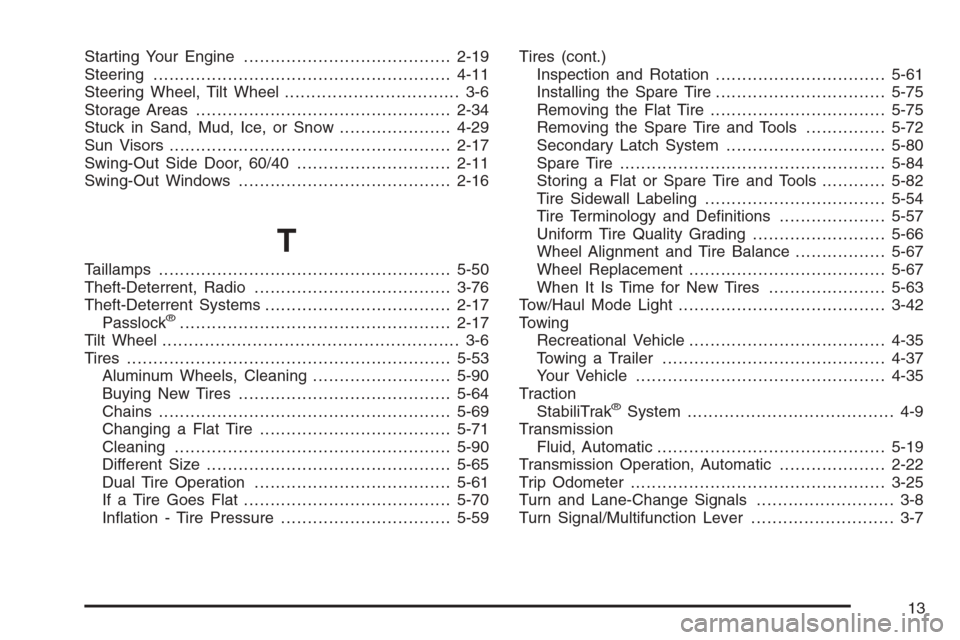
Starting Your Engine.......................................2-19
Steering........................................................4-11
Steering Wheel, Tilt Wheel................................. 3-6
Storage Areas................................................2-34
Stuck in Sand, Mud, Ice, or Snow.....................4-29
Sun Visors.....................................................2-17
Swing-Out Side Door, 60/40.............................2-11
Swing-Out Windows........................................2-16
T
Taillamps.......................................................5-50
Theft-Deterrent, Radio.....................................3-76
Theft-Deterrent Systems...................................2-17
Passlock
®...................................................2-17
Tilt Wheel........................................................ 3-6
Tires.............................................................5-53
Aluminum Wheels, Cleaning..........................5-90
Buying New Tires........................................5-64
Chains.......................................................5-69
Changing a Flat Tire....................................5-71
Cleaning....................................................5-90
Different Size..............................................5-65
Dual Tire Operation.....................................5-61
If a Tire Goes Flat.......................................5-70
Inflation - Tire Pressure................................5-59Tires (cont.)
Inspection and Rotation................................5-61
Installing the Spare Tire................................5-75
Removing the Flat Tire.................................5-75
Removing the Spare Tire and Tools...............5-72
Secondary Latch System..............................5-80
Spare Tire..................................................5-84
Storing a Flat or Spare Tire and Tools............5-82
Tire Sidewall Labeling..................................5-54
Tire Terminology and Definitions....................5-57
Uniform Tire Quality Grading.........................5-66
Wheel Alignment and Tire Balance.................5-67
Wheel Replacement.....................................5-67
When It Is Time for New Tires......................5-63
Tow/Haul Mode Light.......................................3-42
Towing
Recreational Vehicle.....................................4-35
Towing a Trailer..........................................4-37
Your Vehicle...............................................4-35
Traction
StabiliTrak
®System....................................... 4-9
Transmission
Fluid, Automatic...........................................5-19
Transmission Operation, Automatic....................2-22
Trip Odometer................................................3-25
Turn and Lane-Change Signals.......................... 3-8
Turn Signal/Multifunction Lever........................... 3-7
13