seats CHEVROLET EXPRESS CARGO VAN 2007 1.G Owner's Manual
[x] Cancel search | Manufacturer: CHEVROLET, Model Year: 2007, Model line: EXPRESS CARGO VAN, Model: CHEVROLET EXPRESS CARGO VAN 2007 1.GPages: 458, PDF Size: 2.62 MB
Page 74 of 458
Never put a rear facing child restraint in the right
front passenger’s seat unless the airbag is off.
Here is why:
{CAUTION:
A child in a rear-facing child restraint
can be seriously injured or killed if the
right front passenger’s airbag inates.
This is because the back of the rear-facing
child restraint would be very close to the
inating airbag. Be sure the airbag is off
before using a rear-facing child restraint in
the right front seat position. If you secure a
forward-facing child restraint in the right
front seat, always move the right front
passenger seat as far back as it will go.
A rear seat is a safer place to secure a forward
facing child restraint. SeeWhere to Put the
Restraint on page 52. If you need to secure a
forward-facing child restraint in the right front seatposition, move the seat as far back as it will go
before securing a forward-facing child restraint. See
Manual Seats on page 9orPower Seat on page 10.
{CAUTION:
If the airbag readiness light in the
instrument panel cluster ever comes on
when you have turned off the airbag,
it means that something may be wrong
with the airbag system. The right front
passenger’s airbag could inate even
though the switch is off. If this ever
happens, have the vehicle serviced
promptly. Until you have the vehicle
serviced, do not let anyone whom the
national government has identied as a
member of a passenger airbag risk group
sit in the right front passenger’s position
(for example, do not secure a rear-facing
child restraint in the right front passenger’s
seat). SeeAirbag Off Switch on page 86.
74
Page 75 of 458
If your child restraint has the LATCH system,
seeLower Anchors and Tethers for Children
(LATCH) on page 54.
You will be using the lap-shoulder belt to secure
the child restraint in this position. Be sure to follow
the instructions that came with the child restraint.
Secure the child in the child restraint when and
as the instructions say.
1. Your vehicle has a right front passenger’s
frontal airbag. SeeAirbag Off Switch
on page 86. If your child restraint is
forward-facing, move the seat as far back
as it will go before securing the restraint
in this seat. SeeManual Seats on page 9or
Power Seat on page 10. If you need to
use a rear-facing child restraint in this seat,
make sure the airbag is off once the child
restraint has been installed.
When the airbag off switch has turned off
the right front passenger’s frontal airbag,
the off indicator in the airbag off light should
light and stay lit when you turn the ignition
to RUN or START. SeeAirbag Off Light
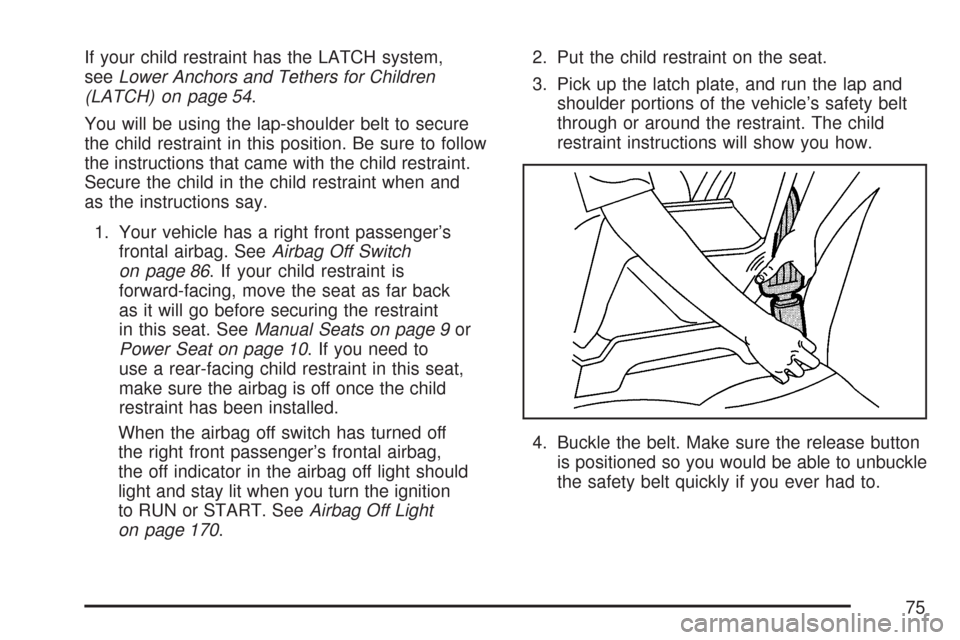
on page 170.2. Put the child restraint on the seat.
3. Pick up the latch plate, and run the lap and
shoulder portions of the vehicle’s safety belt
through or around the restraint. The child
restraint instructions will show you how.
4. Buckle the belt. Make sure the release button
is positioned so you would be able to unbuckle
the safety belt quickly if you ever had to.
75
Page 83 of 458
In any particular crash, no one can say whether
an airbag should have inflated simply because
of the damage to a vehicle or because of what
the repair costs were. Inflation is determined
by what the vehicle hits, the angle of the impact,
and how quickly the vehicle slows down in front
or near-frontal impacts.
If the GVWR (Gross Vehicle Weight Rating) of
your vehicle is 8,500 lb (3 855 kg) or above, your
vehicle has single stage airbags. If the GVWR
is below 8,500 lb (3 855 kg), your vehicle has dual
stage airbags. You can find the GVWR on the
certification label on the rear edge of the driver’s
door. SeeLoading Your Vehicle on page 261
for more information.
Single Stage Airbags
If your vehicle has frontal airbags with single stage
deployment and your vehicle goes straight into
a wall that does not move or deform, the threshold
level is about 9 to 16 mph (14 to 26 km/h). The
threshold level can vary, however, with specific
vehicle design, so that it can be somewhat above
or below this range.
Dual Stage Airbags
If your vehicle has frontal airbags with dual stage
deployment, the restraint will adjust according
to the crash severity. Your vehicle has electronic
frontal sensors which helps the sensing system
distinguish between a moderate and a more
severe frontal impact. For moderate frontal
impacts, these airbags inflate at a level less
than full deployment. For more severe frontal
impacts, full deployment occurs. If the front of
your vehicle goes straight into a wall that does
not move or deform, the threshold level for the
reduced deployment is about 12 to 16 mph
(19 to 26 km/h), and the threshold level for a full
deployment is about 18 to 25 mph (29 to 40 km/h).
The threshold level can vary, however, with
specific vehicle design, so that it can be somewhat
above or below this range.
Vehicles with dual stage airbags also have
sensors which enable the sensing system to
monitor the position of both the driver and
passenger front seats. The seat position sensors
provide information which is used to determine
if the airbags should deploy at a reduced level
or at full deployment.
83
Page 97 of 458
Adding Equipment to Your
Airbag-Equipped Vehicle
Q:Is there anything I might add to the
exterior of the vehicle that could keep
the airbags from working properly?
A:Yes. If you add things that change your
vehicle’s frame, bumper system, height,
front end or side sheet metal, they may keep
the airbag system from working properly.
Also, the airbag system may not work properly
if you relocate any of the airbag sensors.
If you have any questions about this,
you should contact Customer Assistance
before you modify your vehicle. The phone
numbers and addresses for Customer
Assistance are in Step Two of the Customer
Satisfaction Procedure in this manual.
SeeCustomer Satisfaction Procedure
on page 424.
Q:Because I have a disability, I have to get
my vehicle modied. How can I nd out
whether this will affect my airbag system?
A:Changing or moving any parts of the
front seats, safety belts, the airbag sensing
and diagnostic module, steering wheel,
the instrument panel, or airbag wiring can
affect the operation of the airbag system.
If you have questions, call Customer
Assistance. The phone numbers and
addresses for Customer Assistance are
in Step Two of the Customer Satisfaction
Procedure in this manual. SeeCustomer
Satisfaction Procedure on page 424.
Your dealer/retailer and the service manual
have information about the location of the airbag
sensors, sensing and diagnostic module and
airbag wiring.
97
Page 162 of 458
Rear Window Defogger
Some vehicles may have a rear window defogger.
clear as much snow from the window as possible.
The rear window defogger uses a warming grid to
remove fog or frost from the rear window and
will only work when the ignition is RUN.
The rear window defogger will turn off several
minutes after the button is pressed. If turned on
again, the defogger will run for several more
minutes before turning off. The defogger can also
be turned off by pressing the button again or
by turning off the engine.
Notice:Do not use a razor blade or sharp
object to clear the inside rear window. Do not
adhere anything to the defogger grid lines
in the rear glass. These actions may damage
the rear defogger. Repairs would not be
covered by your warranty.
Outlet Adjustment
Use the outlets located near the center and on the
sides of the instrument panel to change the
direction of airflow.
Operation Tips
•Clear away any ice, snow or leaves from the
air inlets at the base of the windshield that
may block the flow of air into your vehicle.
•Use of non-GM approved hood deflectors
may adversely affect the performance of
the system.
•Keep the path under the front seats clear of
objects to help circulate the air inside of
your vehicle more effectively.
162
Page 165 of 458
Turn the center knob clockwise or counterclockwise
to change the direction of the airflow in the rear
seating area.
To change the current mode, select one of the
following:
H(Vent):Use this mode to direct air to the
upper outlets, with a little air directed to the
floor outlets.
2(Floor):Use this mode to direct most of the
air to the floor outlets.
9(Fan):Turn the left knob clockwise or
counterclockwise to HIGH, MED (Medium) or
LOW to increase or decrease the fan speed in the
rear-seating area. Turn the knob to OFF to turn
off the fan.Temperature Control:To increase or decrease
the temperature for the rear of the vehicle, turn the
right knob located on the climate-control panel.
The air-conditioning system on the main climate
control panel must be turned on to direct cooled air
to the rear of the vehicle. If it is not on, then the
temperature in the rear of the vehicle will remain at
cabin temperature.
Be sure to keep the area under the front seats
clear of any objects so that the air inside of your
vehicle can circulate effectively.
For information on how to use the main climate
control system, seeClimate Control System
on page 160. For information on ventilation, see
Outlet Adjustment on page 162.
165
Page 265 of 458
To find out the actual loads on your front and rear
axles, you need to go to a weigh station and
weigh your vehicle. Your dealer can help you with
this. Be sure to spread out your load equally on
both sides of the centerline.
Never exceed the GVWR for your vehicle, or the
GAWR for either the front or rear axle.
And, if you do have a heavy load, you should
spread it out.
{CAUTION:
Do not load your vehicle any heavier than
the Gross Vehicle Weight Rating (GVWR),
or either the maximum front or rear Gross
Axle Weight Rating (GAWR). If you do,
parts on your vehicle can break, and it
can change the way your vehicle handles.
These could cause you to lose control
and crash. Also, overloading can shorten
the life of your vehicle.
{CAUTION:
Things you put inside your vehicle can
strike and injure people in a sudden stop
or turn, or in a crash.
Put things in the cargo area of your
vehicle. Try to spread the weight
evenly.
Never stack heavier things, like
suitcases, inside the vehicle so that
some of them are above the tops of
the seats.
Do not leave an unsecured child
restraint in your vehicle.
When you carry something inside the
vehicle, secure it whenever you can.
Do not leave a seat folded down
unless you need to.
Add-On Equipment
When you carry removable items, you may need
to put a limit on how many people you carry
inside your vehicle. Be sure to weigh your vehicle
before you buy and install the new equipment.
265
Page 351 of 458
Tire Terminology and Denitions
Air Pressure:The amount of air inside the tire
pressing outward on each square inch of the
tire. Air pressure is expressed in pounds
per square inch (psi) or kilopascal (kPa).
Accessory Weight:This means the combined
weight of optional accessories. Some examples of
optional accessories are, automatic transmission,
power steering, power brakes, power windows,
power seats, and air conditioning.
Aspect Ratio:The relationship of a tire’s height
to its width.
Belt:A rubber coated layer of cords that is
located between the plies and the tread. Cords
may be made from steel or other reinforcing
materials.
Bead:The tire bead contains steel wires wrapped
by steel cords that hold the tire onto the rim.
Bias Ply Tire:A pneumatic tire in which the plies
are laid at alternate angles less than 90 degrees
to the centerline of the tread.Cold Tire Pressure:The amount of air pressure in
a tire, measured in pounds per square inch (psi) or
kilopascals (kPa) before a tire has built up heat
from driving. SeeInation - Tire Pressure on
page 354.
Curb Weight:This means the weight of a motor
vehicle with standard and optional equipment
including the maximum capacity of fuel, oil, and
coolant, but without passengers and cargo.
DOT Markings:A code molded into the sidewall
of a tire signifying that the tire is in compliance
with the U.S. Department of Transportation (DOT)
motor vehicle safety standards. The DOT code
includes the Tire Identification Number (TIN),
an alphanumeric designator which can also identify
the tire manufacturer, production plant, brand,
and date of production.
GVWR:Gross Vehicle Weight Rating. See
Loading Your Vehicle on page 261.
GAWR FRT:Gross Axle Weight Rating for the
front axle. SeeLoading Your Vehicle on page 261.
351
Page 452 of 458
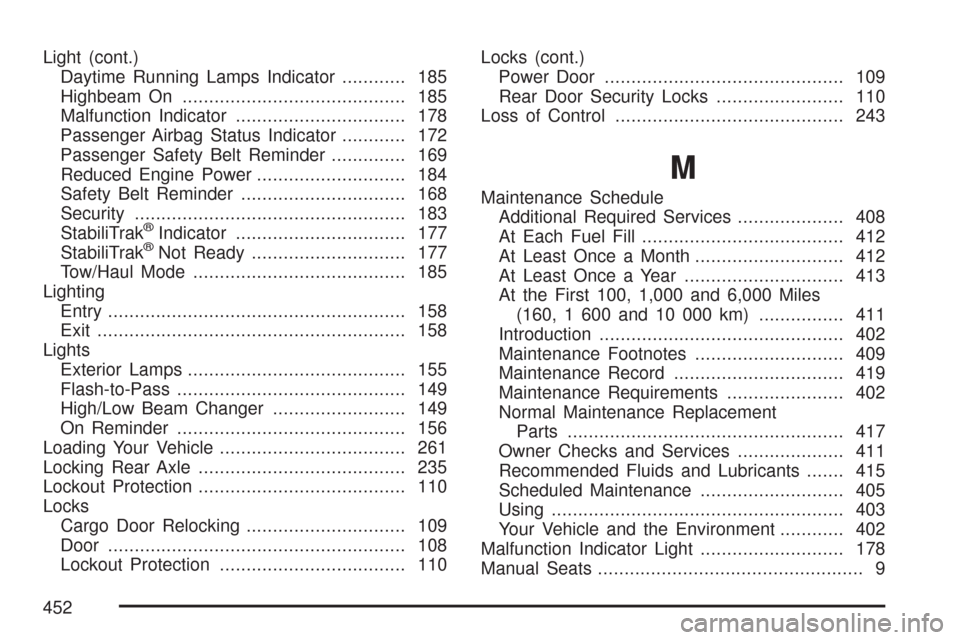
Light (cont.)
Daytime Running Lamps Indicator............ 185
Highbeam On.......................................... 185
Malfunction Indicator................................ 178
Passenger Airbag Status Indicator............ 172
Passenger Safety Belt Reminder.............. 169
Reduced Engine Power............................ 184
Safety Belt Reminder............................... 168
Security................................................... 183
StabiliTrak
®Indicator................................ 177
StabiliTrak®Not Ready............................. 177
Tow/Haul Mode........................................ 185
Lighting
Entry........................................................ 158
Exit.......................................................... 158
Lights
Exterior Lamps......................................... 155
Flash-to-Pass........................................... 149
High/Low Beam Changer......................... 149
On Reminder........................................... 156
Loading Your Vehicle................................... 261
Locking Rear Axle....................................... 235
Lockout Protection....................................... 110
Locks
Cargo Door Relocking.............................. 109
Door........................................................ 108
Lockout Protection................................... 110Locks (cont.)
Power Door............................................. 109
Rear Door Security Locks........................ 110
Loss of Control........................................... 243
M
Maintenance Schedule
Additional Required Services.................... 408
At Each Fuel Fill...................................... 412
At Least Once a Month............................ 412
At Least Once a Year.............................. 413
At the First 100, 1,000 and 6,000 Miles
(160, 1 600 and 10 000 km)................ 411
Introduction.............................................. 402
Maintenance Footnotes............................ 409
Maintenance Record................................ 419
Maintenance Requirements...................... 402
Normal Maintenance Replacement
Parts.................................................... 417
Owner Checks and Services.................... 411
Recommended Fluids and Lubricants....... 415
Scheduled Maintenance........................... 405
Using....................................................... 403
Your Vehicle and the Environment............ 402
Malfunction Indicator Light........................... 178
Manual Seats.................................................. 9
452
Page 456 of 458
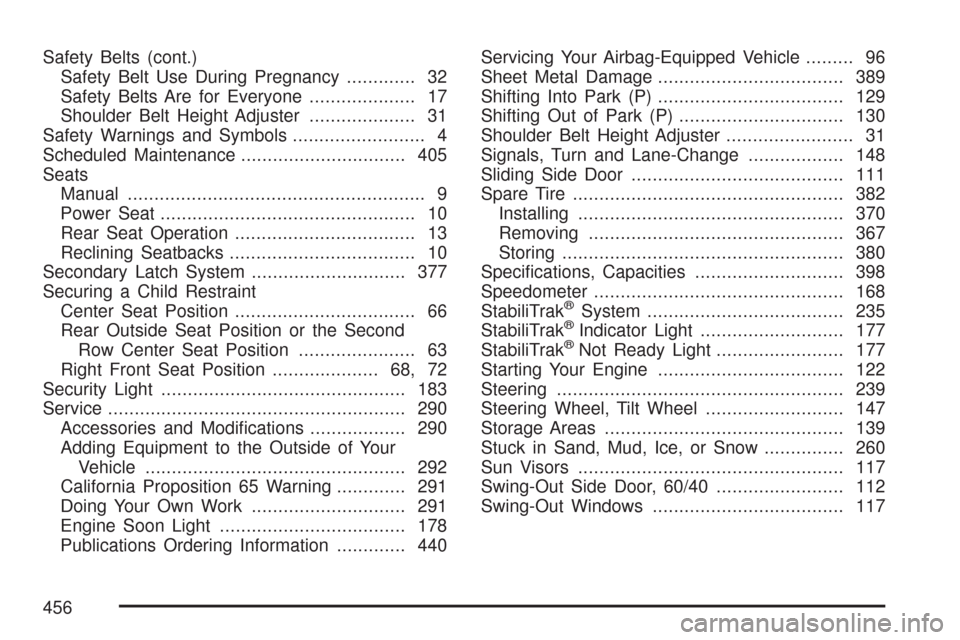
Safety Belts (cont.)
Safety Belt Use During Pregnancy............. 32
Safety Belts Are for Everyone.................... 17
Shoulder Belt Height Adjuster.................... 31
Safety Warnings and Symbols......................... 4
Scheduled Maintenance............................... 405
Seats
Manual........................................................ 9
Power Seat................................................ 10
Rear Seat Operation.................................. 13
Reclining Seatbacks................................... 10
Secondary Latch System............................. 377
Securing a Child Restraint
Center Seat Position.................................. 66
Rear Outside Seat Position or the Second
Row Center Seat Position...................... 63
Right Front Seat Position.................... 68, 72
Security Light.............................................. 183
Service........................................................ 290
Accessories and Modifications.................. 290
Adding Equipment to the Outside of Your
Vehicle................................................. 292
California Proposition 65 Warning............. 291
Doing Your Own Work............................. 291
Engine Soon Light................................... 178
Publications Ordering Information............. 440Servicing Your Airbag-Equipped Vehicle......... 96
Sheet Metal Damage................................... 389
Shifting Into Park (P)................................... 129
Shifting Out of Park (P)............................... 130
Shoulder Belt Height Adjuster........................ 31
Signals, Turn and Lane-Change.................. 148
Sliding Side Door........................................ 111
Spare Tire................................................... 382
Installing.................................................. 370
Removing................................................ 367
Storing..................................................... 380
Specifications, Capacities............................ 398
Speedometer............................................... 168
StabiliTrak
®System..................................... 235
StabiliTrak®Indicator Light........................... 177
StabiliTrak®Not Ready Light........................ 177
Starting Your Engine................................... 122
Steering...................................................... 239
Steering Wheel, Tilt Wheel.......................... 147
Storage Areas............................................. 139
Stuck in Sand, Mud, Ice, or Snow............... 260
Sun Visors.................................................. 117
Swing-Out Side Door, 60/40........................ 112
Swing-Out Windows.................................... 117
456