trailer CHEVROLET EXPRESS CARGO VAN 2017 1.G Owner's Manual
[x] Cancel search | Manufacturer: CHEVROLET, Model Year: 2017, Model line: EXPRESS CARGO VAN, Model: CHEVROLET EXPRESS CARGO VAN 2017 1.GPages: 346, PDF Size: 6.54 MB
Page 208 of 346
Chevrolet Express Owner Manual (GMNA-Localizing-U.S./Canada/Mexico-9967827) - 2017 - crc - 5/6/16
Driving and Operating 207
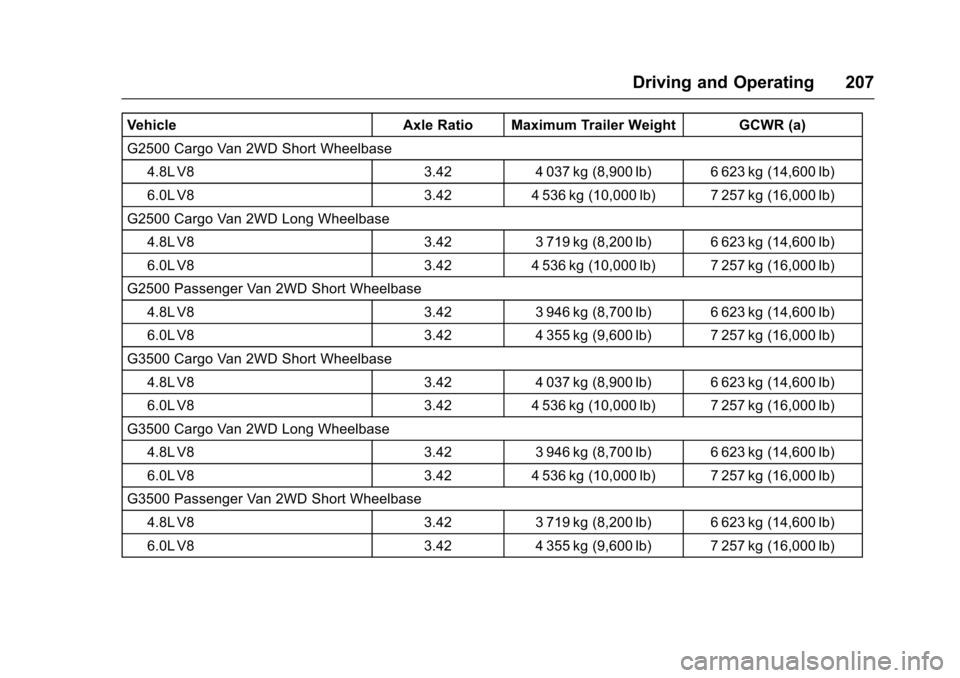
VehicleAxle Ratio Maximum Trailer Weight GCWR (a)
G2500 Cargo Van 2WD Short Wheelbase
4.8L V83.424037kg (8,900lb) 6623kg (14,600lb)
6.0L V83.424536kg (10,000lb) 7257kg (16,000lb)
G2500 Cargo Van 2WD Long Wheelbase
4.8L V83.423719kg (8,200lb) 6623kg (14,600lb)
6.0L V83.424536kg (10,000lb) 7257kg (16,000lb)
G2500 Passenger Van 2WD Short Wheelbase
4.8L V83.423946kg (8,700lb) 6623kg (14,600lb)
6.0L V83.424355kg (9,600lb) 7257kg (16,000lb)
G3500 Cargo Van 2WD Short Wheelbase
4.8L V83.424037kg (8,900lb) 6623kg (14,600lb)
6.0L V83.424536kg (10,000lb) 7257kg (16,000lb)
G3500 Cargo Van 2WD Long Wheelbase
4.8L V83.423946kg (8,700lb) 6623kg (14,600lb)
6.0L V83.424536kg (10,000lb) 7257kg (16,000lb)
G3500 Passenger Van 2WD Short Wheelbase
4.8L V83.423719kg (8,200lb) 6623kg (14,600lb)
6.0L V83.424355kg (9,600lb) 7257kg (16,000lb)
Page 209 of 346
Chevrolet Express Owner Manual (GMNA-Localizing-U.S./Canada/Mexico-9967827) - 2017 - crc - 5/6/16
208 Driving and Operating
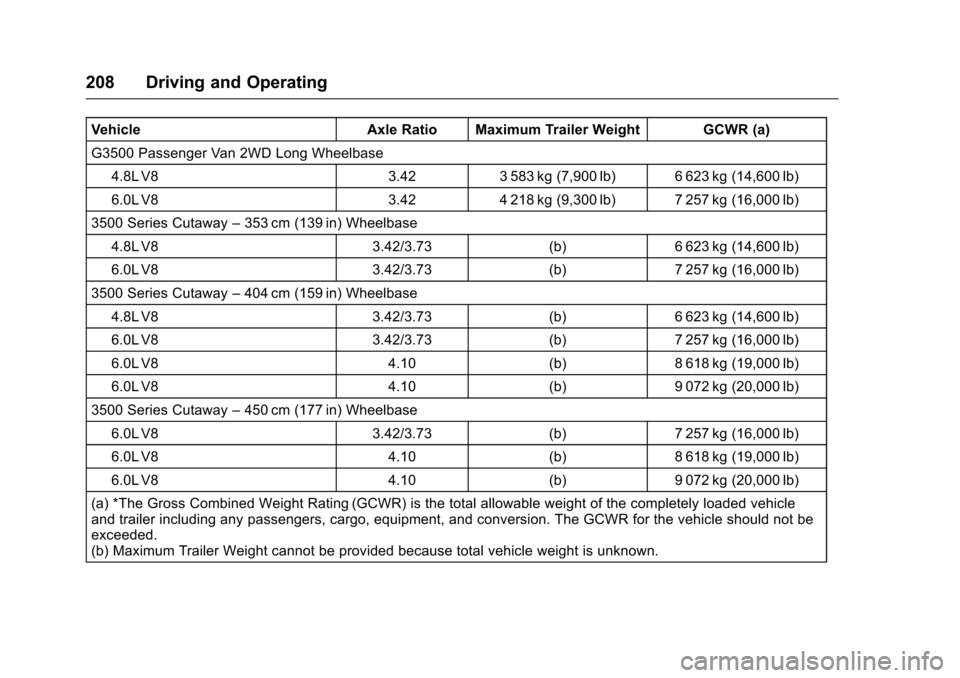
VehicleAxle Ratio Maximum Trailer Weight GCWR (a)
G3500 Passenger Van 2WD Long Wheelbase
4.8L V83.423583kg (7,900lb) 6623kg (14,600lb)
6.0L V83.424218kg (9,300lb) 7257kg (16,000lb)
3500 Series Cutaway–353 cm (139 in) Wheelbase
4.8L V83.42/3.73(b)6623kg (14,600lb)
6.0L V83.42/3.73(b)7257kg (16,000lb)
3500 Series Cutaway–404 cm (159 in) Wheelbase
4.8L V83.42/3.73(b)6623kg (14,600lb)
6.0L V83.42/3.73(b)7257kg (16,000lb)
6.0L V84.10(b)8618kg (19,000lb)
6.0L V84.10(b)9072kg (20,000lb)
3500 Series Cutaway–450 cm (177 in) Wheelbase
6.0L V83.42/3.73(b)7257kg (16,000lb)
6.0L V84.10(b)8618kg (19,000lb)
6.0L V84.10(b)9072kg (20,000lb)
(a) *The Gross Combined Weight Rating (GCWR) is the total allowable weight of the completely loaded vehicleand trailer including any passengers, cargo, equipment, and conversion. The GCWR for the vehicle should not beexceeded.(b) Maximum Trailer Weight cannot be provided because total vehicle weight is unknown.
Page 210 of 346
Chevrolet Express Owner Manual (GMNA-Localizing-U.S./Canada/Mexico-9967827) - 2017 - crc - 5/6/16
Driving and Operating 209
Ask your dealer for traileringinformation or advice.
Weight of the Trailer Tongue
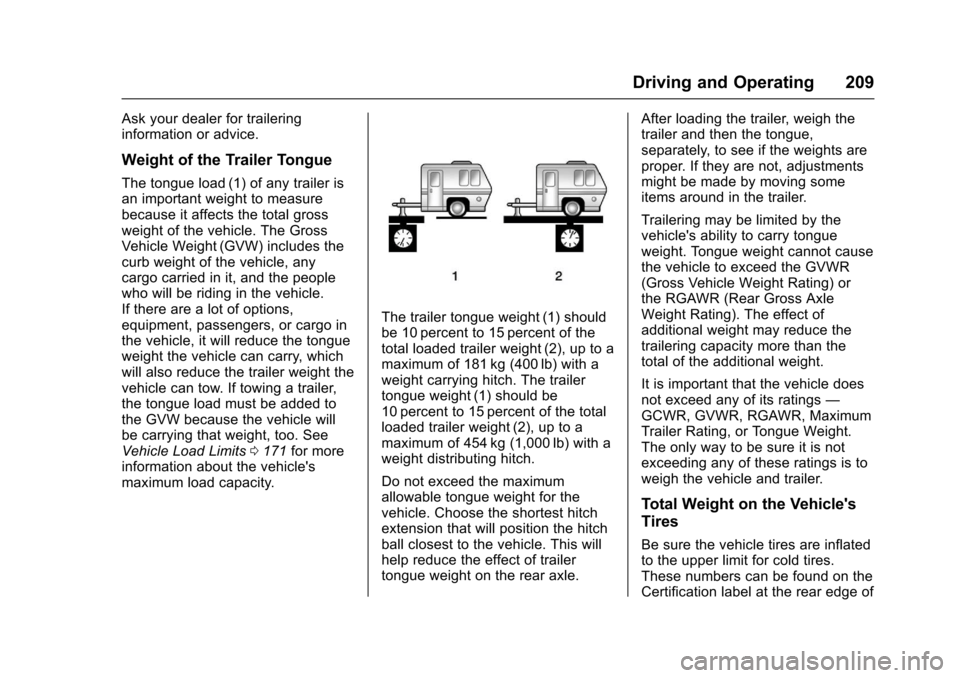
The tongue load (1) of any trailer isan important weight to measurebecause it affects the total grossweight of the vehicle. The GrossVehicle Weight (GVW) includes thecurb weight of the vehicle, anycargo carried in it, and the peoplewho will be riding in the vehicle.If there are a lot of options,equipment, passengers, or cargo inthe vehicle, it will reduce the tongueweight the vehicle can carry, whichwill also reduce the trailer weight thevehicle can tow. If towing a trailer,the tongue load must be added tothe GVW because the vehicle willbe carrying that weight, too. SeeVehicle Load Limits0171for moreinformation about the vehicle'smaximum load capacity.
The trailer tongue weight (1) shouldbe 10 percent to 15 percent of thetotal loaded trailer weight (2), up to amaximum of 181 kg (400 lb) with aweight carrying hitch. The trailertongue weight (1) should be10 percent to 15 percent of the totalloaded trailer weight (2), up to amaximum of 454 kg (1,000 lb) with aweight distributing hitch.
Do not exceed the maximumallowable tongue weight for thevehicle. Choose the shortest hitchextension that will position the hitchball closest to the vehicle. This willhelp reduce the effect of trailertongue weight on the rear axle.
After loading the trailer, weigh thetrailer and then the tongue,separately, to see if the weights areproper. If they are not, adjustmentsmight be made by moving someitems around in the trailer.
Trailering may be limited by thevehicle's ability to carry tongueweight. Tongue weight cannot causethe vehicle to exceed the GVWR(Gross Vehicle Weight Rating) orthe RGAWR (Rear Gross AxleWeight Rating). The effect ofadditional weight may reduce thetrailering capacity more than thetotal of the additional weight.
It is important that the vehicle doesnot exceed any of its ratings—GCWR, GVWR, RGAWR, MaximumTrailer Rating, or Tongue Weight.The only way to be sure it is notexceeding any of these ratings is toweigh the vehicle and trailer.
Total Weight on the Vehicle's
Tires
Be sure the vehicle tires are inflatedto the upper limit for cold tires.These numbers can be found on theCertification label at the rear edge of
Page 211 of 346
Chevrolet Express Owner Manual (GMNA-Localizing-U.S./Canada/Mexico-9967827) - 2017 - crc - 5/6/16
210 Driving and Operating
the driver door, or seeVehicle LoadLimits0171.Makesurenottogoover the GVW limit for the vehicle,or the GAWR, including the weightof the trailer tongue. If using aweight distributing hitch, make surenot to go over the rear axle limitbefore applying the weightdistribution spring bars.
Towing Equipment
Hitches
The correct hitch equipment helpsmaintain combination control. Manytrailers can be towed with aweight-carrying hitch which simplyfeatures a coupler latched to thehitch ball, or a tow eye latched to apintle hook. Other trailers mayrequire a weight-distributing hitchthat uses spring bars to distributethe trailer tongue weight among thetwo vehicle and trailer axles. See“Weight of the Trailer Tongue”underTr a i l e r To w i n g0205for rating limitswith various hitch types.
Consider using sway controls withany trailer. Ask a traileringprofessional about sway controls orrefer to the trailer manufacturer'srecommendations and instructions.
Weight-Distributing Hitches
and Weight Carrying Hitches
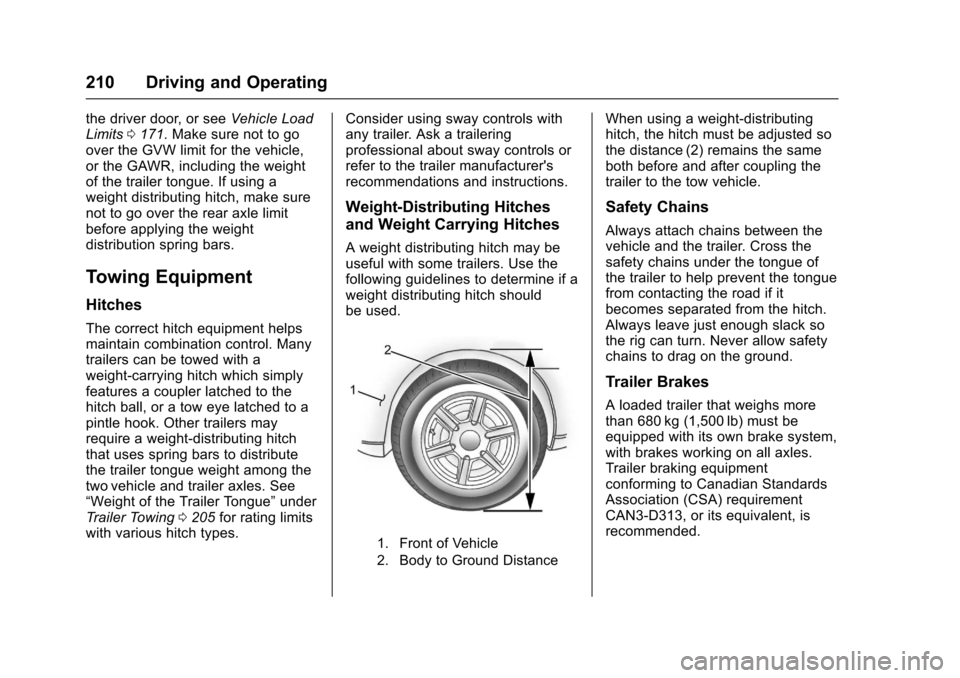
Aweightdistributinghitchmaybeuseful with some trailers. Use thefollowing guidelines to determine if aweight distributing hitch shouldbe used.
1. Front of Vehicle
2. Body to Ground Distance
When using a weight-distributinghitch, the hitch must be adjusted sothe distance (2) remains the sameboth before and after coupling thetrailer to the tow vehicle.
Safety Chains
Always attach chains between thevehicle and the trailer. Cross thesafety chains under the tongue ofthe trailer to help prevent the tonguefrom contacting the road if itbecomes separated from the hitch.Always leave just enough slack sothe rig can turn. Never allow safetychains to drag on the ground.
Trailer Brakes
Aloadedtrailerthatweighsmorethan 680 kg (1,500 lb) must beequipped with its own brake system,with brakes working on all axles.Trailer braking equipmentconforming to Canadian StandardsAssociation (CSA) requirementCAN3-D313, or its equivalent, isrecommended.
Page 212 of 346
Chevrolet Express Owner Manual (GMNA-Localizing-U.S./Canada/Mexico-9967827) - 2017 - crc - 5/6/16
Driving and Operating 211
State and local regulations may alsorequire the trailer to have its ownbraking system if loaded above acertain threshold.
Be sure to read and follow theinstructions for the trailer brakes sothey are installed, adjusted, andmaintained properly.
Do not tap into the vehicle'shydraulic brake system.
Trailer Wiring Harness
The optional heavy-duty trailerwiring package includes a wiringharness, with a seven-pin connectorat the rear of the vehicle and afour-wire harness assembly underthe driver side of the instrumentpanel. The four-wire harnessassembly comes without aconnector.
If the vehicle does not have a trailerhitch, the seven-wire harnessassembly with connector is tapedtogether and located in a framepocket at the driver side rear leftcorner of the frame.
If the vehicle has a trailer hitch, theseven-wire harness assembly withconnector is attached to a bracketon the hitch platform. In both cases,the seven-wire harness has aconnector and includes a 30-ampfeed wire.
Use only a round, seven-wireconnector with flat blade terminalsmeeting SAE J2863 specificationsfor proper electrical connectivity.
The seven-wire harness connectorcontains the following trailer circuits:
.Light Green: Back-up Lamps(10A fuse)**
.White: Ground
.Dark Blue: Trailer Brake Signal
.Dark Green: Right Rear Stopand Turn Signal*
.Red/Black Stripe: Battery Feed(30A Fuse)
.Brown: Trailer Park LampSupply Voltage (15A fuse)**
.Ye l l o w : L e f t R e a r S t o p a n d Tu r nSignal *
The four-wire harness (withoutconnector) contains the followingcircuits:
.Black: Ground
.Red/White: Battery Feed
.Dark Blue: Trailer Brake Signal
.Light Blue: CHMSL/StoplampSupply Voltage
*Ifthevehicleisacutawaywithtrailer provisions, a 15 amp fuse willbe shared for both left/stop trailerturn and right/stop trailer turnsignals. However, the cutawaylighting connector will have a10 amp fuse for each signal.
** If the vehicle is a cutaway withtrailer provisions, a 15 amp fuse willbe shared for trailer park lamps andcutaway rear lighting connector parklamps. Also, a 10 amp fuse will beshared for trailer back-up lamps andcutaway rear lighting connectorback-up lamps.
Tow/Haul Mode
This button is on the instrumentpanel, to the right of the steeringwheel.
Page 213 of 346
Chevrolet Express Owner Manual (GMNA-Localizing-U.S./Canada/Mexico-9967827) - 2017 - crc - 5/6/16
212 Driving and Operating
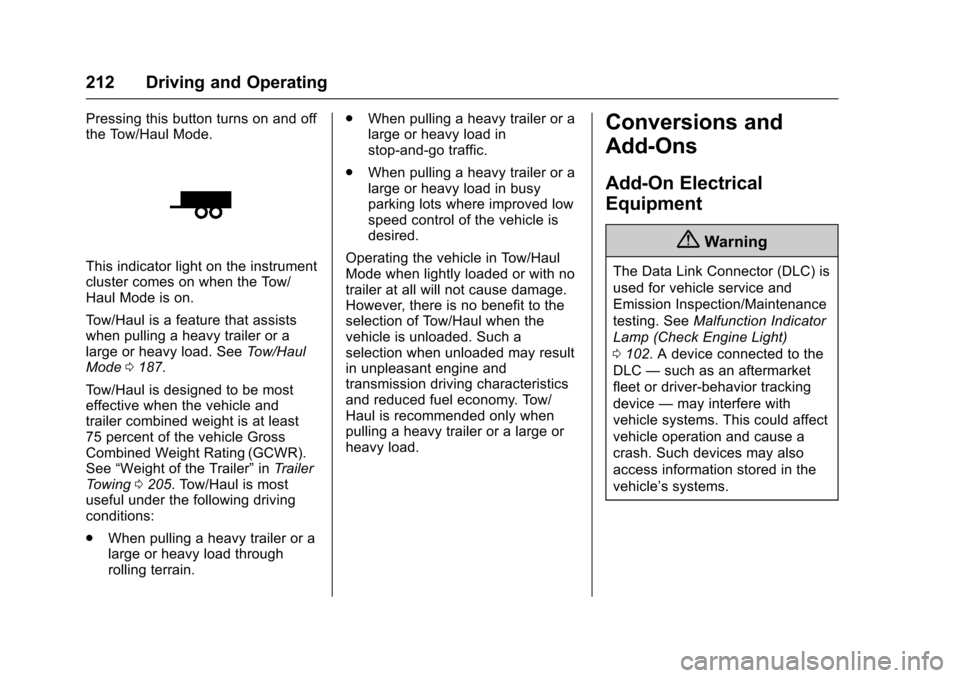
Pressing this button turns on and offthe Tow/Haul Mode.
This indicator light on the instrumentcluster comes on when the Tow/Haul Mode is on.
To w / H a u l i s a f e a t u r e t h a t a s s i s t swhen pulling a heavy trailer or alarge or heavy load. SeeTo w / H a u lMode0187.
To w / H a u l i s d e s i g n e d t o b e m o s teffective when the vehicle andtrailer combined weight is at least75 percent of the vehicle GrossCombined Weight Rating (GCWR).See“Weight of the Trailer”inTr a i l e rTo w i n g0205.Tow/Haulismostuseful under the following drivingconditions:
.When pulling a heavy trailer or alarge or heavy load throughrolling terrain.
.When pulling a heavy trailer or alarge or heavy load instop-and-go traffic.
.When pulling a heavy trailer or alarge or heavy load in busyparking lots where improved lowspeed control of the vehicle isdesired.
Operating the vehicle in Tow/HaulMode when lightly loaded or with notrailer at all will not cause damage.However, there is no benefit to theselection of Tow/Haul when thevehicle is unloaded. Such aselection when unloaded may resultin unpleasant engine andtransmission driving characteristicsand reduced fuel economy. Tow/Haul is recommended only whenpulling a heavy trailer or a large orheavy load.
Conversions and
Add-Ons
Add-On Electrical
Equipment
{Warning
The Data Link Connector (DLC) is
used for vehicle service and
Emission Inspection/Maintenance
testing. SeeMalfunction Indicator
Lamp (Check Engine Light)
0102.Adeviceconnectedtothe
DLC—such as an aftermarket
fleet or driver-behavior tracking
device—may interfere with
vehicle systems. This could affect
vehicle operation and cause a
crash. Such devices may also
access information stored in the
vehicle’ssystems.
Page 224 of 346
Chevrolet Express Owner Manual (GMNA-Localizing-U.S./Canada/Mexico-9967827) - 2017 - crc - 5/2/16
Vehicle Care 223
Caution (Continued)
fluid could come out and fall on
hot engine parts or exhaust
system parts, starting a fire. Too
little fluid could cause the
transmission to overheat. Be sure
to get an accurate reading if
checking the transmission fluid.
Wait at least 30 minutes with theengine off, before checking thetransmission fluid level if the vehiclehas been driven:
.In hot weather, when outsidetemperatures are above 32 °C(90 °F).
.The vehicle is heavily loaded.
.At high speed for quite a while inhot weather.
.In heavy traffic and hot weather.
.While pulling a trailer.
After driving under these conditions,ahotcheckcanbeperformed.Thefluid should be hot, which is 71 °C to93 °C (160 °F to 200 °F).
Acoldfluidlevelcheckcanbeperformed after the vehicle hasbeen sitting for eight hours or morewith the engine off, but this is usedonly as a reference. Let the enginerun at idle for five minutes if theoutside temperature is between 15 °Cto32°C(60°Fto90°F).Shouldthe fluid level be low during this coldcheck, the fluid must be checkedwarm or hot before adding fluid.If the outside temperature is colderthan 15 °C (60 °F) or hotter than 32 °C(90°F),acoldcheckcannotbeperformed.
Awarmfluidlevelcheckcanbeperformed by driving the vehicleunder lightly loaded conditions andoutside temperatures between 10 °Cto 27 °C (50 °F to 80 °F). Thevehicle should be driven for at least24 km (15 mi) before performing awarm check. Checking the fluidwarm or hot will give a moreaccurate reading of the fluid levelthan a cold check.
Because the vehicle is equippedwith a high-efficiency air-to-oilcooler, the transmission fluidtemperature may not reach the
required hot fluid level checkingtemperature under normal lightlyloaded driving vehicle conditions.
Checking the Fluid Level
Prepare the vehicle:
1. Park the vehicle on a levelplace. Keep the enginerunning.
2. With the parking brake applied,place the shift lever in P (Park).
3. With a foot on the brake pedal,move the shift lever througheach gear range, pausing forabout three seconds in eachrange. When M is reached,move the selector from M1through M3. Then, position theshift lever in P (Park).
4. Let the engine run at idle fortwo minutes or more.
Then, without shutting off theengine, use the steps that follow.
Page 232 of 346
Chevrolet Express Owner Manual (GMNA-Localizing-U.S./Canada/Mexico-9967827) - 2017 - crc - 5/2/16
Vehicle Care 231
If Steam is Coming from the
Engine Compartment
{Warning
Steam from an overheated engine
can burn you badly, even if you
just open the hood. Stay away
from the engine if you see or hear
steam coming from it. Just turn it
off and get everyone away from
the vehicle until it cools down.
Wait until there is no sign of
steam or coolant before you open
the hood.
If you keep driving when the
engine is overheated, the liquids
in it can catch fire. You or others
could be badly burned. Stop the
engine if it overheats, and get out
of the vehicle until the engine
is cool.
If No Steam is Coming from
the Engine Compartment
If an engine overheat warning isdisplayed but no steam can be seenor heard, the problem may not be
too serious. Sometimes the enginecan get a little too hot when thevehicle:
.Climbs a long hill on a hot day.
.Stops after high-speed driving.
.Idles for long periods in traffic.
.To w s a t r a i l e r . S e e“Driving onGrades”underTr a i l e rTo w i n g0205.
If the overheat warning is displayedwith no sign of steam:
1. Turn the air off.
2. Turn the heater on to thehighest temperature and to thehighest fan speed. Open thewindows as necessary.
3. When it is safe to do so, pull offthe road, shift to P (Park) orN(Neutral) and let theengine idle.
If the engine coolant temperaturegauge is no longer in the overheatzone or an overheat warning nolonger displays, the vehicle can bedriven. Continue to drive the vehicleslowly for about 10 minutes. Keep asafe vehicle distance from the
vehicle in front. If the warning doesnot come back on, continue to drivenormally and have the coolingsystem checked for proper fill andfunction.
If the warning continues, pull over,stop, and park the vehicleright away.
If there is still no sign of steam,push down the accelerator until theengine speed is about twice as fastas normal idle speed for at leastthree minutes while parked. If thewarning is still on, turn off theengine until it cools down.
If the decision is made not to lift thehood, get service help right away.
Engine Fan
The vehicle has a clutched enginecooling fan. When the clutch isengaged, the fan spins faster toprovide more air to cool the engine.In most everyday driving conditions,the fan is spinning slower and theclutch is not fully engaged. Thisimproves fuel economy and reducesfan noise. Under heavy vehicleloading, trailer towing, and/or high
Page 248 of 346
Chevrolet Express Owner Manual (GMNA-Localizing-U.S./Canada/Mexico-9967827) - 2017 - crc - 5/2/16
Vehicle Care 247
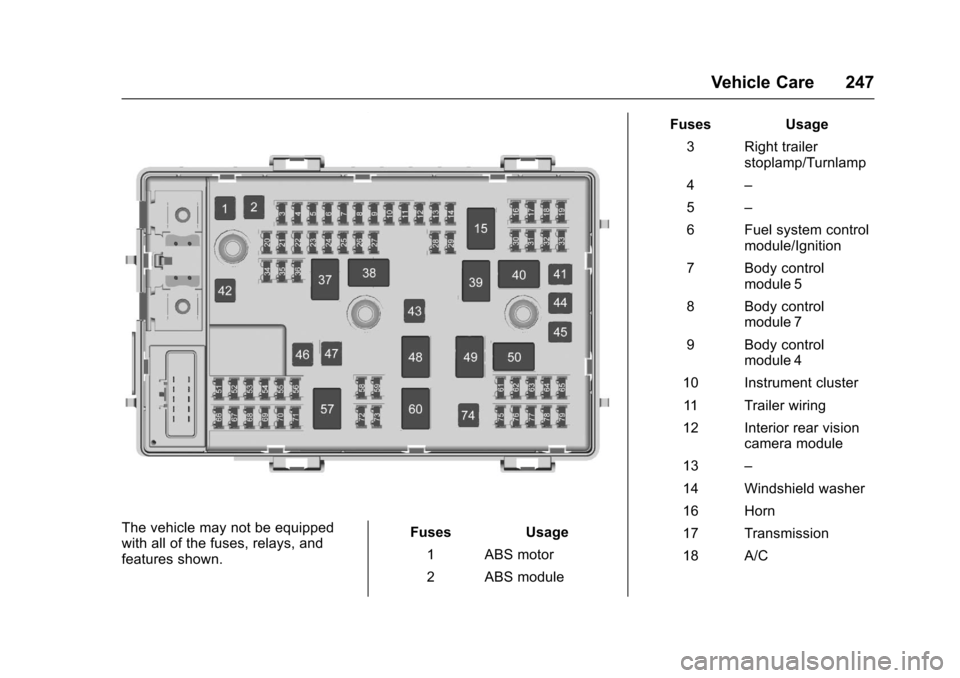
The vehicle may not be equippedwith all of the fuses, relays, andfeatures shown.
Fuses Usage
1ABSmotor
2ABSmodule
Fuses Usage
3Righttrailerstoplamp/Turnlamp
4–
5–
6Fuelsystemcontrolmodule/Ignition
7Bodycontrolmodule 5
8Bodycontrolmodule 7
9Bodycontrolmodule 4
10 Instrument cluster
11 Tr a i l e r w i r i n g
12 Interior rear visioncamera module
13–
14 Windshield washer
16 Horn
17 Transmission
18 A/C
Page 249 of 346
Chevrolet Express Owner Manual (GMNA-Localizing-U.S./Canada/Mexico-9967827) - 2017 - crc - 5/2/16
248 Vehicle Care
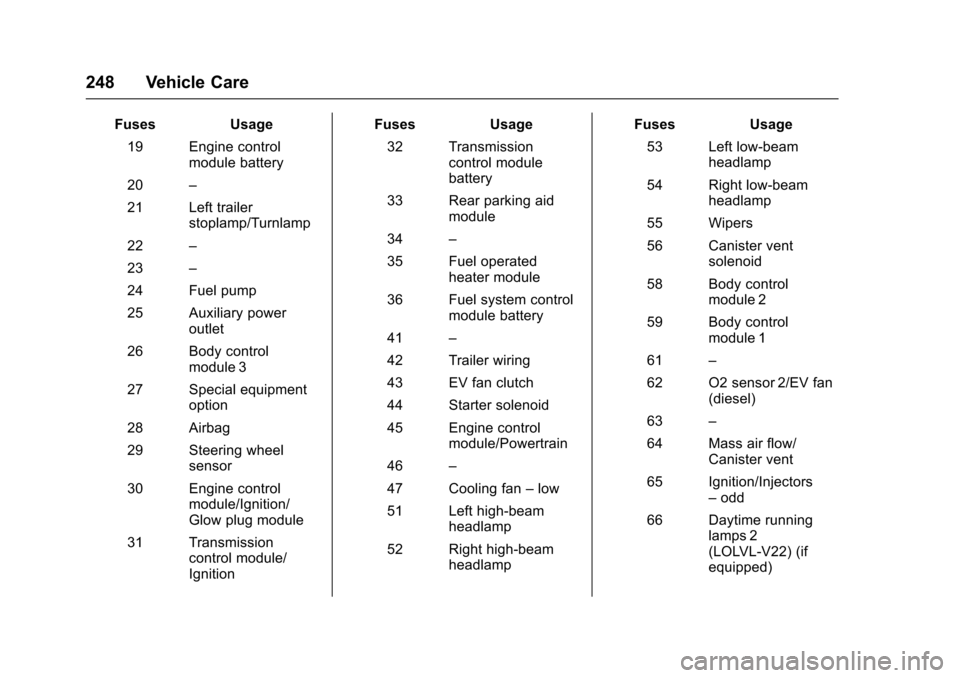
FusesUsage
19 Engine controlmodule battery
20–
21 Left trailerstoplamp/Turnlamp
22–
23–
24 Fuel pump
25 Auxiliary poweroutlet
26 Body controlmodule 3
27 Special equipmentoption
28 Airbag
29 Steering wheelsensor
30 Engine controlmodule/Ignition/Glow plug module
31 Transmissioncontrol module/Ignition
FusesUsage
32 Transmissioncontrol modulebattery
33 Rear parking aidmodule
34–
35 Fuel operatedheater module
36 Fuel system controlmodule battery
41–
42 Trailer wiring
43 EV fan clutch
44 Starter solenoid
45 Engine controlmodule/Powertrain
46–
47 Cooling fan–low
51 Left high-beamheadlamp
52 Right high-beamheadlamp
FusesUsage
53 Left low-beamheadlamp
54 Right low-beamheadlamp
55 Wipers
56 Canister ventsolenoid
58 Body controlmodule 2
59 Body controlmodule 1
61–
62 O2 sensor 2/EV fan(diesel)
63–
64 Mass air flow/Canister vent
65 Ignition/Injectors–odd
66 Daytime runninglamps 2(LOLVL-V22) (ifequipped)