ECU CHEVROLET EXPRESS PASSANGER 2007 1.G Workshop Manual
[x] Cancel search | Manufacturer: CHEVROLET, Model Year: 2007, Model line: EXPRESS PASSANGER, Model: CHEVROLET EXPRESS PASSANGER 2007 1.GPages: 458, PDF Size: 2.62 MB
Page 283 of 458
During your trip, check occasionally to be sure
that the load is secure, and that the lamps and any
trailer brakes are still working.
Following Distance
Stay at least twice as far behind the vehicle ahead
as you would when driving your vehicle without
a trailer. This can help you avoid situations
that require heavy braking and sudden turns.
Passing
You’ll need more passing distance up ahead when
you’re towing a trailer. And, because you’re a
good deal longer, you’ll need to go much farther
beyond the passed vehicle before you can
return to your lane.
Backing Up
Hold the bottom of the steering wheel with
one hand. Then, to move the trailer to the left, just
move that hand to the left. To move the trailer
to the right, move your hand to the right. Always
back up slowly and, if possible, have someone
guide you.
Making Turns
Notice:Making very sharp turns while
trailering could cause the trailer to come in
contact with the vehicle. Your vehicle could be
damaged. Avoid making very sharp turns
while trailering.
When you’re turning with a trailer, make wider
turns than normal. Do this so your trailer
won’t strike soft shoulders, curbs, road signs,
trees or other objects. Avoid jerky or sudden
maneuvers. Signal well in advance.
283
Page 315 of 458
{CAUTION:
You can be burned if you spill coolant
on hot engine parts. Coolant contains
ethylene glycol, and it will burn if the
engine parts are hot enough. Do not spill
coolant on a hot engine.
Occasionally check the coolant level in the
radiator. For information on how to add coolant to
the radiator, seeCooling System on page 317.
Radiator Pressure Cap
The radiator pressure cap is located near the
center of the engine compartment. SeeEngine
Compartment Overview on page 302for more
information on location.
Notice:If the pressure cap is not tightly
installed, coolant loss and possible engine
damage may occur. Be sure the cap is
properly and tightly secured.
Engine Overheating
If your vehicle has the DURAMAX®Diesel engine,
see the DURAMAX®Diesel manual for more
information.
You will find an engine coolant temperature gage
on your vehicle’s instrument panel. SeeEngine
Coolant Temperature Gage on page 178for more
information.
315
Page 356 of 458
Tire Inspection and Rotation
Tires should be rotated every 5,000 to 8,000 miles
(8 000 to 13 000 km).
Any time you notice unusual wear, rotate your
tires as soon as possible and check wheel
alignment. Also check for damaged tires or wheels.
SeeWhen It Is Time for New Tires on page 358
andWheel Replacement on page 362for
more information.
Make sure the spare tire is stored securely. Push,
pull, and then try to rotate or turn the tire. If it
moves, use the ratchet/wheel wrench to tighten the
cable. SeeChanging a Flat Tire on page 366.
If your vehicle has dual rear wheels, also see
Dual Tire Operation on page 355.
The purpose of regular rotation is to achieve more
uniform wear for all tires on the vehicle. The
first rotation is the most important. SeeScheduled
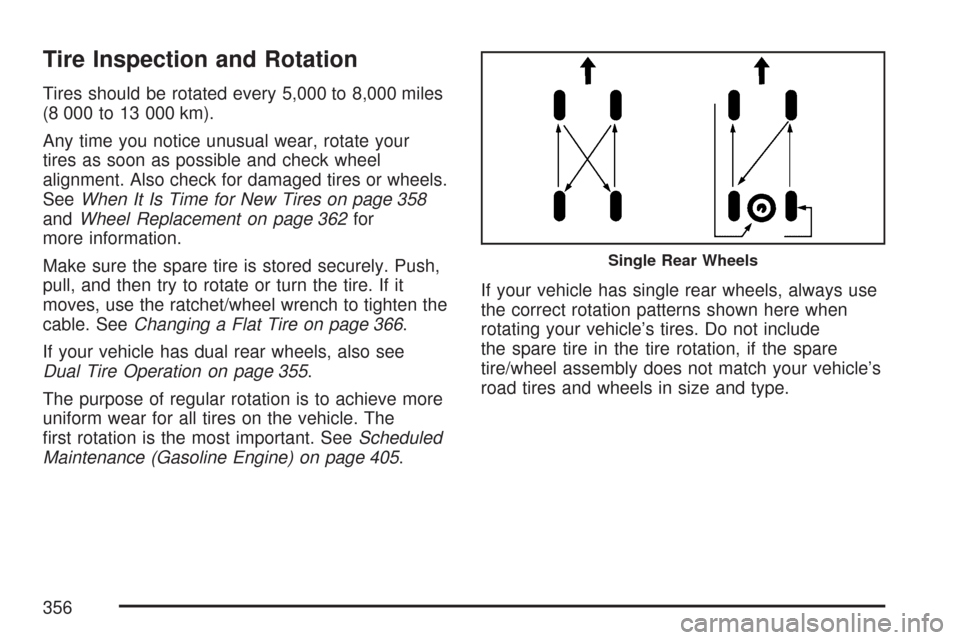
Maintenance (Gasoline Engine) on page 405.If your vehicle has single rear wheels, always use
the correct rotation patterns shown here when
rotating your vehicle’s tires. Do not include
the spare tire in the tire rotation, if the spare
tire/wheel assembly does not match your vehicle’s
road tires and wheels in size and type.
Single Rear Wheels
356
Page 364 of 458
Tire Chains
{CAUTION:
If your vehicle has dual wheels or
P245/75R16 or LT245/75R16 size tires,
do not use tire chains. They can damage
your vehicle because there is not
enough clearance. Tire chains used on
a vehicle without the proper amount of
clearance can cause damage to the brakes,
suspension, or other vehicle parts. The
area damaged by the tire chains could
cause you to lose control of your vehicle
and you or others may be injured in
a crash.
Use another type of traction device only
if its manufacturer recommends it for
use on your vehicle and tire size
combination and road conditions.
Follow that manufacturer’s instructions.
CAUTION: (Continued)
CAUTION: (Continued)
To help avoid damage to your vehicle,
drive slowly, readjust, or remove the
device if it is contacting your vehicle,
and do not spin the vehicle’s wheels.
If you do nd traction devices that will t,
install them on the rear tires.
Notice:If your vehicle does not have
dual wheels and has a tire size other than
P245/75R16 or LT245/75R16, use tire chains
only where legal and only when you must.
Use chains that are the proper size for your
tires. Install them on the tires of the rear axle.
Do not use chains on the tires of the front axle.
Tighten them as tightly as possible with the
ends securely fastened. Drive slowly and follow
the chain manufacturer’s instructions. If you
can hear the chains contacting your vehicle,
stop and retighten them. If the contact
continues, slow down until it stops. Driving
too fast or spinning the wheels with chains on
will damage your vehicle.
364
Page 367 of 458
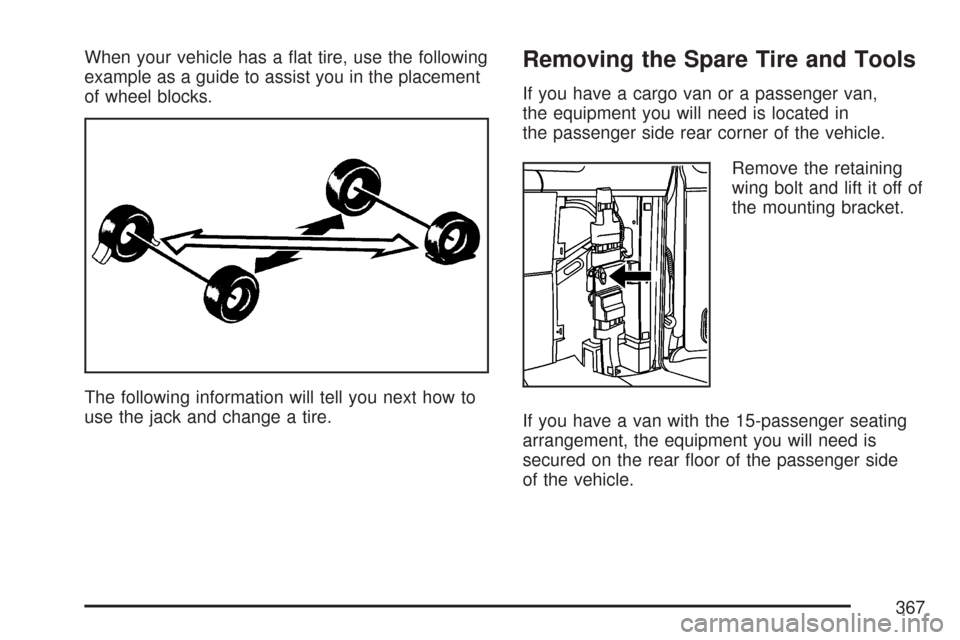
When your vehicle has a flat tire, use the following
example as a guide to assist you in the placement
of wheel blocks.
The following information will tell you next how to
use the jack and change a tire.Removing the Spare Tire and Tools
If you have a cargo van or a passenger van,
the equipment you will need is located in
the passenger side rear corner of the vehicle.
Remove the retaining
wing bolt and lift it off of
the mounting bracket.
If you have a van with the 15-passenger seating
arrangement, the equipment you will need is
secured on the rear floor of the passenger side
of the vehicle.
367
Page 381 of 458
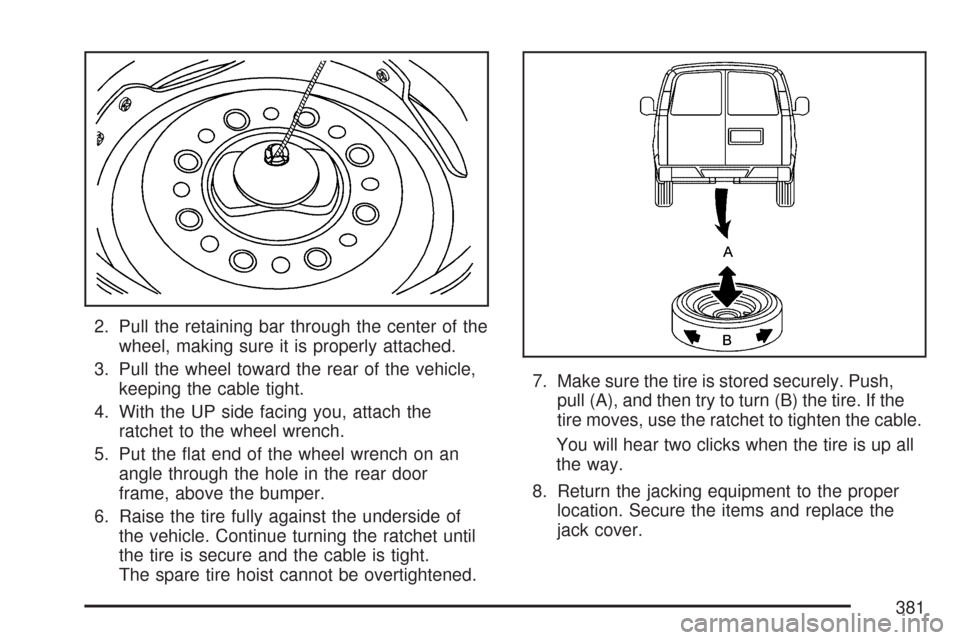
2. Pull the retaining bar through the center of the
wheel, making sure it is properly attached.
3. Pull the wheel toward the rear of the vehicle,
keeping the cable tight.
4. With the UP side facing you, attach the
ratchet to the wheel wrench.
5. Put the flat end of the wheel wrench on an
angle through the hole in the rear door
frame, above the bumper.
6. Raise the tire fully against the underside of
the vehicle. Continue turning the ratchet until
the tire is secure and the cable is tight.
The spare tire hoist cannot be overtightened.7. Make sure the tire is stored securely. Push,
pull (A), and then try to turn (B) the tire. If the
tire moves, use the ratchet to tighten the cable.
You will hear two clicks when the tire is up all
the way.
8. Return the jacking equipment to the proper
location. Secure the items and replace the
jack cover.
381
Page 412 of 458
At Each Fuel Fill
It is important to perform these underhood checks
at each fuel ll.
Engine Oil Level Check
Check the engine oil level and add the proper oil
if necessary. SeeEngine Oil (Gasoline Engine)
on page 303for further details.
Notice:It is important to check the engine
oil regularly and keep it at the proper
level. Failure to keep the engine oil at the
proper level can cause damage to the engine
not covered by your warranty.
Engine Coolant Level Check
Check the engine coolant level and add
DEX-COOL®coolant mixture if necessary. See
Engine Coolant on page 312for further details.
Windshield Washer Fluid Level Check
Check the windshield washer fluid level in
the windshield washer fluid reservoir and add
the proper fluid if necessary.
At Least Once a Month
Tire Ination Check
Inspect your vehicle’s tires and make sure they
are inflated to the correct pressures. Do not forget
to check the spare tire. SeeInation - Tire
Pressure on page 354. Check to make sure the
spare tire is stored securely. SeeChanging a Flat
Tire on page 366.
Tire Wear Inspection
Tire rotation may be required for high mileage
highway drivers prior to the Engine Oil Life System
service notification. Check the tires for wear
and, if necessary, rotate the tires. SeeTire
Inspection and Rotation on page 356.
412
Page 430 of 458
Roadside Assistance Program
In the U.S., call1-800-CHEV-USA
(1-800-243-8872); (Text telephone (TTY):
1-800-833-6000).
In Canada, call1-800-268-6800.
Service is available 24 hours a day,
365 days a year.
As the owner of a new Chevrolet vehicle,
you are automatically enrolled in the
Chevrolet Roadside Assistance program.
Who is Covered?
Roadside Assistance coverage is for the vehicle
operator, regardless of ownership. In Canada,
a person driving this vehicle without the consent
of the owner is not eligible for coverage.
The following services are provided in the U.S.
during the Bumper-to-Bumper warranty period and,
in Canada, during the Base Warranty coverage
period of the New Vehicle Limited Warranty, up to
a maximum coverage of $100.
•Fuel Delivery:Delivery of enough fuel for the
vehicle to get to the nearest service station
(approximately $5 in Canada). Serviceto provide diesel may be restricted. For safety
reasons, propane and other alternative
fuels will not be provided through this service.
•Lock-out Service:To ensure security,
the driver must present personal identification
before lock-out service is provided. In
Canada, the vehicle registration is also
required. Lock-out service will be covered at
no charge if you are unable to gain entry
into your vehicle. A remote unlock may
be available if you have an active OnStar
®
subscription.
•Emergency Tow From a Public Roadway
or Highway:Tow to the nearest dealership
for warranty service or in the event of a
vehicle-disabling accident. Winch-out
assistance when the vehicle is mired in sand,
mud, or snow.
•Flat Tire Change:Installation of a spare tire
in good condition, when equipped and
properly inflated, is covered at no charge.
The customer is responsible for the repair or
replacement of the tire if not covered by a
warrantable failure.
430
Page 431 of 458
•Jump Start:No-start occurrences which
require a battery jump start will be covered
at no charge.
•Trip Routing Service (Canada only):Upon
request, Roadside Assistance will send you
detailed, computer personalized maps,
highlighting your choice of either the most
direct route or the most scenic route to your
destination, anywhere in North America,
along with helpful travel information pertaining
to your trip.
We will make every attempt to send your
personalized trip routing as quickly as
possible, but it is best to allow three weeks
before your planned departure date.
Trip routing requests will be limited to
six per calendar year.
•Trip Interruption Benets and Assistance
(Canada only):In the event of a warranty
related vehicle disablement, while en route and
over 250 kilometres from original point of
departure, you may qualify for trip interruption
expense assistance. This assistance covers
reasonable reimbursement of up to a
maximum of $500 (Canadian) for (A) meals
(maximum of $50/day), (B) lodging (maximumof $100/night) and (C) alternate ground
transportation (maximum of $40/day). This
benefit is to assist you with some of the
unplanned expense you may incur while
waiting for your vehicle to be repaired.
Pre-authorization, original detailed receipts
and a copy of the repair order are required.
Once authorization has been given, your
advisor will help you make any necessary
arrangements and explain how to claim for trip
interruption expense assistance.
•Alternative Service (Canada only):There
may be times, when Roadside Assistance
cannot provide timely assistance. Your advisor
may authorize you to secure local emergency
road service, and you will be reimbursed
up to $100 upon submission of the original
receipt to Roadside Assistance.
In many instances, mechanical failures are covered
under Chevrolet’s Bumper-to-Bumper warranty, for
U.S. customers, and the duration of the Base
Warranty Coverage of the New Vehicle Limited
Warranty, for Canadian customers. However, any
cost for parts and labor for non-warranty repairs are
the responsibility of the driver.
431
Page 443 of 458
OnStar
If your vehicle has OnStar®and you subscribe
to the OnStar®services, please refer to the
OnStar®Terms and Conditions for information
on data collection and use.
Navigation System
If your vehicle has anavigation system,
use of the system may result in the storage of
destinations, addresses, telephone numbers,
and other trip information.Please refer to
the navigation system operating manual for
information on stored data and for deletion
instructions.
Radio Frequency
Identication (RFID)
RFIDtechnology is used in some vehicles for
functions such as tire pressure monitoring
and ignition system security, as well as in
connection with conveniences such as key fobs
for remote door locking/unlocking and starting,
and in-vehicle transmitters for garage door
openers. RFID technology in GM vehicles does
not use or record personal information or link
with any other GM system containing personal
information.
443