belt CHEVROLET EXPRESS PASSANGER 2007 1.G Manual PDF
[x] Cancel search | Manufacturer: CHEVROLET, Model Year: 2007, Model line: EXPRESS PASSANGER, Model: CHEVROLET EXPRESS PASSANGER 2007 1.GPages: 458, PDF Size: 2.62 MB
Page 286 of 458
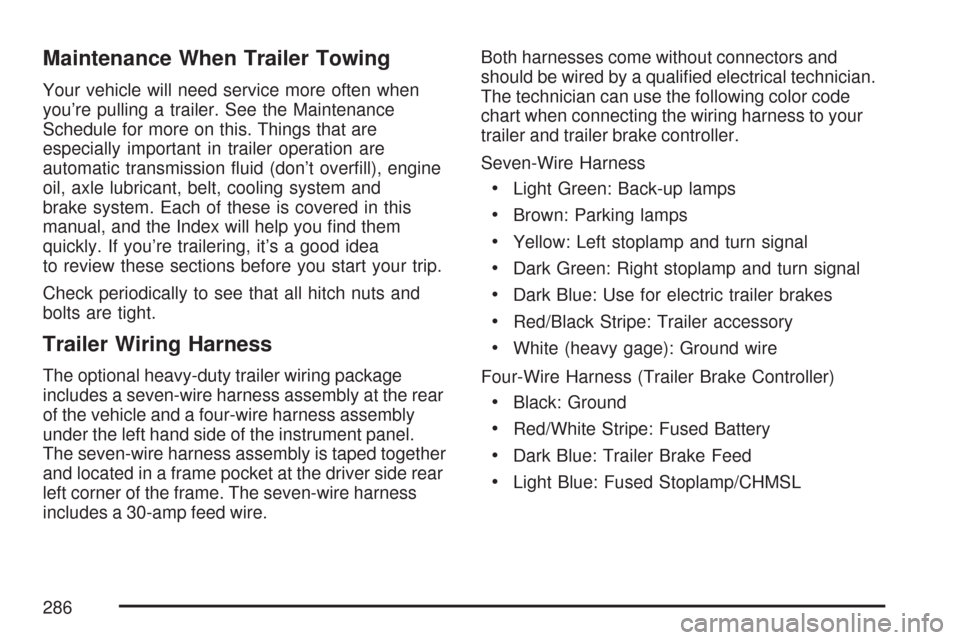
Maintenance When Trailer Towing
Your vehicle will need service more often when
you’re pulling a trailer. See the Maintenance
Schedule for more on this. Things that are
especially important in trailer operation are
automatic transmission fluid (don’t overfill), engine
oil, axle lubricant, belt, cooling system and
brake system. Each of these is covered in this
manual, and the Index will help you find them
quickly. If you’re trailering, it’s a good idea
to review these sections before you start your trip.
Check periodically to see that all hitch nuts and
bolts are tight.
Trailer Wiring Harness
The optional heavy-duty trailer wiring package
includes a seven-wire harness assembly at the rear
of the vehicle and a four-wire harness assembly
under the left hand side of the instrument panel.
The seven-wire harness assembly is taped together
and located in a frame pocket at the driver side rear
left corner of the frame. The seven-wire harness
includes a 30-amp feed wire.Both harnesses come without connectors and
should be wired by a qualified electrical technician.
The technician can use the following color code
chart when connecting the wiring harness to your
trailer and trailer brake controller.
Seven-Wire Harness
•Light Green: Back-up lamps
•Brown: Parking lamps
•Yellow: Left stoplamp and turn signal
•Dark Green: Right stoplamp and turn signal
•Dark Blue: Use for electric trailer brakes
•Red/Black Stripe: Trailer accessory
•White (heavy gage): Ground wire
Four-Wire Harness (Trailer Brake Controller)
•Black: Ground
•Red/White Stripe: Fused Battery
•Dark Blue: Trailer Brake Feed
•Light Blue: Fused Stoplamp/CHMSL
286
Page 288 of 458
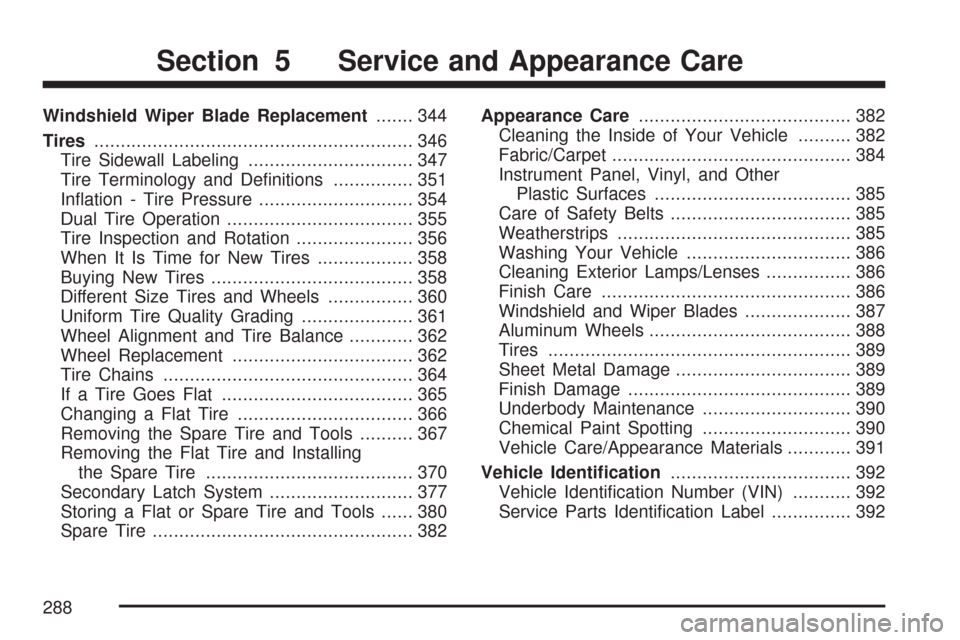
Windshield Wiper Blade Replacement....... 344
Tires............................................................ 346
Tire Sidewall Labeling............................... 347
Tire Terminology and Definitions............... 351
Inflation - Tire Pressure............................. 354
Dual Tire Operation................................... 355
Tire Inspection and Rotation...................... 356
When It Is Time for New Tires.................. 358
Buying New Tires...................................... 358
Different Size Tires and Wheels................ 360
Uniform Tire Quality Grading..................... 361
Wheel Alignment and Tire Balance............ 362
Wheel Replacement.................................. 362
Tire Chains............................................... 364
If a Tire Goes Flat.................................... 365
Changing a Flat Tire................................. 366
Removing the Spare Tire and Tools.......... 367
Removing the Flat Tire and Installing
the Spare Tire....................................... 370
Secondary Latch System........................... 377
Storing a Flat or Spare Tire and Tools...... 380
Spare Tire................................................. 382Appearance Care........................................ 382
Cleaning the Inside of Your Vehicle.......... 382
Fabric/Carpet............................................. 384
Instrument Panel, Vinyl, and Other
Plastic Surfaces..................................... 385
Care of Safety Belts.................................. 385
Weatherstrips............................................ 385
Washing Your Vehicle............................... 386
Cleaning Exterior Lamps/Lenses................ 386
Finish Care............................................... 386
Windshield and Wiper Blades.................... 387
Aluminum Wheels...................................... 388
Tires......................................................... 389
Sheet Metal Damage................................. 389
Finish Damage.......................................... 389
Underbody Maintenance............................ 390
Chemical Paint Spotting............................ 390
Vehicle Care/Appearance Materials............ 391
Vehicle Identication.................................. 392
Vehicle Identification Number (VIN)........... 392
Service Parts Identification Label............... 392
Section 5 Service and Appearance Care
288
Page 350 of 458
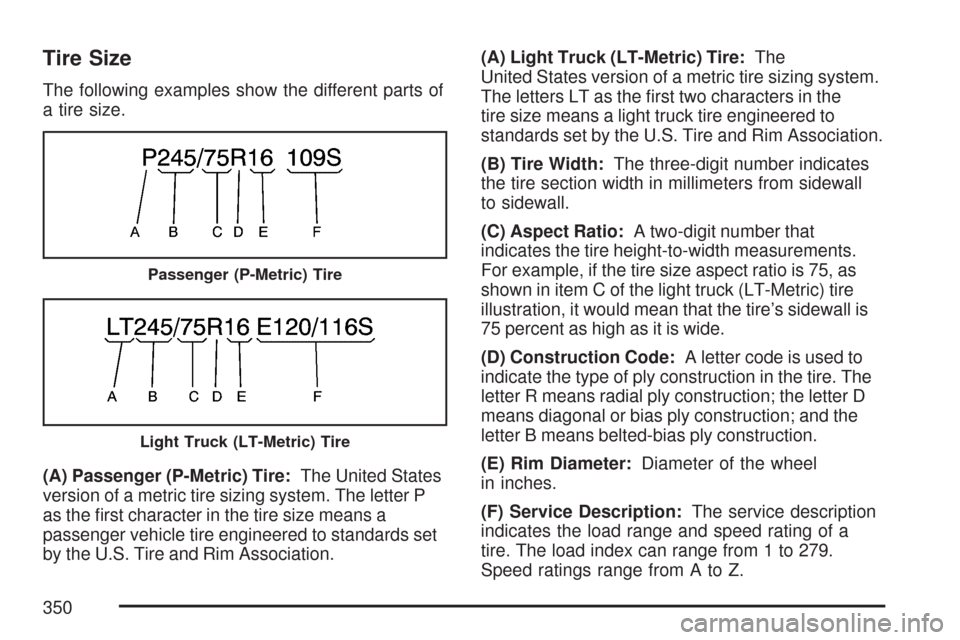
Tire Size
The following examples show the different parts of
a tire size.
(A) Passenger (P-Metric) Tire:The United States
version of a metric tire sizing system. The letter P
as the first character in the tire size means a
passenger vehicle tire engineered to standards set
by the U.S. Tire and Rim Association.(A) Light Truck (LT-Metric) Tire:The
United States version of a metric tire sizing system.
The letters LT as the first two characters in the
tire size means a light truck tire engineered to
standards set by the U.S. Tire and Rim Association.
(B) Tire Width:The three-digit number indicates
the tire section width in millimeters from sidewall
to sidewall.
(C) Aspect Ratio:A two-digit number that
indicates the tire height-to-width measurements.
For example, if the tire size aspect ratio is 75, as
shown in item C of the light truck (LT-Metric) tire
illustration, it would mean that the tire’s sidewall is
75 percent as high as it is wide.
(D) Construction Code:A letter code is used to
indicate the type of ply construction in the tire. The
letter R means radial ply construction; the letter D
means diagonal or bias ply construction; and the
letter B means belted-bias ply construction.
(E) Rim Diameter:Diameter of the wheel
in inches.
(F) Service Description:The service description
indicates the load range and speed rating of a
tire. The load index can range from 1 to 279.
Speed ratings range from A to Z.
Passenger (P-Metric) Tire
Light Truck (LT-Metric) Tire
350
Page 351 of 458
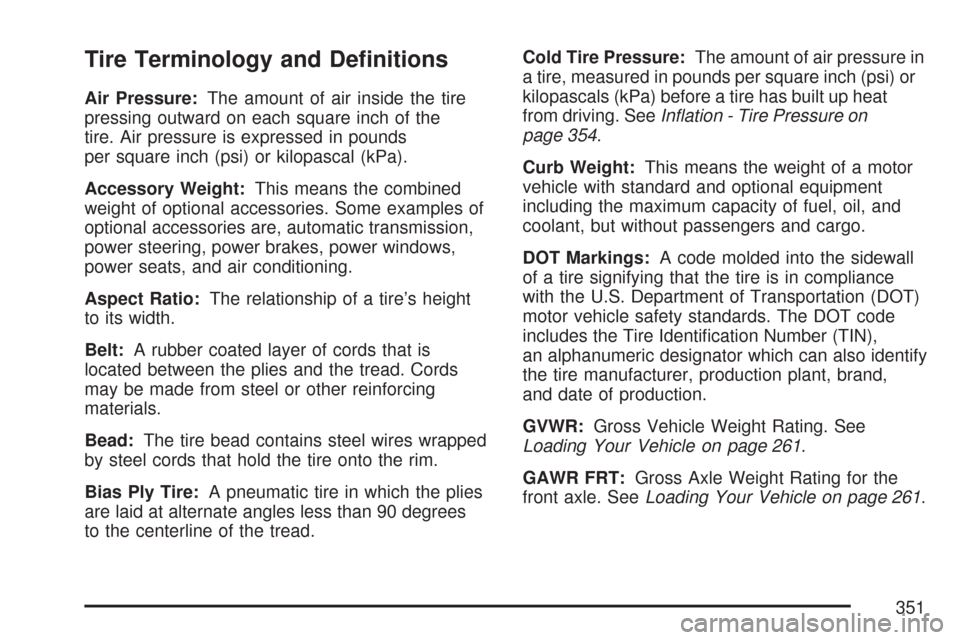
Tire Terminology and Denitions
Air Pressure:The amount of air inside the tire
pressing outward on each square inch of the
tire. Air pressure is expressed in pounds
per square inch (psi) or kilopascal (kPa).
Accessory Weight:This means the combined
weight of optional accessories. Some examples of
optional accessories are, automatic transmission,
power steering, power brakes, power windows,
power seats, and air conditioning.
Aspect Ratio:The relationship of a tire’s height
to its width.
Belt:A rubber coated layer of cords that is
located between the plies and the tread. Cords
may be made from steel or other reinforcing
materials.
Bead:The tire bead contains steel wires wrapped
by steel cords that hold the tire onto the rim.
Bias Ply Tire:A pneumatic tire in which the plies
are laid at alternate angles less than 90 degrees
to the centerline of the tread.Cold Tire Pressure:The amount of air pressure in
a tire, measured in pounds per square inch (psi) or
kilopascals (kPa) before a tire has built up heat
from driving. SeeInation - Tire Pressure on
page 354.
Curb Weight:This means the weight of a motor
vehicle with standard and optional equipment
including the maximum capacity of fuel, oil, and
coolant, but without passengers and cargo.
DOT Markings:A code molded into the sidewall
of a tire signifying that the tire is in compliance
with the U.S. Department of Transportation (DOT)
motor vehicle safety standards. The DOT code
includes the Tire Identification Number (TIN),
an alphanumeric designator which can also identify
the tire manufacturer, production plant, brand,
and date of production.
GVWR:Gross Vehicle Weight Rating. See
Loading Your Vehicle on page 261.
GAWR FRT:Gross Axle Weight Rating for the
front axle. SeeLoading Your Vehicle on page 261.
351
Page 359 of 458
If the tires have an all-season tread design,
the TPC spec number will be followed by a MS,
for mud and snow. SeeTire Sidewall Labeling
on page 347for additional information.
{CAUTION:
Mixing tires could cause you to lose
control while driving. If you mix tires of
different sizes, brands, or types (radial
and bias-belted tires) the vehicle may not
handle properly, and you could have a
crash. Using tires of different sizes,
brands, or types may also cause damage
to your vehicle. Be sure to use the correct
size, brand, and type of tires on your
vehicle’s wheels.
{CAUTION:
If you use bias-ply tires on your vehicle,
the wheel rim anges could develop
cracks after many miles of driving. A tire
and/or wheel could fail suddenly, causing
a crash. Use only radial-ply tires with the
wheels on your vehicle.
If you must replace your vehicle’s tires with
those that do not have a TPC Spec number,
make sure they are the same size, load range,
speed rating, and construction type (radial
and bias-belted tires) as your vehicle’s
original tires.
Your vehicle’s original equipment tires are listed
on the Tire and Loading Information label.
This label is attached to the vehicle’s center pillar
(B-pillar). SeeLoading Your Vehicle on page 261,
for more information about the Tire and Loading
Information label.
359
Page 385 of 458
Instrument Panel, Vinyl, and
Other Plastic Surfaces
A soft cloth dampened with water may be used
to remove dust. If a more thorough cleaning
is necessary, a clean soft cloth dampened
with a mild soap solution can be used to gently
remove dust and dirt. Never use spot lifters
or removers on plastic surfaces. Many commercial
cleaners and coatings that are sold to preserve
and protect soft plastic surfaces may permanently
change the appearance and feel of your interior
and are not recommended. Do not use silicone or
wax-based products, or those containing organic
solvents to clean your vehicle’s interior because
they can alter the appearance by increasing
the gloss in a non-uniform manner.
Some commercial products may increase gloss
on your instrument panel. The increase in
gloss may cause annoying reflections in the
windshield and even make it difficult to see
through the windshield under certain conditions.
Care of Safety Belts
Keep belts clean and dry.
{CAUTION:
Do not bleach or dye safety belts. If you
do, it may severely weaken them. In a
crash, they might not be able to provide
adequate protection. Clean safety belts
only with mild soap and lukewarm water.
Weatherstrips
Silicone grease on weatherstrips will make them
last longer, seal better, and not stick or squeak.
Apply silicone grease with a clean cloth. During
very cold, damp weather frequent application may
be required. SeeRecommended Fluids and
Lubricants on page 415.
385
Page 401 of 458
Maintenance Schedule................................ 402
Introduction............................................... 402
Maintenance Requirements........................ 402
Your Vehicle and the Environment............ 402
Using the Maintenance Schedule............... 403
Scheduled Maintenance
(Gasoline Engine).................................. 405
Additional Required Services
(Gasoline Engine).................................. 408
Maintenance Footnotes
(Gasoline Engine).................................. 409Owner Checks and Services..................... 411
At the First 100, 1,000 and 6,000 Miles
(160, 1 600 and 10 000 km).................. 411
At Each Fuel Fill....................................... 412
At Least Once a Month............................. 412
At Least Once a Year............................... 413
Recommended Fluids and Lubricants........ 415
Normal Maintenance
Replacement Parts................................. 417
Engine Drive Belt Routing......................... 418
Maintenance Record.................................. 419
Section 6 Maintenance Schedule
401
Page 409 of 458
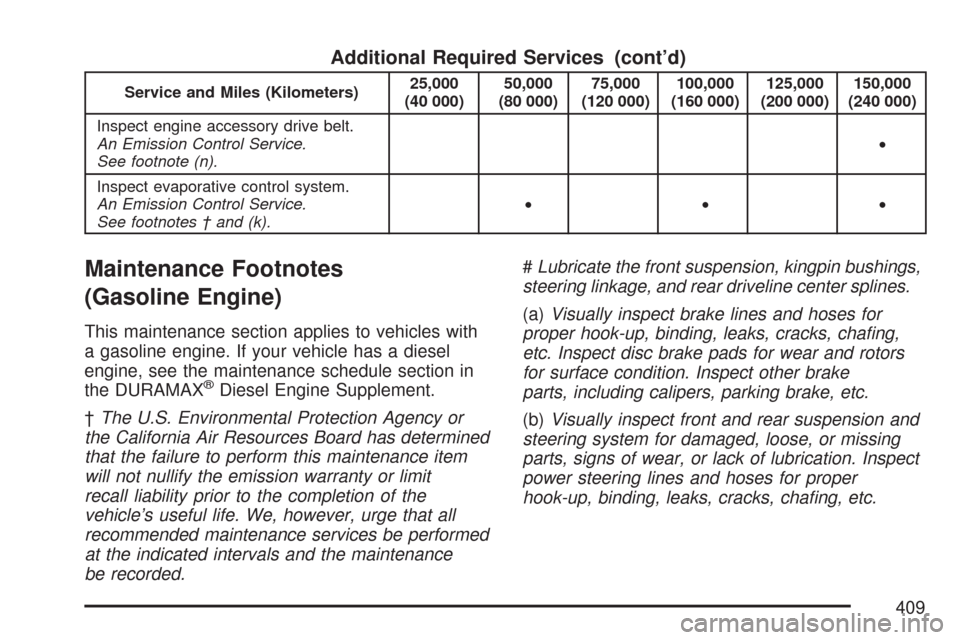
Additional Required Services (cont’d)
Service and Miles (Kilometers)25,000
(40 000)50,000
(80 000)75,000
(120 000)100,000
(160 000)125,000
(200 000)150,000
(240 000)
Inspect engine accessory drive belt.
An Emission Control Service.
See footnote (n).•
Inspect evaporative control system.
An Emission Control Service.
See footnotes † and (k).•••
Maintenance Footnotes
(Gasoline Engine)
This maintenance section applies to vehicles with
a gasoline engine. If your vehicle has a diesel
engine, see the maintenance schedule section in
the DURAMAX
®Diesel Engine Supplement.
†The U.S. Environmental Protection Agency or
the California Air Resources Board has determined
that the failure to perform this maintenance item
will not nullify the emission warranty or limit
recall liability prior to the completion of the
vehicle’s useful life. We, however, urge that all
recommended maintenance services be performed
at the indicated intervals and the maintenance
be recorded.#Lubricate the front suspension, kingpin bushings,
steering linkage, and rear driveline center splines.
(a)Visually inspect brake lines and hoses for
proper hook-up, binding, leaks, cracks, chang,
etc. Inspect disc brake pads for wear and rotors
for surface condition. Inspect other brake
parts, including calipers, parking brake, etc.
(b)Visually inspect front and rear suspension and
steering system for damaged, loose, or missing
parts, signs of wear, or lack of lubrication. Inspect
power steering lines and hoses for proper
hook-up, binding, leaks, cracks, chang, etc.
409
Page 410 of 458
(c)Visually inspect hoses and have them replaced
if they are cracked, swollen, or deteriorated.
Inspect all pipes, ttings, and clamps; replace with
genuine parts as needed. To help ensure proper
operation, a pressure test of the cooling system
and pressure cap and cleaning the outside of the
radiator and air conditioning condenser is
recommended at least once a year.
(d)Inspect wiper blades for wear, cracking,
or contamination. Clean the windshield and wiper
blades, if contaminated. Replace wiper blades
that are worn or damaged. See Windshield Wiper
Blade Replacement on page 344 and Windshield
and Wiper Blades on page 387 for more
information.
(e)Make sure the safety belt reminder light and
all belts, buckles, latch plates, retractors, and
anchorages are working properly. Look for
any other loose or damaged safety belt system
parts. If you see anything that might keep a safety
belt system from doing its job, have it repaired.
Have any torn or frayed safety belts replaced.
Also look for any opened or broken airbag
coverings, and have them repaired or replaced.
The airbag system does not need regular
maintenance.(f)Lubricate all key lock cylinders, hood hinges,
hood prop rod pivot, hood latch assembly,
secondary latch, pivots, spring anchor, release
pawl, rear compartment hinges, latches, locks, fuel
door hinge, and any moving seat hardware. More
frequent lubrication may be required when exposed
to a corrosive environment. Applying silicone grease
on weatherstrips with a clean cloth will make them
last longer, seal better, and not stick or squeak.
(g)Vehicles with Gross Vehicle Weight Rating
(GVWR) above 10,000 lbs (4 536 kg) only: Inspect
shields for damage or looseness. Adjust or
replace as required. This is a Noise Emission
Control Service. Applicable to vehicles sold in the
United States and recommended for vehicles
sold in Canada.
(h)Change automatic transmission uid and lter
if the vehicle is mainly driven under one or
more of these conditions:
-In heavy city traffic where the outside
temperature regularly reaches 90°F (32°C)
or higher.
-In hilly or mountainous terrain.
-When doing frequent trailer towing.
-Uses such as found in taxi, police,
or delivery service.
410
Page 411 of 458
(i)Drain, ush, and rell cooling system. This
service can be complex; you should have
your dealer/retailer perform this service. See
Engine Coolant on page 312 for what to use.
Inspect hoses. Clean radiator, condenser, pressure
cap, and ller neck. Pressure test the cooling
system and pressure cap.
(j)A uid loss in any vehicle system could indicate
a problem. Have the system inspected and
repaired and the uid level checked. Add uid if
needed.
(k)Inspect system. Check all fuel and vapor lines
and hoses for proper hook-up, routing, and
condition. Check that the purge valve works
properly, if equipped. Replace as needed.
(l)If you drive regularly under dusty conditions,
inspect the lter at each engine oil change.
(m)Check system for interference or binding and
for damaged or missing parts. Replace parts
as needed. Replace any components that have
high effort or excessive wear. Do not lubricate
accelerator or cruise control cables.
(n)Visually inspect belt for fraying, excessive
cracks, or obvious damage. Replace belt if
necessary.Owner Checks and Services
These owner checks and services should be
performed at the intervals specified to help
ensure the safety, dependability, and emission
control performance of your vehicle. Your
GM Goodwrench
®dealer can assist you with
these checks and services.
Be sure any necessary repairs are completed at
once. Whenever any fluids or lubricants are added
to your vehicle, make sure they are the proper
ones, as shown inRecommended Fluids and
Lubricants on page 415.
At the First 100, 1,000 and 6,000 Miles
(160, 1 600 and 10 000 km)
For vehicles with dual wheels, check dual wheel
nut torque. For proper torque, seeCapacities
and Specications on page 398.
411