check engine light CHEVROLET HHR 2009 1.G User Guide
[x] Cancel search | Manufacturer: CHEVROLET, Model Year: 2009, Model line: HHR, Model: CHEVROLET HHR 2009 1.GPages: 450, PDF Size: 2.49 MB
Page 190 of 450
OIL LIFE
Press the information button until OIL LIFE displays.
The engine oil life system shows an estimate of the oil’s
remaining useful life. It shows 100% when the system
is reset after an oil change. It alerts you to change the oil
on a schedule consistent with your driving conditions.
In addition to the engine oil life system monitoring the oil
life, additional maintenance is recommended in the
Maintenance Schedule in this manual. SeeEngine Oil
on page 5-17andScheduled Maintenance on page 6-4.
Always reset the engine oil life system after an oil
change. See “How to Reset the Engine Oil Life System”
underEngine Oil Life System on page 5-21.
COOLANT
Press the information button until COOLANT displays.
This mode shows the temperature of the engine coolant
in either degrees Fahrenheit (°F) or degrees Celsius (°C).
Tire Pressure
If your vehicle has a Tire Pressure Monitor System
(TPMS), the pressure for each tire can be viewed in the
DIC. The tire pressure is shown in either pounds per
square inch (psi) or kilopascals (kPa). Press the
information button until LF ## PSI (kPa) ## RF displays
for the front tires. Press the information button again until
LR ## PSI (kPa) ## RR displays for the rear tires.If a low tire pressure condition is detected by the system
while driving, a message advising you to check the tire
pressure appears in the display. SeeInflation - Tire
Pressure on page 5-61andDIC Warnings and Messages
on page 3-50for more information.
DIC Warnings and Messages
These messages appear if there is a problem detected
in one of your vehicle’s systems.
A message clears when the vehicle’s condition is no
longer present. To acknowledge a message and clear it
from the display, press and hold any of the DIC buttons.
If the condition is still present, the warning message
comes back on the next time the vehicle is turned off and
back on. With most messages, a warning chime sounds
when the message displays. Your vehicle may have other
warning messages.
AUTO (Automatic) LIGHTS OFF
This message displays if the automatic headlamp
system is disabled with the headlamp switch.
SeeAutomatic Headlamp System on page 3-16
for more information.
3-50
Page 191 of 450
AUTO (Automatic) LIGHTS ON
This message displays if the automatic headlamp
system is enabled with the headlamp switch.
SeeAutomatic Headlamp System on page 3-16
for more information.
BRAKE FLUID
This message displays, while the ignition is on, when
the brake uid level is low. The brake system warning
light on the instrument panel cluster also comes on.
SeeBrake System Warning Light on page 3-33for more
information. Have the brake system serviced by your
dealer/retailer as soon as possible.
CHANGE OIL SOON
This message displays when the life of the engine oil
has expired and it should be changed.
When this message is acknowledged and cleared from
the display, the engine oil life system must still be reset
separately. SeeEngine Oil Life System on page 5-21
andScheduled Maintenance on page 6-4for more
information.
CHECK GAS CAP
This message displays if the fuel cap has not been fully
tightened. Recheck the fuel cap to make sure that it
is on properly. A few driving trips with the cap properly
installed should turn the message off.
CHECK TIRE PRESS (Pressure)
If your vehicle has a Tire Pressure Monitor System
(TPMS), this message displays when the pressure in
one or more of the vehicle’s tires needs to be checked.
If a tire pressure message appears on the DIC, stop as
soon as you can. Have the tire pressures checked and
set to those shown on the Tire Loading Information
label. SeeTires on page 5-53,Loading the Vehicle on
page 4-25, andInflation - Tire Pressure on page 5-61.
The DIC also shows the tire pressure values. SeeDIC
Operation and Displays on page 3-48. If the tire pressure
is low, the low tire pressure warning light comes on.
SeeTire Pressure Light on page 3-37.
COMPETITIVE MODE
If your vehicle has this feature, this message displays
when the Competitive Driving mode is selected.
The Traction Control System (TCS) will not be operating
while in the Competitive Driving mode and the ESC/TCS
light on the instrument panel cluster will be on solid.
Adjust your driving accordingly. SeeTraction Control
System (TCS) on page 4-10,Electronic Stability Control
(ESC) on page 4-7, andElectronic Stability Control
(ESC)/Traction Control System (TCS) Indicator/Warning
Light on page 3-35for more information.
3-51
Page 241 of 450
Under certain weather or operating conditions, occasional
brake squeak, squeal, or other noise might be heard with
the vehicle’s performance braking system. The brake
system on SS models is designed for superior fade
resistance and consistent operation using high
performance brake pads. Brake noise and brake dust
are normal and do not affect system performance.
Adding non-dealer/non-retailer accessories can affect
vehicle performance. SeeAccessories and Modifications
on page 5-3.
Antilock Brake System (ABS)
The vehicle might have the Antilock Brake System
(ABS), an advanced electronic braking system that helps
prevent a braking skid.
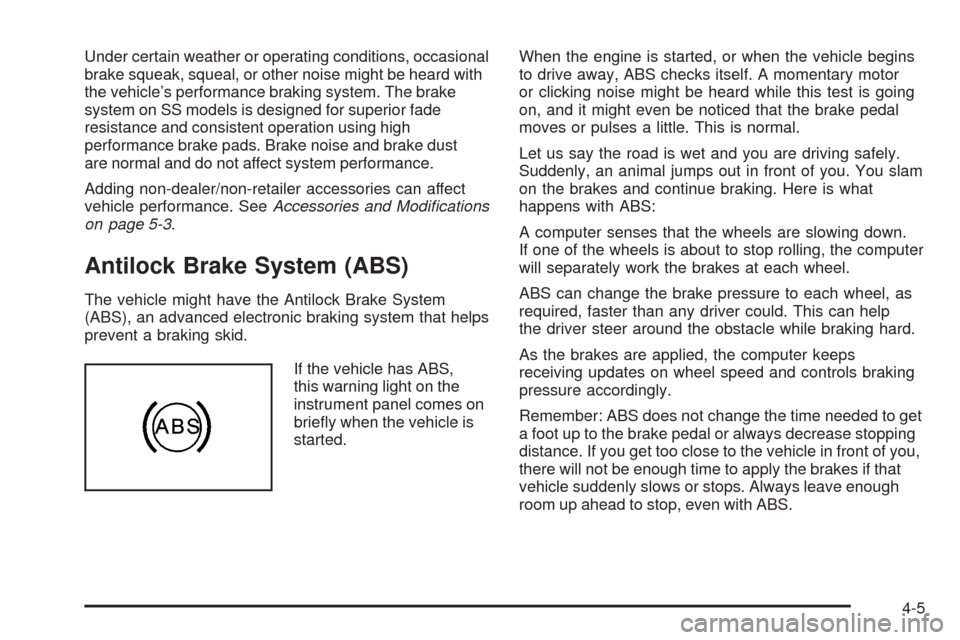
If the vehicle has ABS,
this warning light on the
instrument panel comes on
briey when the vehicle is
started.When the engine is started, or when the vehicle begins
to drive away, ABS checks itself. A momentary motor
or clicking noise might be heard while this test is going
on, and it might even be noticed that the brake pedal
moves or pulses a little. This is normal.
Let us say the road is wet and you are driving safely.
Suddenly, an animal jumps out in front of you. You slam
on the brakes and continue braking. Here is what
happens with ABS:
A computer senses that the wheels are slowing down.
If one of the wheels is about to stop rolling, the computer
will separately work the brakes at each wheel.
ABS can change the brake pressure to each wheel, as
required, faster than any driver could. This can help
the driver steer around the obstacle while braking hard.
As the brakes are applied, the computer keeps
receiving updates on wheel speed and controls braking
pressure accordingly.
Remember: ABS does not change the time needed to get
a foot up to the brake pedal or always decrease stopping
distance. If you get too close to the vehicle in front of you,
there will not be enough time to apply the brakes if that
vehicle suddenly slows or stops. Always leave enough
room up ahead to stop, even with ABS.
4-5
Page 254 of 450
Racing or Other Competitive Driving
See your warranty book before using your vehicle for
racing or other competitive driving. After reviewing your
warranty book, please see the GM Performance Parts
website or catalog and contact the race sanctioning
bodies, for example Sports Car Club of America (SCCA)
or Grand American, for parts and equipment required for
racing or other competitive driving.
Notice:If you use your vehicle for competitive
driving, the engine may use more oil than it would
with normal use. Low oil levels can damage the
engine. Be sure to check the oil level often during
competitive driving and keep the level at or near the
upper mark that shows the proper operating range
on the engine oil dipstick. For information on how to
add oil, seeEngine Oil on page 5-17.
Driving at Night
Night driving is more dangerous than day driving because
some drivers are likely to be impaired — by alcohol or
drugs, with night vision problems, or by fatigue.Night driving tips include:
Drive defensively.
Do not drink and drive.
Reduce headlamp glare by adjusting the inside
rearview mirror.
Slow down and keep more space between you and
other vehicles because headlamps can only light up
so much road ahead.
Watch for animals.
When tired, pull off the road.
Do not wear sunglasses.
Avoid staring directly into approaching headlamps.
Keep the windshield and all glass on your vehicle
clean — inside and out.
Keep your eyes moving, especially during turns or
curves.
No one can see as well at night as in the daytime. But, as
we get older, these differences increase. A 50-year-old
driver might need at least twice as much light to see the
same thing at night as a 20-year-old.
4-18
Page 259 of 450
{CAUTION:
Snow can trap engine exhaust under the vehicle.
This may cause exhaust gases to get inside.
Engine exhaust contains carbon monoxide (CO)
which cannot be seen or smelled. It can cause
unconsciousness and even death.If the vehicle is
stuck in the snow:
Clear away snow from around the base of
your vehicle, especially any that is blocking
the exhaust pipe.
Check again from time to time to be sure
snow does not collect there.
Open a window about two inches (5 cm) on
the side of the vehicle that is away from the
wind to bring in fresh air.
Fully open the air outlets on or under the
instrument panel.
Adjust the Climate Control system to a setting
that circulates the air inside the vehicle and
set the fan speed to the highest setting.
See Climate Control System in the Index.
For more information about carbon monoxide, see
Engine Exhaust on page 2-37.
CAUTION: (Continued)
CAUTION: (Continued)
Snow can trap exhaust gases under your vehicle.
This can cause deadly CO (carbon monoxide) gas
to get inside. CO could overcome you and kill you.
You cannot see it or smell it, so you might not
know it is in your vehicle. Clear away snow from
around the base of your vehicle, especially any
that is blocking the exhaust.
Run the engine for short periods only as needed to
keep warm, but be careful.
To save fuel, run the engine for only short periods as
needed to warm the vehicle and then shut the engine
off and close the window most of the way to save heat.
Repeat this until help arrives but only when you feel really
uncomfortable from the cold. Moving about to keep warm
also helps.
If it takes some time for help to arrive, now and then
when you run the engine, push the accelerator
pedal slightly so the engine runs faster than the idle
speed. This keeps the battery charged to restart
the vehicle and to signal for help with the headlamps.
Do this as little as possible to save fuel.
4-23
Page 283 of 450
Keep a record with all parts receipts and list the
mileage and the date of any service work performed.
SeeMaintenance Record on page 6-18.
Adding Equipment to the Outside of
the Vehicle
Things added to the outside of the vehicle can affect the
airow around it. This can cause wind noise and can
affect fuel economy and windshield washer performance.
Check with your dealer/retailer before adding equipment
to the outside of the vehicle.
Fuel
Use of the recommended fuel is an important part
of the proper maintenance of this vehicle. To help
keep the engine clean and maintain optimum vehicle
performance, we recommend the use of gasoline
advertised as TOP TIER Detergent Gasoline.
The 8th digit of the Vehicle Identication Number (VIN)
shows the code letter or number that identies the
vehicle’s engine. The VIN is at the top left of the
instrument panel. SeeVehicle Identification Number
(VIN) on page 5-107.
If the vehicle has the 2.2L L4 engine (VIN Code B)
or the 2.4L L4 engine (VIN Code V), you can use either
unleaded gasoline or ethanol fuel containing up to85% ethanol (E85). SeeFuel E85 (85% Ethanol) on
page 5-7. If the vehicle has the 2.0L L4 engine
(VIN Code X), use only unleaded gasoline.
SeeGasoline Octane on page 5-5.
Gasoline Octane
If the vehicle has the 2.2L L4 engine (VIN Code B), use
regular unleaded gasoline with a posted octane rating
of 87 or higher. If the octane rating is less than 87, you
might notice an audible knocking noise when you
drive, commonly referred to as spark knock. If this
occurs, use a gasoline rated at 87 octane or higher as
soon as possible. If you are using gasoline rated at
87 octane or higher and you hear heavy knocking, the
engine needs service.
If the vehicle has the 2.4L L4 engine (VIN Code V) or
the 2.0L L4 engine (VIN Code X), use premium unleaded
gasoline with a posted octane rating of 91 or higher.
You can also use regular unleaded gasoline rated at
87 octane or higher, but the vehicle’s acceleration could
be slightly reduced, and you might notice a slight audible
knocking noise, commonly referred to as spark knock.
If the octane is less than 87, you might notice a heavy
knocking noise when you drive. If this occurs, use a
gasoline rated at 87 octane or higher as soon as possible.
Otherwise, you could damage the engine. If you are using
gasoline rated at 87 octane or higher and you hear heavy
knocking, the engine needs service.
5-5
Page 310 of 450
8. By this time, the coolant level inside the radiator
ller port may be lower. If the level is lower, add
more of the proper DEX-COOL
®coolant mixture
through the ll port until the level reaches the base
of the ll port.
9. Then replace the pressure cap. At any time during
this procedure, if coolant begins to ow out of the
ll port, reinstall the pressure cap. Be sure the
pressure cap is hand-tight and fully seated.
10. When the engine has cooled, check the coolant in
the coolant recovery tank. The level in the coolant
recovery tank should be at the COLD FILL line
when the engine is cold.
Pressure Cap
Notice:If the pressure cap is not tightly installed,
coolant loss and possible engine damage may
occur. Be sure the cap is properly and tightly
secured.
SeeEngine Compartment Overview on page 5-14for
more information on location.
Engine Overheating
The vehicle has several indicators to warn of engine
overheating.
You will nd a coolant temperature warning light and a
coolant temperature gage on your vehicle’s instrument
panel. SeeEngine Coolant Temperature Warning
Light on page 3-36andEngine Coolant Temperature
Gage on page 3-36for more information.
You may decide not to lift the hood when this warning
appears, but instead get service help right away.
SeeRoadside Assistance Program on page 7-7.
If you do decide to lift the hood, make sure the vehicle
is parked on a level surface.
Then check to see if the engine cooling fans are
running. If the engine is overheating, both fans should
be running. If they are not, do not continue to run
the engine and have the vehicle serviced.
Notice:Engine damage from running the engine
without coolant is not covered by the warranty.
Notice:If the engine catches re because of being
driven with no coolant, your vehicle can be badly
damaged. The costly repairs would not be covered
by the vehicle warranty.
5-32
Page 437 of 450
Bulb Replacement...........................................5-51
Center High-Mounted Stoplamp (CHMSL)........5-49
Fog Lamp ..................................................3-16
Halogen Bulbs............................................5-47
Headlamp Aiming........................................5-44
Headlamps.................................................5-47
Headlamps, Front Turn Signal,
and Parking Lamps..................................5-47
License Plate Lamps....................................5-51
Taillamps, Turn Signal, Stoplamps and
Back-up Lamps........................................5-50
Buying New Tires...........................................5-70
C
Calibration.....................................................2-39
California
Perchlorate Materials Requirements................. 5-4
California Fuel.................................................. 5-6
California Proposition 65 Warning....................... 5-4
Camera, Rear Vision.......................................2-44
Canadian Owners................................................ ii
Capacities and Specications..........................5-114
Carbon Monoxide
Engine Exhaust...........................................2-37
Liftgate......................................................2-12
Winter Driving.............................................4-22Care of
Safety Belts..............................................5-102
Cargo, Rear Side Door....................................2-12
CD, MP3 .......................................................3-74
Center High-Mounted Stoplamp (CHMSL)...........5-49
Chains, Tire...................................................5-74
Charging System Light....................................3-32
Check
Engine Lamp..............................................3-37
Checking Things Under the Hood......................5-12
Chemical Paint Spotting.................................5-106
Child Restraints
Infants and Young Children...........................1-35
Lower Anchors and Tethers for Children..........1-43
Older Children.............................................1-32
Securing a Child Restraint in a
Rear Seat Position...................................1-51
Securing a Child Restraint in the
Right Front Seat Position..........................1-54
Systems.....................................................1-39
Where to Put the Restraint...........................1-42
Chime Level Adjustment..................................3-96
Cigarette Lighter.............................................3-21
Circuit Breakers............................................5-109
3
Page 440 of 450
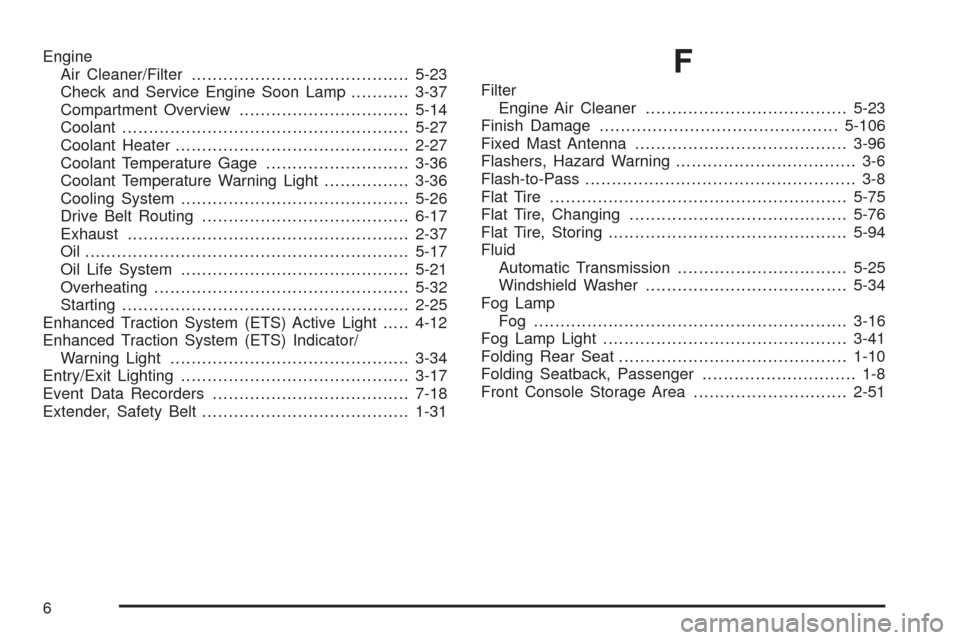
Engine
Air Cleaner/Filter.........................................5-23
Check and Service Engine Soon Lamp...........3-37
Compartment Overview................................5-14
Coolant......................................................5-27
Coolant Heater............................................2-27
Coolant Temperature Gage...........................3-36
Coolant Temperature Warning Light................3-36
Cooling System...........................................5-26
Drive Belt Routing.......................................6-17
Exhaust.....................................................2-37
Oil .............................................................5-17
Oil Life System...........................................5-21
Overheating................................................5-32
Starting......................................................2-25
Enhanced Traction System (ETS) Active Light.....4-12
Enhanced Traction System (ETS) Indicator/
Warning Light.............................................3-34
Entry/Exit Lighting...........................................3-17
Event Data Recorders.....................................7-18
Extender, Safety Belt.......................................1-31F
Filter
Engine Air Cleaner......................................5-23
Finish Damage.............................................5-106
Fixed Mast Antenna........................................3-96
Flashers, Hazard Warning.................................. 3-6
Flash-to-Pass................................................... 3-8
Flat Tire........................................................5-75
Flat Tire, Changing.........................................5-76
Flat Tire, Storing.............................................5-94
Fluid
Automatic Transmission................................5-25
Windshield Washer......................................5-34
Fog Lamp
Fog ...........................................................3-16
Fog Lamp Light..............................................3-41
Folding Rear Seat...........................................1-10
Folding Seatback, Passenger............................. 1-8
Front Console Storage Area.............................2-51
6
Page 442 of 450
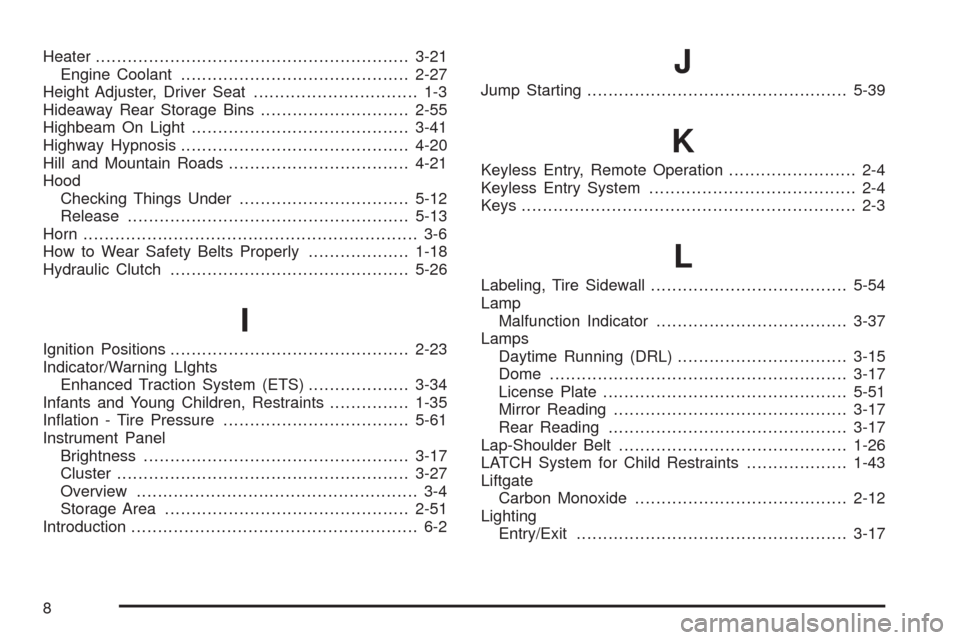
Heater...........................................................3-21
Engine Coolant...........................................2-27
Height Adjuster, Driver Seat............................... 1-3
Hideaway Rear Storage Bins............................2-55
Highbeam On Light.........................................3-41
Highway Hypnosis...........................................4-20
Hill and Mountain Roads..................................4-21
Hood
Checking Things Under................................5-12
Release.....................................................5-13
Horn ............................................................... 3-6
How to Wear Safety Belts Properly...................1-18
Hydraulic Clutch.............................................5-26
I
Ignition Positions.............................................2-23
Indicator/Warning LIghts
Enhanced Traction System (ETS)...................3-34
Infants and Young Children, Restraints...............1-35
Ination - Tire Pressure...................................5-61
Instrument Panel
Brightness..................................................3-17
Cluster.......................................................3-27
Overview..................................................... 3-4
Storage Area..............................................2-51
Introduction...................................................... 6-2
J
Jump Starting.................................................5-39
K
Keyless Entry, Remote Operation........................ 2-4
Keyless Entry System....................................... 2-4
Keys............................................................... 2-3
L
Labeling, Tire Sidewall.....................................5-54
Lamp
Malfunction Indicator....................................3-37
Lamps
Daytime Running (DRL)................................3-15
Dome ........................................................3-17
License Plate..............................................5-51
Mirror Reading............................................3-17
Rear Reading.............................................3-17
Lap-Shoulder Belt...........................................1-26
LATCH System for Child Restraints...................1-43
Liftgate
Carbon Monoxide........................................2-12
Lighting
Entry/Exit...................................................3-17
8