lock CHEVROLET HHR 2009 1.G Manual Online
[x] Cancel search | Manufacturer: CHEVROLET, Model Year: 2009, Model line: HHR, Model: CHEVROLET HHR 2009 1.GPages: 450, PDF Size: 2.49 MB
Page 289 of 450
When replacing the fuel cap, turn it clockwise
until it clicks. Make sure the cap is fully installed.
The diagnostic system can determine if the fuel cap
has been left off or improperly installed. This would
allow fuel to evaporate into the atmosphere.
SeeMalfunction Indicator Lamp on page 3-37.
The CHECK GAS CAP message displays on the Driver
Information Center (DIC) if the fuel cap is not properly
installed. SeeDIC Warnings and Messages on
page 3-50for more information.
To close the fuel door securely, push the door to the
closed position.
{CAUTION:
If a re starts while you are refueling, do not
remove the nozzle. Shut off the ow of fuel by
shutting off the pump or by notifying the station
attendant. Leave the area immediately.
Notice:If you need a new fuel cap, be sure to get
the right type. Your dealer/retailer can get one
for you. If you get the wrong type, it may not t
properly. This may cause the malfunction indicator
lamp to light and may damage the fuel tank and
emissions system. SeeMalfunction Indicator Lamp
on page 3-37.
5-11
Page 293 of 450
A. Windshield Washer Fluid Reservoir. See “Adding
Washer Fluid” underWindshield Washer Fluid
on page 5-34.
B. Pressure Cap. SeePressure Cap on page 5-32.
C. Coolant Recovery Tank. See “Checking Coolant”
underEngine Coolant on page 5-27.
D. Engine Air Cleaner/Filter. SeeEngine Air
Cleaner/Filter on page 5-23.
E. Electric Engine Cooling Fan (Out of View). See
Cooling SystemCooling System on page 5-26.
F. Engine Oil Fill Cap. See “When to Add Engine Oil”
underEngine Oil on page 5-17.G. Engine Oil Dipstick (Out of View). See “Checking
Engine Oil” underEngine Oil on page 5-17.
H. Brake Master Cylinder Reservoir. SeeBrakes on
page 5-35andHydraulic Clutch on page 5-26.
I. Remote Positive (+) Terminal. SeeJump Starting on
page 5-39.
J. Engine Compartment Fuse Block. SeeEngine
Compartment Fuse Block on page 5-111.
K. Remote Negative (−) Terminal (Out of View).
SeeJump Starting on page 5-39.
5-15
Page 295 of 450
A. Pressure Cap. SeePressure Cap on page 5-32.
B. Engine Air Cleaner/Filter. SeeEngine Air
Cleaner/Filter on page 5-23.
C. Windshield Washer Fluid Reservoir. See “Adding
Washer Fluid” underWindshield Washer Fluid
on page 5-34.
D. Coolant Recovery Tank. See “Checking Coolant”
underEngine Coolant on page 5-27.
E. Engine Oil Dipstick. See “Checking Engine Oil”
underEngine Oil on page 5-17.
F. Engine Oil Fill Cap. See “When to Add Engine Oil”
underEngine Oil on page 5-17.
G. Brake Master Cylinder Reservoir. See “Brake Fluid”
underBrakes on page 5-35andHydraulic Clutch
on page 5-26.
H. Underhood Fuse Block. SeeEngine Compartment
Fuse Block on page 5-111.
I. Remote Negative (−) Terminal. SeeJump Starting
on page 5-39.
J. Remote Positive (+) Terminal. SeeJump Starting on
page 5-39.Engine Oil
Checking Engine Oil
It is a good idea to check the engine oil level at each
fuel ll. In order to get an accurate reading, the oil must
be warm and the vehicle must be on level ground.
The engine oil dipstick handle is a yellow loop.
SeeEngine Compartment Overview on page 5-14
for the location of the engine oil dipstick.
1. Turn off the engine and give the oil several minutes
to drain back into the oil pan. If this is not done, the
oil dipstick might not show the actual level.
2. Pull out the dipstick and clean it with a paper towel
or cloth, then push it back in all the way. Remove it
again, keeping the tip down, and check the level.
5-17
Page 300 of 450
How to Reset the Engine Oil Life
System
The Engine Oil Life System calculates when to change
your engine oil and lter based on vehicle use. Whenever
the oil is changed, reset the system so it can calculate
when the next oil change is required. If a situation occurs
where the oil is changed prior to a CHANGE OIL SOON
message being turned on, reset the system.
After changing the engine oil, the system must be reset:
1. Turn the ignition to ON/RUN, with the engine off.
2. Press the information and reset buttons on the
Driver Information Center (DIC) at the same
time to enter the personalization menu. SeeDIC
Vehicle Personalization on page 3-56.
3. Press the information button to scroll through the
available personalization menu modes until the
DIC display shows OIL-LIFE RESET.
4. Press and hold the reset button until the DIC display
shows ACKNOWLEDGED. This will tell you the
system has been reset.
5. Turn the key to LOCK/OFF.For vehicles with the 2.2L (VIN code V) or 2.4L (VIN
code B) engines, you can also reset the system
as follows:
1. Turn the ignition key to ON/RUN with the engine off.
2. Fully press and release the accelerator pedal slowly
three times within ve seconds.
3. Turn the key to LOCK/OFF, then start the engine.
If the CHANGE OIL SOON message comes back
on when the vehicle is started, the engine oil life system
has not reset. Repeat the reset procedure.
What to Do with Used Oil
Used engine oil contains certain elements that can be
unhealthy for your skin and could even cause cancer.
Do not let used oil stay on your skin for very long. Clean
your skin and nails with soap and water, or a good
hand cleaner. Wash or properly dispose of clothing or
rags containing used engine oil. See the manufacturer’s
warnings about the use and disposal of oil products.
5-22
Page 309 of 450
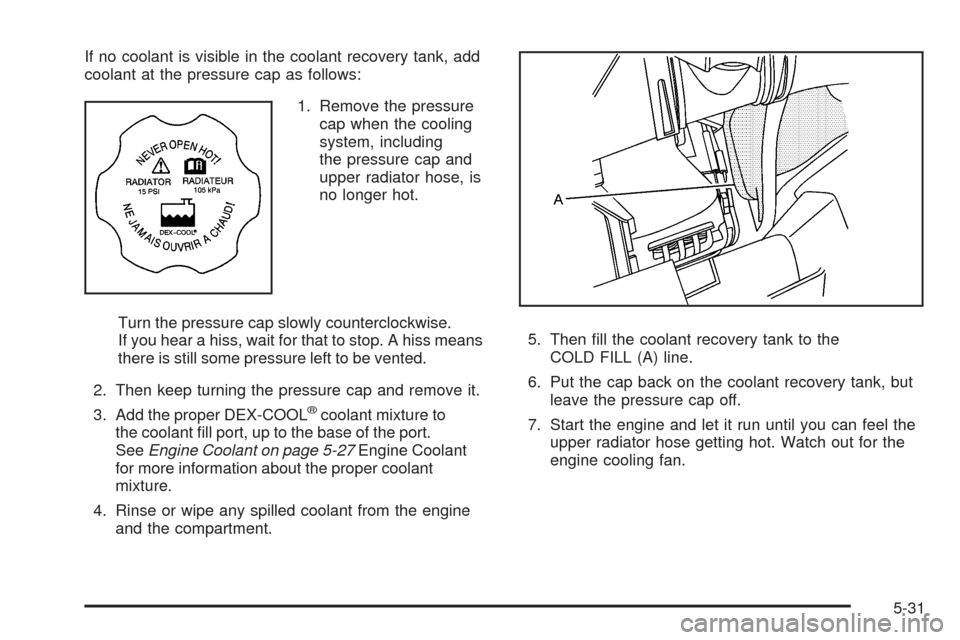
If no coolant is visible in the coolant recovery tank, add
coolant at the pressure cap as follows:
1. Remove the pressure
cap when the cooling
system, including
the pressure cap and
upper radiator hose, is
no longer hot.
Turn the pressure cap slowly counterclockwise.
If you hear a hiss, wait for that to stop. A hiss means
there is still some pressure left to be vented.
2. Then keep turning the pressure cap and remove it.
3. Add the proper DEX-COOL
®coolant mixture to
the coolant ll port, up to the base of the port.
SeeEngine Coolant on page 5-27Engine Coolant
for more information about the proper coolant
mixture.
4. Rinse or wipe any spilled coolant from the engine
and the compartment.5. Then ll the coolant recovery tank to the
COLD FILL (A) line.
6. Put the cap back on the coolant recovery tank, but
leave the pressure cap off.
7. Start the engine and let it run until you can feel the
upper radiator hose getting hot. Watch out for the
engine cooling fan.
5-31
Page 318 of 450
Notice:If you leave the radio or other accessories
on during the jump starting procedure, they could be
damaged. The repairs would not be covered by the
warranty. Always turn off the radio and other
accessories when jump starting the vehicle.
3. Turn off the ignition on both vehicles. Unplug
unnecessary accessories plugged into the cigarette
lighter or the accessory power outlet. Turn off
the radio and all lamps that are not needed.
This will avoid sparks and help save both batteries.
And it could save the radio!
4. Open the hood on the other vehicle and locate the
positive (+) and negative (−) terminal locations on
that vehicle.You will not see the battery of your vehicle under
the hood. It is located in the rear cargo area.
You will not need to access your battery for jump
starting. The vehicle has a remote positive (+) and a
remote negative (−) jump starting terminal.
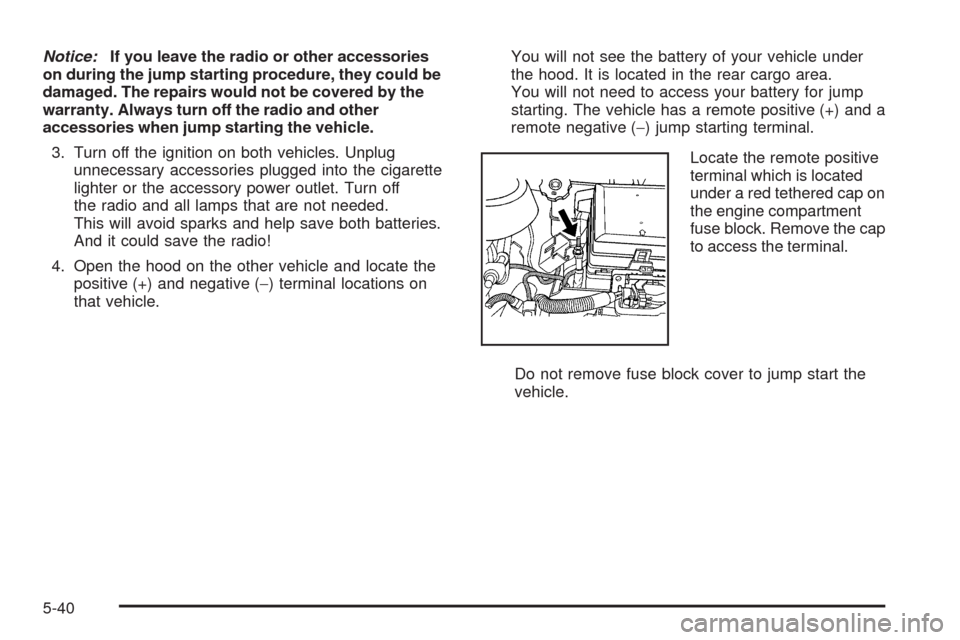
Locate the remote positive
terminal which is located
under a red tethered cap on
the engine compartment
fuse block. Remove the cap
to access the terminal.
Do not remove fuse block cover to jump start the
vehicle.
5-40
Page 324 of 450
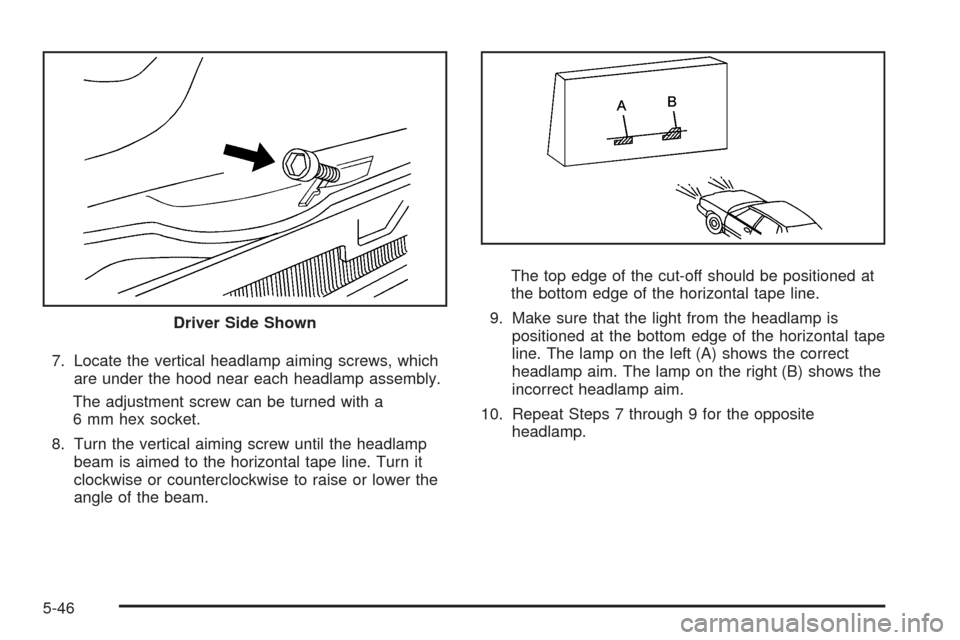
7. Locate the vertical headlamp aiming screws, which
are under the hood near each headlamp assembly.
The adjustment screw can be turned with a
6 mm hex socket.
8. Turn the vertical aiming screw until the headlamp
beam is aimed to the horizontal tape line. Turn it
clockwise or counterclockwise to raise or lower the
angle of the beam.The top edge of the cut-off should be positioned at
the bottom edge of the horizontal tape line.
9. Make sure that the light from the headlamp is
positioned at the bottom edge of the horizontal tape
line. The lamp on the left (A) shows the correct
headlamp aim. The lamp on the right (B) shows the
incorrect headlamp aim.
10. Repeat Steps 7 through 9 for the opposite
headlamp. Driver Side Shown
5-46
Page 326 of 450
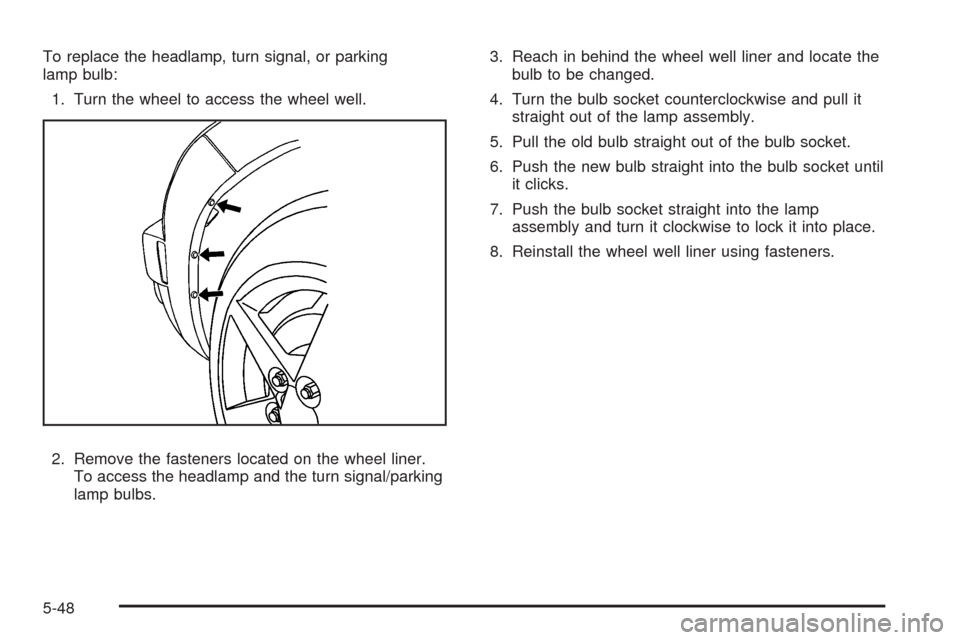
To replace the headlamp, turn signal, or parking
lamp bulb:
1. Turn the wheel to access the wheel well.
2. Remove the fasteners located on the wheel liner.
To access the headlamp and the turn signal/parking
lamp bulbs.3. Reach in behind the wheel well liner and locate the
bulb to be changed.
4. Turn the bulb socket counterclockwise and pull it
straight out of the lamp assembly.
5. Pull the old bulb straight out of the bulb socket.
6. Push the new bulb straight into the bulb socket until
it clicks.
7. Push the bulb socket straight into the lamp
assembly and turn it clockwise to lock it into place.
8. Reinstall the wheel well liner using fasteners.
5-48
Page 327 of 450
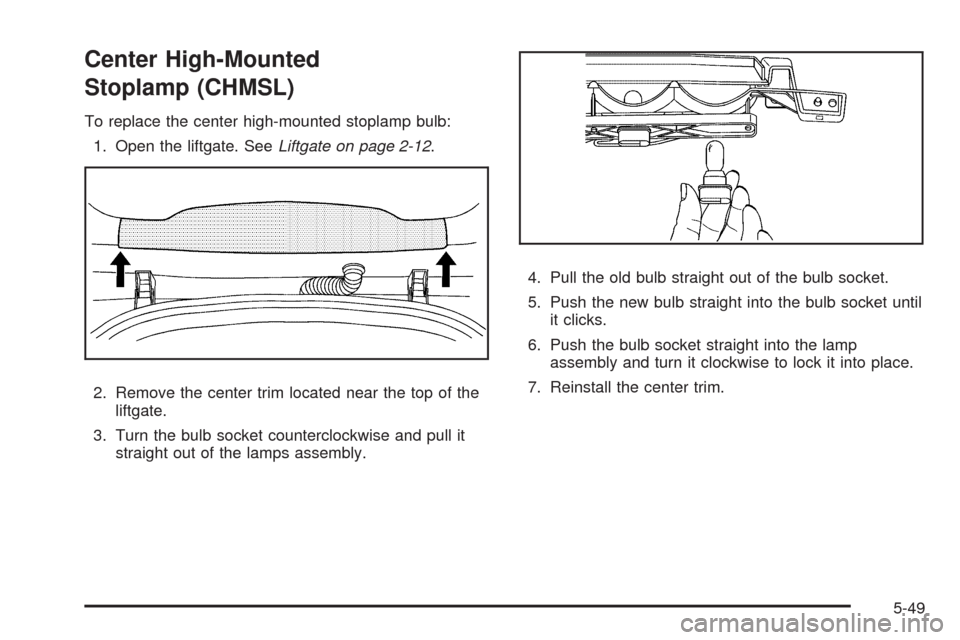
Center High-Mounted
Stoplamp (CHMSL)
To replace the center high-mounted stoplamp bulb:
1. Open the liftgate. SeeLiftgate on page 2-12.
2. Remove the center trim located near the top of the
liftgate.
3. Turn the bulb socket counterclockwise and pull it
straight out of the lamps assembly.4. Pull the old bulb straight out of the bulb socket.
5. Push the new bulb straight into the bulb socket until
it clicks.
6. Push the bulb socket straight into the lamp
assembly and turn it clockwise to lock it into place.
7. Reinstall the center trim.
5-49
Page 328 of 450

Taillamps, Turn Signal, Stoplamps
and Back-up Lamps
A. Stoplamp/Taillamp/Turn Signal Lamp
B. Back-up LampTo replace one of these bulbs:
1. Open the liftgate. SeeLiftgate on page 2-12.
2. Remove the cover in the rear cargo area of the
vehicle to access the bulbs.
3. Turn the bulb socket counterclockwise and pull it
straight out of the lamp assembly.
4. Pull the bulb straight out of the socket.
5. Install a new bulb. When installing the bulb socket
into the assembly, line up the tabs with the slots in
the bulb assembly.
5-50