oil dipstick CHEVROLET HHR 2009 1.G Owners Manual
[x] Cancel search | Manufacturer: CHEVROLET, Model Year: 2009, Model line: HHR, Model: CHEVROLET HHR 2009 1.GPages: 450, PDF Size: 2.49 MB
Page 254 of 450
Racing or Other Competitive Driving
See your warranty book before using your vehicle for
racing or other competitive driving. After reviewing your
warranty book, please see the GM Performance Parts
website or catalog and contact the race sanctioning
bodies, for example Sports Car Club of America (SCCA)
or Grand American, for parts and equipment required for
racing or other competitive driving.
Notice:If you use your vehicle for competitive
driving, the engine may use more oil than it would
with normal use. Low oil levels can damage the
engine. Be sure to check the oil level often during
competitive driving and keep the level at or near the
upper mark that shows the proper operating range
on the engine oil dipstick. For information on how to
add oil, seeEngine Oil on page 5-17.
Driving at Night
Night driving is more dangerous than day driving because
some drivers are likely to be impaired — by alcohol or
drugs, with night vision problems, or by fatigue.Night driving tips include:
Drive defensively.
Do not drink and drive.
Reduce headlamp glare by adjusting the inside
rearview mirror.
Slow down and keep more space between you and
other vehicles because headlamps can only light up
so much road ahead.
Watch for animals.
When tired, pull off the road.
Do not wear sunglasses.
Avoid staring directly into approaching headlamps.
Keep the windshield and all glass on your vehicle
clean — inside and out.
Keep your eyes moving, especially during turns or
curves.
No one can see as well at night as in the daytime. But, as
we get older, these differences increase. A 50-year-old
driver might need at least twice as much light to see the
same thing at night as a 20-year-old.
4-18
Page 293 of 450
A. Windshield Washer Fluid Reservoir. See “Adding
Washer Fluid” underWindshield Washer Fluid
on page 5-34.
B. Pressure Cap. SeePressure Cap on page 5-32.
C. Coolant Recovery Tank. See “Checking Coolant”
underEngine Coolant on page 5-27.
D. Engine Air Cleaner/Filter. SeeEngine Air
Cleaner/Filter on page 5-23.
E. Electric Engine Cooling Fan (Out of View). See
Cooling SystemCooling System on page 5-26.
F. Engine Oil Fill Cap. See “When to Add Engine Oil”
underEngine Oil on page 5-17.G. Engine Oil Dipstick (Out of View). See “Checking
Engine Oil” underEngine Oil on page 5-17.
H. Brake Master Cylinder Reservoir. SeeBrakes on
page 5-35andHydraulic Clutch on page 5-26.
I. Remote Positive (+) Terminal. SeeJump Starting on
page 5-39.
J. Engine Compartment Fuse Block. SeeEngine
Compartment Fuse Block on page 5-111.
K. Remote Negative (−) Terminal (Out of View).
SeeJump Starting on page 5-39.
5-15
Page 295 of 450
A. Pressure Cap. SeePressure Cap on page 5-32.
B. Engine Air Cleaner/Filter. SeeEngine Air
Cleaner/Filter on page 5-23.
C. Windshield Washer Fluid Reservoir. See “Adding
Washer Fluid” underWindshield Washer Fluid
on page 5-34.
D. Coolant Recovery Tank. See “Checking Coolant”
underEngine Coolant on page 5-27.
E. Engine Oil Dipstick. See “Checking Engine Oil”
underEngine Oil on page 5-17.
F. Engine Oil Fill Cap. See “When to Add Engine Oil”
underEngine Oil on page 5-17.
G. Brake Master Cylinder Reservoir. See “Brake Fluid”
underBrakes on page 5-35andHydraulic Clutch
on page 5-26.
H. Underhood Fuse Block. SeeEngine Compartment
Fuse Block on page 5-111.
I. Remote Negative (−) Terminal. SeeJump Starting
on page 5-39.
J. Remote Positive (+) Terminal. SeeJump Starting on
page 5-39.Engine Oil
Checking Engine Oil
It is a good idea to check the engine oil level at each
fuel ll. In order to get an accurate reading, the oil must
be warm and the vehicle must be on level ground.
The engine oil dipstick handle is a yellow loop.
SeeEngine Compartment Overview on page 5-14
for the location of the engine oil dipstick.
1. Turn off the engine and give the oil several minutes
to drain back into the oil pan. If this is not done, the
oil dipstick might not show the actual level.
2. Pull out the dipstick and clean it with a paper towel
or cloth, then push it back in all the way. Remove it
again, keeping the tip down, and check the level.
5-17
Page 296 of 450
When to Add Engine Oil
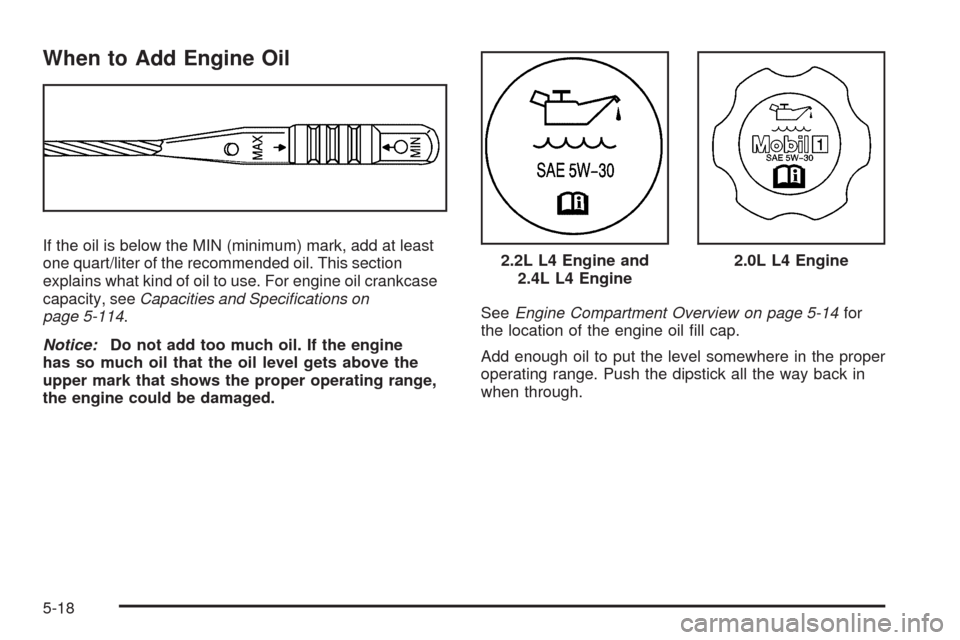
If the oil is below the MIN (minimum) mark, add at least
one quart/liter of the recommended oil. This section
explains what kind of oil to use. For engine oil crankcase
capacity, seeCapacities and Specifications on
page 5-114.
Notice:Do not add too much oil. If the engine
has so much oil that the oil level gets above the
upper mark that shows the proper operating range,
the engine could be damaged.SeeEngine Compartment Overview on page 5-14for
the location of the engine oil ll cap.
Add enough oil to put the level somewhere in the proper
operating range. Push the dipstick all the way back in
when through.2.2L L4 Engine and
2.4L L4 Engine2.0L L4 Engine
5-18