warning CHEVROLET HHR 2010 1.G Owner's Guide
[x] Cancel search | Manufacturer: CHEVROLET, Model Year: 2010, Model line: HHR, Model: CHEVROLET HHR 2010 1.GPages: 480, PDF Size: 5.25 MB
Page 74 of 480

A booster seat (C-D) is a child restraint designed to
improve the fit of the vehicle's safety belt system.
A booster seat can also help a child to see out the
window.
Securing an Add-On Child Restraint in
the Vehicle
{WARNING:
A child can be seriously injured or killed in a crash
if the child restraint is not properly secured in the
vehicle. Secure the child restraint properly in the
vehicle using the vehicle's safety belt or LATCH
system, following the instructions that came with
that child restraint and the instructions in this
manual.
To help reduce the chance of injury, the child restraint
must be secured in the vehicle. Child restraint systems
must be secured in vehicle seats by lap belts or the lap
belt portion of a lap-shoulder belt, or by the LATCH
system. See Lower Anchors and Tethers for Children
(LATCH)
on page 2‑45for more information. A child
can be endangered in a crash if the child restraint is not
properly secured in the vehicle.
2-42
Page 75 of 480
When securing an add-on child restraint, refer to the
instructions that come with the restraint which may be
on the restraint itself or in a booklet, or both, and to this
manual. The child restraint instructions are important,
so if they are not available, obtain a replacement copy
from the manufacturer.
Keep in mind that an unsecured child restraint can
move around in a collision or sudden stop and injure
people in the vehicle. Be sure to properly secure any
child restraint in the vehicle—even when no child
is in it.
Securing the Child Within the Child
Restraint
{WARNING:
A child can be seriously injured or killed in a crash
if the child is not properly secured in the child
restraint. Secure the child properly following the
instructions that came with that child restraint.
Where to Put the Restraint
According to accident statistics, children and infants
are safer when properly restrained in a child restraint
system or infant restraint system secured in a rear
seating position.
We recommend that children and child restraints be
secured in a rear seat, including: an infant or a child
riding in a rear-facing child restraint; a child riding in a
forward-facing child seat; an older child riding in a
booster seat; and children, who are large enough,
using safety belts.
2-43
Page 76 of 480
A label on the sun visor says,“Never put a rear-facing
child restraint in the front.” This is because the risk to
the rear-facing child is so great, if the airbag deploys.
{WARNING:
A child in a rear-facing child restraint can be
seriously injured or killed if the right front
passenger airbag inflates. This is because the
back of the rear-facing child restraint would be
very close to the inflating airbag. A child in a
forward-facing child restraint can be seriously
injured or killed if the right front passenger airbag
inflates and the passenger seat is in a forward
position.
The vehicle may have a passenger sensing
system which is designed to turn off the right front
passenger frontal airbag under certain conditions.
Even if the passenger sensing system,
if equipped, has turned off the right front
passenger frontal airbag, no system is fail-safe.
No one can guarantee that an airbag will not
deploy under some unusual circumstance, even
though it is turned off.
(Continued)
WARNING: (Continued)
Secure rear-facing child restraints in a rear
seat, even if the airbag is off. If you secure a
forward-facing child restraint in the right front seat,
always move the front passenger seat as far back
as it will go. It is better to secure the child restraint
in a rear seat.
SeePassenger Sensing System
on page 2‑70
for additional information.
If the vehicle does not have a rear seat that will
accommodate a rear-facing child restraint, a rear-facing
child restraint should not be installed in the vehicle,
even if the airbag is off.
When securing a child restraint in a rear seating
position, study the instructions that came with your child
restraint to make sure it is compatible with this vehicle.
Wherever a child restraint is installed, be sure to secure
the child restraint properly.
Keep in mind that an unsecured child restraint can
move around in a collision or sudden stop and injure
people in the vehicle. Be sure to properly secure any
child restraint in the vehicle —even when no child
is in it.
2-44
Page 82 of 480
Securing a Child Restraint Designed for the
LATCH System
{WARNING:
If a LATCH-type child restraint is not attached to
anchors, the child restraint will not be able to
protect the child correctly. In a crash, the child
could be seriously injured or killed. Install a
LATCH-type child restraint properly using the
anchors, or use the vehicle's safety belts to
secure the restraint, following the instructions that
came with the child restraint and the instructions
in this manual.
{WARNING:
Do not attach more than one child restraint to a
single anchor. Attaching more than one child
restraint to a single anchor could cause the
anchor or attachment to come loose or even
break during a crash. A child or others could be
injured. To reduce the risk of serious or fatal
injuries during a crash, attach only one child
restraint per anchor.
{WARNING:
Children can be seriously injured or strangled if a
shoulder belt is wrapped around their neck and
the safety belt continues to tighten. Buckle any
unused safety belts behind the child restraint so
children cannot reach them. Pull the shoulder belt
all the way out of the retractor to set the lock,
if your vehicle has one, after the child restraint
has been installed.
2-50
Page 88 of 480
Securing a Child Restraint in the
Right Front Seat Position
This vehicle has airbags. A rear seat is a safer place to
secure a forward-facing child restraint. SeeWhere to
Put the Restraint on page 2‑43.
In addition, the vehicle may have a passenger sensing
system which is designed to turn off the right front
passenger frontal airbag under certain conditions. See
Passenger Sensing System
on page 2‑70and
Passenger Airbag Status Indicatoron page 4‑28for
more information, including important safety information.
A label on the sun visor says, “Never put a rear-facing
child seat in the front.” This is because the risk to the
rear-facing child is so great, if the airbag deploys.
{WARNING:
A child in a rear-facing child restraint can be
seriously injured or killed if the right front
passenger airbag inflates. This is because the
back of the rear-facing child restraint would be
very close to the inflating airbag. A child in a
forward-facing child restraint can be seriously
(Continued)
WARNING: (Continued)
injured or killed if the right front passenger airbag
inflates and the passenger seat is in a forward
position.
The vehicle may have a passenger sensing
system which is designed to turn off the right front
passenger frontal airbag under certain conditions.
Even if the passenger sensing system,
if equipped, has turned off the right front
passenger frontal airbag, no system is fail-safe.
No one can guarantee that an airbag will not
deploy under some unusual circumstance, even
though it is turned off.
Secure rear-facing child restraints in a rear
seat, even if the airbag is off. If you secure a
forward-facing child restraint in the right front seat,
always move the front passenger seat as far back
as it will go. It is better to secure the child restraint
in a rear seat.
SeePassenger Sensing System
on page 2‑70
for additional information.
2-56
Page 92 of 480
Airbag System
The vehicle has the following airbags:
.A frontal airbag for the driver.
.A frontal airbag for the right front passenger.
The vehicle may have the following airbags:
.A roof-rail airbag for the driver and the passenger
seated directly behind the driver.
.A roof-rail airbag for the right front passenger and
the passenger seated directly behind that
passenger.
All of the airbags in your vehicle will have the word
AIRBAG embossed in the trim or on an attached label
near the deployment opening.
For frontal airbags, the word AIRBAG will appear on the
middle part of the steering wheel for the driver and on
the instrument panel for the right front passenger.
With roof-rail airbags, the word AIRBAG will appear
along the headliner or trim. Even if you do not have a right front passenger seat in
your vehicle there is still an active frontal airbag in the
right side of the instrument panel. Do not place cargo in
front of this airbag.
{WARNING:
Be sure that cargo is not near an airbag. In a
crash, an inflating airbag might force that object
toward a person. This could cause severe injury
or even death. Secure objects away from the
area in which an airbag would inflate. For more
information, see
Where Are the Airbags?
on
page 2‑63
and Loading the Vehicleon
page 5‑24
.
Airbags are designed to supplement the protection
provided by safety belts. Even though today's airbags
are also designed to help reduce the risk of injury from
the force of an inflating bag, all airbags must inflate very
quickly to do their job.
2-60
Page 93 of 480
Here are the most important things to know about the
airbag system:
{WARNING:
You can be severely injured or killed in a crash
if you are not wearing your safety belt—even if
you have airbags. Airbags are designed to work
with safety belts, but do not replace them. Also,
airbags are not designed to deploy in every
crash. In some crashes safety belts are your
only restraint. See When Should an Airbag
Inflate? on page 2‑65.
Wearing your safety belt during a crash helps
reduce your chance of hitting things inside the
vehicle or being ejected from it. Airbags are
“supplemental restraints” to the safety belts.
Everyone in your vehicle should wear a safety
belt properly —whether or not there is an airbag
for that person.
{WARNING:
Airbags inflate with great force, faster than the
blink of an eye. Anyone who is up against, or
very close to, any airbag when it inflates can be
seriously injured or killed. Do not sit unnecessarily
close to the airbag, as you would be if you were
sitting on the edge of your seat or leaning forward.
Safety belts help keep you in position before and
during a crash. Always wear your safety belt,
even with airbags. The driver should sit as far
back as possible while still maintaining control of
the vehicle.
Occupants should not lean on or sleep against the
door or side windows in seating positions with
roof-rail airbags.
2-61
Page 94 of 480
{WARNING:
Children who are up against, or very close to, any
airbag when it inflates can be seriously injured or
killed. Airbags plus lap-shoulder belts offer
protection for adults and older children, but not for
young children and infants. Neither the vehicle's
safety belt system nor its airbag system is
designed for them. Young children and infants
need the protection that a child restraint system
can provide. Always secure children properly in
your vehicle. To read how, seeOlder Children
on
page 2‑35
or Infants and Young Childrenon
page 2‑38
.
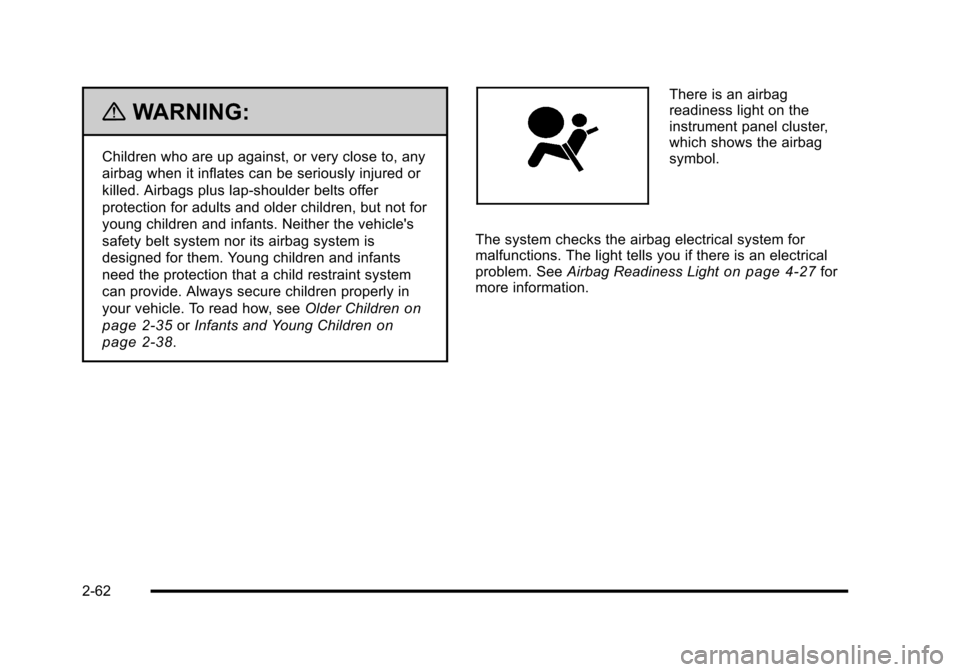
There is an airbag
readiness light on the
instrument panel cluster,
which shows the airbag
symbol.
The system checks the airbag electrical system for
malfunctions. The light tells you if there is an electrical
problem. See Airbag Readiness Light
on page 4‑27for
more information.
2-62
Page 96 of 480
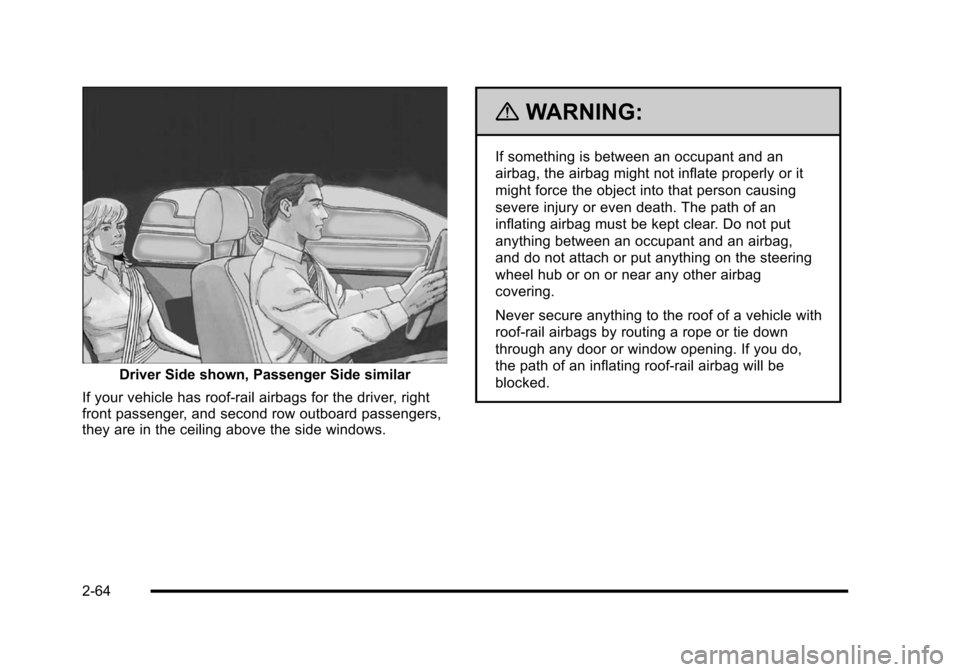
Driver Side shown, Passenger Side similar
If your vehicle has roof-rail airbags for the driver, right
front passenger, and second row outboard passengers,
they are in the ceiling above the side windows.
{WARNING:
If something is between an occupant and an
airbag, the airbag might not inflate properly or it
might force the object into that person causing
severe injury or even death. The path of an
inflating airbag must be kept clear. Do not put
anything between an occupant and an airbag,
and do not attach or put anything on the steering
wheel hub or on or near any other airbag
covering.
Never secure anything to the roof of a vehicle with
roof-rail airbags by routing a rope or tie down
through any door or window opening. If you do,
the path of an inflating roof-rail airbag will be
blocked.
2-64
Page 100 of 480
What Will You See After an Airbag
Inflates?
After the frontal airbags inflate, they quickly deflate, so
quickly that some people may not even realize an
airbag inflated. Roof-rail airbags may still be at least
partially inflated for some time after they deploy. Some
components of the airbag module may be hot for
several minutes. For location of the airbag modules,
seeWhat Makes an Airbag Inflate? on page 2‑67.
The parts of the airbag that come into contact with you
may be warm, but not too hot to touch. There may be
some smoke and dust coming from the vents in the
deflated airbags. Airbag inflation does not prevent the
driver from seeing out of the windshield or being able to
steer the vehicle, nor does it prevent people from
leaving the vehicle.
{WARNING:
When an airbag inflates, there may be dust in the
air. This dust could cause breathing problems for
people with a history of asthma or other breathing
trouble. To avoid this, everyone in the vehicle
should get out as soon as it is safe to do so.
If you have breathing problems but cannot get out
of the vehicle after an airbag inflates, then get
fresh air by opening a window or a door. If you
experience breathing problems following an airbag
deployment, you should seek medical attention.
The vehicle has a feature that may automatically unlock
the doors, turn on the interior lamps and hazard warning
flashers, and shut off the fuel system after the airbags
inflate. You can lock the doors, turn off the interior
lamps and hazard warning flashers by using the
controls for those features.
2-68