weight CHEVROLET HHR 2011 1.G Owners Manual
[x] Cancel search | Manufacturer: CHEVROLET, Model Year: 2011, Model line: HHR, Model: CHEVROLET HHR 2011 1.GPages: 430, PDF Size: 4.57 MB
Page 66 of 430
Black plate (34,1)Chevrolet HHR Owner Manual - 2011
Child Restraints
Older Children
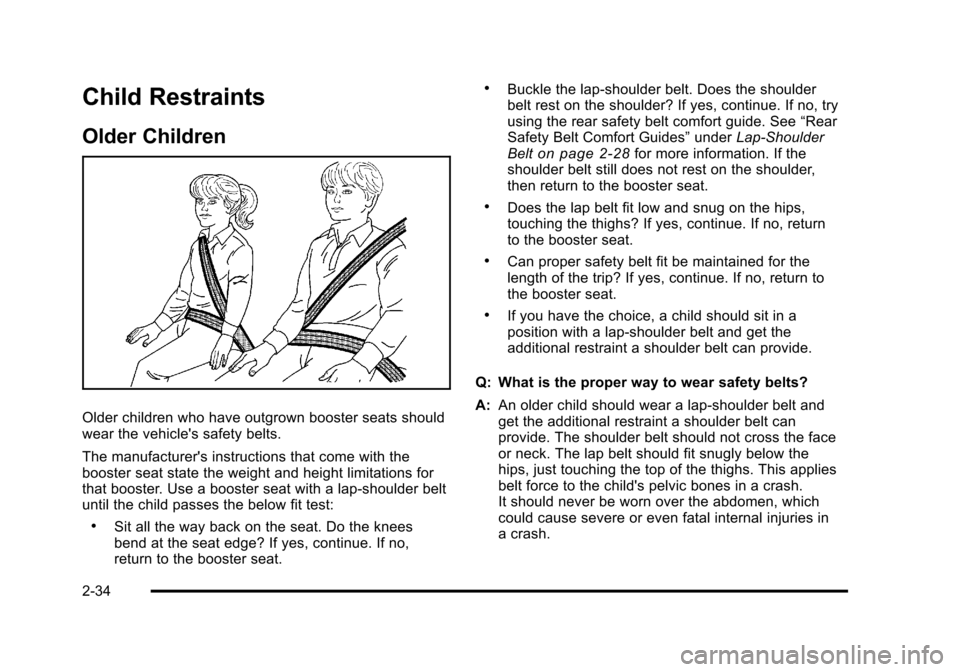
Older children who have outgrown booster seats should
wear the vehicle's safety belts.
The manufacturer's instructions that come with the
booster seat state the weight and height limitations for
that booster. Use a booster seat with a lap-shoulder belt
until the child passes the below fit test:
.Sit all the way back on the seat. Do the knees
bend at the seat edge? If yes, continue. If no,
return to the booster seat.
.Buckle the lap-shoulder belt. Does the shoulder
belt rest on the shoulder? If yes, continue. If no, try
using the rear safety belt comfort guide. See“Rear
Safety Belt Comfort Guides” underLap-Shoulder
Belt
on page 2‑28for more information. If the
shoulder belt still does not rest on the shoulder,
then return to the booster seat.
.Does the lap belt fit low and snug on the hips,
touching the thighs? If yes, continue. If no, return
to the booster seat.
.Can proper safety belt fit be maintained for the
length of the trip? If yes, continue. If no, return to
the booster seat.
.If you have the choice, a child should sit in a
position with a lap-shoulder belt and get the
additional restraint a shoulder belt can provide.
Q: What is the proper way to wear safety belts?
A: An older child should wear a lap-shoulder belt and
get the additional restraint a shoulder belt can
provide. The shoulder belt should not cross the face
or neck. The lap belt should fit snugly below the
hips, just touching the top of the thighs. This applies
belt force to the child's pelvic bones in a crash.
It should never be worn over the abdomen, which
could cause severe or even fatal internal injuries in
a crash.
2-34
Page 70 of 430

Black plate (38,1)Chevrolet HHR Owner Manual - 2011
{WARNING:
Never do this.
Children who are up against, or very close to, any
airbag when it inflates can be seriously injured or
killed. Never put a rear-facing child restraint in the
right front seat. Secure a rear-facing child restraint
in a rear seat. It is also better to secure a
forward-facing child restraint in a rear seat. If you
must secure a forward-facing child restraint in the
right front seat, always move the front passenger
seat as far back as it will go.
Q: What are the different types of add-on childrestraints?
A: Add-on child restraints, which are purchased by the
vehicle's owner, are available in four basic types.
Selection of a particular restraint should take into
consideration not only the child's weight, height, and
age but also whether or not the restraint will be
compatible with the motor vehicle in which it will
be used.
2-38
Page 71 of 430
Black plate (39,1)Chevrolet HHR Owner Manual - 2011
For most basic types of child restraints, there are
many different models available. When purchasing a
child restraint, be sure it is designed to be used in a
motor vehicle. If it is, the restraint will have a label
saying that it meets federal motor vehicle safety
standards.
The restraint manufacturer's instructions that come
with the restraint state the weight and height
limitations for a particular child restraint. In addition,
there are many kinds of restraints available for
children with special needs.
{WARNING:
To reduce the risk of neck and head injury during
a crash, infants need complete support. This is
because an infant's neck is not fully developed
and its head weighs so much compared with the
rest of its body. In a crash, an infant in a
rear-facing child restraint settles into the restraint,
so the crash forces can be distributed across the
strongest part of an infant's body, the back and
shoulders. Infants should always be secured in
rear-facing child restraints.
{WARNING:
A young child's hip bones are still so small that
the vehicle's regular safety belt may not remain
low on the hip bones, as it should. Instead, it may
settle up around the child's abdomen. In a crash,
the belt would apply force on a body area that is
unprotected by any bony structure. This alone
could cause serious or fatal injuries. To reduce the
risk of serious or fatal injuries during a crash,
young children should always be secured in
appropriate child restraints.
2-39
Page 99 of 430
Black plate (67,1)Chevrolet HHR Owner Manual - 2011
United StatesCanada
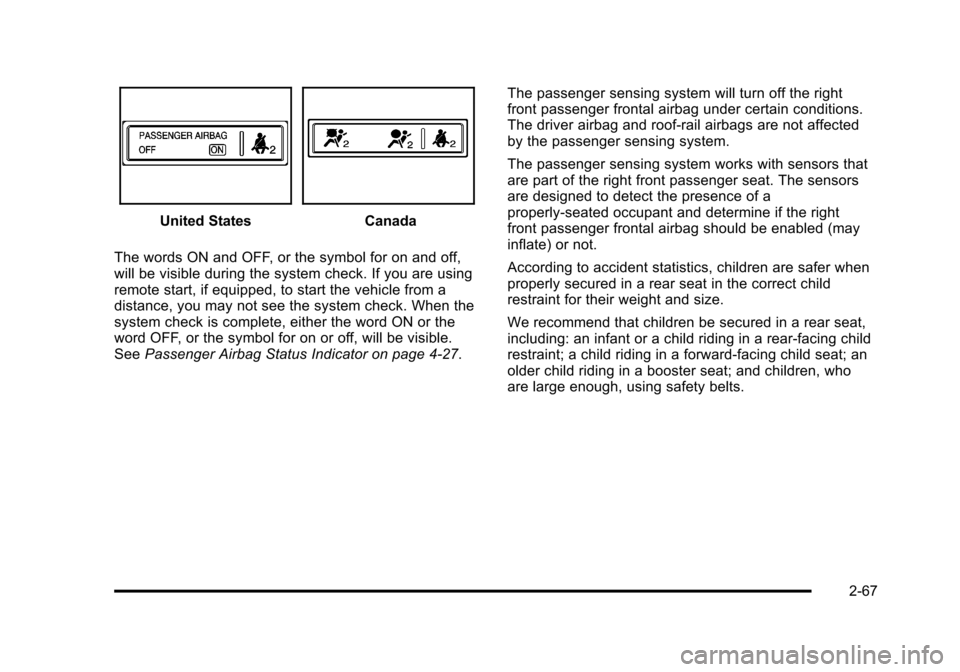
The words ON and OFF, or the symbol for on and off,
will be visible during the system check. If you are using
remote start, if equipped, to start the vehicle from a
distance, you may not see the system check. When the
system check is complete, either the word ON or the
word OFF, or the symbol for on or off, will be visible.
See Passenger Airbag Status Indicator on page 4‑27. The passenger sensing system will turn off the right
front passenger frontal airbag under certain conditions.
The driver airbag and roof‐rail airbags are not affected
by the passenger sensing system.
The passenger sensing system works with sensors that
are part of the right front passenger seat. The sensors
are designed to detect the presence of a
properly-seated occupant and determine if the right
front passenger frontal airbag should be enabled (may
inflate) or not.
According to accident statistics, children are safer when
properly secured in a rear seat in the correct child
restraint for their weight and size.
We recommend that children be secured in a rear seat,
including: an infant or a child riding in a rear-facing child
restraint; a child riding in a forward-facing child seat; an
older child riding in a booster seat; and children, who
are large enough, using safety belts.
2-67
Page 100 of 430
Black plate (68,1)Chevrolet HHR Owner Manual - 2011
A label on the sun visor says,“Never put a rear-facing
child seat in the front.” This is because the risk to the
rear-facing child is so great, if the airbag deploys.
{WARNING:
A child in a rear-facing child restraint can be
seriously injured or killed if the right front
passenger airbag inflates. This is because the
back of the rear-facing child restraint would be
very close to the inflating airbag. A child in a
forward-facing child restraint can be seriously
injured or killed if the right front passenger airbag
inflates and the passenger seat is in a forward
position.
Even if the passenger sensing system has turned
off the right front passenger frontal airbag, no
system is fail-safe. No one can guarantee that an
airbag will not deploy under some unusual
circumstance, even though the airbag is
turned off.
Secure rear-facing child restraints in a rear seat,
even if the airbag is off. If you secure a
forward-facing child restraint in the right front seat,
(Continued)
WARNING: (Continued)
always move the front passenger seat as far back
as it will go. It is better to secure the child restraint
in a rear seat.
If the vehicle does not have a rear seat that will
accommodate a rear‐facing child restraint, a rear‐facing
child restraint should not be installed in the vehicle,
even if the airbag is off.
The passenger sensing system is designed to turn off
the right front passenger frontal airbag if:
.The right front passenger seat is unoccupied.
.The system determines that an infant is present in
a child restraint.
.A right front passenger takes his/her weight off of
the seat for a period of time.
.Or, if there is a critical problem with the airbag
system or the passenger sensing system.
When the passenger sensing system has turned off the
right front passenger frontal airbag, the off indicator will
light and stay lit to remind you that the airbag is off. See
Passenger Airbag Status Indicator on page 4‑27.
2-68
Page 138 of 430
Black plate (32,1)Chevrolet HHR Owner Manual - 2011
2. Move the shift lever into P (Park) by holding in thebutton on the shift lever and pushing the lever all
the way toward the front of the vehicle.
3. Turn the ignition key to LOCK/OFF.
Leaving the Vehicle With the Engine
Running (Automatic Transmission)
{WARNING:
It can be dangerous to leave the vehicle with the
engine running. The vehicle could move suddenly
if the shift lever is not fully in P (Park) with the
parking brake firmly set. And, if you leave the
vehicle with the engine running, it could overheat
and even catch fire. You or others could be
injured. Do not leave the vehicle with the engine
running.
If you have to leave an automatic transmission vehicle
with the engine running, be sure the vehicle is in
P (Park) and the parking brake is firmly set before you
leave it. After you have moved the shift lever into
P (Park), hold the brake pedal down. Then, see if you
can move the shift lever away from P (Park) without first
pushing the button. If you can, it means that the shift
lever was not fully locked into P (Park).
Torque Lock (Automatic Transmission)
If you are parking on a hill and you do not shift into
P (Park) properly, the weight of the vehicle may put too
much force on the parking pawl in the transmission. You
may find it difficult to pull the shift lever out of P (Park).
This is called “torque lock.” To prevent torque lock, set
the parking brake and then shift into P (Park) properly
before you leave the driver seat. To find out how, see
Shifting Into Park (Automatic Transmission)
on
page 3‑31.
Move the shift lever out of P (Park) before you release
the parking brake.
If torque lock does occur, you may need to have
another vehicle push yours a little uphill to take some of
the pressure from the parking pawl in the transmission,
so you can pull the shift lever out of P (Park).
3-32
Page 241 of 430
Black plate (3,1)Chevrolet HHR Owner Manual - 2011
For persons under 21, it is against the law in every
U.S. state to drink alcohol. There are good medical,
psychological, and developmental reasons for
these laws.
The obvious way to eliminate the leading highway
safety problem is for people never to drink alcohol and
then drive.
Medical research shows that alcohol in a person's
system can make crash injuries worse, especially
injuries to the brain, spinal cord, or heart. This means
that when anyone who has been drinking—driver or
passenger —is in a crash, that person's chance of
being killed or permanently disabled is higher than if
the person had not been drinking.
Control of a Vehicle
The following three systems help to control the vehicle
while driving —brakes, steering, and accelerator. At
times, as when driving on snow or ice, it is easy to ask
more of those control systems than the tires and road
can provide. Meaning, you can lose control of the
vehicle. See Traction Control System (TCS)
on
page 5‑8, Enhanced Traction System (ETS)on
page 5‑10, and Electronic Stability Control (ESC)on
page 5‑6.
Adding non‐dealer/non‐retailer accessories can affect
vehicle performance. See Accessories and
Modifications on page 6‑3.
Braking
See Brake System Warning Light on page 4‑29.
Braking action involves perception time and reaction
time. Deciding to push the brake pedal is perception
time. Actually doing it is reaction time.
Average reaction time is about three‐fourths of a
second. But that is only an average. It might be less
with one driver and as long as two or three seconds or
more with another. Age, physical condition, alertness,
coordination, and eyesight all play a part. So do alcohol,
drugs, and frustration. But even in three‐fourths of a
second, a vehicle moving at 100 km/h (60 mph) travels
20 m (66 feet). That could be a lot of distance in an
emergency, so keeping enough space between the
vehicle and others is important.
And, of course, actual stopping distances vary greatly
with the surface of the road, whether it is pavement or
gravel; the condition of the road, whether it is wet, dry,
or icy; tire tread; the condition of the brakes; the weight
of the vehicle; and the amount of brake force applied.
Avoid needless heavy braking. Some people drive in
spurts, heavy acceleration followed by heavy braking,
rather than keeping pace with traffic. This is a mistake.
The brakes might not have time to cool between hard
stops. The brakes will wear out much faster with a lot of
heavy braking. Keeping pace with the traffic and
5-3
Page 260 of 430
Black plate (22,1)Chevrolet HHR Owner Manual - 2011
reverse directions causes a rocking motion that could
free the vehicle. If that does not get the vehicle out after
a few tries, it might need to be towed out. If the vehicle
does need to be towed out, seeTowing Your Vehicle
on
page 5‑28.
Loading the Vehicle
It is very important to know how much weight your
vehicle can carry. Two labels on your vehicle
show how much weight it may properly carry, the
Tire and Loading Information label and the Vehicle
Certification label.
{WARNING:
Do not load the vehicle any heavier than the
Gross Vehicle Weight Rating (GVWR),
or either the maximum front or rear Gross
Axle Weight Rating (GAWR). If you do, parts
on the vehicle can break, and it can change
the way the vehicle handles. These could
cause you to lose control and crash. Also,
overloading can shorten the life of the
vehicle.
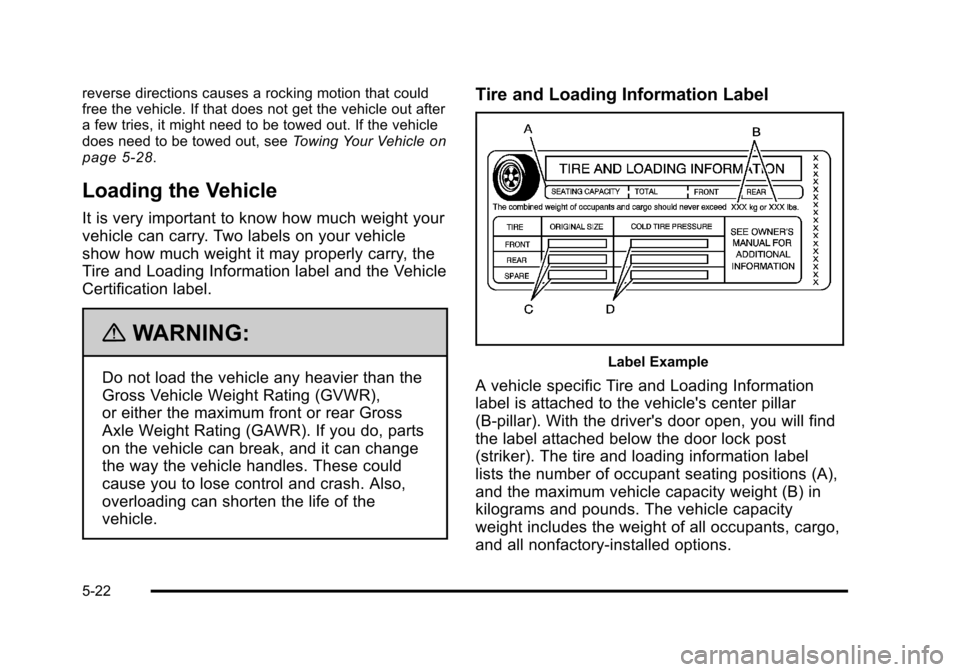
Tire and Loading Information Label
Label Example
A vehicle specific Tire and Loading Information
label is attached to the vehicle's center pillar
(B-pillar). With the driver's door open, you will find
the label attached below the door lock post
(striker). The tire and loading information label
lists the number of occupant seating positions (A),
and the maximum vehicle capacity weight (B) in
kilograms and pounds. The vehicle capacity
weight includes the weight of all occupants, cargo,
and all nonfactory‐installed options.
5-22
Page 261 of 430
Black plate (23,1)Chevrolet HHR Owner Manual - 2011
The Tire and Loading Information label also lists
the tire size of the original equipment tires (C) and
the recommended cold tire inflation pressures (D).
For more information on tires and inflation, see
Tires
on page 6‑47andInflation - Tire Pressureon
page 6‑54
.
There is also important loading information on the
Certification/Tire label. It tells you the Gross
Vehicle Weight Rating (GVWR) and the Gross
Axle Weight Rating (GAWR) for the front and rear
axles. See “Certification/Tire Label” later in this
section.
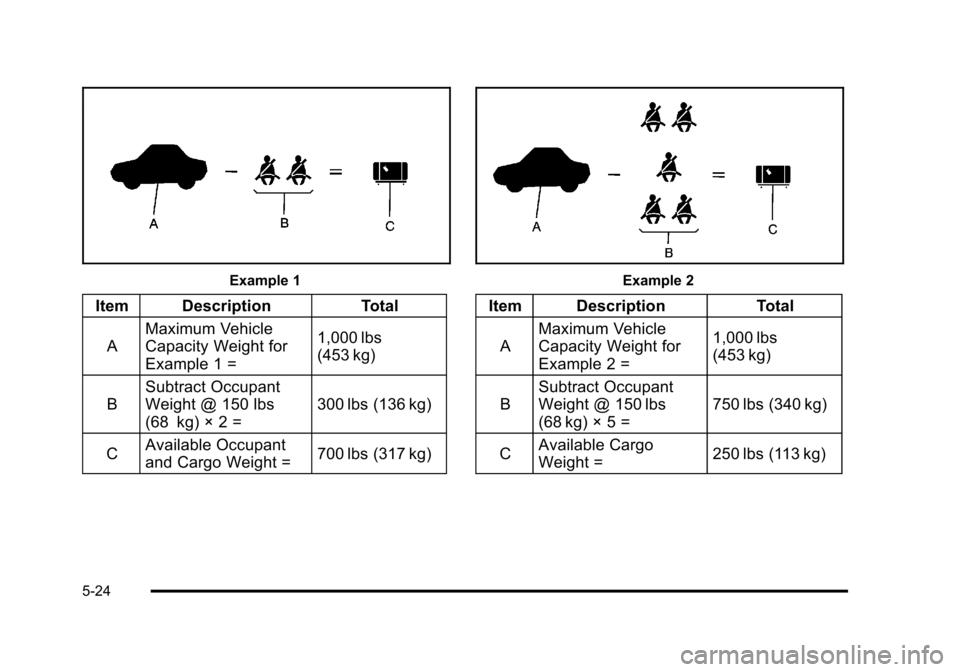
Steps for Determining Correct Load Limit
1.Locate the statement “The combined weight
of occupants and cargo should never exceed
XXX kg or XXX lbs” on your vehicle's placard.
2.Determine the combined weight of the driver
and passengers that will be riding in your
vehicle.
3.Subtract the combined weight of the driver
and passengers from XXX kg or XXX lbs.
4.The resulting figure equals the available
amount of cargo and luggage load capacity.
For example, if the“XXX”amount equals
1400 lbs and there will be five 150 lb
passengers in your vehicle, the amount of
available cargo and luggage load capacity is
650 lbs (1400 −750 (5 x 150) = 650 lbs).
5.Determine the combined weight of luggage
and cargo being loaded on the vehicle. That
weight may not safely exceed the available
cargo and luggage load capacity calculated in
Step 4.
6.If your vehicle will be towing a trailer, the load
from your trailer will be transferred to your
vehicle. Consult this manual to determine
how this reduces the available cargo and
luggage load capacity for your vehicle.
If your vehicle can tow a trailer, see Towing a
Trailer (Automatic Transmission)
on page 5‑31or
Towing a Trailer (Manual Transmission)
on
page 5‑37
for important information on towing a
trailer, towing safety rules, and trailering tips.
5-23
Page 262 of 430
Black plate (24,1)Chevrolet HHR Owner Manual - 2011
Example 1
Item DescriptionTotal
A Maximum Vehicle
Capacity Weight for
Example 1 = 1,000 lbs
(453 kg)
B Subtract Occupant
Weight @ 150 lbs
(68 kg) × 2 = 300 lbs (136 kg)
C Available Occupant
and Cargo Weight =
700 lbs (317 kg)
Example 2
Item Description
Total
A Maximum Vehicle
Capacity Weight for
Example 2 = 1,000 lbs
(453 kg)
B Subtract Occupant
Weight @ 150 lbs
(68 kg) × 5 = 750 lbs (340 kg)
C Available Cargo
Weight =
250 lbs (113 kg)
5-24