tow CHEVROLET IMPALA 2007 9.G User Guide
[x] Cancel search | Manufacturer: CHEVROLET, Model Year: 2007, Model line: IMPALA, Model: CHEVROLET IMPALA 2007 9.GPages: 460, PDF Size: 2.56 MB
Page 118 of 460
NEUTRAL (N):In this position, your engine does
not connect with the wheels. To restart when
you are already moving, use NEUTRAL (N) only.
Also, use NEUTRAL (N) when your vehicle is
being towed.
{CAUTION:
Shifting into a drive gear while your
engine is running at high speed is
dangerous. Unless your foot is rmly on
the brake pedal, your vehicle could move
very rapidly. You could lose control and
hit people or objects. Do not shift into a
drive gear while your engine is running at
high speed.
Notice:Shifting out of PARK (P) or
NEUTRAL (N) while the engine is running at
high speed may damage the transaxle.
The repairs would not be covered by your
warranty. Be sure the engine is not running at
high speeds when shifting your vehicle.DRIVE (D):This position is for normal driving.
It provides the best fuel economy for your vehicle.
If you need more power for passing, and you are:
Going less than 35 mph (55 km/h), push the
accelerator pedal about halfway down.
Going about 35 mph (55 km/h) or more, push
the accelerator pedal all the way down.
You will shift down to the next gear and have
more power.
Downshifting the transaxle in slippery road
conditions could result in skidding, see “Skidding”
underLoss of Control on page 262.
Notice:Driving your vehicle if you notice that
it is moving slowly or not shifting gears as
you increase speed may damage the transaxle.
Have your vehicle serviced right away. You
can drive in SECOND (2) when you are driving
less than 35 mph (55 km/h) and DRIVE (D)
for higher speeds until then.
118
Page 119 of 460
THIRD (3):This position is also used for normal
driving. However, it reduces vehicle speed
more than DRIVE (D) without using your brakes.
You might choose THIRD (3) instead of DRIVE (D)
when driving on hilly, winding roads, when
towing a trailer, so there is less shifting between
gears and when going down a steep hill.
SECOND (2):This position reduces vehicle speed
even more than THIRD (3) without using your
brakes. You can use SECOND (2) on hills. It can
help control your speed as you go down steep
mountain roads. You would also then want to use
your brakes off and on.
Notice:Driving in SECOND (2) for more
than 25 miles (40 km) or at speeds over
55 mph (90 km/h) may damage the transaxle.
Also, shifting into SECOND (2) at speeds above
65 mph (105 km/h) can cause damage. Drive in
THIRD (3) or DRIVE (D) instead of SECOND (2).FIRST (1):This position reduces vehicle speed
even more than SECOND (2) without using
your brakes. You can use it on very steep hills,
or in deep snow or mud. If the shift lever is
in FIRST (1) while the vehicle is moving forward,
the transaxle will not shift into rst gear until
the vehicle is going slowly enough.
Notice:Spinning the tires or holding the
vehicle in one place on a hill using only the
accelerator pedal may damage the transaxle.
If you are stuck, do not spin the tires. When
stopping on a hill, use the brakes, or parking
brake to hold the vehicle in place.
119
Page 120 of 460
Parking Brake
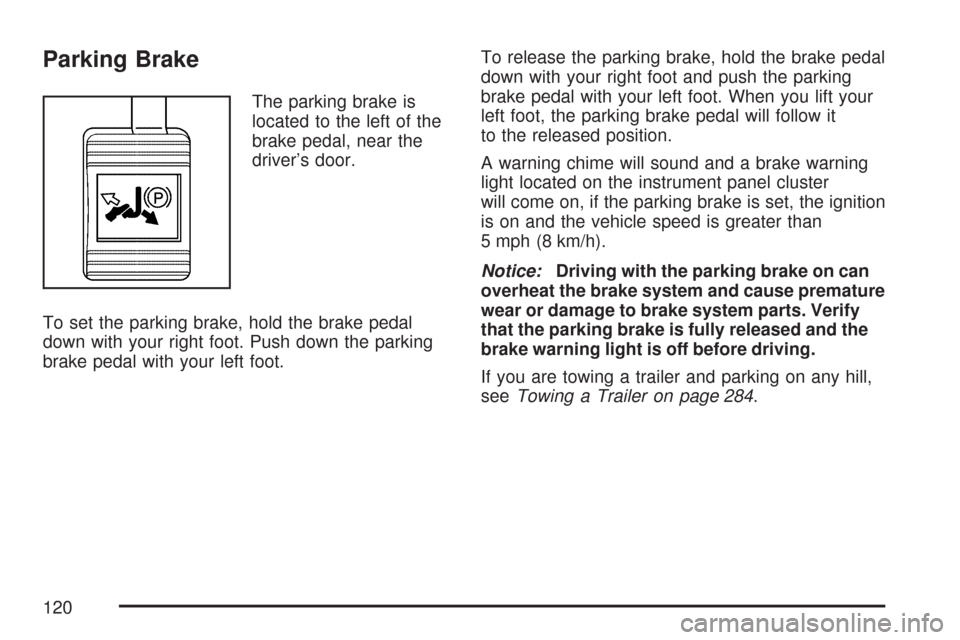
The parking brake is
located to the left of the
brake pedal, near the
driver’s door.
To set the parking brake, hold the brake pedal
down with your right foot. Push down the parking
brake pedal with your left foot.To release the parking brake, hold the brake pedal
down with your right foot and push the parking
brake pedal with your left foot. When you lift your
left foot, the parking brake pedal will follow it
to the released position.
A warning chime will sound and a brake warning
light located on the instrument panel cluster
will come on, if the parking brake is set, the ignition
is on and the vehicle speed is greater than
5 mph (8 km/h).
Notice:Driving with the parking brake on can
overheat the brake system and cause premature
wear or damage to brake system parts. Verify
that the parking brake is fully released and the
brake warning light is off before driving.
If you are towing a trailer and parking on any hill,
seeTowing a Trailer on page 284.
120
Page 121 of 460
Shifting Into Park (P)
{CAUTION:
It is dangerous to get out of your vehicle
if the shift lever is not fully in PARK (P)
with the parking brake rmly set. Your
vehicle can roll.
Do not leave your vehicle when the engine
is running unless you have to. If you have
left the engine running, the vehicle can
move suddenly. You or others could be
injured. To be sure your vehicle will not
move, even when you are on fairly level
ground, always set your parking brake
and move the shift lever to PARK (P). See
Shifting Into Park (P) on page 121.Ifyou
are pulling a trailer, seeTowing a Trailer
on page 284.
Steering Column Shift Lever
1. Hold the brake pedal down with your right foot
and set the parking brake.
2. Move the shift lever into PARK (P) by pulling
the shift lever toward you and moving it up as
far as it will go.
3. Turn the ignition key to OFF.
4. Remove the key and take it with you. If you
can leave your vehicle with the ignition key in
your hand, your vehicle is in PARK (P).
Console Shift Lever
1. Hold the brake pedal down with your right foot
and set the parking brake.
2. Move the shift lever into PARK (P) by holding
in the button on the shift lever and pushing
the lever all the way toward the front of
the vehicle.
3. Turn the ignition key to OFF.
4. Remove the key and take it with you. If you
can leave your vehicle with the ignition key in
your hand, your vehicle is in PARK (P).
121
Page 122 of 460
Leaving Your Vehicle With the Engine
Running
{CAUTION:
It can be dangerous to leave your vehicle
with the engine running. Your vehicle could
move suddenly if the shift lever is not fully
in PARK (P) with the parking brake rmly
set. And, if you leave the vehicle with the
engine running, it could overheat and even
catch re. You or others could be injured.
Do not leave your vehicle with the engine
running.
If you have to leave your vehicle with the engine
running, be sure your vehicle is in PARK (P) and
your parking brake is rmly set before you leave it.
After you have moved the shift lever into the
PARK (P) position, hold the regular brake pedal
down. Then, see if you can move the shift lever
away from PARK (P) without rst pulling it towardyou or if you have the console shift lever, without
rst pushing the button. If you can, it means that the
shift lever was not fully locked into PARK (P).
Torque Lock
If you are parking on a hill and you do not shift
your transaxle into PARK (P) properly, the weight
of the vehicle may put too much force on the
parking pawl in the transaxle. You may nd
it difficult to pull the shift lever out of PARK (P).
This is called “torque lock.” To prevent torque lock,
set the parking brake and then shift into PARK (P)
properly before you leave the driver’s seat.
To nd out how, seeShifting Into Park (P) on
page 121.
When you are ready to drive, move the shift lever
out of PARK (P) before you release the parking
brake.
If torque lock does occur, you may need to have
another vehicle push yours a little uphill to
take some of the pressure from the parking pawl
in the transaxle, so you can pull the shift lever
out of PARK (P).
122
Page 125 of 460
Running the Engine While Parked
It is better not to park with the engine running. But if
you ever have to, here are some things to know.
{CAUTION:
Idling the engine with the climate control
system off could allow dangerous exhaust
into your vehicle. See the earlier caution
underEngine Exhaust on page 124.
Also, idling in a closed-in place can let
deadly carbon monoxide (CO) into your
vehicle even if the climate control fan is at
the highest setting. One place this can
happen is a garage. Exhaust — with
CO — can come in easily. NEVER park in
a garage with the engine running.
Another closed-in place can be a blizzard.
SeeWinter Driving on page 272.
{CAUTION:
It can be dangerous to get out of your
vehicle if the shift lever is not fully in
PARK (P) with the parking brake rmly
set. Your vehicle can roll. Do not leave
your vehicle when the engine is running
unless you have to. If you have left the
engine running, the vehicle can move
suddenly. You or others could be injured.
To be sure your vehicle will not move,
even when you are on fairly level ground,
always set the parking brake and move
the shift lever to PARK (P).
Follow the proper steps to be sure your vehicle
will not move. SeeShifting Into Park (P) on
page 121.
If you are parking on a hill and if you are pulling a
trailer, also seeTowing a Trailer on page 284.
125
Page 126 of 460
Mirrors
Manual Rearview Mirror
If the vehicle has this mirror, it has a lever located at
the bottom of the mirror between the two lamps.
The lever is used to change the mirror from the
day to the night position. To reduce glare from
headlamps behind you while driving at night, pull
the lever toward you. To return the mirror to the day
position, return the lever to its original position.
There are two map lamps located on the bottom of
the mirror. Press the button next to each lamp to
turn it on and off.
Manual Rearview Mirror with
OnStar
®
If the vehicle has this mirror, it has a lever located
at the bottom of the mirror between the two
lamps. The lever is used to change the mirror
from the day to the night position. To reduce glare
from headlamps behind you while driving at
night, pull the lever toward you. To return the
mirror to the day position, return the lever
to its original position.There are two map lamps located on the bottom of
the mirror. Press the button next to each lamp to
turn it on and off.
There are also OnStar
®buttons located at the
bottom of the mirror face. See your dealer for more
information on the system and how to subscribe to
OnStar
®. SeeOnStar®System on page 128for
more information about the services OnStar®
provides.
Automatic Dimming Rearview Mirror
with OnStar
®
The vehicle may have an automatic dimming
rearview mirror with the OnStar®System.
Press the button located below the mirror, on the far
left, for up to three seconds to turn the automatic
dimming feature off and on.
There are two map lamps located on the bottom of
the mirror. Press the button next to each lamp to
turn it on and off.
There are also OnStar
®buttons located at the
bottom of the mirror. See your dealer for more
information on the system and how to subscribe to
OnStar
®. SeeOnStar®System on page 128for
more information about the service OnStar®
provides.
126
Page 155 of 460
Headlamp High/Low-Beam Changer
To change the headlamps from low beam to
high beam, push the turn signal/multifunction lever
toward the front of the vehicle.
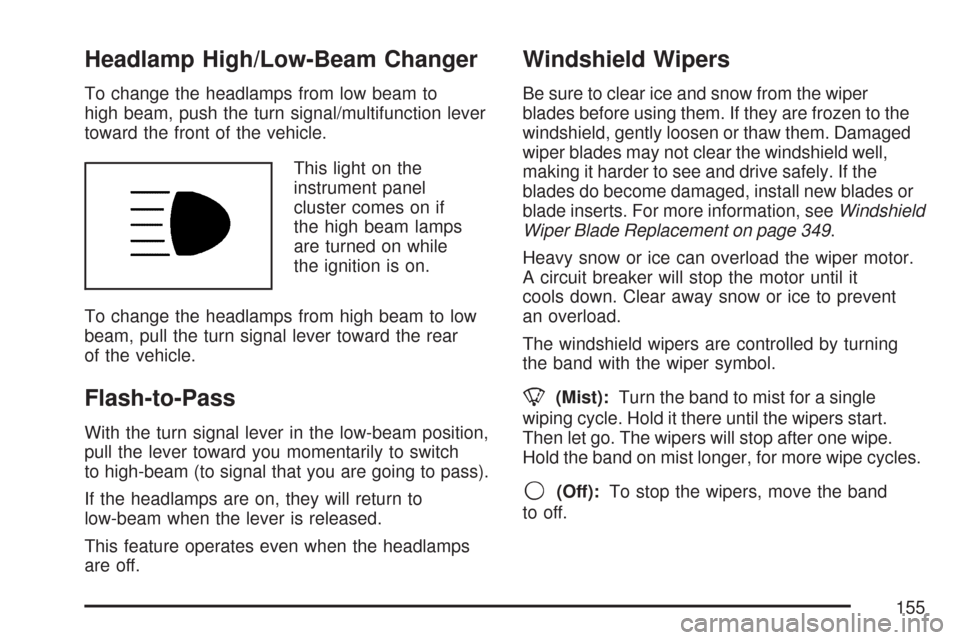
This light on the
instrument panel
cluster comes on if
the high beam lamps
are turned on while
the ignition is on.
To change the headlamps from high beam to low
beam, pull the turn signal lever toward the rear
of the vehicle.
Flash-to-Pass
With the turn signal lever in the low-beam position,
pull the lever toward you momentarily to switch
to high-beam (to signal that you are going to pass).
If the headlamps are on, they will return to
low-beam when the lever is released.
This feature operates even when the headlamps
are off.
Windshield Wipers
Be sure to clear ice and snow from the wiper
blades before using them. If they are frozen to the
windshield, gently loosen or thaw them. Damaged
wiper blades may not clear the windshield well,
making it harder to see and drive safely. If the
blades do become damaged, install new blades or
blade inserts. For more information, seeWindshield
Wiper Blade Replacement on page 349.
Heavy snow or ice can overload the wiper motor.
A circuit breaker will stop the motor until it
cools down. Clear away snow or ice to prevent
an overload.
The windshield wipers are controlled by turning
the band with the wiper symbol.
8(Mist):Turn the band to mist for a single
wiping cycle. Hold it there until the wipers start.
Then let go. The wipers will stop after one wipe.
Hold the band on mist longer, for more wipe cycles.
9(Off):To stop the wipers, move the band
to off.
155
Page 182 of 460
When the ignition is on, the brake system warning
light will also come on when you set your
parking brake. The light will stay on if your parking
brake does not release fully. If it stays on after
your parking brake is fully released, it means you
have a brake problem.
If the light comes on while you are driving, pull
off the road and stop carefully. You may notice that
the pedal is harder to push, or the pedal may go
closer to the oor. It may take longer to stop.
If the light is still on, have the vehicle towed for
service. SeeTowing Your Vehicle on page 282.
{CAUTION:
Your brake system may not be working
properly if the brake system warning light
is on. Driving with the brake system
warning light on can lead to an accident.
If the light is still on after you have pulled
off the road and stopped carefully, have
the vehicle towed for service.
Anti-Lock Brake System
Warning Light
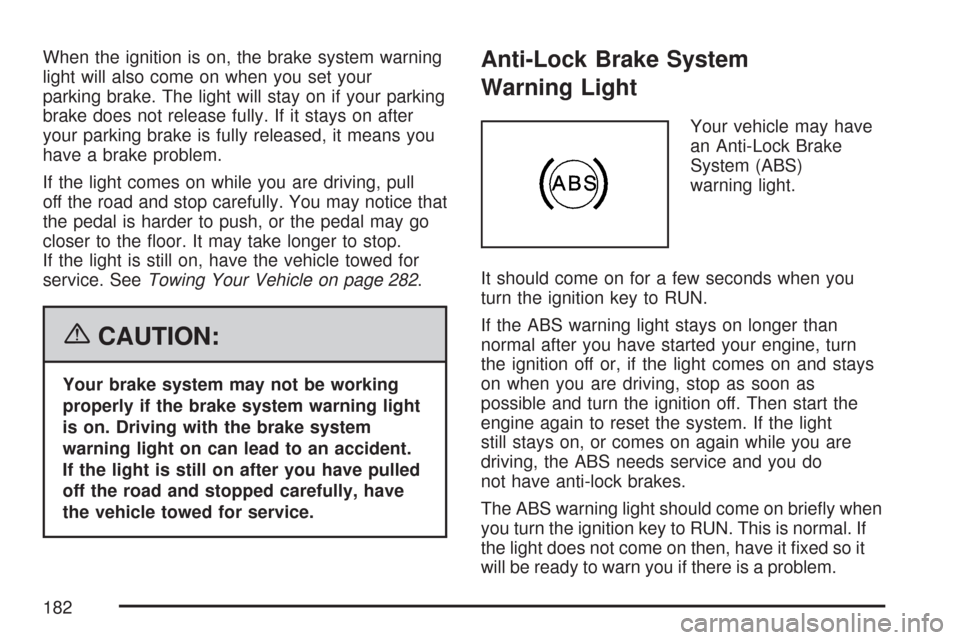
Your vehicle may have
an Anti-Lock Brake
System (ABS)
warning light.
It should come on for a few seconds when you
turn the ignition key to RUN.
If the ABS warning light stays on longer than
normal after you have started your engine, turn
the ignition off or, if the light comes on and stays
on when you are driving, stop as soon as
possible and turn the ignition off. Then start the
engine again to reset the system. If the light
still stays on, or comes on again while you are
driving, the ABS needs service and you do
not have anti-lock brakes.
The ABS warning light should come on briey when
you turn the ignition key to RUN. This is normal. If
the light does not come on then, have it xed so it
will be ready to warn you if there is a problem.
182
Page 184 of 460
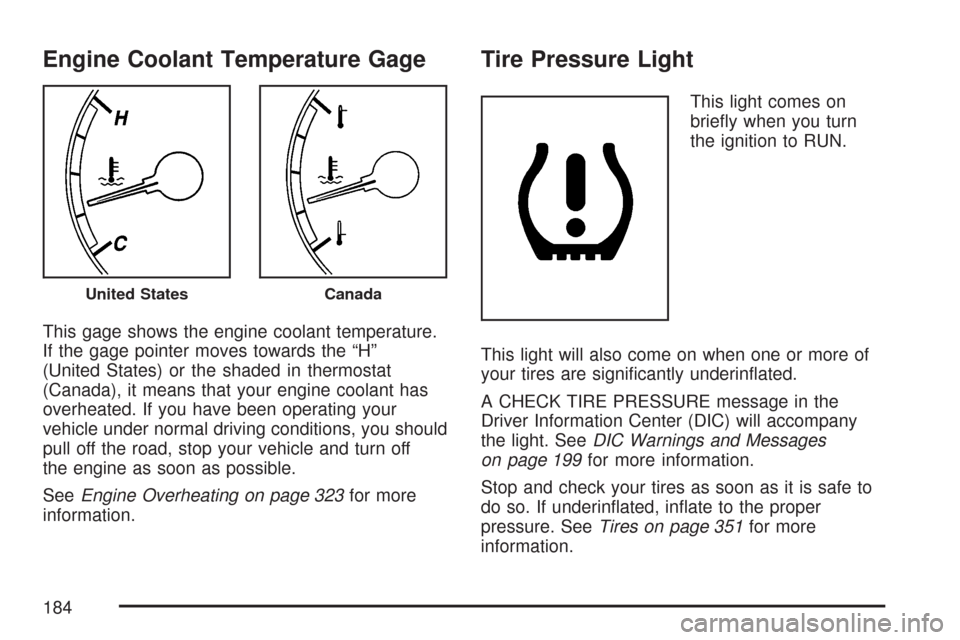
Engine Coolant Temperature Gage
This gage shows the engine coolant temperature.
If the gage pointer moves towards the “H”
(United States) or the shaded in thermostat
(Canada), it means that your engine coolant has
overheated. If you have been operating your
vehicle under normal driving conditions, you should
pull off the road, stop your vehicle and turn off
the engine as soon as possible.
SeeEngine Overheating on page 323for more
information.
Tire Pressure Light
This light comes on
briey when you turn
the ignition to RUN.
This light will also come on when one or more of
your tires are signicantly underinated.
A CHECK TIRE PRESSURE message in the
Driver Information Center (DIC) will accompany
the light. SeeDIC Warnings and Messages
on page 199for more information.
Stop and check your tires as soon as it is safe to
do so. If underinated, inate to the proper
pressure. SeeTires on page 351for more
information.
United StatesCanada
184