brake CHEVROLET IMPALA 2007 9.G Owner's Guide
[x] Cancel search | Manufacturer: CHEVROLET, Model Year: 2007, Model line: IMPALA, Model: CHEVROLET IMPALA 2007 9.GPages: 460, PDF Size: 2.56 MB
Page 271 of 460
{CAUTION:
If you do not shift down, the brakes could
get so hot that they would not work well.
You would then have poor braking or
even none going down a hill. You could
crash. Shift down to let the engine assist
the brakes on a steep downhill slope.
{CAUTION:
Coasting downhill in NEUTRAL (N) or with
the ignition off is dangerous. The brakes
will have to do all the work of slowing
down. They could get so hot that they
would not work well. You would then have
poor braking or even none going down a
hill. You could crash. Always have the
engine running and your vehicle in gear
when you go downhill.
Know how to go down hills. The most important
thing to know is this: let your engine do some of
the slowing down. Shift to a lower gear when
you go down a steep or long hill.
Know how to go uphill. You may want to shift
down to a lower gear. The lower gears help
cool your engine and transaxle, and you can
climb the hill better.
Stay in your own lane when driving on two-lane
roads in hills or mountains. Do not swing wide
or cut across the center of the road. Drive at
speeds that let you stay in your own lane.
As you go over the top of a hill, be alert. There
could be something in your lane, like a stalled
car or an accident.
You may see highway signs on mountains that
warn of special problems. Examples are long
grades, passing or no-passing zones, a falling
rocks area, or winding roads. Be alert to these
and take appropriate action.
271
Page 273 of 460
Driving on Snow or Ice
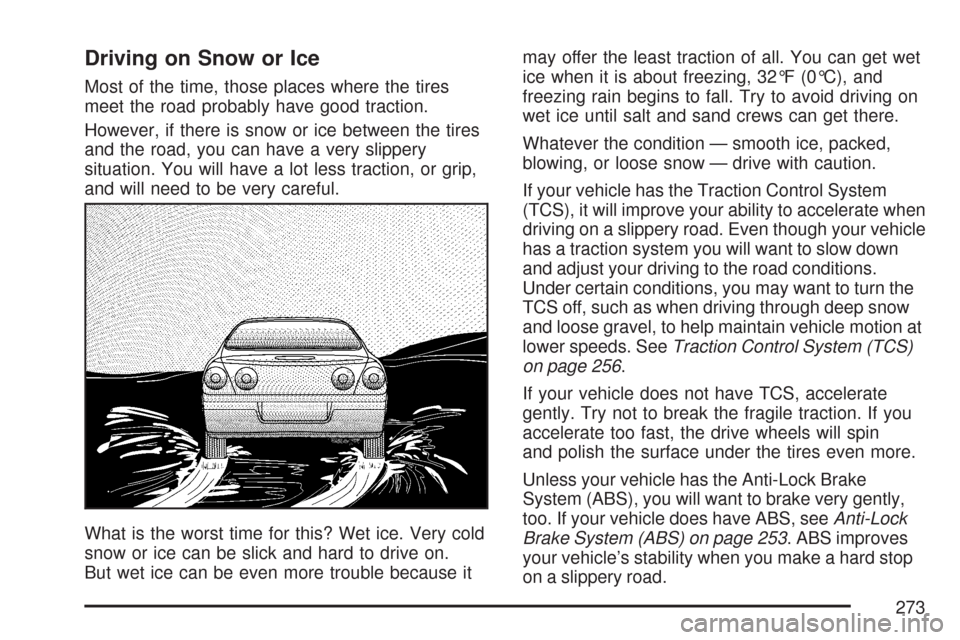
Most of the time, those places where the tires
meet the road probably have good traction.
However, if there is snow or ice between the tires
and the road, you can have a very slippery
situation. You will have a lot less traction, or grip,
and will need to be very careful.
What is the worst time for this? Wet ice. Very cold
snow or ice can be slick and hard to drive on.
But wet ice can be even more trouble because itmay offer the least traction of all. You can get wet
ice when it is about freezing, 32°F (0°C), and
freezing rain begins to fall. Try to avoid driving on
wet ice until salt and sand crews can get there.
Whatever the condition — smooth ice, packed,
blowing, or loose snow — drive with caution.
If your vehicle has the Traction Control System
(TCS), it will improve your ability to accelerate when
driving on a slippery road. Even though your vehicle
has a traction system you will want to slow down
and adjust your driving to the road conditions.
Under certain conditions, you may want to turn the
TCS off, such as when driving through deep snow
and loose gravel, to help maintain vehicle motion at
lower speeds. SeeTraction Control System (TCS)
on page 256.
If your vehicle does not have TCS, accelerate
gently. Try not to break the fragile traction. If you
accelerate too fast, the drive wheels will spin
and polish the surface under the tires even more.
Unless your vehicle has the Anti-Lock Brake
System (ABS), you will want to brake very gently,
too. If your vehicle does have ABS, seeAnti-Lock
Brake System (ABS) on page 253. ABS improves
your vehicle’s stability when you make a hard stop
on a slippery road.
273
Page 274 of 460
Whether your vehicle has ABS or not, you will want
to begin stopping sooner than you would on dry
pavement. Without ABS, if you feel your vehicle
begin to slide, let up on the brakes a little. Push the
brake pedal down steadily to get the most traction
you can.
Remember, unless your vehicle has ABS, if you
brake so hard that the wheels stop rolling,
your vehicle will just slide. Brake so the wheels
always keep rolling and you can still steer.
Whatever your vehicle’s braking system, allow
greater following distance on any slippery road.
Watch for slippery spots. The road might be
ne until you hit a spot that is covered with ice.
On an otherwise clear road, ice patches may
appear in shaded areas where the sun cannot
reach, such as around clumps of trees, behind
buildings, or under bridges. Sometimes the
surface of a curve or an overpass may remain
icy when the surrounding roads are clear. If you
see a patch of ice ahead of you, brake before
you are on it. Try not to brake while you are
actually on the ice, and avoid sudden steering
maneuvers.
If You Are Caught in a Blizzard
If you are stopped by heavy snow, you could be
in a serious situation. You should probably stay with
your vehicle unless you know for sure that you are
near help and you can hike through the snow. Here
are some things to do to summon help and keep
yourself and your passengers safe:
Turn on the hazard ashers.
Tie a red cloth to your vehicle to alert police that
you have been stopped by the snow.
Put on extra clothing or wrap a blanket
around you. If you do not have blankets or
extra clothing, make body insulators from
newspapers, burlap bags, rags, oor
mats — anything you can wrap around
yourself or tuck under your clothing to
keep warm.
274
Page 284 of 460
Dolly Towing
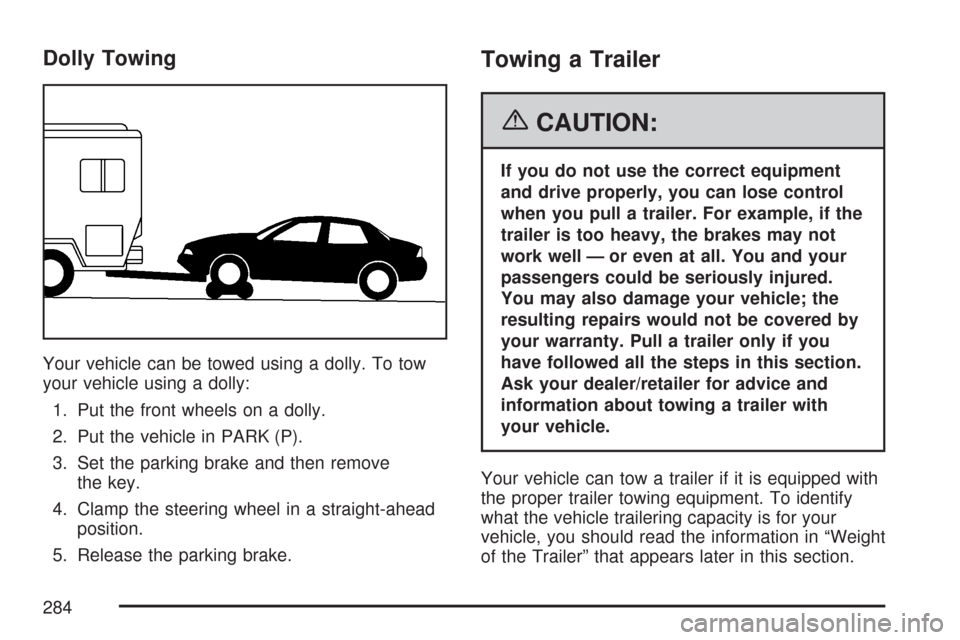
Your vehicle can be towed using a dolly. To tow
your vehicle using a dolly:
1. Put the front wheels on a dolly.
2. Put the vehicle in PARK (P).
3. Set the parking brake and then remove
the key.
4. Clamp the steering wheel in a straight-ahead
position.
5. Release the parking brake.
Towing a Trailer
{CAUTION:
If you do not use the correct equipment
and drive properly, you can lose control
when you pull a trailer. For example, if the
trailer is too heavy, the brakes may not
work well — or even at all. You and your
passengers could be seriously injured.
You may also damage your vehicle; the
resulting repairs would not be covered by
your warranty. Pull a trailer only if you
have followed all the steps in this section.
Ask your dealer/retailer for advice and
information about towing a trailer with
your vehicle.
Your vehicle can tow a trailer if it is equipped with
the proper trailer towing equipment. To identify
what the vehicle trailering capacity is for your
vehicle, you should read the information in “Weight
of the Trailer” that appears later in this section.
284
Page 288 of 460
Trailer Brakes
Does your trailer have its own brakes? Be sure to
read and follow the instructions for the trailer
brakes so you’ll be able to install, adjust
and maintain them properly.
If your vehicle has anti-lock brakes, do not try
to tap into your vehicle’s brake system. If you
do, both brake systems won’t work well, or
at all.
Even if your vehicle doesn’t have anti-lock
brakes, don’t tap into your vehicle’s brake
system if the trailer’s brake system will
use more than 0.02 cubic inch (0.3 cc) of uid
from your vehicle’s master cylinder. If it
does, both braking systems won’t work well.
You could even lose your brakes.
Will the trailer brake parts take 3,000 psi
(20 650 kPa) of pressure? If not, the
trailer brake system must not be used with
your vehicle.
If everything checks out this far, then make
the brake uid tap at the upper rear master
cylinder port. But don’t use copper tubing
for this. If you do, it will bend and break off.
Use steel brake tubing.
Driving with a Trailer
Towing a trailer requires a certain amount of
experience. Before setting out for the open road,
you’ll want to get to know your rig. Acquaint
yourself with the feel of handling and braking with
the added weight of the trailer. And always
keep in mind that the vehicle you are driving is
now a good deal longer and not nearly as
responsive as your vehicle is by itself.
Before you start, check the trailer hitch and
platform (and attachments), safety chains,
electrical connector, lamps, tires and mirror
adjustment. If the trailer has electric brakes, start
your vehicle and trailer moving and then apply
the trailer brake controller by hand to be sure the
brakes are working. This lets you check your
electrical connection at the same time.
During your trip, check occasionally to be sure
that the load is secure, and that the lamps and any
trailer brakes are still working.
288
Page 290 of 460
Driving On Grades
Reduce speed and shift to a lower gearbefore
you start down a long or steep downgrade. If you
don’t shift down, you might have to use your
brakes so much that they would get hot and no
longer work well.
On a long uphill grade, shift down and reduce
your speed to around 45 mph (70 km/h) to reduce
the possibility of engine and transmission
overheating.
Notice:When the outside temperature is
above 100° F (38° C) and/or there is a steep,
continuous grade, the recommended speed
when towing is 55 mph (88 km/h) or less.
Extended higher than normal engine and
transmission temperatures may damage your
vehicle.
If you have overdrive, you may want to drive in
THIRD (3) instead of DRIVE (D).
Parking on Hills
{CAUTION:
You really should not park your vehicle,
with a trailer attached, on a hill. If
something goes wrong, your rig could
start to move. People can be injured, and
both your vehicle and the trailer can be
damaged.
But if you ever have to park your rig on a hill,
here’s how to do it:
1. Apply your regular brakes, but don’t shift into
PARK (P) yet.
2. Have someone place chocks under the trailer
wheels.
3. When the wheel chocks are in place, release
the regular brakes until the chocks absorb
the load.
4. Reapply the regular brakes. Then apply your
parking brake, and then shift to PARK (P).
5. Release the regular brakes.
290
Page 291 of 460
When You Are Ready to Leave After
Parking on a Hill
1. Apply your regular brakes and hold the pedal
down while you:
start your engine,
shift into a gear, and
release the parking brake.
2. Let up on the brake pedal.
3. Drive slowly until the trailer is clear of
the chocks.
4. Stop and have someone pick up and store
the chocks.
Maintenance When Trailer Towing
Your vehicle will need service more often when
you’re pulling a trailer. See the Maintenance
Schedule for more on this. Things that are
especially important in trailer operation are
automatic transmission uid (don’t overll),
engine oil, drive belts, cooling system and brake
system. Each of these is covered in this manual,
and the Index will help you nd them quickly.
If you’re trailering, it’s a good idea to review
this information before you start your trip.
Check periodically to see that all hitch nuts and
bolts are tight.
Engine Cooling When Trailer Towing
Your cooling system may temporarily overheat
during severe operating conditions. SeeEngine
Overheating on page 323.
291
Page 293 of 460
Service........................................................ 296
Accessories and Modications................... 296
California Proposition 65 Warning.............. 297
Doing Your Own Service Work.................. 297
Adding Equipment to the Outside of
Your Vehicle.......................................... 298
Fuel............................................................. 298
Gasoline Octane........................................ 298
Gasoline Specications.............................. 299
California Fuel........................................... 299
Additives................................................... 299
Fuel E85 (85% Ethanol)............................ 300
Fuels in Foreign Countries........................ 301
Filling the Tank......................................... 302
Filling a Portable Fuel Container............... 304
Checking Things Under the Hood.............. 304
Hood Release........................................... 305
Engine Compartment Overview.................. 306
Engine Oil................................................. 310
Engine Oil Life System.............................. 314
Engine Air Cleaner/Filter............................ 316
Automatic Transaxle Fluid......................... 317Engine Coolant.......................................... 320
Pressure Cap............................................ 323
Engine Overheating................................... 323
Overheated Engine Protection
Operating Mode..................................... 326
Cooling System......................................... 326
Power Steering Fluid................................. 332
Windshield Washer Fluid........................... 333
Brakes...................................................... 334
Battery...................................................... 337
Jump Starting............................................ 338
Headlamp Aiming........................................ 343
Bulb Replacement....................................... 343
Halogen Bulbs........................................... 344
Headlamps, Front Turn Signal,
Sidemarker, and Parking Lamps............. 344
Taillamps, Turn Signal, Sidemarker,
Stoplamps and Back-up Lamps.............. 346
License Plate Lamp................................... 348
Replacement Bulbs................................... 349
Windshield Wiper Blade Replacement....... 349
Section 5 Service and Appearance Care
293
Page 296 of 460
Service
Your dealer knows your vehicle best and wants
you to be happy with it. We hope you will go
to your dealer for all your service needs. You will
get genuine GM parts and GM-trained and
supported service people.
We hope you will want to keep your GM vehicle all
GM. Genuine GM parts have one of these marks:
Accessories and Modications
When you add non-GM accessories to your vehicle
they can affect your vehicle’s performance and
safety, including such things as, airbags, braking,
stability, ride and handling, emissions systems,
aerodynamics, durability, and electronic systems
like anti-lock brakes, traction control and
stability control. Some of these accessories may
even cause malfunction or damage not covered
by warranty.
GM Accessories are designed to complement and
function with other systems on your vehicle.
Your GM dealer/retailer can accessorize your
vehicle using genuine GM Accessories. When you
go to your GM dealer/retailer and ask for GM
Accessories, you will know that GM-trained and
supported service technicians will perform the work
using genuine GM Accessories.
296
Page 304 of 460
Filling a Portable Fuel Container
{CAUTION:
Never ll a portable fuel container while it
is in your vehicle. Static electricity
discharge from the container can ignite the
gasoline vapor. You can be badly burned
and your vehicle damaged if this occurs.
To help avoid injury to you and others:
Dispense gasoline only into approved
containers.
Do not ll a container while it is inside a
vehicle, in a vehicle’s trunk, pickup
bed, or on any surface other than the
ground.
Bring the ll nozzle in contact with
the inside of the ll opening before
operating the nozzle. Contact should
be maintained until the lling is
complete.
Do not smoke while pumping gasoline.
Do not use a cellular phone while
pumping gasoline.
Checking Things Under
the Hood
{CAUTION:
An electric fan under the hood can start up
and injure you even when the engine is not
running. Keep hands, clothing, and tools
away from any underhood electric fan.
{CAUTION:
Things that burn can get on hot engine
parts and start a re. These include
liquids like fuel, oil, coolant, brake uid,
windshield washer and other uids, and
plastic or rubber. You or others could be
burned. Be careful not to drop or spill
things that will burn onto a hot engine.
304