steering CHEVROLET IMPALA 2007 9.G Owner's Guide
[x] Cancel search | Manufacturer: CHEVROLET, Model Year: 2007, Model line: IMPALA, Model: CHEVROLET IMPALA 2007 9.GPages: 460, PDF Size: 2.56 MB
Page 263 of 460
If you have the Anti-Lock Brake System (ABS),
remember: It helps avoid only the braking skid.
If you do not have ABS, then in a braking
skid, where the wheels are no longer rolling,
release enough pressure on the brakes to get
the wheels rolling again. This restores steering
control. Push the brake pedal down steadily
when you have to stop suddenly. As long as the
wheels are rolling, you will have steering control.
Driving at Night
Night driving is more dangerous than day driving.
One reason is that some drivers are likely to
be impaired — by alcohol or drugs, with night
vision problems, or by fatigue.
Here are some tips on night driving.
Drive defensively.
Do not drink and drive.
Adjust the inside rearview mirror to reduce the
glare from headlamps behind you.
Since you cannot see as well, slow down and
keep more space between you and other
vehicles.
Slow down, especially on higher speed roads.
Your vehicle’s headlamps can light up only so
much road ahead.
In remote areas, watch for animals.
If you are tired, pull off the road in a safe
place and rest.
No one can see as well at night as in the daytime.
But as we get older these differences increase.
A 50-year-old driver might require at least twice as
much light to see the same thing at night as a
20-year-old.
What you do in the daytime can also affect your
night vision. For example, if you spend the
day in bright sunshine you are wise to wear
sunglasses. Your eyes will have less trouble
adjusting to night. But if you are driving, do not
wear sunglasses at night. They might cut down on
glare from headlamps, but they also make a lot
of things invisible.
263
Page 274 of 460
Whether your vehicle has ABS or not, you will want
to begin stopping sooner than you would on dry
pavement. Without ABS, if you feel your vehicle
begin to slide, let up on the brakes a little. Push the
brake pedal down steadily to get the most traction
you can.
Remember, unless your vehicle has ABS, if you
brake so hard that the wheels stop rolling,
your vehicle will just slide. Brake so the wheels
always keep rolling and you can still steer.
Whatever your vehicle’s braking system, allow
greater following distance on any slippery road.
Watch for slippery spots. The road might be
ne until you hit a spot that is covered with ice.
On an otherwise clear road, ice patches may
appear in shaded areas where the sun cannot
reach, such as around clumps of trees, behind
buildings, or under bridges. Sometimes the
surface of a curve or an overpass may remain
icy when the surrounding roads are clear. If you
see a patch of ice ahead of you, brake before
you are on it. Try not to brake while you are
actually on the ice, and avoid sudden steering
maneuvers.
If You Are Caught in a Blizzard
If you are stopped by heavy snow, you could be
in a serious situation. You should probably stay with
your vehicle unless you know for sure that you are
near help and you can hike through the snow. Here
are some things to do to summon help and keep
yourself and your passengers safe:
Turn on the hazard ashers.
Tie a red cloth to your vehicle to alert police that
you have been stopped by the snow.
Put on extra clothing or wrap a blanket
around you. If you do not have blankets or
extra clothing, make body insulators from
newspapers, burlap bags, rags, oor
mats — anything you can wrap around
yourself or tuck under your clothing to
keep warm.
274
Page 277 of 460
Rocking Your Vehicle to Get It Out
First, turn the steering wheel left and right.
That will clear the area around the front wheels.
If your vehicle has traction control, you should turn
the traction control system off. SeeTraction
Control System (TCS) on page 256. Then shift
back and forth between REVERSE (R) and
a forward gear, spinning the wheels as little as
possible. Release the accelerator pedal while you
shift, and press lightly on the accelerator pedal
when the transaxle is in gear. By slowly spinning
the wheels in the forward and reverse directions,
you will cause a rocking motion that may free your
vehicle. If that does not get your vehicle out
after a few tries, it may need to be towed out.
If your vehicle does need to be towed out,
seeTowing Your Vehicle on page 282.
Loading Your Vehicle
It is very important to know how much weight your
vehicle can carry. Two labels on your vehicle
show how much weight it may properly carry, the
Tire and Loading Information label and the
Vehicle Certication label.
{CAUTION:
Do not load your vehicle any heavier than
the Gross Vehicle Weight Rating (GVWR),
or either the maximum front or rear Gross
Axle Weight Rating (GAWR). If you do,
parts on your vehicle can break, and it
can change the way your vehicle handles.
These could cause you to lose control
and crash. Also, overloading can shorten
the life of your vehicle.
277
Page 284 of 460
Dolly Towing
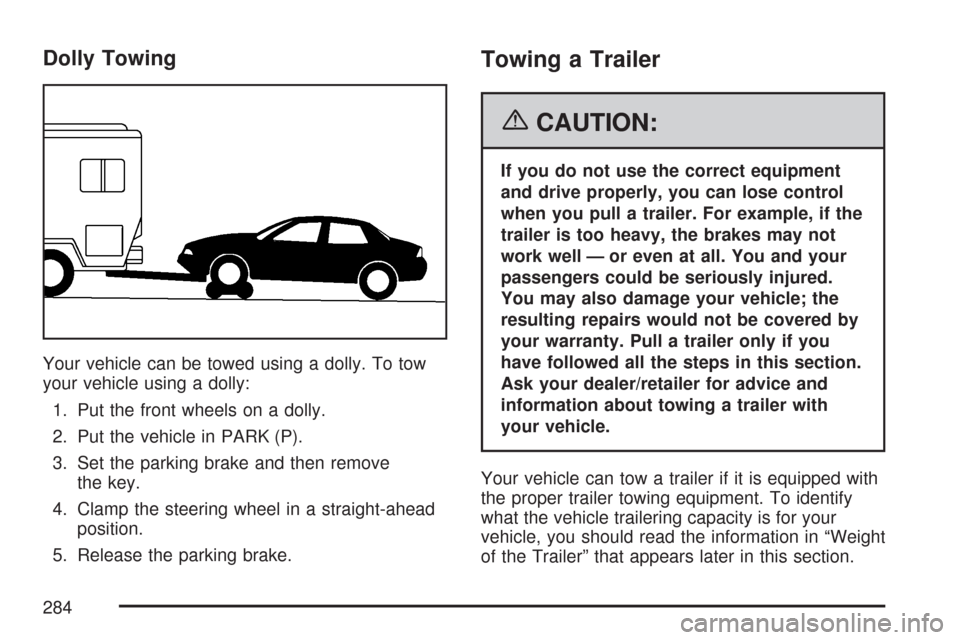
Your vehicle can be towed using a dolly. To tow
your vehicle using a dolly:
1. Put the front wheels on a dolly.
2. Put the vehicle in PARK (P).
3. Set the parking brake and then remove
the key.
4. Clamp the steering wheel in a straight-ahead
position.
5. Release the parking brake.
Towing a Trailer
{CAUTION:
If you do not use the correct equipment
and drive properly, you can lose control
when you pull a trailer. For example, if the
trailer is too heavy, the brakes may not
work well — or even at all. You and your
passengers could be seriously injured.
You may also damage your vehicle; the
resulting repairs would not be covered by
your warranty. Pull a trailer only if you
have followed all the steps in this section.
Ask your dealer/retailer for advice and
information about towing a trailer with
your vehicle.
Your vehicle can tow a trailer if it is equipped with
the proper trailer towing equipment. To identify
what the vehicle trailering capacity is for your
vehicle, you should read the information in “Weight
of the Trailer” that appears later in this section.
284
Page 289 of 460
Following Distance
Stay at least twice as far behind the vehicle ahead
as you would when driving your vehicle without
a trailer. This can help you avoid situations
that require heavy braking and sudden turns.
Passing
You’ll need more passing distance up ahead when
you’re towing a trailer. And, because you’re a
good deal longer, you’ll need to go much farther
beyond the passed vehicle before you can
return to your lane.
Backing Up
Hold the bottom of the steering wheel with
one hand. Then, to move the trailer to the left, just
move that hand to the left. To move the trailer
to the right, move your hand to the right. Always
back up slowly and, if possible, have someone
guide you.
Making Turns
Notice:Making very sharp turns while
trailering could cause the trailer to come in
contact with the vehicle. Your vehicle could be
damaged. Avoid making very sharp turns
while trailering.
When you’re turning with a trailer, make wider
turns than normal. Do this so your trailer
won’t strike soft shoulders, curbs, road signs,
trees or other objects. Avoid jerky or sudden
maneuvers. Signal well in advance.
Turn Signals When Towing a Trailer
When you tow a trailer, your vehicle may
need additional wiring. Check with your
dealer/retailer. The arrows on your instrument
panel will ash whenever you signal a turn or lane
change. Properly hooked up, the trailer lamps
will also ash, telling other drivers you’re about to
turn, change lanes or stop.
When towing a trailer, the arrows on your
instrument panel will ash for turns even if the bulbs
on the trailer are burned out. Thus, you may think
drivers behind you are seeing your signal when
they are not. It’s important to check occasionally to
be sure the trailer bulbs are still working.
289
Page 293 of 460
Service........................................................ 296
Accessories and Modications................... 296
California Proposition 65 Warning.............. 297
Doing Your Own Service Work.................. 297
Adding Equipment to the Outside of
Your Vehicle.......................................... 298
Fuel............................................................. 298
Gasoline Octane........................................ 298
Gasoline Specications.............................. 299
California Fuel........................................... 299
Additives................................................... 299
Fuel E85 (85% Ethanol)............................ 300
Fuels in Foreign Countries........................ 301
Filling the Tank......................................... 302
Filling a Portable Fuel Container............... 304
Checking Things Under the Hood.............. 304
Hood Release........................................... 305
Engine Compartment Overview.................. 306
Engine Oil................................................. 310
Engine Oil Life System.............................. 314
Engine Air Cleaner/Filter............................ 316
Automatic Transaxle Fluid......................... 317Engine Coolant.......................................... 320
Pressure Cap............................................ 323
Engine Overheating................................... 323
Overheated Engine Protection
Operating Mode..................................... 326
Cooling System......................................... 326
Power Steering Fluid................................. 332
Windshield Washer Fluid........................... 333
Brakes...................................................... 334
Battery...................................................... 337
Jump Starting............................................ 338
Headlamp Aiming........................................ 343
Bulb Replacement....................................... 343
Halogen Bulbs........................................... 344
Headlamps, Front Turn Signal,
Sidemarker, and Parking Lamps............. 344
Taillamps, Turn Signal, Sidemarker,
Stoplamps and Back-up Lamps.............. 346
License Plate Lamp................................... 348
Replacement Bulbs................................... 349
Windshield Wiper Blade Replacement....... 349
Section 5 Service and Appearance Care
293
Page 307 of 460

A. Windshield Washer Fluid Reservoir. See
“Adding Washer Fluid” underWindshield
Washer Fluid on page 333.
B. Battery. SeeBattery on page 337.
C. Underhood Fuse Block. SeeUnderhood Fuse
Block on page 400.
D. Remote Positive (+) Terminal. SeeJump
Starting on page 338.
E. Coolant Recovery Tank. See “Checking
Coolant” underCooling System on page 326.
F. Pressure Cap. SeePressure Cap on page 323.
G. Power Steering Fluid Cap. SeePower
Steering Fluid on page 332.H. Engine Oil Fill Cap. See “When to Add Engine
Oil” underEngine Oil on page 310.
I. Engine Oil Dipstick. See “Checking Engine Oil”
underEngine Oil on page 310.
J. Automatic Transaxle Fluid Dipstick (Out of
View). See “Checking the Fluid Level” under
Automatic Transaxle Fluid on page 317.
K. Brake Master Cylinder Reservoir. See “Brake
Fluid” underBrakes on page 334.
L. Engine Air Cleaner/Filter. SeeEngine Air
Cleaner/Filter on page 316.
307
Page 309 of 460

A. Windshield Washer Fluid Reservoir. See
“Adding Washer Fluid” underWindshield
Washer Fluid on page 333.
B. Battery. SeeBattery on page 337.
C. Underhood Fuse Block. SeeUnderhood Fuse
Block on page 400.
D. Remote Positive (+) Terminal. SeeJump
Starting on page 338.
E. Pressure Cap. SeePressure Cap on page 323.
F. Power Steering Fluid Cap. SeePower
Steering Fluid on page 332.
G. Engine Oil Dipstick. See “Checking Engine Oil”
underEngine Oil on page 310.H. Engine Oil Fill Cap. See “When to Add Engine
Oil” underEngine Oil on page 310.
I. Automatic Transaxle Fluid Dipstick (Out of
View). See “Checking the Fluid Level” under
Automatic Transaxle Fluid on page 317.
J. Brake Master Cylinder Reservoir. See “Brake
Fluid” underBrakes on page 334.
K. Engine Air Cleaner/Filter. SeeEngine Air
Cleaner/Filter on page 316.
L. Coolant Recovery Tank. See “Checking
Coolant” underCooling System on page 326.
309
Page 332 of 460

Power Steering Fluid
The power steering uid
reservoir is located
toward the rear of the
engine compartment on
the passenger’s side
of the vehicle. See
Engine Compartment
Overview on page 306
for reservoir location.
When to Check Power Steering Fluid
It is not necessary to regularly check power
steering uid unless you suspect there is a leak
in the system or you hear an unusual noise.
A uid loss in this system could indicate a problem.
Have the system inspected and repaired.
How to Check Power Steering Fluid
To check the power steering uid, do the following:
1. Turn the key off and let the engine
compartment cool down.
2. Wipe the cap and the top of the
reservoir clean.
3. Unscrew the cap and wipe the dipstick with a
clean rag.
4. Replace the cap and completely tighten it.
5. Remove the cap again and look at the
uid level on the dipstick.
The uid level should be somewhere within the
cross-hatched area on the dipstick. If the uid is at
the ADD mark, you should add uid.
What to Use
To determine what kind of uid to use, see
Recommended Fluids and Lubricants on page 417.
Always use the proper uid. Failure to use the
proper uid can cause leaks and damage hoses
and seals.
332
Page 356 of 460

Tire Terminology and Denitions
Air Pressure:The amount of air inside the tire
pressing outward on each square inch of the
tire. Air pressure is expressed in pounds
per square inch (psi) or kilopascal (kPa).
Accessory Weight:This means the combined
weight of optional accessories. Some examples of
optional accessories are, automatic transmission,
power steering, power brakes, power windows,
power seats, and air conditioning.
Aspect Ratio:The relationship of a tire’s height
to its width.
Belt:A rubber coated layer of cords that is
located between the plies and the tread. Cords
may be made from steel or other reinforcing
materials.
Bead:The tire bead contains steel wires wrapped
by steel cords that hold the tire onto the rim.Bias Ply Tire:A pneumatic tire in which the plies
are laid at alternate angles less than 90 degrees
to the centerline of the tread.
Cold Tire Pressure:The amount of air pressure
in a tire, measured in pounds per square inch
(psi) or kilopascals (kPa) before a tire has built up
heat from driving. SeeInation - Tire Pressure
on page 359.
Curb Weight:This means the weight of a motor
vehicle with standard and optional equipment
including the maximum capacity of fuel, oil, and
coolant, but without passengers and cargo.
DOT Markings:A code molded into the sidewall
of a tire signifying that the tire is in compliance
with the U.S. Department of Transportation (DOT)
motor vehicle safety standards. The DOT code
includes the Tire Identication Number (TIN),
an alphanumeric designator which can also identify
the tire manufacturer, production plant, brand,
and date of production.
356