cooling CHEVROLET IMPALA 2010 9.G User Guide
[x] Cancel search | Manufacturer: CHEVROLET, Model Year: 2010, Model line: IMPALA, Model: CHEVROLET IMPALA 2010 9.GPages: 432, PDF Size: 1.89 MB
Page 296 of 432
What to Use
{
WARNING:
Adding only plain water to the cooling system can
be dangerous. Plain water, or some other liquid
such as alcohol, can boil before the proper coolant
mixture will. The vehicle’s coolant warning system
is set for the proper coolant mixture. With plain
water or the wrong mixture, the engine could get
too hot but you would not get the overheat
warning. The engine could catch fire and you or
others could be burned. Use a 50/50 mixture of
clean, drinkable water and DEX-COOL
®
coolant.Use a 50/50 mixture of clean, drinkable water and
DEX-COOL
®
coolant. If using this mixture, nothing else
needs to be added. This mixture:
•
Gives freezing protection down to−34°F (−37°C),
outside temperature.
•
Gives boiling protection up to 265°F (129°C),
engine temperature.
•
Protects against rust and corrosion.
•
Will not damage aluminum parts.
•
Helps keep the proper engine temperature.
Notice:If an improper coolant mixture is used,
the engine could overheat and be badly damaged.
The repair cost would not be covered by the vehicle
warranty. Too much water in the mixture can
freeze and crack the engine, radiator, heater core,
and other parts.
Notice:If extra inhibitors and/or additives are used
in the vehicle’s cooling system, the vehicle could
be damaged. Use only the proper mixture of
the engine coolant listed in this manual for the
cooling system. SeeRecommended Fluids and
Lubricants on page 7-10for more information.
6-26
Page 297 of 432
Checking CoolantThe vehicle must be on a level surface when checking
the coolant level.
Check to see if coolant is visible in the coolant recovery
tank. If the coolant inside the coolant recovery tank
is boiling, do not do anything else until it cools down.
If coolant is visible but the coolant level is not at or above
the COLD FILL line, add a 50/50 mixture of clean,
drinkable water and DEX-COOL
®coolant at the coolant
recovery tank, but be sure the cooling system is cool
before this is done. See Engine Coolant Engine Coolant
for more information.
If your vehicle has one of the V6 engines, the coolant
recovery tank is located in the rear of the engine
compartment on the passenger’s side of the vehicle.
If your vehicle has the 5.3L V8 engine, the coolant
recovery tank is located in the rear of the engine
compartment on the driver’s side of the vehicle.
SeeEngine Compartment Overview on page 6-14.
When the engine is cold, the coolant level should be at
or above the COLD FILL line on the coolant recovery
tank. To check the coolant level, look for the COLD FILL
line on the side of the coolant recovery tank that
faces the engine. If the level is not correct, there may
be a leak in the cooling system.
How to Add Coolant to the
Recovery Tank
{
WARNING:
You can be burned if you spill coolant on hot
engine parts. Coolant contains ethylene glycol
and it will burn if the engine parts are hot enough.
Do not spill coolant on a hot engine.
Notice:This vehicle has a specific coolant fill
procedure. Failure to follow this procedure could
cause the engine to overheat and be severely
damaged.
If coolant is needed, add the proper DEX-COOL
®
coolant mixture at the coolant recovery tank.
When the coolant level in the coolant recovery tank is at
the COLD FILL line, start the vehicle.
If the overheat warning continues, there is one more
thing you can try. You can add the proper coolant
mixture directly to the cooling system through the
coolant fill neck on the engine, but be sure the system
is cool before you do it.
6-27
Page 298 of 432
How to Add Coolant to the Radiator
{
WARNING:
An electric engine cooling fan under the hood can
start up even when the engine is not running and
can cause injury. Keep hands, clothing, and tools
away from any underhood electric fan.{
WARNING:
Steam and scalding liquids from a hot cooling
system can blow out and burn you badly. They are
under pressure, and if you turn the surge tank
pressure cap — even a little — they can come
out at high speed. Never turn the cap when the
cooling system, including the surge tank pressure
cap, is hot. Wait for the cooling system and surge
tank pressure cap to cool if you ever have to turn
the pressure cap.If coolant is needed, add the proper mixture directly to
the radiator, but be sure the cooling system is cool
before this is done.
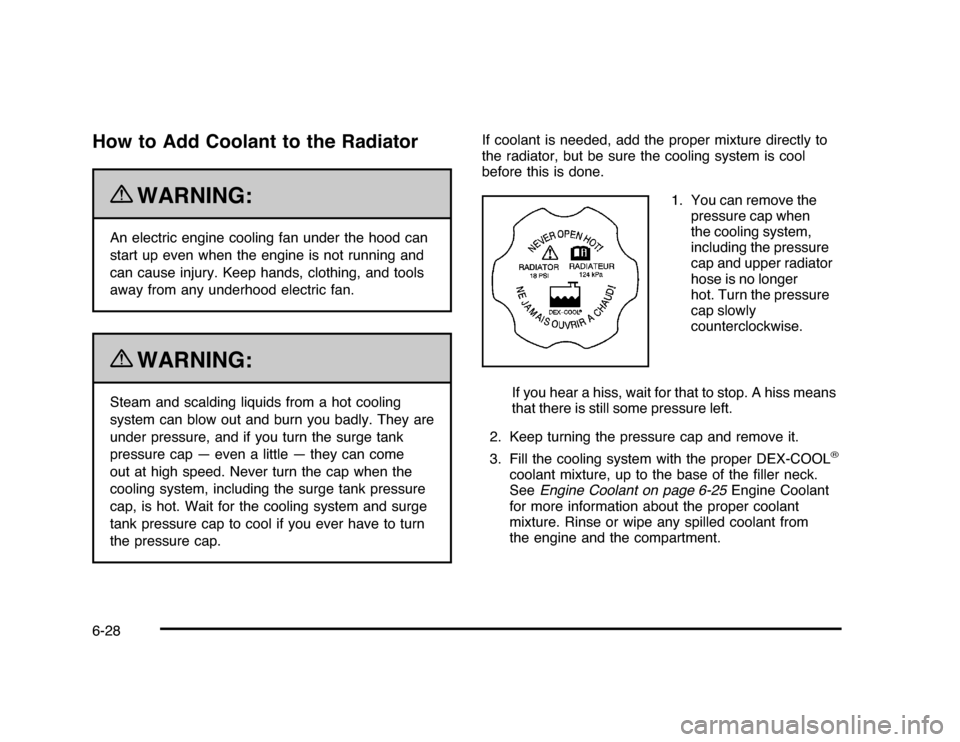
1. You can remove the
pressure cap when
the cooling system,
including the pressure
cap and upper radiator
hose is no longer
hot. Turn the pressure
cap slowly
counterclockwise.
If you hear a hiss, wait for that to stop. A hiss means
that there is still some pressure left.
2. Keep turning the pressure cap and remove it.
3. Fill the cooling system with the proper DEX-COOL
®
coolant mixture, up to the base of the filler neck.
SeeEngine Coolant on page 6-25Engine Coolant
for more information about the proper coolant
mixture. Rinse or wipe any spilled coolant from
the engine and the compartment.
6-28
Page 300 of 432
In addition, you will find an ENGINE OVERHEATED
IDLE ENGINE and an ENGINE OVERHEATED STOP
ENGINE message displayed on the vehicle’s Driver
Information Center (DIC). SeeDIC Warnings and
Messages on page 4-44DIC Warnings and Messages
for more information.
You may decide not to lift the hood when this warning
appears, but instead get service help right away.
SeeRoadside Assistance Program on page 8-7.
If you do decide to lift the hood, make sure the vehicle
is parked on a level surface.
Then check to see if the engine cooling fans are
running. If the engine is overheating, both fans should
be running. If they are not, do not continue to run
the engine and have the vehicle serviced.
Notice:Engine damage from running the engine
without coolant is not covered by the warranty.
Notice:If the engine catches fire while driving with
no coolant, the vehicle can be badly damaged.
The costly repairs would not be covered by
the vehicle warranty. SeeOverheated Engine
Protection Operating Mode on page 6-32for
information on driving to a safe place in an
emergency.
If Steam Is Coming From The Engine
Compartment
{
WARNING:
Steam from an overheated engine can burn you
badly, even if you just open the hood. Stay away
from the engine if you see or hear steam coming
from it. Turn it off and get everyone away from the
vehicle until it cools down. Wait until there is no sign
of steam or coolant before you open the hood.
If you keep driving when the vehicles engine is
overheated, the liquids in it can catch fire. You or
others could be badly burned. Stop the engine if it
overheats, and get out of the vehicle until the
engine is cool.
SeeOverheated Engine Protection Operating Mode
on page 6-32for information on driving to a safe
place in an emergency.
6-30
Page 342 of 432
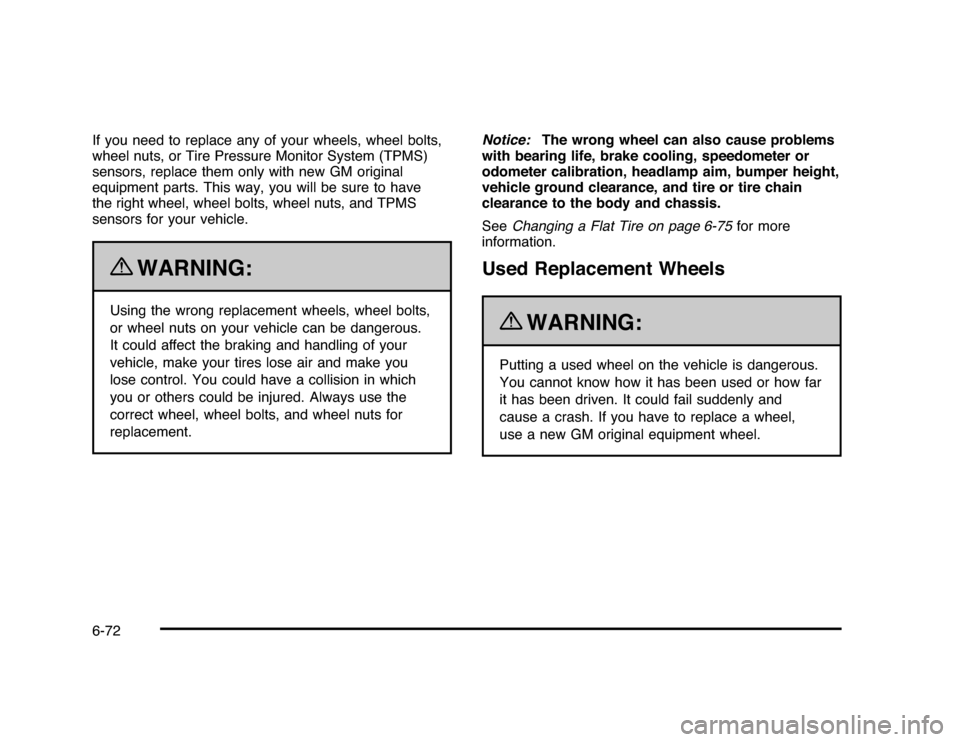
If you need to replace any of your wheels, wheel bolts,
wheel nuts, or Tire Pressure Monitor System (TPMS)
sensors, replace them only with new GM original
equipment parts. This way, you will be sure to have
the right wheel, wheel bolts, wheel nuts, and TPMS
sensors for your vehicle.
{
WARNING:
Using the wrong replacement wheels, wheel bolts,
or wheel nuts on your vehicle can be dangerous.
It could affect the braking and handling of your
vehicle, make your tires lose air and make you
lose control. You could have a collision in which
you or others could be injured. Always use the
correct wheel, wheel bolts, and wheel nuts for
replacement.Notice:The wrong wheel can also cause problems
with bearing life, brake cooling, speedometer or
odometer calibration, headlamp aim, bumper height,
vehicle ground clearance, and tire or tire chain
clearance to the body and chassis.
SeeChanging a Flat Tire on page 6-75for more
information.
Used Replacement Wheels
{
WARNING:
Putting a used wheel on the vehicle is dangerous.
You cannot know how it has been used or how far
it has been driven. It could fail suddenly and
cause a crash. If you have to replace a wheel,
use a new GM original equipment wheel.
6-72
Page 369 of 432
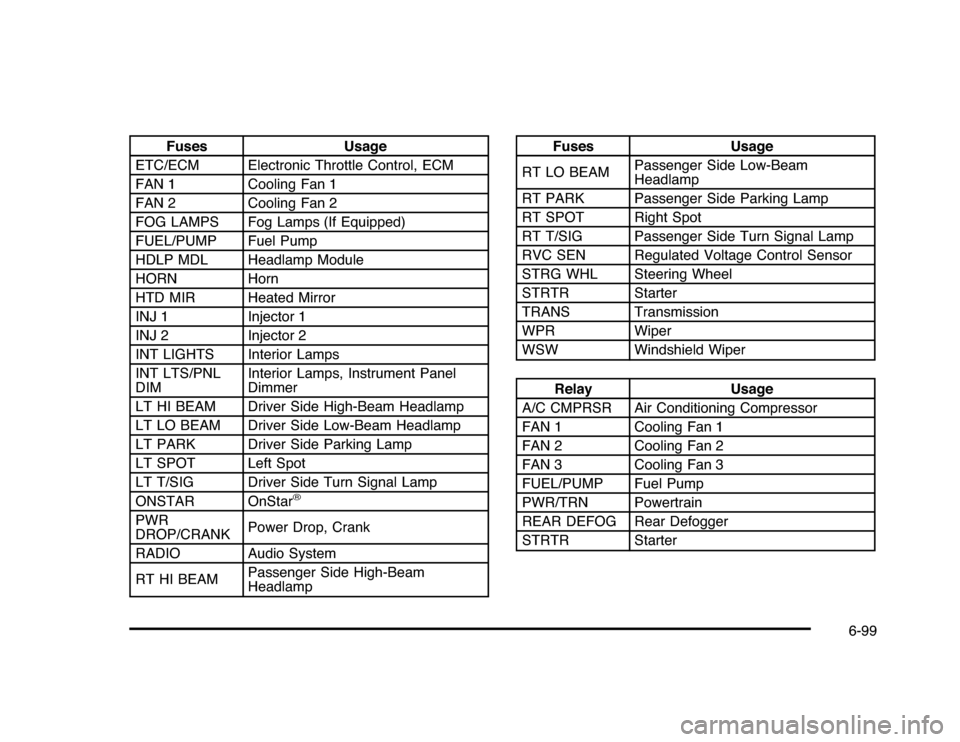
Fuses Usage
ETC/ECM Electronic Throttle Control, ECM
FAN 1 Cooling Fan 1
FAN 2 Cooling Fan 2
FOG LAMPS Fog Lamps (If Equipped)
FUEL/PUMP Fuel Pump
HDLP MDL Headlamp Module
HORN Horn
HTD MIR Heated Mirror
INJ 1 Injector 1
INJ 2 Injector 2
INT LIGHTS Interior Lamps
INT LTS/PNL
DIMInterior Lamps, Instrument Panel
Dimmer
LT HI BEAM Driver Side High-Beam Headlamp
LT LO BEAM Driver Side Low-Beam Headlamp
LT PARK Driver Side Parking Lamp
LT SPOT Left Spot
LT T/SIG Driver Side Turn Signal Lamp
ONSTAR OnStar
®
PWR
DROP/CRANKPower Drop, Crank
RADIO Audio System
RT HI BEAMPassenger Side High-Beam
Headlamp
Fuses Usage
RT LO BEAMPassenger Side Low-Beam
Headlamp
RT PARK Passenger Side Parking Lamp
RT SPOT Right Spot
RT T/SIG Passenger Side Turn Signal Lamp
RVC SEN Regulated Voltage Control Sensor
STRG WHL Steering Wheel
STRTR Starter
TRANS Transmission
WPR Wiper
WSW Windshield WiperRelay Usage
A/C CMPRSR Air Conditioning Compressor
FAN 1 Cooling Fan 1
FAN 2 Cooling Fan 2
FAN 3 Cooling Fan 3
FUEL/PUMP Fuel Pump
PWR/TRN Powertrain
REAR DEFOG Rear Defogger
STRTR Starter
6-99
Page 370 of 432
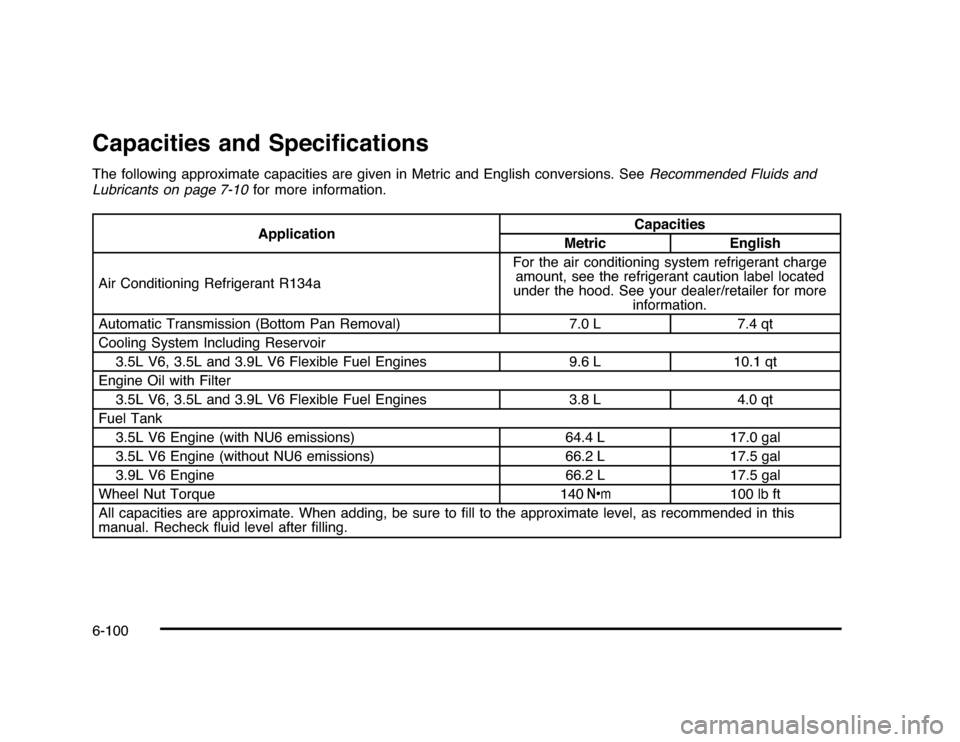
Capacities and SpecificationsThe following approximate capacities are given in Metric and English conversions. SeeRecommended Fluids and
Lubricants on page 7-10for more information.
ApplicationCapacities
Metric English
Air Conditioning Refrigerant R134aFor the air conditioning system refrigerant charge
amount, see the refrigerant caution label located
under the hood. See your dealer/retailer for more
information.
Automatic Transmission (Bottom Pan Removal) 7.0 L 7.4 qt
Cooling System Including Reservoir
3.5L V6, 3.5L and 3.9L V6 Flexible Fuel Engines 9.6 L 10.1 qt
Engine Oil with Filter
3.5L V6, 3.5L and 3.9L V6 Flexible Fuel Engines 3.8 L 4.0 qt
Fuel Tank
3.5L V6 Engine (with NU6 emissions) 64.4 L 17.0 gal
3.5L V6 Engine (without NU6 emissions) 66.2 L 17.5 gal
3.9L V6 Engine 66.2 L 17.5 gal
Wheel Nut Torque 140Y100 lb ft
All capacities are approximate. When adding, be sure to fill to the approximate level, as recommended in this
manual. Recheck fluid level after filling.
6-100
Page 376 of 432
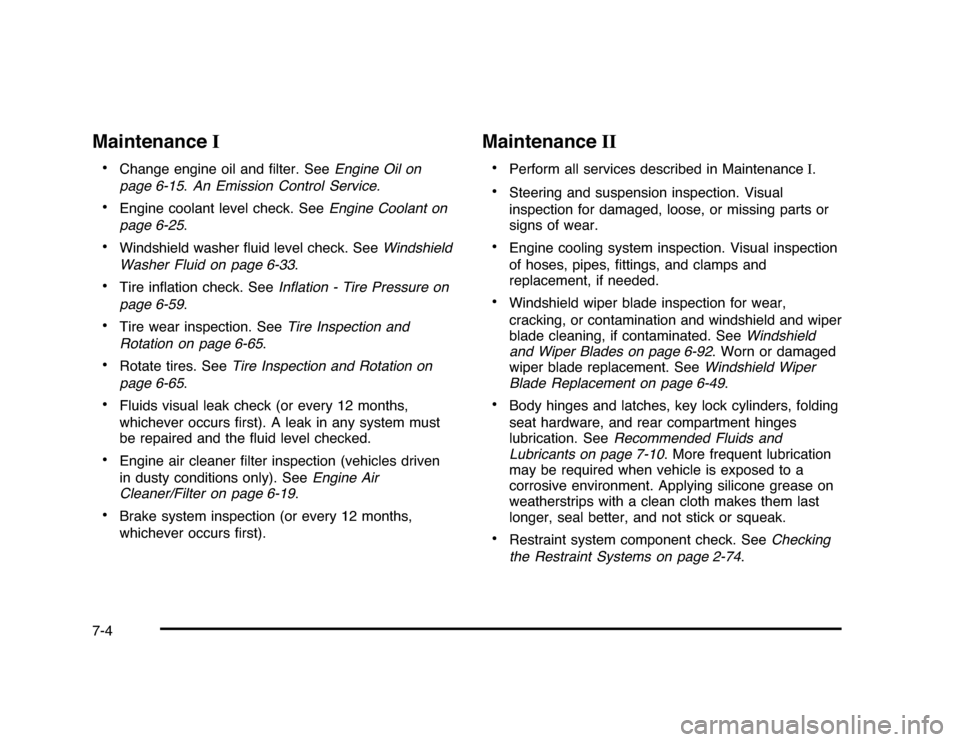
MaintenanceI•
Change engine oil and filter. SeeEngine Oil on
page 6-15.An Emission Control Service.
•
Engine coolant level check. SeeEngine Coolant on
page 6-25.
•
Windshield washer fluid level check. SeeWindshield
Washer Fluid on page 6-33.
•
Tire inflation check. SeeInflation - Tire Pressure on
page 6-59.
•
Tire wear inspection. SeeTire Inspection and
Rotation on page 6-65.
•
Rotate tires. SeeTire Inspection and Rotation on
page 6-65.
•
Fluids visual leak check (or every 12 months,
whichever occurs first). A leak in any system must
be repaired and the fluid level checked.
•
Engine air cleaner filter inspection (vehicles driven
in dusty conditions only). SeeEngine Air
Cleaner/Filter on page 6-19.
•
Brake system inspection (or every 12 months,
whichever occurs first).
MaintenanceII•
Perform all services described in MaintenanceI.
•
Steering and suspension inspection. Visual
inspection for damaged, loose, or missing parts or
signs of wear.
•
Engine cooling system inspection. Visual inspection
of hoses, pipes, fittings, and clamps and
replacement, if needed.
•
Windshield wiper blade inspection for wear,
cracking, or contamination and windshield and wiper
blade cleaning, if contaminated. SeeWindshield
and Wiper Blades on page 6-92. Worn or damaged
wiper blade replacement. SeeWindshield Wiper
Blade Replacement on page 6-49.
•
Body hinges and latches, key lock cylinders, folding
seat hardware, and rear compartment hinges
lubrication. SeeRecommended Fluids and
Lubricants on page 7-10. More frequent lubrication
may be required when vehicle is exposed to a
corrosive environment. Applying silicone grease on
weatherstrips with a clean cloth makes them last
longer, seal better, and not stick or squeak.
•
Restraint system component check. SeeChecking
the Restraint Systems on page 2-74.
7-4
Page 377 of 432
•
Automatic transmission fluid level check and adding
fluid, if needed. SeeAutomatic Transmission Fluid
on page 6-22.
•
Engine air cleaner filter inspection. SeeEngine Air
Cleaner/Filter on page 6-19.
•
Passenger compartment air filter replacement
(or every 12 months, whichever occurs first).
More frequent replacement may be required if
vehicle is driven regularly under dusty conditions.
Additional Required ServicesAt Each Fuel Stop
•
Engine oil level check. SeeEngine Oil on
page 6-15.
•
Engine coolant level check. SeeEngine Coolant on
page 6-25.
•
Windshield washer fluid level check. SeeWindshield
Washer Fluid on page 6-33.
Once a Month
•
Tire inflation check. SeeInflation - Tire Pressure on
page 6-59.
•
Tire wear inspection. SeeTire Inspection and
Rotation on page 6-65.
Once a Year
•
Starter switch check. SeeOwner Checks and
Services on page 7-8.
•
Parking brake and automatic transmission P (Park)
mechanism check. SeeOwner Checks and
Services on page 7-8.
•
Automatic transmission shiftlock control system
check. SeeOwner Checks and Services on
page 7-8.
•
Ignition transmission lock check. SeeOwner
Checks and Services on page 7-8.
•
Engine cooling system and pressure cap pressure
check. Radiator and air conditioning condenser
outside cleaning. SeeCooling System on
page 6-24.
•
Exhaust system and nearby heat shields inspection
for loose or damaged components.
•
Throttle system inspection for interference, binding
or for damaged or missing parts. Replace parts as
needed. Replace any components that have
high effort or excessive wear. Do not lubricate
accelerator or cruise control cables.
7-5
Page 378 of 432

First Engine Oil Change After Every
40 000 km/25,000 Miles
•
Fuel system inspection for damage or leaks.
First Engine Oil Change After Every
80 000 km/50,000 Miles
•
Engine air cleaner filter replacement. SeeEngine
Air Cleaner/Filter on page 6-19.
•
Automatic transmission fluid change (severe
service) for vehicles mainly driven in heavy
city traffic in hot weather, in hilly or mountainous
terrain, when frequently towing a trailer, or used for
taxi, police, or delivery service. SeeAutomatic
Transmission Fluid on page 6-22.
First Engine Oil Change After Every
160 000 km/100,000 Miles
•
Automatic transmission fluid change (normal
service). SeeAutomatic Transmission Fluid
on page 6-22.
•
Spark plug replacement and spark plug wires
inspection.An Emission Control Service.
First Engine Oil Change After Every
240 000 km/150,000 Miles
•
Engine cooling system drain, flush, and refill,
cooling system and cap pressure check, and
cleaning of outside of radiator and air conditioning
condenser (or every 5 years, whichever occurs
first). SeeEngine Coolant on page 6-25.
An Emission Control Service.
•
Engine accessory drive belt inspection for fraying,
excessive cracks, or obvious damage and
replacement, if needed.An Emission Control
Service.
7-6