lock CHEVROLET IMPALA 2011 9.G Owners Manual
[x] Cancel search | Manufacturer: CHEVROLET, Model Year: 2011, Model line: IMPALA, Model: CHEVROLET IMPALA 2011 9.GPages: 376, PDF Size: 5.71 MB
Page 280 of 376
Black plate (34,1)Chevrolet Impala Owner Manual - 2011
10-34 Vehicle Care
If there is a problem on the road and
a fuse needs to be replaced, the
same amperage fuse can be
borrowed. Choose some feature of
the vehicle that is not needed to use
and replace it as soon as possible.
Headlamp Wiring
An electrical overload may cause
the lamps to go on and off, or in
some cases to remain off. Have the
headlamp wiring checked right away
if the lamps go on and off or
remain off.
Windshield Wipers
If the wiper motor overheats due to
heavy snow or ice, the windshield
wipers will stop until the motor cools
and will then restart.
Although the circuit is protected
from electrical overload, overload
due to heavy snow or ice may
cause wiper linkage damage.Always clear ice and heavy snow
from the windshield before using the
windshield wipers.
If the overload is caused by an
electrical problem and not snow or
ice, be sure to get it fixed.
Fuses and Circuit
Breakers
The wiring circuits in the vehicle are
protected from short circuits by a
combination of fuses and circuit
breakers. This greatly reduces the
chance of fires caused by electrical
problems.
Look at the silver-colored band
inside the fuse. If the band is broken
or melted, replace the fuse. Be sure
you replace a bad fuse with a new
one of the identical size and rating.
Engine Compartment
Fuse Block
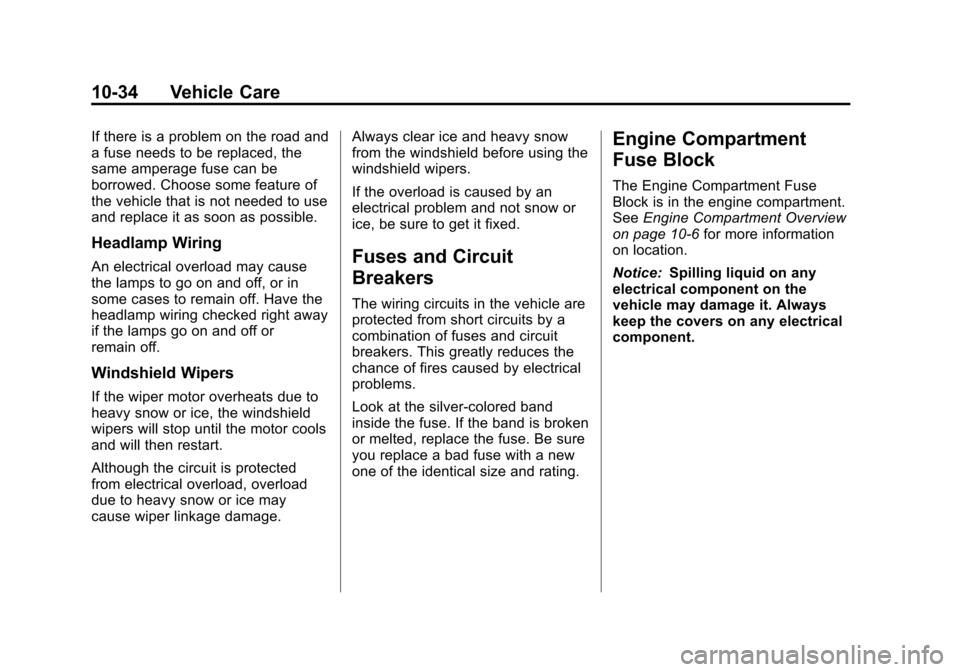
The Engine Compartment Fuse
Block is in the engine compartment.
See
Engine Compartment Overview
on page 10‑6 for more information
on location.
Notice: Spilling liquid on any
electrical component on the
vehicle may damage it. Always
keep the covers on any electrical
component.
Page 281 of 376
Black plate (35,1)Chevrolet Impala Owner Manual - 2011
Vehicle Care 10-35
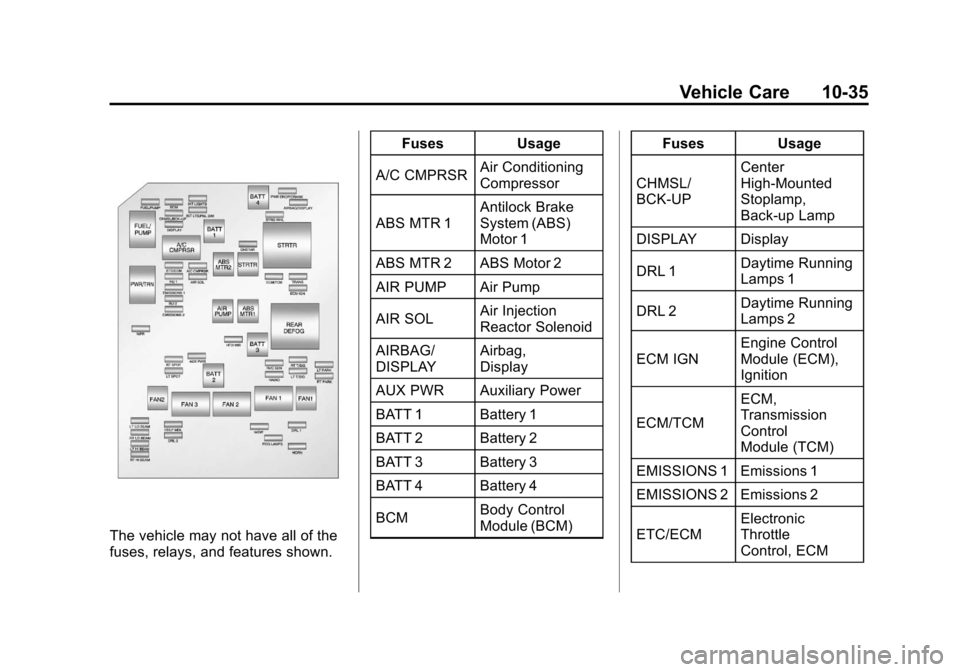
The vehicle may not have all of the
fuses, relays, and features shown.Fuses Usage
A/C CMPRSR Air Conditioning
Compressor
ABS MTR 1 Antilock Brake
System (ABS)
Motor 1
ABS MTR 2 ABS Motor 2
AIR PUMP Air Pump
AIR SOL Air Injection
Reactor Solenoid
AIRBAG/
DISPLAY Airbag,
Display
AUX PWR Auxiliary Power
BATT 1 Battery 1
BATT 2 Battery 2
BATT 3 Battery 3
BATT 4 Battery 4
BCM Body Control
Module (BCM) Fuses Usage
CHMSL/
BCK‐UP Center
High‐Mounted
Stoplamp,
Back‐up Lamp
DISPLAY Display
DRL 1 Daytime Running
Lamps 1
DRL 2 Daytime Running
Lamps 2
ECM IGN Engine Control
Module (ECM),
Ignition
ECM/TCM ECM,
Transmission
Control
Module (TCM)
EMISSIONS 1 Emissions 1
EMISSIONS 2 Emissions 2
ETC/ECM Electronic
Throttle
Control, ECM
Page 283 of 376

Black plate (37,1)Chevrolet Impala Owner Manual - 2011
Vehicle Care 10-37
Instrument Panel Fuse
Block
The fuse block is on the passenger
side of the vehicle in the carpet
molding. Remove the fuse block
door to access the fuses.
The vehicle may not be equipped
with all of the fuses, relays, and
features shown.Fuses Usage
AIRBAG Airbags
AMP Amplifier
AUX Auxiliary Outlets
CNSTR Canister Fuses Usage
DR/LCK Door Locks
HTD/SEAT Heated Seats
PWR/MIR Power Mirrors
PWR/SEAT Power Seats
PWR/WNDW Power Window
RAP Retained
Accessory
Power
S/ROOF Sunroof
TRUNK Trunk
TRUNK Trunk Relay
XM XM™ Radio
Page 296 of 376

Black plate (50,1)Chevrolet Impala Owner Manual - 2011
10-50 Vehicle Care
The TPMS sensor matching process
is outlined below:
1. Set the parking brake.
2. Turn the ignition switch to ON/RUN with the engine off.
3. Press the Remote Keyless Entry (RKE) transmitter's lock and
unlock buttons at the same time
for approximately five seconds.
The horn sounds twice to signal
the receiver is in relearn mode
and the TIRE LEARNING
ACTIVE message displays on
the DIC screen.
4. Start with the driver side front tire. 5. Remove the valve cap from the
valve cap stem. Activate the
TPMS sensor by increasing or
decreasing the tire's air pressure
for five seconds, or until a
horn chirp sounds. The horn
chirp, which may take up to
30 seconds to sound, confirms
that the sensor identification
code has been matched to this
tire and wheel position.
6. Proceed to the passenger side front tire, and repeat the
procedure in Step 5.
7. Proceed to the passenger side rear tire, and repeat the
procedure in Step 5. 8. Proceed to the driver side rear
tire, and repeat the procedure
in Step 5. The horn sounds
two times to indicate the sensor
identification code has been
matched to the driver side rear
tire, and the TPMS sensor
matching process is no longer
active. The TIRE LEARNING
ACTIVE message on the
DIC display screen goes off.
9. Turn the ignition switch to LOCK/OFF.
10. Set all four tires to the recommended air pressure
level as indicated on the Tire
and Loading Information label.
11. Put the valve caps back on the valve stems.
Page 301 of 376
Black plate (55,1)Chevrolet Impala Owner Manual - 2011
Vehicle Care 10-55
Non‐TPC Spec rated tires may
give a low‐pressure warning
that is higher or lower than the
proper warning level you would
get with TPC Spec rated tires.
SeeTire Pressure Monitor
System on page 10‑46.
Your vehicle's original
equipment tires are listed on the
Tire and Loading Information
label. See Vehicle Load Limits
on page 9‑12 for more
information about the Tire and
Loading Information label and its
location on your vehicle.
Different Size Tires and
Wheels
If you add wheels or tires that are a
different size than your original
equipment wheels and tires, this
could affect the way your vehicle
performs, including its braking, ride
and handling characteristics,
stability, and resistance to rollover. Additionally, if your vehicle has
electronic systems such as antilock
brakes, rollover airbags, traction
control, and electronic stability
control, the performance of these
systems can be affected.
{WARNING
If you add different sized wheels,
your vehicle may not provide
an acceptable level of
performance and safety if tires
not recommended for those
wheels are selected. You may
increase the chance that you will
crash and suffer serious injury.
Only use GM specific wheel and
tire systems developed for your
vehicle, and have them properly
installed by a GM certified
technician.
See Buying New Tires on
page 10‑53 andAccessories and
Modifications on page 10‑3 for
additional information.
Uniform Tire Quality
Grading
Quality grades can be found
where applicable on the tire
sidewall between tread shoulder
and maximum section width.
For example:
Treadwear 200 Traction AA
Temperature A
The following information
relates to the system developed
by the United States National
Highway Traffic Safety
Administration (NHTSA),
which grades tires
by treadwear, traction,
and temperature performance.
Page 306 of 376
Black plate (60,1)Chevrolet Impala Owner Manual - 2011
10-60 Vehicle Care
If a tire goes flat, avoid further tire
and wheel damage by driving slowly
to a level place, well off the road,
if possible. Turn on the hazard
warning flashers. SeeHazard
Warning Flashers on page 6‑4.
{WARNING
Changing a tire can be
dangerous. The vehicle can slip
off the jack and roll over or fall on
you or other people. You and they
could be badly injured or even
killed. Find a level place to
change your tire. To help prevent
the vehicle from moving:
1. Set the parking brake firmly.
2. Put an automatic transmission shift lever in
P (Park), or shift a manual
transmission to 1 (First) or
R (Reverse).
(Continued)
WARNING (Continued)
3. Turn off the engine and donot restart while the vehicle
is raised.
4. Do not allow passengers to remain in the vehicle.
To be certain the vehicle will not
move, put blocks at the front and
rear of the tire farthest away from
the one being changed. That
would be the tire on the other
side, at the opposite end of
the vehicle.
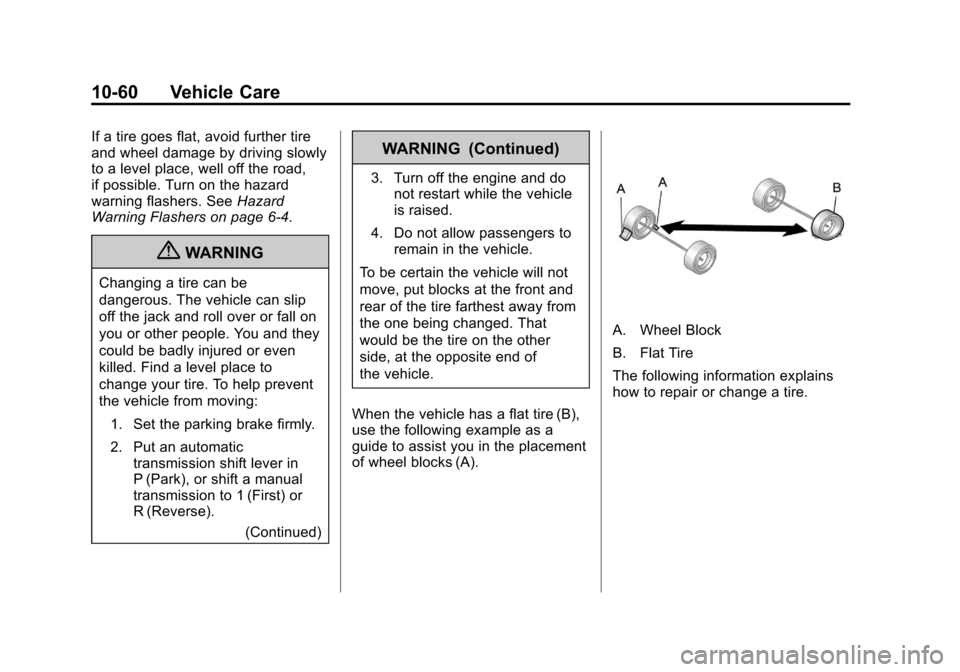
When the vehicle has a flat tire (B),
use the following example as a
guide to assist you in the placement
of wheel blocks (A).
A. Wheel Block
B. Flat Tire
The following information explains
how to repair or change a tire.
Page 307 of 376
Black plate (61,1)Chevrolet Impala Owner Manual - 2011
Vehicle Care 10-61
Tire Changing
Removing the Spare Tire and
Tools
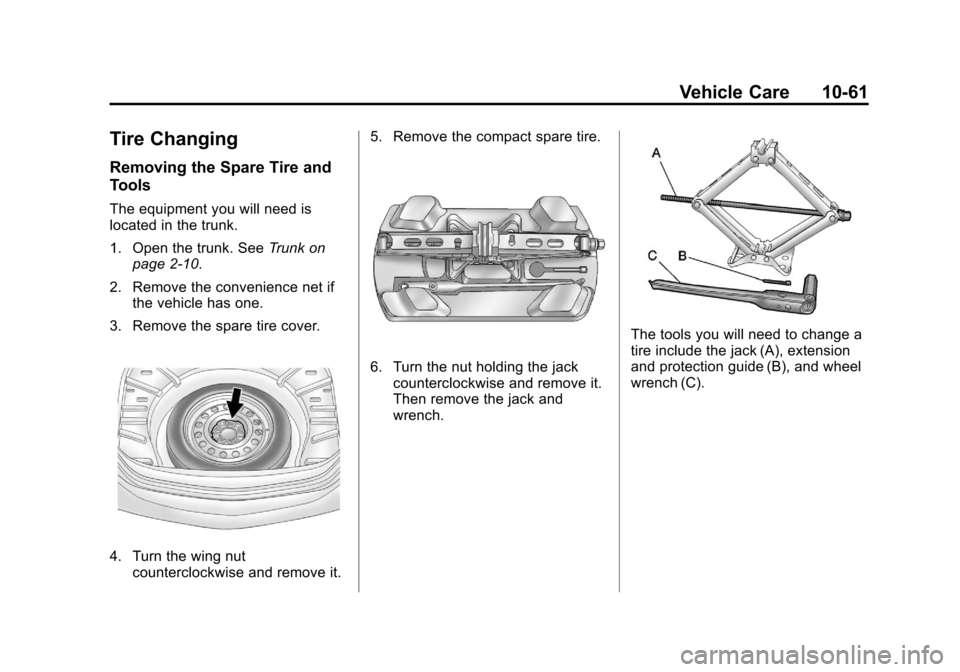
The equipment you will need is
located in the trunk.
1. Open the trunk. SeeTrunk on
page 2‑10.
2. Remove the convenience net if the vehicle has one.
3. Remove the spare tire cover.
4. Turn the wing nut counterclockwise and remove it. 5. Remove the compact spare tire.
6. Turn the nut holding the jack
counterclockwise and remove it.
Then remove the jack and
wrench.
The tools you will need to change a
tire include the jack (A), extension
and protection guide (B), and wheel
wrench (C).
Page 308 of 376
Black plate (62,1)Chevrolet Impala Owner Manual - 2011
10-62 Vehicle Care
Removing the Flat Tire and
Installing the Spare Tire
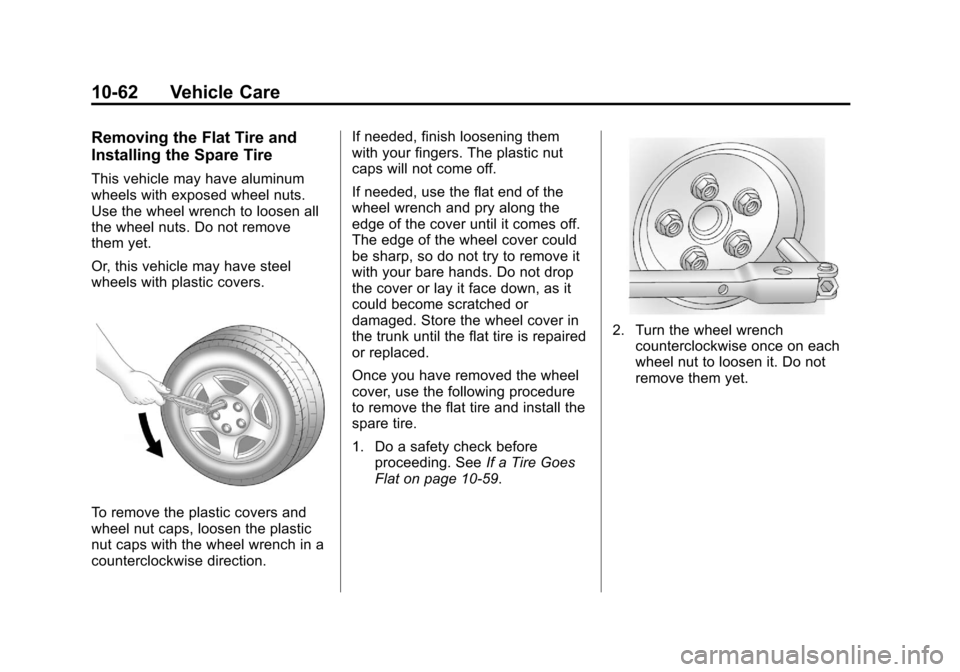
This vehicle may have aluminum
wheels with exposed wheel nuts.
Use the wheel wrench to loosen all
the wheel nuts. Do not remove
them yet.
Or, this vehicle may have steel
wheels with plastic covers.
To remove the plastic covers and
wheel nut caps, loosen the plastic
nut caps with the wheel wrench in a
counterclockwise direction.If needed, finish loosening them
with your fingers. The plastic nut
caps will not come off.
If needed, use the flat end of the
wheel wrench and pry along the
edge of the cover until it comes off.
The edge of the wheel cover could
be sharp, so do not try to remove it
with your bare hands. Do not drop
the cover or lay it face down, as it
could become scratched or
damaged. Store the wheel cover in
the trunk until the flat tire is repaired
or replaced.
Once you have removed the wheel
cover, use the following procedure
to remove the flat tire and install the
spare tire.
1. Do a safety check before
proceeding. See If a Tire Goes
Flat on page 10‑59.
2. Turn the wheel wrench counterclockwise once on each
wheel nut to loosen it. Do not
remove them yet.
Page 310 of 376
Black plate (64,1)Chevrolet Impala Owner Manual - 2011
10-64 Vehicle Care
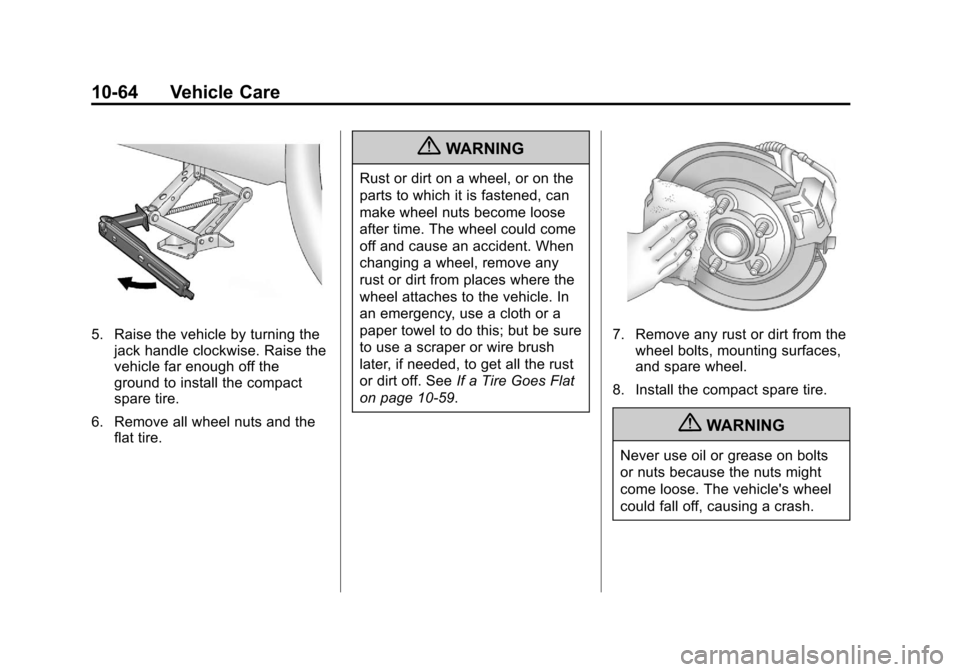
5. Raise the vehicle by turning thejack handle clockwise. Raise the
vehicle far enough off the
ground to install the compact
spare tire.
6. Remove all wheel nuts and the flat tire.
{WARNING
Rust or dirt on a wheel, or on the
parts to which it is fastened, can
make wheel nuts become loose
after time. The wheel could come
off and cause an accident. When
changing a wheel, remove any
rust or dirt from places where the
wheel attaches to the vehicle. In
an emergency, use a cloth or a
paper towel to do this; but be sure
to use a scraper or wire brush
later, if needed, to get all the rust
or dirt off. See If a Tire Goes Flat
on page 10‑59.
7. Remove any rust or dirt from the wheel bolts, mounting surfaces,
and spare wheel.
8. Install the compact spare tire.
{WARNING
Never use oil or grease on bolts
or nuts because the nuts might
come loose. The vehicle's wheel
could fall off, causing a crash.
Page 311 of 376
Black plate (65,1)Chevrolet Impala Owner Manual - 2011
Vehicle Care 10-65
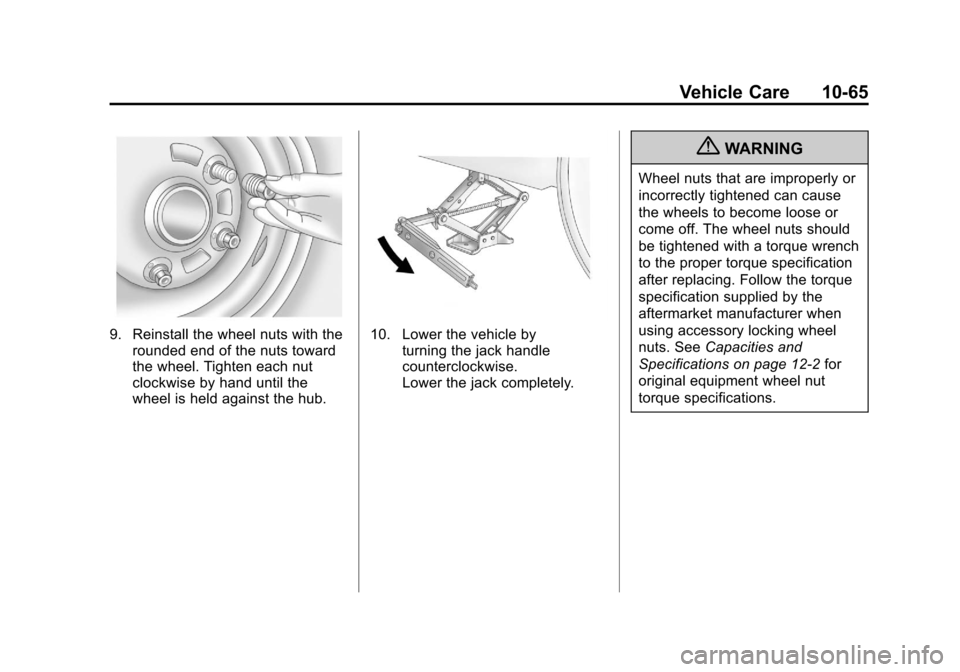
9. Reinstall the wheel nuts with therounded end of the nuts toward
the wheel. Tighten each nut
clockwise by hand until the
wheel is held against the hub.10. Lower the vehicle by turning the jack handle
counterclockwise.
Lower the jack completely.
{WARNING
Wheel nuts that are improperly or
incorrectly tightened can cause
the wheels to become loose or
come off. The wheel nuts should
be tightened with a torque wrench
to the proper torque specification
after replacing. Follow the torque
specification supplied by the
aftermarket manufacturer when
using accessory locking wheel
nuts. See Capacities and
Specifications on page 12‑2 for
original equipment wheel nut
torque specifications.