lock CHEVROLET IMPALA 2011 9.G Owner's Manual
[x] Cancel search | Manufacturer: CHEVROLET, Model Year: 2011, Model line: IMPALA, Model: CHEVROLET IMPALA 2011 9.GPages: 376, PDF Size: 5.71 MB
Page 41 of 376
Black plate (13,1)Chevrolet Impala Owner Manual - 2011
Keys, Doors and Windows 2-13
Immobilizer
SeeRadio Frequency Statement on
page 13‑17 for information
regarding Part 15 of the Federal
Communications Commission (FCC)
rules and Industry Canada
Standards RSS-210/220/310.
Immobilizer Operation
This vehicle has PASS-Key®III+
(Personalized Automotive Security
System) theft-deterrent system.
PASS-Key III+ is a passive
theft-deterrent system.
The system is automatically armed
when the key is removed from the
ignition.
The system is automatically
disarmed when the key is turned to
ON/RUN, ACC/ACCESSORY,
or START from the LOCK/OFF
position.
You do not have to manually arm or
disarm the system. The security light will come on if
there is a problem with arming or
disarming the theft-deterrent
system.
When the PASS-Key III+ system
senses that someone is using the
wrong key, it prevents the vehicle
from starting. Anyone using a
trial-and-error method to start the
vehicle will be discouraged because
of the high number of electrical key
codes.
If the engine does not start and the
security light on the instrument
panel cluster comes on when trying
to start the vehicle, there may be a
problem with the theft-deterrent
system. Turn the ignition off and
try again.
If the engine still does not start,
and the key appears to be
undamaged, try another ignition key.
At this time, you may also want to
check the fuse. See
Fuses and
Circuit Breakers on page 10‑34. If the engine still does not start with
the other key, the vehicle needs
service. If the vehicle does start, the
first key may be faulty. See your
dealer who can service the
PASS-Key III+ to have a new
key made.
It is possible for the PASS-Key III+
decoder to learn the transponder
value of a new or replacement key.
Up to 10 keys may be programmed
for the vehicle. The following
procedure is for programming
additional keys only. If all the
currently programmed keys are lost
or do not operate, you must see
your dealer or a locksmith who can
service PASS-Key III+ to have keys
made and programmed to the
system.
See your dealer or a locksmith who
can service PASS-Key III+ to get a
new key blank cut exactly as the
ignition key that operates the
system.
Page 42 of 376
Black plate (14,1)Chevrolet Impala Owner Manual - 2011
2-14 Keys, Doors and Windows
To program the new additional key:
1. Verify that the new key has a
1stamped on it.
2. Insert the original, already programmed key in the ignition
and start the engine. If the
engine will not start, see your
dealer for service.
3. After the engine has started, turn the key to LOCK/OFF,
and remove the key.
4. Insert the new key to be programmed and turn it to
the ON/RUN position within
five seconds of turning the
ignition to the LOCK/OFF
position in Step 3.
The security light will turn off
once the key has been
programmed. 5. Repeat Steps 1 through 4 if
additional keys are to be
programmed.
If you lose or damage your
PASS-Key III+ key, see your dealer
or a locksmith who can service
PASS-Key III+ to have a new
key made.
Do not leave the key or device
that disarms or deactivates
the theft-deterrent system in
the vehicle.
Exterior Mirrors
Convex Mirrors
{WARNING
A convex mirror can make things,
like other vehicles, look farther
away than they really are. If you
cut too sharply into the right lane,
you could hit a vehicle on the
right. Check the inside mirror or
glance over your shoulder before
changing lanes.
The passenger side mirror is convex
shaped. A convex mirror's surface is
curved so more can be seen from
the driver seat.
Page 45 of 376
Black plate (17,1)Chevrolet Impala Owner Manual - 2011
Keys, Doors and Windows 2-17
Power Windows
{WARNING
Leaving children in a vehicle with
the keys is dangerous for many
reasons. Children or others could
be badly injured or even killed.
They could operate the power
windows or other controls or even
make the vehicle move. The
windows will function and they
could be seriously injured or killed
if caught in the path of a closing
window. Do not leave keys in a
vehicle with children.
When there are children in the
rear seat use the window lockout
button to prevent unintentional
operation of the windows.
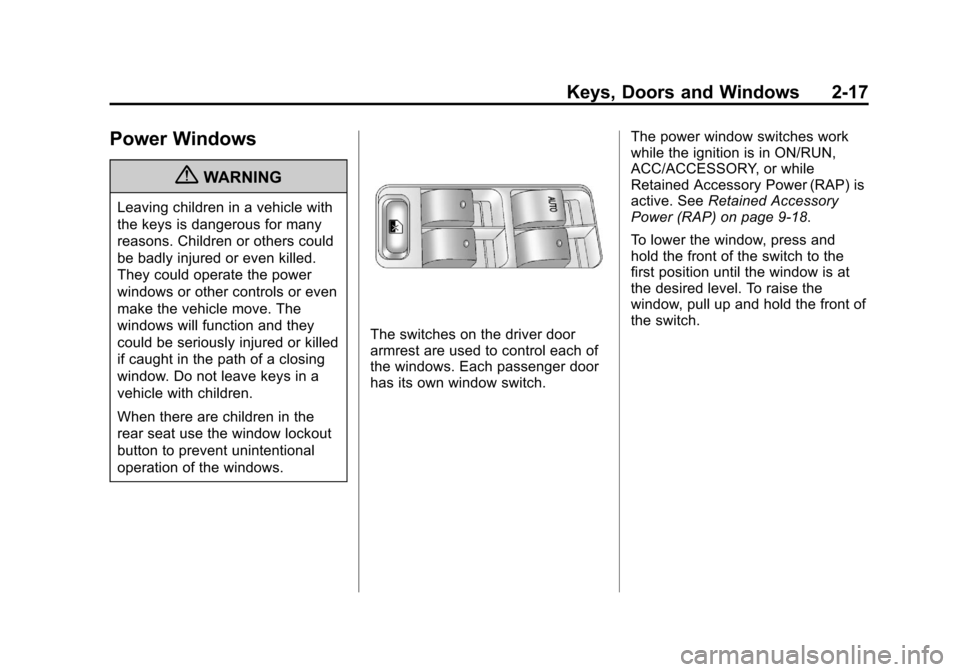
The switches on the driver door
armrest are used to control each of
the windows. Each passenger door
has its own window switch.The power window switches work
while the ignition is in ON/RUN,
ACC/ACCESSORY, or while
Retained Accessory Power (RAP) is
active. See
Retained Accessory
Power (RAP) on page 9‑18.
To lower the window, press and
hold the front of the switch to the
first position until the window is at
the desired level. To raise the
window, pull up and hold the front of
the switch.
Page 46 of 376
Black plate (18,1)Chevrolet Impala Owner Manual - 2011
2-18 Keys, Doors and Windows
Express-Down Window
The driver window switch has an
express-down feature labeled
AUTO. This lets you lower the
window completely without holding
the switch. Press the front of the
switch to the second position
and release.
To stop the window while it is
lowering, briefly pull up on
the switch.
Window Lockout
o(Window Lockout):The driver
window switches also include a
lockout switch. Press the right side
of the switch to prevent the rear
passengers from using their window
switches. The driver can still control
all the windows and the front
passenger can control their own
window with the lockout on. Press
the left side of the switch to return to
normal window operation. A red bar
on the right side of the switch
indicates that the lockout is off.
Sun Visors
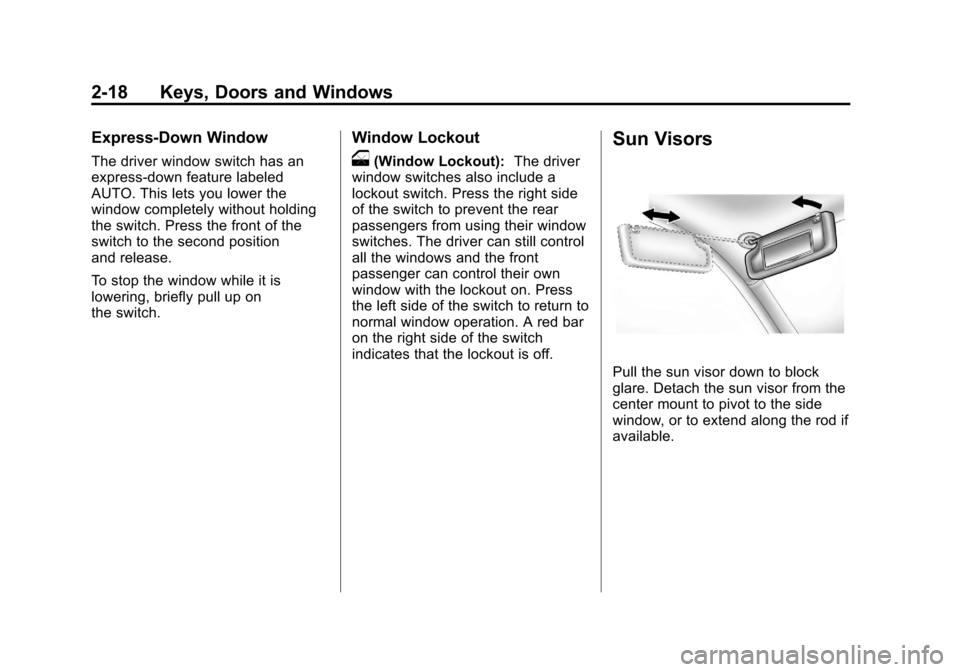
Pull the sun visor down to block
glare. Detach the sun visor from the
center mount to pivot to the side
window, or to extend along the rod if
available.
Page 50 of 376
Black plate (2,1)Chevrolet Impala Owner Manual - 2011
3-2 Seats and Restraints
Head Restraints
The vehicle's front seats have
adjustable head restraints in the
outboard seating positions.
{WARNING
With head restraints that are not
installed and adjusted properly,
there is a greater chance that
occupants will suffer a neck/
spinal injury in a crash. Do not
drive until the head restraints for
all occupants are installed and
adjusted properly.
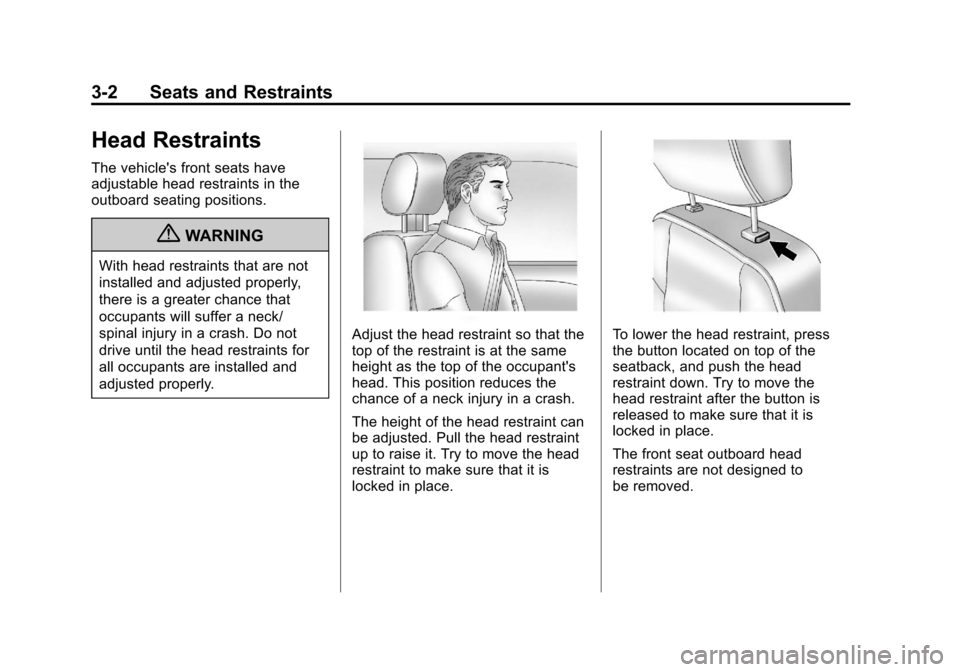
Adjust the head restraint so that the
top of the restraint is at the same
height as the top of the occupant's
head. This position reduces the
chance of a neck injury in a crash.
The height of the head restraint can
be adjusted. Pull the head restraint
up to raise it. Try to move the head
restraint to make sure that it is
locked in place.To lower the head restraint, press
the button located on top of the
seatback, and push the head
restraint down. Try to move the
head restraint after the button is
released to make sure that it is
locked in place.
The front seat outboard head
restraints are not designed to
be removed.
Page 51 of 376
Black plate (3,1)Chevrolet Impala Owner Manual - 2011
Seats and Restraints 3-3
Rear Seat
The vehicle's rear seat has head
restraints in the outboard seating
positions that cannot be adjusted.
The vehicle's rear seat has a
headrest in the center seating
position that cannot be adjusted.
The rear seat head restraints and
headrest are not designed to be
removed.Front Seats
Seat Adjustment
Manual Seats
{WARNING
You can lose control of the
vehicle if you try to adjust a
manual driver seat while the
vehicle is moving. The sudden
movement could startle and
confuse you, or make you push a
pedal when you do not want to.
Adjust the driver seat only when
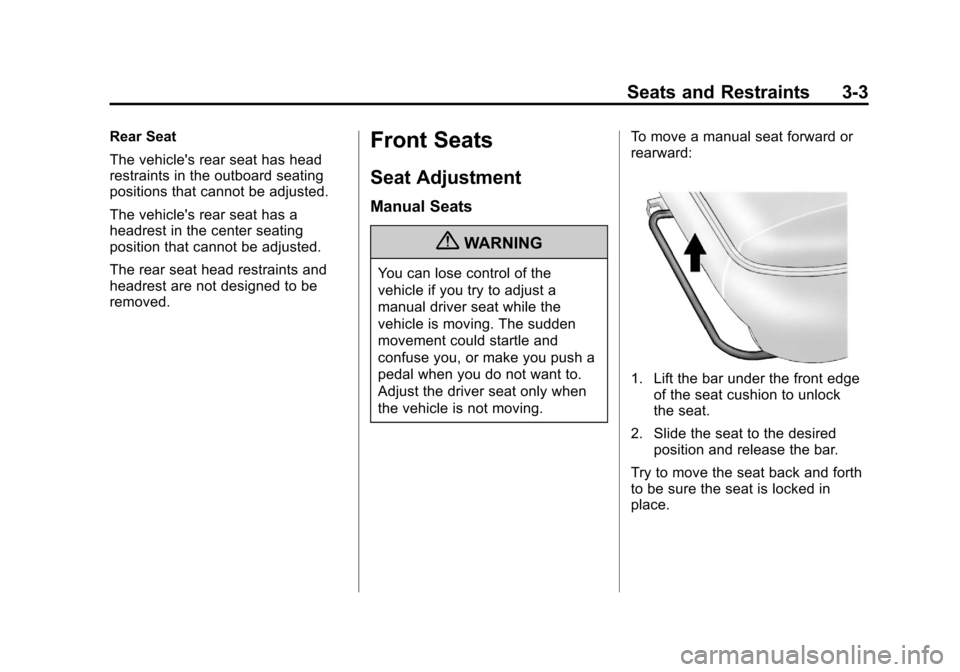
the vehicle is not moving.To move a manual seat forward or
rearward:
1. Lift the bar under the front edge
of the seat cushion to unlock
the seat.
2. Slide the seat to the desired position and release the bar.
Try to move the seat back and forth
to be sure the seat is locked in
place.
Page 54 of 376
Black plate (6,1)Chevrolet Impala Owner Manual - 2011
3-6 Seats and Restraints
Manual Reclining Seatbacks
{WARNING
You can lose control of the
vehicle if you try to adjust a
manual driver seat while the
vehicle is moving. The sudden
movement could startle and
confuse you, or make you push a
pedal when you do not want to.
Adjust the driver seat only when
the vehicle is not moving.
{WARNING
If either seatback is not locked, it
could move forward in a sudden
stop or crash. That could cause
injury to the person sitting there.
Always push and pull on the
seatbacks to be sure they
are locked.
To recline a manual seatback:
1. Lift the lever.
2. Move the seatback to thedesired position, and then
release the lever to lock the
seatback in place.
3. Push and pull on the seatback to make sure it is locked.
To return the seatback to the
upright position:
1. Lift the lever fully without applying pressure to the
seatback, and the seatback will
return to the upright position. 2. Push and pull on the seatback to
make sure it is locked.
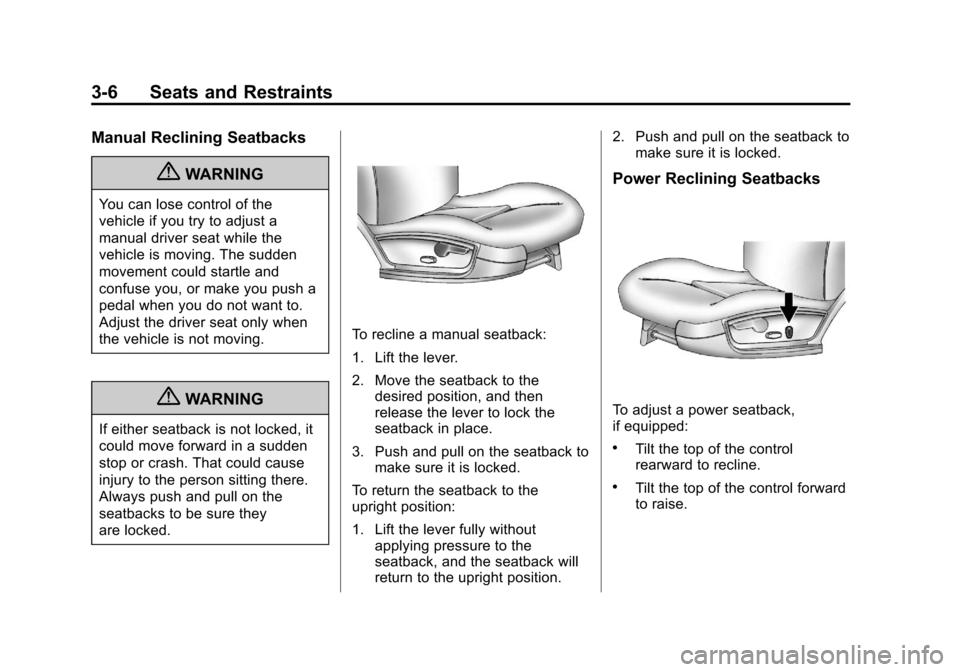
Power Reclining Seatbacks
To adjust a power seatback,
if equipped:
.Tilt the top of the control
rearward to recline.
.Tilt the top of the control forward
to raise.
Page 57 of 376
Black plate (9,1)Chevrolet Impala Owner Manual - 2011
Seats and Restraints 3-9
To return the seats to the normal
position:
{WARNING
If either seatback is not locked, it
could move forward in a sudden
stop or crash. That could cause
injury to the person sitting there.
Always push and pull on the
seatbacks to be sure they
are locked.1. Raise the seatback and make
sure it latches.
{WARNING
A safety belt that is improperly
routed, not properly attached,
or twisted will not provide the
protection needed in a crash.
The person wearing the belt could
be seriously injured. After raising
the rear seatback, always check
to be sure that the safety belts
are properly routed and attached,
and are not twisted.
2. Make sure the safety belts are properly stowed over the
seatback in all three seating
positions. 3. Flip the bottom seat cushion
back into place. Push down
firmly on the seat cushion to
make sure it is secure.
When the seat is not in use, the
seatback should be placed in the
upright, locked position, and
the seat cushion should be in
the down position.
Under Seat Storage
The vehicle has a storage area
under the rear seat. See Rear
Storage on page 4‑2 for more
information.
Page 62 of 376
Black plate (14,1)Chevrolet Impala Owner Manual - 2011
3-14 Seats and Restraints
First, before you or your
passenger(s) wear a safety belt,
there is important information you
should know.
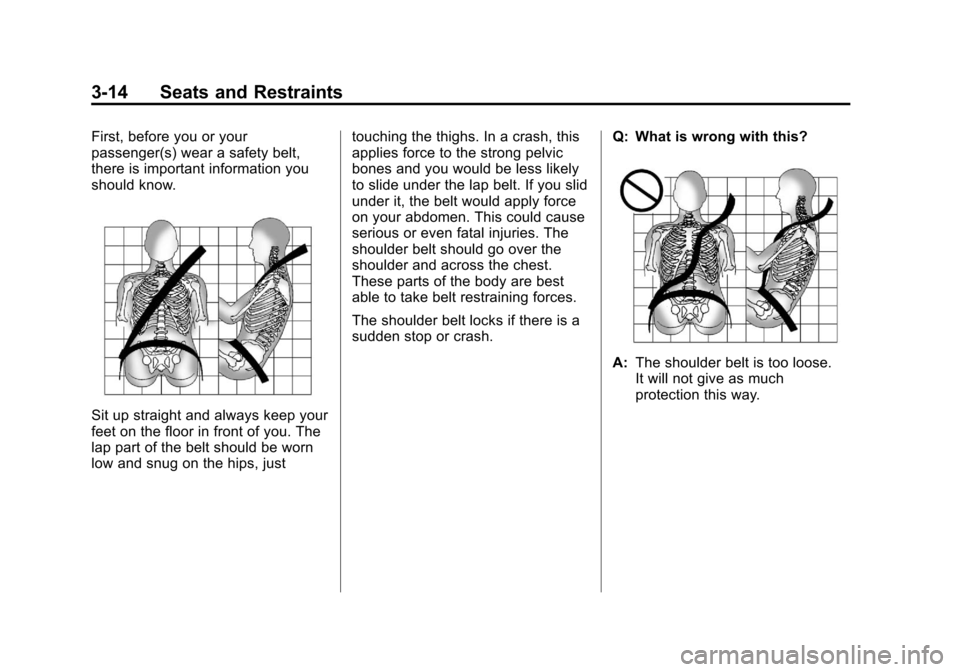
Sit up straight and always keep your
feet on the floor in front of you. The
lap part of the belt should be worn
low and snug on the hips, justtouching the thighs. In a crash, this
applies force to the strong pelvic
bones and you would be less likely
to slide under the lap belt. If you slid
under it, the belt would apply force
on your abdomen. This could cause
serious or even fatal injuries. The
shoulder belt should go over the
shoulder and across the chest.
These parts of the body are best
able to take belt restraining forces.
The shoulder belt locks if there is a
sudden stop or crash.
Q: What is wrong with this?
A:
The shoulder belt is too loose.
It will not give as much
protection this way.
Page 67 of 376
Black plate (19,1)Chevrolet Impala Owner Manual - 2011
Seats and Restraints 3-19
Lap-Shoulder Belt
All seating positions in the vehicle
have a lap-shoulder belt except for
the center front passenger position
(if equipped), which has a lap belt.
SeeLap Belt on page 3‑24 for more
information.
The following instructions explain
how to wear a lap-shoulder belt
properly.
1. Adjust the seat, if the seat is adjustable, so you can sit up
straight. To see how, see
“Seats” in the Index.
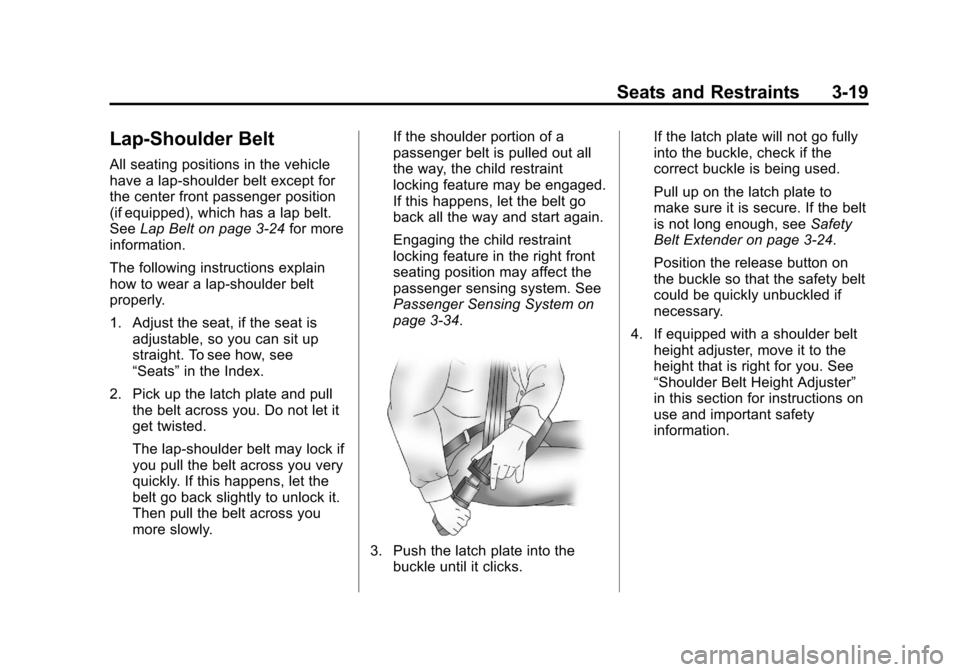
2. Pick up the latch plate and pull the belt across you. Do not let it
get twisted.
The lap-shoulder belt may lock if
you pull the belt across you very
quickly. If this happens, let the
belt go back slightly to unlock it.
Then pull the belt across you
more slowly. If the shoulder portion of a
passenger belt is pulled out all
the way, the child restraint
locking feature may be engaged.
If this happens, let the belt go
back all the way and start again.
Engaging the child restraint
locking feature in the right front
seating position may affect the
passenger sensing system. See
Passenger Sensing System on
page 3‑34.
3. Push the latch plate into the
buckle until it clicks. If the latch plate will not go fully
into the buckle, check if the
correct buckle is being used.
Pull up on the latch plate to
make sure it is secure. If the belt
is not long enough, see
Safety
Belt Extender on page 3‑24.
Position the release button on
the buckle so that the safety belt
could be quickly unbuckled if
necessary.
4. If equipped with a shoulder belt height adjuster, move it to the
height that is right for you. See
“Shoulder Belt Height Adjuster”
in this section for instructions on
use and important safety
information.