lock CHEVROLET KODIAK 2004 Owner's Manual
[x] Cancel search | Manufacturer: CHEVROLET, Model Year: 2004, Model line: KODIAK, Model: CHEVROLET KODIAK 2004Pages: 366, PDF Size: 6.87 MB
Page 78 of 366

Express-Down Feature
The driver’s window also has an express-down feature
that allows the window to be lowered without holding
down the switch. Press and hold the rear of the window
switch labeled AUTO for one second to activate the
express-down mode.
The express-down mode can be cancelled at any time
by pressing the front of the switch. To open the
window part way, lightly tap the switch until the window
is at the desired position.
Lockout Feature
If you have a crew cab model with power windows, the
driver’s door will have a window lockout feature.
When engaged, this feature will prevent all window
switches, except the driver’s window switches,
from operating. This switch is located above the four
window switches on the driver’s door. When the switch
is not engaged, all windows will return to normal
operation.
Sliding Rear Window
To open the sliding rear window, pull the latch toward
the driver’s side of the vehicle.
To close the window, slide the window toward the
passenger’s side of the vehicle. The latch will
automatically lock into place. Try to open the window
without releasing the latch to be sure the window
is in the locked position.
Sun Visors
To block out glare, you can swing down the visors. You
can also swing them out to block glare from the side.
Theft-Deterrent Systems
Vehicle theft is big business, especially in some cities,
and even commercial vehicles are no exception.
Although your vehicle has a number of theft-deterrent
features, we know that nothing we put on it can make it
impossible to steal. However, there are ways you
can help.
2-10
Page 80 of 366
Ignition Positions
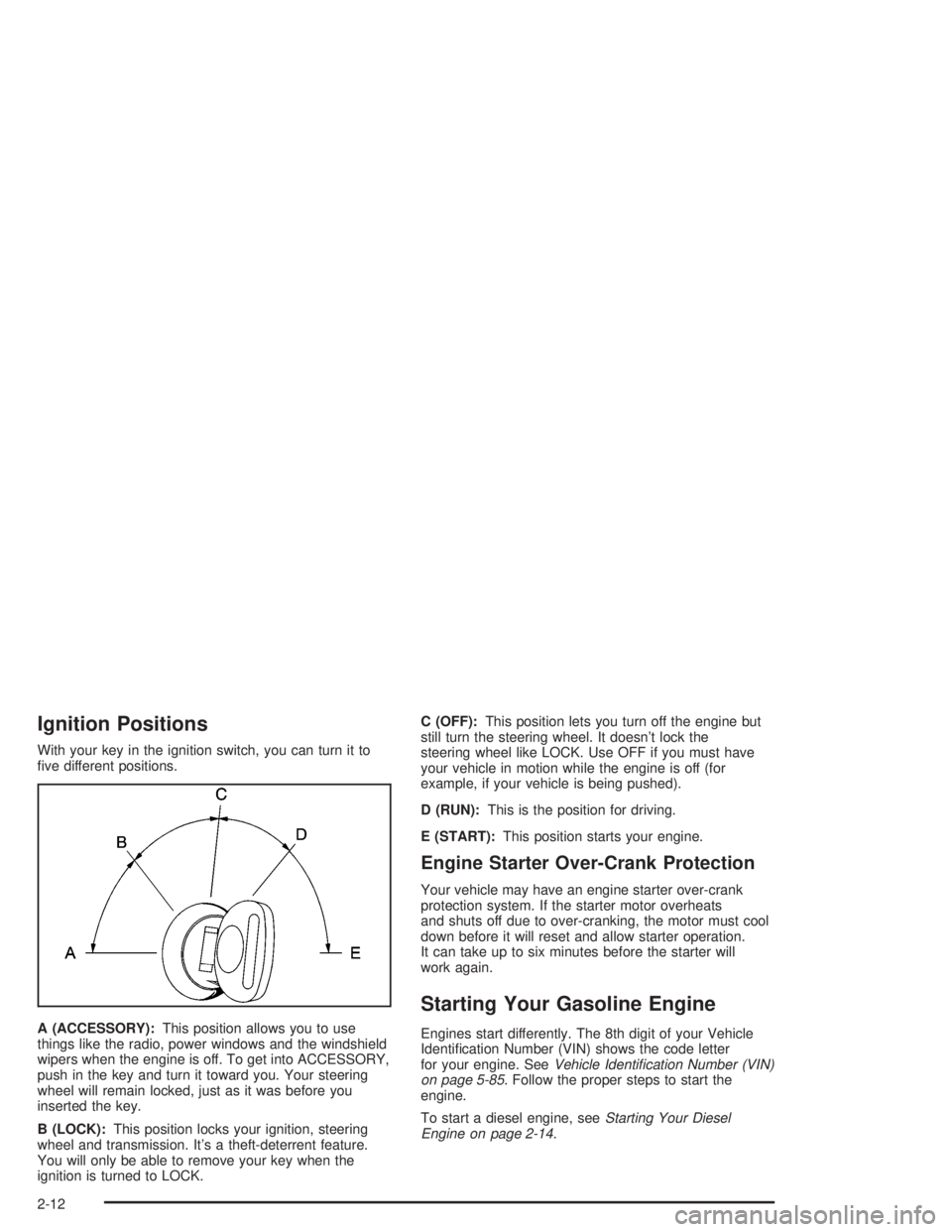
With your key in the ignition switch, you can turn it to
five different positions.
A (ACCESSORY):This position allows you to use
things like the radio, power windows and the windshield
wipers when the engine is off. To get into ACCESSORY,
push in the key and turn it toward you. Your steering
wheel will remain locked, just as it was before you
inserted the key.
B (LOCK):This position locks your ignition, steering
wheel and transmission. It’s a theft-deterrent feature.
You will only be able to remove your key when the
ignition is turned to LOCK.C (OFF):This position lets you turn off the engine but
still turn the steering wheel. It doesn’t lock the
steering wheel like LOCK. Use OFF if you must have
your vehicle in motion while the engine is off (for
example, if your vehicle is being pushed).
D (RUN):This is the position for driving.
E (START):This position starts your engine.
Engine Starter Over-Crank Protection
Your vehicle may have an engine starter over-crank
protection system. If the starter motor overheats
and shuts off due to over-cranking, the motor must cool
down before it will reset and allow starter operation.
It can take up to six minutes before the starter will
work again.
Starting Your Gasoline Engine
Engines start differently. The 8th digit of your Vehicle
Identification Number (VIN) shows the code letter
for your engine. SeeVehicle Identication Number (VIN)
on page 5-85. Follow the proper steps to start the
engine.
To start a diesel engine, seeStarting Your Diesel
Engine on page 2-14.
2-12
Page 93 of 366
Diesel Engine Exhaust Brake
The exhaust brake is available on vehicles equipped
with a diesel engine. It is located in the exhaust system.
The exhaust brake is used to help slow the vehicle
and may assist the vehicle’s foundation brakes. The use
of the exhaust brake will assist the braking of the
vehicle and prolong the life of the foundation brake
lining material.
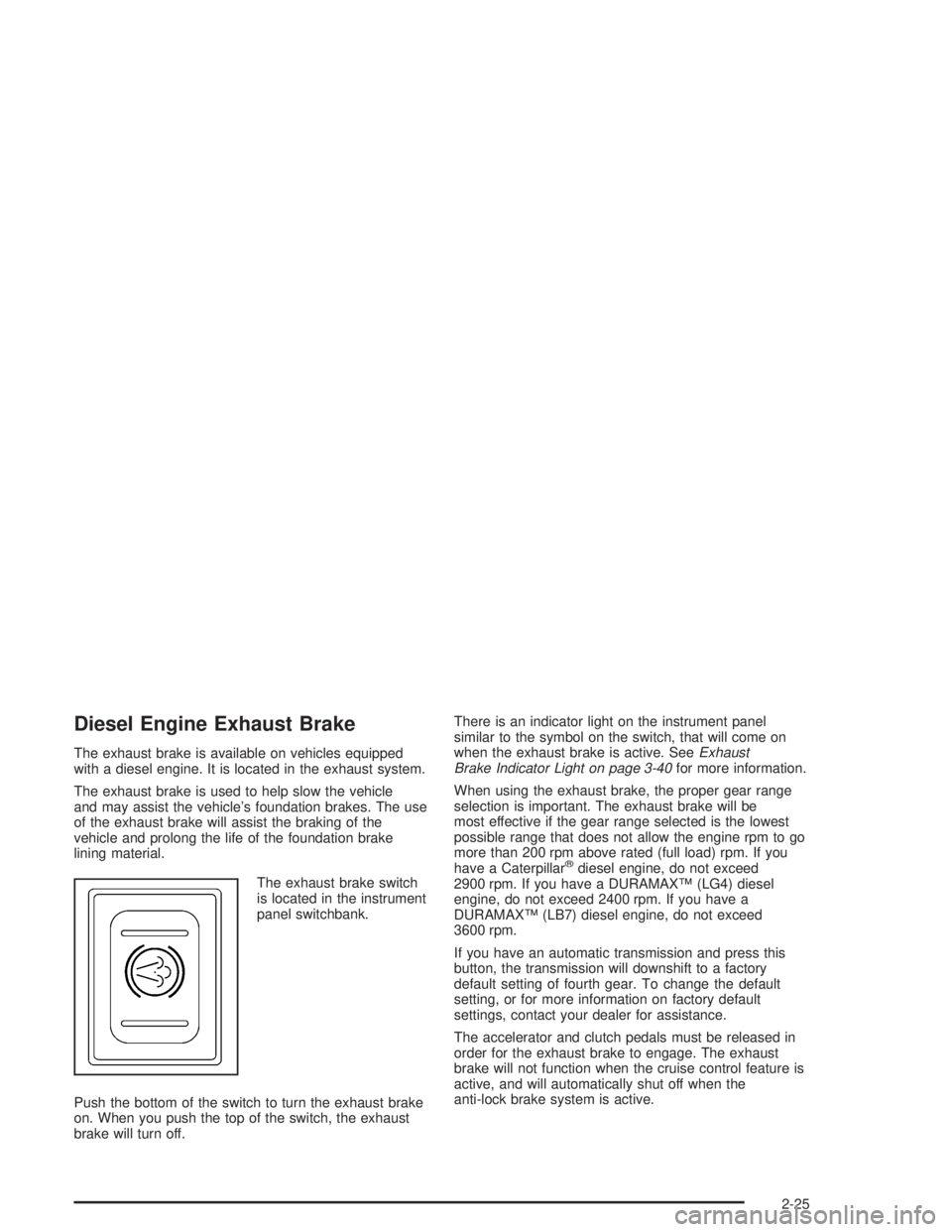
The exhaust brake switch
is located in the instrument
panel switchbank.
Push the bottom of the switch to turn the exhaust brake
on. When you push the top of the switch, the exhaust
brake will turn off.There is an indicator light on the instrument panel
similar to the symbol on the switch, that will come on
when the exhaust brake is active. SeeExhaust
Brake Indicator Light on page 3-40for more information.
When using the exhaust brake, the proper gear range
selection is important. The exhaust brake will be
most effective if the gear range selected is the lowest
possible range that does not allow the engine rpm to go
more than 200 rpm above rated (full load) rpm. If you
have a Caterpillar
®diesel engine, do not exceed
2900 rpm. If you have a DURAMAX™ (LG4) diesel
engine, do not exceed 2400 rpm. If you have a
DURAMAX™ (LB7) diesel engine, do not exceed
3600 rpm.
If you have an automatic transmission and press this
button, the transmission will downshift to a factory
default setting of fourth gear. To change the default
setting, or for more information on factory default
settings, contact your dealer for assistance.
The accelerator and clutch pedals must be released in
order for the exhaust brake to engage. The exhaust
brake will not function when the cruise control feature is
active, and will automatically shut off when the
anti-lock brake system is active.
2-25
Page 108 of 366
Outside Power Mirrors
If you have outside power mirrors, they can be adjusted
from the inside of the vehicle.
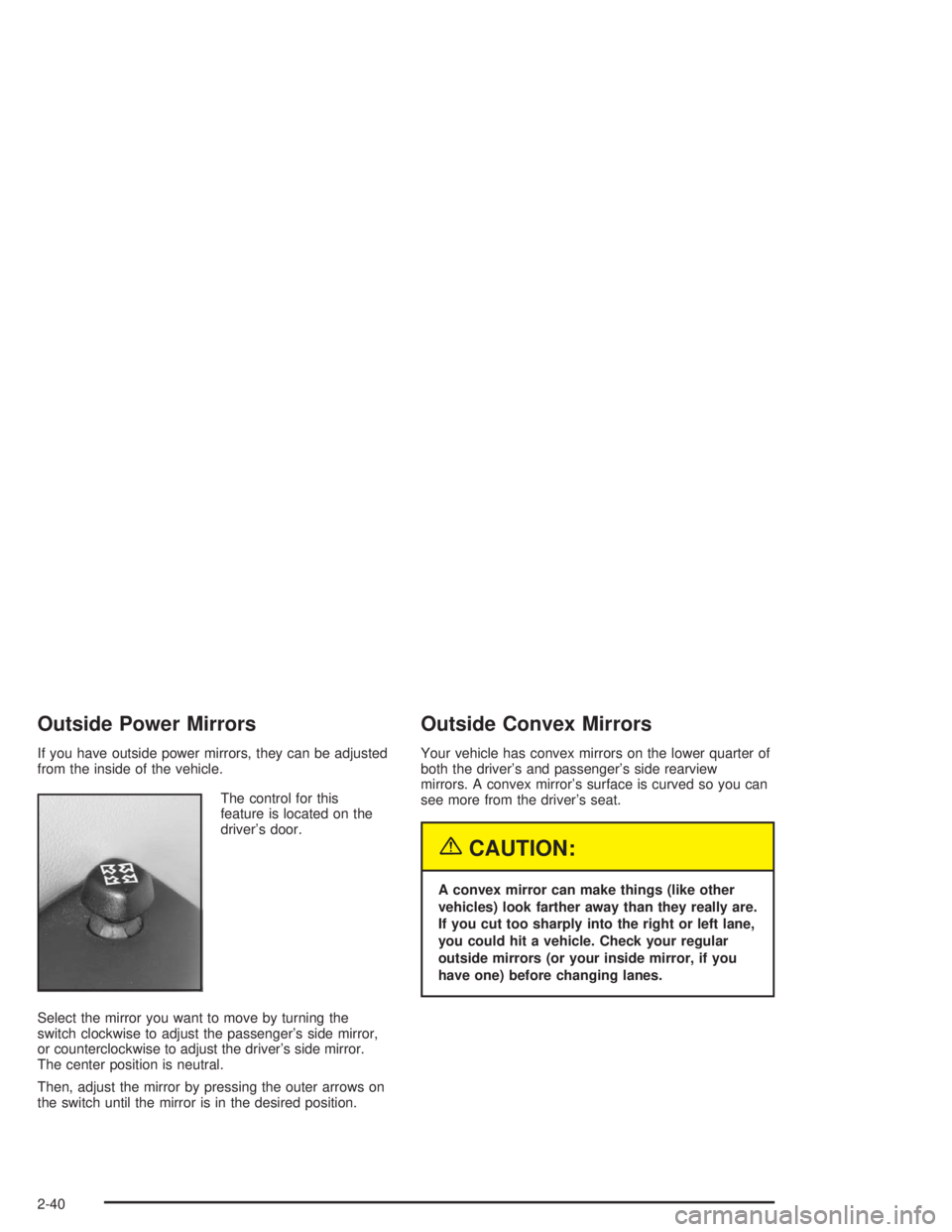
The control for this
feature is located on the
driver’s door.
Select the mirror you want to move by turning the
switch clockwise to adjust the passenger’s side mirror,
or counterclockwise to adjust the driver’s side mirror.
The center position is neutral.
Then, adjust the mirror by pressing the outer arrows on
the switch until the mirror is in the desired position.
Outside Convex Mirrors
Your vehicle has convex mirrors on the lower quarter of
both the driver’s and passenger’s side rearview
mirrors. A convex mirror’s surface is curved so you can
see more from the driver’s seat.
{CAUTION:
A convex mirror can make things (like other
vehicles) look farther away than they really are.
If you cut too sharply into the right or left lane,
you could hit a vehicle. Check your regular
outside mirrors (or your inside mirror, if you
have one) before changing lanes.
2-40
Page 110 of 366
Center Console Storage Area
Your vehicle may have a center console compartment
between the bucket or suspension seats.
The back of your center bench seat may also fold
forward to reveal a console compartment.
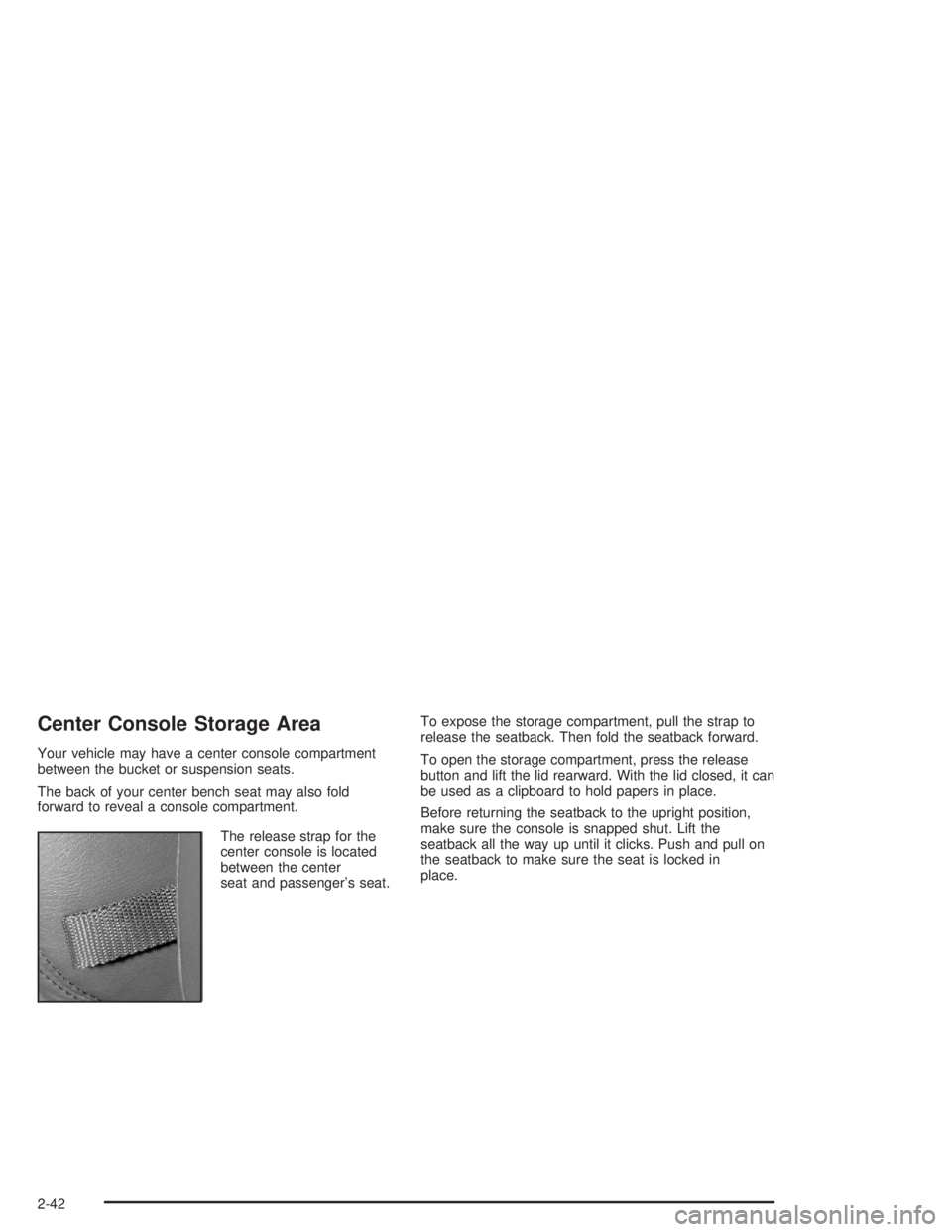
The release strap for the
center console is located
between the center
seat and passenger’s seat.To expose the storage compartment, pull the strap to
release the seatback. Then fold the seatback forward.
To open the storage compartment, press the release
button and lift the lid rearward. With the lid closed, it can
be used as a clipboard to hold papers in place.
Before returning the seatback to the upright position,
make sure the console is snapped shut. Lift the
seatback all the way up until it clicks. Push and pull on
the seatback to make sure the seat is locked in
place.
2-42
Page 111 of 366
Instrument Panel Overview...............................3-4
Hazard Warning Flashers................................3-5
Other Warning Devices...................................3-6
Horn.............................................................3-6
Tilt Wheel.....................................................3-7
Turn Signal/Multifunction Lever.........................3-7
Exterior Lamps.............................................3-13
Interior Lamps..............................................3-15
Instrument Panel Switchbank..........................3-16
Accessory Power Outlets...............................3-17
Ashtrays and Cigarette Lighter........................3-18
Climate Controls............................................3-19
Climate Control System.................................3-19
Outlet Adjustment.........................................3-22
Rear Heating System....................................3-23
Warning Lights, Gages, and Indicators............3-23
Instrument Panel Cluster................................3-24
Speedometer and Odometer...........................3-25
Tachometer.................................................3-26
Safety Belt Reminder Light.............................3-26
Safety Belt Reminder Tone............................3-26
Air Bag Readiness Light................................3-27
Air Bag Off Light..........................................3-28Charging System Light..................................3-30
Voltmeter Gage............................................3-30
Service Transmission Warning Light................3-31
Range Inhibit Warning Indicator......................3-31
Brake System Warning Light..........................3-31
Parking Brake Warning Light..........................3-34
Anti-Lock Brake System Warning Light.............3-34
Trailer Anti-Lock Brake System
Warning Light...........................................3-35
Engine Coolant Temperature Gage..................3-35
Low Coolant Warning Light............................3-36
Wait to Start Indicator...................................3-36
Malfunction Indicator Lamp.............................3-37
Oil Pressure Gage........................................3-37
Low Oil Level Light.......................................3-38
Change Engine Oil Light................................3-39
Engine Overspeed Warning Light....................3-39
Engine Shutdown Warning Light.....................3-39
Transmission Temperature Gage.....................3-40
Exhaust Brake Indicator Light.........................3-40
Differential Lock Indicator Light.......................3-40
Reduced Engine Power Light.........................3-41
Daytime Running Lamps Indicator Light...........3-41
Section 3 Instrument Panel
3-1
Page 117 of 366
Tilt Wheel
A tilt wheel allows you to adjust the steering wheel
before you drive. You can raise it to the highest level to
give your legs more room when you exit and enter
the vehicle.
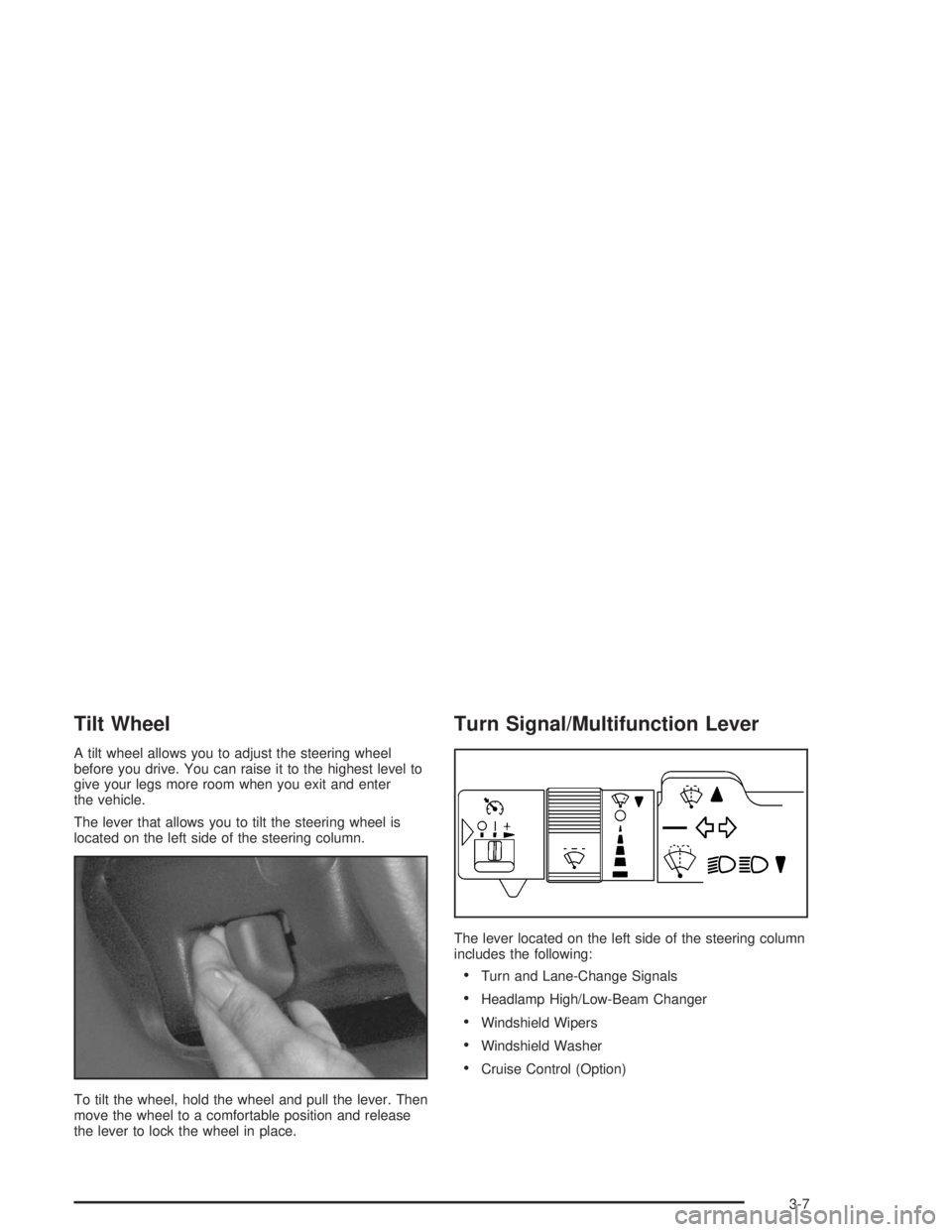
The lever that allows you to tilt the steering wheel is
located on the left side of the steering column.
To tilt the wheel, hold the wheel and pull the lever. Then
move the wheel to a comfortable position and release
the lever to lock the wheel in place.
Turn Signal/Multifunction Lever
The lever located on the left side of the steering column
includes the following:
•Turn and Lane-Change Signals
•Headlamp High/Low-Beam Changer
•Windshield Wipers
•Windshield Washer
•Cruise Control (Option)
3-7
Page 119 of 366
8(Mist):For a single wiping cycle, turn the band to
this symbol. Hold it there until the wipers start, then
let go. The wipers will stop after one cycle. If you want
more cycles, hold the band on mist longer.
You can set the wiper speed for a long or short delay
between wipes. This can be very useful in light rain
or snow. Turn the band to one of the four delay settings
to choose the delay time. The further the band is
turned upward, the longer the delay will be. The further
the band is turned downward, the shorter the delay
will be.
6(Low Speed):For steady wiping at low speed,
turn the band toward you to the first solid band
below the delay settings.
1(High Speed):For high-speed wiping, turn the
band further, to the second solid band below the delay
settings. To stop the wipers, move the band to off.
Be sure to clear ice and snow from the wiper blades
before using them. If they are frozen to the windshield,
carefully loosen or thaw them. If your blades do
become worn or damaged, get new blades or blade
inserts. For more information, seeWindshield Wiper
Blade Replacement on page 5-63.Heavy snow or ice can overload your wipers. The
windshield wiper motor is protected from overload by a
circuit breaker and a fuse. If the motor overheats
due to heavy snow or ice the wiper will stop until the
motor cools. Although the circuit is protected from
electrical overload, overload due to heavy snow or ice
may cause wiper linkage damage. Always clear ice and
heavy snow from the windshield before using your
windshield wipers.
Windshield Washer
L
(Washer Fluid):There is a paddle marked with the
windshield washer symbol at the top of the multifunction
lever. To spray washer fluid on the windshield, press
the paddle. The wipers will clear the window and
then either stop or return to your preset speed.
{CAUTION:
In freezing weather, do not use your washer
until the windshield is warmed. Otherwise the
washer uid can form ice on the windshield,
blocking your vision.
3-9
Page 123 of 366
Exterior Lamps
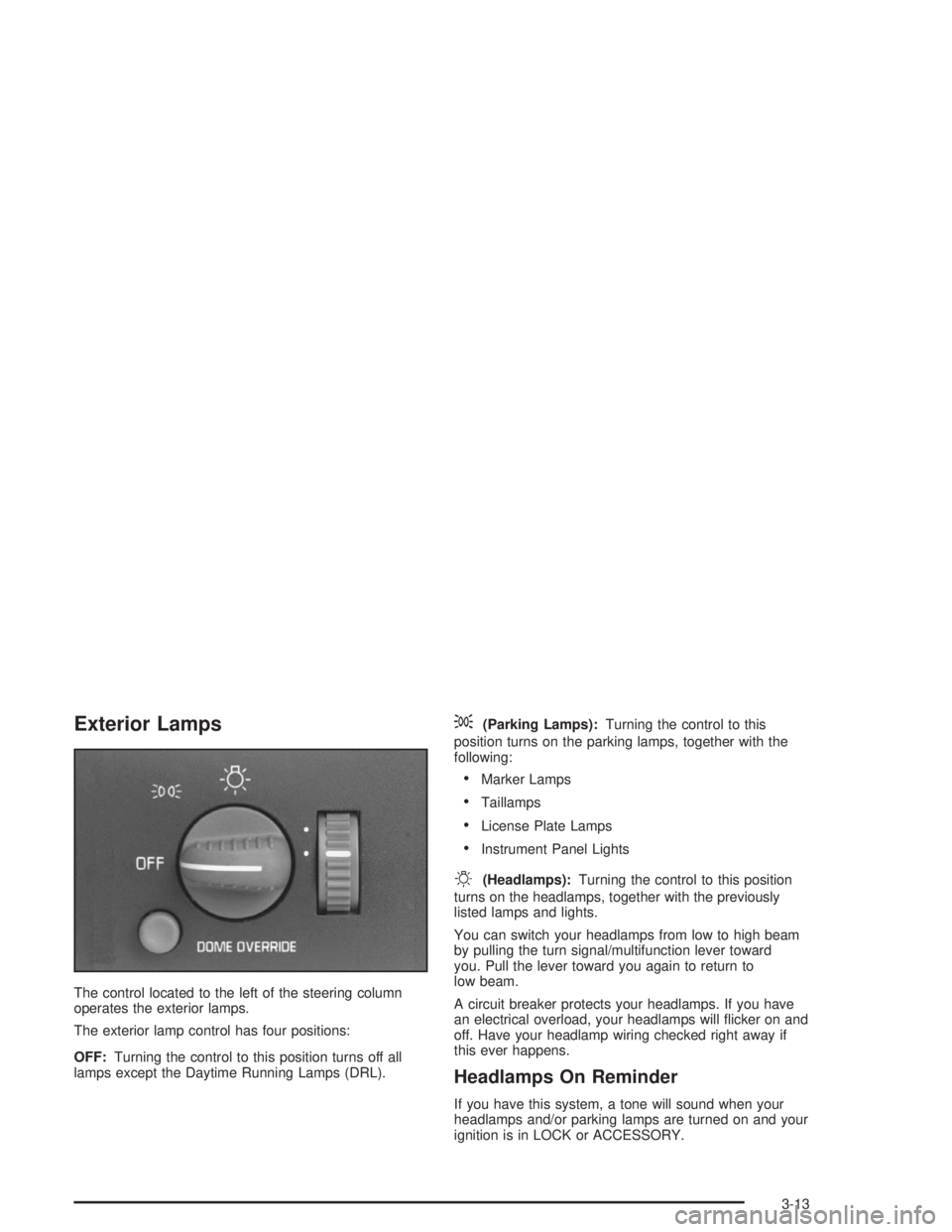
The control located to the left of the steering column
operates the exterior lamps.
The exterior lamp control has four positions:
OFF:Turning the control to this position turns off all
lamps except the Daytime Running Lamps (DRL).
;(Parking Lamps):Turning the control to this
position turns on the parking lamps, together with the
following:
•Marker Lamps
•Taillamps
•License Plate Lamps
•Instrument Panel Lights
O(Headlamps):Turning the control to this position
turns on the headlamps, together with the previously
listed lamps and lights.
You can switch your headlamps from low to high beam
by pulling the turn signal/multifunction lever toward
you. Pull the lever toward you again to return to
low beam.
A circuit breaker protects your headlamps. If you have
an electrical overload, your headlamps will flicker on and
off. Have your headlamp wiring checked right away if
this ever happens.
Headlamps On Reminder
If you have this system, a tone will sound when your
headlamps and/or parking lamps are turned on and your
ignition is in LOCK or ACCESSORY.
3-13
Page 127 of 366
This switchbank is located in the center of the instrument
panel.
e(Marker Lamp Defeat Switch):See “Marker Lamp
Defeat Switch” underExterior Lamps on page 3-13.
j(Manual High Idle Switch):See “Manual High Idle
System” underStarting Your Diesel Engine on
page 2-14.
i(Traction Control Switch):SeeTraction Control
System (TCS) on page 4-11.
f(Outside Heated Mirror Switch):SeeOutside
Heated Mirrors on page 2-41.
g(Power Take Off Switch):SeePower Take-Off
(PTO) on page 4-36.
h(Rear Air Suspension Dump Control
Switch):See “Rear Air Suspension Dump Control”
underTwo-Speed Rear Axle Electric Shift Control
on page 2-26.
k(Rear Axle Shift Control Switch):See “Air Shift
Control” (Automatic Transmission) underTwo-Speed
Rear Axle Electric Shift Control on page 2-26.
Exhaust Brake Switch:SeeDiesel Engine Exhaust
Brake on page 2-25.
l(Differential Lock Control Switch):SeeRear
Axle Differential Lock Control on page 4-10.
cd(Air Bag Off Switch):SeeAir Bag Off Switch
on page 1-55.
If your vehicle does not have some of the features
controlled by these switches, there will be a blank switch
marker in its place.
Accessory Power Outlets
With accessory power outlets, you can plug in auxiliary
electrical equipment such as a cellular telephone or
CB radio.
The accessory power outlets are located on the
passenger’s side of the instrument panel.
To use an outlet, pull the cover down. When not using
it, always cover the outlet with the protective cap.
These circuits are protected by a fuse and have
maximum current levels.
Notice:Leaving electrical equipment on for
extended periods will drain the battery. Always turn
off electrical equipment when not in use and do
not plug in equipment that exceeds the maximum
amperage rating.
3-17